
Shared Memory Systems CEG 4131 Computer Architecture III
![Characteristics of shared memory systems [3] • Any processor can directly reference any memory](https://slidetodoc.com/presentation_image_h2/0416ae426bcabcc2cbb3cf695e47637a/image-4.jpg "Characteristics of shared memory systems [3] • Any processor can directly reference any memory")
![Requirements [3] • Support for memory coherency – The machine must make sure that](https://slidetodoc.com/presentation_image_h2/0416ae426bcabcc2cbb3cf695e47637a/image-6.jpg "Requirements [3] • Support for memory coherency – The machine must make sure that")
![Shared Memory Program [3] Sum all the elements of an array of dimension size.](https://slidetodoc.com/presentation_image_h2/0416ae426bcabcc2cbb3cf695e47637a/image-7.jpg "Shared Memory Program [3] Sum all the elements of an array of dimension size.")
![Multiprocessor Software Functions – Example [3] • INITIALIZE – assigns a number (proc_num) to](https://slidetodoc.com/presentation_image_h2/0416ae426bcabcc2cbb3cf695e47637a/image-8.jpg "Multiprocessor Software Functions – Example [3] • INITIALIZE – assigns a number (proc_num) to")
![Architecture [3] An example of shared-bus architecture with 4 processors Both static and dynamic](https://slidetodoc.com/presentation_image_h2/0416ae426bcabcc2cbb3cf695e47637a/image-9.jpg "Architecture [3] An example of shared-bus architecture with 4 processors Both static and dynamic")
![Natural Extensions of Memory System [4] 10](https://slidetodoc.com/presentation_image_h2/0416ae426bcabcc2cbb3cf695e47637a/image-10.jpg "Natural Extensions of Memory System [4] 10")
![Memory Organization [1] 11](https://slidetodoc.com/presentation_image_h2/0416ae426bcabcc2cbb3cf695e47637a/image-11.jpg "Memory Organization [1] 11")
![Caches and Cache Coherence [4] • Caches play key role in all cases –](https://slidetodoc.com/presentation_image_h2/0416ae426bcabcc2cbb3cf695e47637a/image-12.jpg "Caches and Cache Coherence [4] • Caches play key role in all cases –")
![Mutual Exclusion [4] • Provided by LOCK-UNLOCK around critical section – Set of operations](https://slidetodoc.com/presentation_image_h2/0416ae426bcabcc2cbb3cf695e47637a/image-15.jpg "Mutual Exclusion [4] • Provided by LOCK-UNLOCK around critical section – Set of operations")
![Simple Software Lock [4] lock: and unlock: ld cmp bnz st register, location register,](https://slidetodoc.com/presentation_image_h2/0416ae426bcabcc2cbb3cf695e47637a/image-16.jpg "Simple Software Lock [4] lock: and unlock: ld cmp bnz st register, location register,")
![Atomic Exchange Instruction [4] • Specifies a location and register. In atomic operation: –](https://slidetodoc.com/presentation_image_h2/0416ae426bcabcc2cbb3cf695e47637a/image-17.jpg "Atomic Exchange Instruction [4] • Specifies a location and register. In atomic operation: –")
![Simple Test&Set Lock [4] lock: unlock: t&s bnz ret st register, location lock location,](https://slidetodoc.com/presentation_image_h2/0416ae426bcabcc2cbb3cf695e47637a/image-18.jpg "Simple Test&Set Lock [4] lock: unlock: t&s bnz ret st register, location lock location,")
![Mutual Exclusion: Altera [1] • A mutex allows cooperating processors to agree that one](https://slidetodoc.com/presentation_image_h2/0416ae426bcabcc2cbb3cf695e47637a/image-19.jpg "Mutual Exclusion: Altera [1] • A mutex allows cooperating processors to agree that one")
![Altera Mutex [2] 20](https://slidetodoc.com/presentation_image_h2/0416ae426bcabcc2cbb3cf695e47637a/image-20.jpg "Altera Mutex [2] 20")
![Example: Opening and locking a mutex [2] #include <altera_avalon_mutex. h> /* get the mutex](https://slidetodoc.com/presentation_image_h2/0416ae426bcabcc2cbb3cf695e47637a/image-21.jpg "Example: Opening and locking a mutex [2] #include <altera_avalon_mutex. h> /* get the mutex")
![Performance Criteria (T&S Lock) [4] • Uncontended Latency – Very low if repeatedly accessed](https://slidetodoc.com/presentation_image_h2/0416ae426bcabcc2cbb3cf695e47637a/image-22.jpg "Performance Criteria (T&S Lock) [4] • Uncontended Latency – Very low if repeatedly accessed")
![Improved Hardware Primitives: LL-SC [4] • Goals: – Test with reads – Failed read-modify-write](https://slidetodoc.com/presentation_image_h2/0416ae426bcabcc2cbb3cf695e47637a/image-23.jpg "Improved Hardware Primitives: LL-SC [4] • Goals: – Test with reads – Failed read-modify-write")
![Simple Lock with LL-SC [4] lock: ll bnz reg 1, location reg 1, lock](https://slidetodoc.com/presentation_image_h2/0416ae426bcabcc2cbb3cf695e47637a/image-24.jpg "Simple Lock with LL-SC [4] lock: ll bnz reg 1, location reg 1, lock")
![A Simple Centralized Barrier [2] • Shared counter maintains number of processes that have](https://slidetodoc.com/presentation_image_h2/0416ae426bcabcc2cbb3cf695e47637a/image-25.jpg "A Simple Centralized Barrier [2] • Shared counter maintains number of processes that have")
- Slides: 26
Shared Memory Systems CEG 4131 Computer Architecture III Miodrag Bolic 1
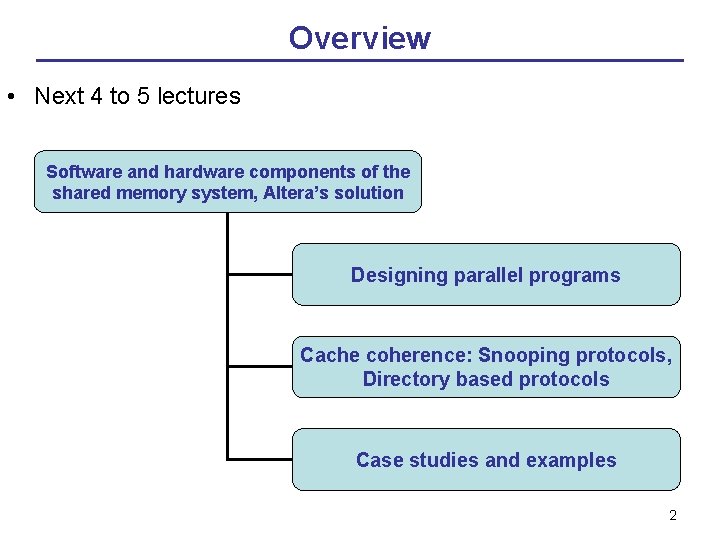
Overview • Next 4 to 5 lectures Software and hardware components of the shared memory system, Altera’s solution Designing parallel programs Cache coherence: Snooping protocols, Directory based protocols Case studies and examples 2
Outline • Characteristics of shared memory systems • Programming shared-memory multiprocessors • Hardware implementation – – Architectures Memory access Caches Synchronization 3
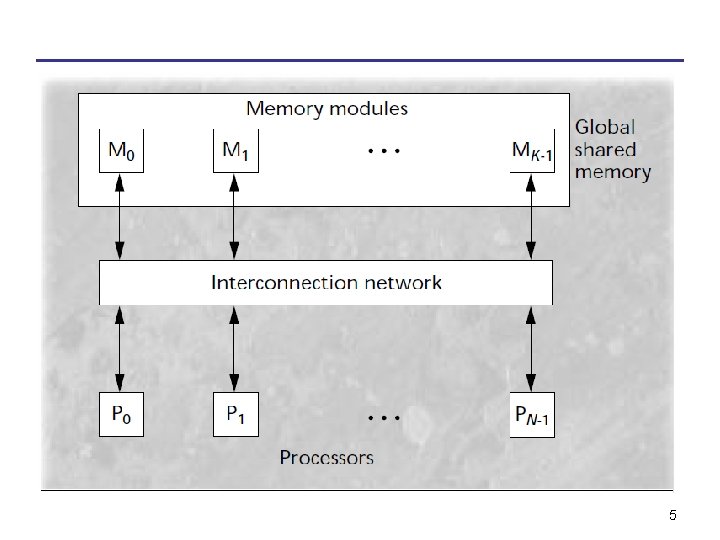
Characteristics of shared memory systems [3] • Any processor can directly reference any memory location. • Communication occurs implicitly as result of loads and stores. • Location of data in memory is transparent to the programmer. • Inherently provided on wide range of platforms (standard processors today have specific extra hardware for share memory systems) • Memory may be physically distributed among processors. 4
5
Requirements [3] • Support for memory coherency – The machine must make sure that all of the processing nodes have an accurate picture of the most up-to-date memory. • Support for atomic operations on data – The machine must allow for only one processor to change data at a time. – Nonatomic operation: One processor requests data and before the request is answered, another processor changes that data. 6
Shared Memory Program [3] Sum all the elements of an array of dimension size. INITIALIZE; //assign proc_nums and num_procs if (proc_num == 0) { //initialize the sum read_array(global_array_to_sum, size); //read the array and array size from file LOCK(global_sum); global_sum = 0; UNLOCK(global_sum); } local_sum = size_to_sum lower_ind = upper_ind = 0; = size/num_procs; size_to_sum * proc_num; size_to_sum * (proc_num + 1); BARRIER(num_procs); //waits for num_procs to get to this point in the program //if size = 100, num_proc = 4, processor 0 sums 0 to 24, proc 1 sums 25 to 49, etc for (int i = lower_ind; i < upper_ind; i++) local_sum += global_array_to_sum[i]; LOCK(global_sum); //locks the sum variable so only this process can change it global_sum += local_sum; UNLOCK(global_sum); //gives the sum back so other procs can add to it BARRIER(num_procs); //waits for num_procs to get to this point in the program if (proc_num == 0) printf("sum is %d", global_sum); 7
Multiprocessor Software Functions – Example [3] • INITIALIZE – assigns a number (proc_num) to each processor in the system; assigns the total number of processors (num_procs). • LOCK(data) – Allows a processor to “check out” a certain piece of shared data. – While one processor has the data locked, no other processors can obtain the lock. – The lock is blocking, so once a LOCK is encountered, execution of the program cannot proceed until the LOCK is obtained. • UNLOCK(data) – releases a lock so that other processors can obtain it. • BARRIER(n_procs) – When a BARRIER is encountered, a processor waits at that BARRIER until n_procs processors reach the BARRIER, then execution can proceed. 8
Architecture [3] An example of shared-bus architecture with 4 processors Both static and dynamic networks can be used to connect processors and shared memory 9
Natural Extensions of Memory System [4] 10
Memory Organization [1] 11
Caches and Cache Coherence [4] • Caches play key role in all cases – Reduce average data access time – Reduce bandwidth demands placed on shared interconnect • But private processor caches create a problem – Copies of a variable can be present in multiple caches – A write by one processor may not become visible to others • They’ll keep accessing stale value in their caches – Cache coherence problem – Need to take actions to ensure visibility 12
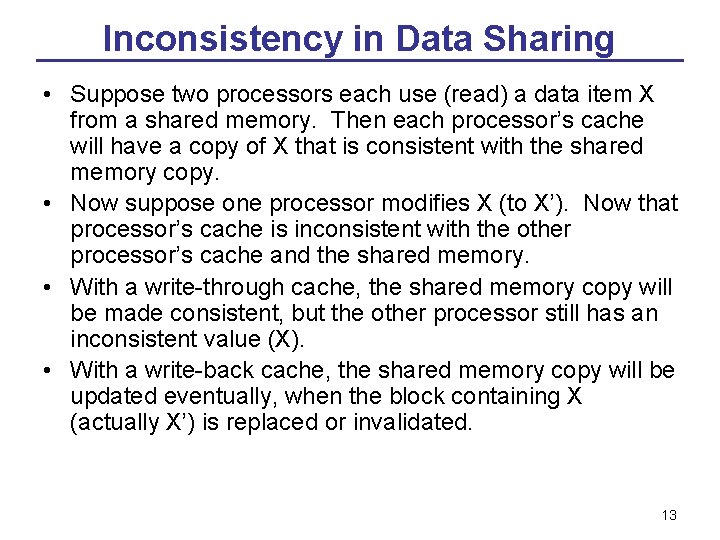
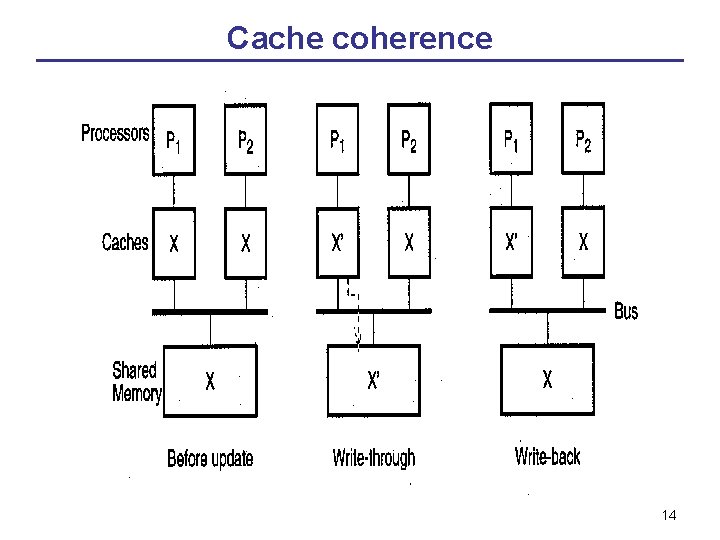
Inconsistency in Data Sharing • Suppose two processors each use (read) a data item X from a shared memory. Then each processor’s cache will have a copy of X that is consistent with the shared memory copy. • Now suppose one processor modifies X (to X’). Now that processor’s cache is inconsistent with the other processor’s cache and the shared memory. • With a write-through cache, the shared memory copy will be made consistent, but the other processor still has an inconsistent value (X). • With a write-back cache, the shared memory copy will be updated eventually, when the block containing X (actually X’) is replaced or invalidated. 13
Cache coherence 14
Mutual Exclusion [4] • Provided by LOCK-UNLOCK around critical section – Set of operations we want to execute atomically – Implementation of LOCK/UNLOCK must guarantee mutual excl. • Can lead to significant serialization if contended – Especially since expect non-local accesses in critical section • Mutex stands for “mutual exclusion” 15
Simple Software Lock [4] lock: and unlock: ld cmp bnz st register, location register, #0 lock location, #1 / /* copy location to register*/ /* compare with 0 */ /* if not 0, try again */ * store 1 to mark it locked */ /* return control to caller */ st ret location, #0 /* write 0 to location */ /* return control to caller*/ • Problem: lock needs atomicity in its own implementation – Read (test) and write (set) of lock variable by a process not atomic • Solution: atomic read-modify-write or exchange instructions – atomically test value of location and set it to another value, return success or failure somehow 16
Atomic Exchange Instruction [4] • Specifies a location and register. In atomic operation: – Value in location read into a register – Another value (function of value read or not) stored into location • Many variants • Simple example: test&set – – Value in location read into a specified register Constant 1 stored into location Successful if value loaded into register is 0 Other constants could be used instead of 1 and 0 • Can be used to build locks 17
Simple Test&Set Lock [4] lock: unlock: t&s bnz ret st register, location lock location, #0 /* if not 0, try again */ /* return control to caller */ /* write 0 to location */ /* return control to caller */ • Other read-modify-write primitives can be used too – Swap 18
Mutual Exclusion: Altera [1] • A mutex allows cooperating processors to agree that one of them should be allowed mutually exclusive access to a hardware resource in the system. • Component that is added in SOPC builder • Shared memory can be accessed without using mutexes 19
Altera Mutex [2] 20
Example: Opening and locking a mutex [2] #include <altera_avalon_mutex. h> /* get the mutex device handle */ alt_mutex_dev* mutex = altera_avalon_mutex_open( “/dev/mutex” ); /* acquire the mutex, setting the value to one */ altera_avalon_mutex_lock( mutex, 1 ); /* * Access a shared resource here. */ /* release the lock */ altera_avalon_mutex_unlock( mutex ); 21
Performance Criteria (T&S Lock) [4] • Uncontended Latency – Very low if repeatedly accessed by same processor; indept. of p • Traffic – Lots if many processors compete; poor scaling with p – Each t&s generates invalidations, and all rush out again to t&s • Storage – Very small (single variable); independent of p • Fairness – Poor, can cause starvation • Test&set with backoff similar, but less traffic • Luckily, better hardware primitives as well as algorithms exist 22
Improved Hardware Primitives: LL-SC [4] • Goals: – Test with reads – Failed read-modify-write attempts don’t generate invalidations – Nice if single primitive can implement range of r-m-w operations • • Load-Locked (or -linked), Store-Conditional LL reads variable into register Follow with arbitrary instructions to manipulate its value SC tries to store back to location if and only if no one else has written to the variable since this processor’s LL – If SC succeeds, means all three steps happened atomically – If fails, doesn’t write or generate invalidations (need to retry LL) – Success indicated by condition codes; 23
Simple Lock with LL-SC [4] lock: ll bnz reg 1, location reg 1, lock sc location, reg 2 beqz lock ret *-------------*/ unlock: st location, #0 ret /* LL location to reg 1 */ /* if location is locked, try again*/ /* SC reg 2 into location*/ /* if failed, start again */ /* return control to the caller of lock */ /* write 0 to location */ • SC can fail (without putting transaction on bus) if: – Tries to get bus but another processor’s SC gets bus first • LL, SC are not lock, unlock respectively – Only guarantee no conflicting write to lock variable between them – But can use directly to implement simple operations on shared variables 24
A Simple Centralized Barrier [2] • Shared counter maintains number of processes that have arrived – increment when arrive (lock), check until reaches numprocs struct bar_type { int counter; struct lock_type lock; int flag = 0; } bar_name; BARRIER (bar_name, p) { LOCK(bar_name. lock); if (bar_name. counter == 0) bar_name. flag = 0; /* reset flag if first to reach*/ mycount = bar_name. counter++; /* mycount is private */ UNLOCK(bar_name. lock); if (mycount == p) { /* last to arrive */ bar_name. counter = 0; /* reset for next barrier */ bar_name. flag = 1; /* release waiters */ } else while (bar_name. flag == 0) {}; /* busy wait for release */ } 25
References 1. Altera Corp. , Creating Multiprocessor NIOS II System Tutorial, 2005. 2. Altera Corp. , Altera Embedded Peripherals Handbook, 2005. 3. J. Kowalczyk, “Multiprocessor Systems, ” Xilinx, 2003. 4. D. Culler, J. P. Singh, Parallel Computer Architectures, A Hardware/Software Approach, Morgan Kaufman, 1999. 26