
Shared Language Integration Through Multilingualism Tallinn 2019 English


- Slides: 32
Shared Language: Integration Through Multilingualism , Tallinn 2019 English, Panacea or Pandemic Robert Phillipson Copenhagen Business School, Denmark Handelshøjskolen i København, Danmark
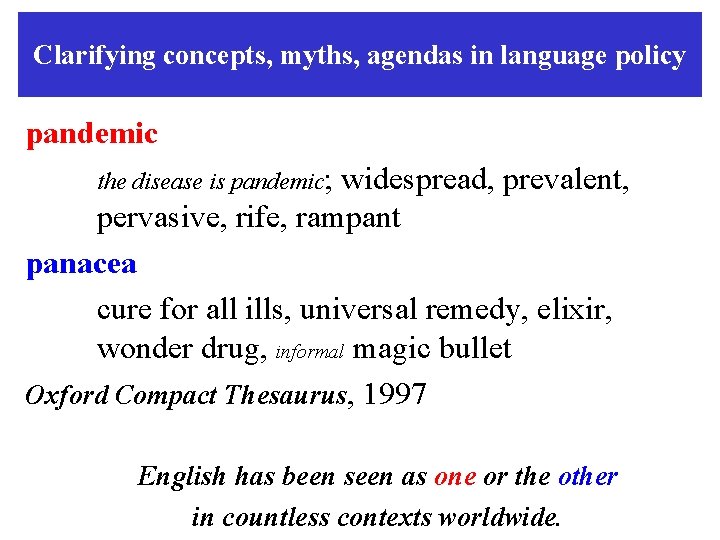
Clarifying concepts, myths, agendas in language policy pandemic the disease is pandemic; widespread, prevalent, pervasive, rife, rampant panacea cure for all ills, universal remedy, elixir, wonder drug, informal magic bullet Oxford Compact Thesaurus, 1997 English has been seen as one or the other in countless contexts worldwide.
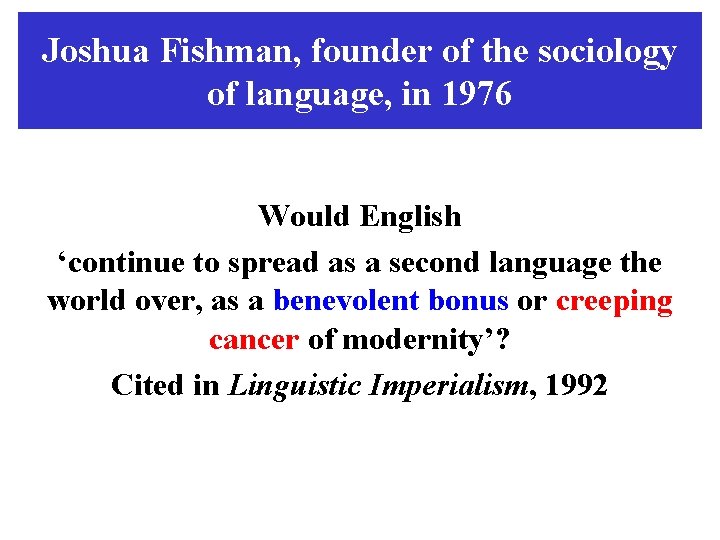
Joshua Fishman, founder of the sociology of language, in 1976 Would English ‘continue to spread as a second language the world over, as a benevolent bonus or creeping cancer of modernity’? Cited in Linguistic Imperialism, 1992
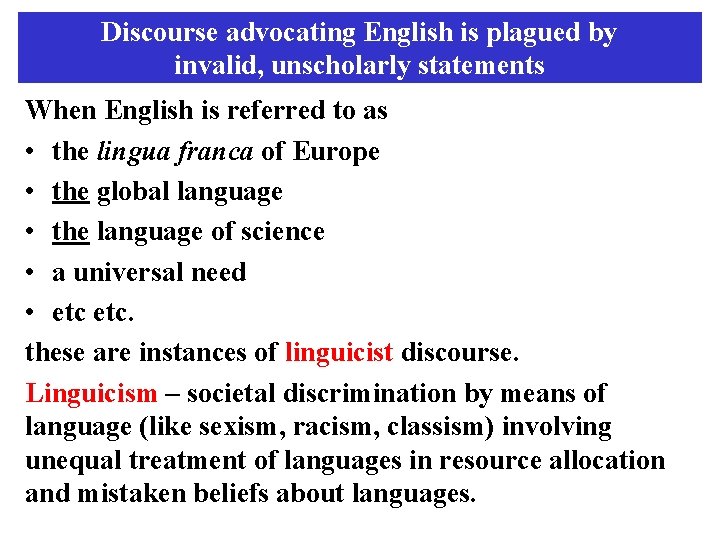
Discourse advocating English is plagued by invalid, unscholarly statements When English is referred to as • the lingua franca of Europe • the global language • the language of science • a universal need • etc. these are instances of linguicist discourse. Linguicism – societal discrimination by means of language (like sexism, racism, classism) involving unequal treatment of languages in resource allocation and mistaken beliefs about languages.
How can integration be through multilingualism? • The Index of The Routledge Handbook of Multilingualism (2012), has no entry for integration. • Nor are there entries for dictionaries, vocabulary, translation, writing, neoliberalism, or hegemony (see my review of the book in the TESOL Quarterly). • The supranational integration that membership of the EU entails is ‘integration through law’ (treaties, Lisbon constitutional treaty, Eurolaw, court decisions of the European Court of Justice, directives) through the medium of 24 languages, i. e. integration through multilingualism. • The use made of the 24 languages is equal, parallel, for some written and spoken purposes and unequal for others. In the EU, some languages are more equal than others (Orwell). Some languages are ‘shared’ more than others.
Examples of the expansion of English that have language policy implications and may involve linguicism • English learning ever earlier in schools • at continental European universities, using English as the medium of instruction and publication • English-medium ‘international’ schools • universities in ‘English-speaking countries’ remain monolingual and monocultural, even if the student intake is diverse • US/UK/Australian university branch campuses in Asia and the Middle East use same content & language • British Council and corporate world are promoting English-medium schools in basic education worldwide
Impact of the expansion of English on local and global integration • • Globalisation of multinational US & UK publishers Journals in English (& The Economist) are pre-eminent English as a/the primary corporate language English now the dominant in-house language in EU institutions except the European Court of Justice • NATO and US global military activity • Hollywood, technologies of ‘social’ media, Amazon • etc.
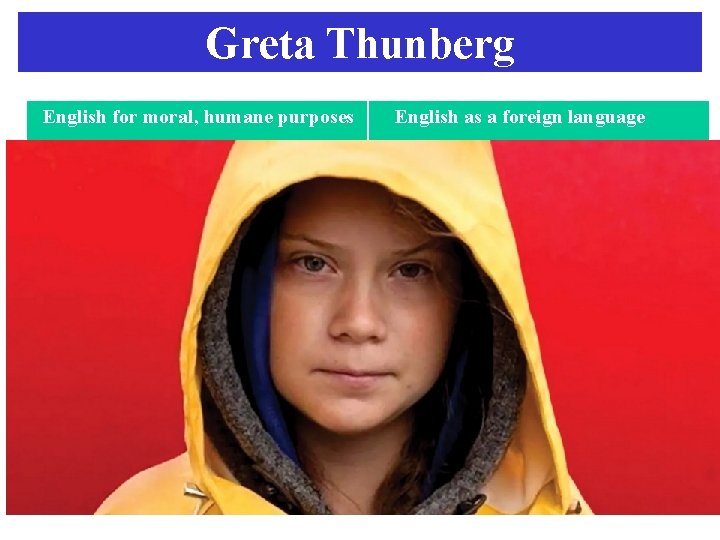
Greta Thunberg English for moral, humane purposes English as a foreign language
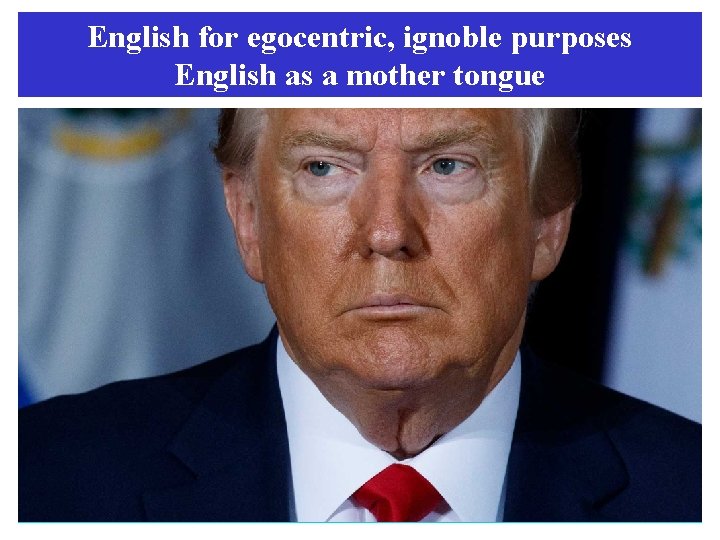
English for egocentric, ignoble purposes English as a mother tongue
How is English used, for what purposes? There is nothing intrinsic to a language that can explain an expansion - but there are lots of myths about ‘superior’ languages. What is crucial is the purposes that a language serves, the resources invested in it (in contrast with other languages), beliefs about it, and the roles the languages perform. English, like any other dominant language, can be used to include or exclude. All of these issues exist at the macro level (international pressures), the meso level (institutional policies) and the micro level (interpersonal interactions).
English is studied ever earlier in schools in continental Europe • There is a concomitant contraction of the learning of French, German, Russian, and other foreign languages. Is there a policy for languages throughout schooling? • Time for English may entail the marginalisation of minority languages, local (autochtonous) and migrant. For speakers of such languages this risks leading to assimilation rather than integration. Integration is bi-directional, a reciprocal process, assimilation is uni-directional.
Integration is characterised by voluntary additive language ‘learning’ of other cultures. Assimilation means being forcibly transferred to another group, which can constitute cultural and linguistic genocide. A report commissioned by the (Inuit) Nunavut local government in Canada, April 2019: Skutnabb-Kangas, Tove, Robert Phillipson, & Robert Dunbar. Is Nunavut education criminally inadequate? An analysis of current policies for Inuktut and English in education, international and national law, linguistic and cultural genocide and crimes against humanity. Globalisation involves macro-level processes and structures of assimilation and integration, as does membership of the European Union.
‘an ever closer union of the peoples of Europe’ Heading for a federation/federation? Or merely inter-governmental? The Lisbon Constitutional Treaty enshrines market forces, which impact on language policy at supranational, and sub-national levels. Normand Labrie, La construction linguistique de la Communauté Européenne. 1993 English-only Europe? Challenging language policy. 2003 La domination de l'anglais: un défi pour l'Europe. 2019. The Economist 15/6/2019: “Brexit is the ideal moment to make English the EU’s common language”
English undermining multilingualism? • Translation and interpretation are for all 24 official and working languages for important documents (Eurolaw, directives etc. ) and high-level meetings. • English is the dominant in-house language for drafting and conceptualising texts. This grants English a privileged status de facto, but not de jure. • French in the European Court of Justice is challenged by English. • EU multilingualism a reality for many purposes but in many EU policies there is a linguicist privileging of English (e. g. research applications).
terra nullius • a doctrine to justify European territorial expansion in the Americas, Australasia, Africa etc. , the myth of unoccupied territory • territorial, cultural and linguistic dispossession • entailing ‘success’ for homo americanus (UK, N America, South Africa, New Zealand, etc. ) and for the Chinese CCCP (Tibet, Uighur, …) • failure for homo sovieticus (but minorities in the Russian Federation are at risk)
Globalisation as cultura nullius • military, economic, cultural americanisation • Mc. Donaldisation (Ritzer 2011) in academia, the business world, the media, advertising, lifestyles, entertainment, clothing etc. ; Régis Debray, Civilisation. Comment nous sommes devenus américains • neoliberal commodification principles become internalised cultural norms • consumerist capitalism is internalised as a necessity in the modern world (Kayman 2004) • transition from the cultural cold war (Saunders 1999) to the technological cold war – Huawei vs. Apple
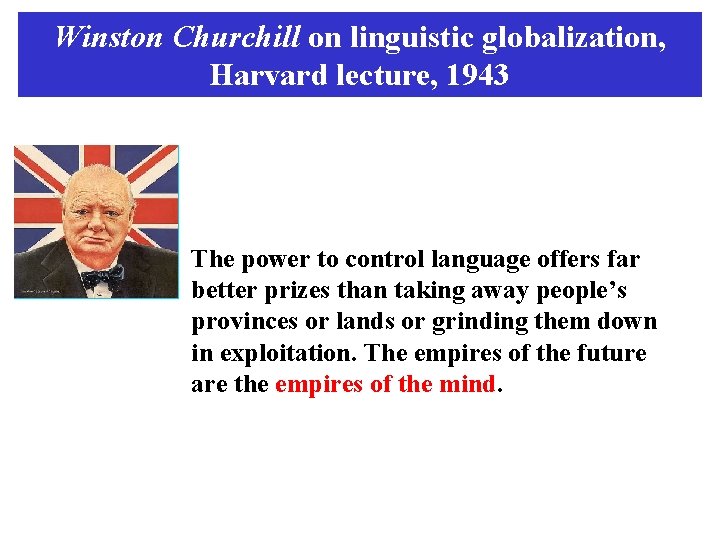
Winston Churchill on linguistic globalization, Harvard lecture, 1943 The power to control language offers far better prizes than taking away people’s provinces or lands or grinding them down in exploitation. The empires of the future are the empires of the mind.
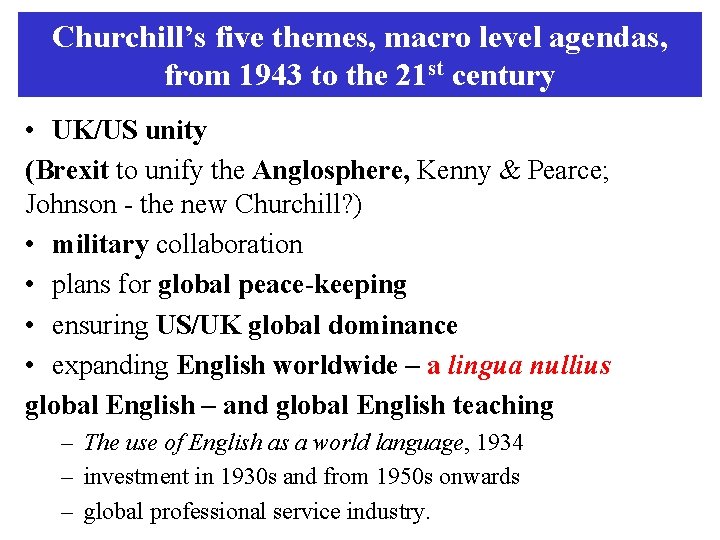
Churchill’s five themes, macro level agendas, from 1943 to the 21 st century • UK/US unity (Brexit to unify the Anglosphere, Kenny & Pearce; Johnson - the new Churchill? ) • military collaboration • plans for global peace-keeping • ensuring US/UK global dominance • expanding English worldwide – a lingua nullius global English – and global English teaching – The use of English as a world language, 1934 – investment in 1930 s and from 1950 s onwards – global professional service industry.
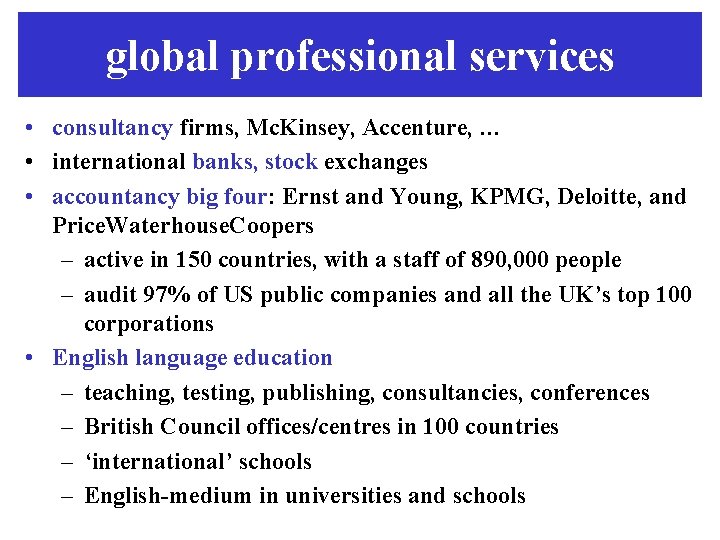
global professional services • consultancy firms, Mc. Kinsey, Accenture, … • international banks, stock exchanges • accountancy big four: Ernst and Young, KPMG, Deloitte, and Price. Waterhouse. Coopers – active in 150 countries, with a staff of 890, 000 people – audit 97% of US public companies and all the UK’s top 100 corporations • English language education – teaching, testing, publishing, consultancies, conferences – British Council offices/centres in 100 countries – ‘international’ schools – English-medium in universities and schools
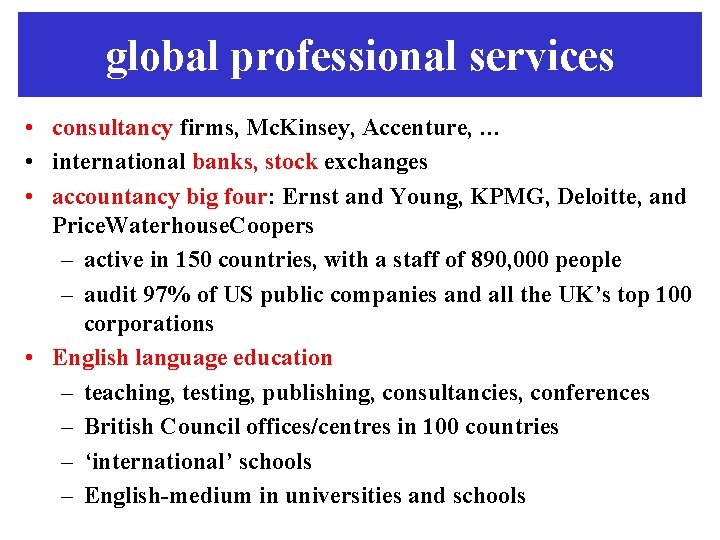
global professional services • consultancy firms, Mc. Kinsey, Accenture, … • international banks, stock exchanges • accountancy big four: Ernst and Young, KPMG, Deloitte, and Price. Waterhouse. Coopers – active in 150 countries, with a staff of 890, 000 people – audit 97% of US public companies and all the UK’s top 100 corporations • English language education – teaching, testing, publishing, consultancies, conferences – British Council offices/centres in 100 countries – ‘international’ schools – English-medium in universities and schools
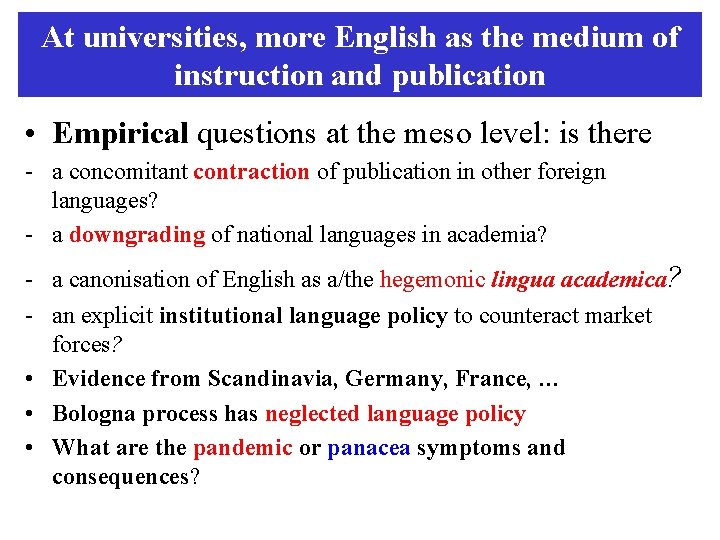
At universities, more English as the medium of instruction and publication • Empirical questions at the meso level: is there - a concomitant contraction of publication in other foreign languages? - a downgrading of national languages in academia? - a canonisation of English as a/the hegemonic lingua academica? - an explicit institutional language policy to counteract market forces? • Evidence from Scandinavia, Germany, France, … • Bologna process has neglected language policy • What are the pandemic or panacea symptoms and consequences?
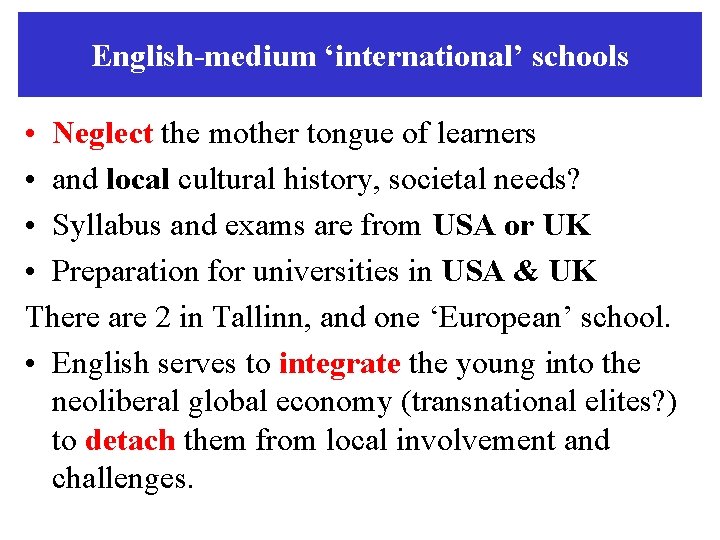
English-medium ‘international’ schools • Neglect the mother tongue of learners • and local cultural history, societal needs? • Syllabus and exams are from USA or UK • Preparation for universities in USA & UK There are 2 in Tallinn, and one ‘European’ school. • English serves to integrate the young into the neoliberal global economy (transnational elites? ) to detach them from local involvement and challenges.
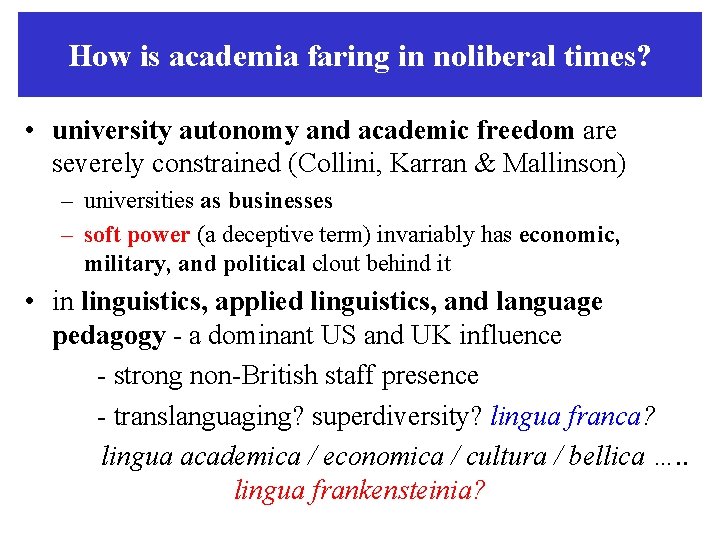
How is academia faring in noliberal times? • university autonomy and academic freedom are severely constrained (Collini, Karran & Mallinson) – universities as businesses – soft power (a deceptive term) invariably has economic, military, and political clout behind it • in linguistics, applied linguistics, and language pedagogy - a dominant US and UK influence - strong non-British staff presence - translanguaging? superdiversity? lingua franca? lingua academica / economica / cultura / bellica …. . lingua frankensteinia?
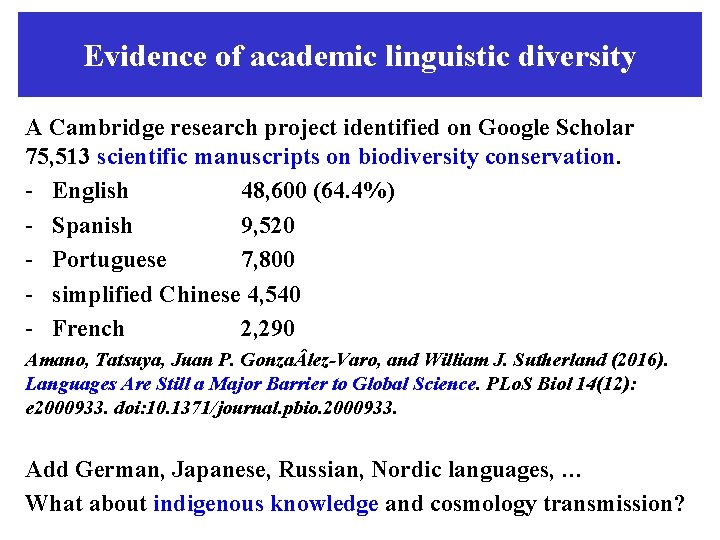
Evidence of academic linguistic diversity A Cambridge research project identified on Google Scholar 75, 513 scientific manuscripts on biodiversity conservation. - English 48, 600 (64. 4%) - Spanish 9, 520 - Portuguese 7, 800 - simplified Chinese 4, 540 - French 2, 290 Amano, Tatsuya, Juan P. Gonza lez-Varo, and William J. Sutherland (2016). Languages Are Still a Major Barrier to Global Science. PLo. S Biol 14(12): e 2000933. doi: 10. 1371/journal. pbio. 2000933. Add German, Japanese, Russian, Nordic languages, … What about indigenous knowledge and cosmology transmission?
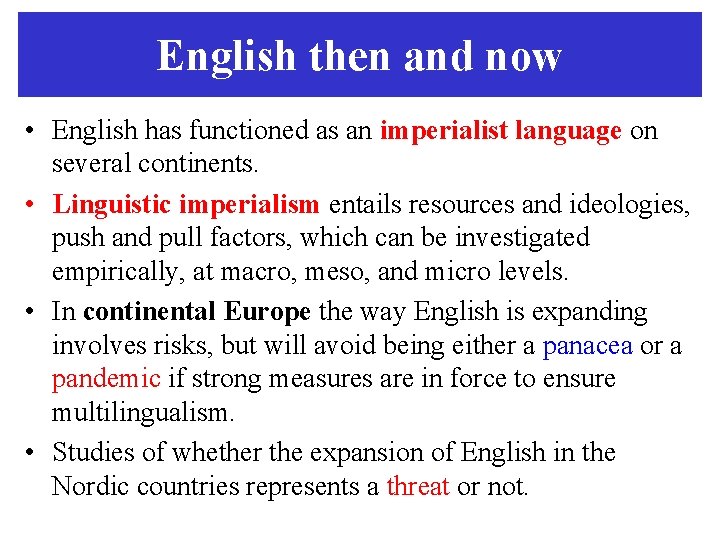
English then and now • English has functioned as an imperialist language on several continents. • Linguistic imperialism entails resources and ideologies, push and pull factors, which can be investigated empirically, at macro, meso, and micro levels. • In continental Europe the way English is expanding involves risks, but will avoid being either a panacea or a pandemic if strong measures are in force to ensure multilingualism. • Studies of whether the expansion of English in the Nordic countries represents a threat or not.
Nordic government policy for universities: the parallel use of English and Nordic languages • that it be possible to use both the languages of the Nordic countries essential to society and English as languages of science • that the presentation of scientific results in the languages of the Nordic countries essential to society be rewarded • that instruction in scientific technical language, especially in written form, be given in both English and the languages of the Nordic countries essential to society • that universities, colleges, and other scientific institutions can develop long-range strategies for the choice of language, the parallel use of languages, language instruction, and translation grants within their fields …
Language policy in higher education in five Nordic countries More parallel, please! Best practice of parallel language use at Nordic Universities: 11 recommendations Nordic Council of Ministers 2018
Recommendations (1) 1. All universities should have a language policy integrated with its internationalization policy and that relates to national language policy parameters and the role of the university locally. 2. All universities should have a language policy committee that follows developments continually. 3. A language centre should, on the basis of research criteria, elaborate courses in the local language of relevance for ‘international’ staff and students, and should ensure the quality of such courses; it should also offer translation and language revision services; it should develop digital resources.
Recommendations (2) 4. International teaching and research staff should be instructed in forms of parallel academic language use, and features of local students’ dialogue; they should also be familiarised with the local language of university administration; and progressively acquire competence to function fully in the local language; this should be stipulated in their employment contract. 5. There should be needs analysis in relation to study disciplines and future employment for guest students and foreign students doing an entire degree; local students should be instructed in the discourse of their academic field in their language and in English, and ideally in additional languages. 6. Elaboration of a specialised needs analysis so as to achieve full parallel competence.
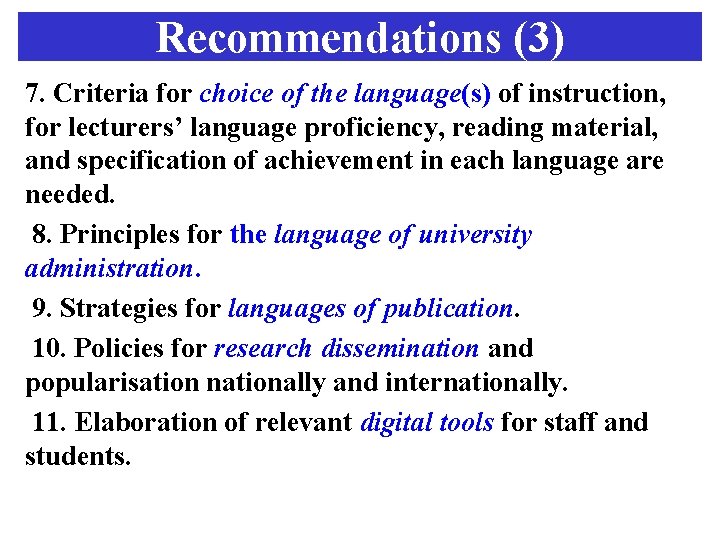
Recommendations (3) 7. Criteria for choice of the language(s) of instruction, for lecturers’ language proficiency, reading material, and specification of achievement in each language are needed. 8. Principles for the language of university administration. 9. Strategies for languages of publication. 10. Policies for research dissemination and popularisation nationally and internationally. 11. Elaboration of relevant digital tools for staff and students.
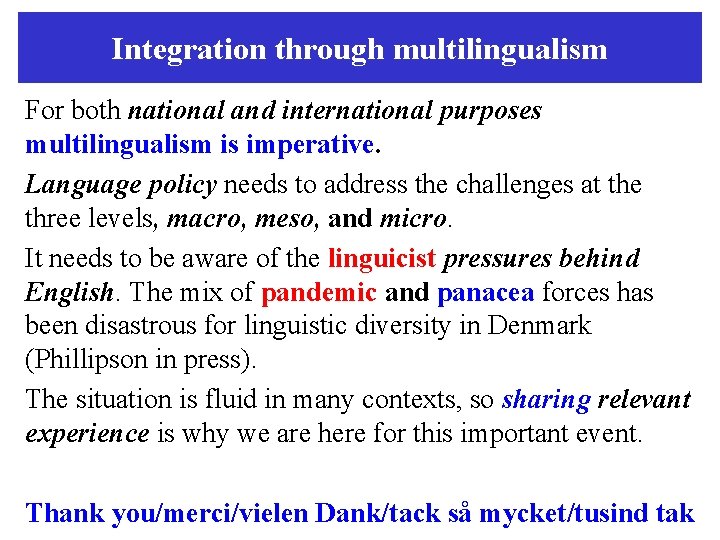
Integration through multilingualism For both national and international purposes multilingualism is imperative. Language policy needs to address the challenges at the three levels, macro, meso, and micro. It needs to be aware of the linguicist pressures behind English. The mix of pandemic and panacea forces has been disastrous for linguistic diversity in Denmark (Phillipson in press). The situation is fluid in many contexts, so sharing relevant experience is why we are here for this important event. Thank you/merci/vielen Dank/tack så mycket/tusind tak