
Shared Decision Making in Maternity Care Improving Care


- Slides: 49
Shared Decision Making in Maternity Care: Improving Care for Moms and Babies Together September 21, 2018 PROVIDE Mid-Project Meeting
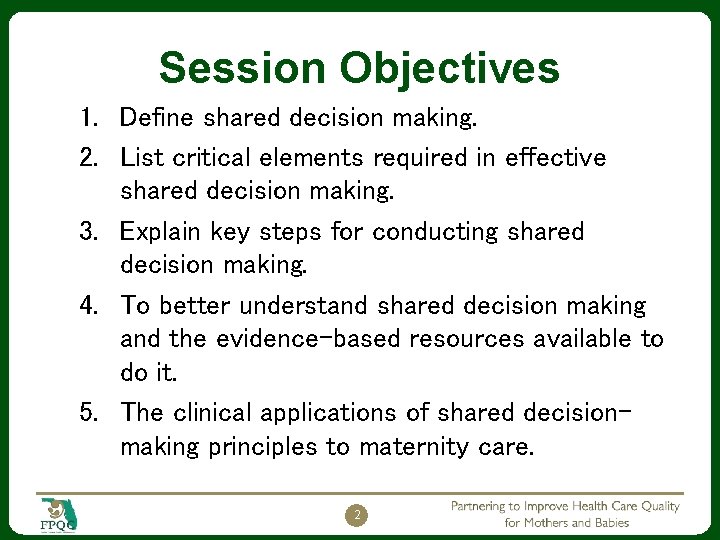
Session Objectives 1. Define shared decision making. 2. List critical elements required in effective shared decision making. 3. Explain key steps for conducting shared decision making. 4. To better understand shared decision making and the evidence-based resources available to do it. 5. The clinical applications of shared decisionmaking principles to maternity care. 2
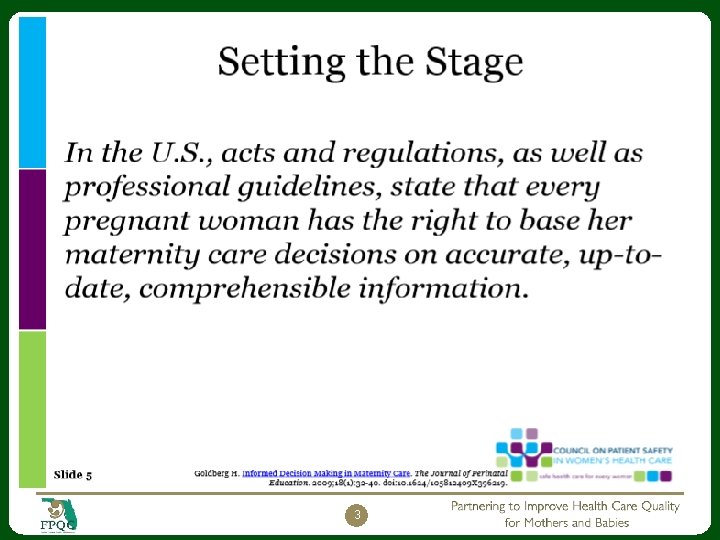
Setting the Stage Patients involved in shared decision making feel an increased sense of responsibility for health of baby and self baby (Harrison, et al. , 2003), and experience shorter recovery periods (Green & Baston, 2003) Patients involved in childbirth decisions have lower levels of fear (Green & Baston, 2003; Green et al. , 1990) and experience less depressive and posttraumatic stress symptoms after birth (Green & Baston, 2003; Green et al. , 1990) Women who had a cesarean were more likely to indicate feeling pressure from a health-care practitioner to have an intervention that women who had a vaginal birth (Green & Baston, 2003; Green et al. , 1990) Goldberg H. Informed Decision Making in Maternity Care. The Journal of Perinatal Education. 2009; 18(1): 32 -40. doi: 10. 1624/105812409 X 396219. 3
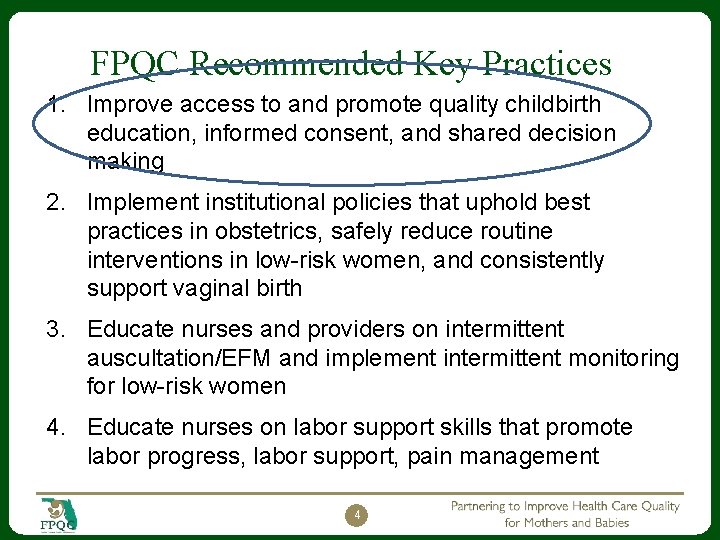
FPQC Recommended Key Practices 1. Improve access to and promote quality childbirth education, informed consent, and shared decision making 2. Implement institutional policies that uphold best practices in obstetrics, safely reduce routine interventions in low-risk women, and consistently support vaginal birth 3. Educate nurses and providers on intermittent auscultation/EFM and implement intermittent monitoring for low-risk women 4. Educate nurses on labor support skills that promote labor progress, labor support, pain management 4
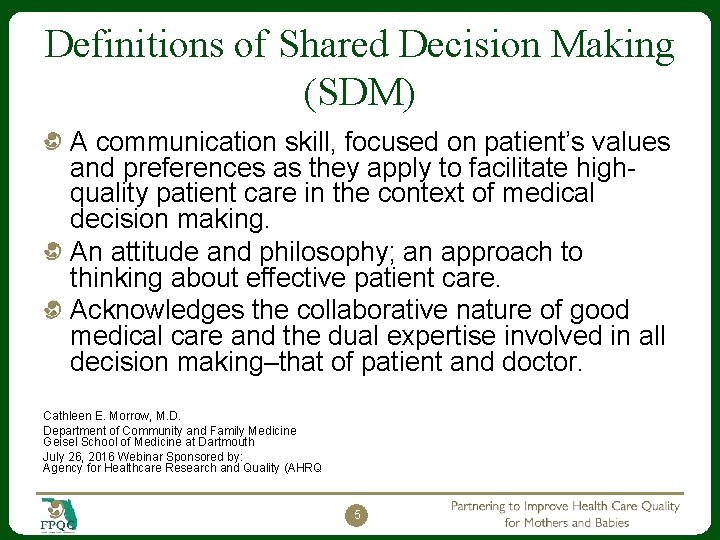
Definitions of Shared Decision Making (SDM) A communication skill, focused on patient’s values and preferences as they apply to facilitate highquality patient care in the context of medical decision making. An attitude and philosophy; an approach to thinking about effective patient care. Acknowledges the collaborative nature of good medical care and the dual expertise involved in all decision making–that of patient and doctor. Cathleen E. Morrow, M. D. Department of Community and Family Medicine Geisel School of Medicine at Dartmouth July 26, 2016 Webinar Sponsored by: Agency for Healthcare Research and Quality (AHRQ 5
Shared decision making is a collaborative process that enables people to make the health care decisions that are right for them, in the context of their own lives. It draws on the expertise and knowledge of both the patient and provider. The care provider shares her medical expertise and provides evidence-based information about care options, and the patient shares her values, preferences, and concerns. Together they make a decision and carry it out The best health care decisions are made when patients and providers work together. – Rebekah Gee, Maureen Corry Patient Engagement and Shared Decision Making in Maternity Care Obstetrics & Gynecology: November 2012 - Volume 120 Issue 5 - p 995– 99 6
What studies are showing Studies suggest that many health providers believe patients are not interested in participating in health care decision making. Evidence suggests that most patient want more information than given, and many would like to be more involved in their health decisions. AHRQ online resources: https: //www. ahrq. gov/professionals/education/curriculumtools/shareddecisionmaking/index. htm 7
Benefits to Health care Professionals: Improved quality of care delivered Increased patient satisfaction Benefits to Patients: Improved patient experience of care Improved patient adherence to treatment recommendations Using the SHARE Approach builds a trusting and lasting relationship between health care professionals and patients. 8
When to engage in shared decision making? Engage when your patient has a health problem that needs a treatment decision. Not every patient encounter requires shared decision making. Some patients may not want to or be ready to participate in shared decision making. A patient choosing not to participate in the decisionmaking process is still making a decision. 9
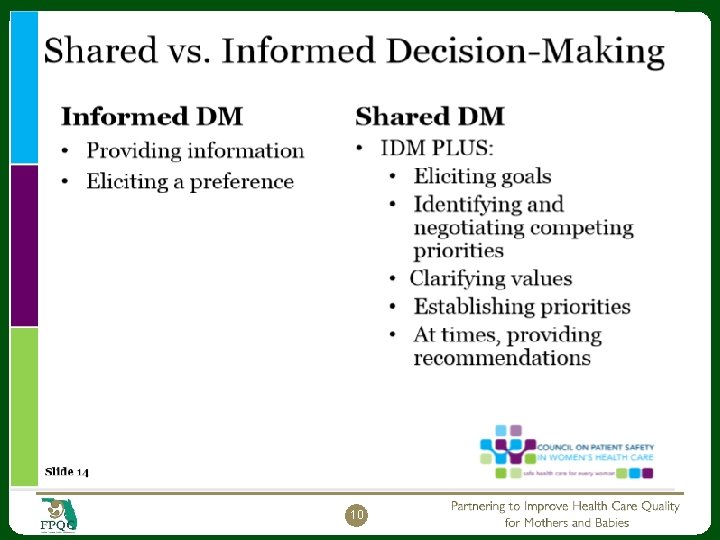
10
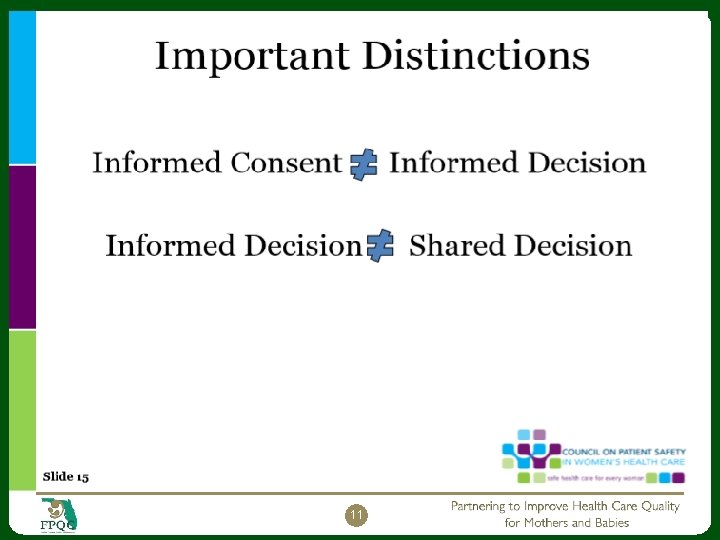
11
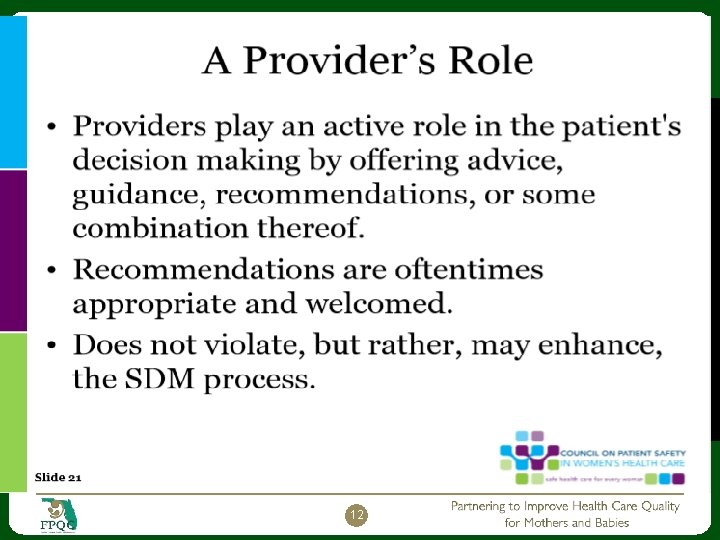
12
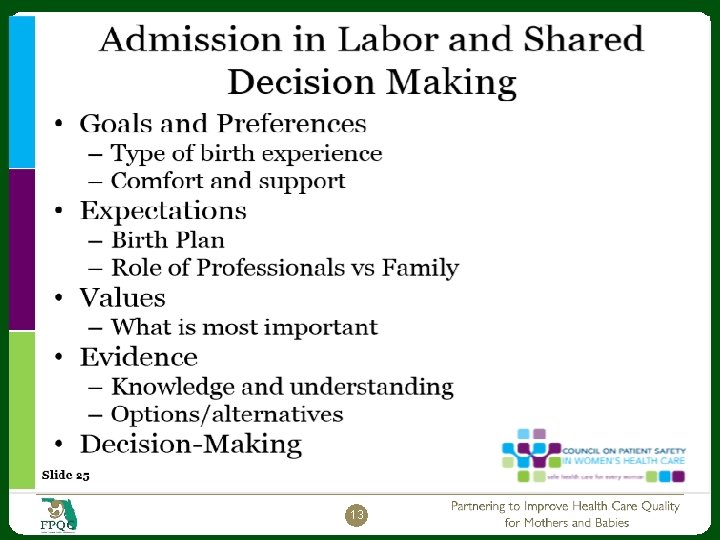
13
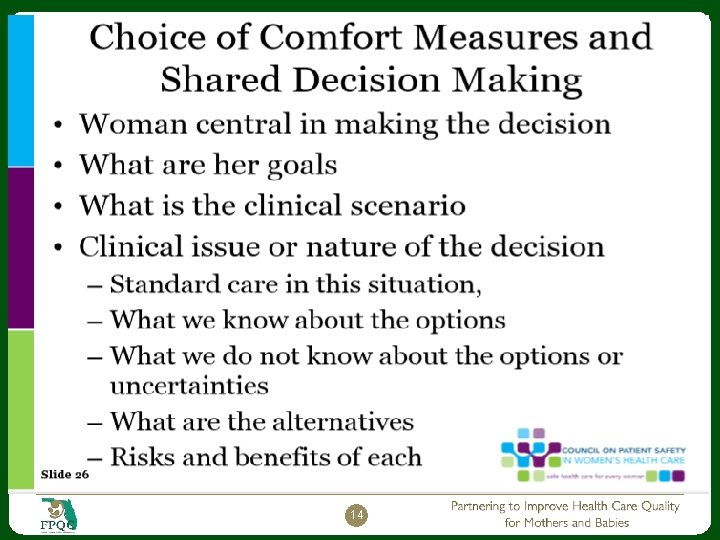
14
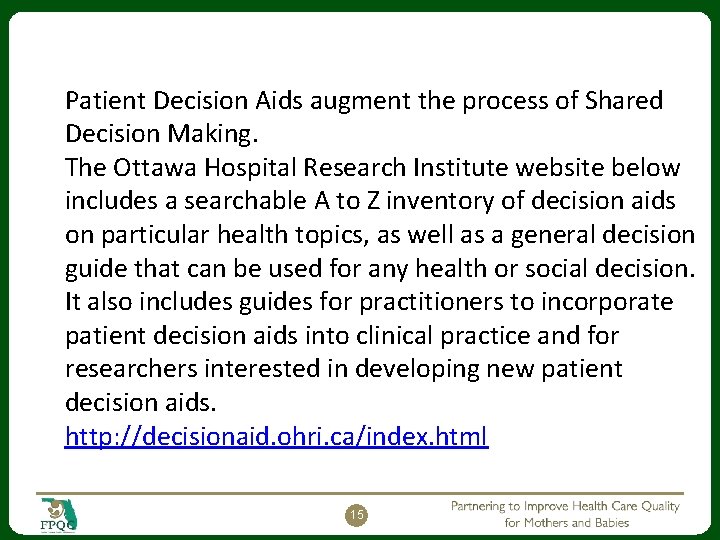
Patient Decision Aids augment the process of Shared Decision Making. The Ottawa Hospital Research Institute website below includes a searchable A to Z inventory of decision aids on particular health topics, as well as a general decision guide that can be used for any health or social decision. It also includes guides for practitioners to incorporate patient decision aids into clinical practice and for researchers interested in developing new patient decision aids. http: //decisionaid. ohri. ca/index. html 15
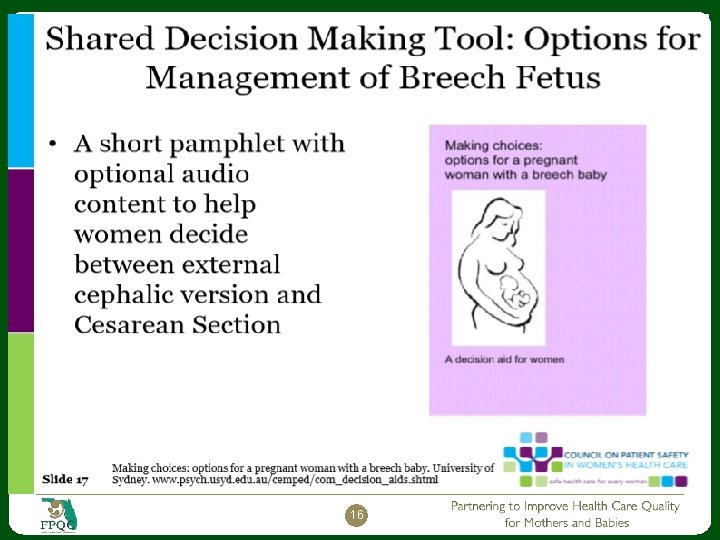
16
AHRQ online resources: https: //www. ahrq. gov/professionals/education/curriculum 17 tools/shareddecisionmaking/index. htm
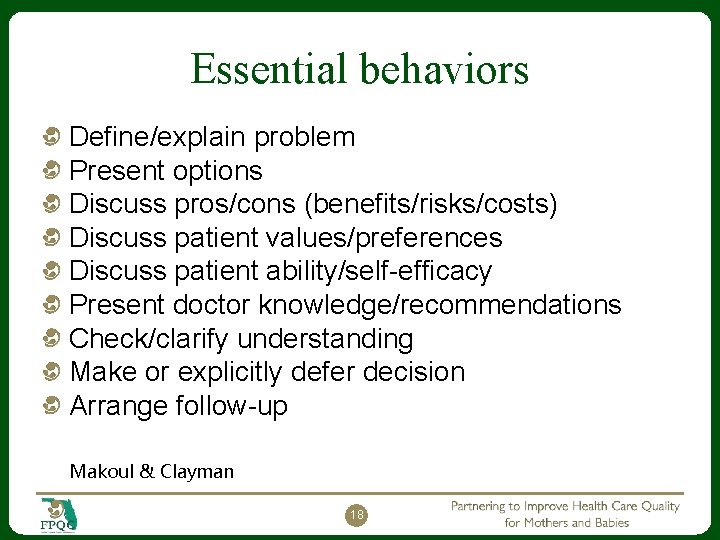
Essential behaviors Define/explain problem Present options Discuss pros/cons (benefits/risks/costs) Discuss patient values/preferences Discuss patient ability/self-efficacy Present doctor knowledge/recommendations Check/clarify understanding Make or explicitly defer decision Arrange follow-up Makoul & Clayman 18
19
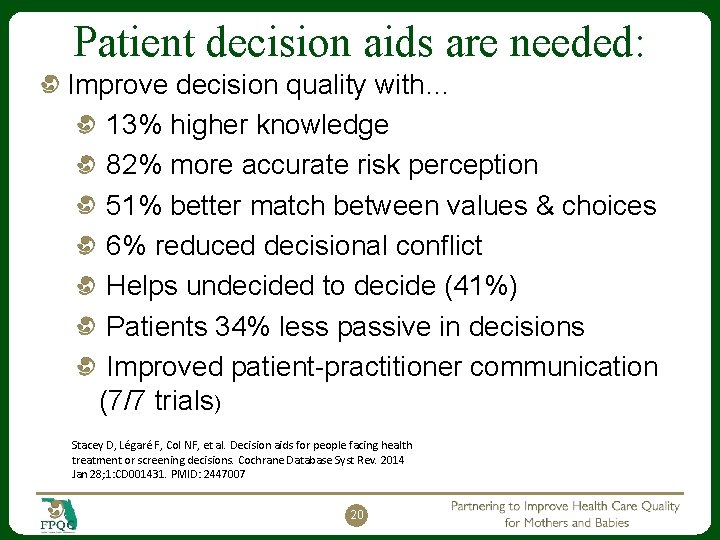
Patient decision aids are needed: Improve decision quality with… 13% higher knowledge 82% more accurate risk perception 51% better match between values & choices 6% reduced decisional conflict Helps undecided to decide (41%) Patients 34% less passive in decisions Improved patient-practitioner communication (7/7 trials) Stacey D, Légaré F, Col NF, et al. Decision aids for people facing health treatment or screening decisions. Cochrane Database Syst Rev. 2014 Jan 28; 1: CD 001431. PMID: 2447007 20
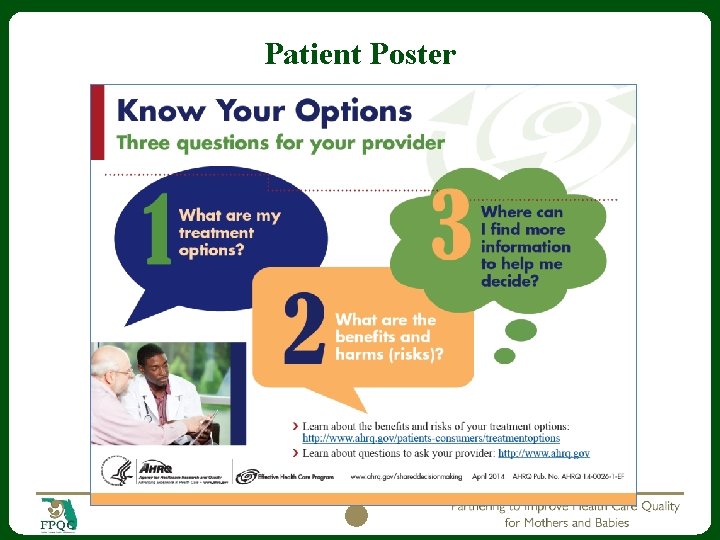
Patient Poster 21
22
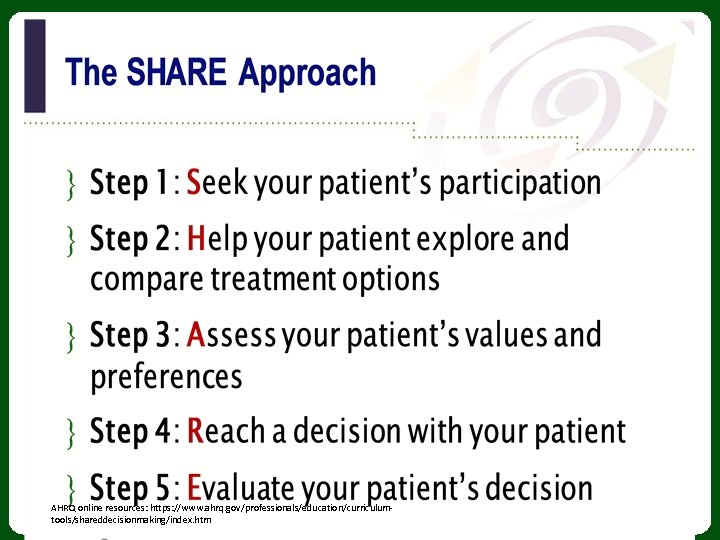
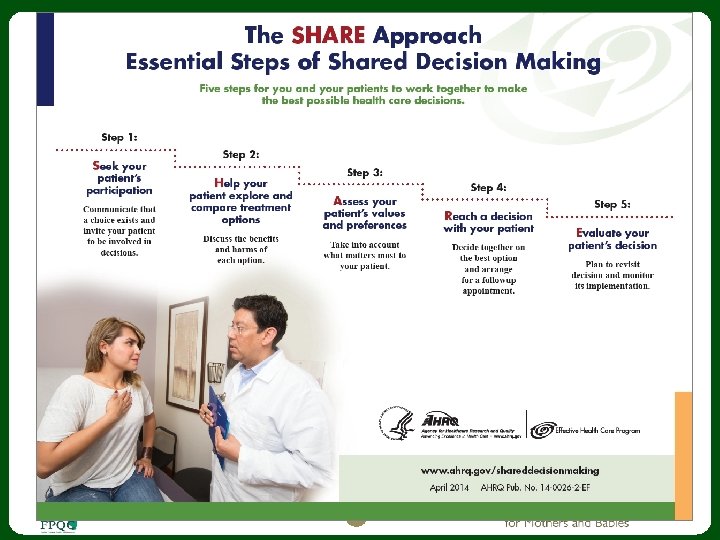
Presenting SHARE steps. . . The mnemonic “SHARE” is a learning device to help you readily recall the steps in the SHARE Approach Model. You may find that you do not present them in “linear order” during encounters. The important takeaway is to address all five steps. AHRQ online resources: https: //www. ahrq. gov/professionals/education/curriculumtools/shareddecisionmaking/index. html 23
Step 1: Seek your patient’s participation Communicate that a choice exists and invite the patient to participate in the decision-making process. Many patients are not aware that they can and should participate in their health care decision making. Many patients are not aware of the uncertainty in medicine, and that the outcomes of various treatments are variable. AHRQ online resources: https: //www. ahrq. gov/professionals/education/curriculum- l tools/shareddecisionmaking/index. htm 24
Step 1: Seek your patient’s participation Tips Summarize the health problem and communicate there may be more than one treatment choice. Ask your patient to participate with the health care team. Assess the role your patient Use cues to continually wants to play. engage your Include family/caregivers in decisions. patient. For example, “I’d like your input” AHRQ online resources: https: //www. ahrq. gov/professionals/education/curriculumtools/shareddecisionmaking/index. html 25
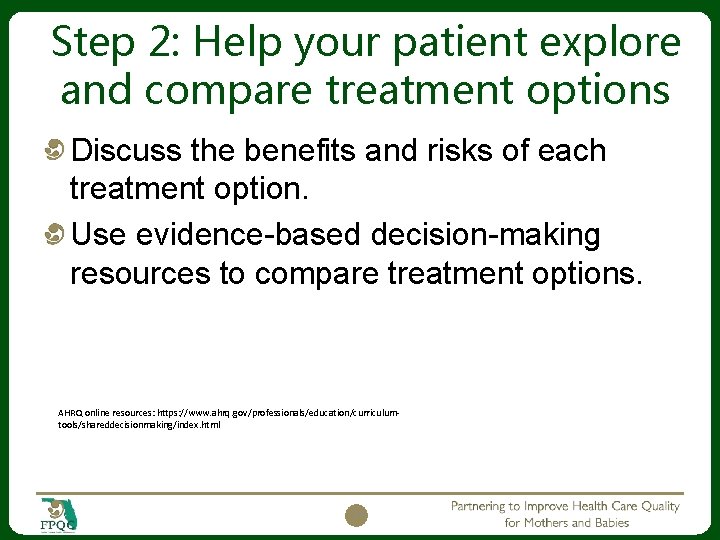
Step 2: Help your patient explore and compare treatment options Discuss the benefits and risks of each treatment option. Use evidence-based decision-making resources to compare treatment options. AHRQ online resources: https: //www. ahrq. gov/professionals/education/curriculumtools/shareddecisionmaking/index. html 26
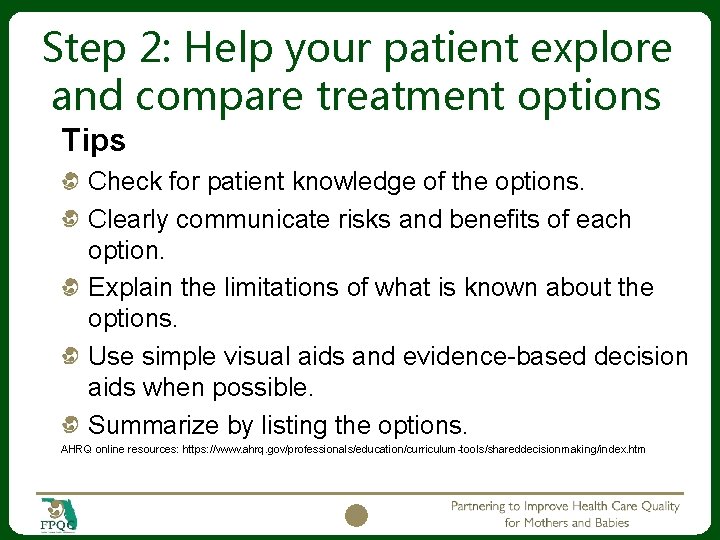
Step 2: Help your patient explore and compare treatment options Tips Check for patient knowledge of the options. Clearly communicate risks and benefits of each option. Explain the limitations of what is known about the options. Use simple visual aids and evidence-based decision aids when possible. Summarize by listing the options. AHRQ online resources: https: //www. ahrq. gov/professionals/education/curriculum-tools/shareddecisionmaking/index. htm 27
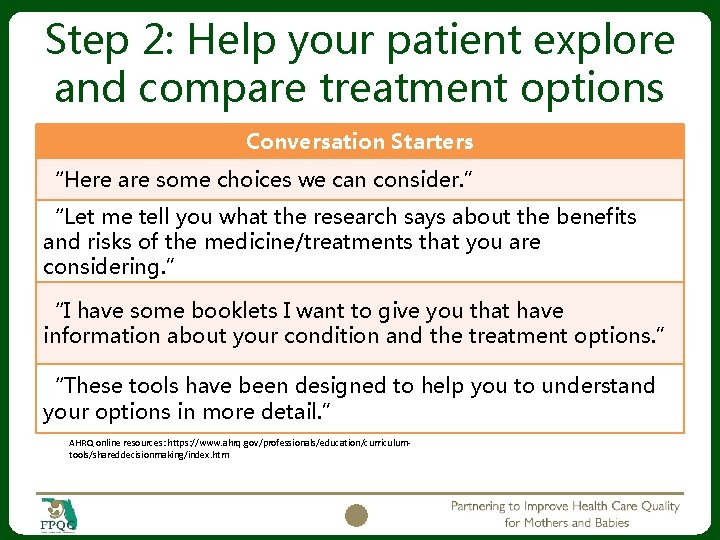
Step 2: Help your patient explore and compare treatment options Conversation Starters “Here are some choices we can consider. ” “Let me tell you what the research says about the benefits and risks of the medicine/treatments that you are considering. ” “I have some booklets I want to give you that have information about your condition and the treatment options. ” “These tools have been designed to help you to understand your options in more detail. ” AHRQ online resources: https: //www. ahrq. gov/professionals/education/curriculumtools/shareddecisionmaking/index. htm 28
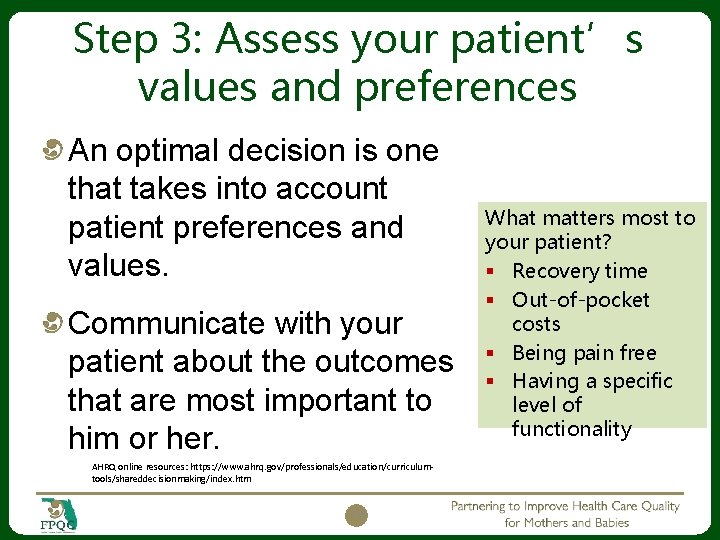
Step 3: Assess your patient’s values and preferences An optimal decision is one that takes into account patient preferences and values. Communicate with your patient about the outcomes that are most important to him or her. AHRQ online resources: https: //www. ahrq. gov/professionals/education/curriculumtools/shareddecisionmaking/index. htm 29 What matters most to your patient? § Recovery time § Out-of-pocket costs § Being pain free § Having a specific level of functionality
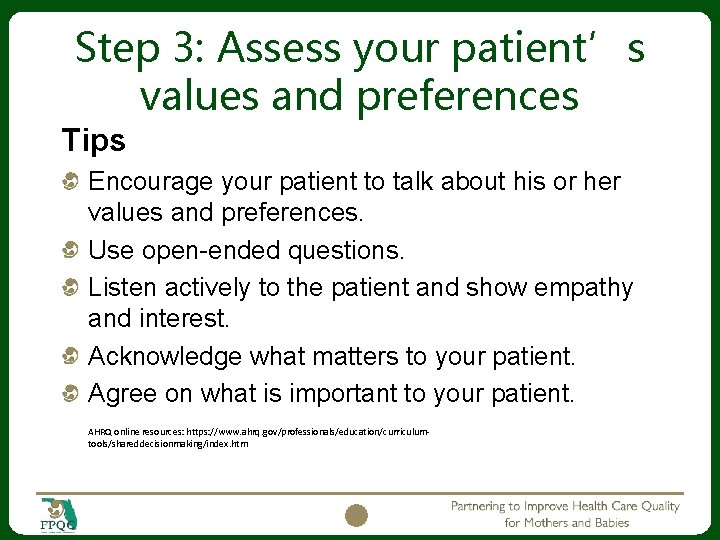
Step 3: Assess your patient’s values and preferences Tips Encourage your patient to talk about his or her values and preferences. Use open-ended questions. Listen actively to the patient and show empathy and interest. Acknowledge what matters to your patient. Agree on what is important to your patient. AHRQ online resources: https: //www. ahrq. gov/professionals/education/curriculumtools/shareddecisionmaking/index. htm 30
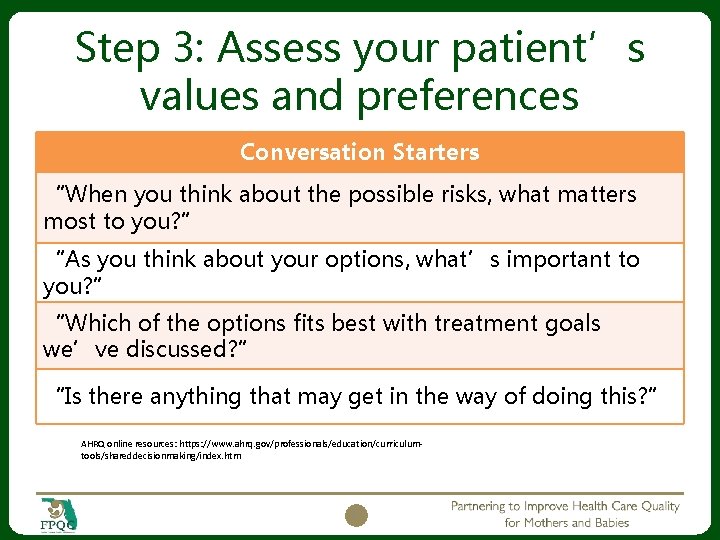
Step 3: Assess your patient’s values and preferences Conversation Starters “When you think about the possible risks, what matters most to you? ” “As you think about your options, what’s important to you? ” “Which of the options fits best with treatment goals we’ve discussed? ” “Is there anything that may get in the way of doing this? ” AHRQ online resources: https: //www. ahrq. gov/professionals/education/curriculumtools/shareddecisionmaking/index. htm 31
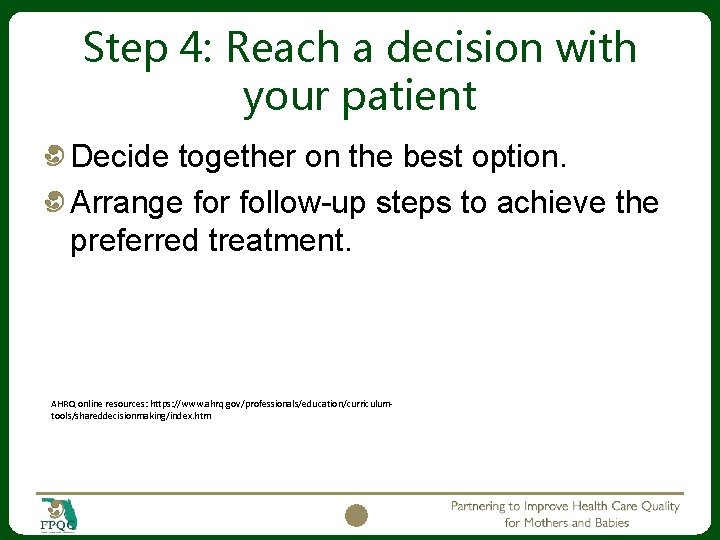
Step 4: Reach a decision with your patient Decide together on the best option. Arrange for follow-up steps to achieve the preferred treatment. AHRQ online resources: https: //www. ahrq. gov/professionals/education/curriculumtools/shareddecisionmaking/index. htm 32
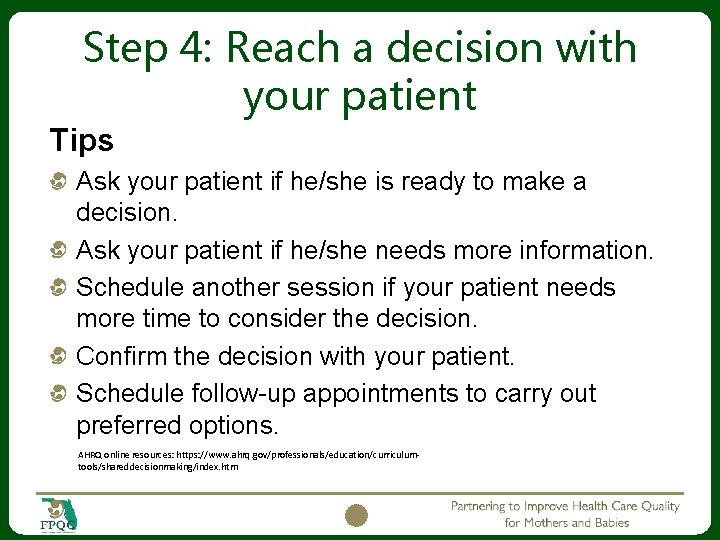
Step 4: Reach a decision with your patient Tips Ask your patient if he/she is ready to make a decision. Ask your patient if he/she needs more information. Schedule another session if your patient needs more time to consider the decision. Confirm the decision with your patient. Schedule follow-up appointments to carry out preferred options. AHRQ online resources: https: //www. ahrq. gov/professionals/education/curriculumtools/shareddecisionmaking/index. htm 33
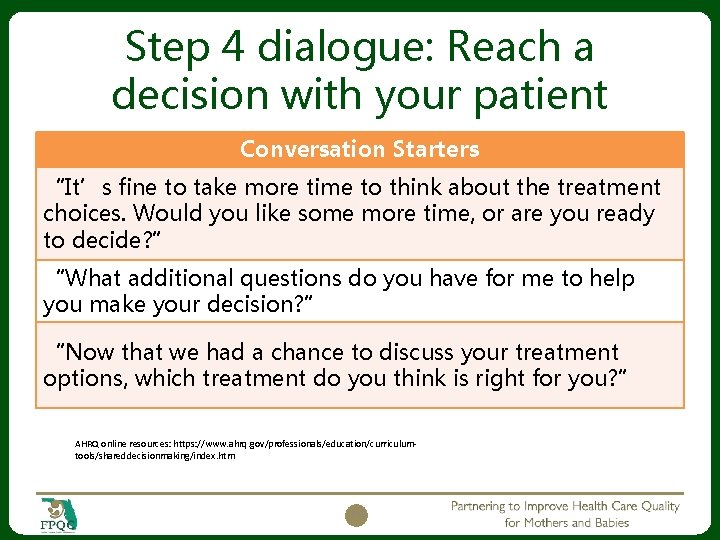
Step 4 dialogue: Reach a decision with your patient Conversation Starters “It’s fine to take more time to think about the treatment choices. Would you like some more time, or are you ready to decide? ” “What additional questions do you have for me to help you make your decision? ” “Now that we had a chance to discuss your treatment options, which treatment do you think is right for you? ” AHRQ online resources: https: //www. ahrq. gov/professionals/education/curriculumtools/shareddecisionmaking/index. htm 34
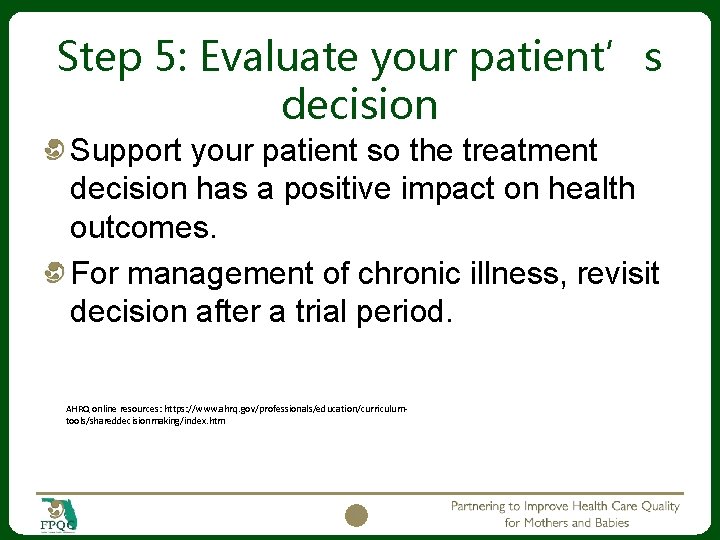
Step 5: Evaluate your patient’s decision Support your patient so the treatment decision has a positive impact on health outcomes. For management of chronic illness, revisit decision after a trial period. AHRQ online resources: https: //www. ahrq. gov/professionals/education/curriculumtools/shareddecisionmaking/index. htm 35
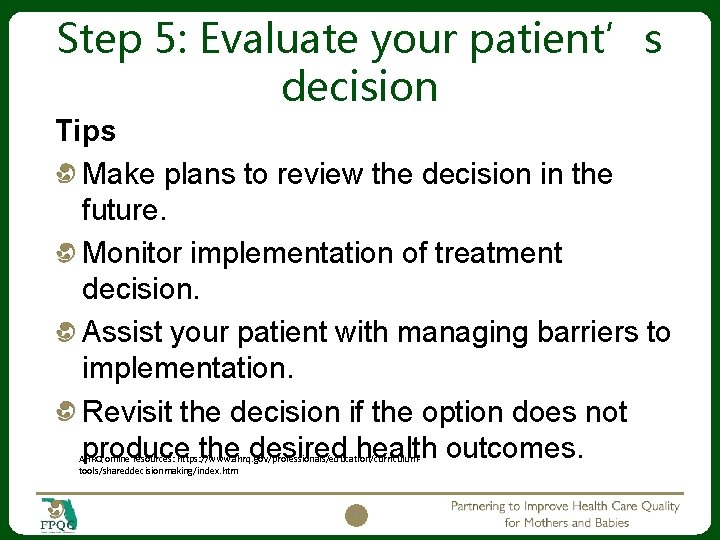
Step 5: Evaluate your patient’s decision Tips Make plans to review the decision in the future. Monitor implementation of treatment decision. Assist your patient with managing barriers to implementation. Revisit the decision if the option does not produce the desired health outcomes. AHRQ online resources: https: //www. ahrq. gov/professionals/education/curriculumtools/shareddecisionmaking/index. htm 36
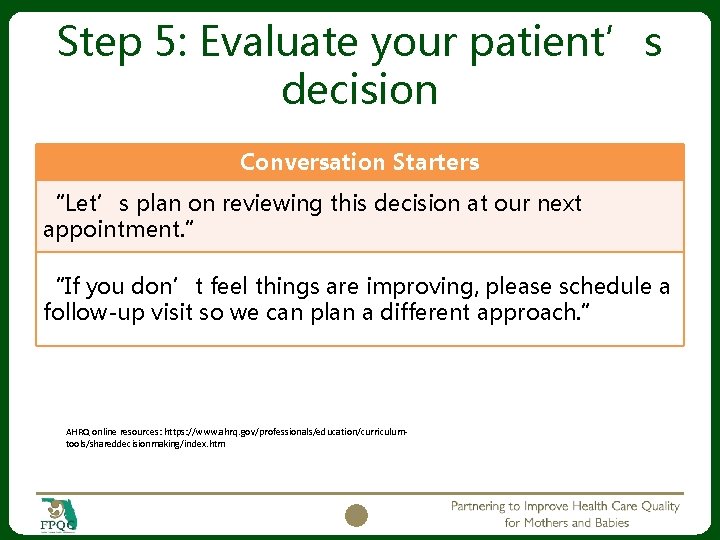
Step 5: Evaluate your patient’s decision Conversation Starters “Let’s plan on reviewing this decision at our next appointment. ” “If you don’t feel things are improving, please schedule a follow-up visit so we can plan a different approach. ” AHRQ online resources: https: //www. ahrq. gov/professionals/education/curriculumtools/shareddecisionmaking/index. htm 37
Putting Shared Decision Making Into Action Role Play Activity AHRQ online resources: https: //www. ahrq. gov/professionals/education/curriculumtools/shareddecisionmaking/index. htm 38
Instructions Break into your assigned group. Choose roles: Provider, patient, reporter, observers. Refer to the Conversation Starters handout and the SHARE Approach model as you role play. Refer to your consumer and clinician summaries during this activity. Role play: Reporter asks for volunteers for provider and patient. Role play a shared decision-making encounter. Observers provide feedback. 39
Debrief Summarize your group’s role play. Could you fit all steps in? What was most challenging? What worked best? How long did it take? How difficult would this be to implement in real life? 40
Key takeaways Shared decision making is a two-way street Occurs when a health care provider and a patient work together to make a health care decision that is best for the patient. The optimal decision takes into account evidencebased information about available options, the provider’s knowledge and experience, and the patient’s values and preferences. AHRQ online resources: https: //www. ahrq. gov/professionals/education/curriculumtools/shareddecisionmaking/index. htm 41
Key takeaways The SHARE Approach is a five-step process for shared decision making that includes exploring and comparing the benefits, harms, and risks of each health care option through meaningful dialogue about what matters most to the patient. AHRQ online resources: https: //www. ahrq. gov/professionals/education/curriculumtools/shareddecisionmaking/index. htm 42
Key takeaways Conversation starters can help you engage patients as you present each of the SHARE Approach Model’s five steps. AHRQ online resources: https: //www. ahrq. gov/professionals/education/curriculumtools/shareddecisionmaking/index. htm 43
Key takeaways Using evidence-based decision aids in shared decision making can: Improve patient’s knowledge of options Result in patient having more accurate expectations of possible benefits and risks Lead to patient making decisions that are more consistent with their values Increase patient’s participation in decision making AHRQ online resources: https: //www. ahrq. gov/professionals/education/curriculumtools/shareddecisionmaking/index. htm 44
Citations AHRQ online resources: https: //www. ahrq. gov/professionals/educa tion/curriculumtools/shareddecisionmaking/index. htm 1. Makoul G, Clayman ML; An integrative model of shared decision making in medical encounters. Patient Educ Couns. 2006; 60(3): 301 -12. 2. Wilson SR, Strub P, Buist AS, Knowles SB, Lavori PW, Lapidus J, Vollmer WM; Better Outcomes of Asthma Treatment (BOAT) Study Group. Shared treatment decision making improves adherence and outcomes in poorly controlled asthma. Am J Respir Crit Care Med. 2010 Mar 15; 181(6): 566 -77. Pub. Med PMID: 20019345. 3. Clever SL, Ford DE, Rubenstein LV, Rost KM, Meredith LS, Sherbourne CD, Wang NY, Arbelaez JJ, Cooper LA. Primary care patients’ involvement in decision-making is associated with improvement in depression. Med Care. 2006 May; 44(5): 398 -405. Pub. Med PMID: 16641657. 4. Da Silva, D. Evidence: Helping people share decisions. A review of evidence considering whether shared decision making is worthwhile. 2012 June. London, England: Health Foundation. http: //www. health. org. uk/public/cms/75/76/313/3448/Helping. People. Share. Dec ision. Making. pdf? real. Name=r. FVU 5 h. pdf 45
Citations 5. Swanson KA, Bastani R, Rubenstein LV, Meredith LS, Ford DE. Effect of mental health care and shared decision making on patient satisfaction in a community sample of patients with depression. Med Care Res Rev. 2007 Aug; 64(4): 416 -30. Pub. Med PMID: 17684110. 6. Thompson L. , Mc. Cabe R. The effect of clinician-patient alliance and communication on treatment adherence in mental health care: a systematic review. BMC Psychiatry 2012 Jul 24; 12: 87. PMID: 22828119. 7. Duncan E. , Best C. , Hagen S. Shared decision making interventions for people with mental health conditions. Cochrane Database Syst Rev 2010 Jan 20; (1): CD 007297. PMID: 20091628. 8. Stacey D, Légaré F, Col NF, et. al. Decision aids for people facing health treatment or screening decisions. Cochrane Database Syst Rev. 2014 Jan 28; 1: CD 001431. Pub. Med PMID: 24470076 (2014 Systematic Review; 113 studies; 34, 444 participants). 46
Citations 9. Little P. , Everitt H. , Williamson I. , et al. Preferences of patients for patient centred approach to consultation in primary care: observational study. BMJ 2001. 322(7284): 468 -72. PMID: 11222423. 10. Coulter A. , Parsons S. , Askham A. Where are the patients in decisionmaking about their own care? Health Systems and Policy Analysis 2008: p. 1 -26. 11. Levinson W. , Kao A. , Kuby A. , et al. Not all patients want to participate in decision making. A national study of public preferences. J Gen Intern Med 2005 Jun; 20(6): 531 -5. PMID: 15987329. 12. Légaré F. , Ratté S. , Gravel K. , et al. Barriers and facilitators to implementing shared decision-making in clinical practice: update of a systematic review of health professionals’ perceptions. Patient Educ Couns 2008. Dec; 73(3): 526 -35. PMID: 18752915. 13. Guadagnoli E. , Ward P. Patient participation in decision-making. Soc Sci Med 1998 Aug; 47(3): 329 -39. PMID: 9681902. 14. Murray E. , Charles C. , Gafni A. Shared decision-making in primary care: tailoring the Charles et al. model to fit the context of general practice. Patient Educ Couns 2006 Aug; 62(2): 205 -11. PMID: 16139467. 47
Q&A 48
THANK YOU!