
Shared Access Networks Token Ring ATM Fibre channel
Shared Access Networks Token Ring ATM Fibre channel Myrinet 4/598 N: Computer Networks
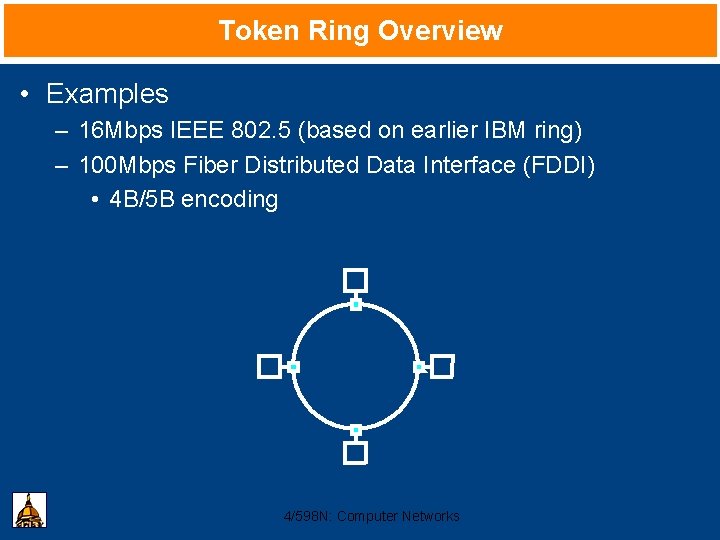
Token Ring Overview • Examples – 16 Mbps IEEE 802. 5 (based on earlier IBM ring) – 100 Mbps Fiber Distributed Data Interface (FDDI) • 4 B/5 B encoding 4/598 N: Computer Networks
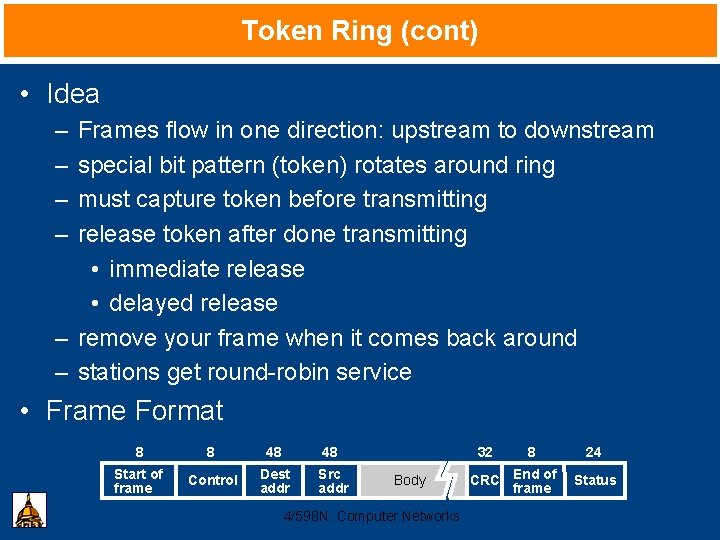
Token Ring (cont) • Idea – – Frames flow in one direction: upstream to downstream special bit pattern (token) rotates around ring must capture token before transmitting release token after done transmitting • immediate release • delayed release – remove your frame when it comes back around – stations get round-robin service • Frame Format 8 8 48 48 Start of frame Control Dest addr Src addr 32 Body 4/598 N: Computer Networks 8 CRC End of frame 24 Status

Timed Token Algorithm • Token Holding Time (THT) – upper limit on how long a station can hold the token • Token Rotation Time (TRT) – how long it takes the token to traverse the ring. – TRT <= Active. Nodes x THT + Ring. Latency • Target Token Rotation Time (TTRT) – agreed-upon upper bound on TRT 4/598 N: Computer Networks
Algorithm (cont) • Each node measures TRT between successive tokens – if measured-TRT > TTRT: token is late so don’t send – if measured-TRT < TTRT: token is early so OK to send • Two classes of traffic – synchronous: can always send – asynchronous: can send only if token is early • Worse case: 2 x. TTRT between seeing token • Back-to-back 2 x. TTRT rotations not possible 4/598 N: Computer Networks
Token Maintenance • Lost Token – no token when initializing ring – bit error corrupts token pattern – node holding token crashes • Generating a Token (and agreeing on TTRT) – – execute when join ring or suspect a failure send a claim frame that includes the node’s TTRT bid when receive claim frame, update the bid and forward if your claim frame makes it all the way around the ring: • your bid was the lowest • everyone knows TTRT • you insert new token 4/598 N: Computer Networks
Maintenance (cont) • Monitoring for a Valid Token – should periodically see valid transmission (frame or token) – maximum gap = ring latency + max frame < = 2. 5 ms – set timer at 2. 5 ms and send claim frame if it fires 4/598 N: Computer Networks

FDDI (Fiber Distributed Data Interface) • The late-80’s version of token ring (100 Mbps, fiber-based) • Dual-ring (two fibers): 2 nd ring used for fault recovery • Can handle single point failures 4/598 N: Computer Networks
ATM Technology (courtesy: ATM Forum) • Negotiated Service Contract – Connection Oriented - virtual circuit – End-to-End Quality of Service • Cell Switching – 53 Byte Cell – 48 Byte Payload, 5 Byte Header • Fixed Size • Header contains virtual circuit information • Payload can be voice, video or other data types 4/598 N: Computer Networks
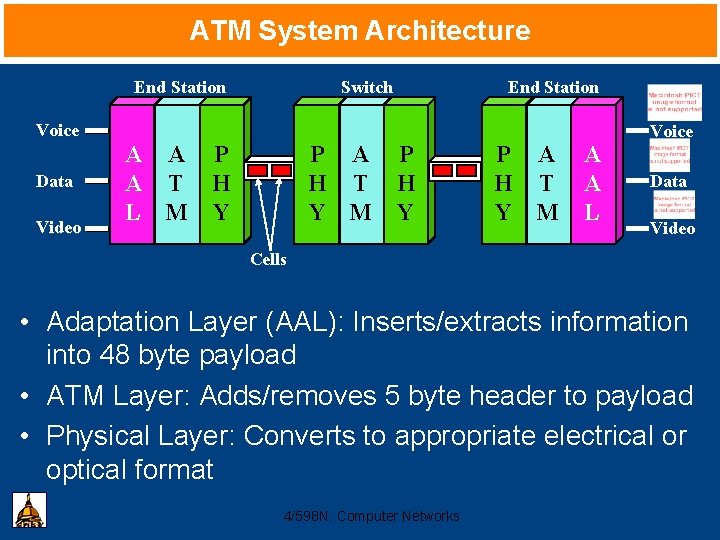
ATM System Architecture End Station Switch End Station Voice Data Video A A A T L M P H Y P A H T Y M A A L Voice Data Video Cells • Adaptation Layer (AAL): Inserts/extracts information into 48 byte payload • ATM Layer: Adds/removes 5 byte header to payload • Physical Layer: Converts to appropriate electrical or optical format 4/598 N: Computer Networks
Fibre Channel • • • Connect servers, workstations, disk storage etc. Optical or electrical media 133 Mbps to 1062 Mbps 10 km point-to-point links or loop or connect to a switch IP, SCSI etc. • http: //hsi. web. cern. ch/HSI/fcs/spec/overview. htm 4/598 N: Computer Networks
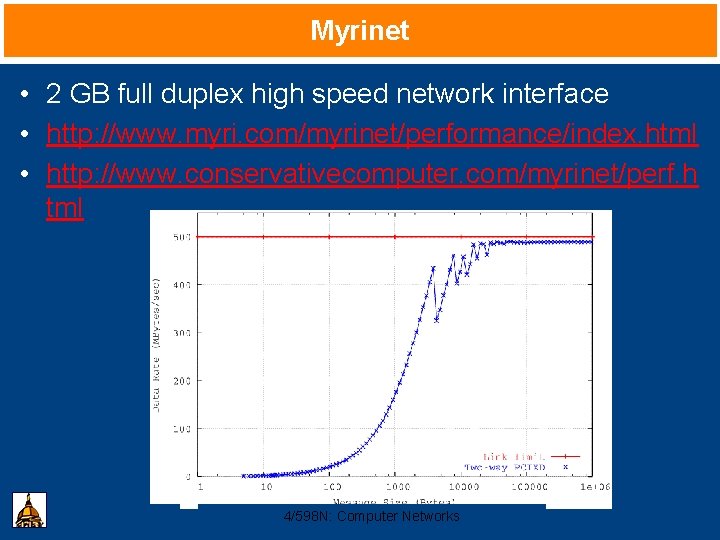
Myrinet • 2 GB full duplex high speed network interface • http: //www. myri. com/myrinet/performance/index. html • http: //www. conservativecomputer. com/myrinet/perf. h tml 4/598 N: Computer Networks
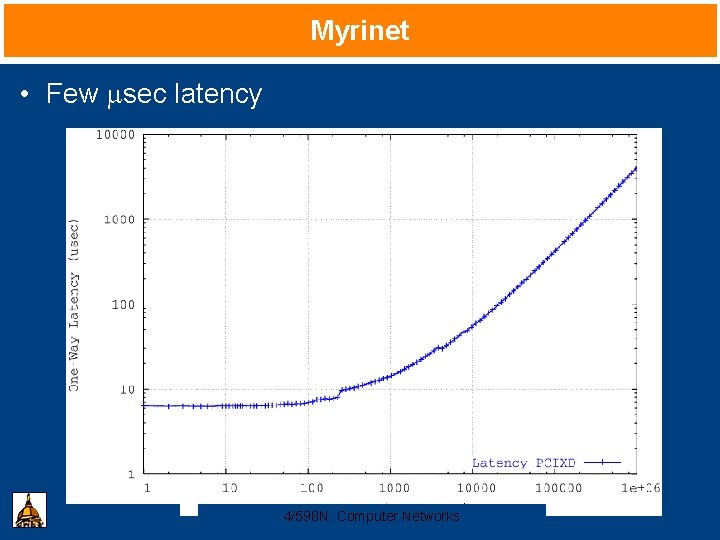
Myrinet • Few sec latency 4/598 N: Computer Networks
- Slides: 13