
Share the ppb level accuracy in common LCMS

Share the ppb level accuracy in common LC-MS analysis Zhang Jiyang School of Mechanical Engineering and Automatization, National University of Defense Technology November 14, 2012
Outline • Background ▫ Proteomics goes to the high-high age ▫ Instrument calibration and data re-calibration • FTDR 2. 0: implement ppb level re-calibration ▫ Workflow ▫ Algorithms ▫ Results • Discussions ▫ How to utilize the high accuracy?
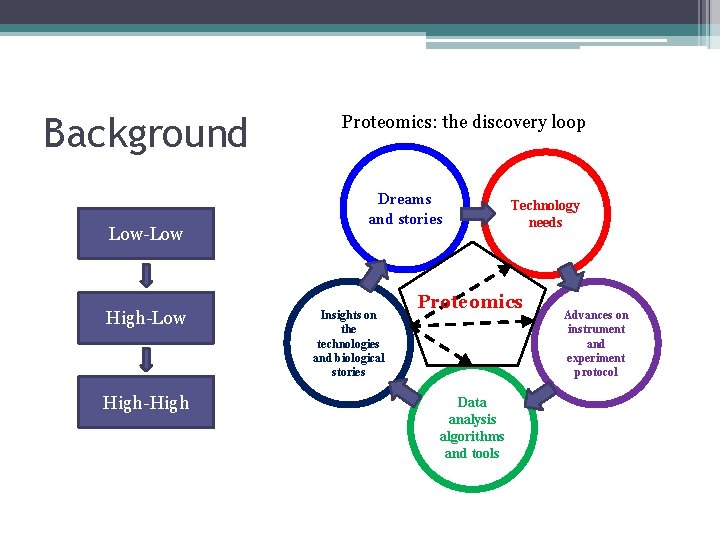
Background Low-Low High-High Proteomics: the discovery loop Dreams and stories Insights on the technologies and biological stories Technology needs Proteomics Data analysis algorithms and tools Advances on instrument and experiment protocol

High sensitivity LTQ • Low-Low MS and MS/MS Very fast scan speed MET: 3 Da No obvious isotopic profiles MET: 0. 6 Da Few isotopic profiles only for very high signals
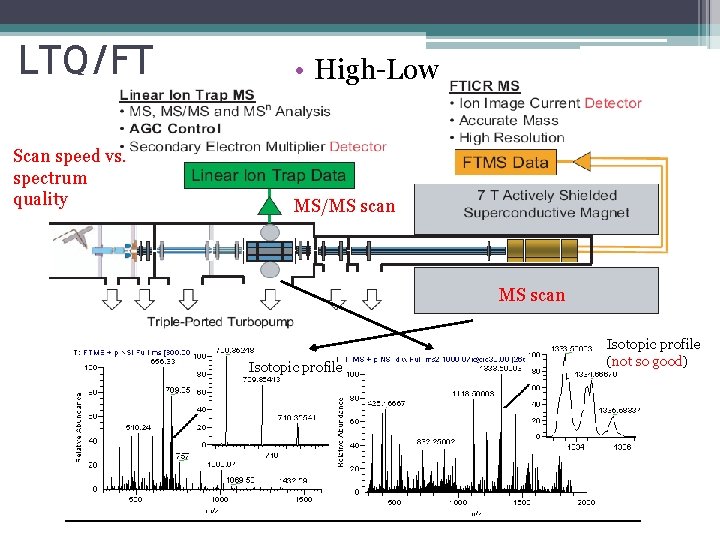
LTQ/FT Scan speed vs. spectrum quality • High-Low MS/MS scan Isotopic profile (not so good)
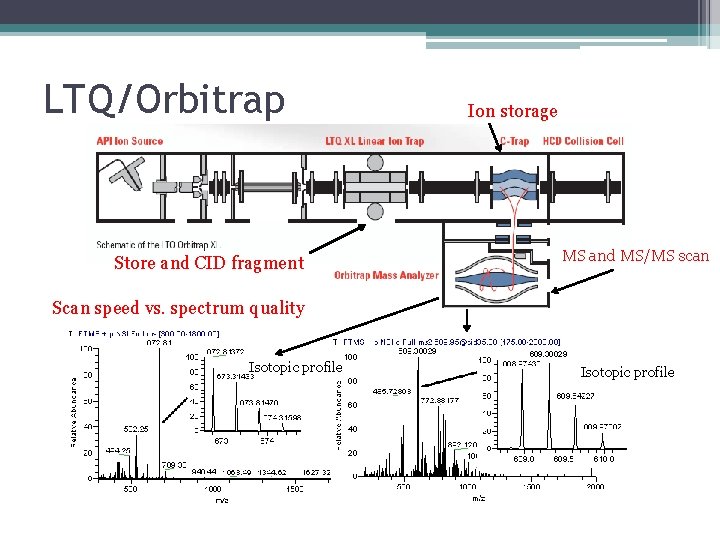
LTQ/Orbitrap Store and CID fragment Ion storage MS and MS/MS scan Scan speed vs. spectrum quality Isotopic profile

Some literatures • Cox J, Mann M. Quantitative, high-resolution proteomics for data-driven systems biology. Annu Rev Biochem. 2011 Jun 7; 80: 273 -99. • Mann M, Kelleher NL. Precision proteomics: the case for high resolution and high mass accuracy. Proc Natl Acad Sci U S A. 2008 Nov 25; 105(47): 18132 -8. • Nilsson T, Mann M, Aebersold R, Yates JR 3 rd, Bairoch A, Bergeron JJ. Mass spectrometry in high-throughput proteomics: ready for the big time. Nat Methods. 2010 Sep; 7(9): 681 -5. • Altelaar AF et al. Database independent proteomics analysis of the ostrich and human proteome. Proc Natl Acad Sci U S A. 2012 Jan 10; 109(2): 407 -12. Epub 2011 Dec 22. • Lamond AI, Uhlen M, Horning S, et al. Advancing cell biology through proteomics in space and time (PROSPECTS). Mol Cell Proteomics. 2012 Mar; 11(3): O 112. 017731. Epub 2012 Feb 6. More dreams with high accuracy and high resolution instruments: Top-down, cross-link based PPI, PTM identification and discovery, real time state monitor of cells…
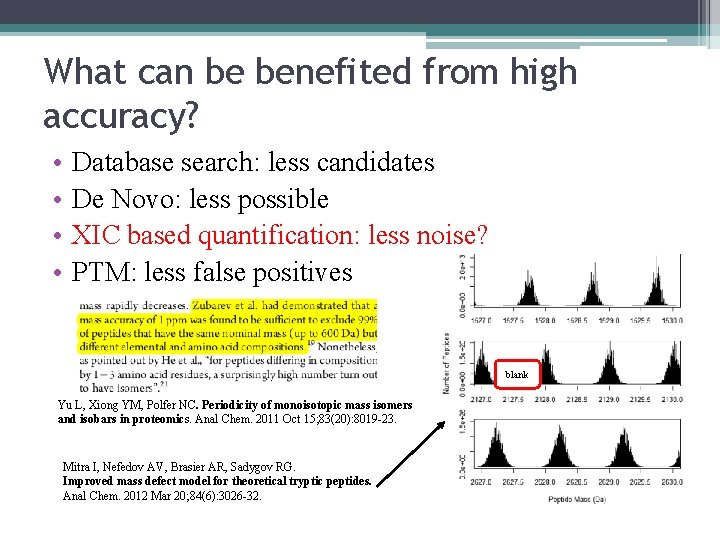
What can be benefited from high accuracy? • • Database search: less candidates De Novo: less possible XIC based quantification: less noise? PTM: less false positives blank Yu L, Xiong YM, Polfer NC. Periodicity of monoisotopic mass isomers and isobars in proteomics. Anal Chem. 2011 Oct 15; 83(20): 8019 -23. Mitra I, Nefedov AV, Brasier AR, Sadygov RG. Improved mass defect model for theoretical tryptic peptides. Anal Chem. 2012 Mar 20; 84(6): 3026 -32.
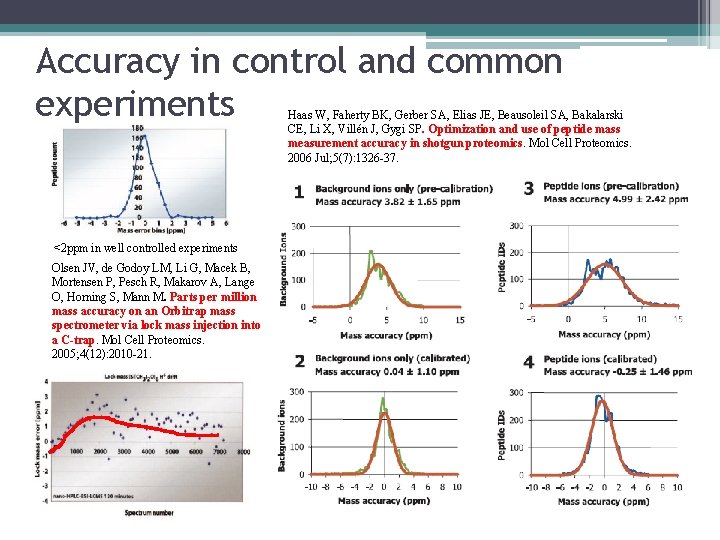
Accuracy in control and common experiments Haas W, Faherty BK, Gerber SA, Elias JE, Beausoleil SA, Bakalarski CE, Li X, Villén J, Gygi SP. Optimization and use of peptide mass measurement accuracy in shotgun proteomics. Mol Cell Proteomics. 2006 Jul; 5(7): 1326 -37. <2 ppm in well controlled experiments Olsen JV, de Godoy LM, Li G, Macek B, Mortensen P, Pesch R, Makarov A, Lange O, Horning S, Mann M. Parts per million mass accuracy on an Orbitrap mass spectrometer via lock mass injection into a C-trap. Mol Cell Proteomics. 2005; 4(12): 2010 -21.
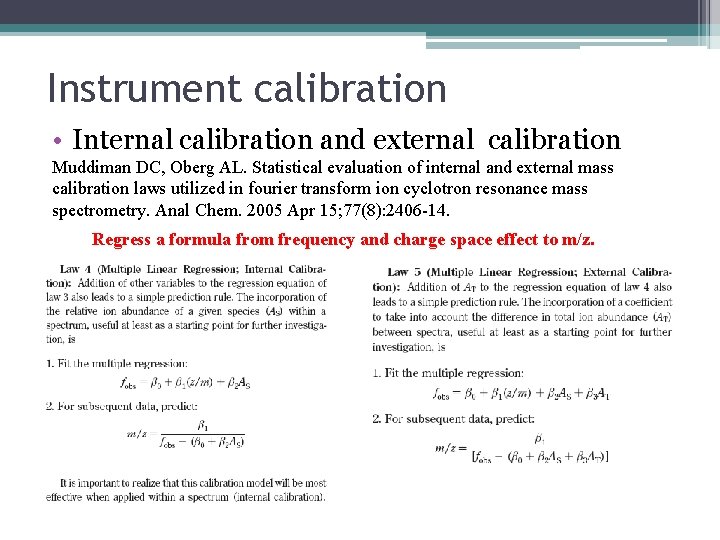
Instrument calibration • Internal calibration and external calibration Muddiman DC, Oberg AL. Statistical evaluation of internal and external mass calibration laws utilized in fourier transform ion cyclotron resonance mass spectrometry. Anal Chem. 2005 Apr 15; 77(8): 2406 -14. Regress a formula from frequency and charge space effect to m/z.
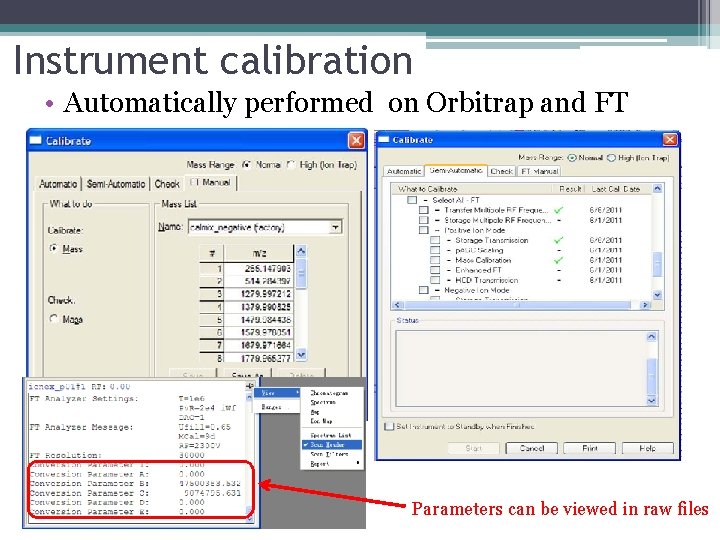
Instrument calibration • Automatically performed on Orbitrap and FT Parameters can be viewed in raw files
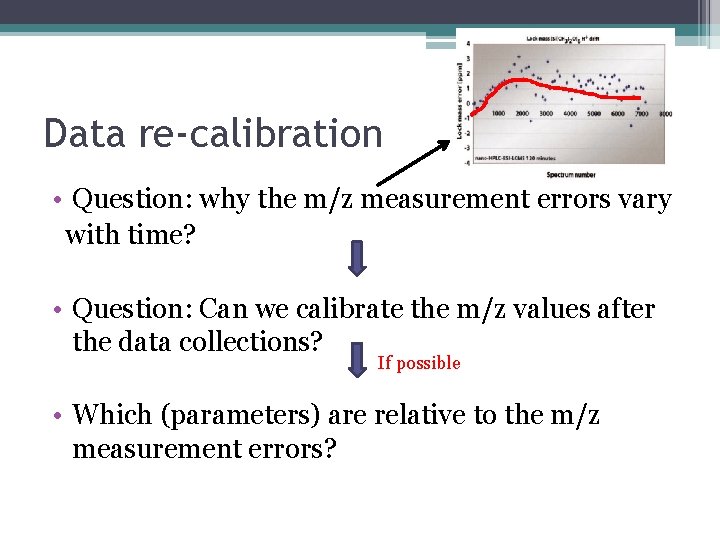
Data re-calibration • Question: why the m/z measurement errors vary with time? • Question: Can we calibrate the m/z values after the data collections? If possible • Which (parameters) are relative to the m/z measurement errors?
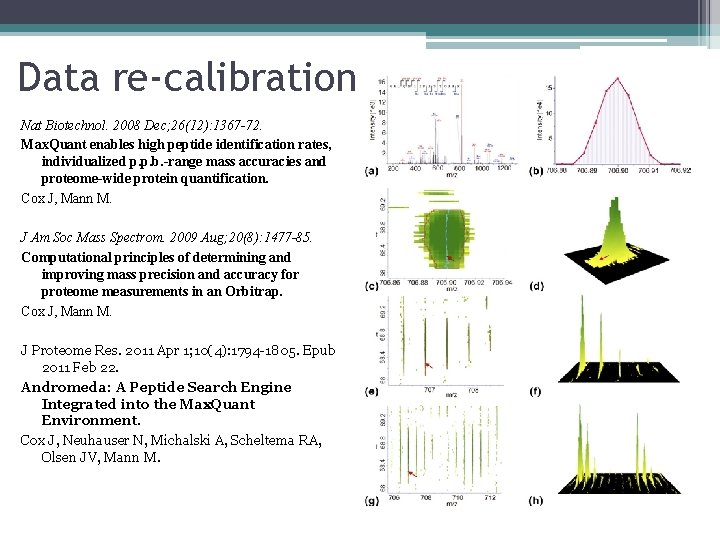
Data re-calibration Nat Biotechnol. 2008 Dec; 26(12): 1367 -72. Max. Quant enables high peptide identification rates, individualized p. p. b. -range mass accuracies and proteome-wide protein quantification. Cox J, Mann M. J Am Soc Mass Spectrom. 2009 Aug; 20(8): 1477 -85. Computational principles of determining and improving mass precision and accuracy for proteome measurements in an Orbitrap. Cox J, Mann M. J Proteome Res. 2011 Apr 1; 10(4): 1794 -1805. Epub 2011 Feb 22. Andromeda: A Peptide Search Engine Integrated into the Max. Quant Environment. Cox J, Neuhauser N, Michalski A, Scheltema RA, Olsen JV, Mann M.
Data re-calibration • Our work: J Proteome Res. 2009 Feb; 8(2): 849 -59. Mass measurement errors of Fourier-transform mass spectrometry (FTMS): distribution, recalibration, and application. Zhang J, Ma J, Dou L, Wu S, Qian X, Xie H, Zhu Y, He F. • Simple Calibration J Proteome Res. 2010 Jan; 9(1): 393 -403. MSQuant, an open source platform for mass spectrometry-based quantitative proteomics. Mortensen P, Gouw JW, Olsen JV, Ong SE, Rigbolt KT, Bunkenborg J, Cox J, Foster LJ, Heck AJ, Blagoev B, Andersen JS, Mann M. • Nonlinear calibration: Mol Cell Proteomics. 2010 Mar; 9(3): 486 -96. Epub 2009 Dec 17. Dta. Refinery, a software tool for elimination of systematic errors from parent ion mass measurements in tandem mass spectra data sets. Petyuk VA, Mayampurath AM, Monroe ME, Polpitiya AD, Purvine SO, Anderson GA, Camp DG 2 nd, Smith RD. • Application: Search with large MET, filteration with little MET: Comparison of Database Search Strategies for High Precursor Mass Accuracy MS/MS Data Edward J. Hsieh, Michael R. Hoopmann, Brendan Mac. Lean and Michael J. Mac. Coss J. Proteome, 2010, 9 (2): 1138– 1143
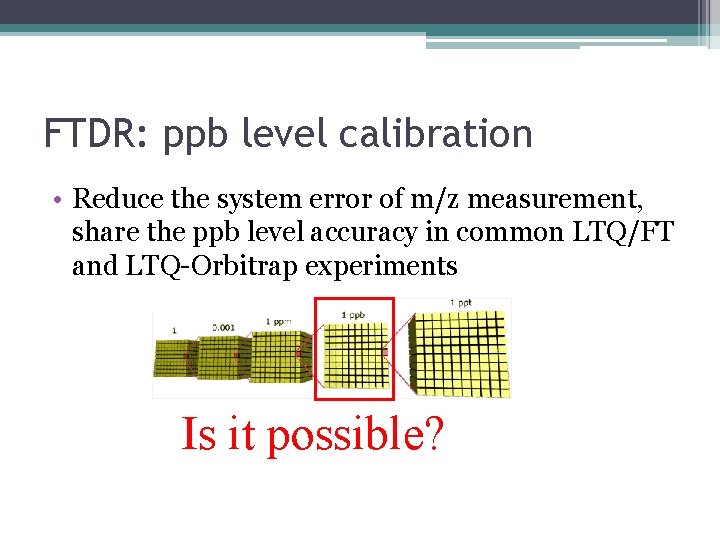
FTDR: ppb level calibration • Reduce the system error of m/z measurement, share the ppb level accuracy in common LTQ/FT and LTQ-Orbitrap experiments Is it possible?
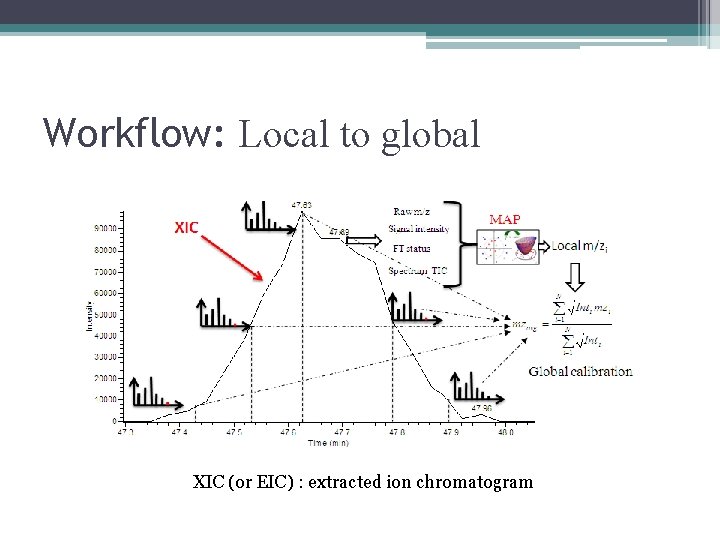
Workflow: Local to global XIC (or EIC) : extracted ion chromatogram
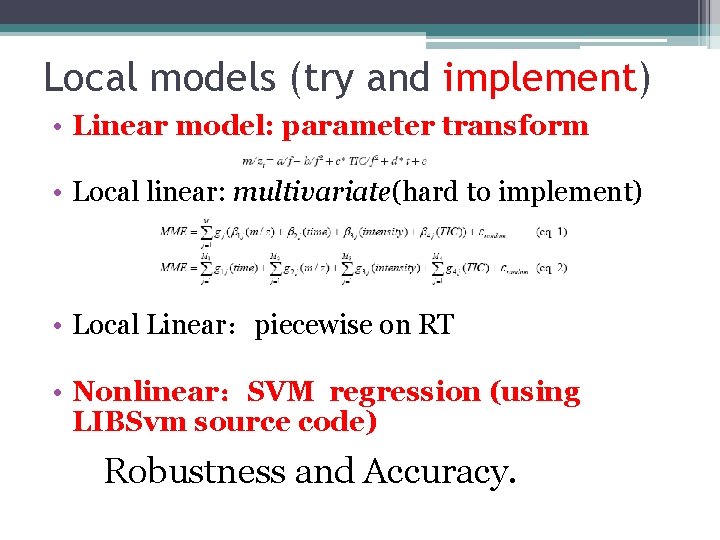
Key Algorithms in FTDR • Parameters extraction and selection • XIC extraction • Parent ion re-selection • Local calibration models
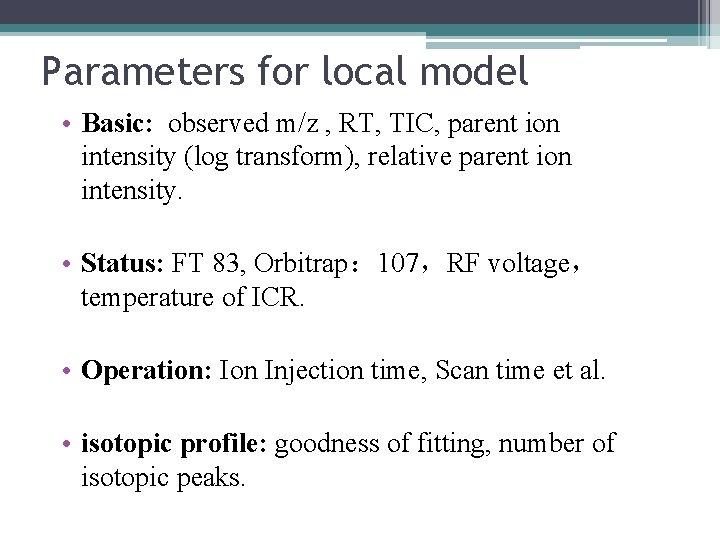
Parameters for local model • Basic: observed m/z , RT, TIC, parent ion intensity (log transform), relative parent ion intensity. • Status: FT 83, Orbitrap: 107,RF voltage, temperature of ICR. • Operation: Ion Injection time, Scan time et al. • isotopic profile: goodness of fitting, number of isotopic peaks.
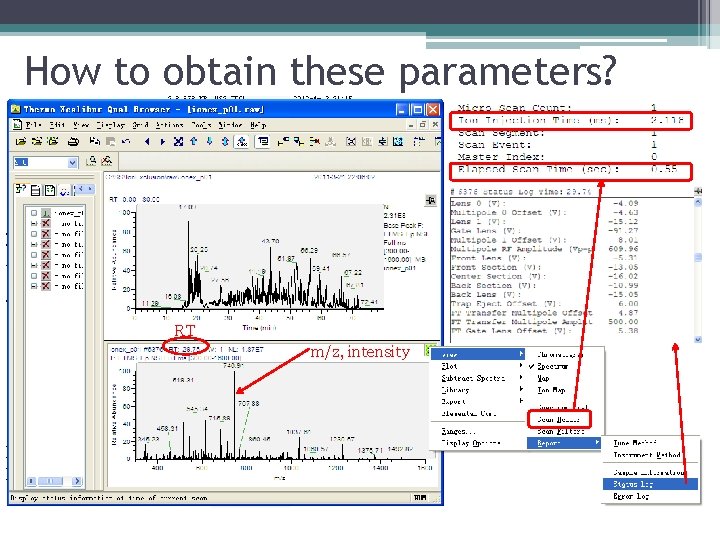
How to obtain these parameters? RT m/z, intensity
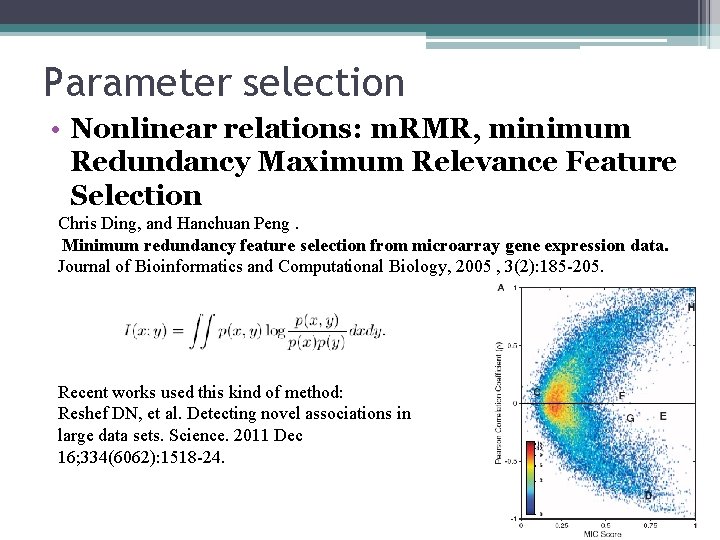
Parameter selection • Nonlinear relations: m. RMR, minimum Redundancy Maximum Relevance Feature Selection Chris Ding, and Hanchuan Peng. Minimum redundancy feature selection from microarray gene expression data. Journal of Bioinformatics and Computational Biology, 2005 , 3(2): 185 -205. Recent works used this kind of method: Reshef DN, et al. Detecting novel associations in large data sets. Science. 2011 Dec 16; 334(6062): 1518 -24.
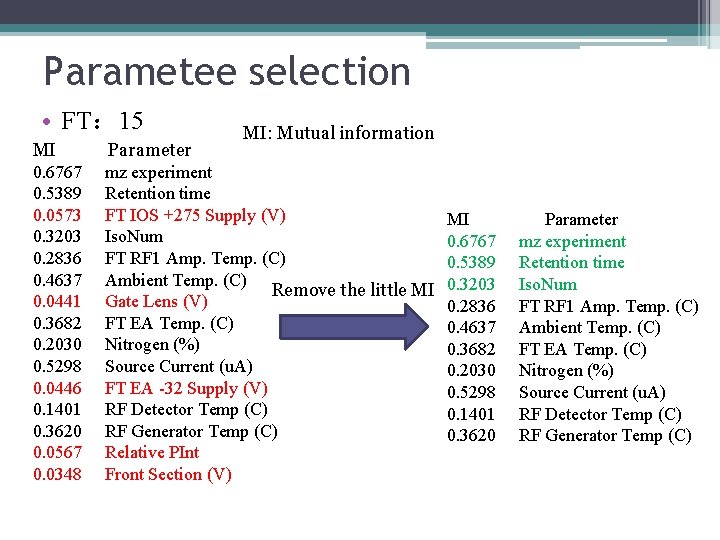
Parametee selection • FT: 15 MI 0. 6767 0. 5389 0. 0573 0. 3203 0. 2836 0. 4637 0. 0441 0. 3682 0. 2030 0. 5298 0. 0446 0. 1401 0. 3620 0. 0567 0. 0348 MI: Mutual information Parameter mz experiment Retention time FT IOS +275 Supply (V) Iso. Num FT RF 1 Amp. Temp. (C) Ambient Temp. (C) Remove the little MI Gate Lens (V) FT EA Temp. (C) Nitrogen (%) Source Current (u. A) FT EA -32 Supply (V) RF Detector Temp (C) RF Generator Temp (C) Relative PInt Front Section (V) MI Parameter 0. 6767 mz experiment 0. 5389 Retention time 0. 3203 Iso. Num 0. 2836 FT RF 1 Amp. Temp. (C) 0. 4637 Ambient Temp. (C) 0. 3682 FT EA Temp. (C) 0. 2030 Nitrogen (%) 0. 5298 Source Current (u. A) 0. 1401 RF Detector Temp (C) 0. 3620 RF Generator Temp (C)
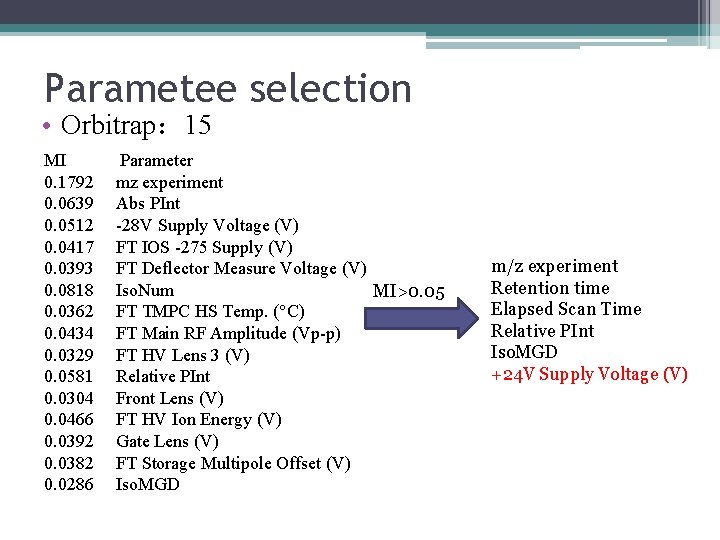
Parametee selection • Orbitrap: 15 MI Parameter 0. 1792 mz experiment 0. 0639 Abs PInt 0. 0512 -28 V Supply Voltage (V) 0. 0417 FT IOS -275 Supply (V) 0. 0393 FT Deflector Measure Voltage (V) 0. 0818 Iso. Num MI>0. 05 0. 0362 FT TMPC HS Temp. (°C) 0. 0434 FT Main RF Amplitude (Vp-p) 0. 0329 FT HV Lens 3 (V) 0. 0581 Relative PInt 0. 0304 Front Lens (V) 0. 0466 FT HV Ion Energy (V) 0. 0392 Gate Lens (V) 0. 0382 FT Storage Multipole Offset (V) 0. 0286 Iso. MGD m/z experiment Retention time Elapsed Scan Time Relative PInt Iso. MGD +24 V Supply Voltage (V)
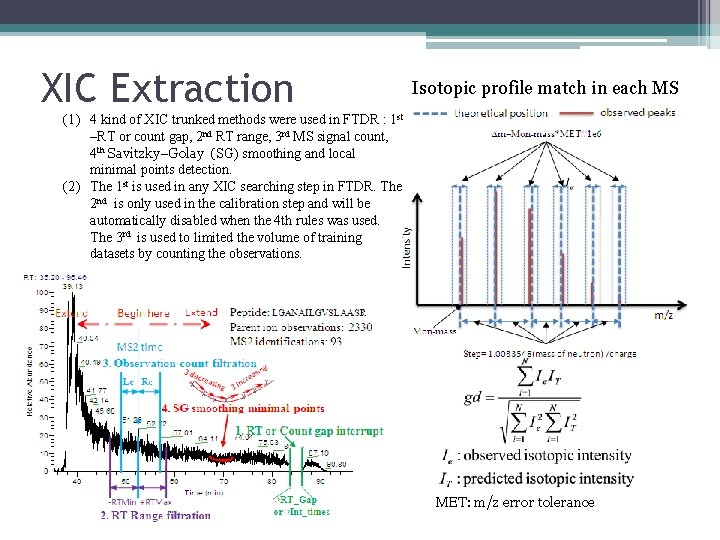
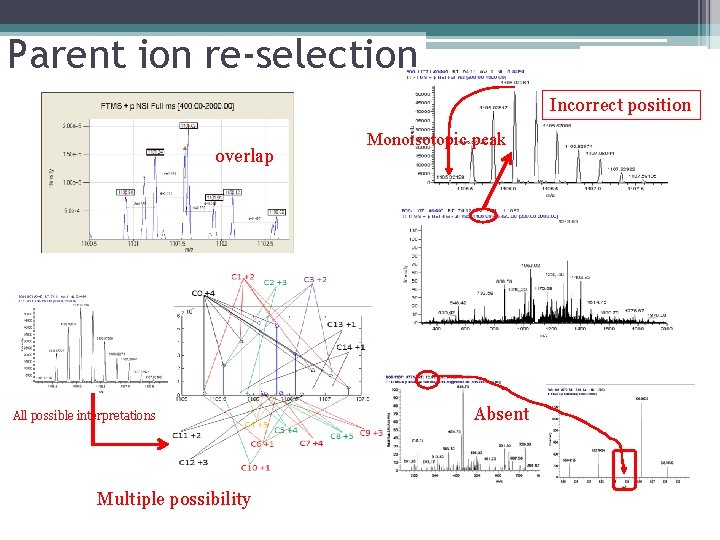
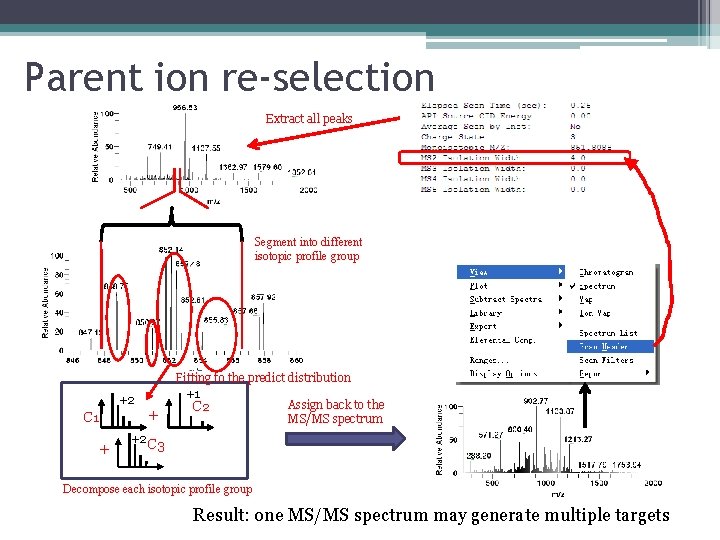
XIC Extraction Isotopic profile match in each MS (1) 4 kind of XIC trunked methods were used in FTDR : 1 st –RT or count gap, 2 nd RT range, 3 rd MS signal count, 4 th Savitzky–Golay (SG) smoothing and local minimal points detection. (2) The 1 st is used in any XIC searching step in FTDR. The 2 nd is only used in the calibration step and will be automatically disabled when the 4 th rules was used. The 3 rd is used to limited the volume of training datasets by counting the observations. MET: m/z error tolerance
Parent ion re-selection Incorrect position overlap All possible interpretations Multiple possibility Monoisotopic peak Absent
Parent ion re-selection Extract all peaks Segment into different isotopic profile group +2 C 1 + + Fitting to the predict distribution +1 Assign back to the C 2 MS/MS spectrum +2 C 3 Decompose each isotopic profile group Result: one MS/MS spectrum may generate multiple targets
Local models (try and implement) • Linear model: parameter transform • Local linear: multivariate(hard to implement) • Local Linear:piecewise on RT • Nonlinear:SVM regression (using LIBSvm source code) Robustness and Accuracy.
Result & discussion • Local calibration and global calibration on ISB_FT dataset • Global calibration on the Yeast_FT_dataset • Compare with Max. Quant • Try on the label free quantification dataset
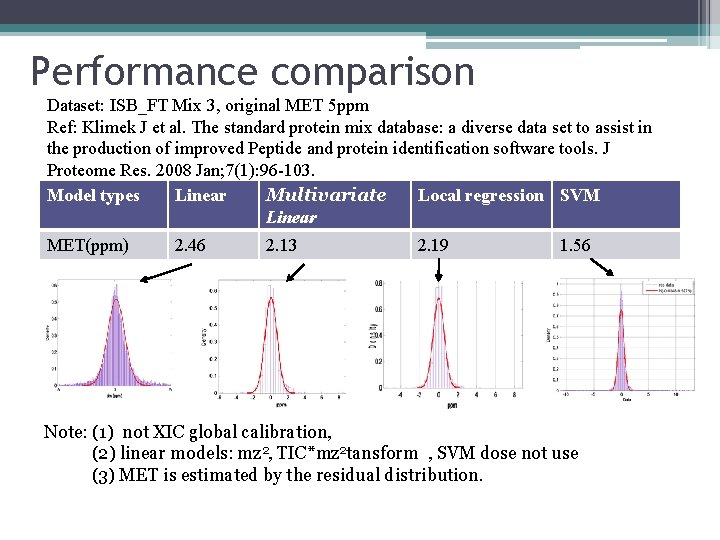
Performance comparison Dataset: ISB_FT Mix 3, original MET 5 ppm Ref: Klimek J et al. The standard protein mix database: a diverse data set to assist in the production of improved Peptide and protein identification software tools. J Proteome Res. 2008 Jan; 7(1): 96 -103. Model types Linear Local regression SVM Multivariate Linear MET(ppm) 2. 46 2. 13 2. 19 1. 56 Note: (1) not XIC global calibration, (2) linear models: mz 2, TIC*mz 2 tansform , SVM dose not use (3) MET is estimated by the residual distribution.
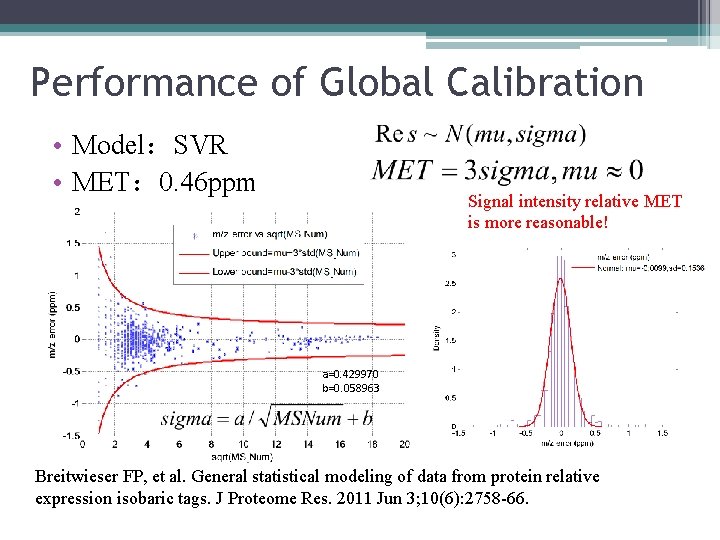
Performance of Global Calibration • Model:SVR • MET: 0. 46 ppm Signal intensity relative MET is more reasonable! a=0. 429970 b=0. 058963 Breitwieser FP, et al. General statistical modeling of data from protein relative expression isobaric tags. J Proteome Res. 2011 Jun 3; 10(6): 2758 -66.
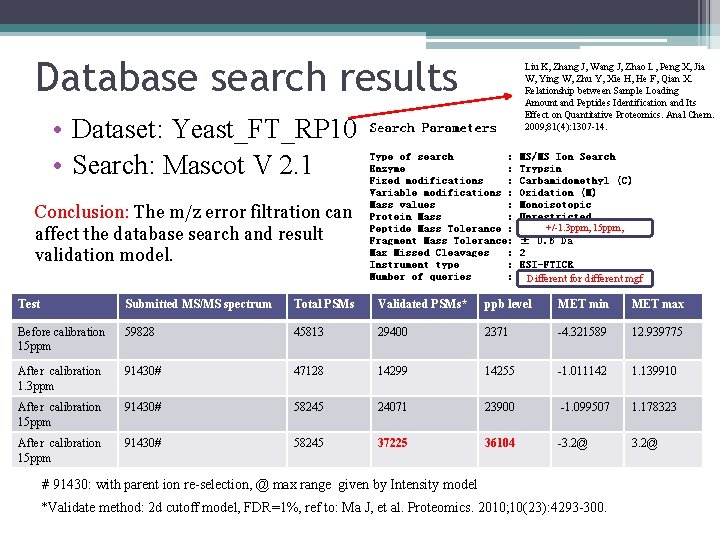
Database search results Liu K, Zhang J, Wang J, Zhao L, Peng X, Jia W, Ying W, Zhu Y, Xie H, He F, Qian X. Relationship between Sample Loading Amount and Peptides Identification and Its Effect on Quantitative Proteomics. Anal Chem. 2009; 81(4): 1307 -14. • Dataset: Yeast_FT_RP 10 • Search: Mascot V 2. 1 Conclusion: The m/z error filtration can affect the database search and result validation model. +/-1. 3 ppm, 15 ppm, Different for different mgf Test Submitted MS/MS spectrum Total PSMs Validated PSMs* ppb level MET min MET max Before calibration 15 ppm 59828 45813 29400 2371 -4. 321589 12. 939775 After calibration 1. 3 ppm 91430# 47128 14299 14255 -1. 011142 1. 139910 After calibration 15 ppm 91430# 58245 24071 23900 -1. 099507 1. 178323 After calibration 15 ppm 91430# 58245 37225 36104 -3. 2@ # 91430: with parent ion re-selection, @ max range given by Intensity model *Validate method: 2 d cutoff model, FDR=1%, ref to: Ma J, et al. Proteomics. 2010; 10(23): 4293 -300.
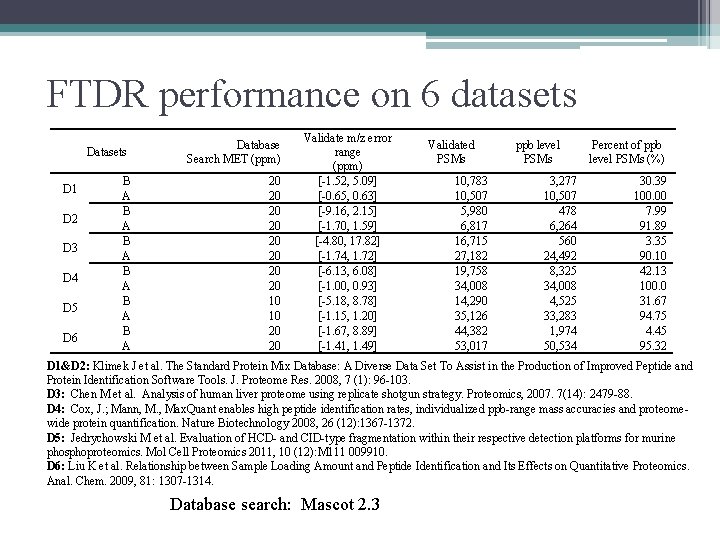
FTDR performance on 6 datasets D 1 D 2 D 3 D 4 D 5 D 6 B A B A B A Database Search MET (ppm) 20 20 10 10 20 20 Validate m/z error range (ppm) [-1. 52, 5. 09] [-0. 65, 0. 63] [-9. 16, 2. 15] [-1. 70, 1. 59] [-4. 80, 17. 82] [-1. 74, 1. 72] [-6. 13, 6. 08] [-1. 00, 0. 93] [-5. 18, 8. 78] [-1. 15, 1. 20] [-1. 67, 8. 89] [-1. 41, 1. 49] Validated PSMs 10, 783 10, 507 5, 980 6, 817 16, 715 27, 182 19, 758 34, 008 14, 290 35, 126 44, 382 53, 017 ppb level PSMs 3, 277 10, 507 478 6, 264 560 24, 492 8, 325 34, 008 4, 525 33, 283 1, 974 50, 534 Percent of ppb level PSMs (%) 30. 39 100. 00 7. 99 91. 89 3. 35 90. 10 42. 13 100. 0 31. 67 94. 75 4. 45 95. 32 D 1&D 2: Klimek J et al. The Standard Protein Mix Database: A Diverse Data Set To Assist in the Production of Improved Peptide and Protein Identification Software Tools. J. Proteome Res. 2008, 7 (1): 96 -103. D 3: Chen M et al. Analysis of human liver proteome using replicate shotgun strategy. Proteomics, 2007. 7(14): 2479 -88. D 4: Cox, J. ; Mann, M. , Max. Quant enables high peptide identification rates, individualized ppb-range mass accuracies and proteomewide protein quantification. Nature Biotechnology 2008, 26 (12): 1367 -1372. D 5: Jedrychowski M et al. Evaluation of HCD- and CID-type fragmentation within their respective detection platforms for murine phosphoproteomics. Mol Cell Proteomics 2011, 10 (12): M 111 009910. D 6: Liu K et al. Relationship between Sample Loading Amount and Peptide Identification and Its Effects on Quantitative Proteomics. Anal. Chem. 2009, 81: 1307 -1314. Database search: Mascot 2. 3
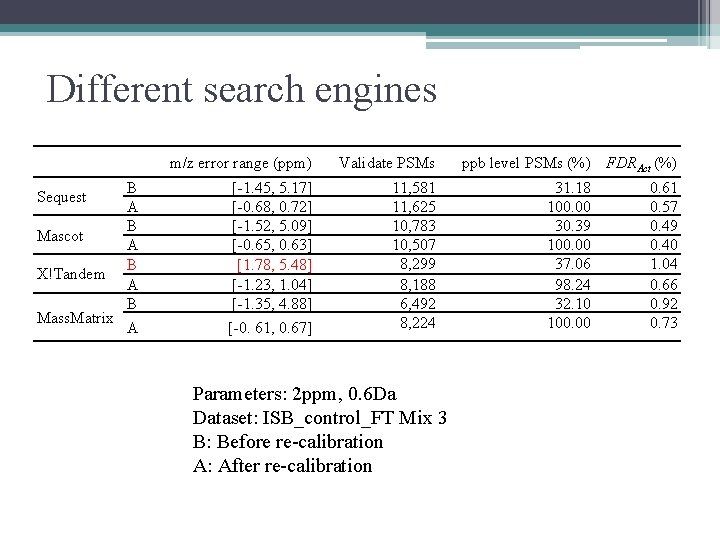
Different search engines B A B Mascot A B X!Tandem A B Mass. Matrix A Sequest m/z error range (ppm) Validate PSMs [-1. 45, 5. 17] [-0. 68, 0. 72] [-1. 52, 5. 09] [-0. 65, 0. 63] [1. 78, 5. 48] [-1. 23, 1. 04] [-1. 35, 4. 88] [-0. 61, 0. 67] 11, 581 11, 625 10, 783 10, 507 8, 299 8, 188 6, 492 8, 224 Parameters: 2 ppm, 0. 6 Da Dataset: ISB_control_FT Mix 3 B: Before re-calibration A: After re-calibration ppb level PSMs (%) FDRAct (%) 31. 18 100. 00 30. 39 100. 00 37. 06 98. 24 32. 10 100. 00 0. 61 0. 57 0. 49 0. 40 1. 04 0. 66 0. 92 0. 73
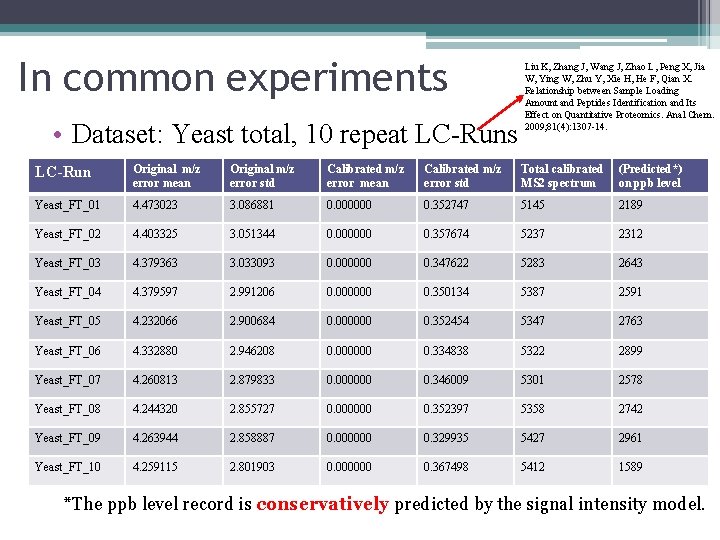
In common experiments • Dataset: Yeast total, 10 repeat LC-Runs Liu K, Zhang J, Wang J, Zhao L, Peng X, Jia W, Ying W, Zhu Y, Xie H, He F, Qian X. Relationship between Sample Loading Amount and Peptides Identification and Its Effect on Quantitative Proteomics. Anal Chem. 2009; 81(4): 1307 -14. LC-Run Original m/z error mean Original m/z error std Calibrated m/z error mean Calibrated m/z error std Total calibrated MS 2 spectrum (Predicted*) on ppb level Yeast_FT_01 4. 473023 3. 086881 0. 000000 0. 352747 5145 2189 Yeast_FT_02 4. 403325 3. 051344 0. 000000 0. 357674 5237 2312 Yeast_FT_03 4. 379363 3. 033093 0. 000000 0. 347622 5283 2643 Yeast_FT_04 4. 379597 2. 991206 0. 000000 0. 350134 5387 2591 Yeast_FT_05 4. 232066 2. 900684 0. 000000 0. 352454 5347 2763 Yeast_FT_06 4. 332880 2. 946208 0. 000000 0. 334838 5322 2899 Yeast_FT_07 4. 260813 2. 879833 0. 000000 0. 346009 5301 2578 Yeast_FT_08 4. 244320 2. 855727 0. 000000 0. 352397 5358 2742 Yeast_FT_09 4. 263944 2. 858887 0. 000000 0. 329935 5427 2961 Yeast_FT_10 4. 259115 2. 801903 0. 000000 0. 367498 5412 1589 *The ppb level record is conservatively predicted by the signal intensity model.
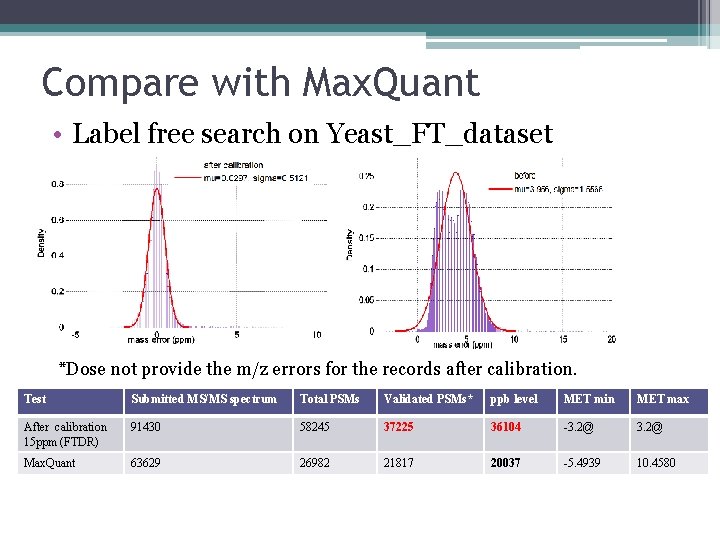
Compare with Max. Quant • Label free search on Yeast_FT_dataset *Dose not provide the m/z errors for the records after calibration. Test Submitted MS/MS spectrum Total PSMs Validated PSMs* ppb level MET min MET max After calibration 15 ppm (FTDR) 91430 58245 37225 36104 -3. 2@ Max. Quant 63629 26982 21817 20037 -5. 4939 10. 4580
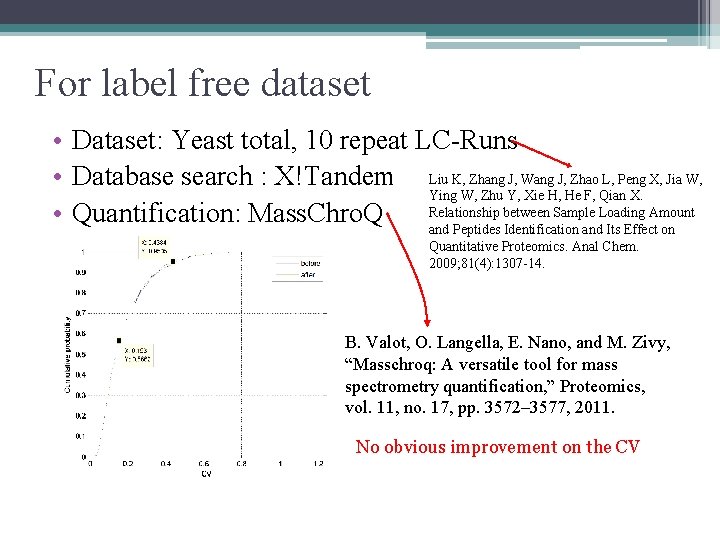
For label free dataset • Dataset: Yeast total, 10 repeat LC-Runs • Database search : X!Tandem Liu K, Zhang J, Wang J, Zhao L, Peng X, Jia W, Ying W, Zhu Y, Xie H, He F, Qian X. Relationship between Sample Loading Amount • Quantification: Mass. Chro. Q and Peptides Identification and Its Effect on Quantitative Proteomics. Anal Chem. 2009; 81(4): 1307 -14. B. Valot, O. Langella, E. Nano, and M. Zivy, “Masschroq: A versatile tool for mass spectrometry quantification, ” Proteomics, vol. 11, no. 17, pp. 3572– 3577, 2011. No obvious improvement on the CV
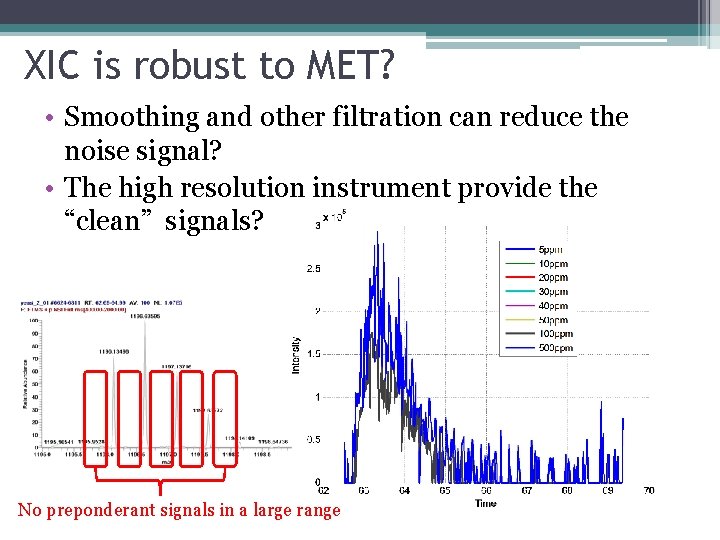
XIC is robust to MET? • Smoothing and other filtration can reduce the noise signal? • The high resolution instrument provide the “clean” signals? No preponderant signals in a large range
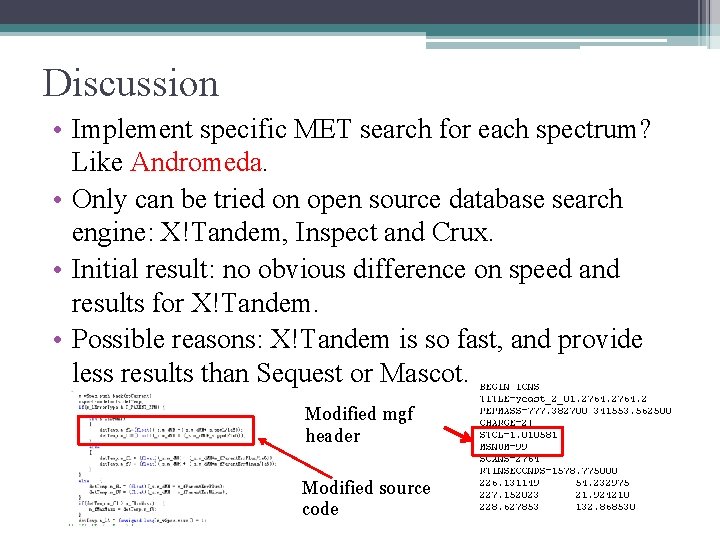
Discussion • Implement specific MET search for each spectrum? Like Andromeda. • Only can be tried on open source database search engine: X!Tandem, Inspect and Crux. • Initial result: no obvious difference on speed and results for X!Tandem. • Possible reasons: X!Tandem is so fast, and provide less results than Sequest or Mascot. Modified mgf header Modified source code
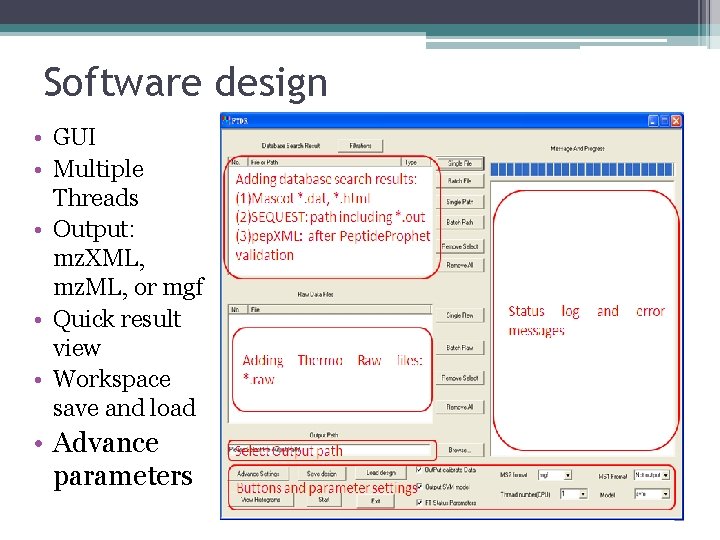
Software design • GUI • Multiple Threads • Output: mz. XML, mz. ML, or mgf • Quick result view • Workspace save and load • Advance parameters
Other applications under considering • PTM search • LC-MSE data processing • Label free quantification with UPLC(narrow XIC)?
Acknowledgement • • • ISB: control dataset Dr. Jie Ma, BPRC Prof. Yunping Zhu, BPRC Prof. Xiaohong Qian, BPRC Our team: Prof. Hong wei Xie, Wei Zhang, Changming Xu.
Thank you for your attention!
- Slides: 41