
Sharable representation of clinical guidelines in GLIF relationship
Sharable representation of clinical guidelines in GLIF : relationship to the Arden Syntax Peleg M, Boxwala AA, Bernstam E, Tu S, Greenes RA, Shortliffe EH. J Biomed Inform. 2001 Jun; 34(3): 170 -81. 2006. 2. 22 Hee Kyong Park
Contents § Clarify roles of – The Arden Syntax – GLIF 3 § Discusses – Why the process of generating a set of MLMs from a GLIF-encoded guideline cannot be automated – Why it can result in information loss – Why simple medical rules are best represented as individual MLMs § Show that the Arden Syntax and GLIF 3 – Play complementary roles 2
Methodologies for modeling shared computer-interpretable guidelines and medical decision rules § § § Arden Syntax for Medical Logic Modules Lobach and colleagues PROforma Asbru EON Guideline Interchange Format(GLIF) 3
Background : Background intro § GLIF 3 – developed by augmenting § GLIF 2 § components that enable computer-interpretation of encoded guidelines – major component § formal expression language – – enables guideline authors to specify decision criteria formally based on the Arden Syntax's logic grammar 4
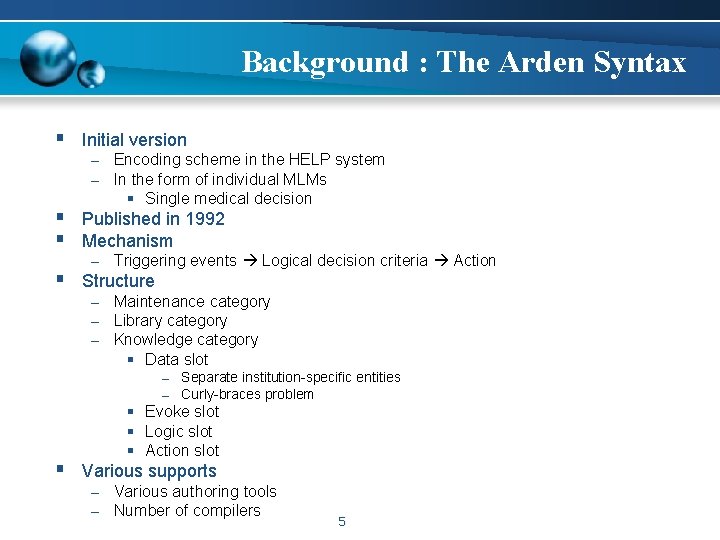
Background : The Arden Syntax § Initial version – – Encoding scheme in the HELP system In the form of individual MLMs § Single medical decision § Published in 1992 § Mechanism – Triggering events Logical decision criteria Action – – – Maintenance category Library category Knowledge category § Data slot § Structure – – Separate institution-specific entities Curly-braces problem § Evoke slot § Logic slot § Action slot § Various supports – – Various authoring tools Number of compilers 5
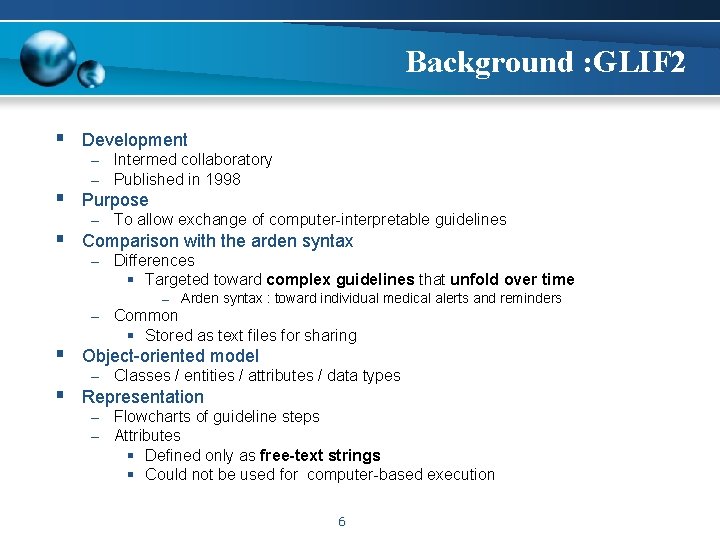
Background : GLIF 2 § Development – – Intermed collaboratory Published in 1998 – To allow exchange of computer-interpretable guidelines – Differences § Targeted toward complex guidelines that unfold over time § Purpose § Comparison with the arden syntax – – Arden syntax : toward individual medical alerts and reminders Common § Stored as text files for sharing § Object-oriented model – Classes / entities / attributes / data types – – Flowcharts of guideline steps Attributes § Defined only as free-text strings § Could not be used for computer-based execution § Representation 6
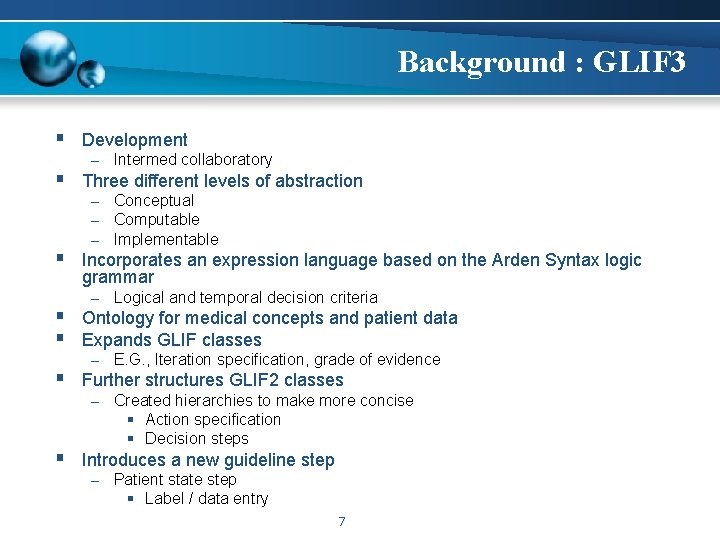
Background : GLIF 3 § Development – Intermed collaboratory – – – Conceptual Computable Implementable § Three different levels of abstraction § Incorporates an expression language based on the Arden Syntax logic grammar – Logical and temporal decision criteria – E. G. , Iteration specification, grade of evidence – Created hierarchies to make more concise § Action specification § Decision steps § Ontology for medical concepts and patient data § Expands GLIF classes § Further structures GLIF 2 classes § Introduces a new guideline step – Patient state step § Label / data entry 7
The GLIF process of guideline modeling § § Top-down method Authoring guidelines Relationship to the Arden Syntax Example 8
Authoring guidelines : step 1 1. 2. Informal textual description of – – The problem A set of assembled evidence Create an imprecise, potentially incomplete conceptual view of the guideline (flowchart) – – – Guideline steps linked to each other in a temporal order Clinical actions § E. G. , Prescribe aspirin Decisions § E. G. , Should the patient should be placed on a diet? Patient states § E. G. , The patient is receiving a single anti-hypertensive drug Parallel execution § Branch steps – Can lead to multiple subsequent steps that converge in a synchronization step § § – Synchronization steps E. G. , Ordering pre-operative lab-tests and scheduling operating-room time Largely in the form of unstructured text strings 9
Authoring guidelines : step 2 § Refine the flowchart representation – Produce a fully detailed, precise, and computable specification – Formal definition of § Decision and eligibility criteria § Patient data § Action specifications § Control flow § Author – Informatician § Aided by a medical expert 10
Authoring guidelines : step 3 § Implementable specification – Contextual adaptation for local health-care setting – Mapping encoded guideline variables / concepts / action specifications to the local clinical information systems § Not yet supported by GLIF 3 11
Relationship to the Arden Syntax § Local & temporal decision criteria – Specified using guideline expression language (GEL) § GEL is derived from and enhances the Arden Syntax § Message_action specification – Based on the Arden's write statement § MLM-macro construct – Maps guideline declaration onto a procedural specification § This procedural specification defines evoke, logic and action slots – Correspond to the respective Arden MLM slots 12
Example § How we can use GLIF to model a complex § guideline How GLIF uses constructs derived from the Arden Syntax 13
Target Guideline § Institution – ACC/AHA/ACP-AISM guidelines § American college of cardiology/american hospital association/american college of physiciansamerican society of internal medicine § Contents(purpose) – Management of patients with chronic stable angina 14
Authoring Process § Top-level flow chart view § Computable representation § Implementation level 15
Top-level flow chart view § § Used protege-2000 Still imprecise and incomplete Information is only free-text Nesting mechanism – Enables expansion of high-level actions and decisions steps – Useful in managing the complexity of large, multistep guidelines that contain many pathways – E. G. , § "Empiric therapy" action step – Can be nested into a subguideline that contains the steps of the treatment algorithm 16
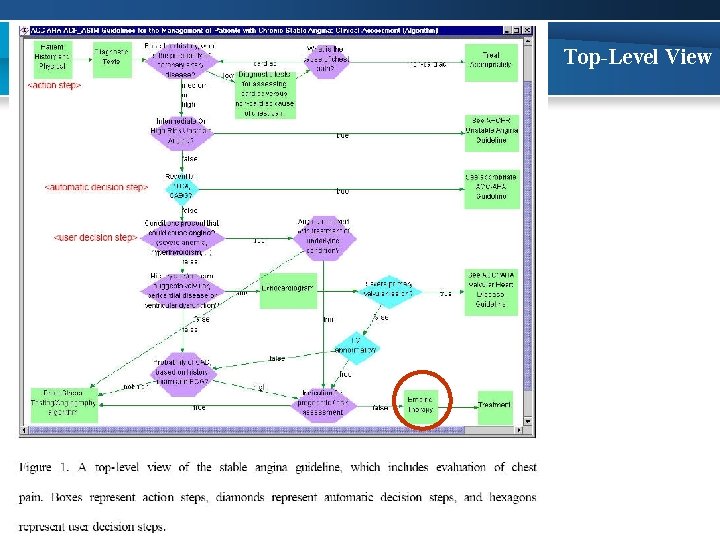
Top-Level View 17
Computable Representation § Refinement of the conceptual flowchart by adding a structured specification – E. g. , Action steps : free text include well-defined tasks § scheduling a procedure, referring a patient, or ordering a test, … § Domain ontology § Decision or eligibility criteria 18
Domain ontology § Contains – Medical concepts / patient-data / structures § By referencing controlled medical vocabulary or – Data model § Default medical data model : Hl 7 RIM § Allow encoding institution-independent concepts § Mapping to institution-dependent EMR codes and procedures – Can be specified in another level – Not yet supported 19
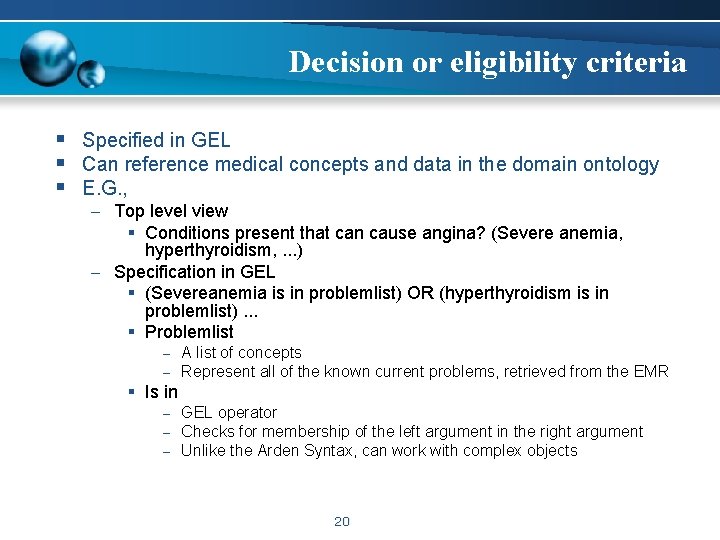
Decision or eligibility criteria § Specified in GEL § Can reference medical concepts and data in the domain ontology § E. G. , – Top level view § Conditions present that can cause angina? (Severe anemia, hyperthyroidism, . . . ) – Specification in GEL § (Severeanemia is in problemlist) OR (hyperthyroidism is in problemlist). . . § Problemlist – – A list of concepts Represent all of the known current problems, retrieved from the EMR § Is in – – – GEL operator Checks for membership of the left argument in the right argument Unlike the Arden Syntax, can work with complex objects 20
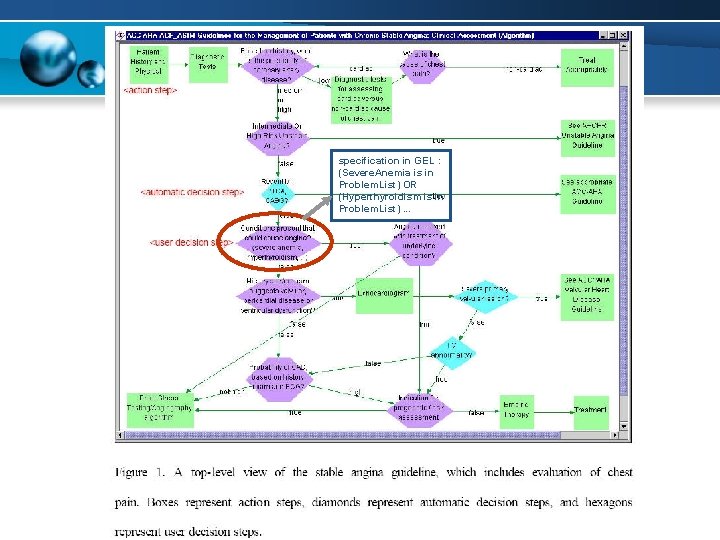
specification in GEL : (Severe. Anemia is in Problem. List) OR (Hyperthyroidism is in Problem. List). . . 21
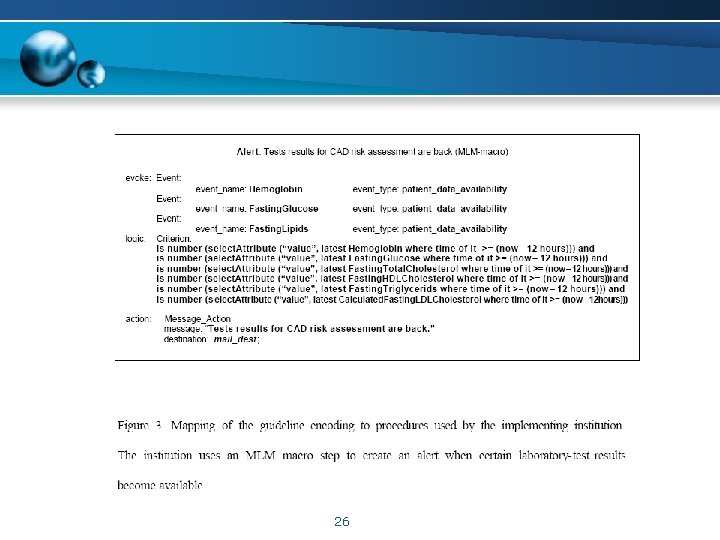
Implementable Level § Mapping onto procedures and data that are § § used by the implementing insititution Local interpretation of high-level guideline recommendations E. g. , ‘evaluation of chest pain’ in stable-angina guideline – No specification about which tesets should be ordered – Interpretation § Serial-troponin levels § Creatine phosphokinase (CPK) § Immediate stress testing §… 22
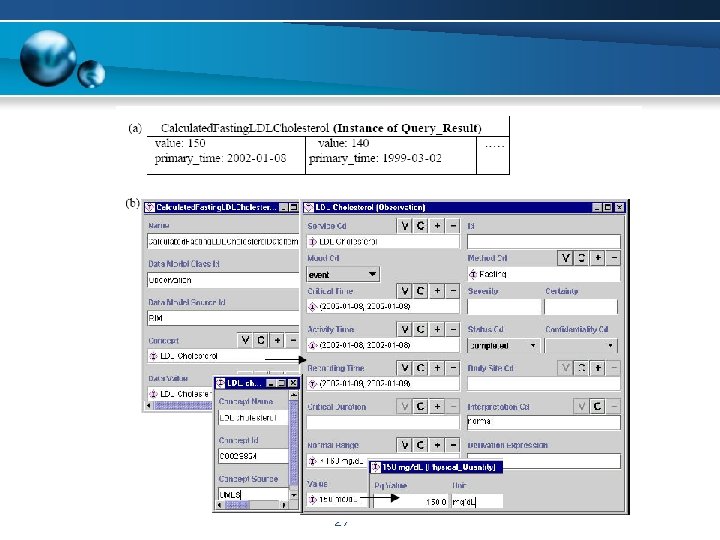
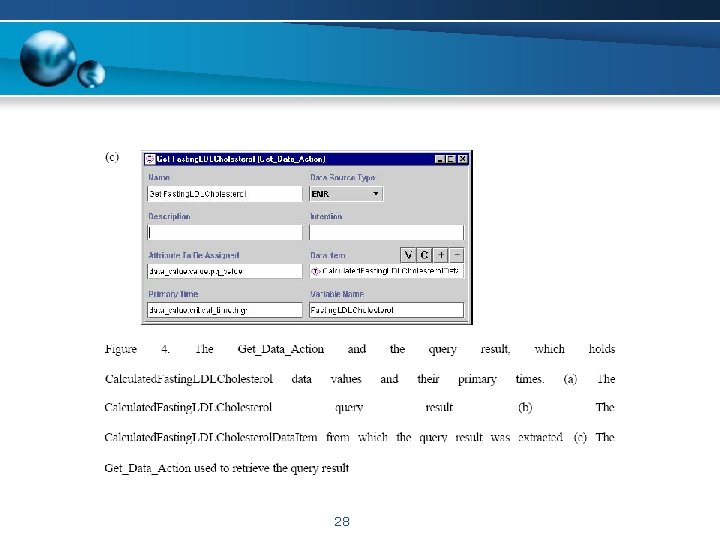
GLIF’s constructs § MLM macro step – Can represent alerts and reminders § Mapping institutional electronic data – Has not yet been defined by either GLIF or the Arden Syntax § Data items – Defined by GLIF’s medical ontology – Contain values and primary times 23
MLM Macro Step § Provide a means to specify declaratively a procedural § pattern in a single construct Represents a particular pattern of GLIF components – GLIF event (MLM evoke slot) – GLIF decision criterion (MLM logic slot) § Logic criterion is expressed in GEL – The Arden Syntax operators are used by GEL – GLIF action specification (MLM action slot) § Message_Action, Assignment_Action, or Event_Action § MLM macro step can be replaced by a sequence of two GLIF guideline steps 24

25
26
27
28
Discussion § GLIF and the Arden Syntax are complementary methodologies – Arden Syntax § Useful for sharing medical knowledge that can be expressed as individual MLMs – GLIF § Designed to specify multi-step guidelines that unfold over time § GLIF 3 extended GLIF 2 by defining GEL based on the Arden Syntax – Not computable – The Arden Syntax’s data model + GLIF’s object-oriented medical data model – Deficient in specifying expressions that relate to more than one of an object’s attributes § GLIF and the Arden Syntax carry out top-down modeling process § The Arden Syntax does not support for maintaining a conceptual view of a guideline that is implemented as multiple interacting MLMs 29
Discussion(2) § Sharing guidelines – The Arden Syntax § Choice 1) Only remap to EMR-specific data and events § Choice 2) only skeletal code is shared that includes textual descriptions of the actions with no formal encoding – GLIF § Deliver guideline on the textual conceptual-level and on the formal computational-level § Adapt the guideline – Using macro step mechanism / Nesting / Medical ontology § GLIF’s medical ontology – Facilitates mapping institutional data elements – The Arden Syntax does not provide such a standard way § GLIF’s MLM-macro – facilitates the transition from the Arden Syntax to GLIF 30
Conclusion § The Arden Syntax – Represents efficiently individual decision rules – Difficult to represent multi-step algorithms that unfold over time § GLIF – May be cumbersome for individual alert or reminder – Has constructs for representing multi-step guidelines – Uses and diverges the Arden Syntax’s logic grammar § Developers of GLIF and the Arden Syntax – Involved in the Clinical Decision Support Technical Committee of HL 7 – Exploring the possibility of developing an expression language that is consistent with the HL 7 RIM 31
- Slides: 31