
Shaping the Future with Computational Scientists in Japan
- Slides: 2
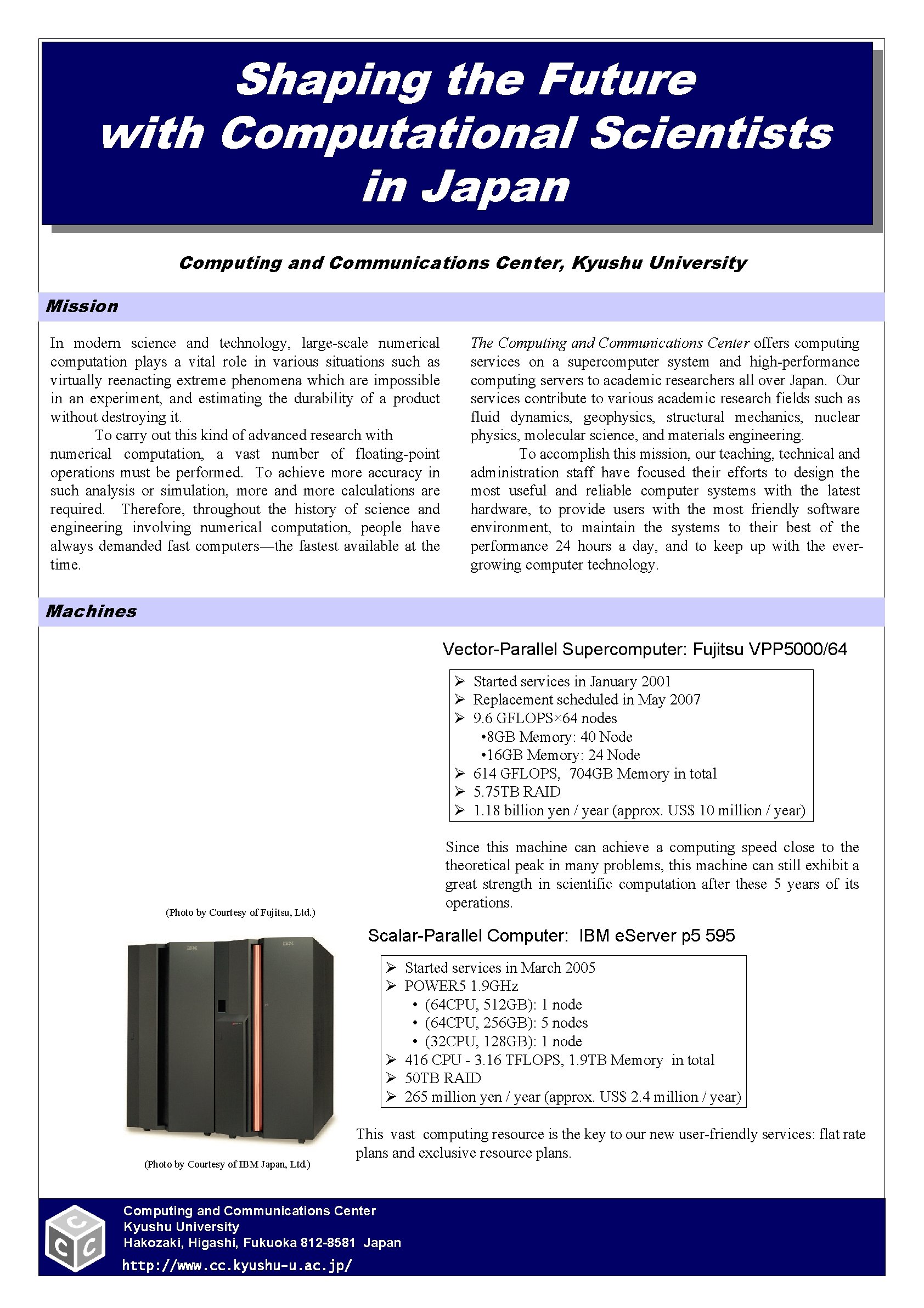
Shaping the Future with Computational Scientists in Japan Computing and Communications Center, Kyushu University Mission In modern science and technology, large-scale numerical computation plays a vital role in various situations such as virtually reenacting extreme phenomena which are impossible in an experiment, and estimating the durability of a product without destroying it. To carry out this kind of advanced research with numerical computation, a vast number of floating-point operations must be performed. To achieve more accuracy in such analysis or simulation, more and more calculations are required. Therefore, throughout the history of science and engineering involving numerical computation, people have always demanded fast computers―the fastest available at the time. The Computing and Communications Center offers computing services on a supercomputer system and high-performance computing servers to academic researchers all over Japan. Our services contribute to various academic research fields such as fluid dynamics, geophysics, structural mechanics, nuclear physics, molecular science, and materials engineering. To accomplish this mission, our teaching, technical and administration staff have focused their efforts to design the most useful and reliable computer systems with the latest hardware, to provide users with the most friendly software environment, to maintain the systems to their best of the performance 24 hours a day, and to keep up with the evergrowing computer technology. Machines Vector-Parallel Supercomputer: Fujitsu VPP 5000/64 Ø Started services in January 2001 Ø Replacement scheduled in May 2007 Ø 9. 6 GFLOPS× 64 nodes • 8 GB Memory: 40 Node • 16 GB Memory: 24 Node Ø 614 GFLOPS, 704 GB Memory in total Ø 5. 75 TB RAID Ø 1. 18 billion yen / year (approx. US$ 10 million / year) Since this machine can achieve a computing speed close to theoretical peak in many problems, this machine can still exhibit a great strength in scientific computation after these 5 years of its operations. (Photo by Courtesy of Fujitsu, Ltd. ) Scalar-Parallel Computer: IBM e. Server p 5 595 Ø Started services in March 2005 Ø POWER 5 1. 9 GHz • (64 CPU, 512 GB): 1 node • (64 CPU, 256 GB): 5 nodes • (32 CPU, 128 GB): 1 node Ø 416 CPU - 3. 16 TFLOPS, 1. 9 TB Memory in total Ø 50 TB RAID Ø 265 million yen / year (approx. US$ 2. 4 million / year) (Photo by Courtesy of IBM Japan, Ltd. ) This vast computing resource is the key to our new user-friendly services: flat rate plans and exclusive resource plans. Computing and Communications Center Kyushu University Hakozaki, Higashi, Fukuoka 812 -8581 Japan http: //www. cc. kyushu-u. ac. jp/
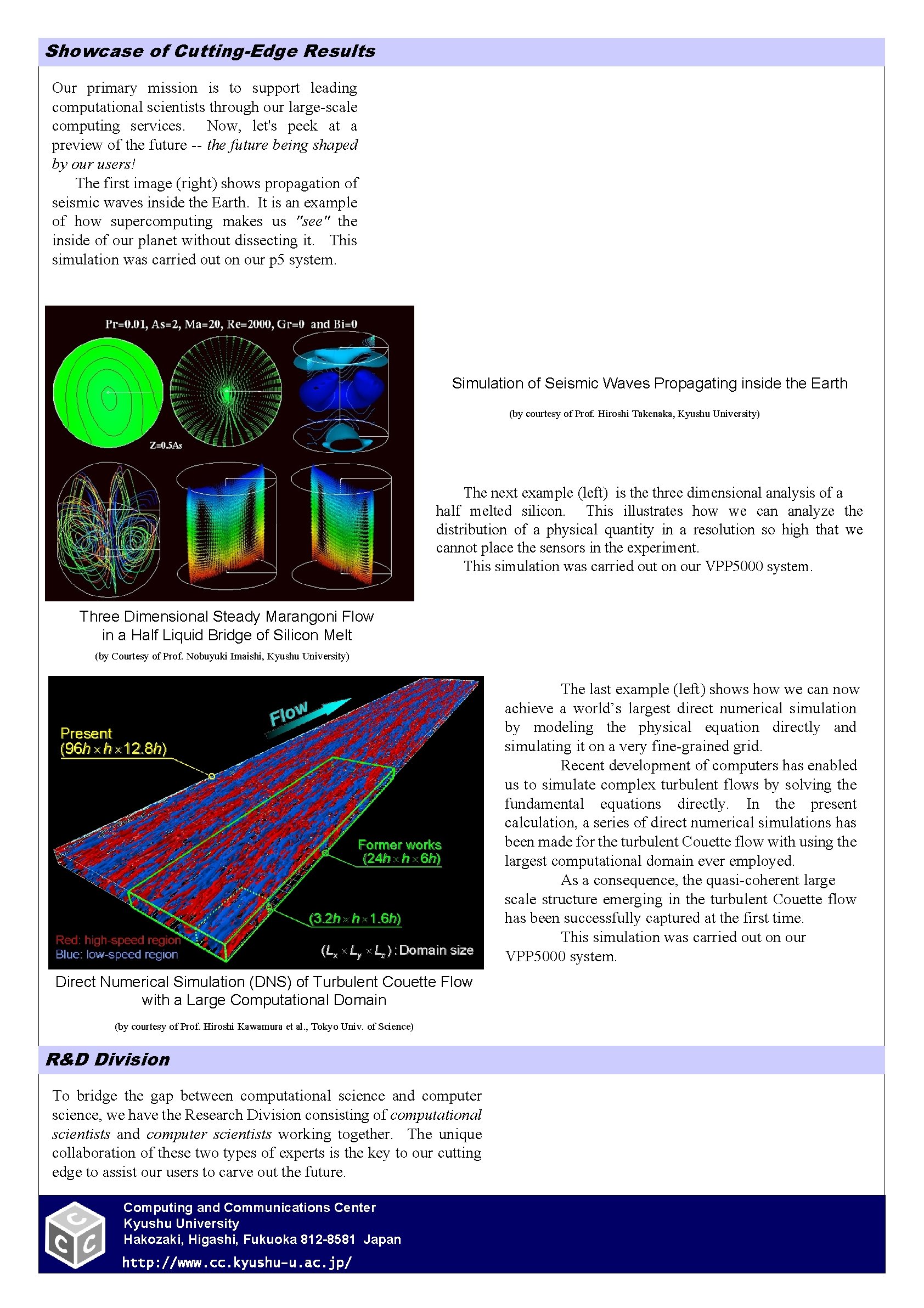
Showcase of Cutting-Edge Results Our primary mission is to support leading computational scientists through our large-scale computing services. Now, let's peek at a preview of the future -- the future being shaped by our users! The first image (right) shows propagation of seismic waves inside the Earth. It is an example of how supercomputing makes us "see" the inside of our planet without dissecting it. This simulation was carried out on our p 5 system. Simulation of Seismic Waves Propagating inside the Earth (by courtesy of Prof. Hiroshi Takenaka, Kyushu University) The next example (left) is the three dimensional analysis of a half melted silicon. This illustrates how we can analyze the distribution of a physical quantity in a resolution so high that we cannot place the sensors in the experiment. This simulation was carried out on our VPP 5000 system. Three Dimensional Steady Marangoni Flow in a Half Liquid Bridge of Silicon Melt (by Courtesy of Prof. Nobuyuki Imaishi, Kyushu University) The last example (left) shows how we can now achieve a world’s largest direct numerical simulation by modeling the physical equation directly and simulating it on a very fine-grained grid. Recent development of computers has enabled us to simulate complex turbulent flows by solving the fundamental equations directly. In the present calculation, a series of direct numerical simulations has been made for the turbulent Couette flow with using the largest computational domain ever employed. As a consequence, the quasi-coherent large scale structure emerging in the turbulent Couette flow has been successfully captured at the first time. This simulation was carried out on our VPP 5000 system. Direct Numerical Simulation (DNS) of Turbulent Couette Flow with a Large Computational Domain (by courtesy of Prof. Hiroshi Kawamura et al. , Tokyo Univ. of Science) R&D Division To bridge the gap between computational science and computer science, we have the Research Division consisting of computational scientists and computer scientists working together. The unique collaboration of these two types of experts is the key to our cutting edge to assist our users to carve out the future. Computing and Communications Center Kyushu University Hakozaki, Higashi, Fukuoka 812 -8581 Japan http: //www. cc. kyushu-u. ac. jp/