
Shaping the future of aviation maintenance training Elearning

- Slides: 29
Shaping the future of aviation maintenance training
E-learning Working group
Working group members Michelle Asmar Samuel Cromie Marc Gianola Hans Jorg Lotter Daniela Mohr Anneke Nabben Catherine Nouyers-Grand Ivo van Oosterhout Leonard Perkins Ghislain Saffar Detlef Schwertmann Ville Väyrynen CEA Trinity college Airfrance Infowerk Airberlin Airbus, NLR Airbus ROC van Amsterdam Airport CAE Snecma Lufthansa Finnair
Mission Statement • Develop a guidance document for the development and use of e-learning as part of a training curriculum that is based on best practices and can be shared amongst the industry and communicated to authorities. The main objective is to assure quality of e-learning. This means shifting the paradigm from a quantitative to a qualitative approach
Objective statement The Working Group will defined the following: • Why do we need e-learning • How to assure the quality of e-learning (guidelines) • How to develop e-learning that supports the learning process of the trainees (guidelines) • How to implement e-learning that supports the learning process of the trainees (guidelines) • Competencies of the target groups
Scope The document's focus includes: • Basic training • Type training • Continuation training • Specialized training (technical & procedural) • All Part certifying organizations Out of scope • All training that is not linked to the field of aviation maintenance. • Recommendation of e-learning products or providers
Objective The objective of the document is to bring about the acceptance and standardisation of the development and use of e-learning as part of a training curriculum for Approved Maintenance Training
Definition of e-learning In general e-learning can be defined as the delivery of training via on or off-line electronic devices. More specifically we can define a course as using e-learning when it includes all of the following:
Definition of e-learning • Part of the training is delivered by means of electronic devices in a classroom or at a distance • The content and the chosen electronic medium are relevant to learning objectives • There is learning support through feedback • Instructional methods such as examples and practice are used • The trainee is asked to demonstrate his/her new knowledge and skills through interactivity • There is a structure or mechanism to collect trainee activity data.
Why? • E-learning is a widely used and accepted media for educational and training purposes. It is used as the delivery means for training programmes in industry, commerce and academia. (Within aviation there is widespread use of e-learning in pilot training and cabin crew training. The FAA has approved distance learning for cognitive aspects of type training)
Why? The use of e-learning will assist the industry to manage the increasing economic impact on the aviation maintenance training industry due to: • Strong regulatory training demands, • Globalization, • Changing learning styles, habits and expectations of trainees, • State of the art technical possibilities, • To support continuation of professionalization, updating knowledge and skills which are increasingly the responsibility of the individual (lifelong learning).
Potential benefits • • Flexibility Standardization Learner support Record keeping Knowledge management Efficiency Safety
Potential challenges • • • Organizational infrastructure Change management towards e-learning Trainee profile/competencies Trainer Profile/competencies Learning style Development of e-learning content needs human and monetary investment. • The content should be analyzed to ensure that it is suitable for e-learning • Legislation and guidelines by unions and authorities on tracking digital behavior and/or personal data
solutions • All challenges can be tackled, the document provides directions • We can provide indicators on quality and potential success • By sharing best practices, solutions to challenges and indicators on quality and success can be improved
Target groups Actors that need to be considered: • Trainees • Instructors • Training organizations • Developers of e-Learning content • Authorities For these groups we have defined competencies/guidelines and objectives
Learning theory • • • Learning process Learning skills Learning styles Training strategy Types of learning
Training strategy • Active learning • On demand learning • Simulators • Serious gaming • Collaborative learning • Adaptive learning
Types of learning In the cognitive domain: • Methods (from descriptive to simulation) • Purpose • Example media • Kinds of learning objective that can be reached (from factual knowledge to complex problem solving) Are linked and the document describes appropriate application
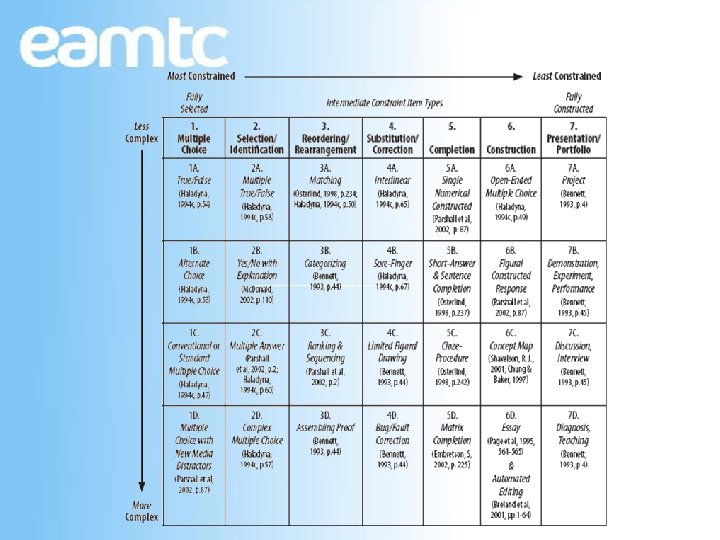
Assessment methodology • Why and what do we need to assess? • Different assessment phases • Pre-assessment • Continuous assessment (formative assessment) • Post assessment (summative assessment) • E-assessment: how to assure proper e-assessment • Assessments complexity levels and constrains
Why and what? • We want to know if a student has the pre requisite level to enter a course • Throughout a course the student should be able to self assess in order to be able to be self regulating • Throughout a led course, the instructor/tutor needs to measure the gap to the desired level • We need to assess knowledge or/and skill in order to demonstrate that the student has reached the required level
Assessments • This means we have shifted the paradigm from a quantitative to a qualitative approach. • Can we be more practical?
Assessments • Assessing student performance in an online course is similar to classroom assessment • For the summative assessment we recommend to put an assessor in the classroom. This is to ensure the identity of the individual doing the assessment • ICT development offers many ways to enrich assessment
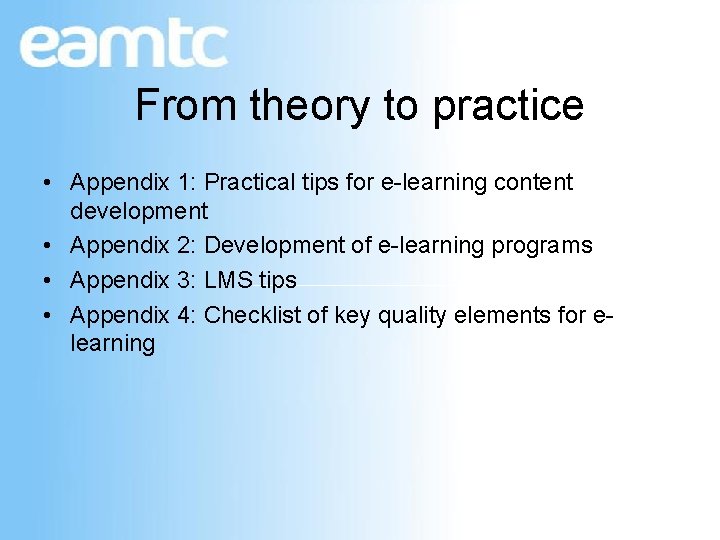
From theory to practice • Appendix 1: Practical tips for e-learning content development • Appendix 2: Development of e-learning programs • Appendix 3: LMS tips • Appendix 4: Checklist of key quality elements for elearning
Conclusion • The working group has concluded that e-learning can have a significant benefit for maintenance training so long as it is applied with quality according to the recommendations of this document
Conclusion • Instead of ruling out options for learning which are not described in guidelines or legislation one should measure the suitability of existing and new developments in e-learning using the Key Quality Elements for quality • Considering the complexity of e-learning and sheer endless list of possibilities we recommend for the EAMTC to open an online forum for E-learning where the community can share best practices and tips concerning e-learning.
Question In essence, is the WG saying that the objective: Propose means that would permit the use of e-Learning in the context of approved training. . will be met if the contents of the doc are followed?
Yes If all actors mentioned in the document follow the contents of the document: • They will change their approach from quantitative to qualitative • They will prove competency and then be able to apply courses through e-learning effectively and efficiently
How much? Educating people costs money, not educating people costs a fortune If you focus on costs you will lose quality If you focus on quality you will save costs