
SHAPING PROCESSES FOR POLYMER MATRIX COMPOSITES 1 Starting




- Slides: 29
SHAPING PROCESSES FOR POLYMER MATRIX COMPOSITES 1. Starting Materials for PMCs 2. Open Mold Processes © 2007 John Wiley & Sons, Inc. M P Groover, Fundamentals of Modern Manufacturing 3/e
Overview of PMC Technology A polymer matrix composite (PMC) is a composite material consisting of a polymer imbedded with a reinforcing phase such as fibers or powders O The importance of PMC processes derive from the growing use of this class of material, especially fiber‑reinforced polymers(FRPs) O FRP composites can be designed with very high strength‑to‑weight and modulus‑to‑weight ratios O These features make them attractive in aircraft, cars, trucks, boats, and sports equipment © 2007 John Wiley & Sons, Inc. M P Groover, Fundamentals of Modern Manufacturing 3/e
PMC Shape Processing O Many PMC shaping processes are slow and labor intensive O In general, techniques for shaping composites are less efficient than for other materials Why? O Composites are more complex than other materials, consisting of two or more phases O For FRPs, there is the need to orient the reinforcing phase O Composite processing technologies have not been the object of refinement over as many years as processes for other materials © 2007 John Wiley & Sons, Inc. M P Groover, Fundamentals of Modern Manufacturing 3/e
Categories of FRP Shape Processes O Open mold processes - some of the original O O FRP manual procedures for laying resins and fibers onto forms Closed mold processes - much the same as those used in plastic molding Filament winding - continuous filaments are dipped in liquid resin and wrapped around a rotating mandrel, producing a rigid, hollow, cylindrical shape Pultrusion - similar to extrusion only adapted to include continuous fiber reinforcement Other - operations not in previous categories © 2007 John Wiley & Sons, Inc. M P Groover, Fundamentals of Modern Manufacturing 3/e
Classification of FRP Processes Figure 15. 1 Classification of manufacturing processes for fiber reinforced polymer (FRP) composites © 2007 John Wiley & Sons, Inc. M P Groover, Fundamentals of Modern Manufacturing 3/e
Video © 2007 John Wiley & Sons, Inc. M P Groover, Fundamentals of Modern Manufacturing 3/e
Starting Materials for PMCs O In a PMC, the starting materials are: O A polymer O A reinforcing phase O They are processed separately before becoming phases in the composite © 2007 John Wiley & Sons, Inc. M P Groover, Fundamentals of Modern Manufacturing 3/e
Polymer Matrix O Thermosetting (TS) polymers are the most common matrix materials O Principal TS polymers are: O Phenolics – used with particulate reinforcing phases O Polyesters and epoxies - most closely associated with FRPs O Thermoplastic molding compounds include fillers or reinforcing agents O Nearly all rubbers are reinforced with carbon black © 2007 John Wiley & Sons, Inc. M P Groover, Fundamentals of Modern Manufacturing 3/e
Reinforcing Agent O Possible geometries - fibers, particles, and flakes O Possible materials - ceramics, metals, other polymers, or elements such as carbon or boron O Particles and flakes are used in many plastic molding compounds O Of most engineering interest is the use of fibers as the reinforcing phase in FRPs © 2007 John Wiley & Sons, Inc. M P Groover, Fundamentals of Modern Manufacturing 3/e
Fibers as the Reinforcing Phase O Common fiber materials: glass, carbon, and Kevlar (a polymer) O In some fabrication processes, the filaments are continuous, while in others, they are chopped into short lengths O In continuous form, individual filaments are usually available as rovings - collections of untwisted continuous strands, convenient form for handling O By contrast, a yarn is a twisted collection of filaments © 2007 John Wiley & Sons, Inc. M P Groover, Fundamentals of Modern Manufacturing 3/e
Fibers as the Reinforcing Phase O The most familiar form of continuous fiber is a cloth ‑ a fabric of woven yarns O Similar to a cloth is a woven roving, a fabric consisting of untwisted filaments rather than yarns O Woven rovings can be produced with unequal numbers of strands in the two directions so that they possess greater strength in one direction O Such unidirectional woven rovings are often preferred in laminated FRP composites © 2007 John Wiley & Sons, Inc. M P Groover, Fundamentals of Modern Manufacturing 3/e
Mats and Preforms as Reinforcements O Fibers can also be in a mat form ‑ a felt consisting of randomly oriented short fibers held loosely together with a binder O Mats are commercially available as blankets of various weights, thicknesses, and widths O Mats can be cut and shaped for use as preforms in some of the closed mold processes O During molding, the resin impregnates the preform and then cures, thus yielding a fiber‑reinforced molding © 2007 John Wiley & Sons, Inc. M P Groover, Fundamentals of Modern Manufacturing 3/e
Combining Matrix and Reinforcement 1. The starting materials arrive at the fabrication operation as separate entities and are combined into the composite during shaping O Filament winding and pultrusion, in which reinforcing phase = continuous fibers 2. The two component materials are combined into some starting form that is convenient for use in the shaping process O Molding compounds O Prepregs © 2007 John Wiley & Sons, Inc. M P Groover, Fundamentals of Modern Manufacturing 3/e
Molding Compounds FRP composite molding compounds consist of the resin matrix with short randomly dispersed fibers, similar to those used in plastic molding O Most molding compounds for composite processing are thermosetting polymers O Since they are designed for molding, they must be capable of flowing O Accordingly, they have not been cured prior to shape processing O Curing is done during and/or after final shaping © 2007 John Wiley & Sons, Inc. M P Groover, Fundamentals of Modern Manufacturing 3/e
Prepregs Fibers impregnated with partially cured TS resins to facilitate shape processing O Available as tapes or cross‑plied sheets or fabrics O Curing is completed during and/or after shaping O Advantage: prepregs are fabricated with continuous filaments rather than chopped random fibers, thus increasing strength and modulus © 2007 John Wiley & Sons, Inc. M P Groover, Fundamentals of Modern Manufacturing 3/e
Open Mold Processes Family of FRP shaping processes that use a single positive or negative mold surface to produce laminated FRP structures O The starting materials (resins, fibers, mats, and woven rovings) are applied to the mold in layers, building up to the desired thickness O This is followed by curing and part removal O Common resins are unsaturated polyesters and epoxies, using fiberglass as the reinforcement © 2007 John Wiley & Sons, Inc. M P Groover, Fundamentals of Modern Manufacturing 3/e
Open Mold FRP Processes 1. Hand lay‑up 2. Spray‑up 3. Automated tape‑laying machines O The differences are in the methods of applying the laminations to the mold, alternative curing techniques, and other differences © 2007 John Wiley & Sons, Inc. M P Groover, Fundamentals of Modern Manufacturing 3/e
Hand Lay‑Up Method Open mold shaping method in which successive layers of resin and reinforcement are manually applied to an open mold to build the laminated FRP composite structure O Labor‑intensive O Finished molding must usually be trimmed with a power saw to size outside edges O Oldest open mold method for FRP laminates, dating to the 1940 s when it was © 2007 Johnfirst Wiley &used Sons, Inc. for M P Groover, boat Fundamentals hulls of Modern Manufacturing 3/e
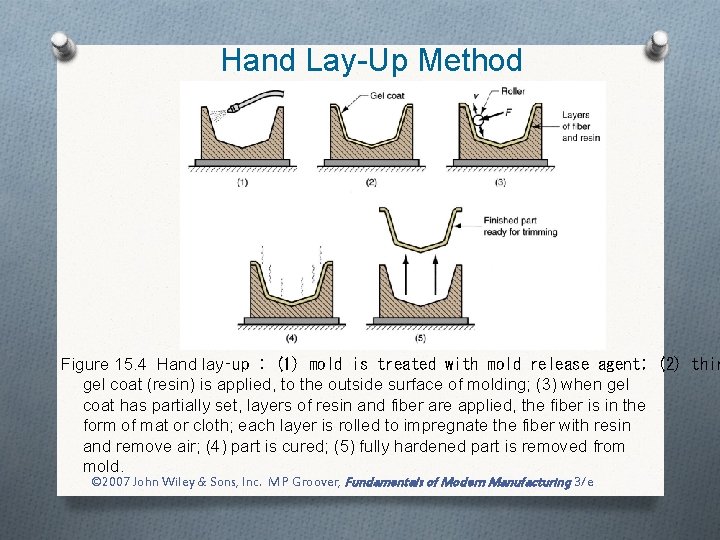
Hand Lay-Up Method Figure 15. 4 Hand lay‑up : (1) mold is treated with mold release agent; (2) thin gel coat (resin) is applied, to the outside surface of molding; (3) when gel coat has partially set, layers of resin and fiber are applied, the fiber is in the form of mat or cloth; each layer is rolled to impregnate the fiber with resin and remove air; (4) part is cured; (5) fully hardened part is removed from mold. © 2007 John Wiley & Sons, Inc. M P Groover, Fundamentals of Modern Manufacturing 3/e
Products Made by Hand Lay‑Up O Generally large in size but low in production quantity - not economical for high production O Applications: O Boat hulls O Swimming pools O Large container tanks O Movie and stage props O Other formed sheets O The largest molding ever made was ship hulls for the British Royal Navy: 85 m (280 ft) long © 2007 John Wiley & Sons, Inc. M P Groover, Fundamentals of Modern Manufacturing 3/e
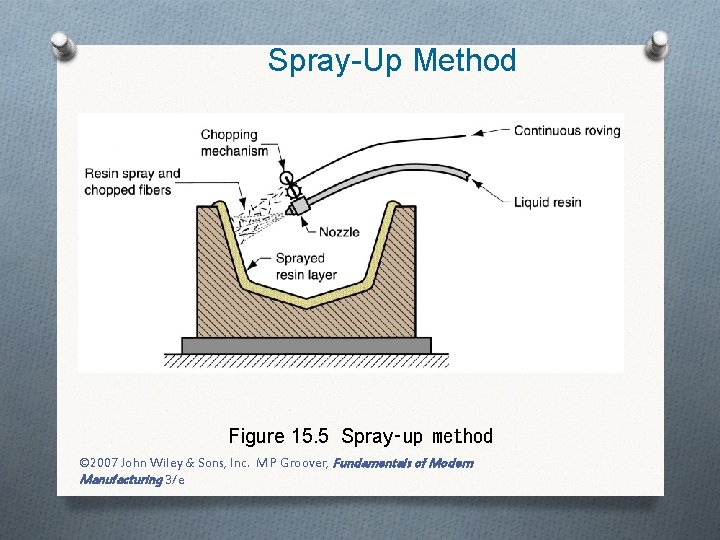
Spray‑Up Method Liquid resin and chopped fibers are sprayed onto an open mold to build successive FRP laminations O Attempt to mechanize application of resin‑fiber layers and reduce lay‑up time O Alternative for step (3) in the hand lay‑up procedure © 2007 John Wiley & Sons, Inc. M P Groover, Fundamentals of Modern Manufacturing 3/e
Spray-Up Method Figure 15. 5 Spray‑up method © 2007 John Wiley & Sons, Inc. M P Groover, Fundamentals of Modern Manufacturing 3/e
Products Made by Spray‑Up O Boat hulls, bathtubs, shower stalls, automobile and truck body parts, recreational vehicle components, furniture, large structural panels, and containers O Movie and stage props are sometimes made by this method O Since products made by spray‑up have randomly oriented short fibers, they are not as strong as those made by lay‑up, in which the fibers are continuous and © 2007 Johndirected Wiley & Sons, Inc. M P Groover, Fundamentals of Modern Manufacturing 3/e
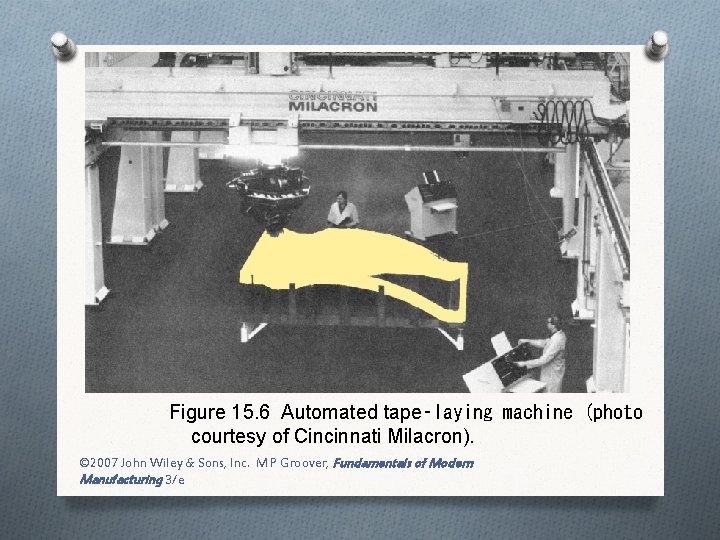
Automated Tape‑Laying Machines Automated tape‑laying machines operate by dispensing a prepreg tape onto an open mold following a programmed path O Typical machine consists of overhead gantry to which the dispensing head is attached O The gantry permits x‑y‑z travel of the head, for positioning and following a defined continuous path © 2007 John Wiley & Sons, Inc. M P Groover, Fundamentals of Modern Manufacturing 3/e
Figure 15. 6 Automated tape‑laying machine (photo courtesy of Cincinnati Milacron). © 2007 John Wiley & Sons, Inc. M P Groover, Fundamentals of Modern Manufacturing 3/e
Curing in Open Mold Processes O O O Curing is required of all thermosetting resins used in FRP laminated composites Curing cross‑links the polymer, transforming it from its liquid or highly plastic condition into a hardened product Three principal process parameters in curing: 1. Time 2. Temperature 3. Pressure © 2007 John Wiley & Sons, Inc. M P Groover, Fundamentals of Modern Manufacturing 3/e
Curing at Room Temperature O Curing normally occurs at room temperature for the TS resins used in hand lay‑up and spray‑up procedures O Moldings made by these processes are often large (e. g. , boat hulls), and heating would be difficult due to product size O In some cases, days are required before room temperature curing is sufficiently complete toofremove the part © 2007 John Wiley & Sons, Inc. M P Groover, Fundamentals Modern Manufacturing 3/e
Curing Methods Based on Heating O Oven curing provides heat at closely controlled temperatures; some curing ovens are equipped to draw a partial vacuum O Infrared heating - used in applications where it is impractical to place molding in oven O Curing in an autoclave, an enclosed chamber equipped to apply heat and/or pressure at controlled levels O In FRP composites processing, it is usually a large horizontal cylinder with doors at either end © 2007 John Wiley & Sons, Inc. M P Groover, Fundamentals of Modern Manufacturing 3/e
Thanks © 2007 John Wiley & Sons, Inc. M P Groover, Fundamentals of Modern Manufacturing 3/e