
Shapes of molecules Arrangements of electron clouds The
- Slides: 15
Shapes of molecules
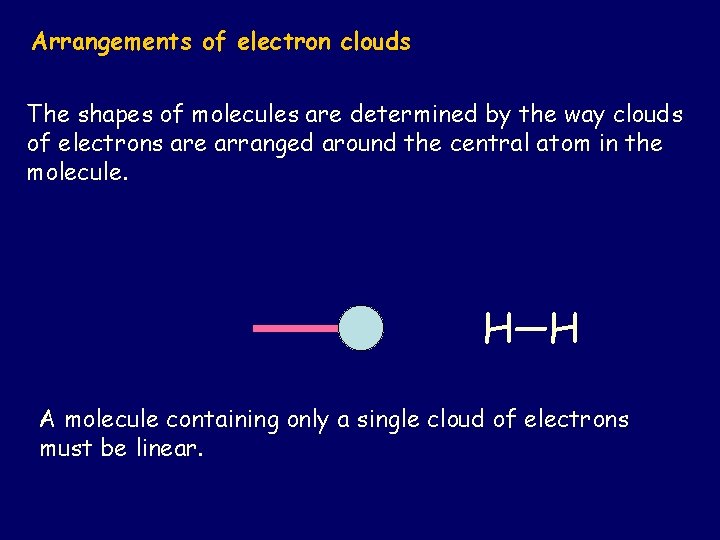
Arrangements of electron clouds The shapes of molecules are determined by the way clouds of electrons are arranged around the central atom in the molecule. H—H A molecule containing only a single cloud of electrons must be linear.
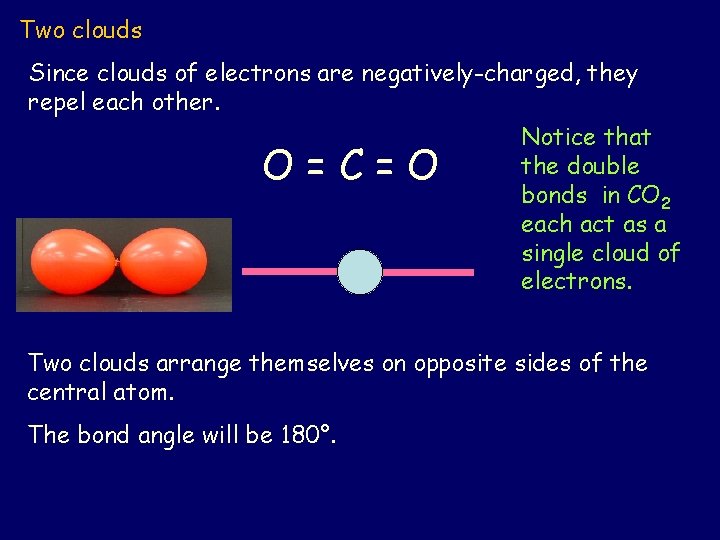
Two clouds Since clouds of electrons are negatively-charged, they repel each other. Notice that the double bonds in CO 2 each act as a single cloud of electrons. O=C=O Two clouds arrange themselves on opposite sides of the central atom. The bond angle will be 180°.
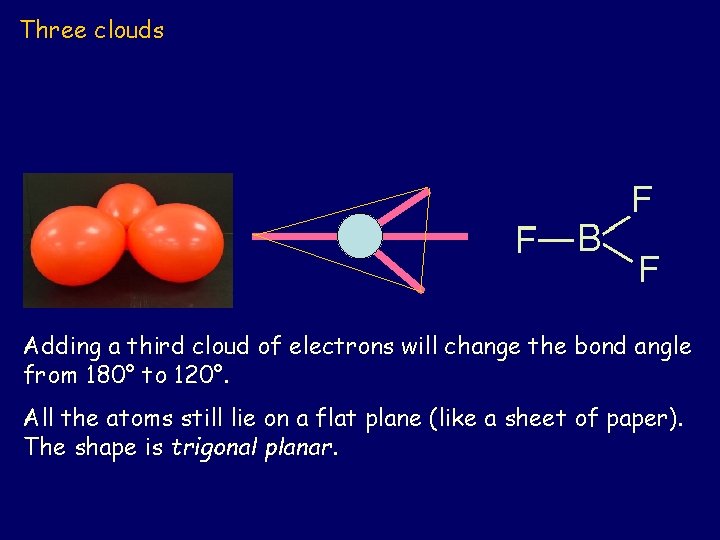
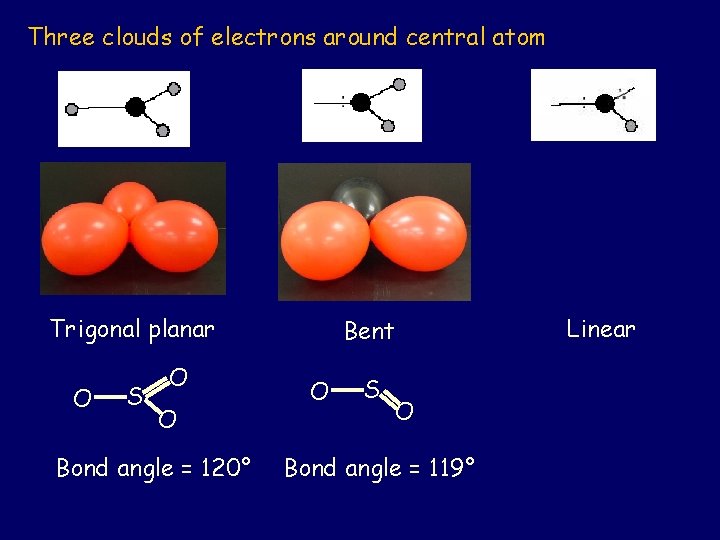
Three clouds Adding a third cloud of electrons will change the bond angle from 180° to 120°. All the atoms still lie on a flat plane (like a sheet of paper). The shape is trigonal planar.
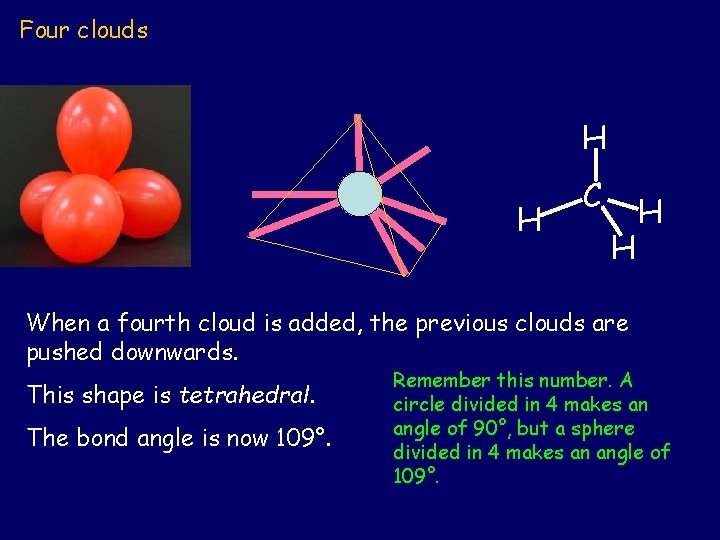
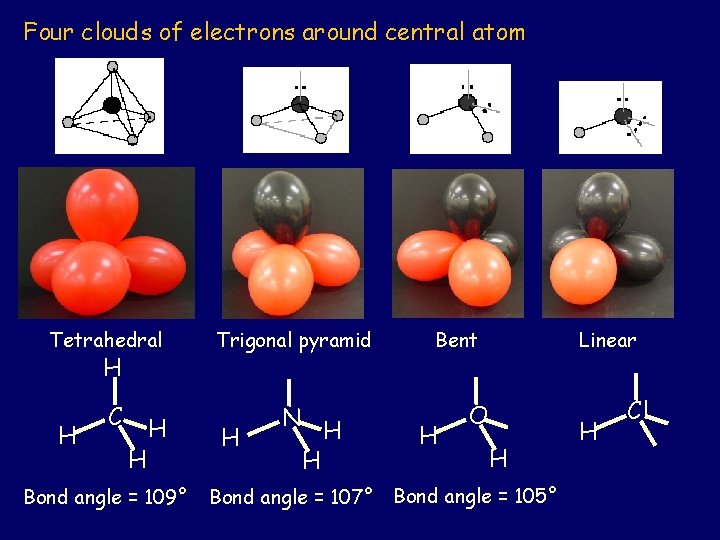
Four clouds H H C H When a fourth cloud is added, the previous clouds are pushed downwards. This shape is tetrahedral. The bond angle is now 109°. H Remember this number. A circle divided in 4 makes an angle of 90°, but a sphere divided in 4 makes an angle of 109°.
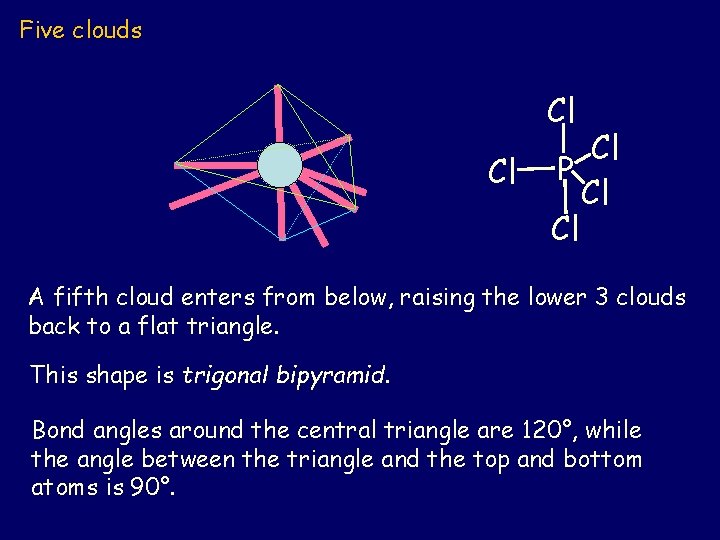
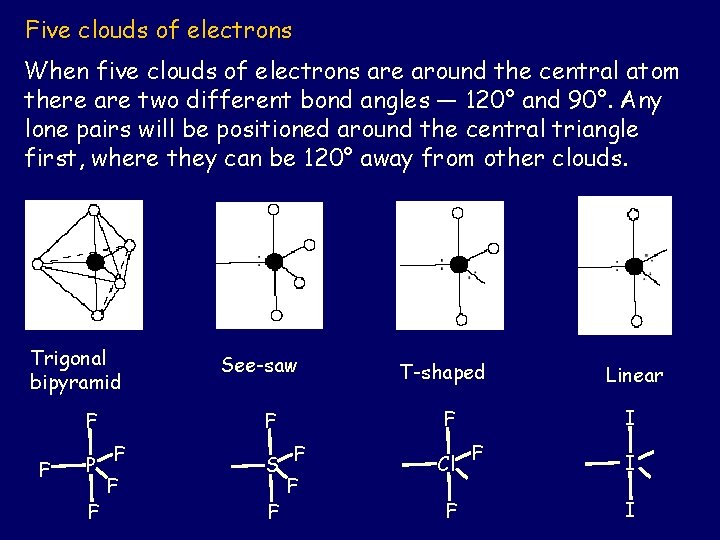
Five clouds Cl Cl Cl P Cl Cl A fifth cloud enters from below, raising the lower 3 clouds back to a flat triangle. This shape is trigonal bipyramid. Bond angles around the central triangle are 120°, while the angle between the triangle and the top and bottom atoms is 90°.
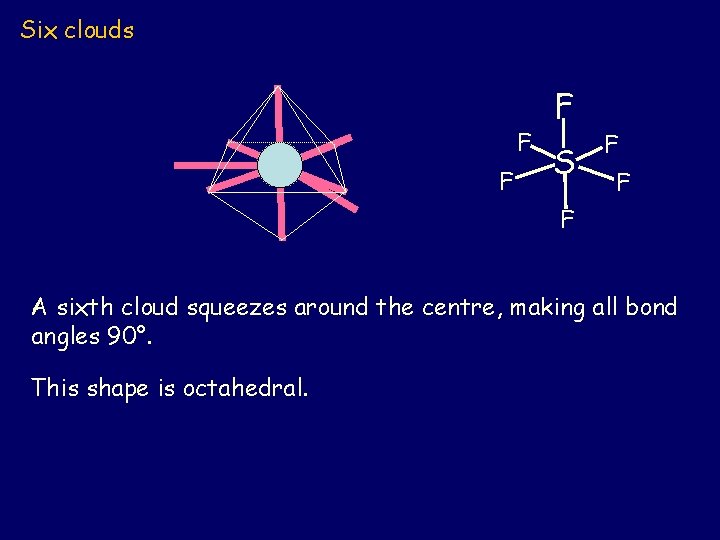
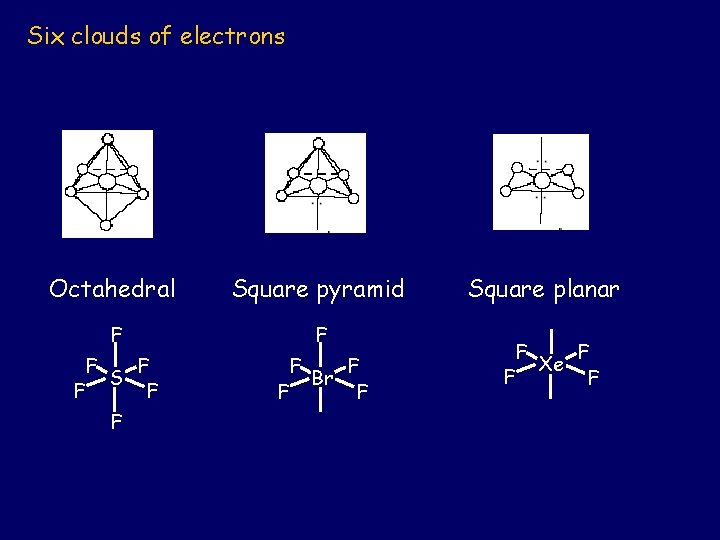
Six clouds F F F S F F F A sixth cloud squeezes around the centre, making all bond angles 90°. This shape is octahedral.
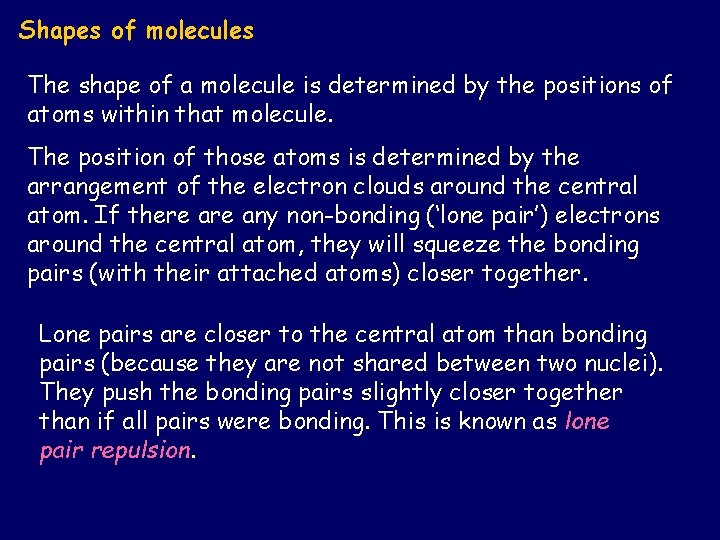
Shapes of molecules The shape of a molecule is determined by the positions of atoms within that molecule. The position of those atoms is determined by the arrangement of the electron clouds around the central atom. If there any non-bonding (‘lone pair’) electrons around the central atom, they will squeeze the bonding pairs (with their attached atoms) closer together. Lone pairs are closer to the central atom than bonding pairs (because they are not shared between two nuclei). They push the bonding pairs slightly closer together than if all pairs were bonding. This is known as lone pair repulsion.
Three clouds of electrons around central atom Trigonal planar O S O O Bond angle = 120° Bent O S O Bond angle = 119° Linear
Four clouds of electrons around central atom Tetrahedral H H C H H Bond angle = 109° Trigonal pyramid H N H H Bond angle = 107° Bent H Linear O H Bond angle = 105° H Cl
Five clouds of electrons When five clouds of electrons are around the central atom there are two different bond angles — 120° and 90°. Any lone pairs will be positioned around the central triangle first, where they can be 120° away from other clouds. Trigonal bipyramid F F P F See-saw F S F F F Cl F Linear I F F F T-shaped F I I
Six clouds of electrons Octahedral Square pyramid F F S F F F Br F F Square planar F F Xe F F
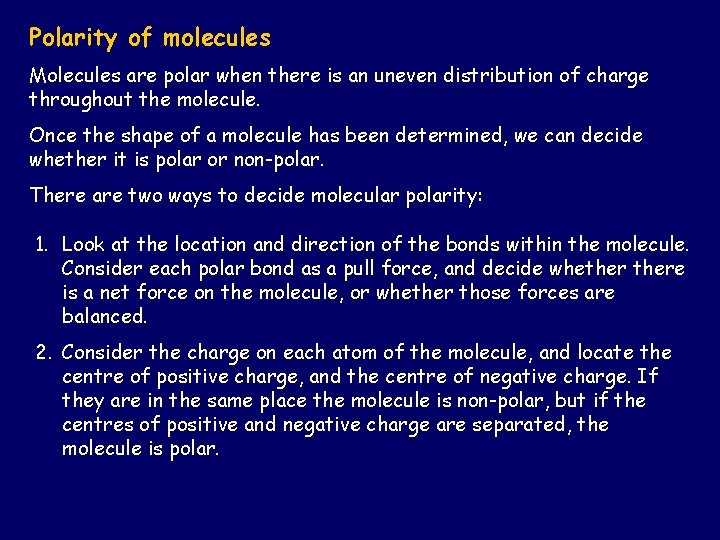
Polarity of molecules Molecules are polar when there is an uneven distribution of charge throughout the molecule. Once the shape of a molecule has been determined, we can decide whether it is polar or non-polar. There are two ways to decide molecular polarity: 1. Look at the location and direction of the bonds within the molecule. Consider each polar bond as a pull force, and decide whethere is a net force on the molecule, or whether those forces are balanced. 2. Consider the charge on each atom of the molecule, and locate the centre of positive charge, and the centre of negative charge. If they are in the same place the molecule is non-polar, but if the centres of positive and negative charge are separated, the molecule is polar.
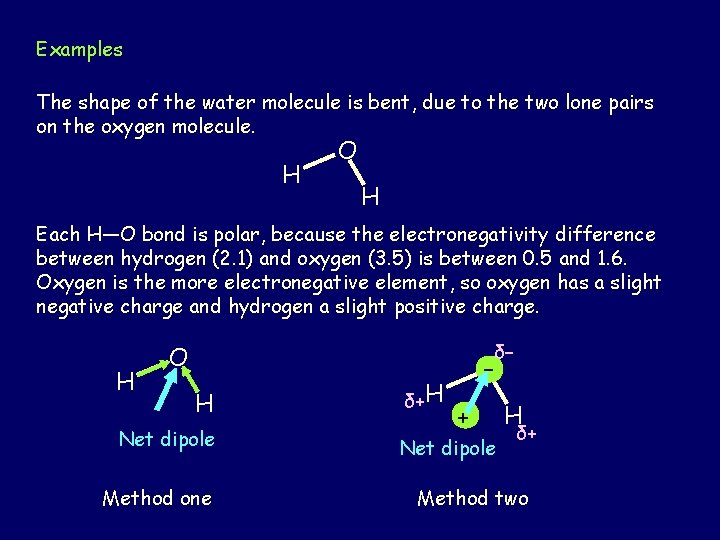
Examples The shape of the water molecule is bent, due to the two lone pairs on the oxygen molecule. H O H Each H—O bond is polar, because the electronegativity difference between hydrogen (2. 1) and oxygen (3. 5) is between 0. 5 and 1. 6. Oxygen is the more electronegative element, so oxygen has a slight negative charge and hydrogen a slight positive charge. H δ– O H Net dipole Method one δ+ H – O + Net dipole H δ+ Method two
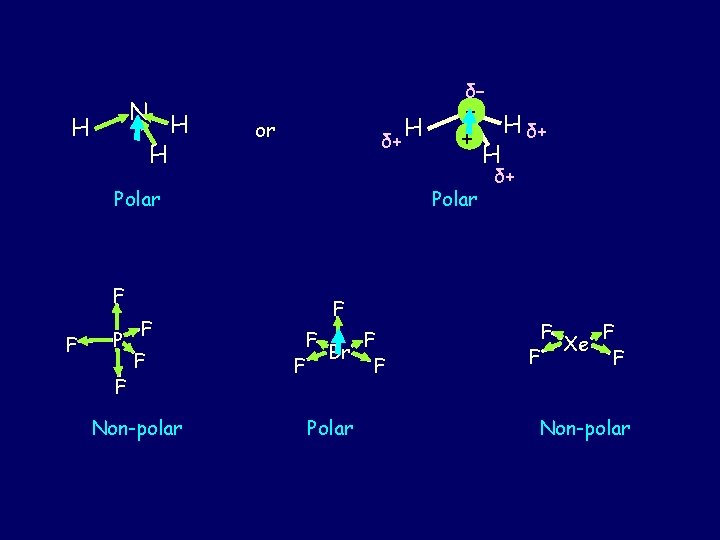
δ– N H H H or δ+ Polar F F P F Non-polar δ+ F F F H – N H δ+ + H F F F Br F Polar F F Xe F F Non-polar