
Shapes and Orientations of Orbitals Periodic table arrangement
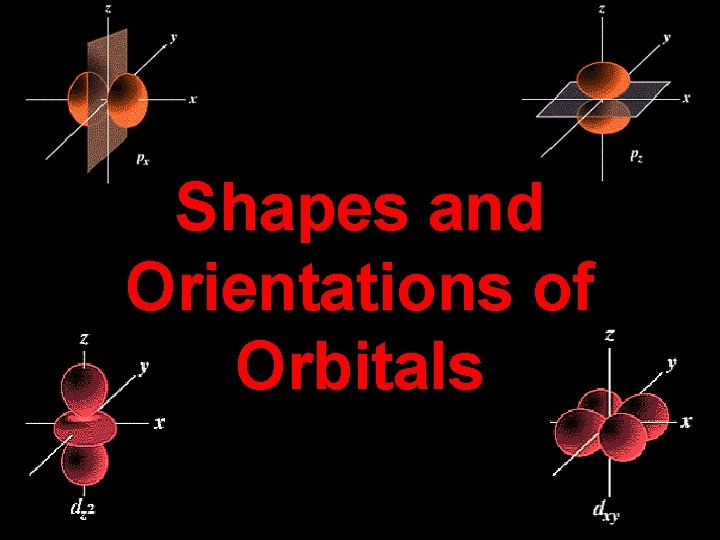
Shapes and Orientations of Orbitals
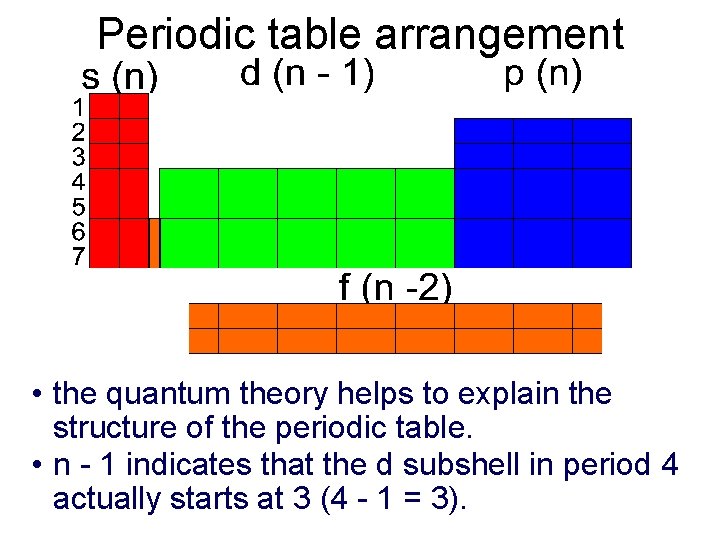
Periodic table arrangement • the quantum theory helps to explain the structure of the periodic table. • n - 1 indicates that the d subshell in period 4 actually starts at 3 (4 - 1 = 3).
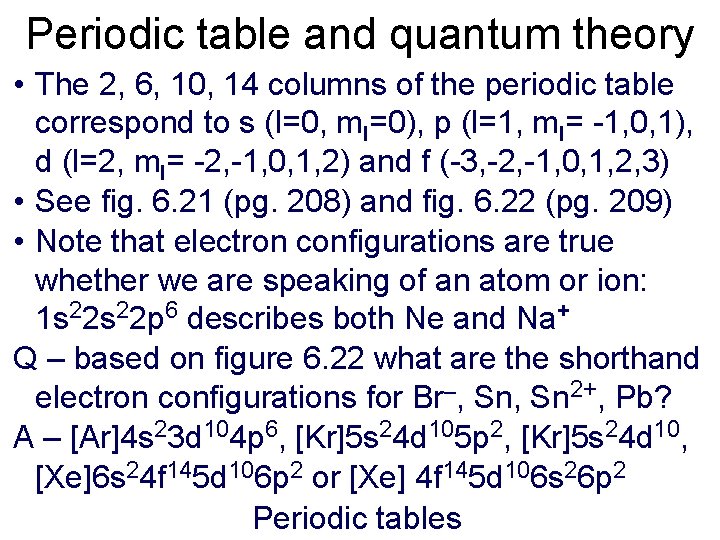
Periodic table and quantum theory • The 2, 6, 10, 14 columns of the periodic table correspond to s (l=0, ml=0), p (l=1, ml= -1, 0, 1), d (l=2, ml= -2, -1, 0, 1, 2) and f (-3, -2, -1, 0, 1, 2, 3) • See fig. 6. 21 (pg. 208) and fig. 6. 22 (pg. 209) • Note that electron configurations are true whether we are speaking of an atom or ion: 1 s 22 p 6 describes both Ne and Na+ Q – based on figure 6. 22 what are the shorthand electron configurations for Br–, Sn 2+, Pb? A – [Ar]4 s 23 d 104 p 6, [Kr]5 s 24 d 105 p 2, [Kr]5 s 24 d 10, [Xe]6 s 24 f 145 d 106 p 2 or [Xe] 4 f 145 d 106 s 26 p 2 Periodic tables
![Unusual electron configurations • Look at your value for Cu ([Ar]4 s 23 d](http://slidetodoc.com/presentation_image_h2/b0f4dd55004a8c495586fc8150e141d1/image-4.jpg "Unusual electron configurations • Look at your value for Cu ([Ar]4 s 23 d")
Unusual electron configurations • Look at your value for Cu ([Ar]4 s 23 d 9). • The actual value for Cu is [Ar]4 s 13 d 10… why? • The explanation is that there is some sort of added stability provided by a filled (or halffilled subshell). • Read 6. 8 (pg. 207 - 8) • The only exceptions that you need to remember are Cr, Cu, Ag, and Au. • The inner transition elements also do not follow expected patterns. However, we do not address this in OAC chemistry.
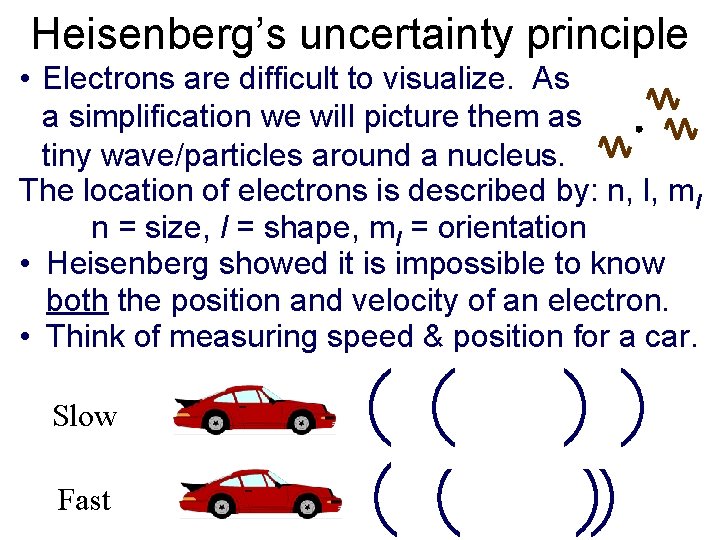
Heisenberg’s uncertainty principle • Electrons are difficult to visualize. As a simplification we will picture them as tiny wave/particles around a nucleus. The location of electrons is described by: n, l, ml n = size, l = shape, ml = orientation • Heisenberg showed it is impossible to know both the position and velocity of an electron. • Think of measuring speed & position for a car. Slow Fast
Heisenberg’s uncertainty principle • The distance between 2+ returning signals gives information on position and velocity. • A car is massive. The energy from the radar waves will not affect its path. However, because electrons are so small, anything that hits them will alter their course. • The first wave will knock the electron out of its normal path. • Thus, we cannot know both position and velocity because we cannot get 2 accurate signals to return.
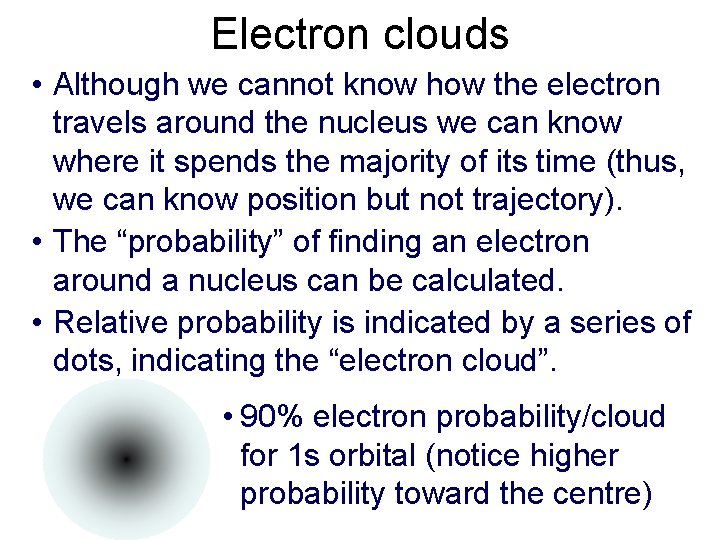
Electron clouds • Although we cannot know how the electron travels around the nucleus we can know where it spends the majority of its time (thus, we can know position but not trajectory). • The “probability” of finding an electron around a nucleus can be calculated. • Relative probability is indicated by a series of dots, indicating the “electron cloud”. • 90% electron probability/cloud for 1 s orbital (notice higher probability toward the centre)
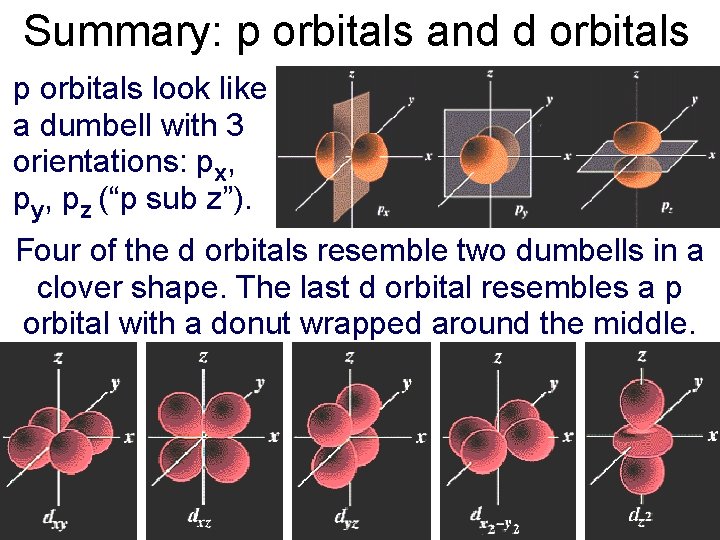
Summary: p orbitals and d orbitals p orbitals look like a dumbell with 3 orientations: px, py, pz (“p sub z”). Four of the d orbitals resemble two dumbells in a clover shape. The last d orbital resembles a p orbital with a donut wrapped around the middle.
• Movie (10) (oa 20) - now you need to know shapes • Each subshell (1 s, 3 p, 2 d, 5 f, 1 g, etc. ) has a specific shape derived from mathematics. • As we move to higher, the shapes get stranger • You need to know 1 s, 2 s, 3 s, 2 p (x 3), 3 d (x 5) • Read 6. 10 (pg. 210 -212) Q -How many shells are shown in Fig 6. 24 ‘ 3 s’ Q- Which orbitals do not contain nodes? Q- Explain why a p sub-shell has the different orientations it does (refer to quantum numbers). Q- Why does s have only one orientation? Q- How far do the probabilities extend from the nucleus (for 1 s for example)? Q- Why do we represent the electron’s position as a probability?
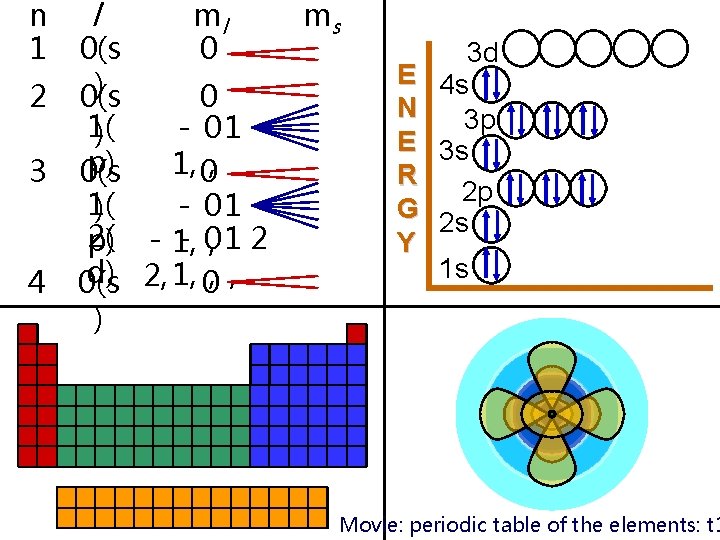
n 1 2 3 4 l ml 0 0(s ) 0(s 0 1( - 01 ) p) 1, 0, 0(s 1( - 01 ) 2( - 1, - 0, 1 2 p) d) 2, 1, 0, , 0(s ) ms E N E R G Y 3 d 4 s 3 p 3 s 2 p 2 s 1 s Movie: periodic table of the elements: t 1
Testing concepts Q- How many shells are shown in Fig 6. 24 ‘ 3 s’ A- Just one (the 3 s). In an atom containing a 3 s subshell both of the other s orbitals would also be present (superimposed on 3 s). Q- Which orbitals do not contain nodes? A- Just the 1 s subshell/orbital. Q- Explain with reference to quantum numbers why it makes sense that a p subshell has the different orientations it does. A- For p (l=1), ml can be -1, 0, 1. These three orbitals correspond to the three possible orientations of p. Recall that ml = orientation.
Testing concepts Q- Why does s have only one orientation? A- Because it’s spherical (or because it has only one value for ml). Q- How far do probabilities extend from the nucleus (for 1 s for example)? A-Theoretically, infinitely. Orbital shapes show where the electron will be 90% of the time. Q- Why do we represent the electron’s position as a probability? A- Heisenberg’s uncertainty principle shows we cannot know both position and velocity.
- Slides: 12