
Shape Symmetry and 2 D shapes Objectives Day
Shape Symmetry and 2 -D shapes Objectives Day 1 Recognise symmetry and complete symmetrical drawings Recognise symmetry in a variety of diagrams; draw symmetrical patterns Day 2 Describe, name and sort 2 -D shapes Draw different polygons; identify their properties Day 3 Describe, name and sort 2 -D shapes using diagrams Identify properties of triangles and sort them using diagrams © hamilton-trust. org. uk 1 Year 3/4
Shape Symmetry and 2 -D shapes Short Mental Workouts Day 1 Lines of symmetry Day 2 2 -D shapes Day 3 2 -D shapes © hamilton-trust. org. uk 2 Year 3/4
Shape Symmetry and 2 -D shapes Short Mental Workout Lines of symmetry © hamilton-trust. org. uk 3 Year 3/4
Shape Symmetry and 2 -D shapes Short Mental Workout Feely bag 2 -D shapes © hamilton-trust. org. uk 4 Year 3/4
Shape Symmetry and 2 -D shapes Short Mental Workout Odd one out 2 -D shapes © hamilton-trust. org. uk 5 Year 3/4
Shape Symmetry and 2 -D shapes Objectives Day 1 Recognise symmetry and complete symmetrical drawings Recognise symmetry in a variety of diagrams; draw symmetrical patterns © hamilton-trust. org. uk 6 Year 3/4
Day 1: Recognise symmetry and complete symmetrical drawings; Recognise symmetry in a variety of diagrams; draw symmetrical patterns Start by watching this VIDEO CLIP about symmetry. © hamilton-trust. org. uk 7 Year 3/4
Day 1: Recognise symmetry and complete symmetrical drawings; Recognise symmetry in a variety of diagrams; draw symmetrical patterns Find shapes with 1 line of symmetry. Talk to your partner about these challenges. Write your answers on whiteboards. Which ones have no lines of symmetry? Find the shapes with 2 or more lines of symmetry. © hamilton-trust. org. uk One of the shapes has 8 lines of symmetry. Which one is it and where are the lines of symmetry? 8 Year 3/4
Day 1: Recognise symmetry and complete symmetrical drawings; Recognise symmetry in a variety of diagrams; draw symmetrical patterns Lines of symmetry on a 2 -D shape divide the shape so it looks exactly the same on either side of the line. © hamilton-trust. org. uk 9 Year 3/4
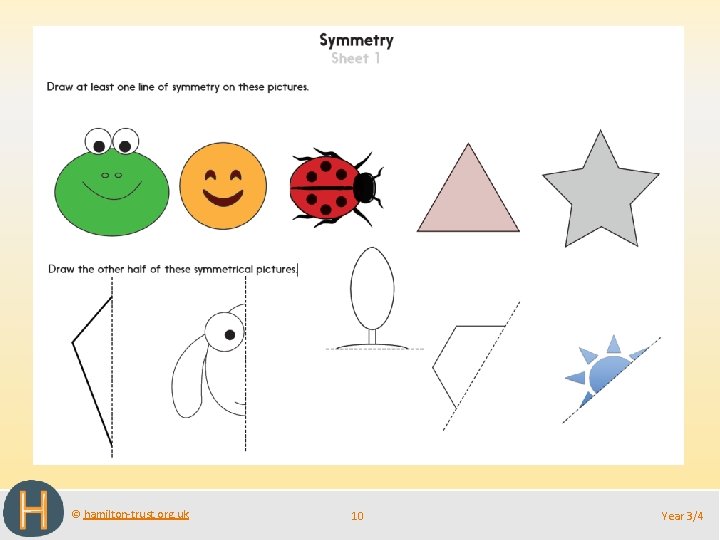
© hamilton-trust. org. uk 10 Year 3/4
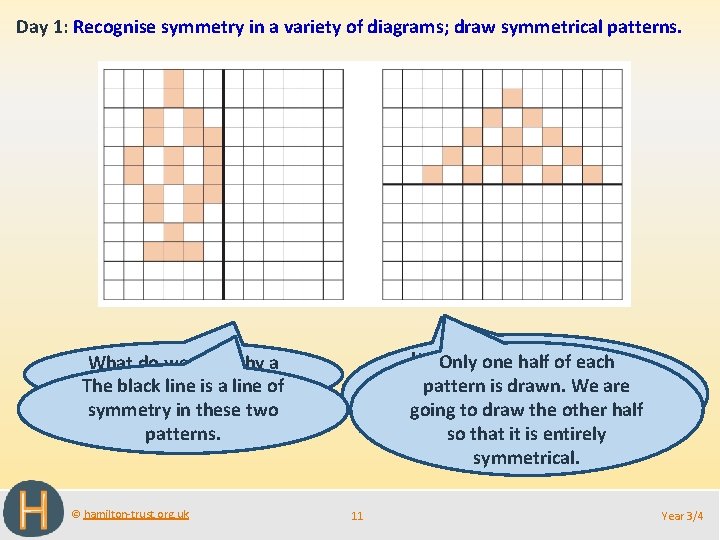
Day 1: Recognise symmetry in a variety of diagrams; draw symmetrical patterns. It is. Only an imaginary line along one half of each which we can fold the pattern is drawn. We are pattern thatthe it is exactly going to so draw other half thesosame halves. thatin it both is entirely symmetrical. What do we mean by a Theline black is a line of of line symmetry? symmetry in these two patterns. © hamilton-trust. org. uk 11 Year 3/4
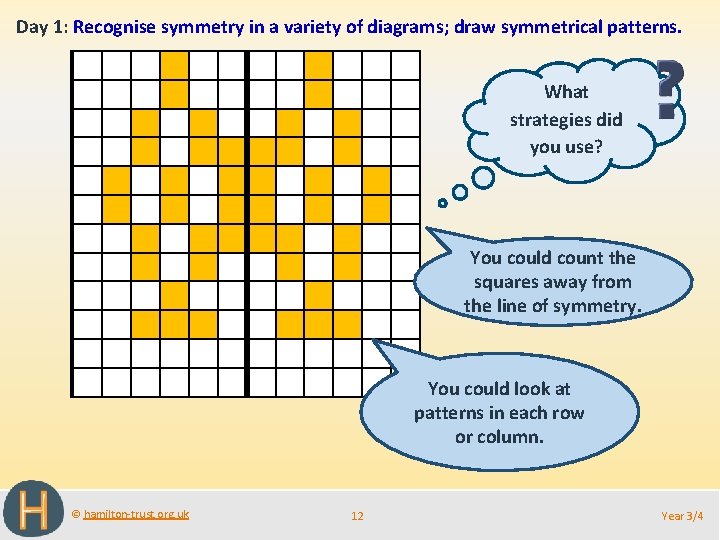
Day 1: Recognise symmetry in a variety of diagrams; draw symmetrical patterns. What strategies did you use? You could count the squares away from the line of symmetry. You could look at patterns in each row or column. © hamilton-trust. org. uk 12 Year 3/4
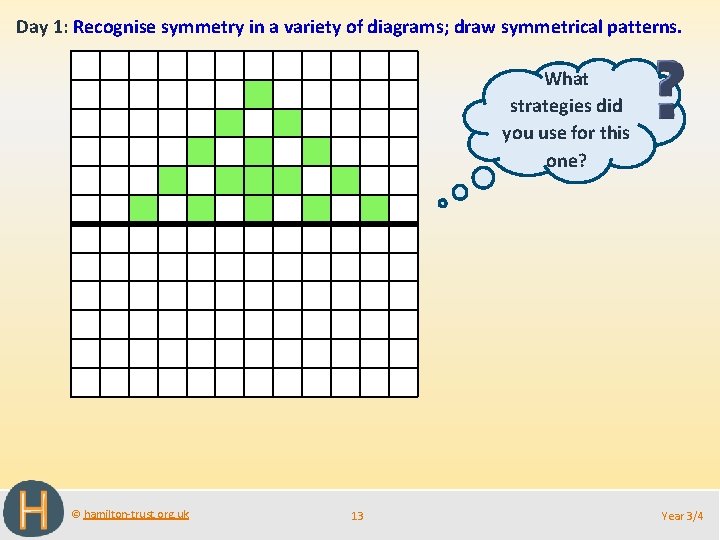
Day 1: Recognise symmetry in a variety of diagrams; draw symmetrical patterns. What strategies did you use for this one? © hamilton-trust. org. uk 13 Year 3/4
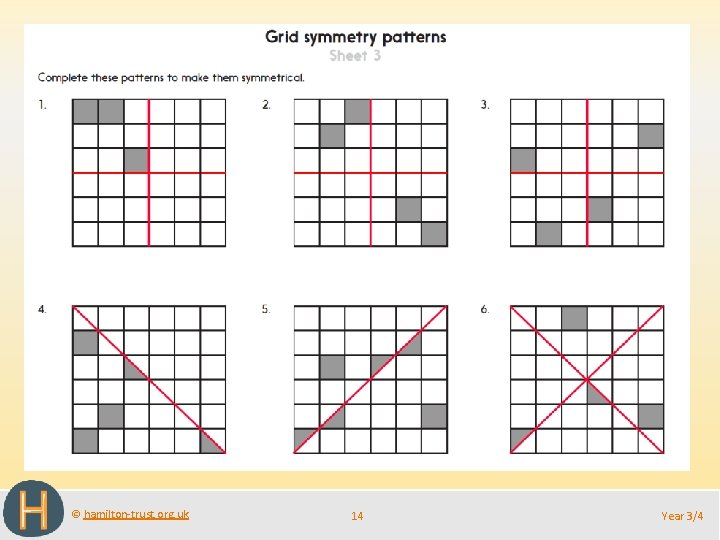
© hamilton-trust. org. uk 14 Year 3/4
Shape Symmetry and 2 -D shapes Objectives Day 2 Describe, name and sort 2 -D shapes Draw different polygons; identify their properties © hamilton-trust. org. uk 15 Year 3/4
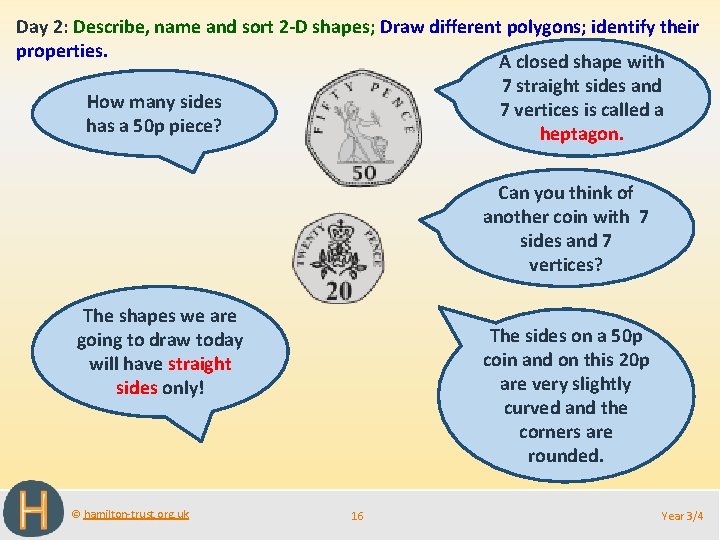
Day 2: Describe, name and sort 2 -D shapes; Draw different polygons; identify their properties. A closed shape with 7 straight sides and How many sides 7 vertices is called a has a 50 p piece? heptagon. Can you think of another coin with 7 sides and 7 vertices? The shapes we are going to draw today will have straight sides only! © hamilton-trust. org. uk The sides on a 50 p coin and on this 20 p are very slightly curved and the corners are rounded. 16 Year 3/4
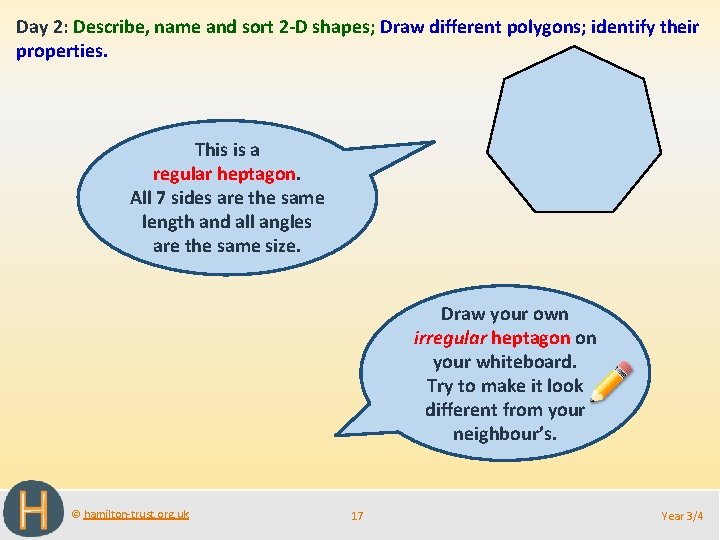
Day 2: Describe, name and sort 2 -D shapes; Draw different polygons; identify their properties. This is a regular heptagon. All 7 sides are the same length and all angles are the same size. Draw your own irregular heptagon on your whiteboard. Try to make it look different from your neighbour’s. © hamilton-trust. org. uk 17 Year 3/4
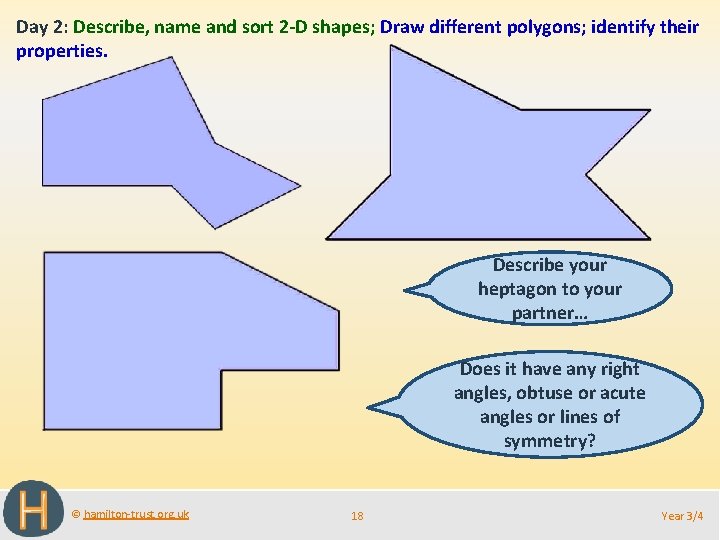
Day 2: Describe, name and sort 2 -D shapes; Draw different polygons; identify their properties. Describe your heptagon to your partner… Does it have any right angles, obtuse or acute angles or lines of symmetry? © hamilton-trust. org. uk 18 Year 3/4
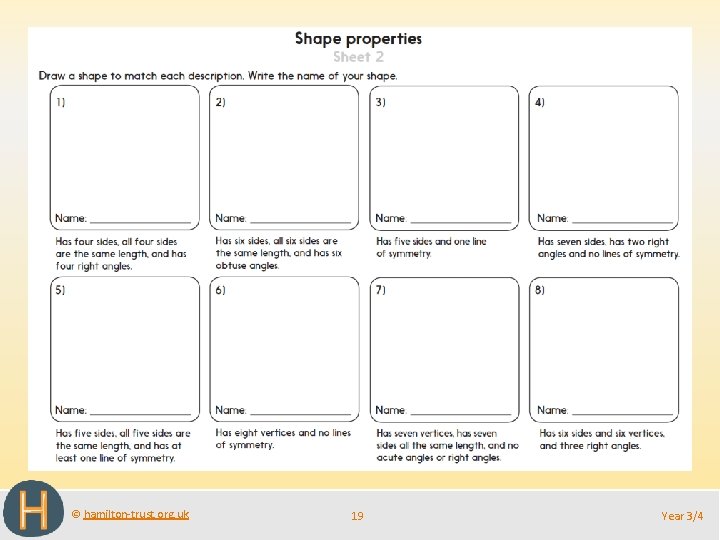
© hamilton-trust. org. uk 19 Year 3/4
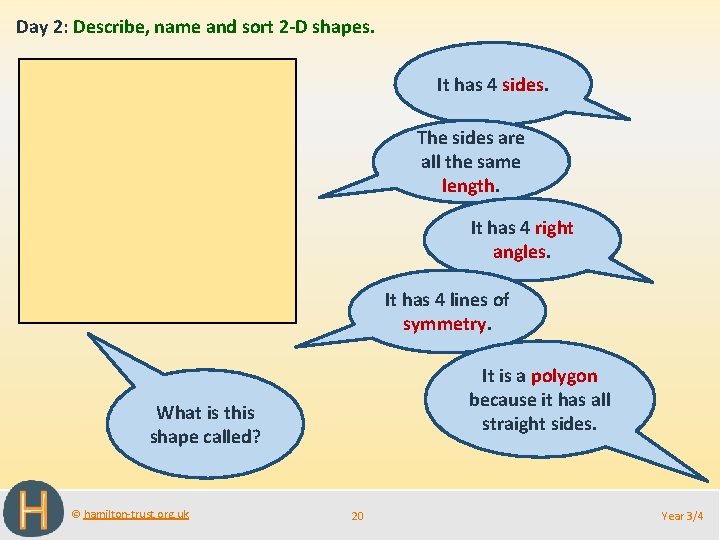
Day 2: Describe, name and sort 2 -D shapes. It has 4 sides. The sides are all the same length. It has 4 right angles. It has 4 lines of symmetry. It is a polygon because it has all straight sides. What is this shape called? © hamilton-trust. org. uk 20 Year 3/4
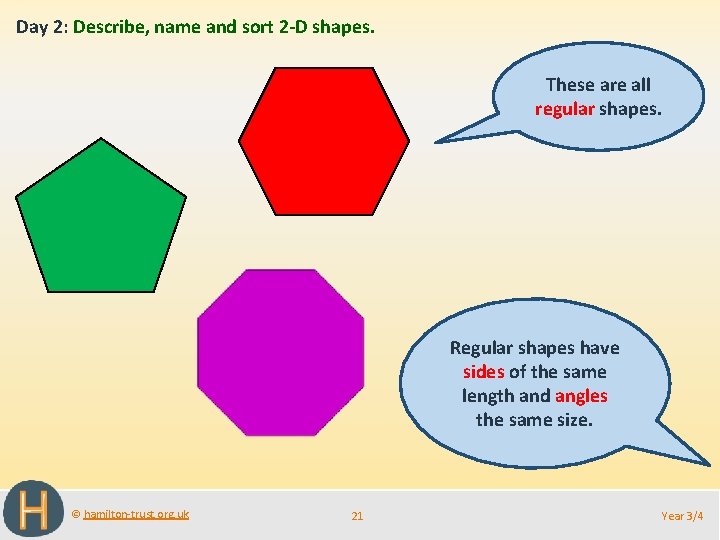
Day 2: Describe, name and sort 2 -D shapes. These are all regular shapes. Regular shapes have sides of the same length and angles the same size. © hamilton-trust. org. uk 21 Year 3/4
Day 2: Describe, name and sort 2 -D shapes. Describe your shape to your partner. Can they guess your shape? You have 30 seconds! Choose a shape and draw around it on your whiteboard. Jot down how you would describe your shape. © hamilton-trust. org. uk Now swap around! 22 Year 3/4
Day 2: Describe, name and sort 2 -D shapes. What mathematical language did we use to describe the shapes…? © hamilton-trust. org. uk 23 Year 3/4
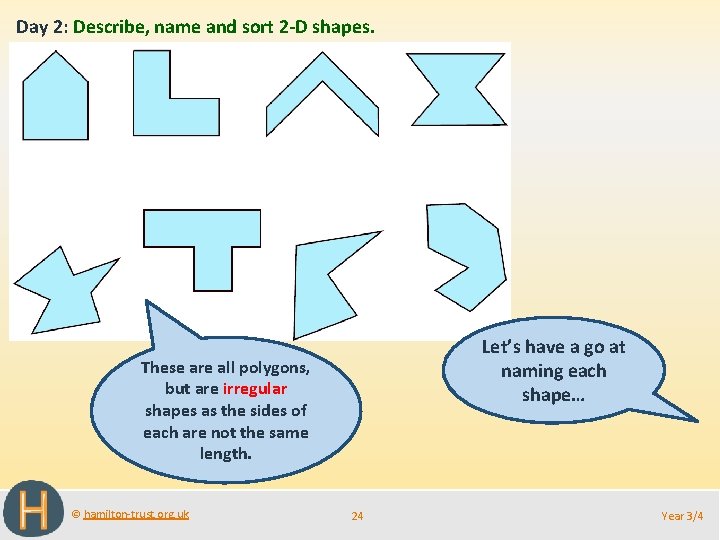
Day 2: Describe, name and sort 2 -D shapes. Let’s have a go at naming each shape… These are all polygons, but are irregular shapes as the sides of each are not the same length. © hamilton-trust. org. uk 24 Year 3/4
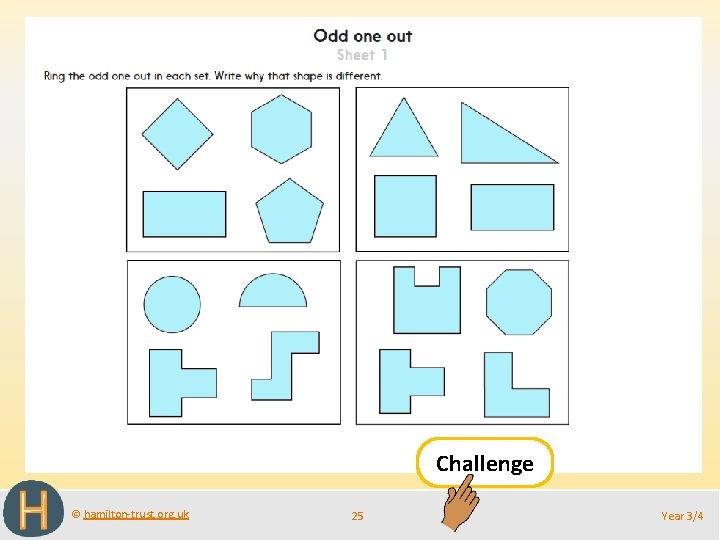
Challenge © hamilton-trust. org. uk 25 Year 3/4
Shape Symmetry and 2 -D shapes Objectives Day 3 Describe, name and sort 2 -D shapes using diagrams Identify properties of triangles and sort them using diagrams © hamilton-trust. org. uk 26 Year 3/4
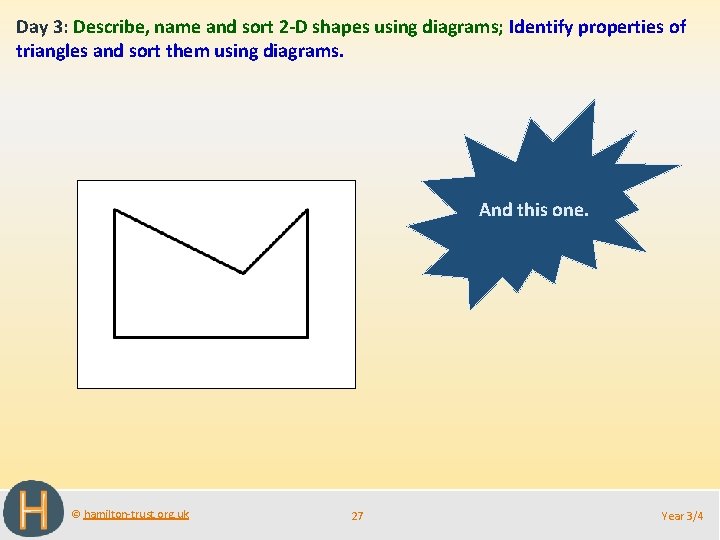
Day 3: Describe, name and sort 2 -D shapes using diagrams; Identify properties of triangles and sort them using diagrams. Describe Now this shape And describe this one. this to your one. partner. © hamilton-trust. org. uk 27 Year 3/4
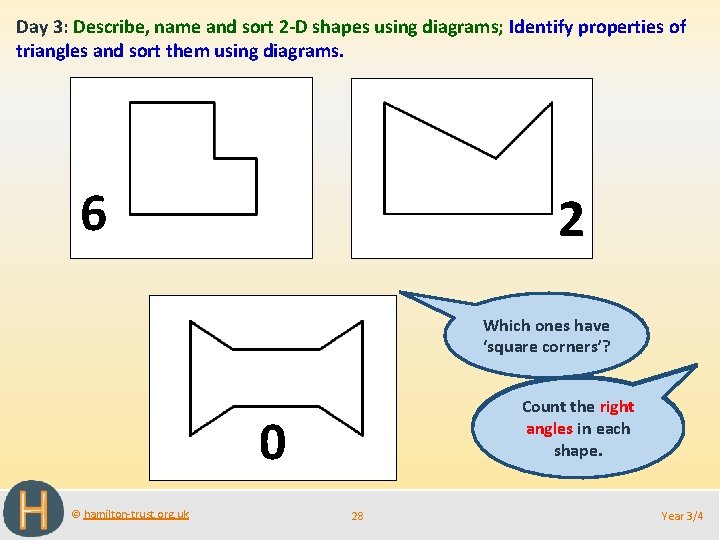
Day 3: Describe, name and sort 2 -D shapes using diagrams; Identify properties of triangles and sort them using diagrams. 6 2 Which ones have ‘square corners’? Remember that Count the right these anglesare in called each right angles. shape. 0 © hamilton-trust. org. uk 28 Year 3/4
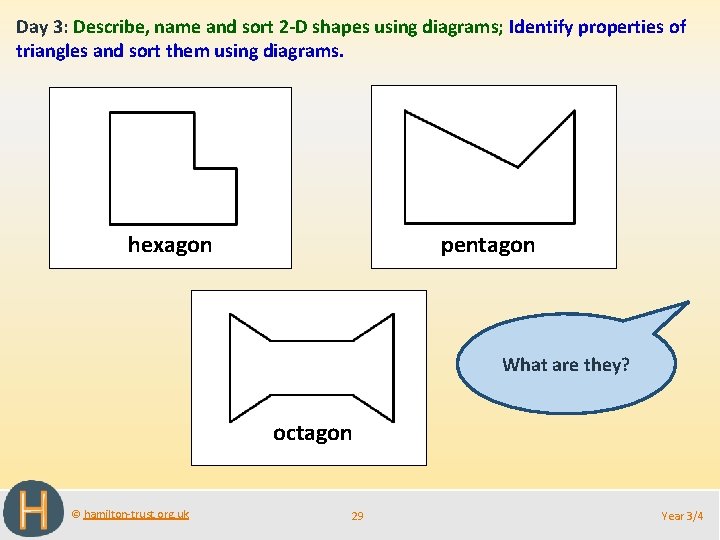
Day 3: Describe, name and sort 2 -D shapes using diagrams; Identify properties of triangles and sort them using diagrams. hexagon pentagon What are they? octagon © hamilton-trust. org. uk 29 Year 3/4
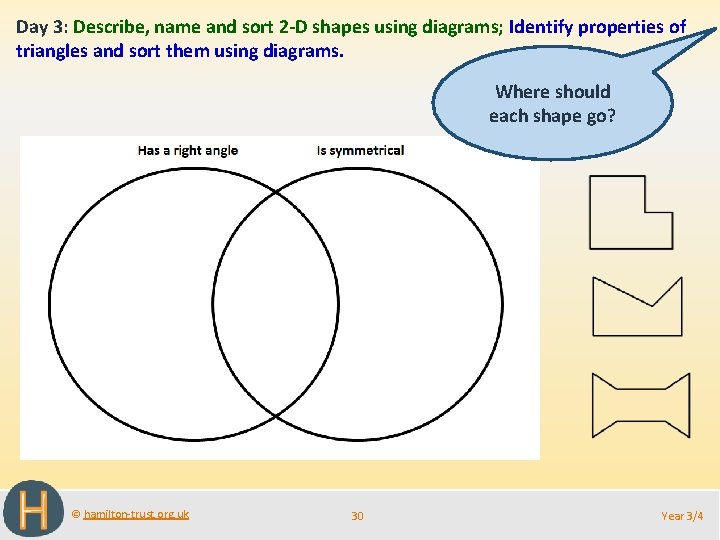
Day 3: Describe, name and sort 2 -D shapes using diagrams; Identify properties of triangles and sort them using diagrams. Where should each shape go? © hamilton-trust. org. uk 30 Year 3/4
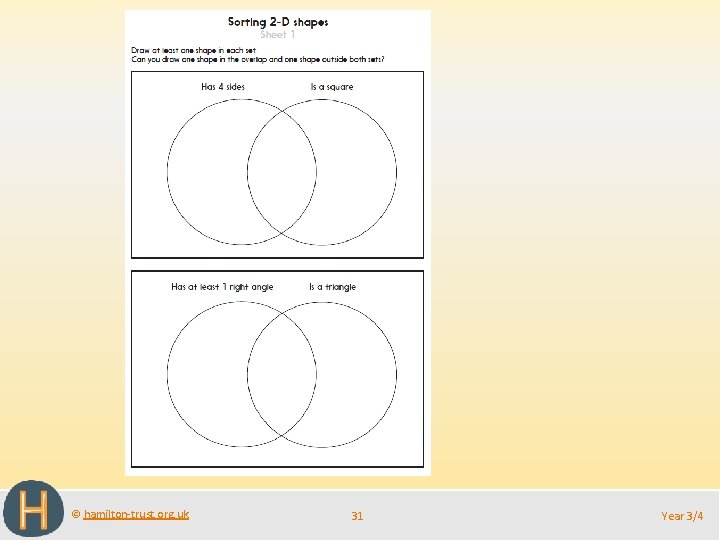
© hamilton-trust. org. uk 31 Year 3/4
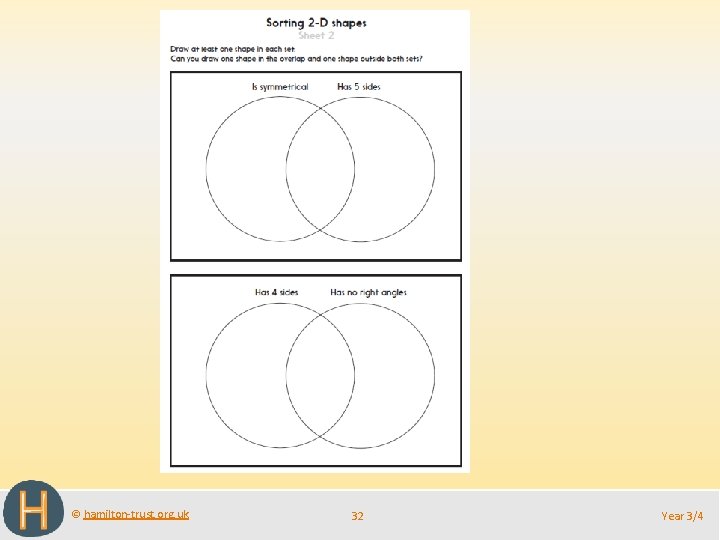
© hamilton-trust. org. uk 32 Year 3/4
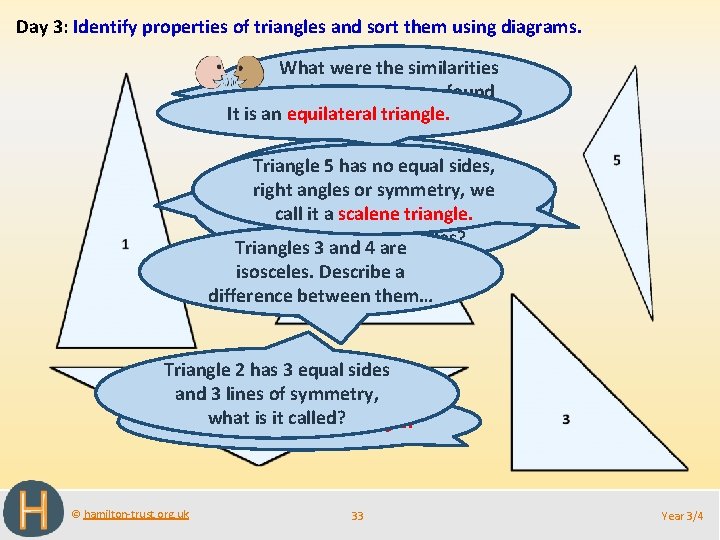
Day 3: Identify properties of triangles and sort them using diagrams. What were the similarities and differences we found It is an equilateral with thesetriangles? Triangle 15 is has no equal 2 sides, Triangle isosceles, sides right angles symmetry, are the sameorlength and itwe is call it a scalene triangle. symmetrical. Which other triangles isosceles? Triangles 3 andare 4 are isosceles. Describe a difference between them… Triangle 2 has 3 equal sides and 3 lines of symmetry, what is it called? Triangle 3 has a right angle! © hamilton-trust. org. uk 33 Year 3/4
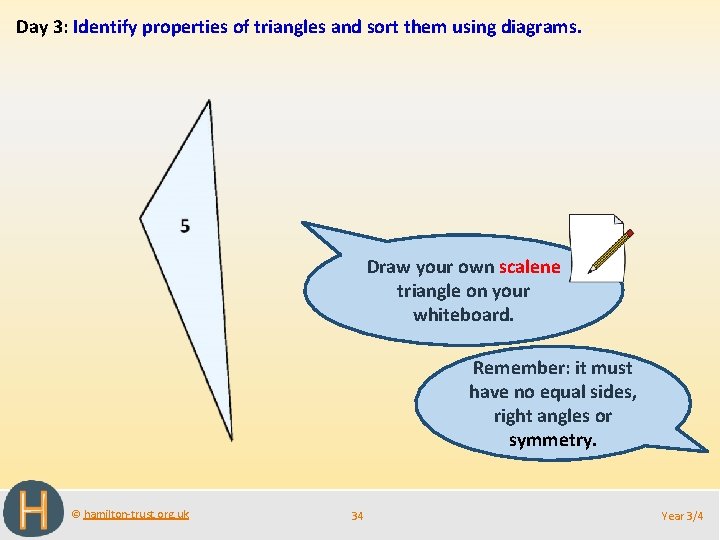
Day 3: Identify properties of triangles and sort them using diagrams. Draw your own scalene triangle on your whiteboard. Remember: it must have no equal sides, right angles or symmetry. © hamilton-trust. org. uk 34 Year 3/4
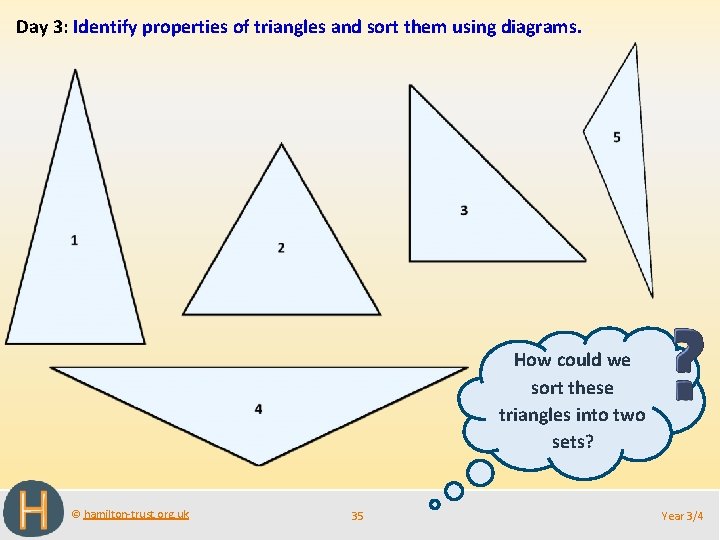
Day 3: Identify properties of triangles and sort them using diagrams. How could we sort these triangles into two sets? © hamilton-trust. org. uk 35 Year 3/4
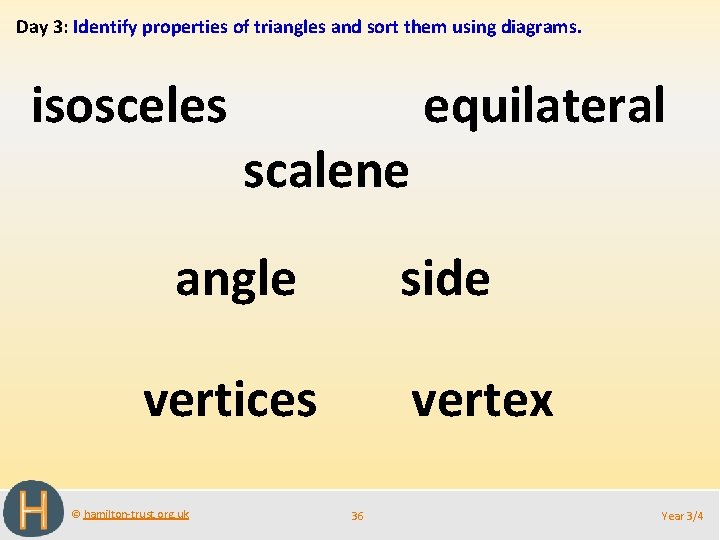
Day 3: Identify properties of triangles and sort them using diagrams. isosceles scalene angle side vertices © hamilton-trust. org. uk equilateral vertex 36 Year 3/4
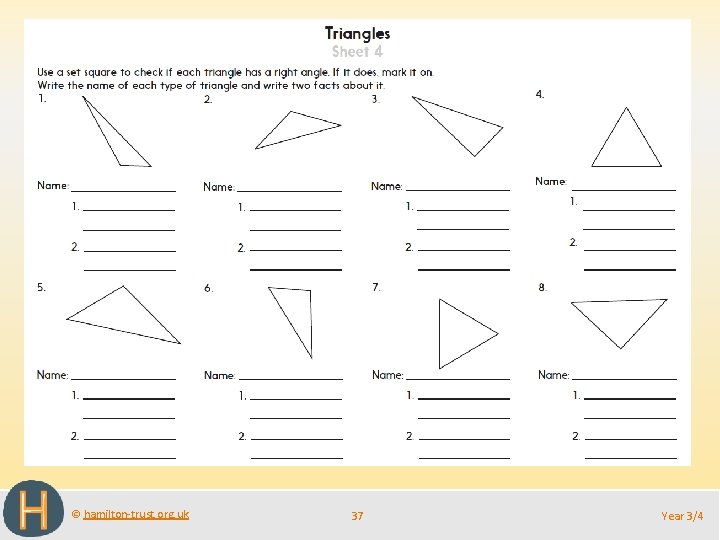
© hamilton-trust. org. uk 37 Year 3/4
Shape Symmetry and 2 -D shapes Well Done! You’ve completed this unit. Objectives Day 1 Recognise symmetry and complete symmetrical drawings Recognise symmetry in a variety of diagrams; draw symmetrical patterns Day 2 Describe, name and sort 2 -D shapes Draw different polygons; identify their properties Day 3 Describe, name and sort 2 -D shapes using diagrams Identify properties of triangles and sort them using diagrams © hamilton-trust. org. uk 38 Year 3/4
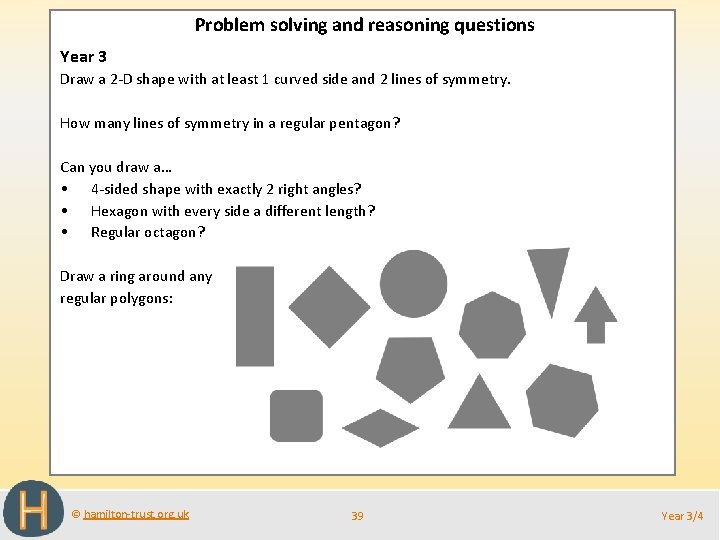
Problem solving and reasoning questions Year 3 Draw a 2 -D shape with at least 1 curved side and 2 lines of symmetry. How many lines of symmetry in a regular pentagon? Can you draw a… • 4 -sided shape with exactly 2 right angles? • Hexagon with every side a different length? • Regular octagon? Draw a ring around any regular polygons: © hamilton-trust. org. uk 39 Year 3/4
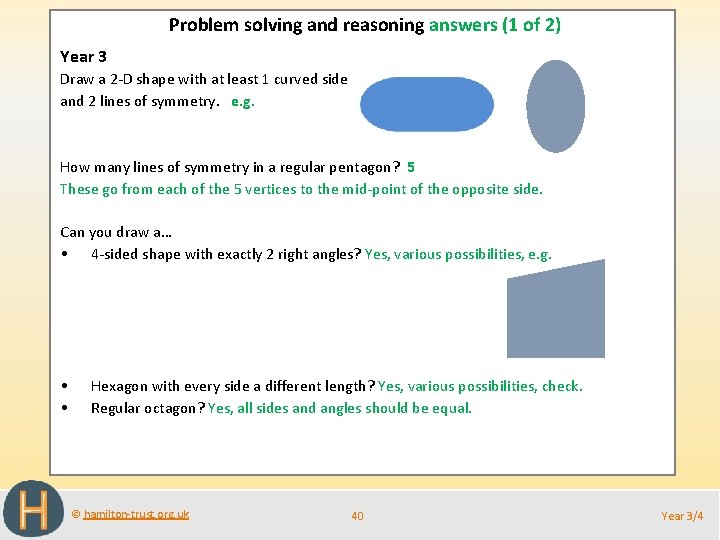
Problem solving and reasoning answers (1 of 2) Year 3 Draw a 2 -D shape with at least 1 curved side and 2 lines of symmetry. e. g. How many lines of symmetry in a regular pentagon? 5 These go from each of the 5 vertices to the mid-point of the opposite side. Can you draw a… • 4 -sided shape with exactly 2 right angles? Yes, various possibilities, e. g. • • Hexagon with every side a different length? Yes, various possibilities, check. Regular octagon? Yes, all sides and angles should be equal. © hamilton-trust. org. uk 40 Year 3/4
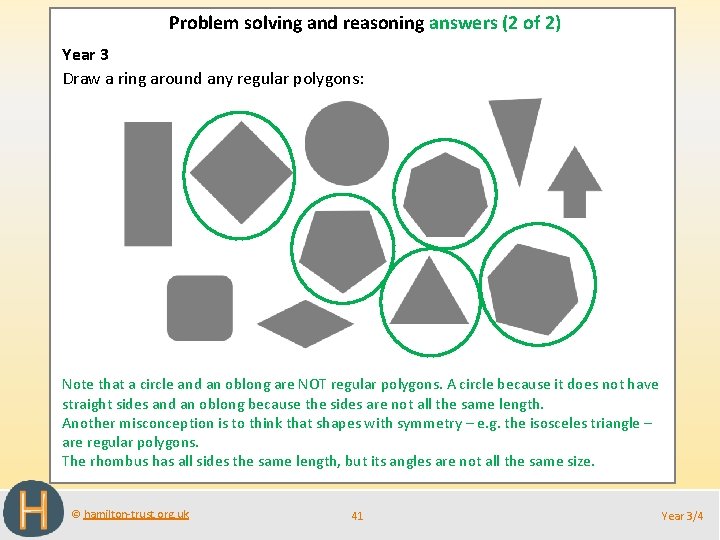
Problem solving and reasoning answers (2 of 2) Year 3 Draw a ring around any regular polygons: Note that a circle and an oblong are NOT regular polygons. A circle because it does not have straight sides and an oblong because the sides are not all the same length. Another misconception is to think that shapes with symmetry – e. g. the isosceles triangle – are regular polygons. The rhombus has all sides the same length, but its angles are not all the same size. © hamilton-trust. org. uk 41 Year 3/4
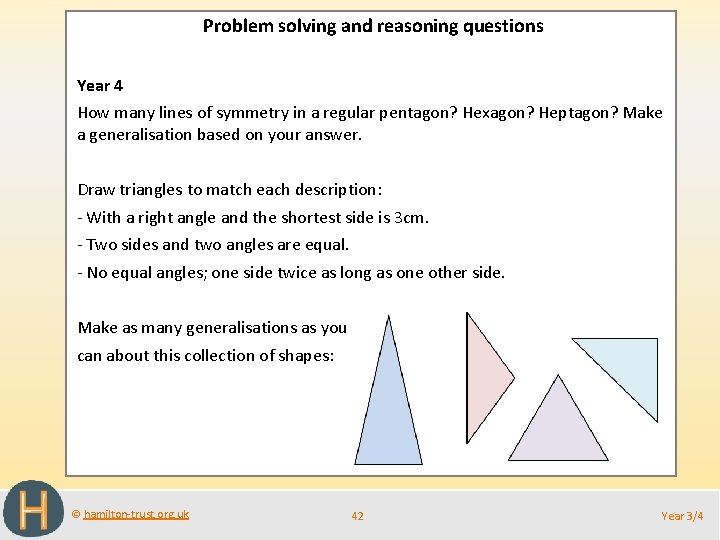
Problem solving and reasoning questions Year 4 How many lines of symmetry in a regular pentagon? Hexagon? Heptagon? Make a generalisation based on your answer. Draw triangles to match each description: - With a right angle and the shortest side is 3 cm. - Two sides and two angles are equal. - No equal angles; one side twice as long as one other side. Make as many generalisations as you can about this collection of shapes: © hamilton-trust. org. uk 42 Year 3/4
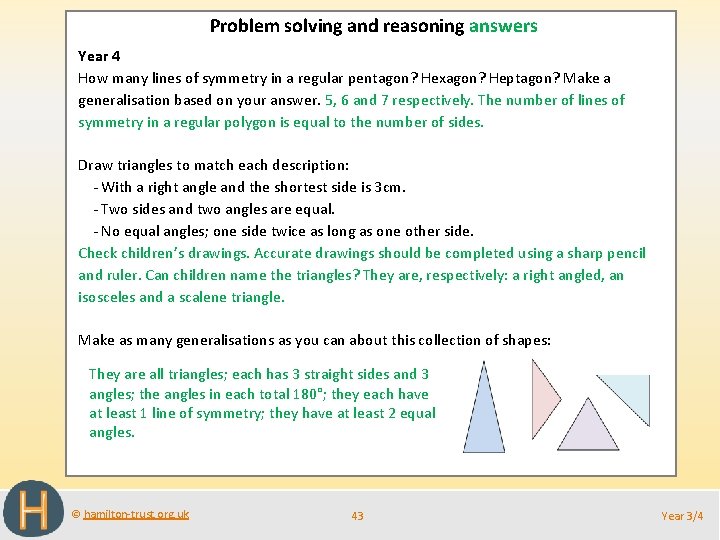
Problem solving and reasoning answers Year 4 How many lines of symmetry in a regular pentagon? Hexagon? Heptagon? Make a generalisation based on your answer. 5, 6 and 7 respectively. The number of lines of symmetry in a regular polygon is equal to the number of sides. Draw triangles to match each description: - With a right angle and the shortest side is 3 cm. - Two sides and two angles are equal. - No equal angles; one side twice as long as one other side. Check children’s drawings. Accurate drawings should be completed using a sharp pencil and ruler. Can children name the triangles? They are, respectively: a right angled, an isosceles and a scalene triangle. Make as many generalisations as you can about this collection of shapes: They are all triangles; each has 3 straight sides and 3 angles; the angles in each total 180°; they each have at least 1 line of symmetry; they have at least 2 equal angles. © hamilton-trust. org. uk 43 Year 3/4
- Slides: 43