
Shape coexistence in the island of inversion Search
- Slides: 11
Shape coexistence in the “island of inversion”: Search for the 02+ state in 32 Mg applying a two-neutron transfer reaction Proposal INTC-2008 -008 / P-239 Thorsten Kröll Physik-Department E 12, TU München, Germany Maier-Leibnitz-Laboratorium für Kern- und Teilchenphysik, Garching, Germany
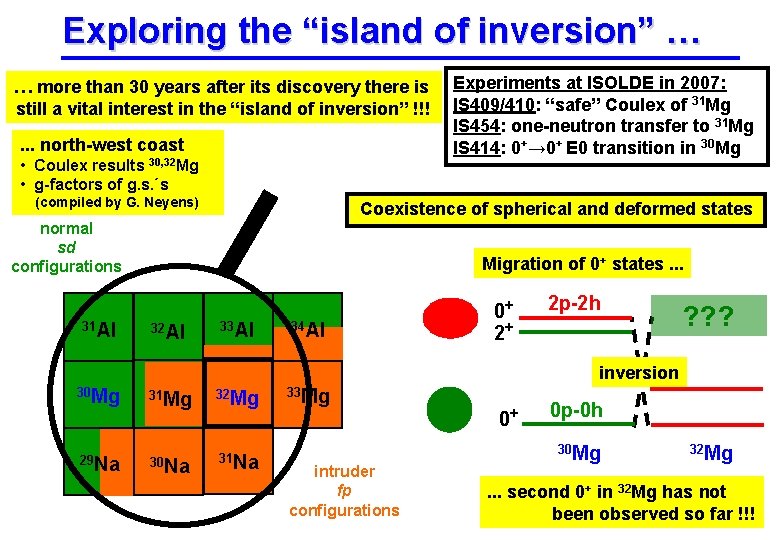
Exploring the “island of inversion” … … more than 30 years after its discovery there is still a vital interest in the “island of inversion” !!!. . . north-west coast • Coulex results 30, 32 Mg • g-factors of g. s. ´s (compiled by G. Neyens) Coexistence of spherical and deformed states normal sd configurations 31 Al Experiments at ISOLDE in 2007: IS 409/410: “safe” Coulex of 31 Mg IS 454: one-neutron transfer to 31 Mg IS 414: 0+→ 0+ E 0 transition in 30 Mg Migration of 0+ states. . . 32 Al 33 Al 34 Al 0+ 2+ 2 p-2 h ? ? ? inversion 30 Mg 31 Mg 32 Mg 29 Na 30 Na 31 Na 33 Mg intruder fp configurations 0+ 0 p-0 h 30 Mg 32 Mg . . . second 0+ in 32 Mg has not been observed so far !!!
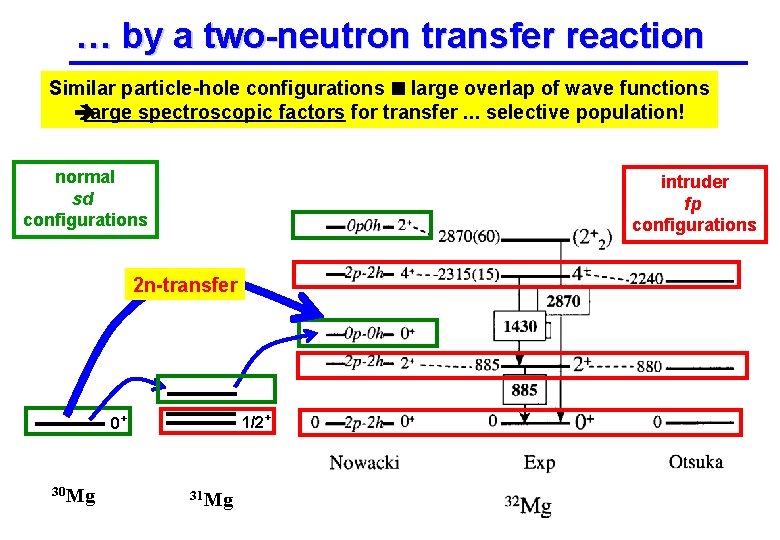
… by a two-neutron transfer reaction Similar particle-hole configurations n large overlap of wave functions è large spectroscopic factors for transfer. . . selective population! normal sd configurations intruder fp configurations 2 n-transfer 1/2+ 0+ 30 Mg 31 Mg
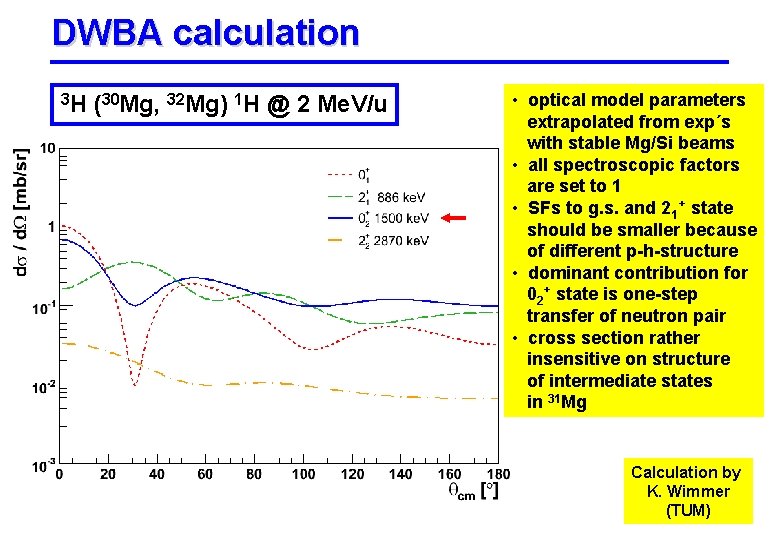
DWBA calculation 3 H (30 Mg, 32 Mg) 1 H @ 2 Me. V/u • optical model parameters extrapolated from exp´s with stable Mg/Si beams • all spectroscopic factors are set to 1 • SFs to g. s. and 21+ state should be smaller because of different p-h-structure • dominant contribution for 02+ state is one-step transfer of neutron pair • cross section rather insensitive on structure of intermediate states in 31 Mg Calculation by K. Wimmer (TUM)
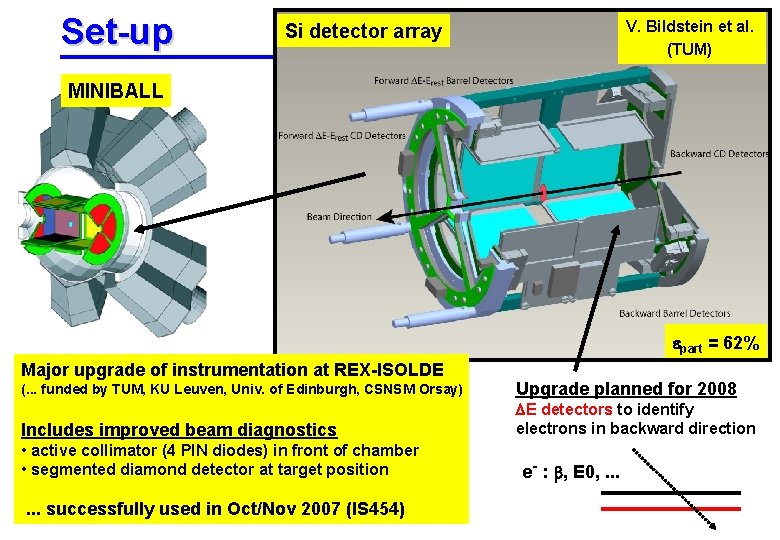
Set-up V. Bildstein et al. (TUM) Si detector array MINIBALL epart = 62% Major upgrade of instrumentation at REX-ISOLDE (. . . funded by TUM, KU Leuven, Univ. of Edinburgh, CSNSM Orsay) Includes improved beam diagnostics • active collimator (4 PIN diodes) in front of chamber • segmented diamond detector at target position . . . successfully used in Oct/Nov 2007 (IS 454) Upgrade planned for 2008 DE detectors to identify electrons in backward direction e- : b, E 0, . . .
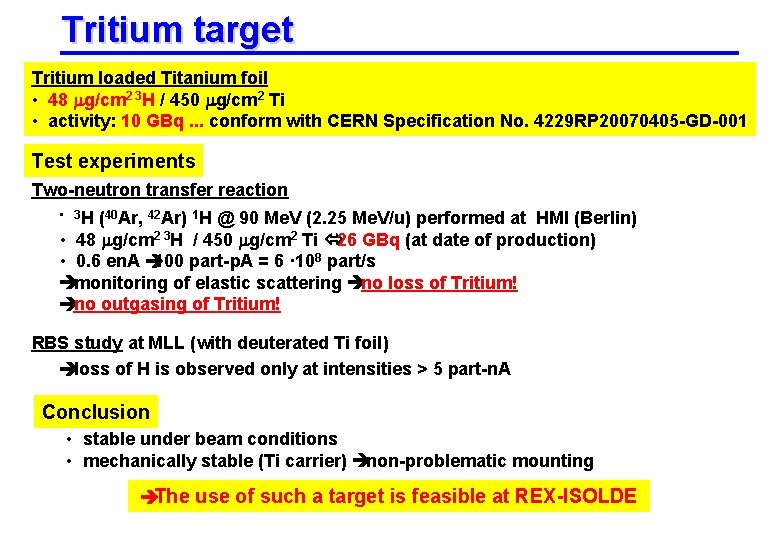
Tritium target Tritium loaded Titanium foil • 48 mg/cm 2 3 H / 450 mg/cm 2 Ti • activity: 10 GBq. . . conform with CERN Specification No. 4229 RP 20070405 -GD-001 Test experiments Two-neutron transfer reaction • 3 H (40 Ar, 42 Ar) 1 H @ 90 Me. V (2. 25 Me. V/u) performed at HMI (Berlin) • 48 mg/cm 2 3 H / 450 mg/cm 2 Ti ó 26 GBq (at date of production) • 0. 6 en. A è 100 part-p. A = 6 · 108 part/s èmonitoring of elastic scattering èno loss of Tritium! èno outgasing of Tritium! RBS study at MLL (with deuterated Ti foil) èloss of H is observed only at intensities > 5 part-n. A Conclusion • stable under beam conditions • mechanically stable (Ti carrier) ènon-problematic mounting èThe use of such a target is feasible at REX-ISOLDE
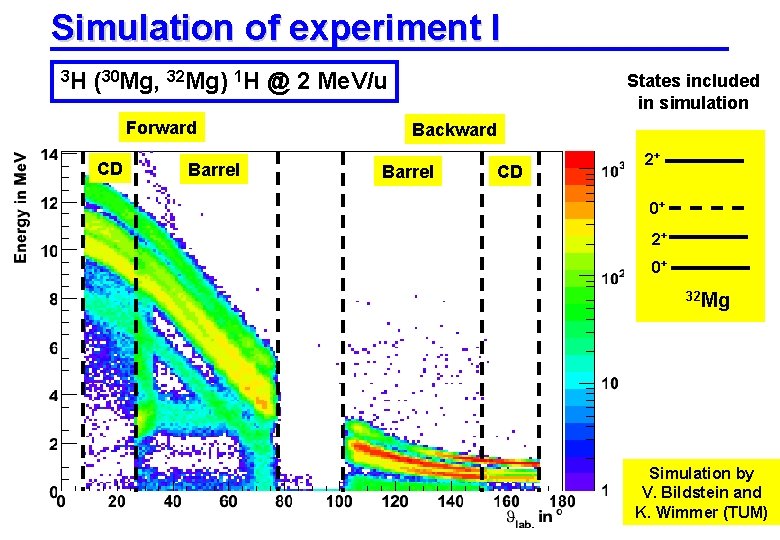
Simulation of experiment I 3 H (30 Mg, 32 Mg) 1 H Forward CD Barrel @ 2 Me. V/u States included in simulation Backward Barrel CD 2+ 0+ 32 Mg Simulation by V. Bildstein and K. Wimmer (TUM)
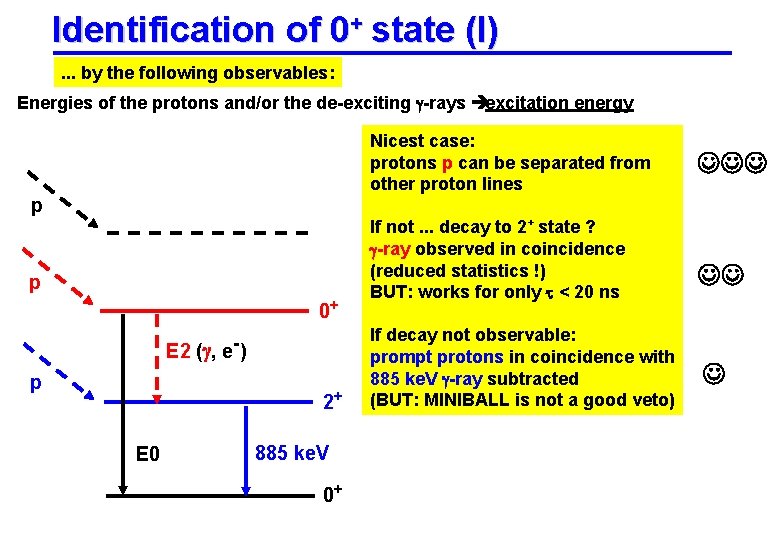
Identification of 0+ state (I). . . by the following observables: Energies of the protons and/or the de-exciting g-rays èexcitation energy Nicest case: protons p can be separated from other proton lines p p 0+ E 2 (g, e-) p 2+ E 0 885 ke. V 0+ If not. . . decay to 2+ state ? g-ray observed in coincidence (reduced statistics !) BUT: works for only t < 20 ns If decay not observable: prompt protons in coincidence with 885 ke. V g-ray subtracted (BUT: MINIBALL is not a good veto) JJJ JJ J
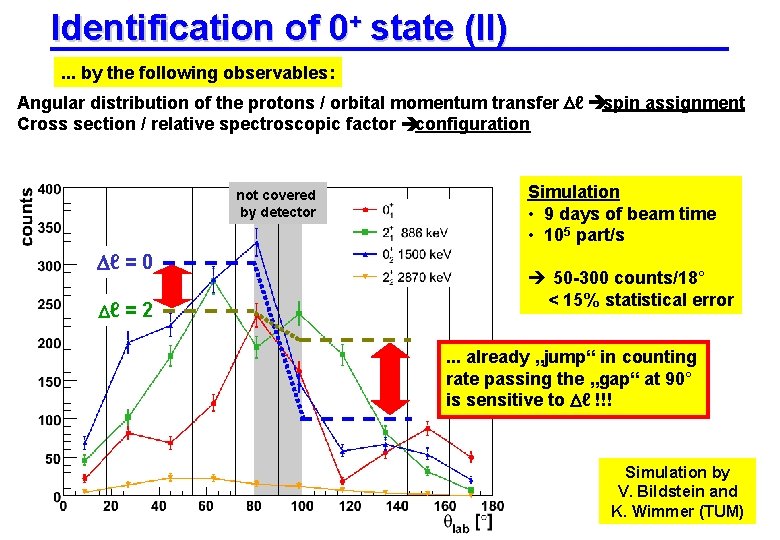
Identification of 0+ state (II). . . by the following observables: Angular distribution of the protons / orbital momentum transfer Dℓ èspin assignment Cross section / relative spectroscopic factor èconfiguration not covered by detector Dℓ = 0 Dℓ = 2 Simulation • 9 days of beam time • 105 part/s è 50 -300 counts/18° < 15% statistical error. . . already „jump“ in counting rate passing the „gap“ at 90° is sensitive to Dℓ !!! Simulation by V. Bildstein and K. Wimmer (TUM)
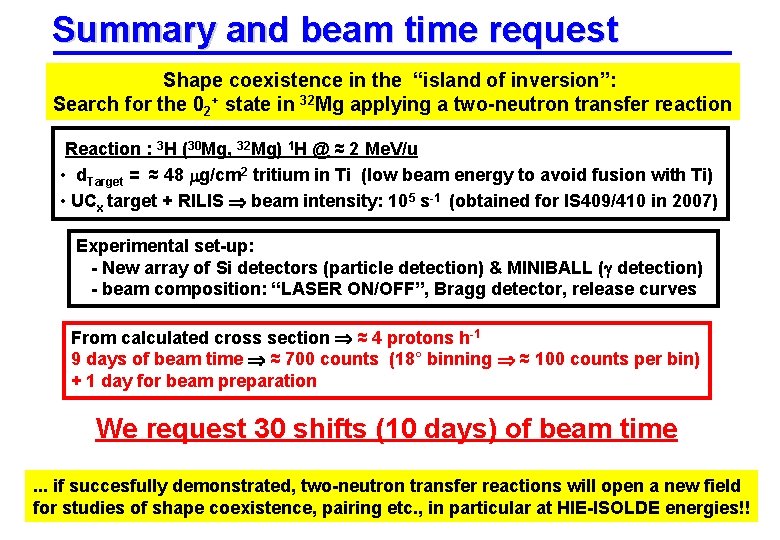
Summary and beam time request Shape coexistence in the “island of inversion”: Search for the 02+ state in 32 Mg applying a two-neutron transfer reaction Reaction : 3 H (30 Mg, 32 Mg) 1 H @ ≈ 2 Me. V/u • d. Target = ≈ 48 mg/cm 2 tritium in Ti (low beam energy to avoid fusion with Ti) • UCx target + RILIS Þ beam intensity: 105 s-1 (obtained for IS 409/410 in 2007) Experimental set-up: - New array of Si detectors (particle detection) & MINIBALL (g detection) - beam composition: “LASER ON/OFF”, Bragg detector, release curves From calculated cross section Þ ≈ 4 protons h-1 9 days of beam time Þ ≈ 700 counts (18° binning Þ ≈ 100 counts per bin) + 1 day for beam preparation We request 30 shifts (10 days) of beam time. . . if succesfully demonstrated, two-neutron transfer reactions will open a new field for studies of shape coexistence, pairing etc. , in particular at HIE-ISOLDE energies!!
… the collaboration Proposal INTC-2008 -008 / P-239 Th. Kröll 1, K. Wimmer 1, R. Krücken 1, V. Bildstein 1, T. Behrens 1, T. Faestermann 1, R. Gernhäuser 1, M. Mahgoub 1, P. Maierbeck 1, D. Habs 2, P. Thirolf 2, T. Morgan 2, W. Schwerdtfeger 2, R. Lutter 2, P. Van Duppen 3, R. Raabe 19, N. Patronis 3, N. Bree 3, M. Huyse 3, O. Ivanov 3, J. Diriken 3, I. Stefanescu 18, J. Van de Walle 4, E. Clement 19, J. Cederkäll 4, D. Voulot 4, F. Wenander 4, L. M. Fraile 5, T. Davinson 6, P. J. Woods 6, T. Nilsson 7, E. Tengborn 7, R. Chapman 8, J. F. Smith 8, L. Angus 8, M. Labiche 17, P. Wady 7, D. Jenkins 9, J. Butterworth 9, B. S. Nara Singh 9, S. Freeman 10, C. Fitzpatrick 10, A. Deacon 10, P. Butler 11, M. Scheck 11, A. Blazhev 12, N. Warr 12, P. Reiter 12, M. Seidlitz 12, G. Georgiev 13, E. Fiori 13, R. Lozeva 13, N. Pietralla 14, G. Schrieder 14, D. Balabanski 15, G. Lo Bianco 16, S. Nardelli 16, and the REX-ISOLDE and MINIBALL collaborations 1 TU München – 2 LMU München – 3 KU Leuven – 4 CERN Genève 5 UC Madrid – 6 University of Edinburgh – 7 Chalmers TH Göteborg 8 University of the West of Scotland, Paisley – 9 University of York 10 University of Manchester – 11 University of Liverpool – 12 Universität zu Köln 13 CSNSM Orsay – 14 TU Darmstadt – 15 INRNE Sofia – 16 Università di Camerino 17 Daresbury Laboratory – 18 Argonne National Laboratory – 19 GANIL Caen