
Shape and Space Circles The value of For

- Slides: 17
Shape and Space Circles
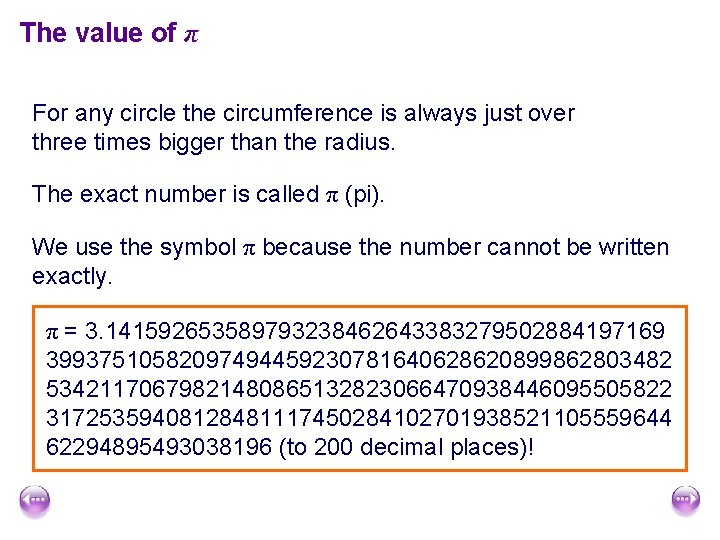
The value of π For any circle the circumference is always just over three times bigger than the radius. The exact number is called π (pi). We use the symbol π because the number cannot be written exactly. π = 3. 141592653589793238462643383279502884197169 39937510582097494459230781640628620899862803482 53421170679821480865132823066470938446095505822 31725359408128481117450284102701938521105559644 62294895493038196 (to 200 decimal places)!
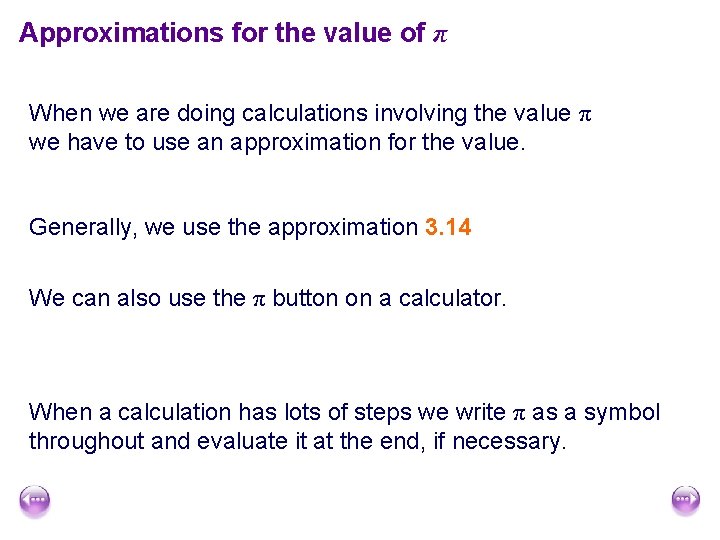
Approximations for the value of π When we are doing calculations involving the value π we have to use an approximation for the value. Generally, we use the approximation 3. 14 We can also use the π button on a calculator. When a calculation has lots of steps we write π as a symbol throughout and evaluate it at the end, if necessary.
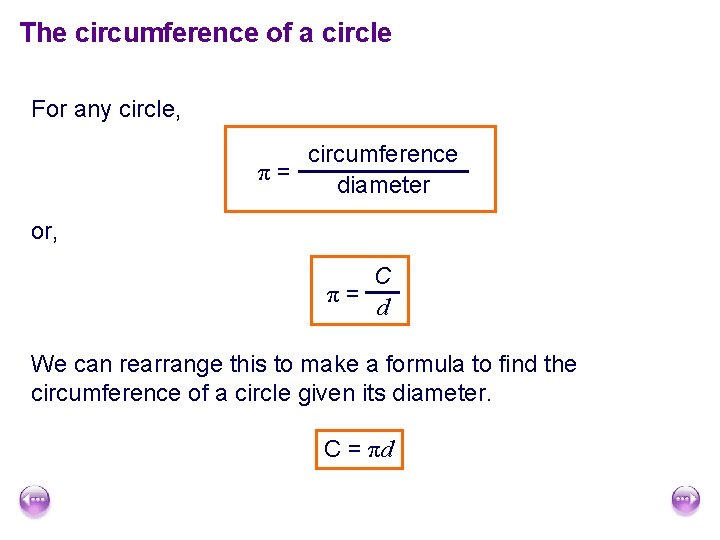
The circumference of a circle For any circle, circumference π= diameter or, C π= d We can rearrange this to make a formula to find the circumference of a circle given its diameter. C = πd
Circle circumference and diameter
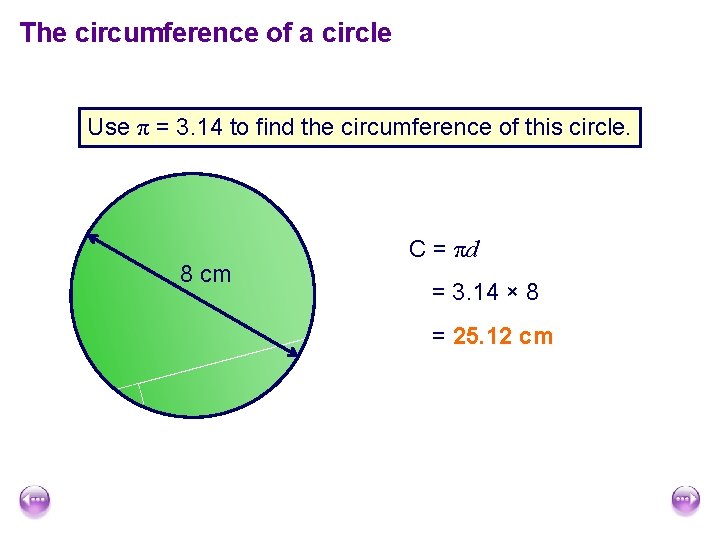
The circumference of a circle Use π = 3. 14 to find the circumference of this circle. 8 cm C = πd = 3. 14 × 8 = 25. 12 cm
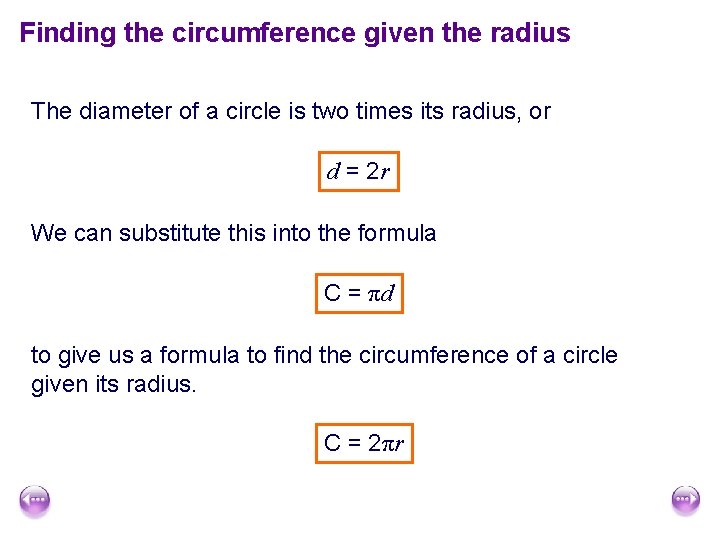
Finding the circumference given the radius The diameter of a circle is two times its radius, or d = 2 r We can substitute this into the formula C = πd to give us a formula to find the circumference of a circle given its radius. C = 2πr
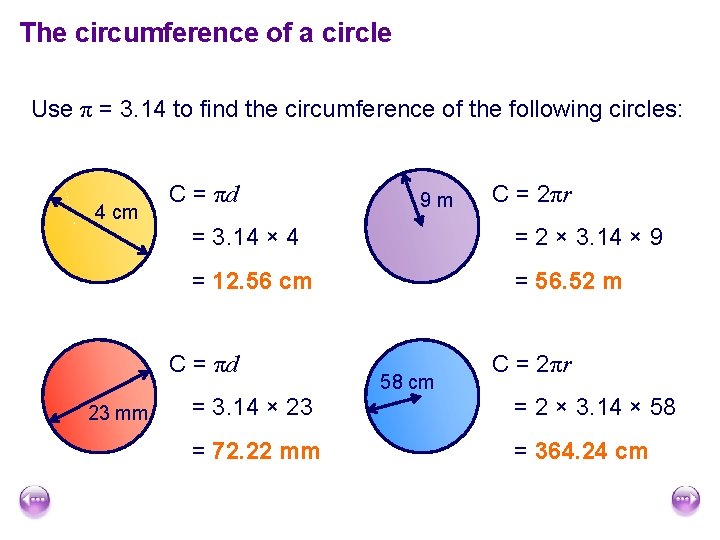
The circumference of a circle Use π = 3. 14 to find the circumference of the following circles: 4 cm C = πd C = 2πr = 3. 14 × 4 = 2 × 3. 14 × 9 = 12. 56 cm = 56. 52 m C = πd 23 mm 9 m 58 cm C = 2πr = 3. 14 × 23 = 2 × 3. 14 × 58 = 72. 22 mm = 364. 24 cm
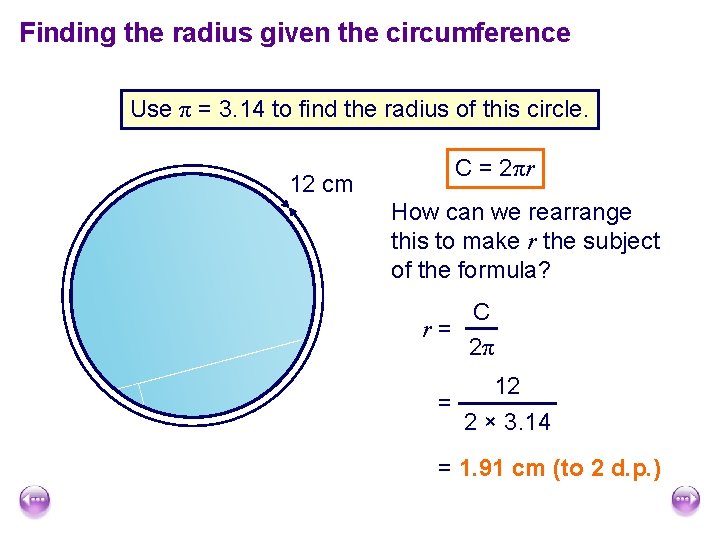
Finding the radius given the circumference Use π = 3. 14 to find the radius of this circle. 12 cm C = 2πr How can we rearrange this to make r the subject of the formula? C r= ? 2π 12 = 2 × 3. 14 = 1. 91 cm (to 2 d. p. )
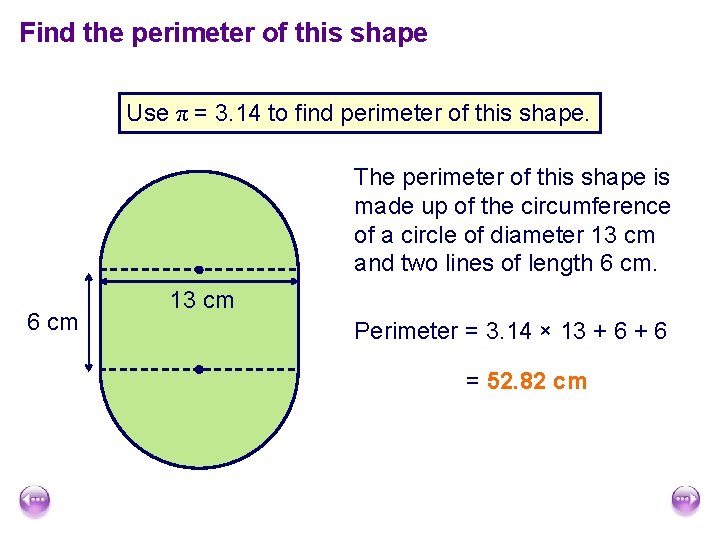
Find the perimeter of this shape Use π = 3. 14 to find perimeter of this shape. The perimeter of this shape is made up of the circumference of a circle of diameter 13 cm and two lines of length 6 cm 13 cm Perimeter = 3. 14 × 13 + 6 = 52. 82 cm
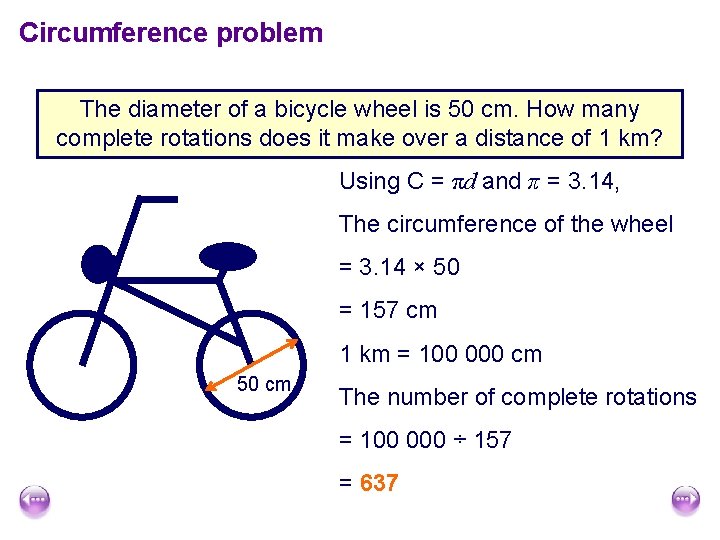
Circumference problem The diameter of a bicycle wheel is 50 cm. How many complete rotations does it make over a distance of 1 km? Using C = πd and π = 3. 14, The circumference of the wheel = 3. 14 × 50 = 157 cm 1 km = 100 000 cm 50 cm The number of complete rotations = 100 000 ÷ 157 = 637
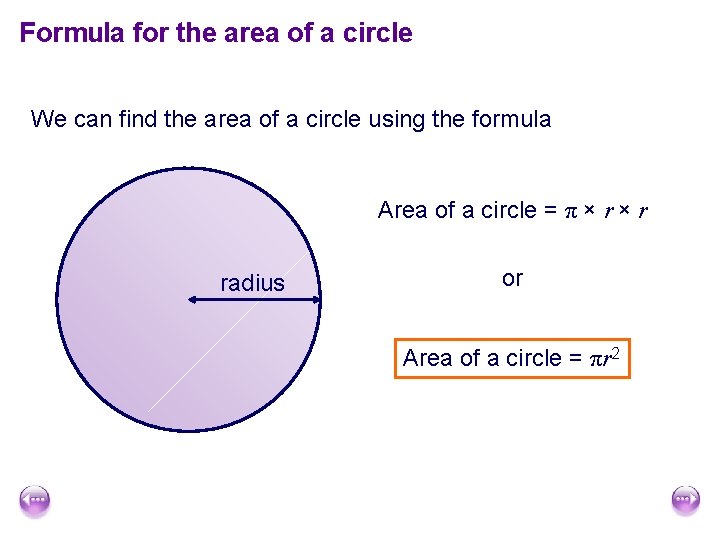
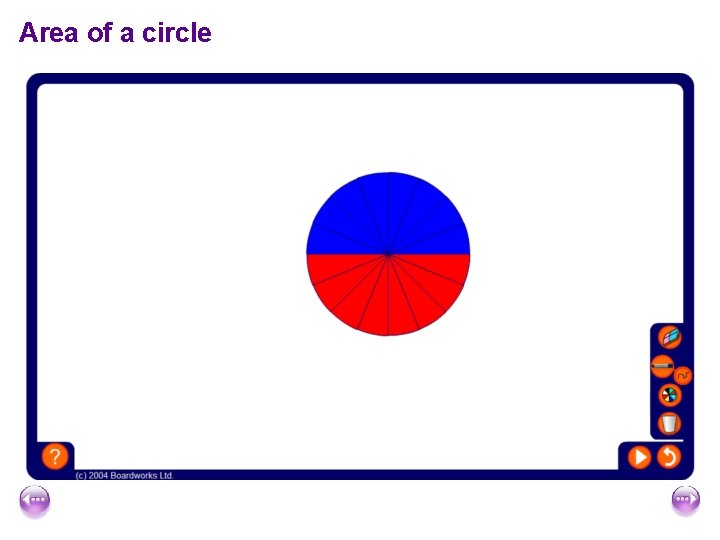
Formula for the area of a circle We can find the area of a circle using the formula Area of a circle = π × r radius or Area of a circle = πr 2
Area of a circle
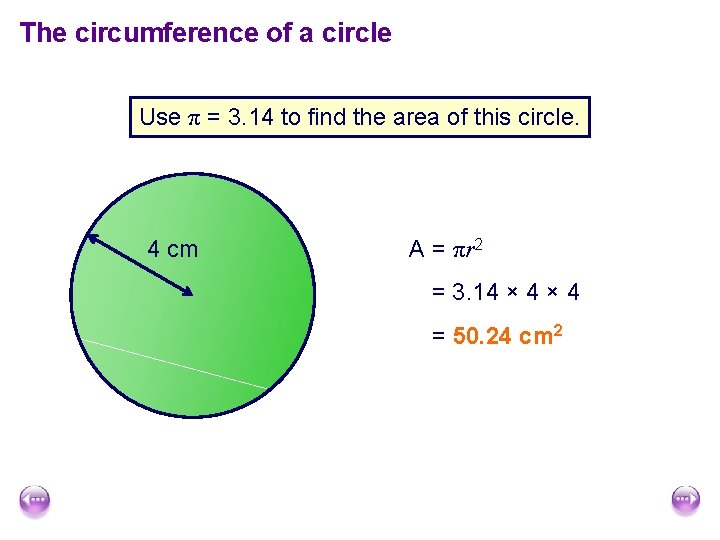
The circumference of a circle Use π = 3. 14 to find the area of this circle. 4 cm A = πr 2 = 3. 14 × 4 = 50. 24 cm 2
Finding the area given the diameter The radius of a circle is half of its radius, or d r= 2 We can substitute this into the formula A = πr 2 to give us a formula to find the area of a circle given its diameter. πd 2 A= 4
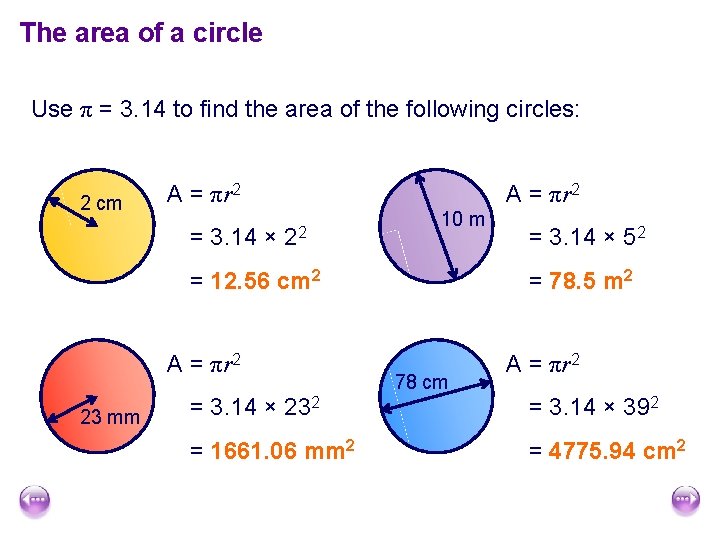
The area of a circle Use π = 3. 14 to find the area of the following circles: 2 cm A = πr 2 = 3. 14 × A = πr 2 22 10 m = 12. 56 cm 2 A = πr 2 23 mm = 3. 14 × 52 = 78. 5 m 2 78 cm A = πr 2 = 3. 14 × 232 = 3. 14 × 392 = 1661. 06 mm 2 = 4775. 94 cm 2
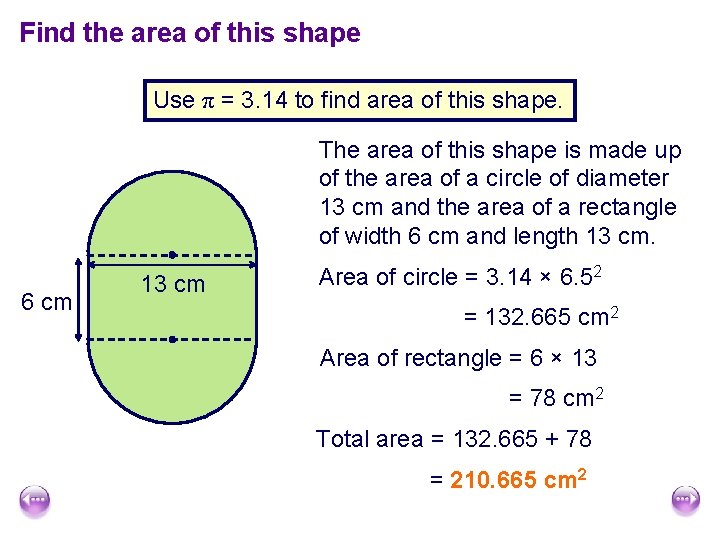
Find the area of this shape Use π = 3. 14 to find area of this shape. The area of this shape is made up of the area of a circle of diameter 13 cm and the area of a rectangle of width 6 cm and length 13 cm. 6 cm 13 cm Area of circle = 3. 14 × 6. 52 = 132. 665 cm 2 Area of rectangle = 6 × 13 = 78 cm 2 Total area = 132. 665 + 78 = 210. 665 cm 2