
Shape Analysis Overview presented by Greta Yorsh Shape
Shape Analysis Overview presented by Greta Yorsh
Shape Analysis [Jones and Muchnick 1981] • Program analysis to determine all possible shapes of the heap at every program point • Applications – Compiler optimizations – Automatic verification
Programs and Properties • Dynamically allocated memory (heap) • Destructive updates • Recursive data structures • Recursive procedures • Concurrency • Memory safety • Preservation of data structure invariants • Partial correctness • Linearizability • Termination
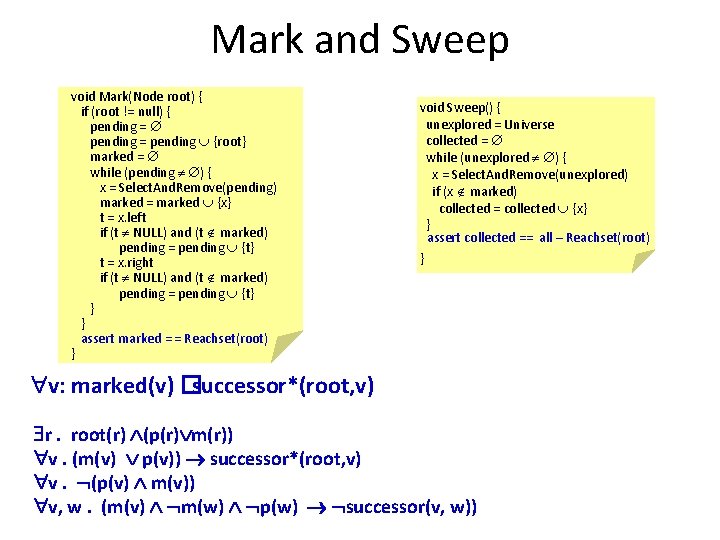
Mark and Sweep void Mark(Node root) { if (root != null) { pending = pending {root} marked = while (pending ) { x = Select. And. Remove(pending) marked = marked {x} t = x. left if (t NULL) and (t marked) pending = pending {t} t = x. right if (t NULL) and (t marked) pending = pending {t} } } assert marked = = Reachset(root) } void Sweep() { unexplored = Universe collected = while (unexplored ) { x = Select. And. Remove(unexplored) if (x marked) collected = collected {x} } assert collected == all – Reachset(root) } v: marked(v) �successor*(root, v) r. root(r) (p(r) m(r)) v. (m(v) p(v)) successor*(root, v) v. (p(v) m(v)) v, w. (m(v) m(w) p(w) successor(v, w))

LIAFA Inria Universität des Saarlandes (Wilhelm) Queen Mary MSR Berkeley MSRC Tel Aviv University (Sagiv) IBM University of Wisconsin (Reps) MSRI . . . and others. . . Parametric Shape Analysis via 3 -valued Logic 5

Timeline: Shape Analysis Parametric Shape Analysis via 3 -valued Logic [Sagiv, Reps, Wilhelm POPL’ 99 , TOPLAS’ 02] Flow analysis and optimization of Lisp-like structures [Jones and Muchnick 1981] Analysis of pointers and structures A Local Shape Analysis Based on Separation Logic [Distefano et al, TACAS’ 06] Verifying Concurrent Heap Manipulating Programs [Yahav et al, POPL’ 01] Numerical Abstractions TVLA [Gopan et al, TACAS’ 04] [Lev Ami et al, SAS‘ 00] Logical Characterization of Heap Abstractions Interprocedural and Recursive Programs [Rinetzky et al, CC‘ 01] 1981 1990 1999 2000 2001 Verifying Linearizability with Heap Decomposition [Manevich, Lev Ami et al, SAS’ 08, CAV’ 08] Verifying Linearizability [Amit et al, CAV’ 07] Procedure Local Heaps and cutpoints [Rinetzky et al, POPL’ 05] 2003 2004 2005 2006 Thread Modular Shape Analysis [Gotsman et al, PLDI 07] 2007 2008 2009
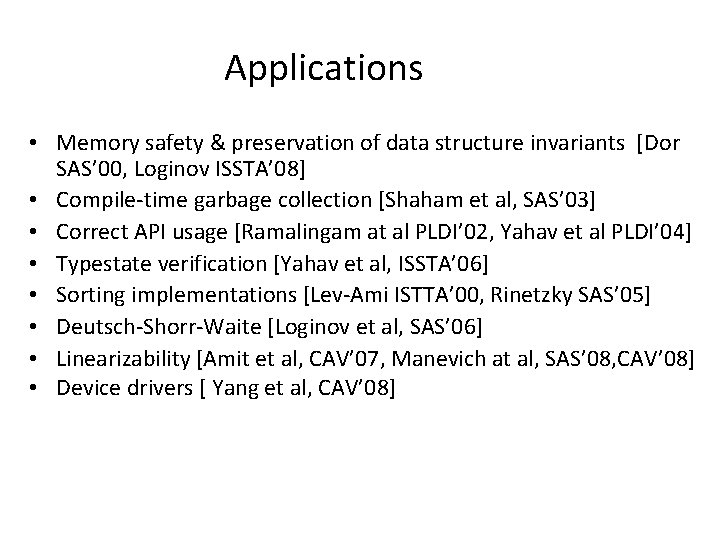
Applications • Memory safety & preservation of data structure invariants [Dor SAS’ 00, Loginov ISSTA’ 08] • Compile-time garbage collection [Shaham et al, SAS’ 03] • Correct API usage [Ramalingam at al PLDI’ 02, Yahav et al PLDI’ 04] • Typestate verification [Yahav et al, ISSTA’ 06] • Sorting implementations [Lev-Ami ISTTA’ 00, Rinetzky SAS’ 05] • Deutsch-Shorr-Waite [Loginov et al, SAS’ 06] • Linearizability [Amit et al, CAV’ 07, Manevich at al, SAS’ 08, CAV’ 08] • Device drivers [ Yang et al, CAV’ 08]

Outline • Shape abstractions in a nutshell • Computing transformers • Challenges in shape analysis
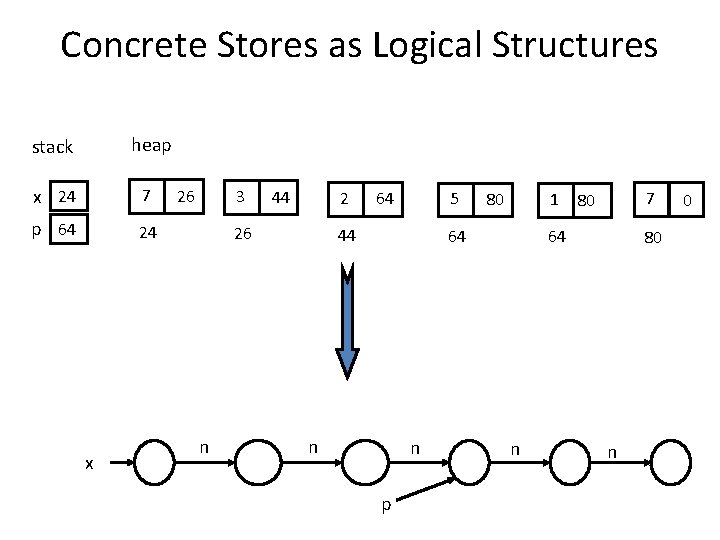
Concrete Stores as Logical Structures heap stack x 24 7 p 64 24 x 26 3 44 2 26 n 5 64 44 n 80 64 n p n 1 80 7 64 80 n 0
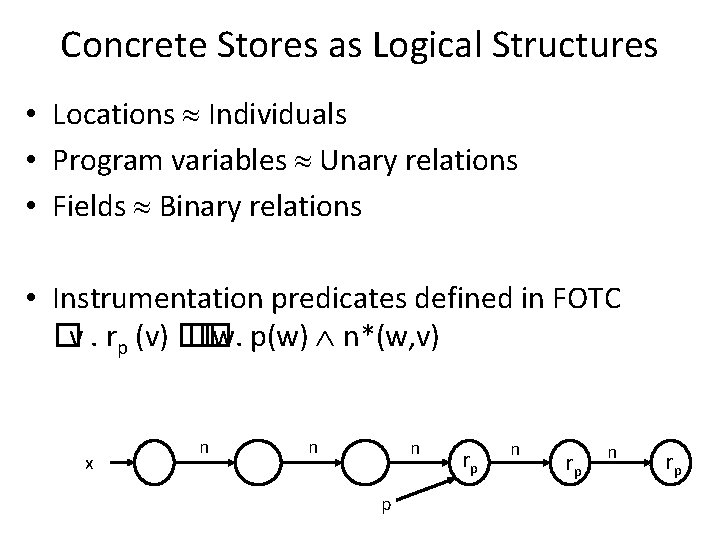
Concrete Stores as Logical Structures • Locations Individuals • Program variables Unary relations • Fields Binary relations • Instrumentation predicates defined in FOTC � v. rp (v) � � � w. p(w) n*(w, v) x n n n p r p n rp
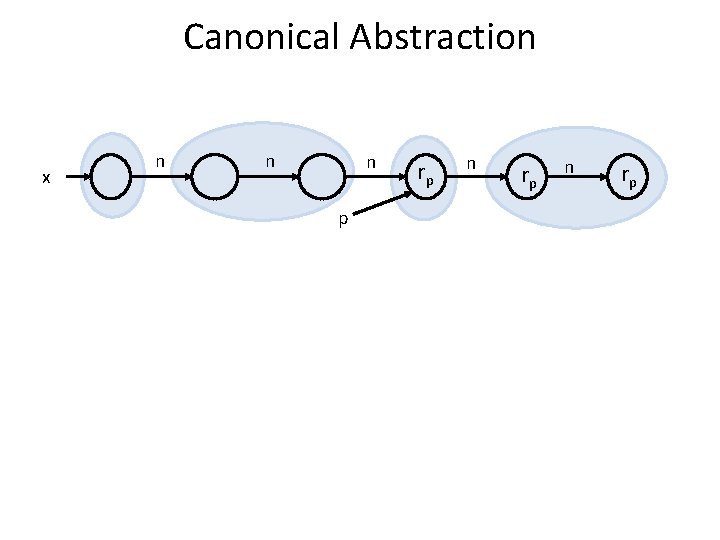
Canonical Abstraction x n n n p r p n rp
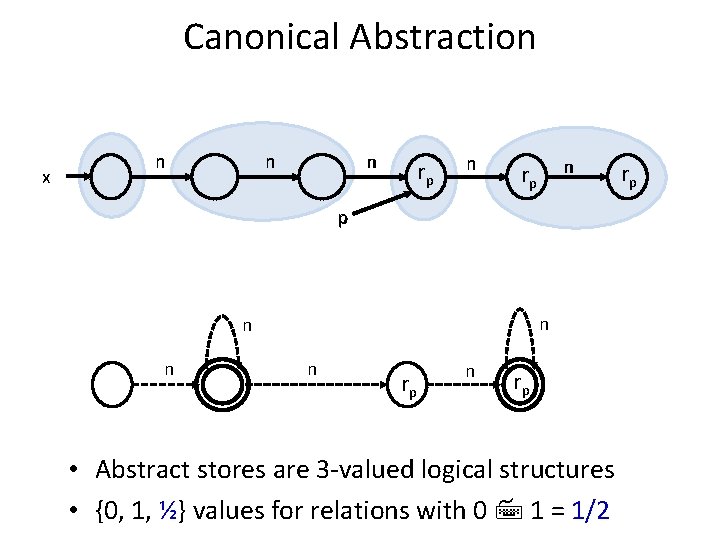
Canonical Abstraction x n n n r p n n rp p n n n n rp • Abstract stores are 3 -valued logical structures • {0, 1, ½} values for relations with 0 1 = 1/2 rp
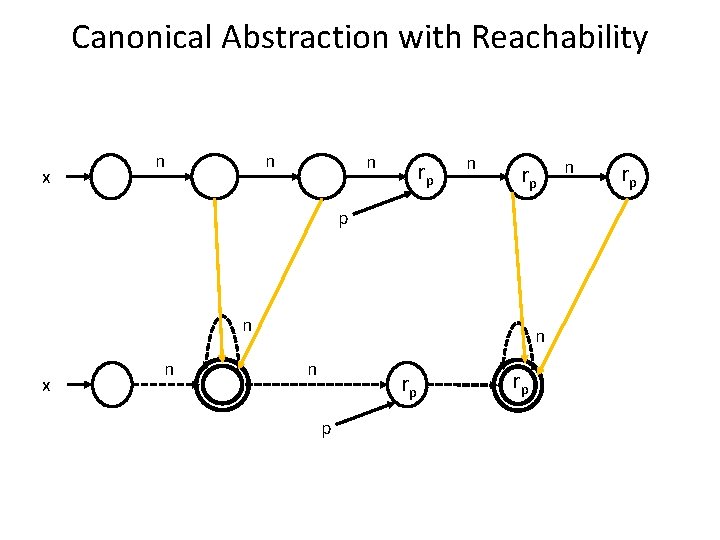
Canonical Abstraction with Reachability x n n n r p n rp p n x n n n rp p r p n rp
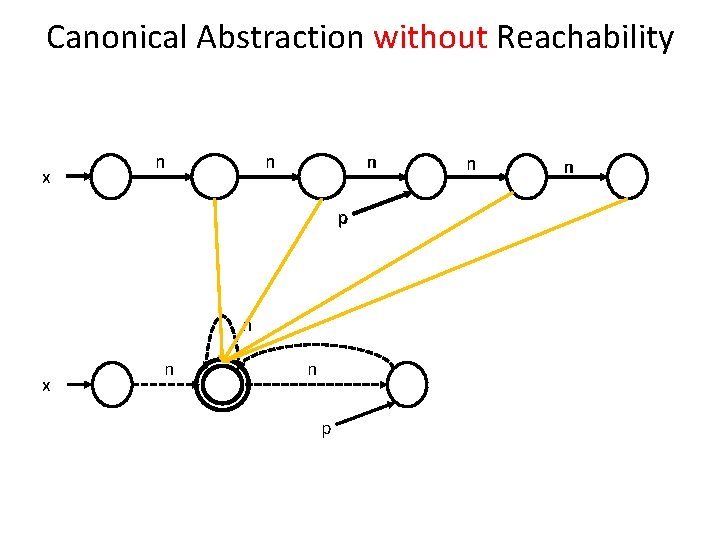
Canonical Abstraction without Reachability x n n n p n x n n p n n
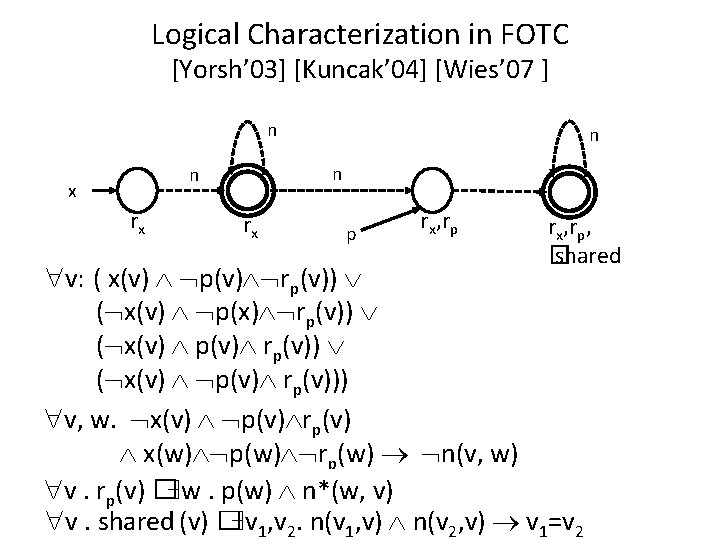
Logical Characterization in FOTC [Yorsh’ 03] [Kuncak’ 04] [Wies’ 07 ] n x n rx n n p rx, rp, � shared . . . v: ( x(v) p(v) rp(v)) ( x(v) p(x) rp(v)) ( x(v) p(v) rp(v))) v, w. x(v) p(v) rp(v) x(w) p(w) rp(w) n(v, w) v. rp(v) � w. p(w) n*(w, v) v. shared (v) � v 1, v 2. n(v 1, v) n(v 2, v) v 1=v 2
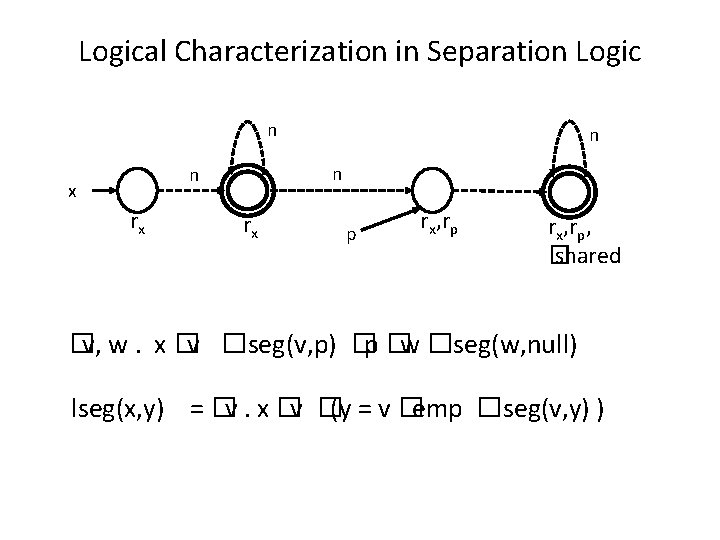
Logical Characterization in Separation Logic n x rx n n p rx, rp, � shared � v, w. x � v � lseg(v, p) � p � w � lseg(w, null) lseg(x, y) = � v. x � v � (y = v � emp � lseg(v, y) )
Canonical Abstraction • Limited form of quantified invariants – quantifier alternation only in instrumentation • Not a static memory partition – The same memory location can be represented by different abstract nodes in different shape graphs
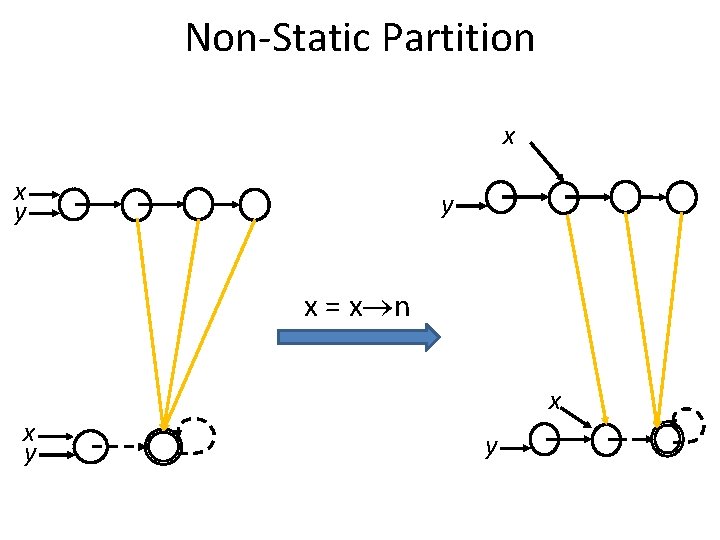
Non-Static Partition x x y y x = x n x y
Outline ü Shape Abstractions in the nutshell • Computing abstract transformers • Challenges in shape analysis
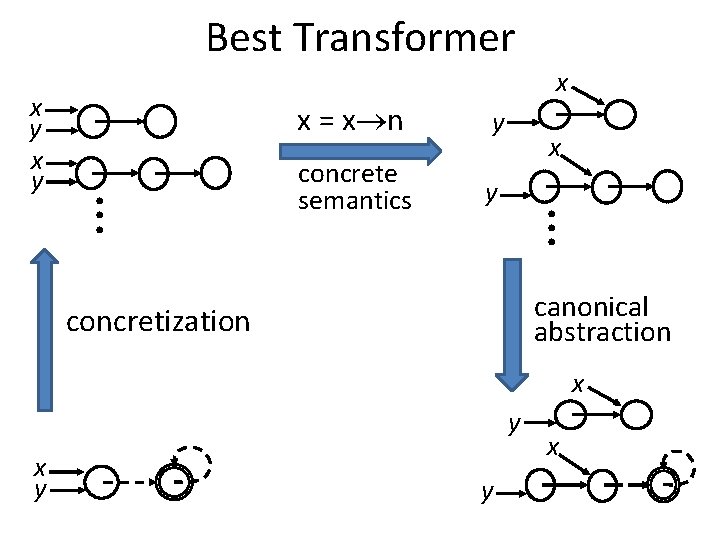
Best Transformer x y x . . . x = x n y concrete semantics y x . . . canonical abstraction concretization x y y x
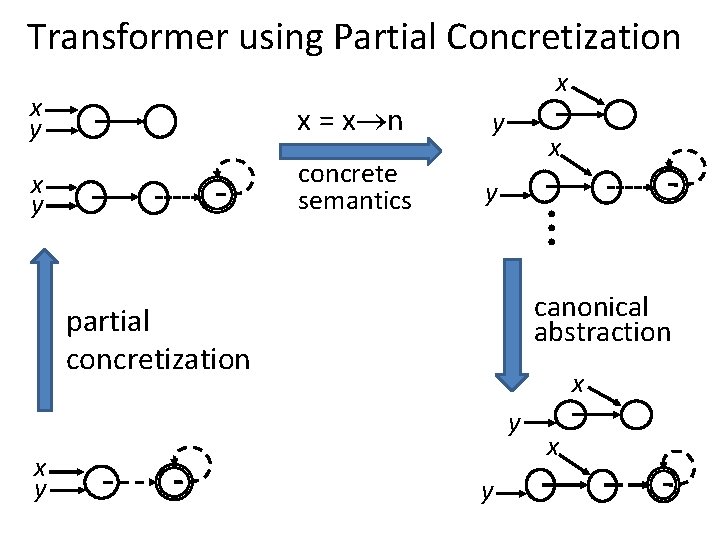
Transformer using Partial Concretization x x y x = x n y x y concrete semantics y x . . . canonical abstraction partial concretization x y y x
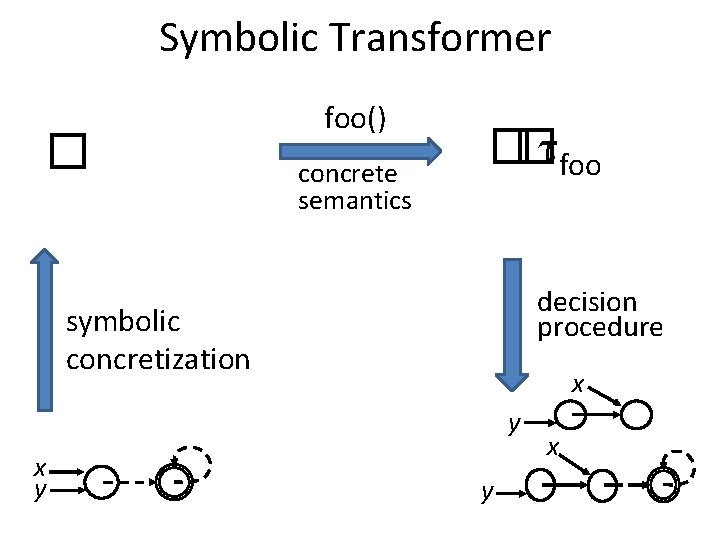
Symbolic Transformer � foo() concrete semantics � � foo decision procedure symbolic concretization x y y x
Partial Concretization • Temporarily refine the abstract domain per statement • Employed in other shape analysis algorithms [Distefano, TACAS’ 06, Evan, SAS’ 07, POPL’ 08] • Soundness is immediate • Precision depends on the heap mutation – Locality – Uniformity • Can even guarantee precision under certain conditions [Lev-Ami, VMCAI’ 07]
Challenges in shape analysis • Programming language features – Procedures – Modularity and encapsulation – Concurrency • Properties • Complex data structures – Hierarchy – Mixture of data and heap – Array of heaps • Scaling to larger programs
Handling Procedures • Complicated sharing patterns [Rinetzky, CC’ 01] • Relational shape analysis [Jeannet, SAS’ 04] • New semantics for procedures (Cutpoints) [Rinetzky, POPL’ 05] • Tabulation for cutpoint free programs [Rinetzky, SAS’ 05] • Handling cutpoints [Gotsman, SAS’ 06]
Concurrency • Models threads as ordinary objects [Yahav, POPL’ 01] • Thread-modular shape analysis [Gotsman, PLDI’ 07] • Heap decomposition and thread quantification [Manevich et al SAS’ 08, CAV’ 08] • Enforcing a locking regime [Rinetzky]
Handling Larger Programs ? • Staged analysis • Specialized abstractions – Counterexample guided refinement • Coercer abstractions – Weaker summary nodes [Arnold, SAS’ 06] – Special join operator [Manevich, SAS’ 04, TACAS’ 07, Yang’ 08] – Heterogeneous abstractions [Yahav, PLDI’ 04] • Implementation techniques – – – Optimizing transformers [Bogodlov, CAV’ 07] Optimizing GC Reducing static size Partial evaluation Persistent data structures [Manevich, SAS’ 04] …
Conclusion • Limited forms of quantified invariants can prove interesting properties • Partial concretization is useful for transformers • Scaling shape analysis is still an open problem • Like a Swiss army knife or a Unix utility – Only for experts –. . . but at least it’s very useful to them
- Slides: 28