
SHANNON JOYNER MODERN SYSTEMS EXTENSIBLE MOTIVATION Applications must
SHANNON JOYNER MODERN SYSTEMS: EXTENSIBLE
MOTIVATION ‣ Applications must conform to operating system interface ‣ One operating system implementation is not ideal for everyone ‣ Cannot optimize for a given application ‣ OSs did not work well for database management systems 1 1 Operating System Support for Database Management. Michael Stonebraker. Communications of the ACM.
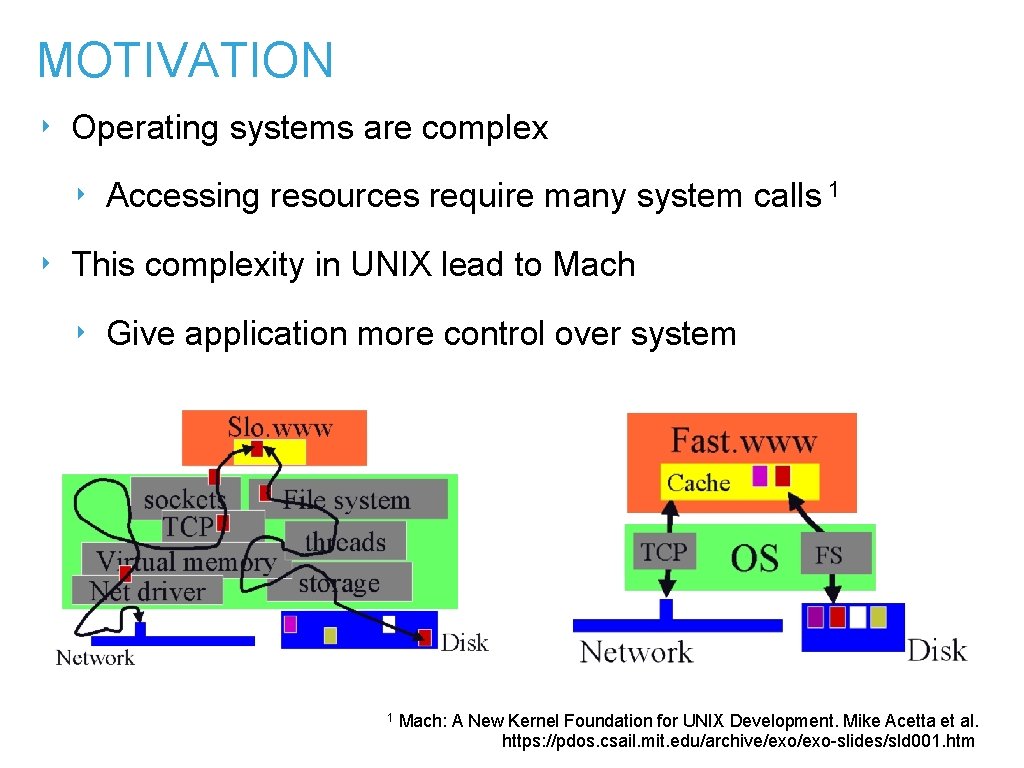
MOTIVATION ‣ Operating systems are complex ‣ Accessing resources require many system calls 1 ‣ This complexity in UNIX lead to Mach ‣ Give application more control over system 1 Mach: A New Kernel Foundation for UNIX Development. Mike Acetta et al. https: //pdos. csail. mit. edu/archive/exo-slides/sld 001. htm
Exokernel: An Operating System Architecture for Application-Level Resource Management Dawson R. Engler, M. Frans Kaashoek, and James O’Toole Jr. M. I. T. Laboratory for Computer Science Proc. 15 th ACM Symposium on Operating Systems Principles (SOSP). Pages 251 -266.
EXOKERNEL GOALS ‣ Make small, fast kernel implementation by implementing simple primitives ‣ Secure, fast way to access hardware resources ‣ System abstractions can be implemented efficiently by application ‣ Applications can have fast, specialized implementations
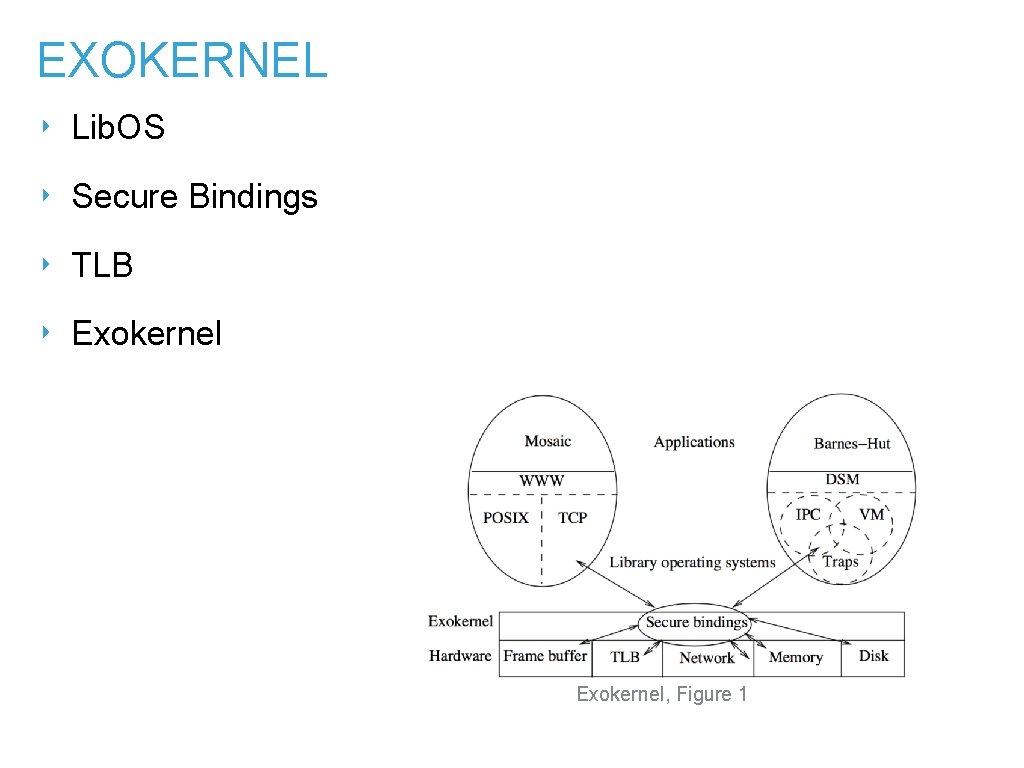
EXOKERNEL ‣ Lib. OS ‣ Secure Bindings ‣ TLB ‣ Exokernel, Figure 1
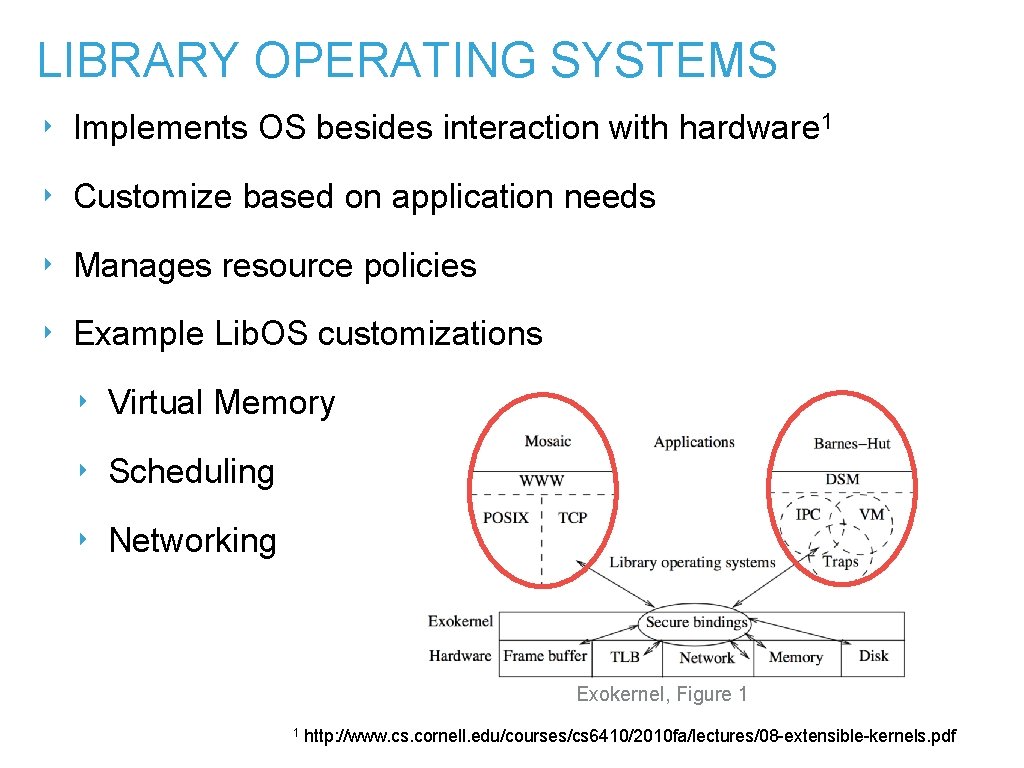
LIBRARY OPERATING SYSTEMS ‣ Implements OS besides interaction with hardware 1 ‣ Customize based on application needs ‣ Manages resource policies ‣ Example Lib. OS customizations ‣ Virtual Memory ‣ Scheduling ‣ Networking Exokernel, Figure 1 1 http: //www. cs. cornell. edu/courses/cs 6410/2010 fa/lectures/08 -extensible-kernels. pdf
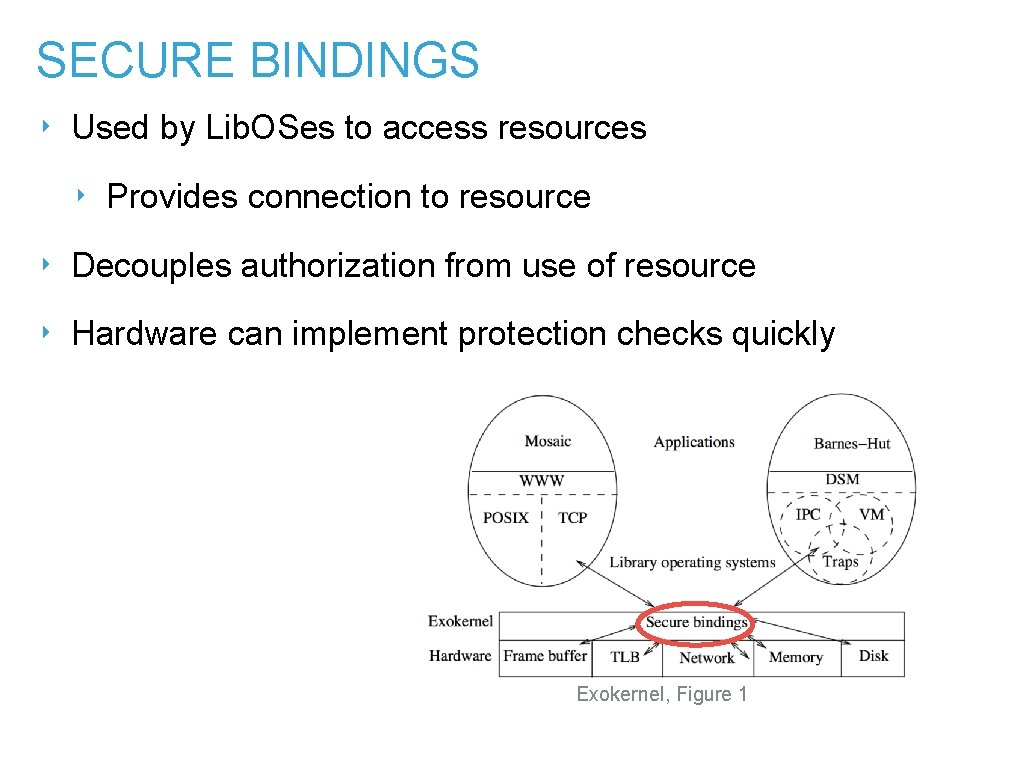
SECURE BINDINGS ‣ Used by Lib. OSes to access resources ‣ Provides connection to resource ‣ Decouples authorization from use of resource ‣ Hardware can implement protection checks quickly Exokernel, Figure 1
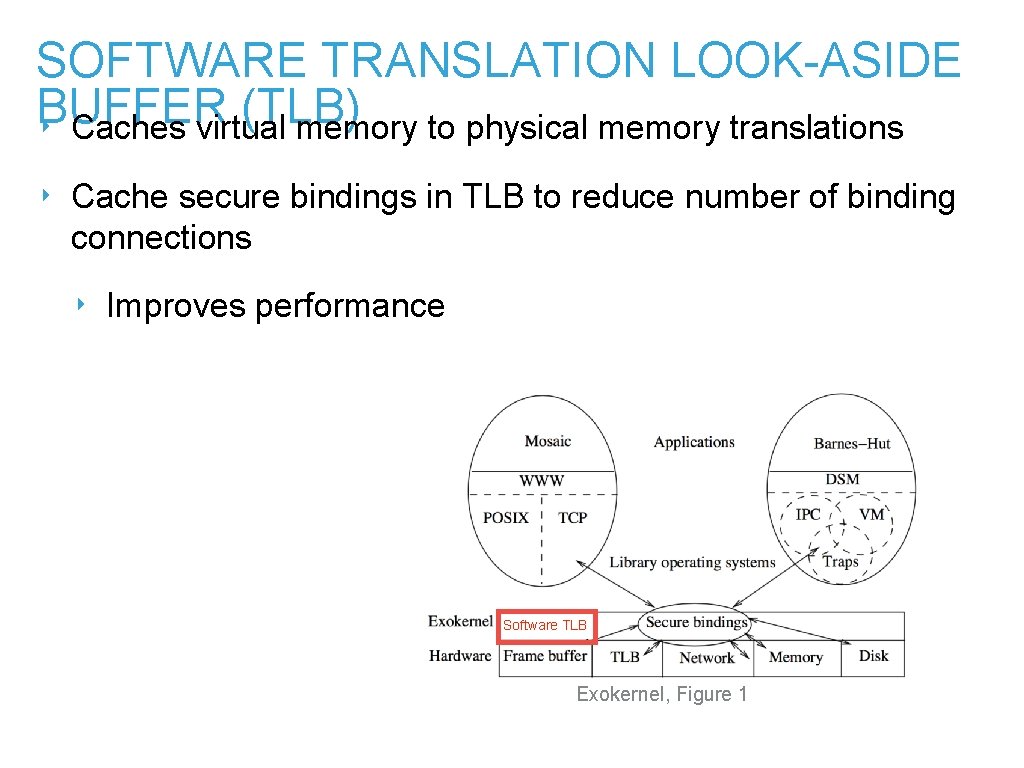
SOFTWARE TRANSLATION LOOK-ASIDE BUFFER (TLB) ‣ Caches virtual memory to physical memory translations ‣ Cache secure bindings in TLB to reduce number of binding connections ‣ Improves performance Software TLB Exokernel, Figure 1
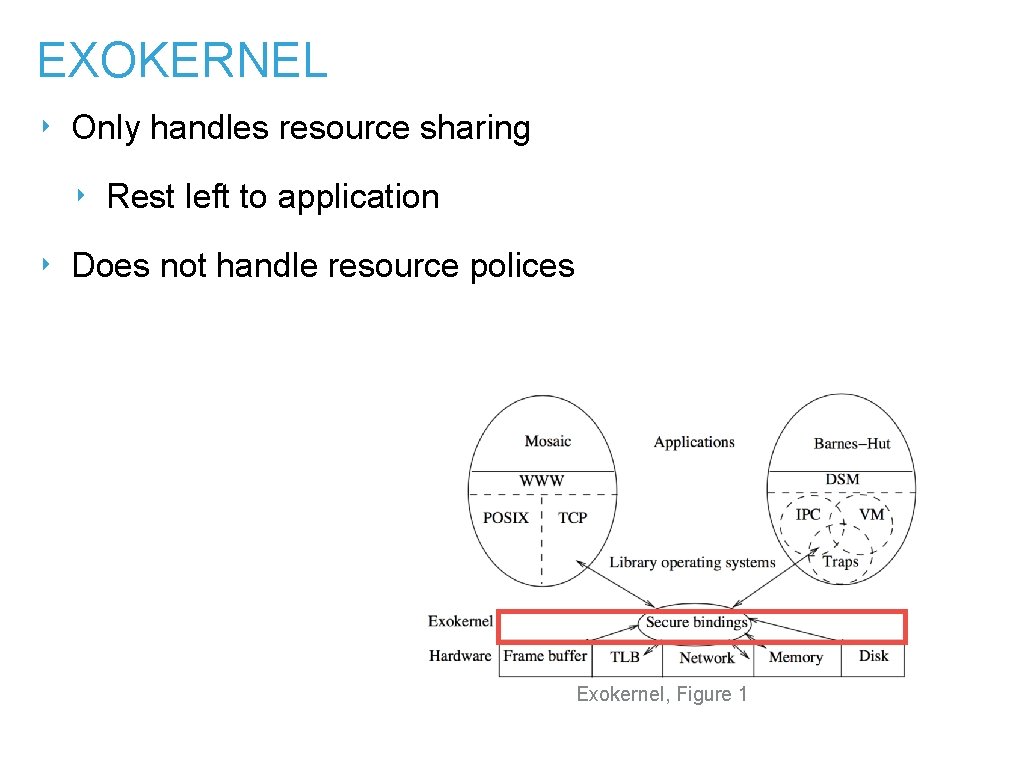
EXOKERNEL ‣ Only handles resource sharing ‣ Rest left to application ‣ Does not handle resource polices Exokernel, Figure 1
EXOKERNEL ‣ Make small, fast kernel implementation by implementing simple primitives ‣ Exokernel ‣ Secure, fast way to access hardware resources ‣ TLB + Secure Bindings ‣ System abstractions can be implemented efficiently by application ‣ Lib. OS + Exokernel ‣ Applications can have fast, specialized implementations ‣ Lib. OS
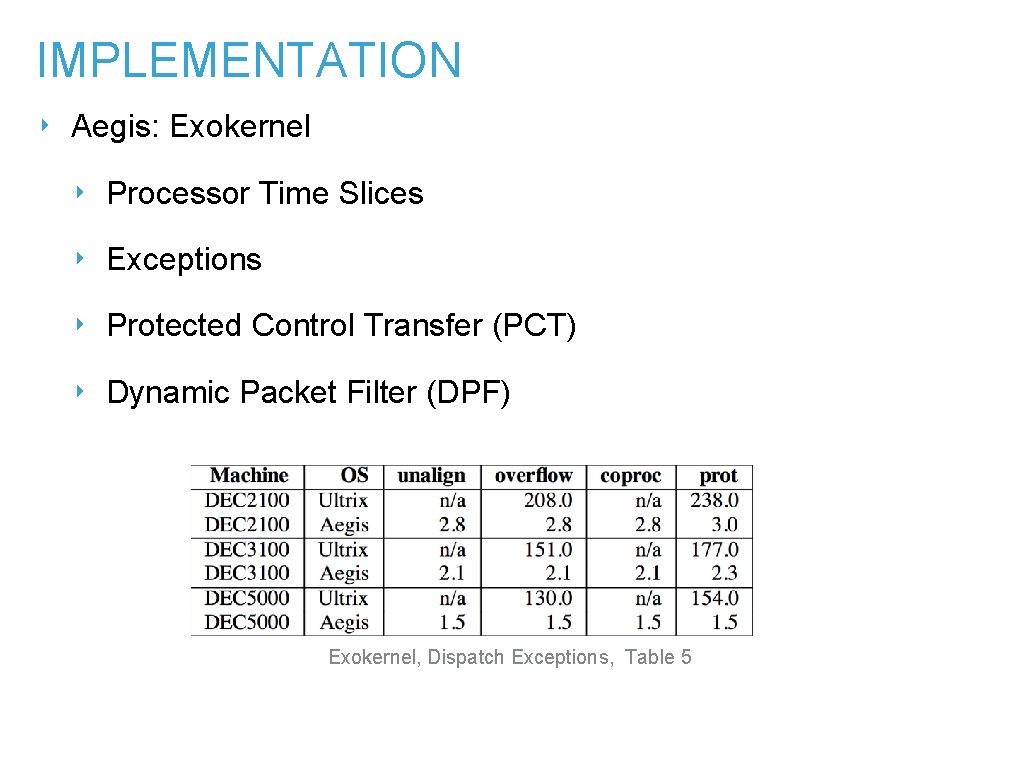
IMPLEMENTATION ‣ Aegis: Exokernel ‣ Processor Time Slices ‣ Exceptions ‣ Protected Control Transfer (PCT) ‣ Dynamic Packet Filter (DPF) Exokernel, Dispatch Exceptions, Table 5
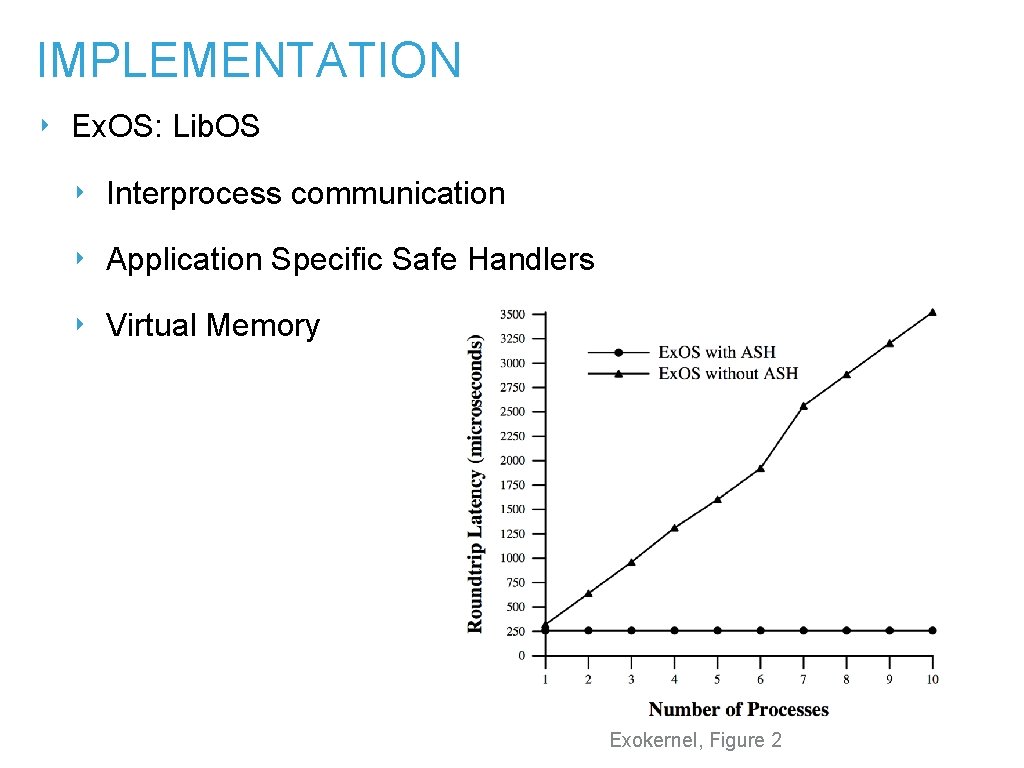
IMPLEMENTATION ‣ Ex. OS: Lib. OS ‣ Interprocess communication ‣ Application Specific Safe Handlers ‣ Virtual Memory Exokernel, Figure 2
QUESTIONS ‣ Who handles resource policies? ‣ Is there a problem with how exokernels handle resource policies? ‣ Why do we need secure bindings?
QUESTIONS ‣ Who handles resource policies? ‣ Is there a problem with how exokernels handle resource policies? ‣ Why do we need secure bindings?
QUESTIONS ‣ Who handles resource policies? ‣ Application handles resource policies.
QUESTIONS ‣ Who handles resource policies? ‣ Is there a problem with how exokernels handle resource policies? ‣ Why do we need secure bindings?
QUESTIONS ‣ Who handles resource policies? ‣ Is there a problem with how exokernels handle resource policies? ‣ Poor isolation. Applications can have conflicting policies. ‣ Why do we need secure bindings? ‣ Why does Exokernel use a software TLB instead of the hardware TLB?
QUESTIONS ‣ Who handles resource policies? ‣ Is there a problem with how exokernels handle resource policies? ‣ Why do we need secure bindings?
QUESTIONS ‣ Who handles resource policies? ‣ Is there a problem with how exokernels handle resource policies? ‣ Why do we need secure bindings? ‣ Protection / authorization of resources. Faster to do in kernel and kernel does not need to understand resources. ‣ Why does Exokernel use a software TLB instead of the hardware TLB?
EXOKERNEL TAKEAWAYS ‣ Can have a minimal kernel and have application customize operating system ‣ Fast ‣ Poor isolation ‣ Each application implements own Lib. OS ‣ No way to prevent systems from conflicting ‣ Hardware compatibility ‣ Need to change Lib. OS depending on hardware interface
1 CONTAINERS ‣ Hypervisor ‣ Hardware abstraction ‣ Previous virtual machines ran on top of hypervisors ‣ No isolation 1 Container-based Operating System Virtualization: A Scalable, High performance Alternative to Hypervisors Stephen Soltesz, Herbert Potzi, Marc Fiuczynski, Andy Bavier, Larry Peterson. Euro. Sys ’ 07.
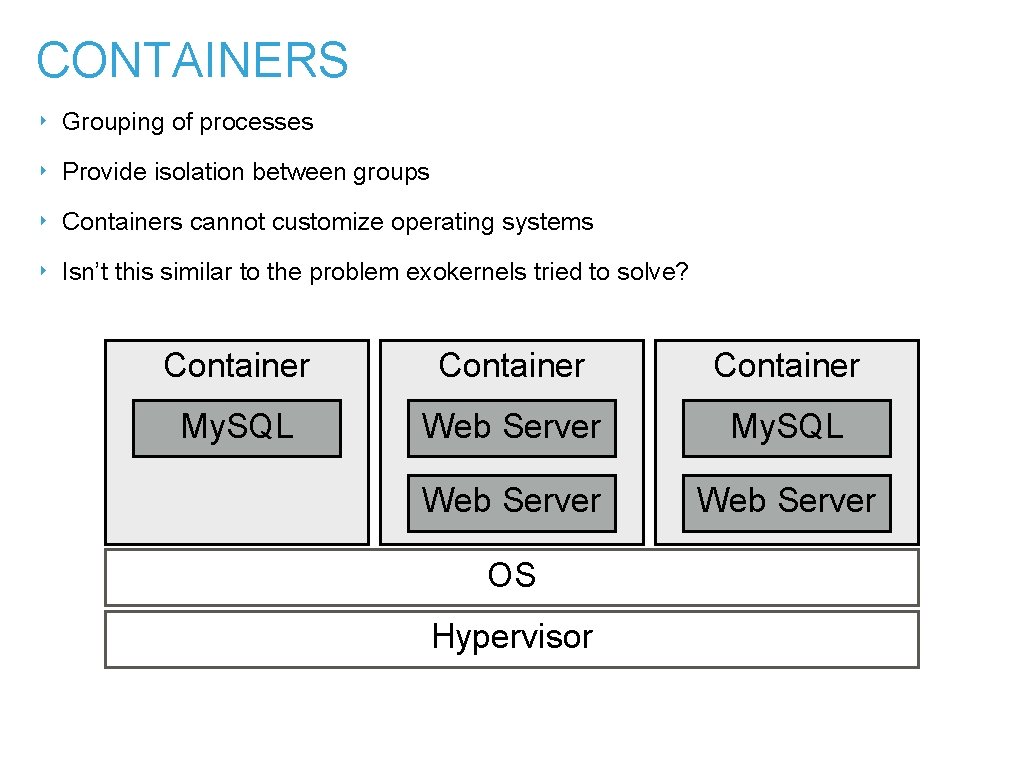
CONTAINERS ‣ Grouping of processes ‣ Provide isolation between groups ‣ Containers cannot customize operating systems ‣ Isn’t this similar to the problem exokernels tried to solve? Container My. SQL Web Server OS Hypervisor
Unikernel: Library Operating Systems for the Cloud alampos Rotsos, David Scott, Ralraj Singh, Thomas. Gazagnaire, Stev University of Cambridge, University of Nottingham, Citrix Systems Ltd, OCaml. Pro SAS In Proceedings of the 18 th International Conference on Architectural Support for Programming Languages and Operating Systems pg. 461– 472.
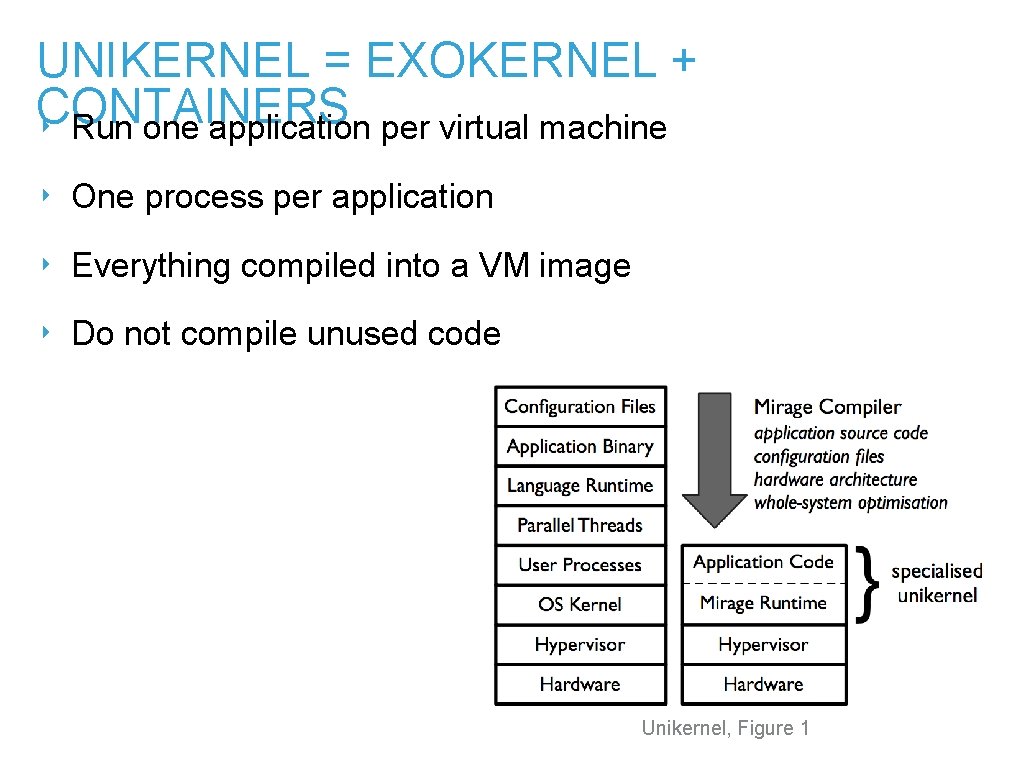
UNIKERNEL = EXOKERNEL + CONTAINERS ‣ Run one application per virtual machine ‣ One process per application ‣ Everything compiled into a VM image ‣ Do not compile unused code Unikernel, Figure 1
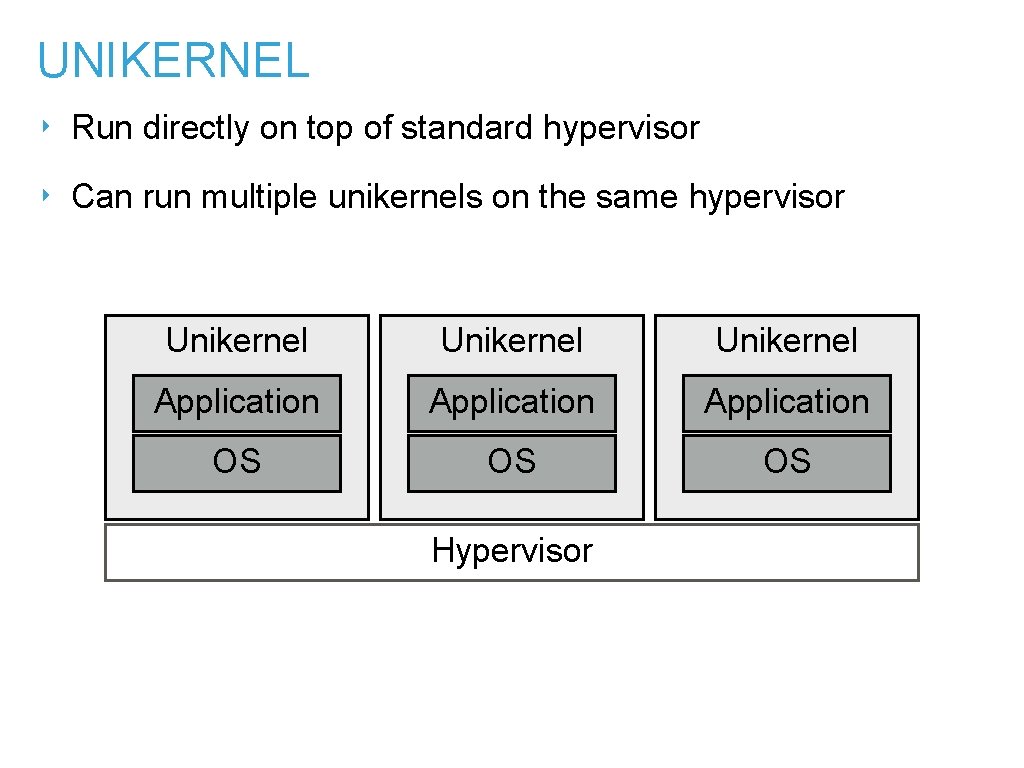
UNIKERNEL ‣ Run directly on top of standard hypervisor ‣ Can run multiple unikernels on the same hypervisor Unikernel Application OS OS OS Hypervisor
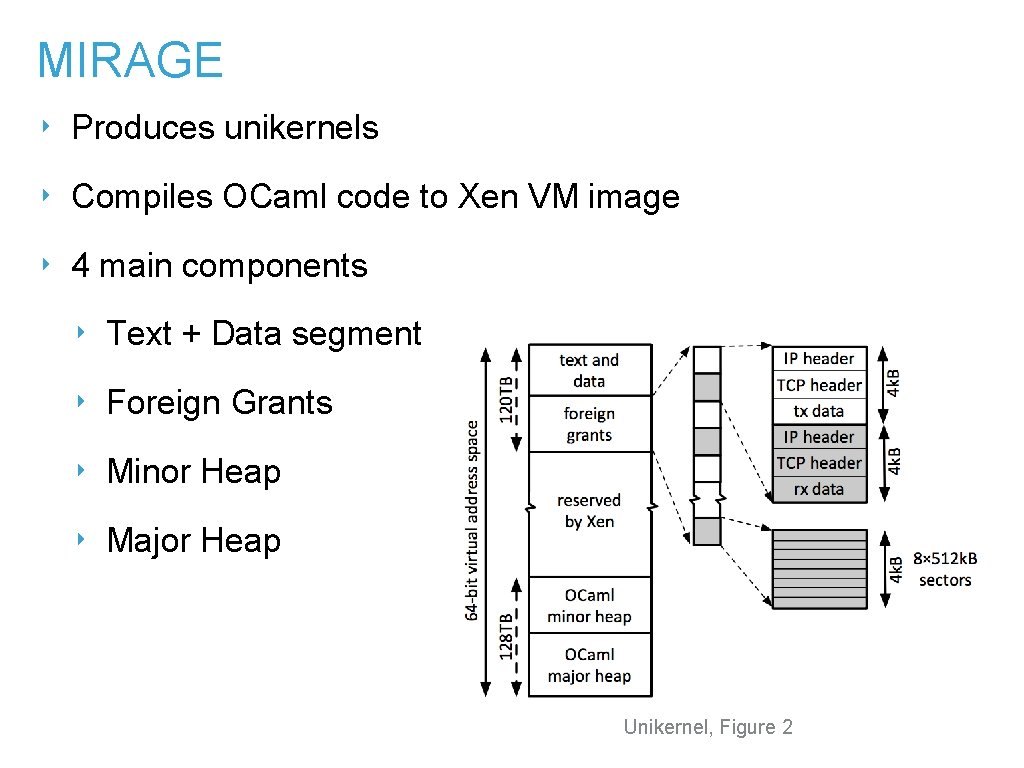
MIRAGE ‣ Produces unikernels ‣ Compiles OCaml code to Xen VM image ‣ 4 main components ‣ Text + Data segment ‣ Foreign Grants ‣ Minor Heap ‣ Major Heap Unikernel, Figure 2
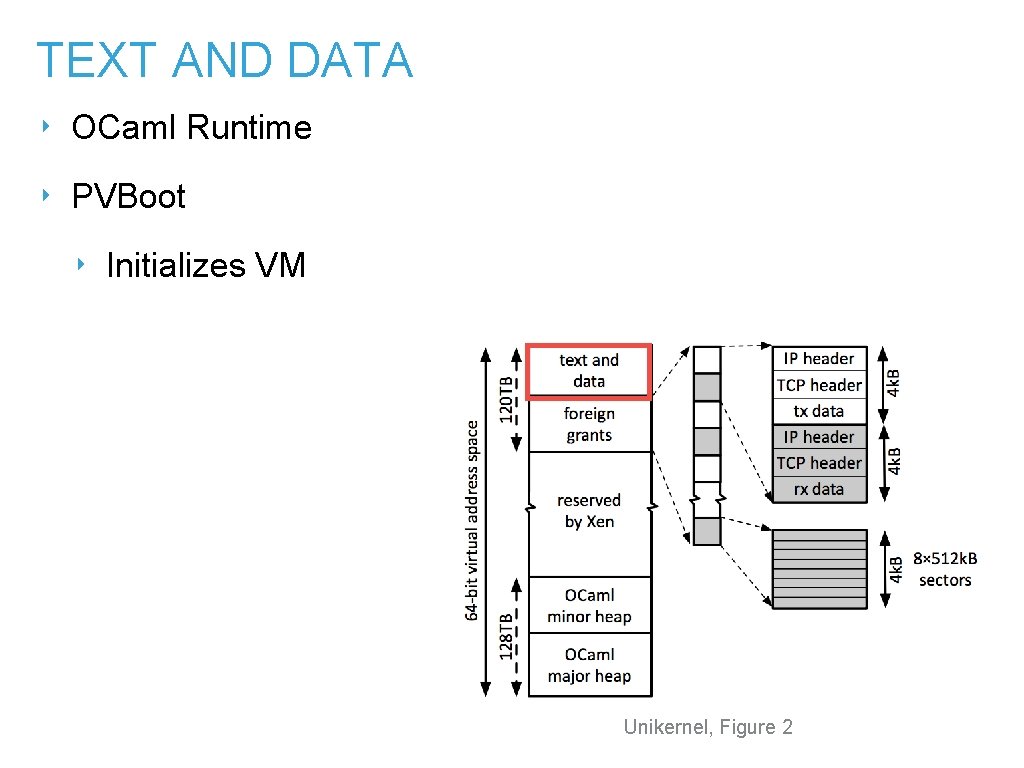
TEXT AND DATA ‣ OCaml Runtime ‣ PVBoot ‣ Initializes VM Unikernel, Figure 2
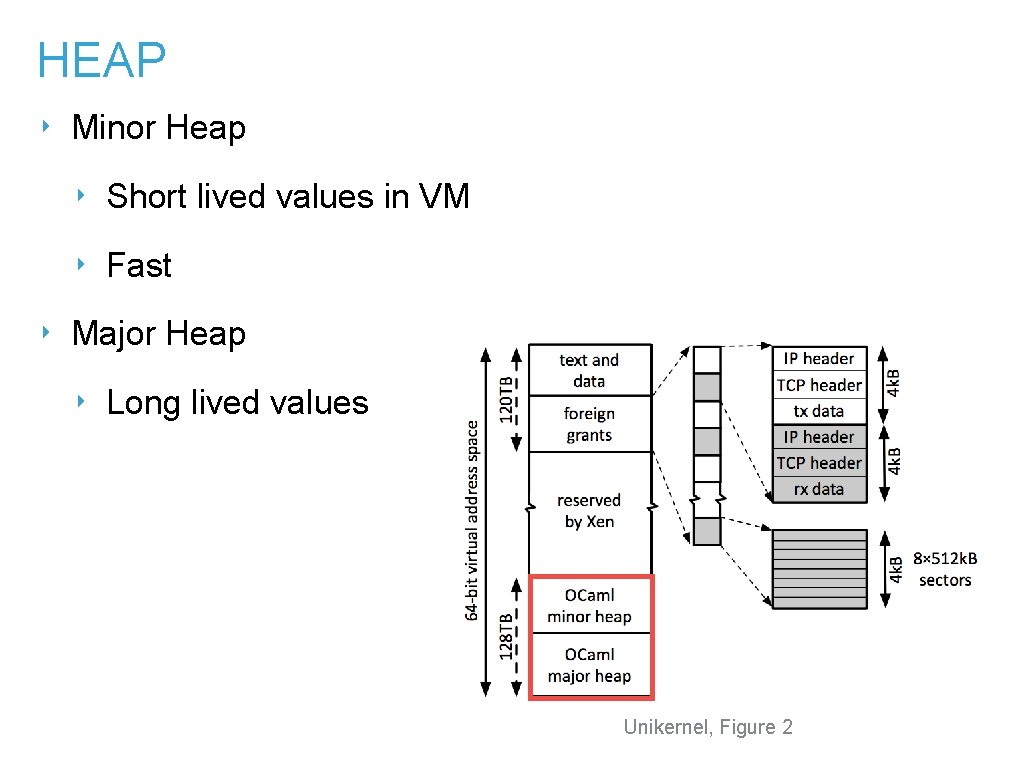
HEAP ‣ Minor Heap ‣ Short lived values in VM ‣ Fast ‣ Major Heap ‣ Long lived values Unikernel, Figure 2
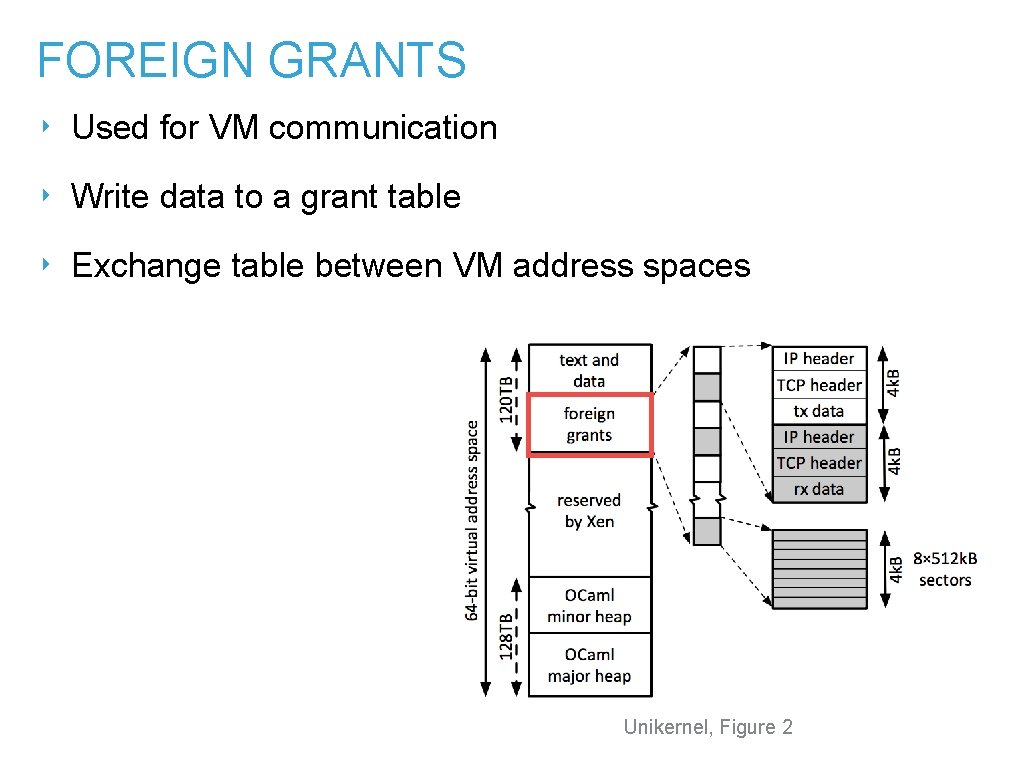
FOREIGN GRANTS ‣ Used for VM communication ‣ Write data to a grant table ‣ Exchange table between VM address spaces Unikernel, Figure 2
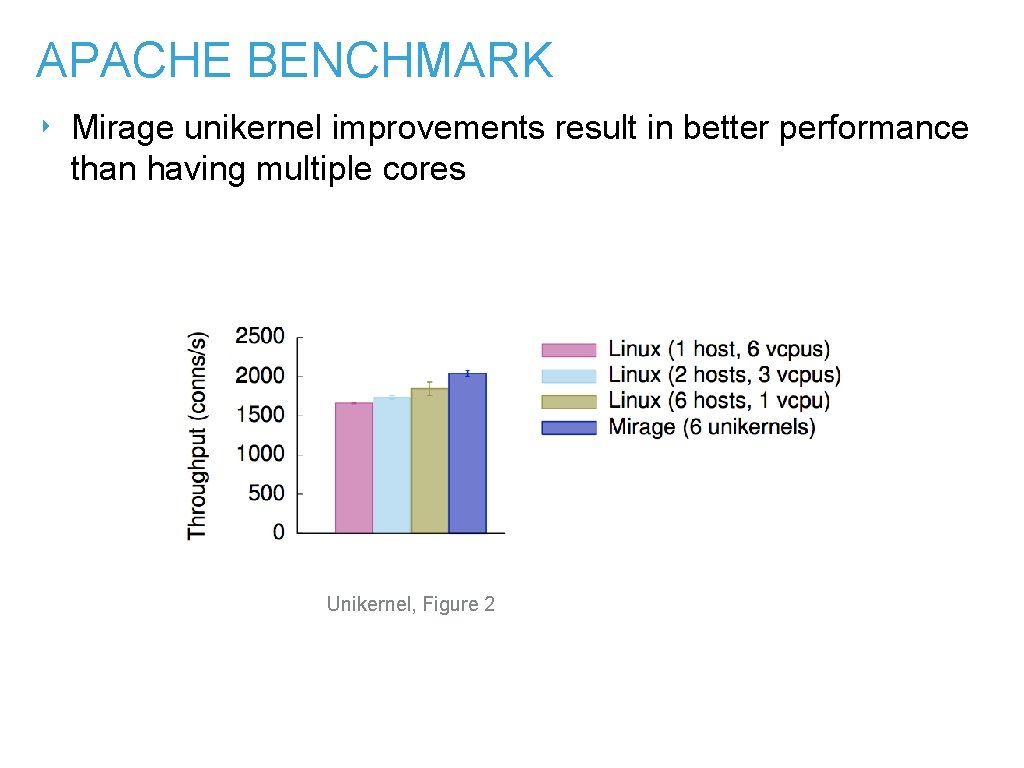
APACHE BENCHMARK ‣ Mirage unikernel improvements result in better performance than having multiple cores Unikernel, Figure 2
EXOKERNEL VERSUS UNIKERNEL ‣ Exokernel ‣ All applications on same system ‣ Poor isolation ‣ Unikernel ‣ Single application per system ‣ Better isolation


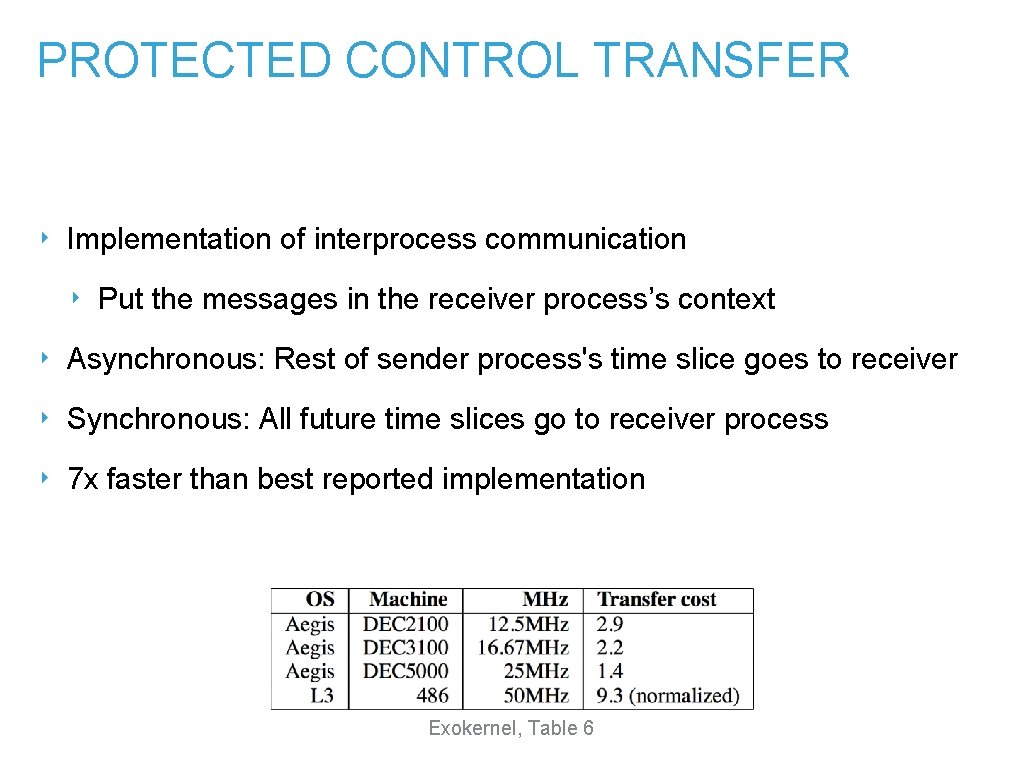
PROTECTED CONTROL TRANSFER ‣ Implementation of interprocess communication ‣ Put the messages in the receiver process’s context ‣ Asynchronous: Rest of sender process's time slice goes to receiver ‣ Synchronous: All future time slices go to receiver process ‣ 7 x faster than best reported implementation Exokernel, Table 6
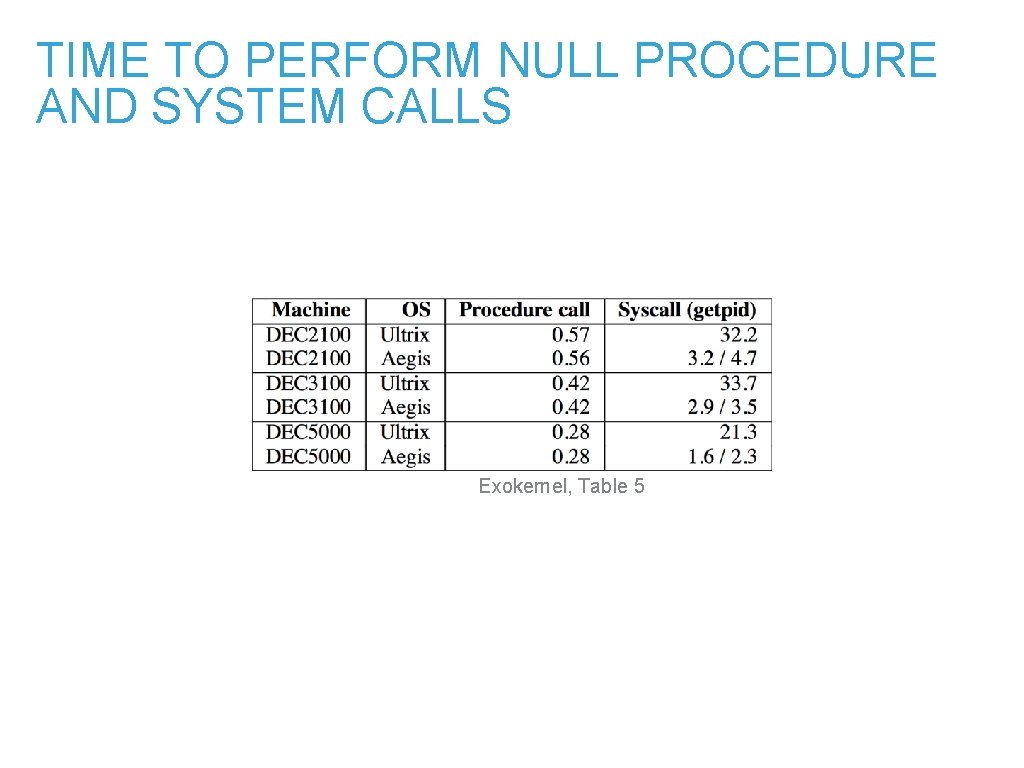
TIME TO PERFORM NULL PROCEDURE AND SYSTEM CALLS Exokernel, Table 5
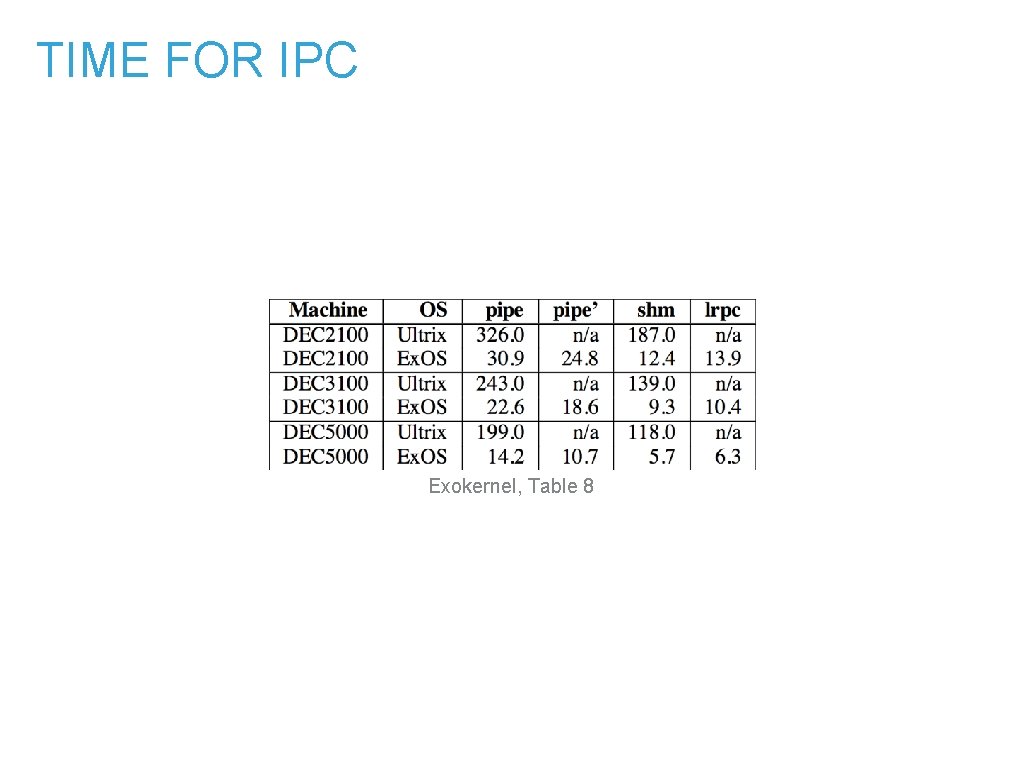
TIME FOR IPC Exokernel, Table 8
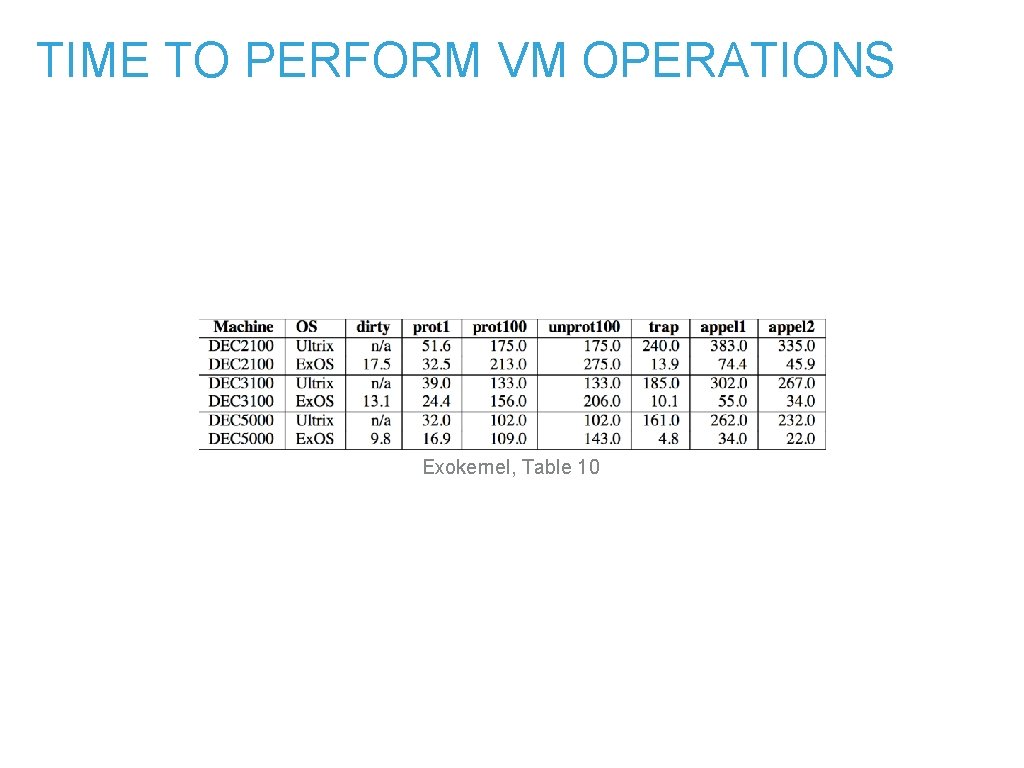
TIME TO PERFORM VM OPERATIONS Exokernel, Table 10
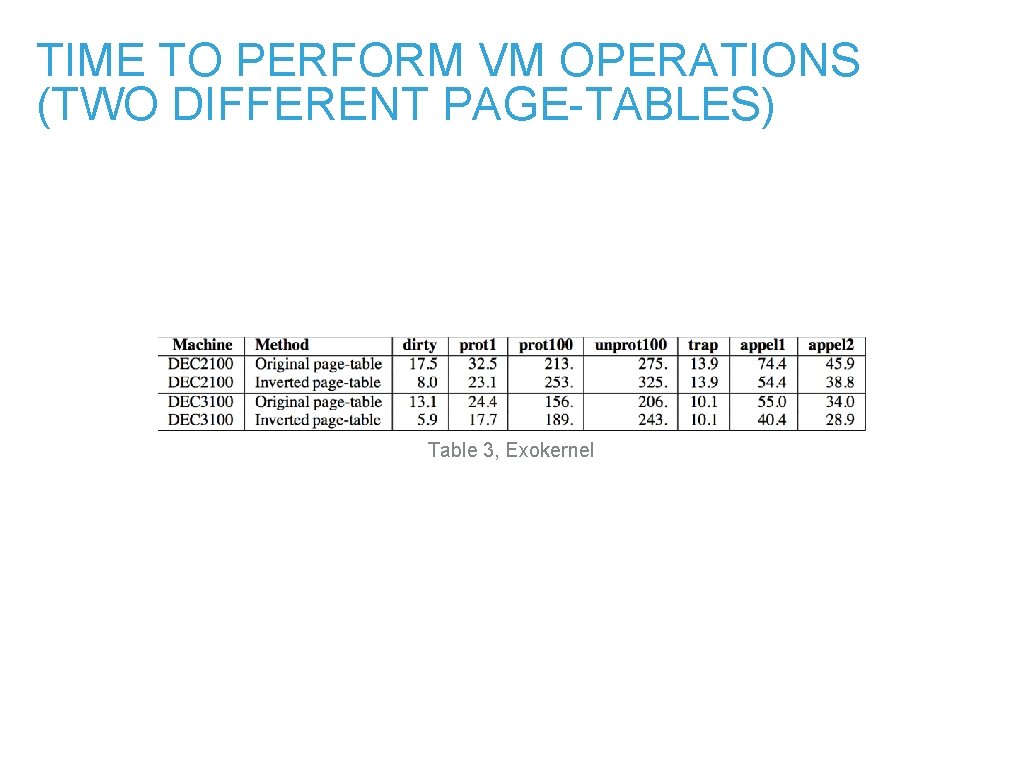
TIME TO PERFORM VM OPERATIONS (TWO DIFFERENT PAGE-TABLES) Table 3, Exokernel
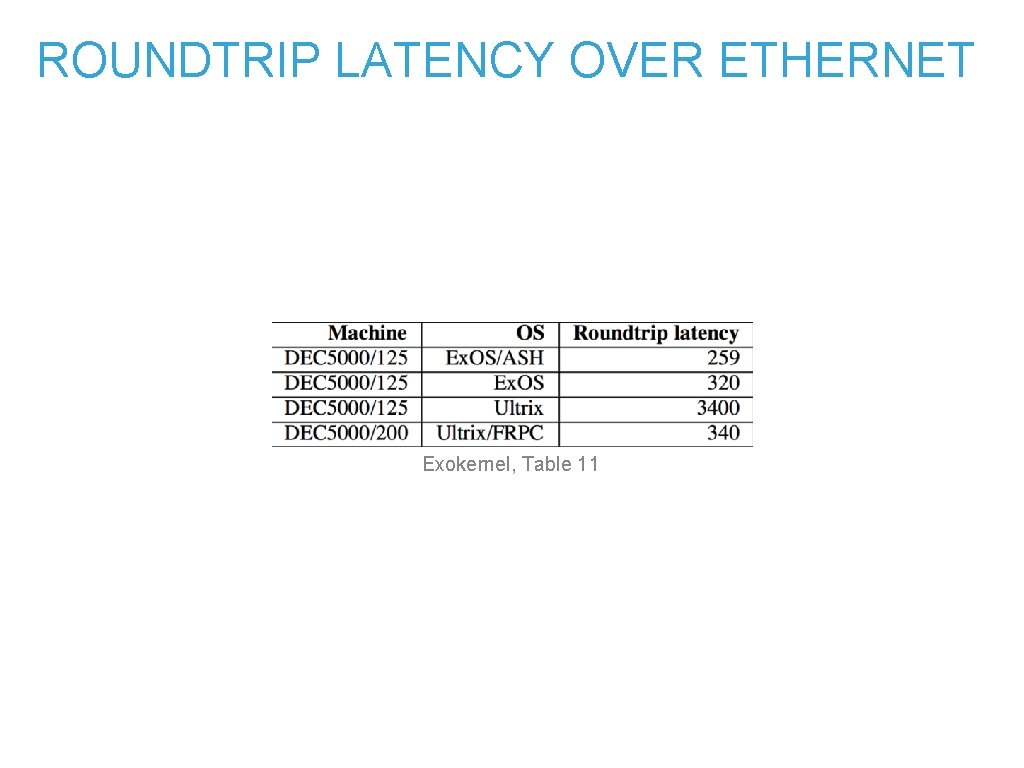
ROUNDTRIP LATENCY OVER ETHERNET Exokernel, Table 11
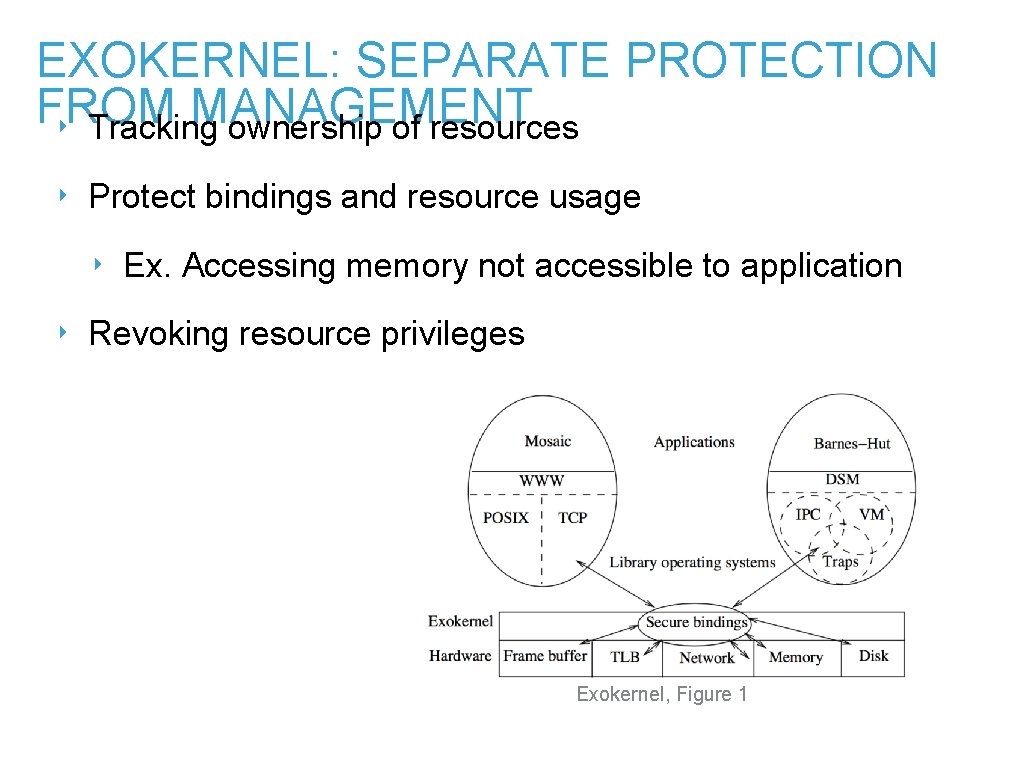
EXOKERNEL: SEPARATE PROTECTION FROM MANAGEMENT ‣ Tracking ownership of resources ‣ Protect bindings and resource usage ‣ Ex. Accessing memory not accessible to application ‣ Revoking resource privileges Exokernel, Figure 1
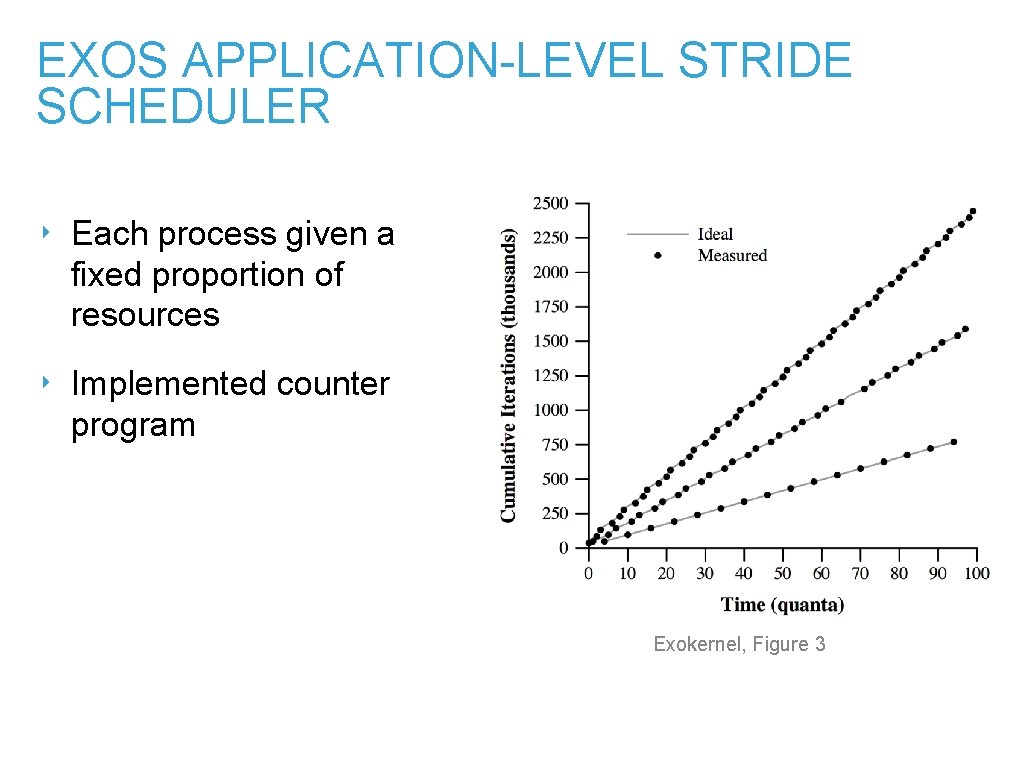
EXOS APPLICATION-LEVEL STRIDE SCHEDULER ‣ Each process given a fixed proportion of resources ‣ Implemented counter program Exokernel, Figure 3
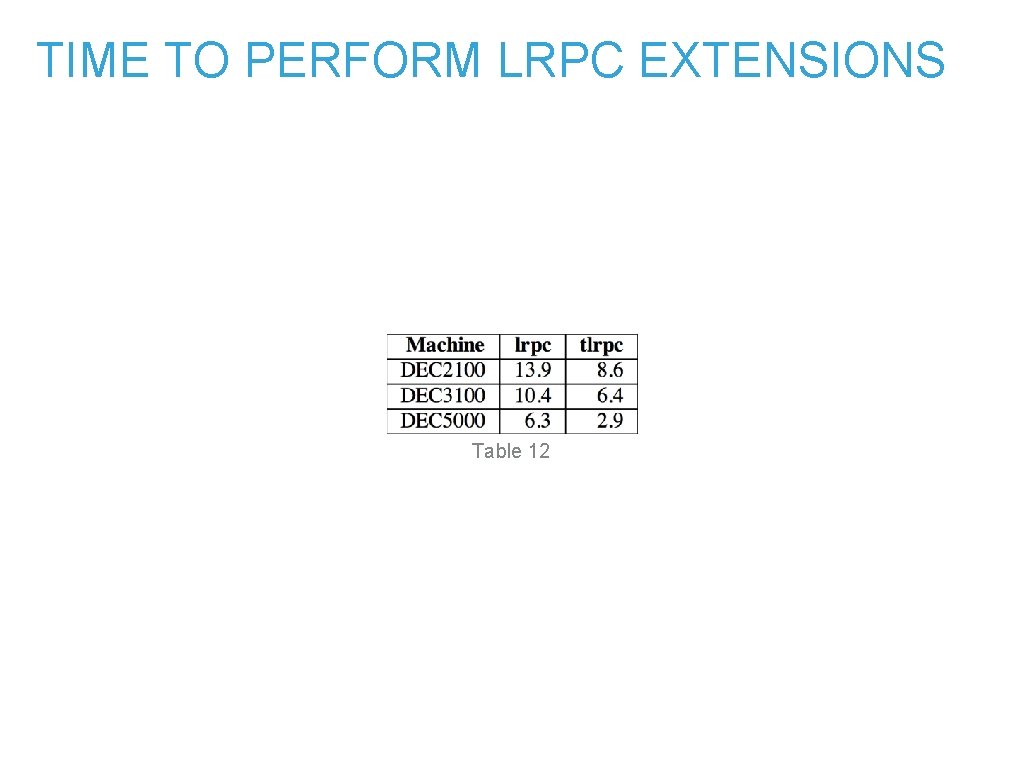
TIME TO PERFORM LRPC EXTENSIONS Table 12
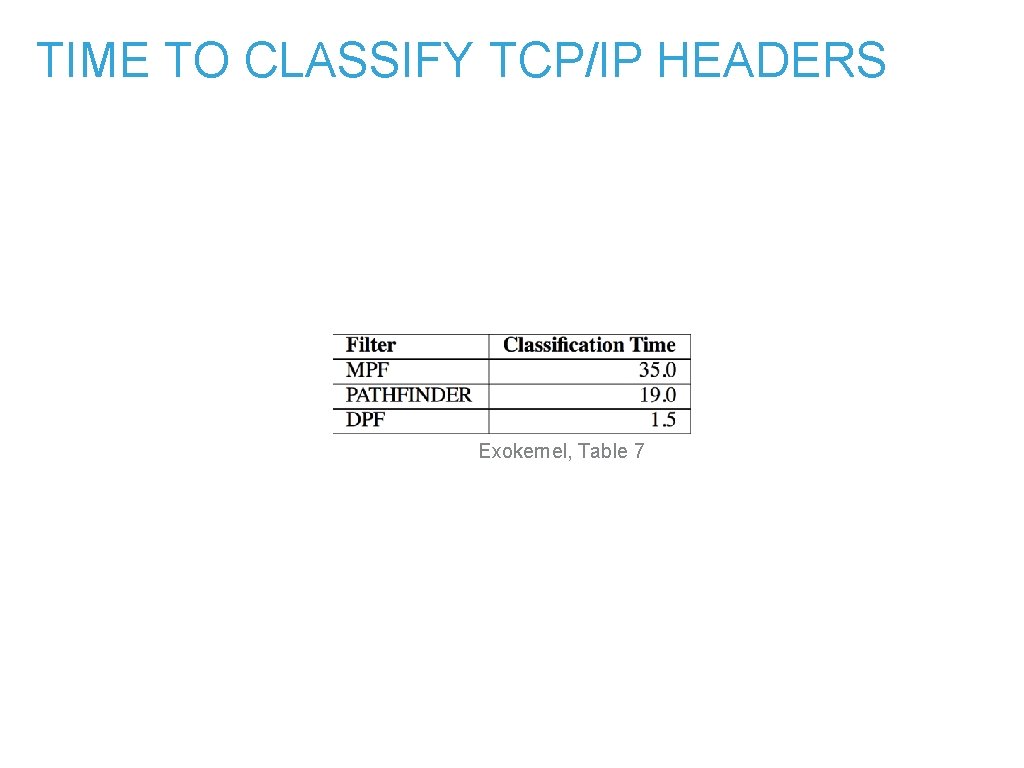
TIME TO CLASSIFY TCP/IP HEADERS Exokernel, Table 7
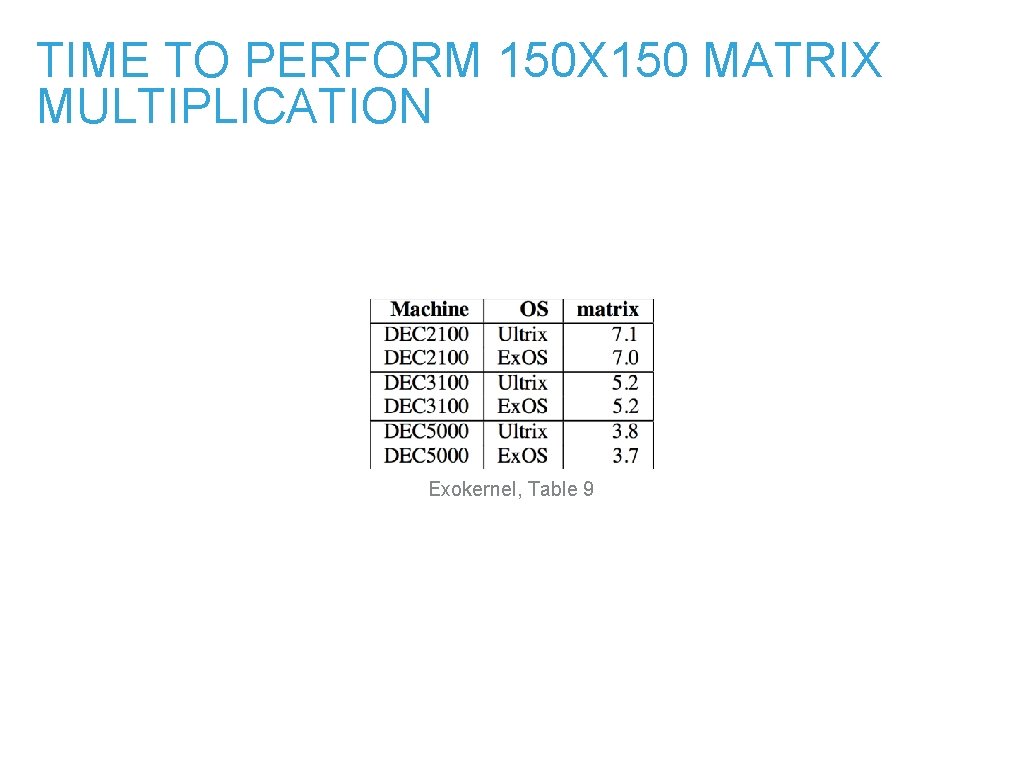
TIME TO PERFORM 150 X 150 MATRIX MULTIPLICATION Exokernel, Table 9
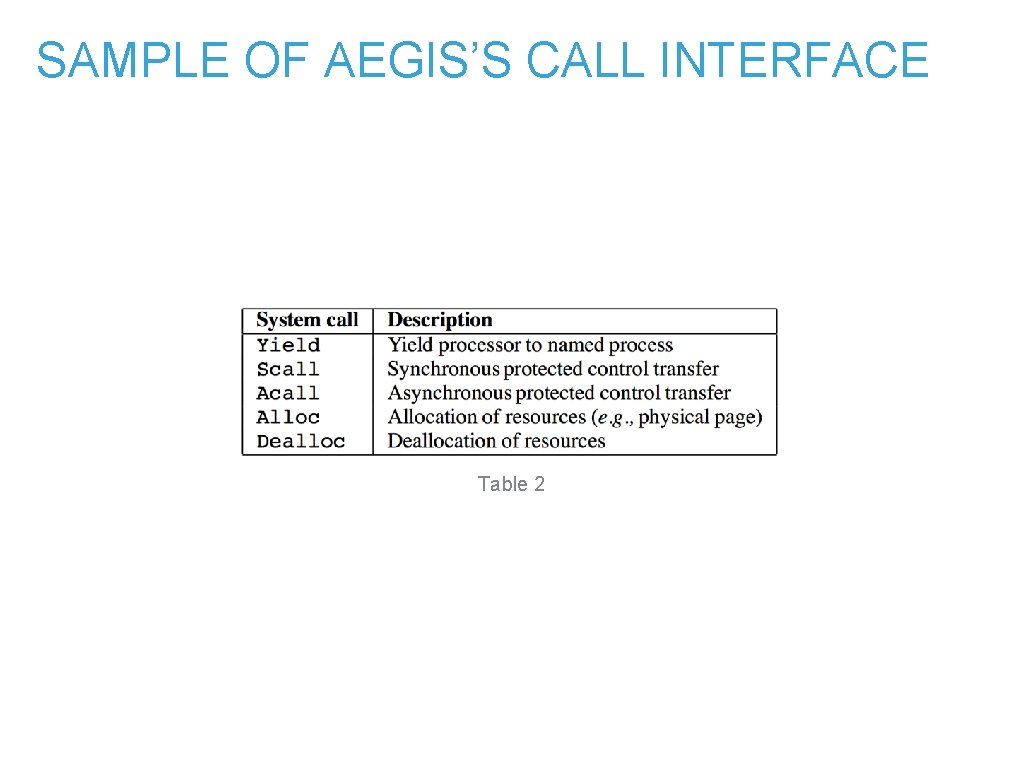
SAMPLE OF AEGIS’S CALL INTERFACE Table 2
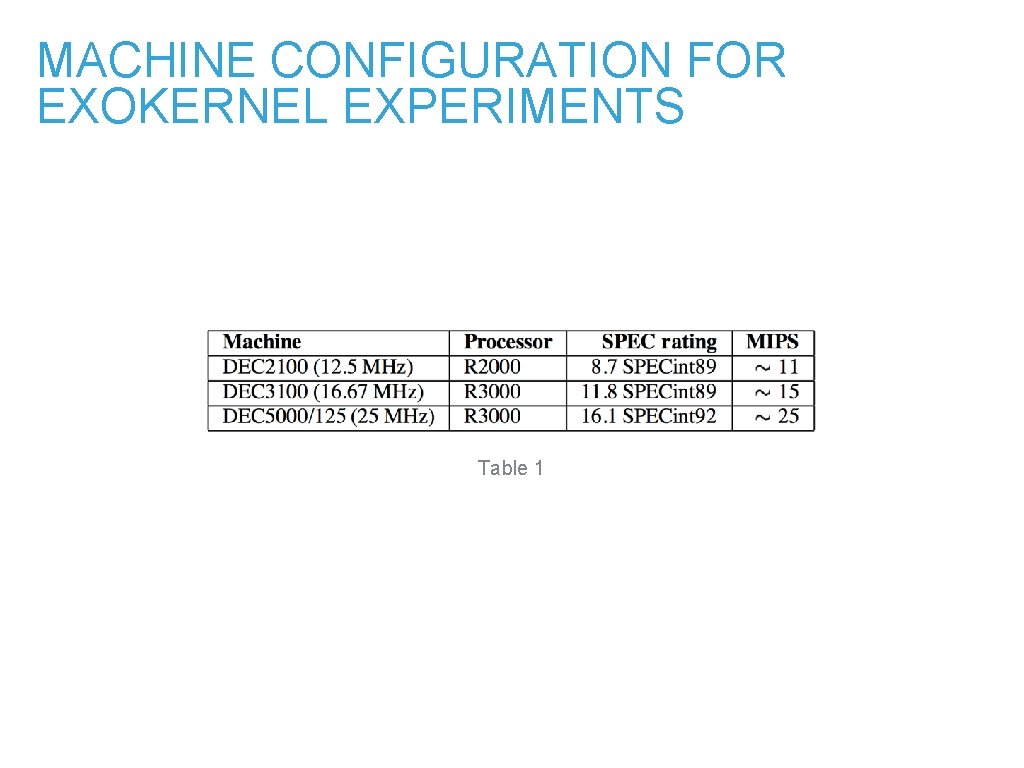
MACHINE CONFIGURATION FOR EXOKERNEL EXPERIMENTS Table 1
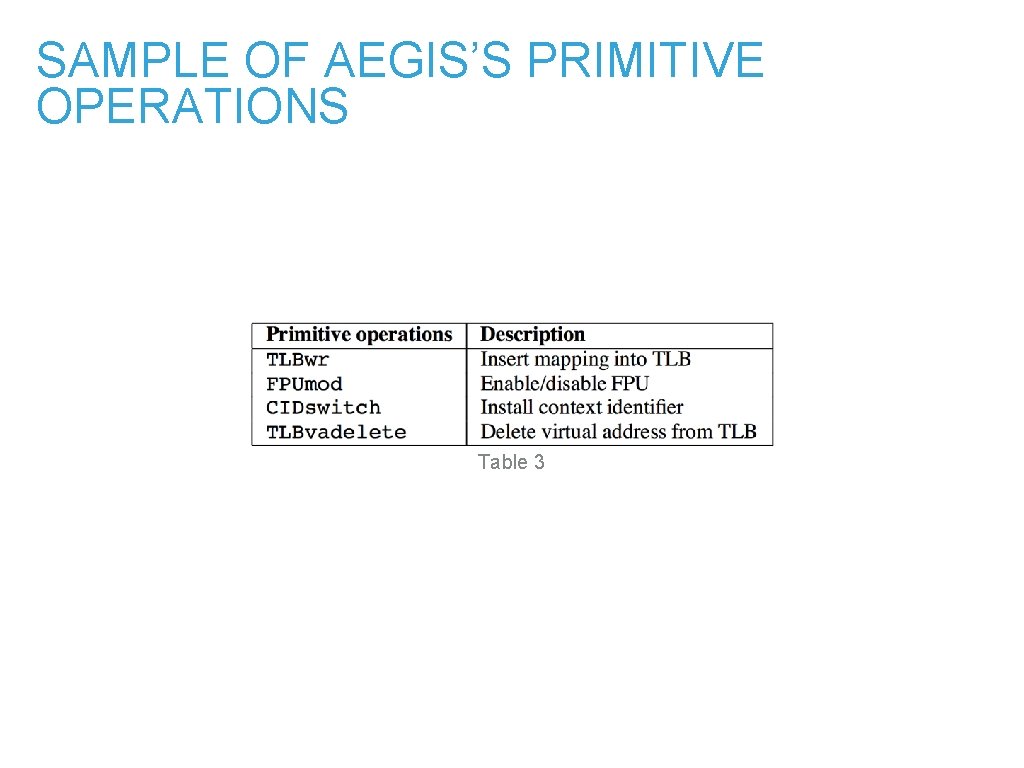
SAMPLE OF AEGIS’S PRIMITIVE OPERATIONS Table 3
EXOKERNEL ‣ Provides interface to interact with hardware ‣ Physical resources managed at application-level ‣ Most of the system implemented using a Library Operating System ‣ Separate resource protection from resource management
SECURE BINDINGS ‣ Used by Lib. OSes to access resources ‣ Decouples authorization from use of resource ‣ Performs authorization at bind time ‣ Hardware can implement protection checks quickly
LIBRARY OPERATING SYSTEM (LIBOS) ‣ Use hardware interface ‣ Implement rest of the operating system ‣ Implementation can be specialized to meet needs of applications
- Slides: 51