
Shanley Pressure Ulcer Prevention Programme SPUPP Dr Emer
- Slides: 29
Shanley Pressure Ulcer Prevention Programme (SPUPP) Dr. Emer Shanley 1, Prof. Zena Moore 1, Dr. Declan Patton 1, Dr Tom O’Connor 1, 1 School of Nursing & Midwifery, Royal College of Surgeons in Ireland (RCSI)
Background • Pressure ulcer prevalence rates increase significantly with age and in Ireland the highest rate of growth in age groups is among older people • Given the relationship between ageing and reduced mobility, it is reasonable to assume that there is a potential for increase in the incidence of pressure ulceration in this age group • Prevention of pressure ulcers is a key issue for enhancing health in the older population
Aims & Objectives of Patient Education • The aim of patient education is to engage patients to develop their competence in the skills necessary to undertake health behaviours that are congruous with their life plans and underpin their independent decision-making • Fundamental objectives must be specified, as patient education must improve patient outcomes by accomplishing valid objectives • This ensures that the patient is receiving an intervention that will ultimately improve their health-related quality of life, by enabling them to make fully informed decisions about their health and well-being, thereby increasing self-efficacy and self-management
European Patients Forum • Patients need to have easy access to relevant understandable information if they are to make informed decisions about their health. Accordingly, the European Patient’s Forum campaign for patient empowerment features education as one of its cornerstones • Self-management skills are crucial to patients as a person living with a chronic condition will spend approximately three hours per year with a health professional. This means that they alone are managing their own health for 8, 757 hours per year
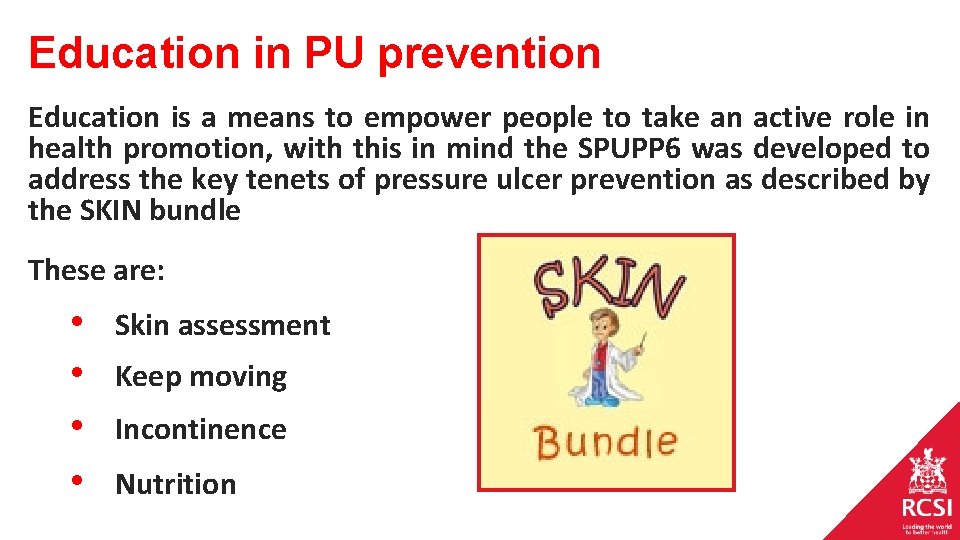
Education in PU prevention Education is a means to empower people to take an active role in health promotion, with this in mind the SPUPP 6 was developed to address the key tenets of pressure ulcer prevention as described by the SKIN bundle These are: • • Skin assessment Keep moving Incontinence Nutrition
Ph. D Study : Phases of development • Phase 1: Development of SPUPP multimedia programme • Phase 2: Development and psychometric evaluation of the Patient Knowledge of Pressure Ulcer Prevention (KPUP) tool • Phase 3: SPUPP evaluation pre and post intervention
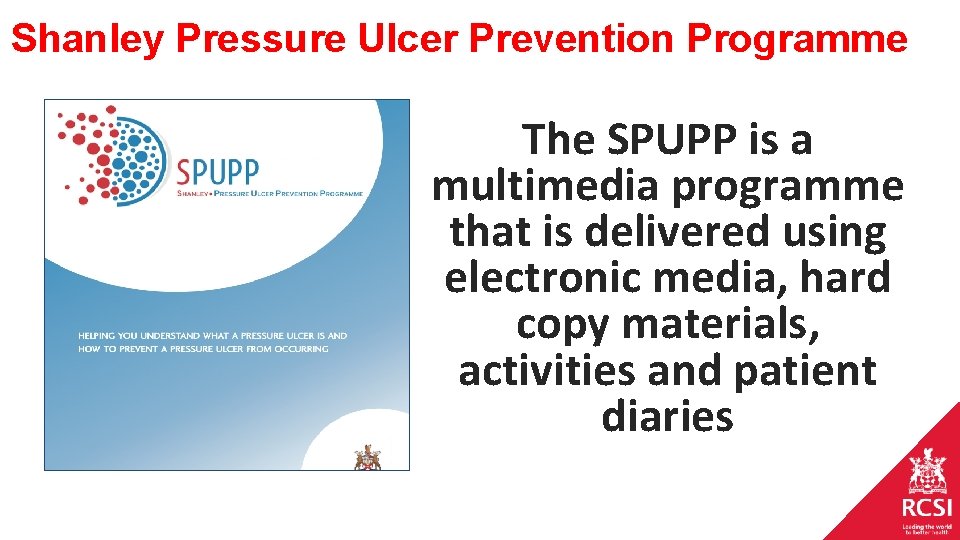
Shanley Pressure Ulcer Prevention Programme The SPUPP is a multimedia programme that is delivered using electronic media, hard copy materials, activities and patient diaries
Multimedia • Multimedia refers to information delivery via a variety of formats and can include text, audio, graphics and video. Benefits include it can be used as a means to overcome the issues associated with poor literacy and to reinforce the information provided • Content can be delivered at a pace that suits the viewer, and repeat viewing is easy • Multimedia education also enables the family or carer to become involved with the education programme which facilitates wider dissemination of the educational content
The SPUPP • Multidisciplinary team involved in development phase-tissue viability, physiotherapy, dietetics, researchers and professional video photographers, in association with the Royal College of Surgeons in Ireland • The Flesch-Kincaid Grade Level was computed to be 6. 3 which equates to reading age of most 11 -12 year olds, whilst the Flesch-Kincaid reading ease is 73 which means it is assessed to be fairly easy to read
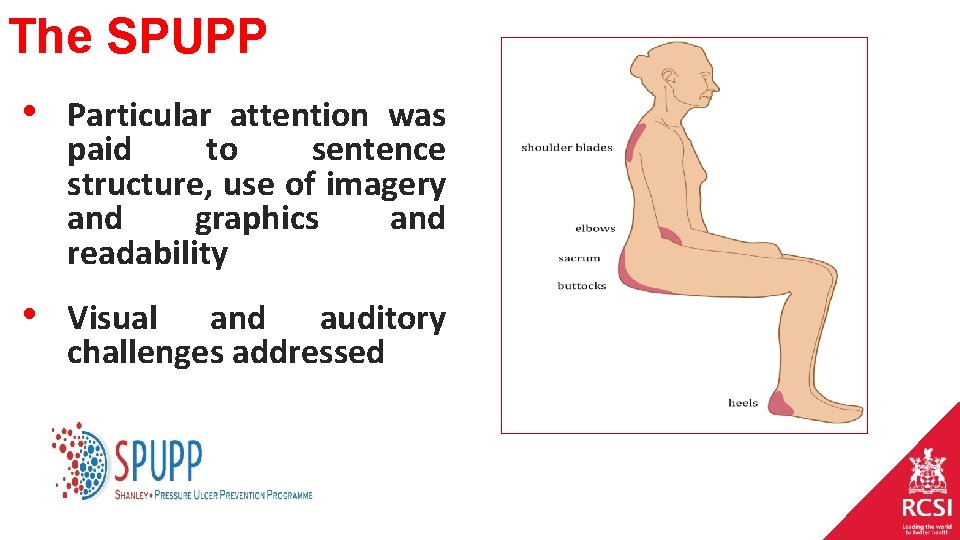
The SPUPP • Particular attention was paid to sentence structure, use of imagery and graphics and readability • Visual and auditory challenges addressed
The SPUPP • SPUPP consists of 5 sessions delivered every 5 days over 20 days, each session lasts 5 -7 minutes, a session summary sheet reinforced the main message in each presentation • A written version of the presentation in the form of a booklet was also provided • There were relevant activities associated with each session such as nutrition diaries, activity sheets and skin care samples for the participant to test, such as moisturiser and soap substitutes
The SPUPP Session 1: Introduction • Overview of the programme and the role of the skin and potential risks to skin integrity; brief description of a pressure ulcer and who is at risk of developing them Session 2 : Skin • Skin care, including when and what to check the skin for, and some practical tips for keeping the skin in good condition
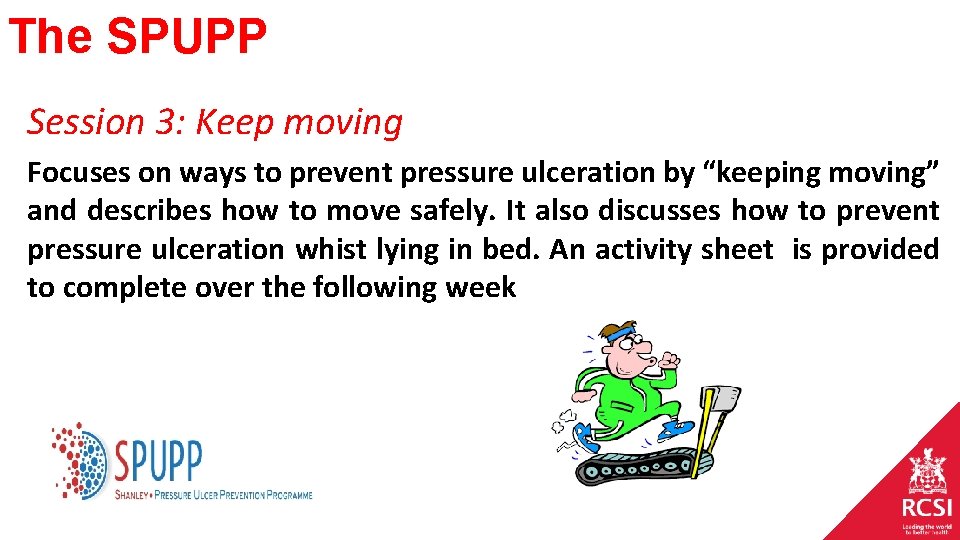
The SPUPP Session 3: Keep moving Focuses on ways to prevent pressure ulceration by “keeping moving” and describes how to move safely. It also discusses how to prevent pressure ulceration whist lying in bed. An activity sheet is provided to complete over the following week
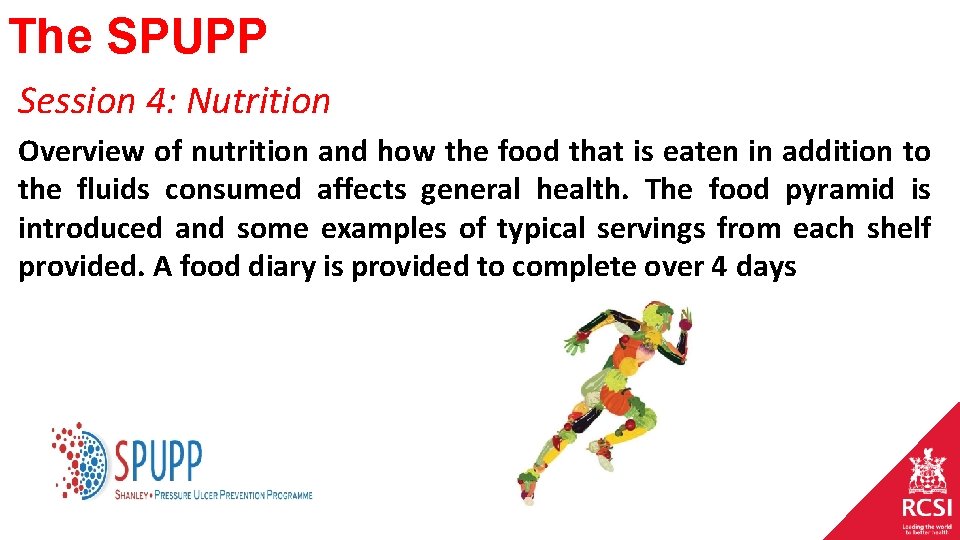
The SPUPP Session 4: Nutrition Overview of nutrition and how the food that is eaten in addition to the fluids consumed affects general health. The food pyramid is introduced and some examples of typical servings from each shelf provided. A food diary is provided to complete over 4 days
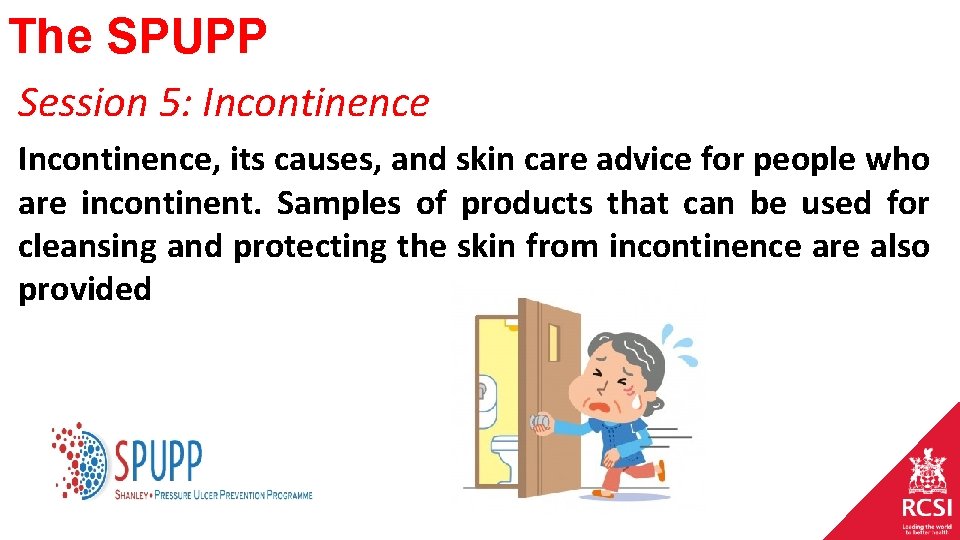
The SPUPP Session 5: Incontinence, its causes, and skin care advice for people who are incontinent. Samples of products that can be used for cleansing and protecting the skin from incontinence are also provided
Ph. D Study : Phases of development • Phase 1: Development of SPUPP multimedia programme • Phase 2: Development and psychometric evaluation of the Patient Knowledge of Pressure Ulcer Prevention (KPUP) tool • Phase 3: SPUPP evaluation pre and post intervention
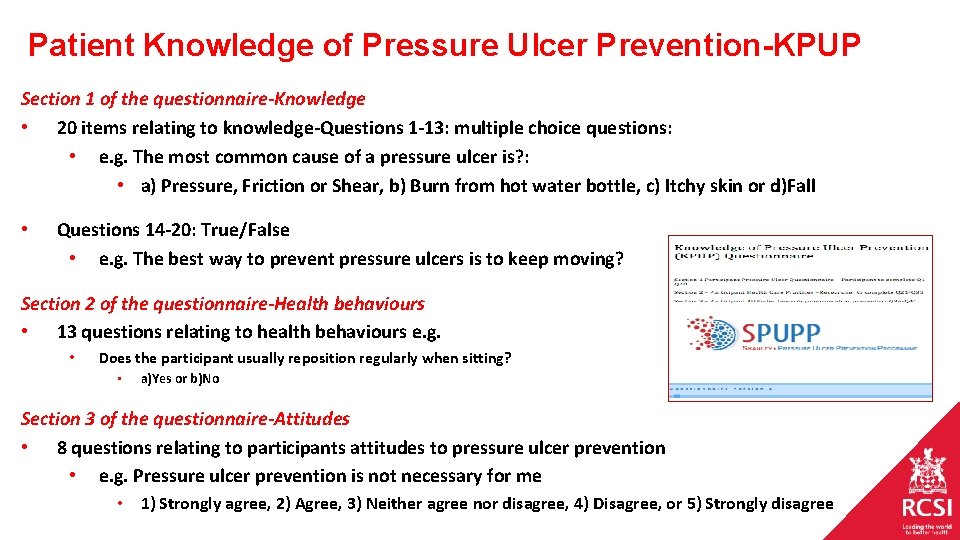
Patient Knowledge of Pressure Ulcer Prevention-KPUP Section 1 of the questionnaire-Knowledge • 20 items relating to knowledge-Questions 1 -13: multiple choice questions: • e. g. The most common cause of a pressure ulcer is? : • a) Pressure, Friction or Shear, b) Burn from hot water bottle, c) Itchy skin or d)Fall • Questions 14 -20: True/False • e. g. The best way to prevent pressure ulcers is to keep moving? Section 2 of the questionnaire-Health behaviours • 13 questions relating to health behaviours e. g. • Does the participant usually reposition regularly when sitting? • a)Yes or b)No Section 3 of the questionnaire-Attitudes • 8 questions relating to participants attitudes to pressure ulcer prevention • e. g. Pressure ulcer prevention is not necessary for me • 1) Strongly agree, 2) Agree, 3) Neither agree nor disagree, 4) Disagree, or 5) Strongly disagree
Phase 2 : KPUP Content Validity • Two expert panels surveyed (Group 1: 13 researchers, • • • Group 2: 26 tissue viability nurses) Section 1 (Knowledge): one item failed to reach a CVI of 0. 78 or higher (CV 1 = 0. 71) and thus, was excluded Section 2 (Attitudes): all items had good CVI scores Section 3 (Health behaviours): CVI calculated for appropriateness and relevance, yielding scores of. 94 -1. 0, and. 92 -1. 0 respectively, indicating good CVI scores for each item in this section
Phase 2 : KPUP Reliability • N=200 older adults; test-retest • Mean knowledge score for the participants: • Test 11. 54/20 (95% CI=11. 10 -11. 99, SD: 3. 07); • Retest 12. 24/20 (95% CI=11. 81 -12. 66, SD: 2. 93) • The correlation between the test/retest computed score was positive, as expected, as r=. 60 (α=. 75) • Consistency for individual items over time was high: • α =. 75 and an ICC of r=. 72 • Cronbach’s alpha for the instrument was relatively stable; =. 58 for test, =. 54 for retest • Overall sections of the instrument show moderate internal consistency and high test-retest stability
Ph. D Study : Phases of development • Phase 1: Development of SPUPP multimedia programme • Phase 2: Development and psychometric evaluation of the Patient Knowledge of Pressure Ulcer Prevention (KPUP) tool • Phase 3: SPUPP evaluation pre and post intervention
Methods • The design was a multi-centre RCT • Following ethical approval, older adults, at risk of a PU, living in the community setting, were invited to participate in the study • Using stratified random sampling, 64 older adults, living in the community who attend either day care centre or retirement groups were randomised to control and intervention groups • All participants completed a pre-validated knowledge questionnaire (KPUPP) pre and post intervention, in addition to an attitude and behavioural survey
Results • Age from 70 -96 years, 75% (n=48) female • 68. 8% (n=44) were either overweight or obese • 40. 6% (n=26) were incontinent of urine • Mobility scores indicated impairments in activity/ mobility • Knowledge was scored out of 20
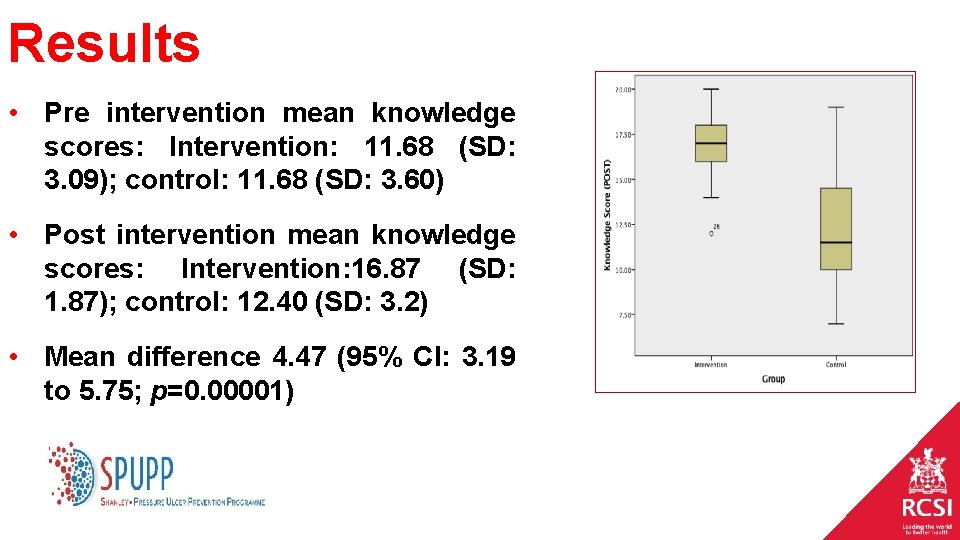
Results • Pre intervention mean knowledge scores: Intervention: 11. 68 (SD: 3. 09); control: 11. 68 (SD: 3. 60) • Post intervention mean knowledge scores: Intervention: 16. 87 (SD: 1. 87); control: 12. 40 (SD: 3. 2) • Mean difference 4. 47 (95% CI: 3. 19 to 5. 75; p=0. 00001)
Results • Positive changes in the intervention group, for selfreported health behaviours and attitudes towards PU prevention • The intervention group saw an increase in the proportion that rated their nutritional intake as excellent and reported an increase in fluid intake, whilst the control group did not report a change in these variables • The intervention group rated the SPUPP very highly
Discussion • This study challenges the myth pertaining to older persons and their supposed lack of willingness to access education, as the participants in the study actively engaged with, and highly rated the SPUPP • This study contributes to the concept of active and healthy ageing; patient empowerment and enhancing the capacity and capability of individuals living within the community care setting
Next steps • Pilot study in an acute Dublin hospital commenced over the summer in a 29 bed rehabilitation ward. Feedback is positive and they have requested a one day/ half day seminar for family members / carers in conjunction with SPUPP • Transitional care unit in a long term geriatric hospital is to deliver SPUPP to all patients once staff training is complete. Nurses and Health care assistants to train in SPUPP and deliver education throughout the hospital • SPUPP to be included in the Pressure Ulcer to Zero campaign nationally with rollout commencing in October 2019 supported by the Department of Health
Remember… S K I N Skin Keep Moving Incontinence Nutrition Email: emershanley 1@gmail. com
Thank you • Thank you for the opportunity to speak to you all today • Special thanks to my eternally patient supervisors, Professor Zena Moore and Dr. Declan Patton • This research is kindly funded by a grant from the School of Nursing and Midwifery, Royal College of Surgeons in Ireland.
References 1. 2. 3. 4. 5. 6. 7. 8. 9. 10. 11. 12. EUROPEAN PATIENTS’ FORUM. 2015. Patient Empowerment Campaign. www. eu-patient. eu/campaign/Patientsprescribe VOWDEN, K. , WARNER, V. & COLLINS, J. 2016. Pressure Ulcer Incidence: Do patients retain information? EWMA Journal, 16, 35 -36 National Institute for Health and Clinical Excellence (NICE). 2014, National Pressure Ulcer Advisory Panel. et al. , 2014). National Pressure Ulcer Advisory Panel, European Pressure Ulcer Advisory Panel & Pan Pacific Pressure Injury Alliance. Prevention and Treatment of Pressure Ulcers: Clinical Practice Guideline, Osborne Park, Western Australia, Cambridge Media. INTERNATIONAL BEST PRACTICE STATEMENT: . 2016. Optimising patient involvement in wound management. Wounds International. Royal College of Surgeons in Ireland, School of Nursing & Midwifery, Shanley, E, Moore, Z, Patton, D. SPUPP Shanley Pressure Ulcer Prevention Programme. Dublin, RCSI Publications, 2016. Print and Electronic Format GIBBONS, W. , SHANKS, H. T. , KLEINHELTER, P. & JONES, P. 2006 b. Eliminating facility-acquired pressure ulcers at Ascension Health. Jt Comm J Qual Patient Saf, 32, 488 -96 CICIRIELLO, S. , JOHNSTON, R. V. , OSBORNE, R. H. , WICKS, I. , DEKROO, T. , CLEREHAN, R. , O'NEILL, C. & BUCHBINDER, R. 2013. SHANLEY, E. 2012. A cluster randomised trial of the leg ulcer prevention programme (LUPP) in venous leg ulcer patients within an Irish Community Care setting. MSc Thesis, Royal College of Surgeons in Ireland. KAPP, S. , MILLER, C. , SAYERS, V. & DONOHUE, L. 2010. The LUPP: effectiveness of a multimedia client education package. Wound Practice and Research, 18, 80 -90. Royal College of Surgeons in Ireland, School of Nursing & Midwifery, Shanley, E, Moore, Z, Patton, D. SPUPP Shanley Pressure Ulcer Prevention Programme. Dublin, RCSI Publications, 2016. Print and Electronic Format. [Supplemental Questionnaire – Knowledge of Pressure Ulcer Prevention [KPUP] v. 1 2016 Print and Electronic Format HEALTH SERVICE EXECUTIVE. 2013 a. Pressure Ulcers to Zero Supported by the Quality Improvement Division Health Service Executive (HSE) and the Royal College of Physicians Ireland(RCPI) through the National Quality Improvement Programme.