
SHAM AL NASEEM SPRING DAY Ayman Abdelkhalek TCLP
SHAM AL- NASEEM SPRING DAY Ayman Abdelkhalek TCLP teacher, Central Academy k-12 school Ann Arbor, MI
By the end students will be able to : - 1 – Know what is “ Sham Al-naseem and when did it start. 2 – Speak about what the Egyptians do on that day. 3 – Make some foods for Sham Al-naseem.
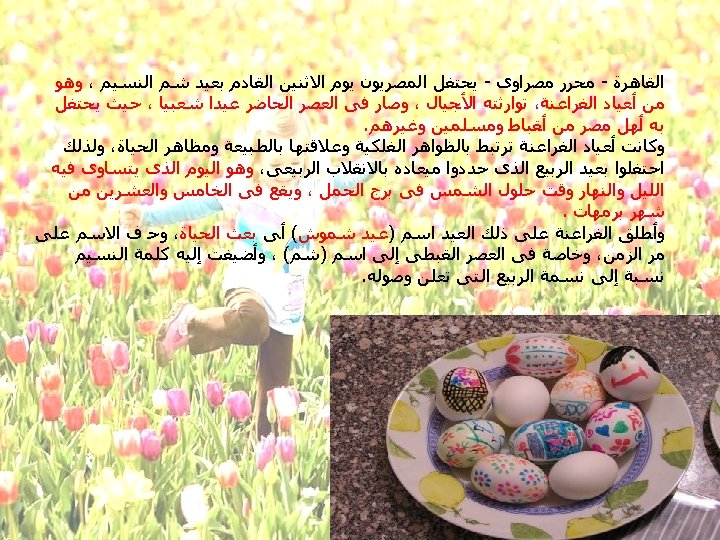
CAIRO - Editor Masrawy – Egyptians are celebrating Sham Al-Naseem on Monday , which is the festivals of the Pharaohs, passing down generations, and became the present-day public holiday, It is celebrated by the people of Egypt; the Copts and Muslims and others. the Pharaohs holidays and celebrations were associated with their relationship to nature and the astronomical phenomena, so celebrating the Spring Festival, which identifies the proper time of spring, is the day on which day and night times are equal , and is on the twenty-fifth of the month Baramhat. the Pharaohs named this day ( Shamoosh Day ) meaning the renaissance of life, and over time, especially in the Coptic era the name became (sham = sniff), and added the word breeze which is related to the Spring breeze which announces its start.
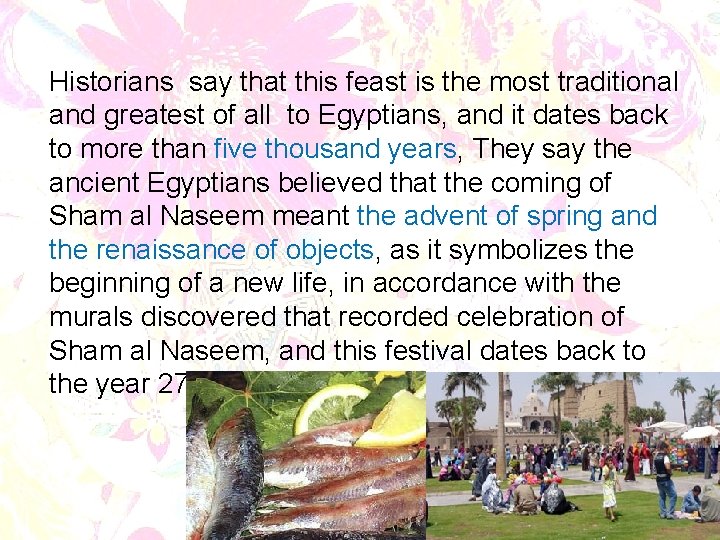
Historians say that this feast is the most traditional and greatest of all to Egyptians, and it dates back to more than five thousand years, They say the ancient Egyptians believed that the coming of Sham al Naseem meant the advent of spring and the renaissance of objects, as it symbolizes the beginning of a new life, in accordance with the murals discovered that recorded celebration of Sham al Naseem, and this festival dates back to the year 2700 BC. m.
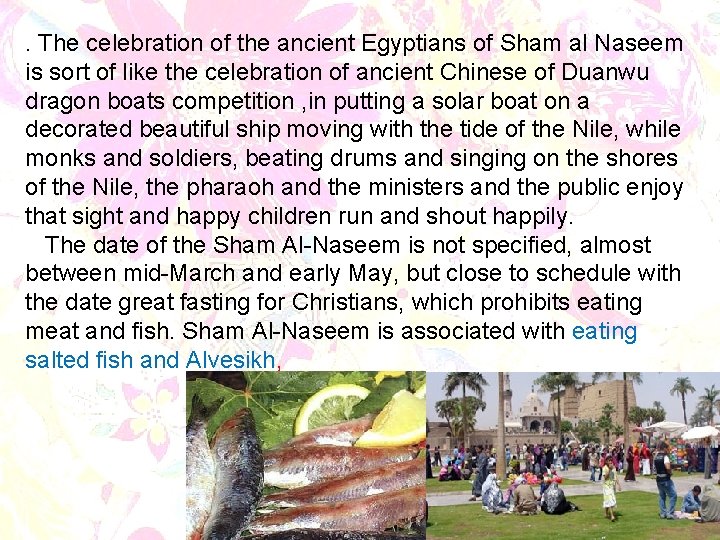
. The celebration of the ancient Egyptians of Sham al Naseem is sort of like the celebration of ancient Chinese of Duanwu dragon boats competition , in putting a solar boat on a decorated beautiful ship moving with the tide of the Nile, while monks and soldiers, beating drums and singing on the shores of the Nile, the pharaoh and the ministers and the public enjoy that sight and happy children run and shout happily. The date of the Sham Al-Naseem is not specified, almost between mid-March and early May, but close to schedule with the date great fasting for Christians, which prohibits eating meat and fish. Sham Al-Naseem is associated with eating salted fish and Alvesikh,
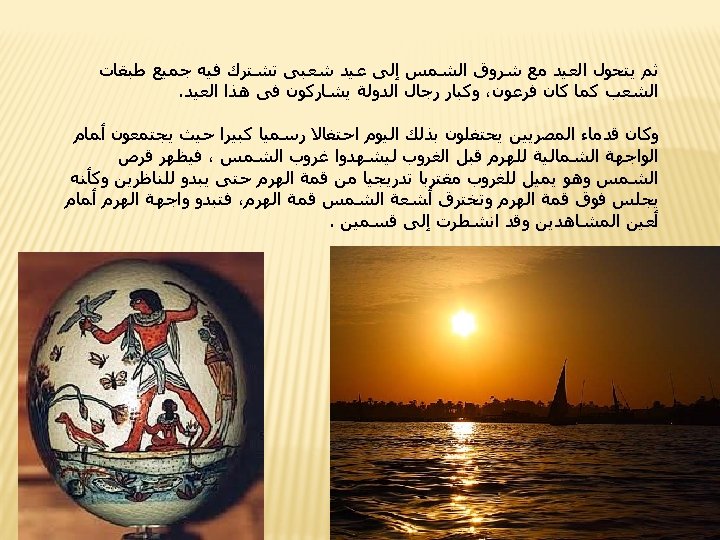
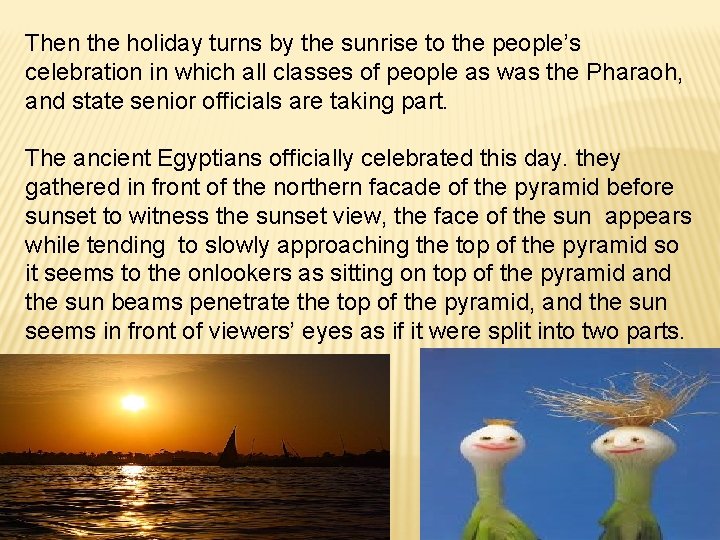
Then the holiday turns by the sunrise to the people’s celebration in which all classes of people as was the Pharaoh, and state senior officials are taking part. The ancient Egyptians officially celebrated this day. they gathered in front of the northern facade of the pyramid before sunset to witness the sunset view, the face of the sun appears while tending to slowly approaching the top of the pyramid so it seems to the onlookers as sitting on top of the pyramid and the sun beams penetrate the top of the pyramid, and the sun seems in front of viewers’ eyes as if it were split into two parts.
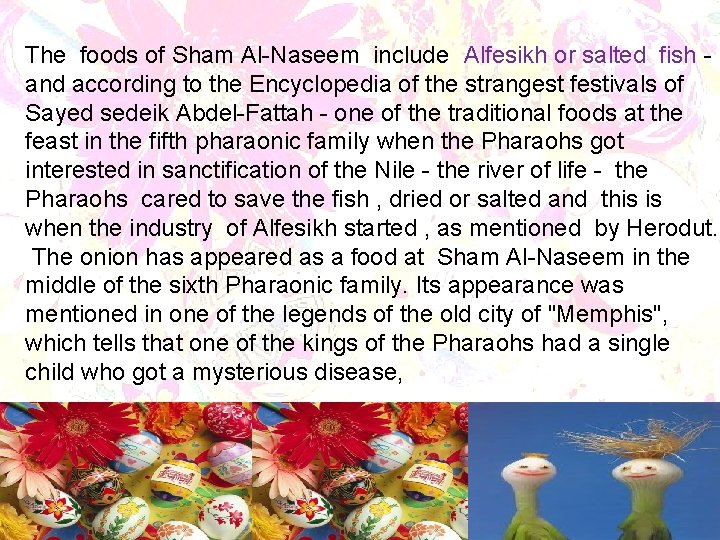
The foods of Sham Al-Naseem include Alfesikh or salted fish and according to the Encyclopedia of the strangest festivals of Sayed sedeik Abdel-Fattah - one of the traditional foods at the feast in the fifth pharaonic family when the Pharaohs got interested in sanctification of the Nile - the river of life - the Pharaohs cared to save the fish , dried or salted and this is when the industry of Alfesikh started , as mentioned by Herodut. The onion has appeared as a food at Sham Al-Naseem in the middle of the sixth Pharaonic family. Its appearance was mentioned in one of the legends of the old city of "Memphis", which tells that one of the kings of the Pharaohs had a single child who got a mysterious disease,
, the king summoned priest of the temple of Amun, who said the Prince’s disease is due to the existence of evil spirits controlling him, and he ordered to put a ripe onion under the head of the prince in bed when the sun sets. the legend explains how the child recovered from his illness, left the bed, and went out to play in the garden. The King held celebrations in the palace for the children of the entire city, and people shared the joys, and when Sham Al-Naseem was due afew days later, the king and his family participated. People hung onion packs on the doors of their homes.
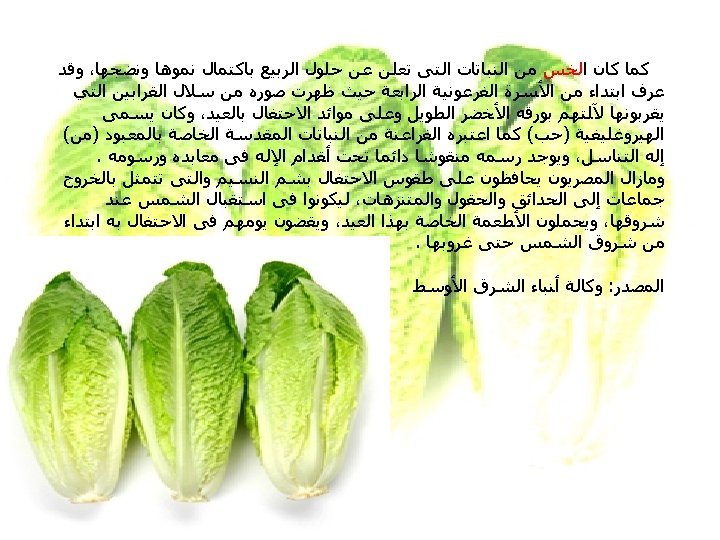
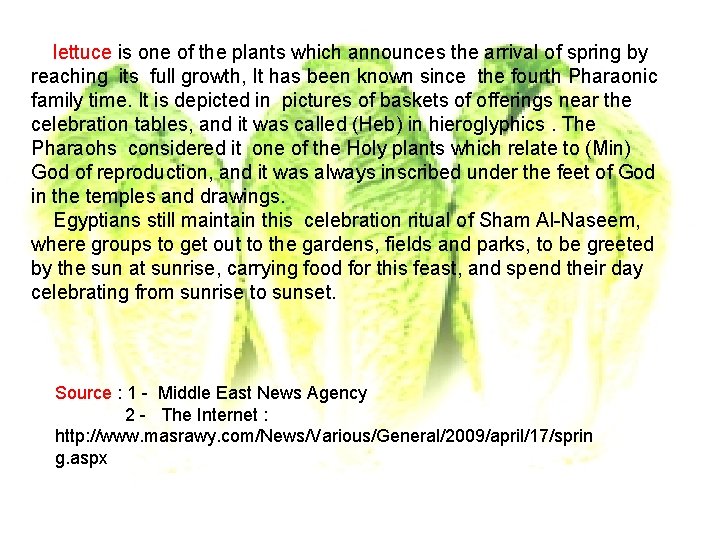
lettuce is one of the plants which announces the arrival of spring by reaching its full growth, It has been known since the fourth Pharaonic family time. It is depicted in pictures of baskets of offerings near the celebration tables, and it was called (Heb) in hieroglyphics. The Pharaohs considered it one of the Holy plants which relate to (Min) God of reproduction, and it was always inscribed under the feet of God in the temples and drawings. Egyptians still maintain this celebration ritual of Sham Al-Naseem, where groups to get out to the gardens, fields and parks, to be greeted by the sun at sunrise, carrying food for this feast, and spend their day celebrating from sunrise to sunset. Source : 1 - Middle East News Agency 2 - The Internet : http: //www. masrawy. com/News/Various/General/2009/april/17/sprin g. aspx
An Egyptian song about Spring ﺍﻟﺪﻧﻴﺎ ﺭﺑﻴﻊ
THANK YOU AND HAVE A GOOD DAY ON SHAM AL-NASEEM Ayman Abdelkhalek TCLP teacher, Central Academy k-12 school Ann Arbor, MI
- Slides: 16