
Shakespeares Language His Times An Introduction Why does





- Slides: 32
Shakespeare’s Language & His Times An Introduction
• Why does Shakespeare cause such fear in the hearts of many students? • What makes him so hard to understand?
Shakespeare’s Language • Because Shakespeare writes in Old English! • Wrong! • Shakespeare writes in Modern English! • The same English we are using in this class right now!
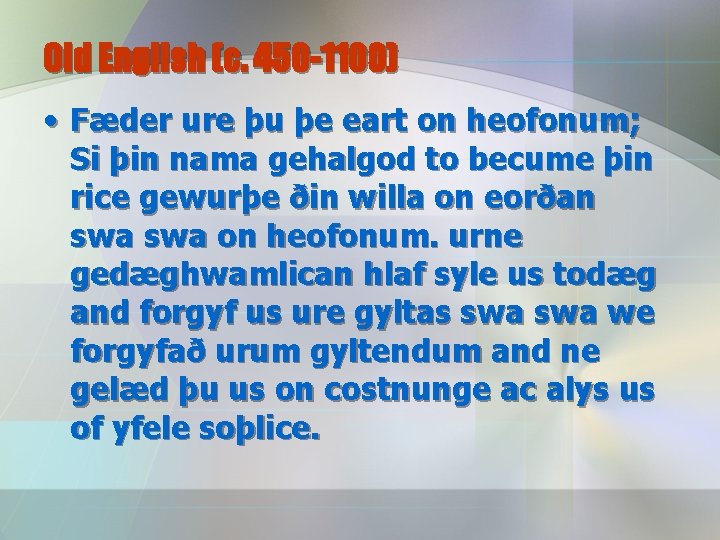
Old English (c. 450 -1100) • Fæder ure þu þe eart on heofonum; Si þin nama gehalgod to becume þin rice gewurþe ðin willa on eorðan swa on heofonum. urne gedæghwamlican hlaf syle us todæg and forgyf us ure gyltas swa we forgyfað urum gyltendum and ne gelæd þu us on costnunge ac alys us of yfele soþlice.
Middle English (1100 -1500) • Oure fadir that art in heuenes, halewid be thi name; thi kyngdoom come to; be thi wille don, in erthe as in heuene. Yyue to vs this dai oure breed ouer othir substaunce, and foryyue to vs oure dettis, as we foryyuen to oure dettouris; and lede vs not in to temptacioun, but delyuere vs fro yuel. Amen.
Modern English (1500 - Present) • Our Father which art in heaven, hallowed be thy name. Thy kingdom come. Thy will be done in earth as it is in heaven. Give us this day our daily bread. And forgive us our trespasses, as we forgive them that trespass against us. And lead us not into temptation. But deliver us from evil. Amen.
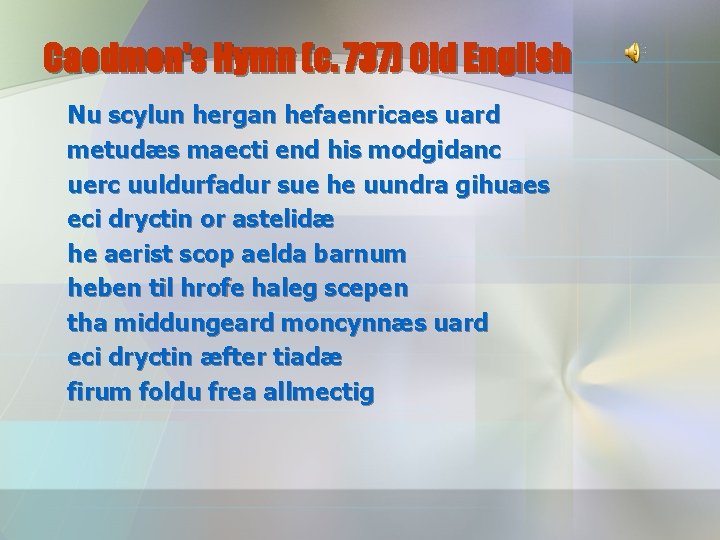
Caedmon's Hymn (c. 737) Old English Nu scylun hergan hefaenricaes uard metudæs maecti end his modgidanc uerc uuldurfadur sue he uundra gihuaes eci dryctin or astelidæ he aerist scop aelda barnum heben til hrofe haleg scepen tha middungeard moncynnæs uard eci dryctin æfter tiadæ firum foldu frea allmectig
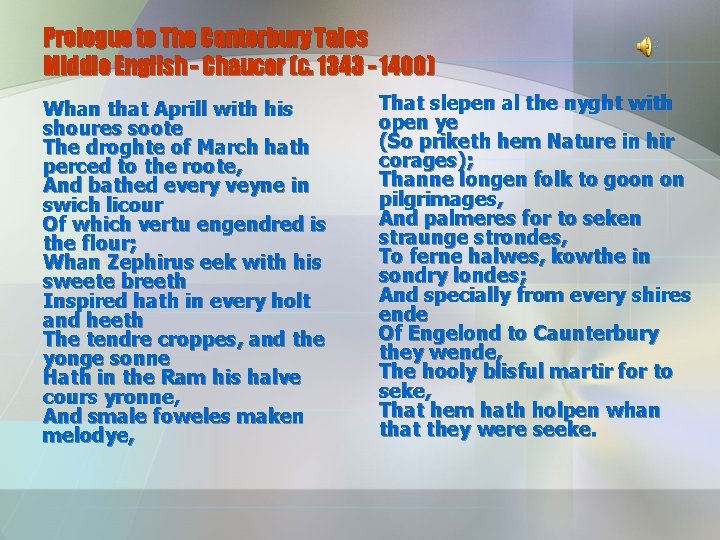
Prologue to The Canterbury Tales Middle English - Chaucer (c. 1343 - 1400) Whan that Aprill with his shoures soote The droghte of March hath perced to the roote, And bathed every veyne in swich licour Of which vertu engendred is the flour; Whan Zephirus eek with his sweete breeth Inspired hath in every holt and heeth The tendre croppes, and the yonge sonne Hath in the Ram his halve cours yronne, And smale foweles maken melodye, That slepen al the nyght with open ye (So priketh hem Nature in hir corages); Thanne longen folk to goon on pilgrimages, And palmeres for to seken straunge strondes, To ferne halwes, kowthe in sondry londes; And specially from every shires ende Of Engelond to Caunterbury they wende, The hooly blisful martir for to seke, That hem hath holpen whan that they were seeke.
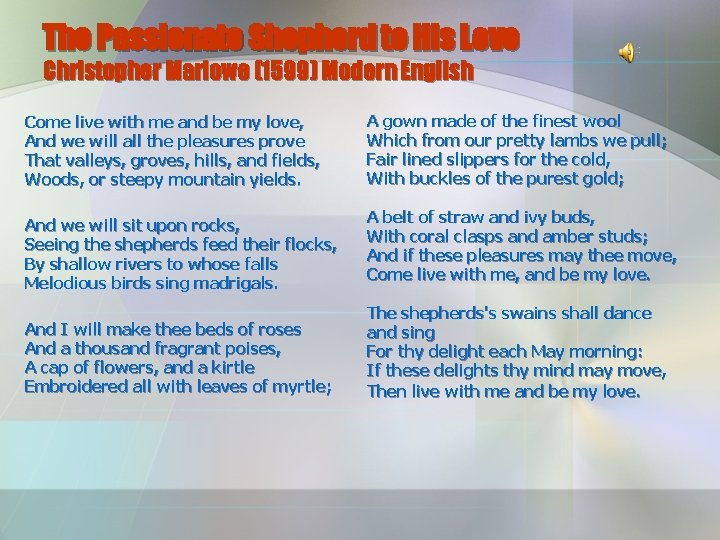
The Passionate Shepherd to His Love Christopher Marlowe (1599) Modern English Come live with me and be my love, And we will all the pleasures prove That valleys, groves, hills, and fields, Woods, or steepy mountain yields. And we will sit upon rocks, Seeing the shepherds feed their flocks, By shallow rivers to whose falls Melodious birds sing madrigals. And I will make thee beds of roses And a thousand fragrant poises, A cap of flowers, and a kirtle Embroidered all with leaves of myrtle; A gown made of the finest wool Which from our pretty lambs we pull; Fair lined slippers for the cold, With buckles of the purest gold; A belt of straw and ivy buds, With coral clasps and amber studs; And if these pleasures may thee move, Come live with me, and be my love. The shepherds's swains shall dance and sing For thy delight each May morning: If these delights thy mind may move, Then live with me and be my love.
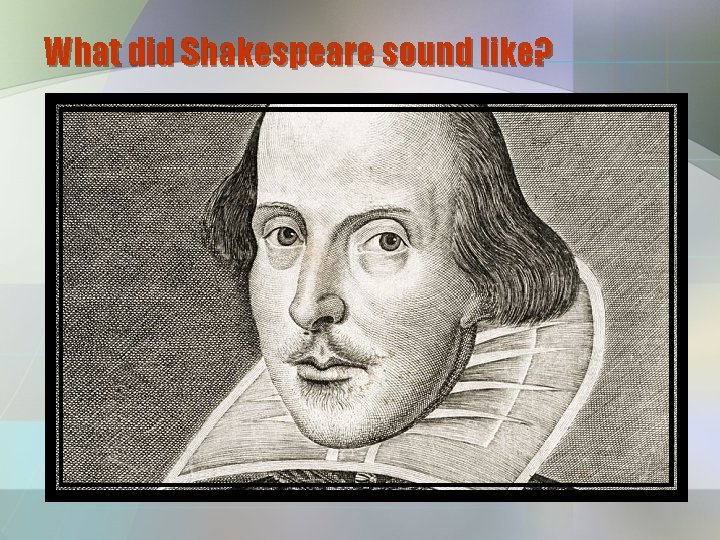
What did Shakespeare sound like?
Shakespeare's Vocabulary • Today our vocabularies only run between 6, 000 and 15, 000 words. • The Bible is made up of only six thousand different words. Shakespeare used between 25, 000 and 29, 000 different words. This is one of the largest vocabularies ever possessed by any member of the human race. • One out of every dozen or so words is a new one that Shakespeare would never use again.
Shakespeare's Vocabulary • Shakespeare added approximately 1, 500 words to the English language. Some examples: • Addiction, advertising, alligator, bandit, bloodstained, cold-blooded, critic, engagement, excitement, eyeball, gloomy, gossip, hint, accessible, amazement, assassination, barefaced, bedazzle, belongings, circumstantial, courtship, critical, dewdrop, downstairs, employer, epileptic, exposure, fairyland, fanged, fashionable, frugal, homely, impartial, ladybird, lament, leapfrog, majestic, moonbeam, paternal, puke, rant, reclusive, roadway, sacrificial, schoolboy, silliness, useful, vulnerable, watchdog, zany.
Phrases Coined by Shakespeare • All our yesterdays (Macbeth) • All that glitters is not gold (The Merchant of Venice) • All's well that ends well (title) • Bated breath (The Merchant of Venice) • Bear a charmed life (Macbeth) • Be-all and the end-all (Macbeth) • The better part of valor is discretion (I Henry IV; possibly already a known saying) • Neither a borrower nor a lender be (Hamlet) • Brave new world (The Tempest) • Break the ice (The Taming of the Shrew) • Brevity is the soul of wit (Hamlet) • Refuse to budge an inch (Measure for Measure / Taming of the Shrew) • Cold comfort (The Taming of the Shrew / King John) • Conscience does make cowards of us all (Hamlet) • Crack of doom (Macbeth) • Dead as a doornail (2 Henry VI) • A dish fit for the gods (Julius Caesar) • Cry havoc and let slip the dogs of war (Julius Caesar) • Dog will have his day (Hamlet) • Devil incarnate (Titus Andronicus / Henry V) • Eaten me out of house and home (2 Henry IV) • Elbow room (King John; first attested 1540 according to Merriam-Webster) • Faint hearted (I Henry VI) • Fight till the last gasp (I Henry VI) • Flaming youth (Hamlet) • Fool's paradise (Romeo and Juliet)
Phrases Coined by Shakespeare • Forever and a day (As You Like It) • For goodness' sake (Henry VIII) • Foregone conclusion (Othello) • Full circle (King Lear) • The game is afoot (I Henry IV) • The game is up (Cymbeline) • Give the devil his due (I Henry IV) • Good riddance (Troilus and Cressida) • Jealousy is the green-eyed monster (Othello) • It was Greek to me (Julius Caesar) • Heart of gold (Henry V) • 'Tis high time (The Comedy of Errors) • Household words (Henry V) • A horse, a horse! My kingdom for a horse! (Richard III) • Ill wind which blows no man to good (2 Henry IV) • In a pickle (The Tempest) • In my heart of hearts (Hamlet) • In my mind's eye (Hamlet) • Infinite space (Hamlet) • In a pickle (The Tempest) • It smells to heaven (Hamlet) • Itching palm (Julius Caesar) • Kill with kindness (Taming of the Shrew) • Killing frost (Henry VIII) • Knock knock! Who's there? (Macbeth) • Laughing stock (The Merry Wives of Windsor) • Lean and hungry look (Julius Caesar) • Lie low (Much Ado about Nothing) • Live long day (Julius Caesar) • Love is blind (Merchant of Venice) • Melted into thin air (The Tempest)
Shakespeare's Vocabulary • The longest word in Shakespeare is 'honorificabilitudinitatibus‘ (Love's Labour's Lost, v. i. 41). • At the Shakespeare Centre in Stratford-upon. Avon, which is the headquarters of the International Shakespeare Association, the library collection in 1999 included the Complete Works in more than 30 languages and individual editions of the plays and poems in over 80 languages, from Arabic and Albanian to Yakut and Zulu.
Why Should We Study Shakespeare? • He tells us so much about human nature. This is probably one of the major reasons why Shakespeare's plays are still watched and studied. If the things he wrote about were not the perennial aspects of human nature, we wouldn't be interested in watching the plays any more. • He reveals to us so much about our own natures. We recognize ourselves in the characters and words he creates. We learn about ourselves when we watch and read Shakespeare.
Why Should We Study Shakespeare? • He is a brilliant dramatist. Shakespeare might have lots of profound things to say to us, but we wouldn't watch the plays unless they worked as drama. The experience of watching the plays is entertaining and spectacular as well as revealing many things about life to us. • He is a great poet. The plays are full of memorable passages of poetry, which along with all Shakespeare's other achievements, contributes to the enduring success of his plays.
The Elizabethan Age
ELIZABETHAN FUN FACTS • Elizabeth I ate so many sweets that her teeth just rotted away and turned black! • Boy’s schools in the Elizabethan era would have been open six days a week, for the whole year. The boys only got off for holidays. Also, school was in session from 6: 00 am to 6: 00 pm. Yikes! • Women were not allowed to act in plays, so men (often teenage boys) would play the women’s parts.
ELIZABETHAN FUN FACTS • Since theatres had no lights, characters often said what time of day it was. • So many people wore wigs in Elizabethan times that if a child was out after dark, they were in danger of having their hair cut to be made for wigs. • One form of entertainment was bull or bear baiting, and cockfights. Bull/bear baiting is when a bull or bear is tied to a post, and five or six dogs attack it. Bets are made on the results of these “games. ”
ELIZABETHAN FUN FACTS • Probably the most popular form of entertainment was going to theater. It cost one penny, and another penny for a seat. • Elizabethan theatres attracted huge crowds - up to 3000 people. • Medicine was basic; Physicians had no idea what caused illnesses and diseases. The beliefs about the causes of illnesses were based on the ancient teachings of Aristotle and Hippocrates.
ELIZABETHAN FUN FACTS • Physicians paid attention to a patient’s bodily fluids, called Humors. Many patients where subjected to bleeding in order to get rid of the bad Humors. • For an earache, a common remedy was to put a roasted onion in the ear. To cure a stye, a person was supposed to rub his eye with the tail of a black tomcat.
ELIZABETHAN FUN FACTS • The most common form of public execution was probably hanging. It was used for most common crimes such as robbery, murder, etc. Royalty who were convicted of some crime were usually beheaded with a sword or axe. • So many people have used Shakespeare's works in their books or plays that if he were alive today, he would earn 55 million dollars a year!
ELIZABETHAN FUN FACTS • For Illnesses, people were told to swallow powdered human skull, live buttered spiders, or crab's eyes. • The cure for baldness: Shave the head and beard, and cover the head with the grease of a fox. Or you could wash the head with the juice of beets five or six times, or crush garlic and rub the head with it.
ELIZABETHAN FUN FACTS • Surgeons and barbers were usually the same man in a town. That is why a barber's pole is red and white. The red is for blood and the white is for bandages. • Soap was very expensive and people rarely washed. Wealthy people used perfume to cover their body odors. • Barbers/Surgeons carried out amputations without using anesthetics - many patients died of shock.
ELIZABETHAN FUN FACTS • In Shakespeare's day, London had a population of about 200, 000 people. • London was filled with every type of criminal: murderers, muggers, shoplifters and more. There was even a school for pickpockets. • Most people died before the age of 50. At 35 they considered themselves old.
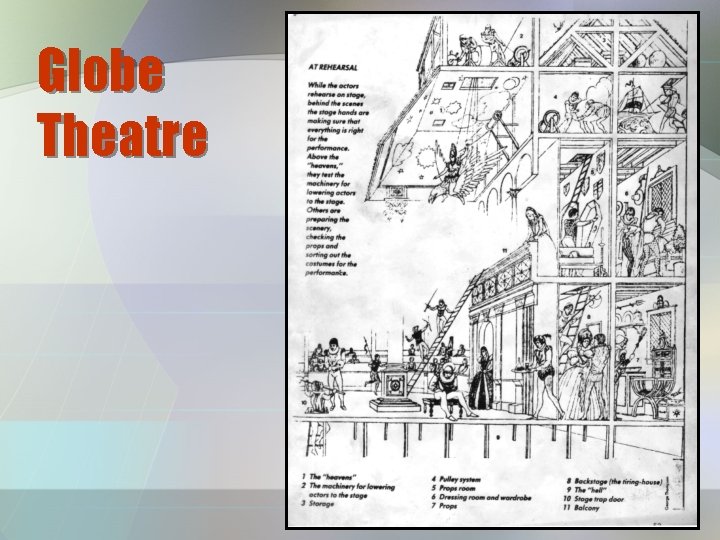
Globe Theatre
Globe Theatre
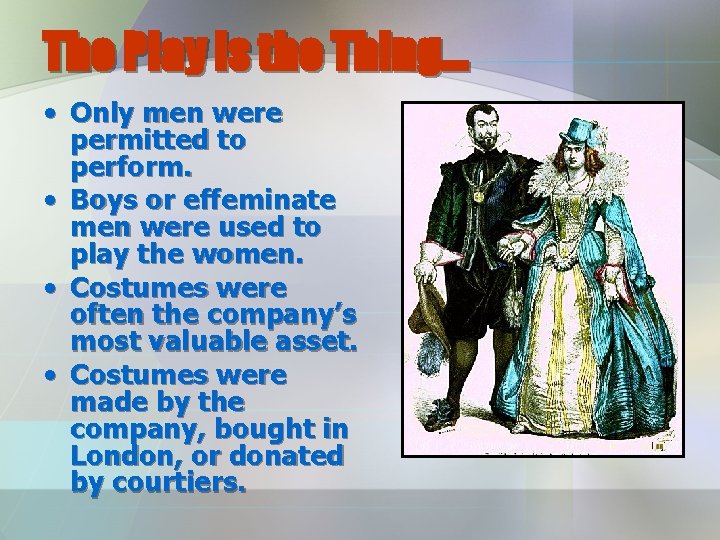
The Play is the Thing… • Only men were permitted to perform. • Boys or effeminate men were used to play the women. • Costumes were often the company’s most valuable asset. • Costumes were made by the company, bought in London, or donated by courtiers.
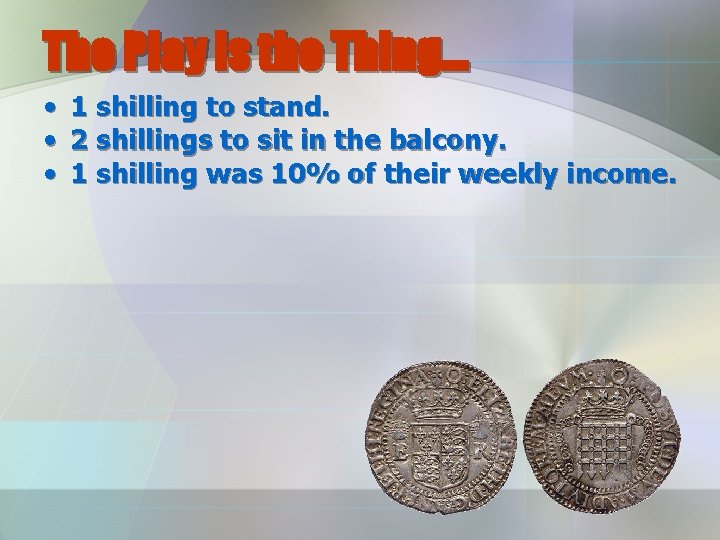
The Play is the Thing… • • • 1 shilling to stand. 2 shillings to sit in the balcony. 1 shilling was 10% of their weekly income.