Shakespeare Dramatic Devices and Figurative Language 9 th

- Slides: 15
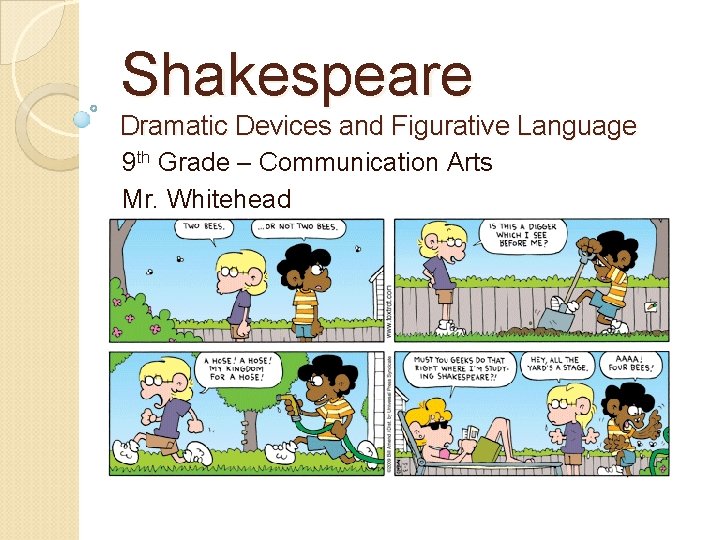
Shakespeare Dramatic Devices and Figurative Language 9 th Grade – Communication Arts Mr. Whitehead
Let’s Review Figurative Language 1. The line “What light through yonder window breaks? It is the East, and Juliet is the sun. ” BEST illustrates what type of figurative language? A. B. C. D. Hyperbole Metaphor Simile Personification
Let’s Review Figurative Language 2. The line “Rise fair sun and kill the jealous moon, who is sick and pale with grief. ” BEST illustrates what type of figurative language? A. B. C. D. Hyperbole Metaphor Simile Personification
Let’s Review Figurative Language 3. The line “You are as glorious as a heavenly angel. ” BEST illustrates what type of figurative language? A. B. C. D. Hyperbole Metaphor Simile Personification
Let’s Review Figurative Language 4. The line “The heart-ache and the thousand natural shocks” BEST illustrates what type of figurative language? A. B. C. D. Hyperbole Metaphor Simile Personification
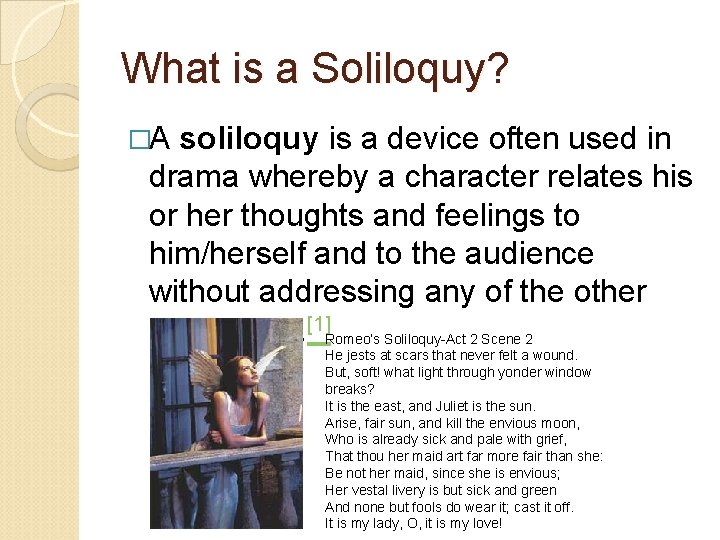
What is a Soliloquy? �A soliloquy is a device often used in drama whereby a character relates his or her thoughts and feelings to him/herself and to the audience without addressing any of the other characters. [1]Romeo’s Soliloquy-Act 2 Scene 2 He jests at scars that never felt a wound. But, soft! what light through yonder window breaks? It is the east, and Juliet is the sun. Arise, fair sun, and kill the envious moon, Who is already sick and pale with grief, That thou her maid art far more fair than she: Be not her maid, since she is envious; Her vestal livery is but sick and green And none but fools do wear it; cast it off. It is my lady, O, it is my love!
Monologue and Aside �Soliloquy is distinct from monologue and aside. �A monologue (or monolog) is when the character may be speaking his or her thoughts aloud, directly addressing another character, or speaking to the audience, especially the former.
An Incredible Example
Aside �An aside is a dramatic device in which a character speaks to the audience. By convention the audience is to realize that the character's speech is unheard by the other characters on stage. It may be addressed to the audience expressly (in character or out) or represent an unspoken thought.
Aside (continued) �An aside is usually a brief comment, rather than a speech, such as a monologue or soliloquy. Unlike a public announcement, it occurs within the context of the play. �An aside is, by convention, a true statement of a character's thought; a character may be mistaken in an aside, but may not be dishonest.
Soliloquy, the past and future �Soliloquies were frequently used in poetic dramas; dramas in prose tend to use a more realistic speaking style and rarely if ever feature them. �The plays of William Shakespeare feature many soliloquies. The "To be or not to be" speech in Hamlet is perhaps the most famous one in the English language.
Hamlet – “to be or not to be”
Let’s Review Figurative Language 5. Hamlet’s “to be or not to be” speech illustrates what type of dramatic element? A. B. C. D. Soliloquy Aside Monologue Speech
Let’s Review Figurative Language 6. Which of the following is not a characteristic of a soliloquy? A. B. C. D. It is heard by the audience It is heard by another character The character relates a thought or feeling It is not heard by another character
Assignment Split into groups of two. Remove all of the figurative language from the Soliloquy and come up with a basic translation of what Romeo says. 2. Combine with another group and reassess your translation. 3. Share your translation with the rest of the class. 1.