
Shakespeare 5 Act Play Structure Drama Drama instead
- Slides: 31
Shakespeare – 5 Act Play Structure Drama
Drama, instead of telling us the whole of a man’s life, must place him in such a situation, tie such a knot, that when it is untied, the whole man is visible. —Leo Tolstoy
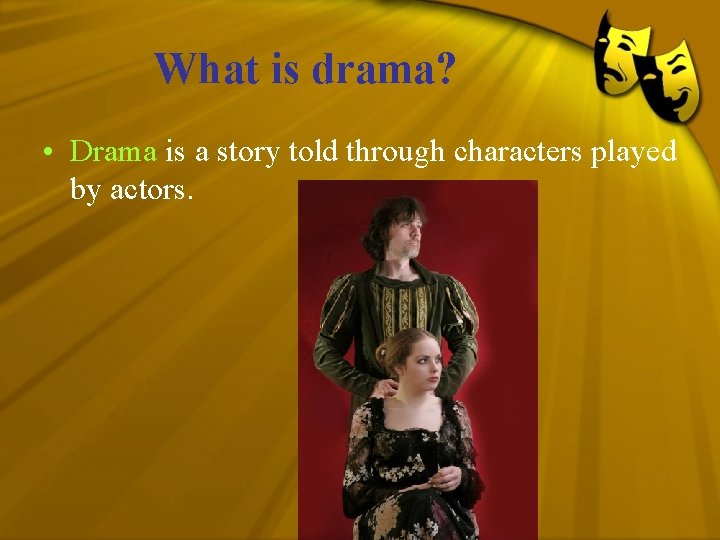
What is drama? • Drama is a story told through characters played by actors.
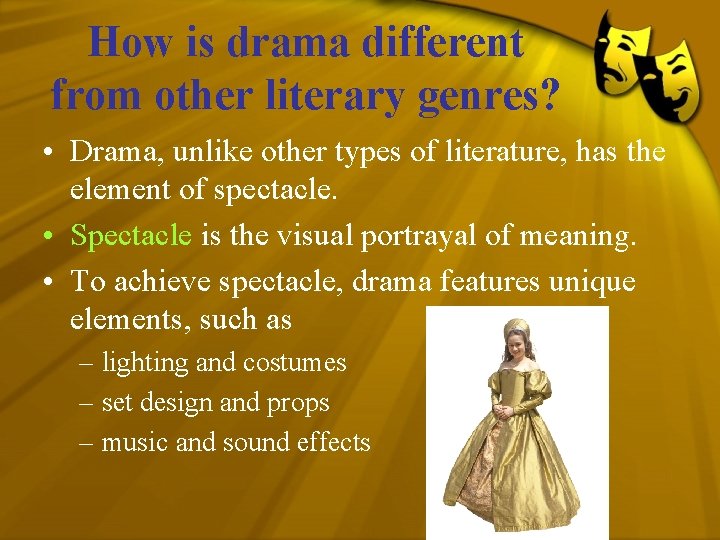
How is drama different from other literary genres? • Drama, unlike other types of literature, has the element of spectacle. • Spectacle is the visual portrayal of meaning. • To achieve spectacle, drama features unique elements, such as – lighting and costumes – set design and props – music and sound effects
What are the purposes of drama? • Drama can – entertain viewers – enlighten viewers by sharing the human condition or experience – help viewers gain insight into themselves and others – teach viewers empathy – allow viewers to explore other visions of the world
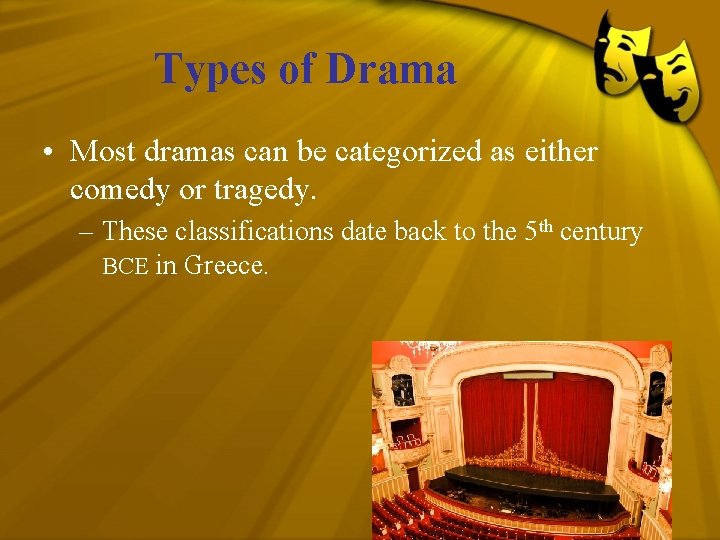
Types of Drama • Most dramas can be categorized as either comedy or tragedy. – These classifications date back to the 5 th century BCE in Greece.
Shakespeare’s Comedies • During the English Renaissance (1485– 1642), Shakespeare led a revival in drama and wrote several comedies. – These comedies were typically lighthearted works that touched on serious themes. – Action in Shakespeare’s comedies usually progressed from initial order to humorous misunderstanding and back to order again. – Often, his comedies ended with a marriage.
Shakespeare’s Tragedies • During the English Renaissance, Shakespeare also wrote several tragedies. – These tragedies closely followed the Greek tragedy format. – They told stories of the downfall of persons of high status. – The fall of these heroes was typically brought about by some tragic flaw in their character. – Often, these tragedies celebrated the courage and dignity of the heroes in the face of doom.
Dramatic Structure • Once a playwright chooses a type of drama, he or she must organize the script into a dramatic structure. • To do this, a playwright borrows elements from fiction, such as characters, setting, and plot structure. • These elements are then placed into parts unique to drama: acts and scenes.
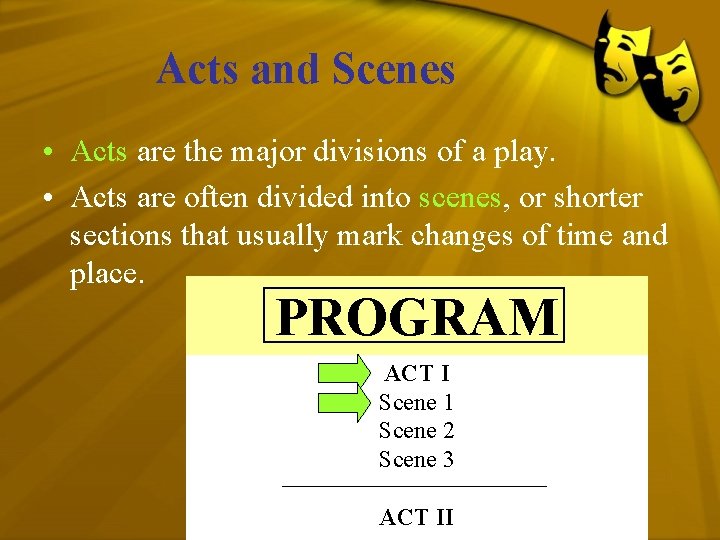
Acts and Scenes • Acts are the major divisions of a play. • Acts are often divided into scenes, or shorter sections that usually mark changes of time and place. PROGRAM ACT I Scene 1 Scene 2 Scene 3 ACT II
Dramatic Structure: Five-Act Play • Most plays written in Shakespeare’s time have a dramatic structure composed of five acts. • For example, The Tragedy of Macbeth is a five -act play.
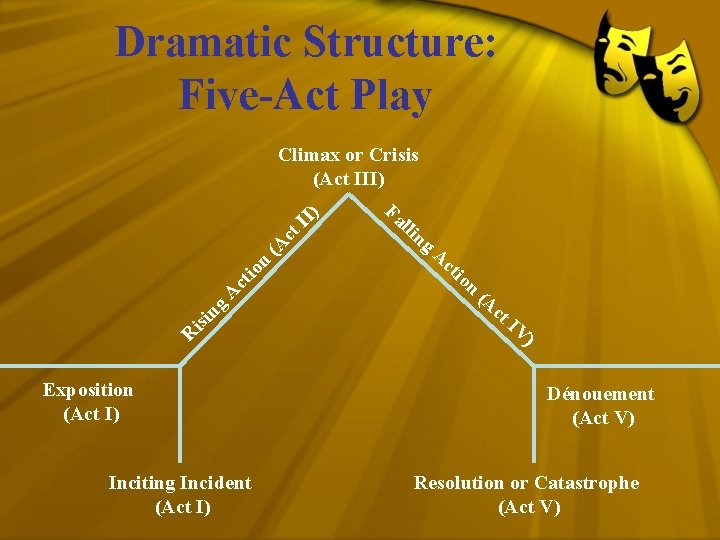
Dramatic Structure: Five-Act Play • A five-act play has the same plot structure as a work of fiction. – It has an exposition, rising action, climax or crisis, falling action, and dénouement. • Each act is assigned to a particular part of the plot structure. – See the diagram on the next slide.
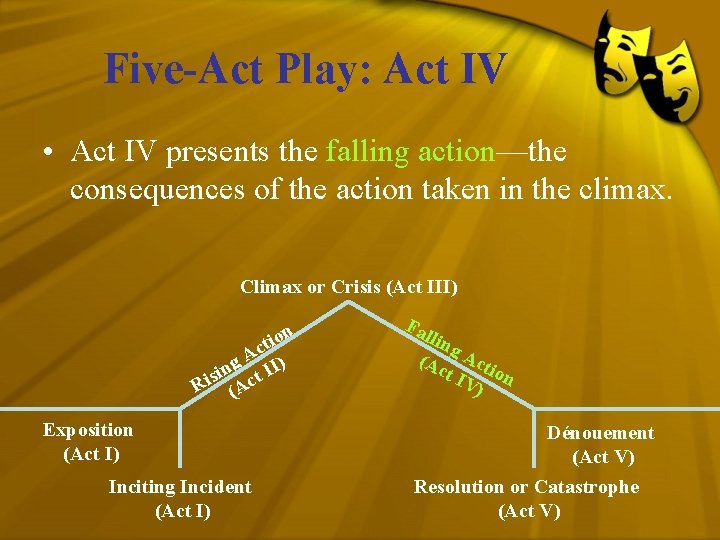
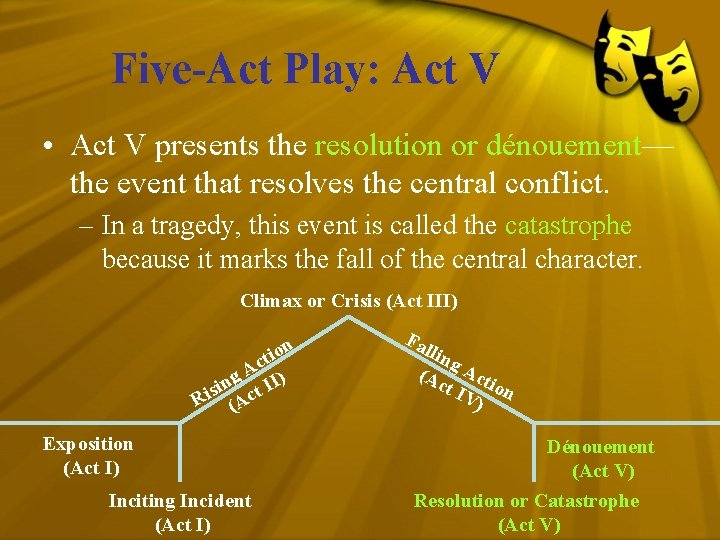
Dramatic Structure: Five-Act Play g is n Climax or Crisis (Act III) Fa I) I lli ng ct (A Ac n tio c A i R Exposition (Act I) Inciting Incident (Act I) n (A ct IV ) Dénouement (Act V) Resolution or Catastrophe (Act V)
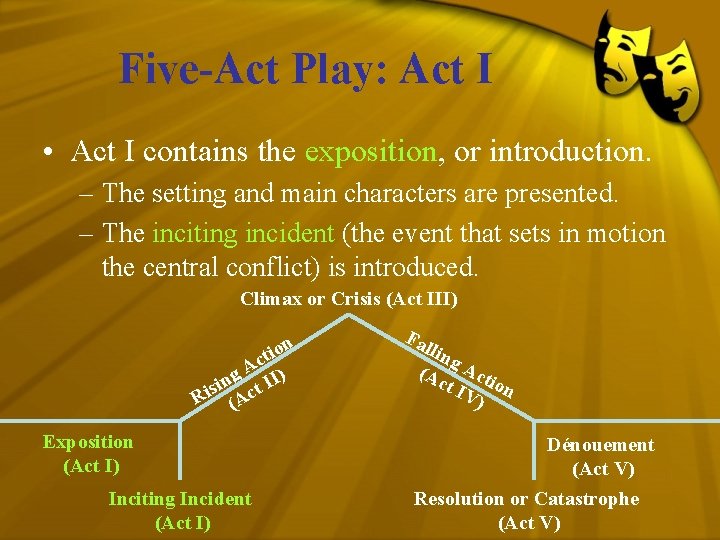
Five-Act Play: Act I • Act I contains the exposition, or introduction. – The setting and main characters are presented. – The inciting incident (the event that sets in motion the central conflict) is introduced. Climax or Crisis (Act III) ion ct A g II) n i s Ri (Act Exposition (Act I) Inciting Incident (Act I) Fa llin g (Ac Act t IV ion ) Dénouement (Act V) Resolution or Catastrophe (Act V)
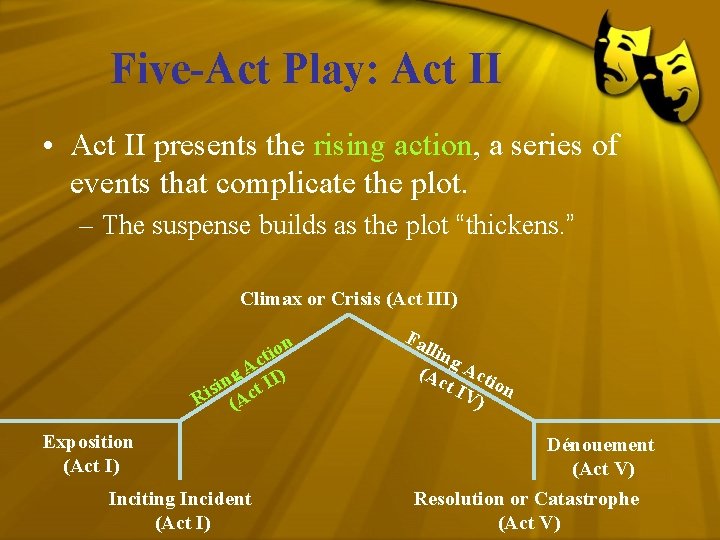
Five-Act Play: Act II • Act II presents the rising action, a series of events that complicate the plot. – The suspense builds as the plot “thickens. ” Climax or Crisis (Act III) on i t c A g II) n i t s Ri (Ac Exposition (Act I) Inciting Incident (Act I) Fa llin g (Ac Act t IV ion ) Dénouement (Act V) Resolution or Catastrophe (Act V)
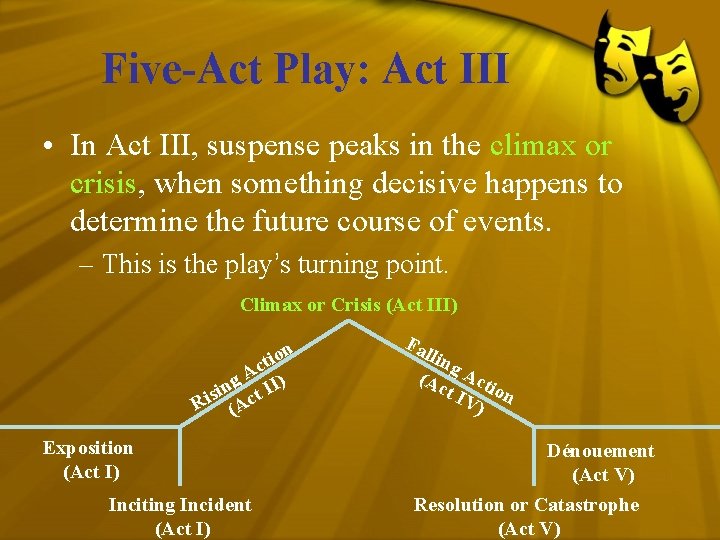
Five-Act Play: Act III • In Act III, suspense peaks in the climax or crisis, when something decisive happens to determine the future course of events. – This is the play’s turning point. Climax or Crisis (Act III) on i t c A g II) n i s Ri (Act Exposition (Act I) Inciting Incident (Act I) Fa llin g (Ac Act t IV ion ) Dénouement (Act V) Resolution or Catastrophe (Act V)
Five-Act Play: Act IV • Act IV presents the falling action—the consequences of the action taken in the climax. Climax or Crisis (Act III) ion ct A g II) n i s Ri (Act Exposition (Act I) Inciting Incident (Act I) Fa llin g (Ac Act t IV ion ) Dénouement (Act V) Resolution or Catastrophe (Act V)
Five-Act Play: Act V • Act V presents the resolution or dénouement— the event that resolves the central conflict. – In a tragedy, this event is called the catastrophe because it marks the fall of the central character. Climax or Crisis (Act III) on i t c A g II) n i s Ri (Act Exposition (Act I) Inciting Incident (Act I) Fa llin g (Ac Act t IV ion ) Dénouement (Act V) Resolution or Catastrophe (Act V)
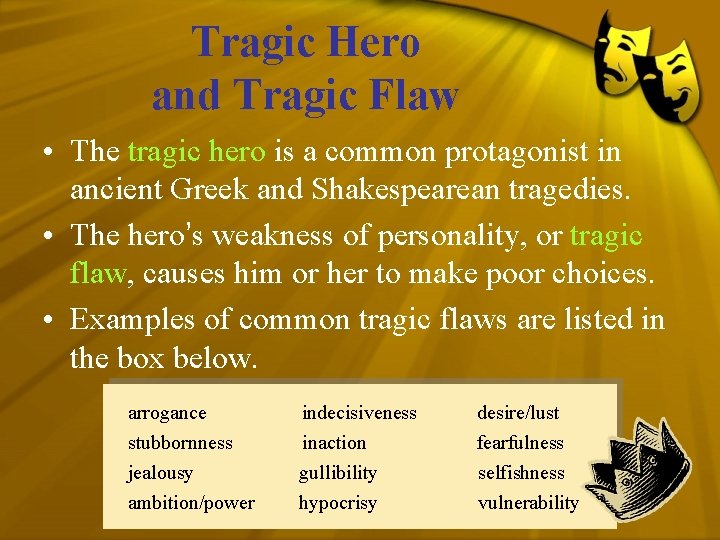
Tragic Hero and Tragic Flaw • The tragic hero is a common protagonist in ancient Greek and Shakespearean tragedies. • The hero’s weakness of personality, or tragic flaw, causes him or her to make poor choices. • Examples of common tragic flaws are listed in the box below. arrogance stubbornness jealousy ambition/power indecisiveness inaction gullibility hypocrisy desire/lust fearfulness selfishness vulnerability
Tragic Hero • A tragic hero in a classical tragedy – is frequently a male figure – is a member of the nobility or an esteemed leader – is responsible for his or her own fate – makes choices that lead to self-destruction or the ruination of relationships – suffers deeply, therefore inciting sympathy from the audience – becomes more self-aware as a result of the suffering
Foils • Foils are minor characters whose personalities serve to highlight the weaknesses of the main character or tragic hero. • In The Tragedy of Macbeth, Banquo is a foil to Macbeth. • For example, when a trusting Macbeth wants to believe the evil witches’ prophecies, a dubious Banquo warns him to be cautious.
Comic Relief • Another type of minor character in classical tragedy is a humorous character who provides comic relief. • Comic relief is a technique used by playwrights to provide a break from the emotional intensity of a play. • In The Tragedy of Macbeth, the drunken Porter who guards the gates of Macbeth’s castle provides comic relief.
Dramatic Speech • Because they are meant to be read out loud, dramatic works rely primarily on the speech of the characters to tell a story. • Powerful dramatic speech engages the audience with its eloquence and emotional intensity.
Types of Dramatic Speech • There are four types of dramatic speech that playwrights use in their scripts: – dialogue – monologue – soliloquy – aside
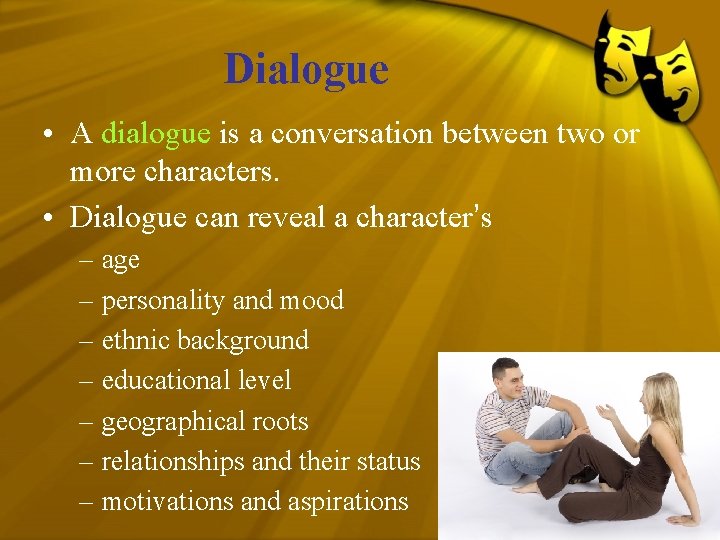
Dialogue • A dialogue is a conversation between two or more characters. • Dialogue can reveal a character’s – age – personality and mood – ethnic background – educational level – geographical roots – relationships and their status – motivations and aspirations
Monologue • Another type of dramatic speech is a monologue—a long speech made by one character. • This type of speech is an expression of a character’s thoughts or feelings regarding another character or situation. • A monologue typically can be heard by other characters on stage.
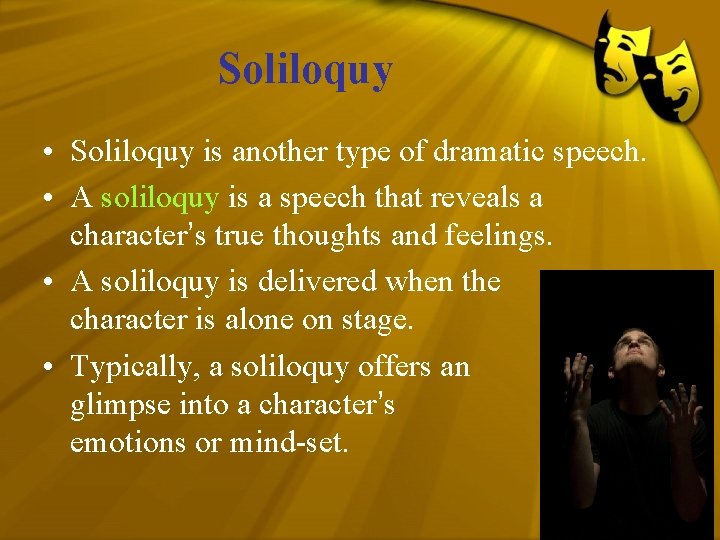
Soliloquy • Soliloquy is another type of dramatic speech. • A soliloquy is a speech that reveals a character’s true thoughts and feelings. • A soliloquy is delivered when the character is alone on stage. • Typically, a soliloquy offers an intimate glimpse into a character’s emotions or mind-set.
Aside • An aside is another type of dramatic speech. • In an aside, a character reveals to the audience his or her innermost thoughts and feelings about a topic. • This technique allows the audience—and no other characters on stage—to hear the character’s desires and motivations. • This aids in the audience’s understanding of subsequent events.
Verbal Irony • Dramatic speech may also include the use of verbal irony. • Verbal irony is when a character says one thing but means another. • Verbal irony is similar to sarcasm.
Other Types of Irony • Two other types of irony are also common in dramas: – Dramatic irony is when something is known by the reader or the audience but is not known by the characters. – Irony of situation is when an event occurs that violates the expectations of the characters, the reader, or the audience.
Stage Directions • The way in which characters deliver their lines sets the tone for each scene in a play. • To help actors determine how to do so, a playwright writes stage directions that describe how something should be performed on stage. • Stage directions also include notes on the staging of the play: set design, lighting, costumes, props, music, and sound effects.