
Shake Alert CISN Testing Center CTC Development Philip
- Slides: 43
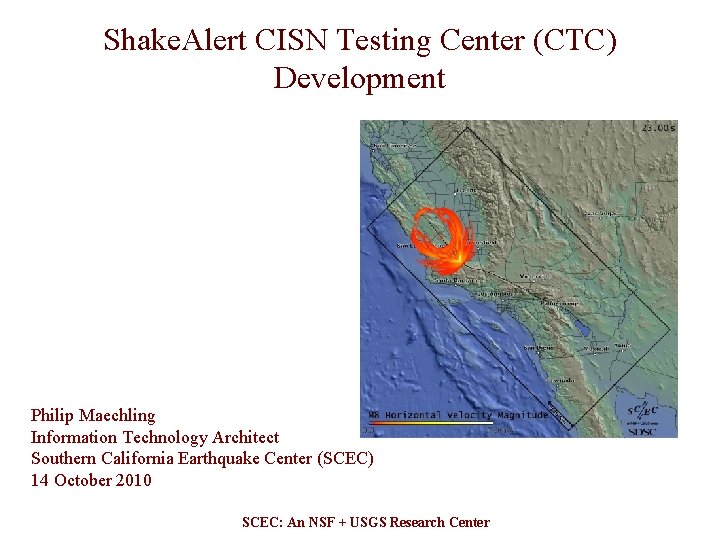
Shake. Alert CISN Testing Center (CTC) Development Philip Maechling Information Technology Architect Southern California Earthquake Center (SCEC) 14 October 2010 SCEC: An NSF + USGS Research Center
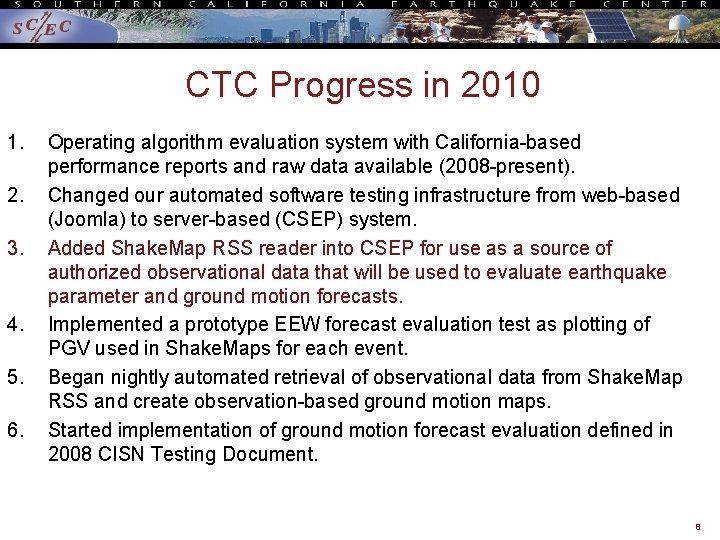
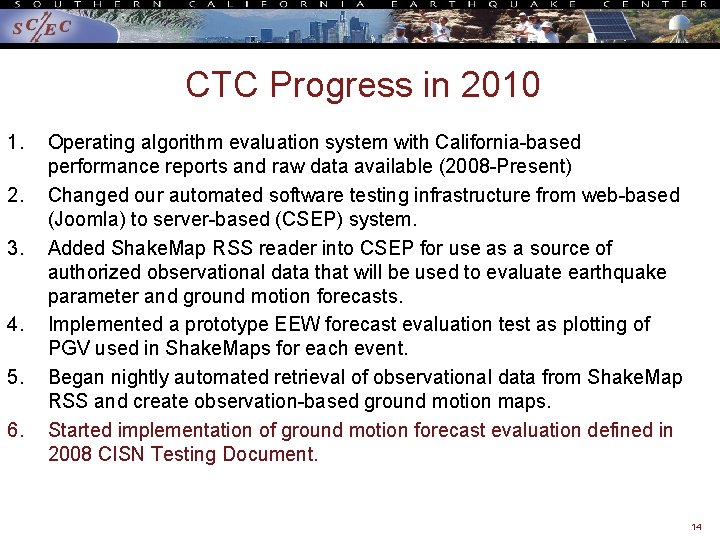
CTC Progress in 2010 1. 2. 3. 4. 5. 6. Operating algorithm evaluation system with California-based performance reports and raw data available (2008 -present). Changed our automated software testing infrastructure from web-based (Joomla) system to server-based (CSEP) system. Added Shake. Map RSS reader into CSEP for use as a source of authorized observational data that will be used to evaluate earthquake parameter and ground motion forecasts. Implemented a prototype EEW forecast evaluation test as plotting of PGV used in Shake. Maps for each event. Began nightly automated retrieval of observational data from Shake. Map RSS and create observation-based ground motion maps. Started implementation of ground motion forecast evaluation defined in 2008 CISN Testing Document. 2
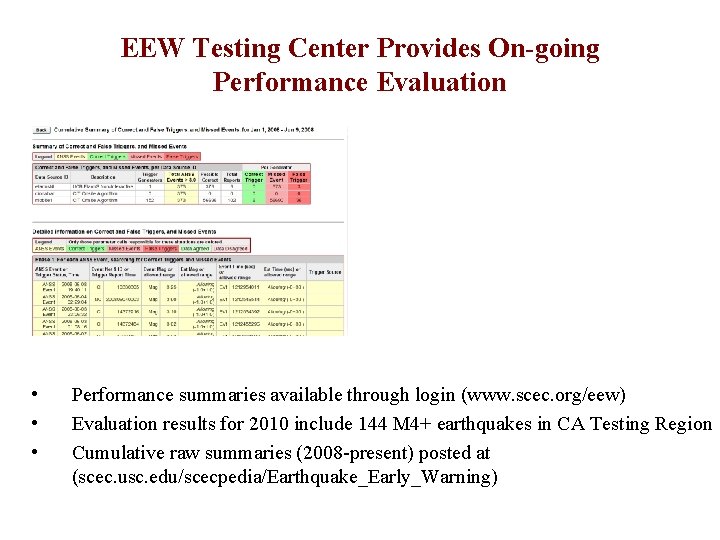
EEW Testing Center Provides On-going Performance Evaluation • • • Performance summaries available through login (www. scec. org/eew) Evaluation results for 2010 include 144 M 4+ earthquakes in CA Testing Region Cumulative raw summaries (2008 -present) posted at (scec. usc. edu/scecpedia/Earthquake_Early_Warning)
CTC Progress in 2010 1. 2. 3. 4. 5. 6. Operating algorithm evaluation system with California-based performance reports and raw data available (2008 -present). Changed our automated software testing infrastructure from web-based (Joomla) system to server-based (CSEP) system. Added Shake. Map RSS reader into CSEP for use as a source of authorized observational data that will be used to evaluate earthquake parameter and ground motion forecasts. Implemented a prototype EEW forecast evaluation test as plotting of PGV used in Shake. Maps for each event. Began nightly automated retrieval of observational data from Shake. Map RSS and create observation-based ground motion maps. Started implementation of ground motion forecast evaluation defined in 2008 CISN Testing Document. 4
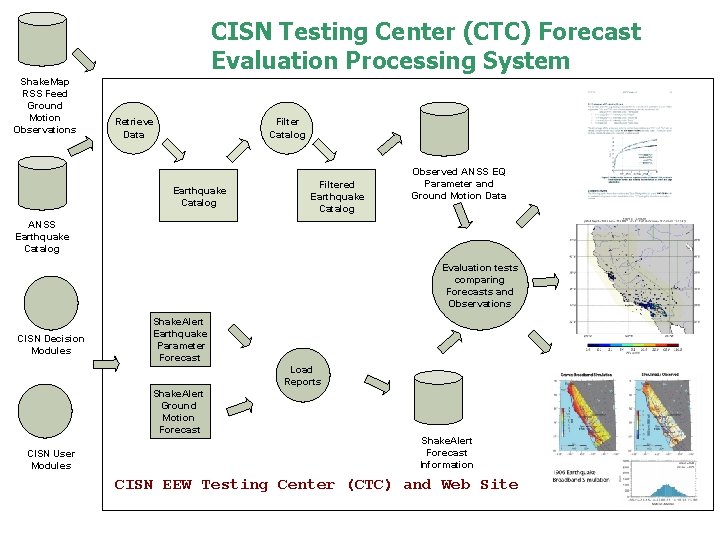
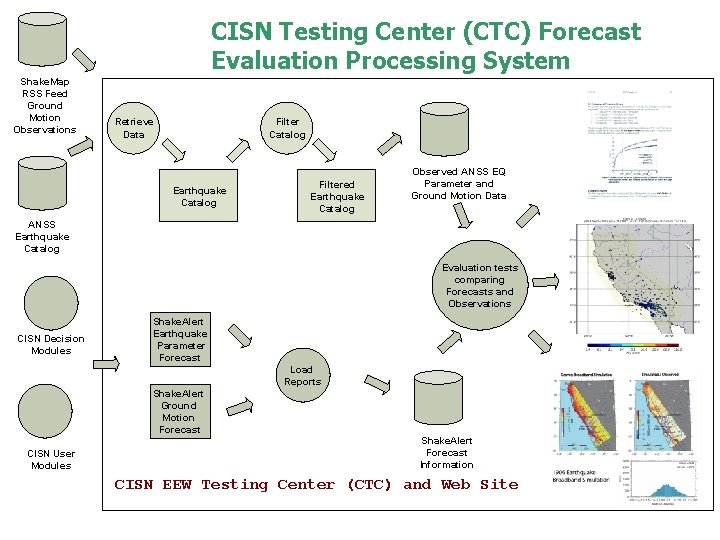
CISN Testing Center (CTC) Forecast Evaluation Processing System Shake. Map RSS Feed Ground Motion Observations Retrieve Data Filter Catalog Earthquake Catalog Filtered Earthquake Catalog Observed ANSS EQ Parameter and Ground Motion Data ANSS Earthquake Catalog Evaluation tests comparing Forecasts and Observations CISN Decision Modules Shake. Alert Earthquake Parameter Forecast Load Reports Shake. Alert Ground Motion Forecast CISN User Modules Shake. Alert Forecast Information CISN EEW Testing Center (CTC) and Web Site
CTC Progress in 2010 1. 2. 3. 4. 5. 6. Operating algorithm evaluation system with California-based performance reports and raw data available (2008 -present). Changed our automated software testing infrastructure from web-based (Joomla) to server-based (CSEP) system. Added Shake. Map RSS reader into CSEP for use as a source of authorized observational data that will be used to evaluate earthquake parameter and ground motion forecasts. Implemented a prototype EEW forecast evaluation test as plotting of PGV used in Shake. Maps for each event. Began nightly automated retrieval of observational data from Shake. Map RSS and create observation-based ground motion maps. Started implementation of ground motion forecast evaluation defined in 2008 CISN Testing Document. 8
CTC Progress in 2010 1. 2. 3. 4. 5. 6. Operating algorithm evaluation system with California-based performance reports and raw data available (2008 -present). Changed our automated software testing infrastructure from web-based (Joomla) to server-based (CSEP) system. Added Shake. Map RSS reader into CSEP for use as a source of authorized observational data that will be used to evaluate earthquake parameter and ground motion forecasts. Implemented a prototype EEW forecast evaluation test as plotting of PGV used in Shake. Maps for each event. Began nightly automated retrieval of observational data from Shake. Map RSS and create observation-based ground motion maps. Started implementation of ground motion forecast evaluation defined in 2008 CISN Testing Document. 10
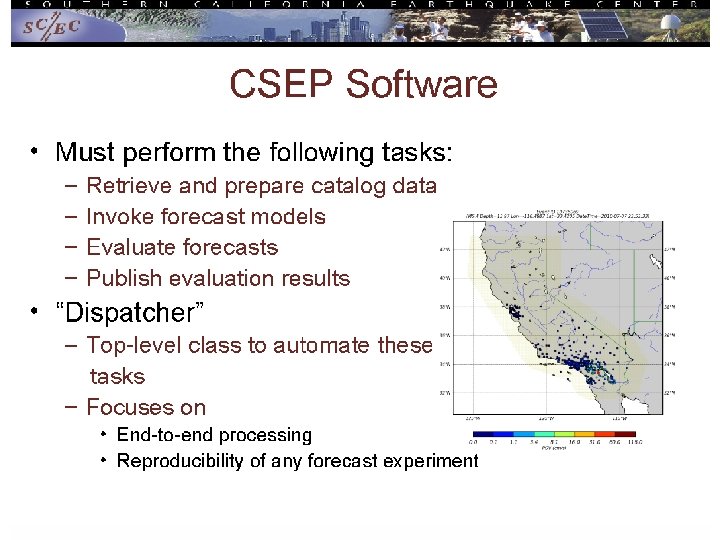
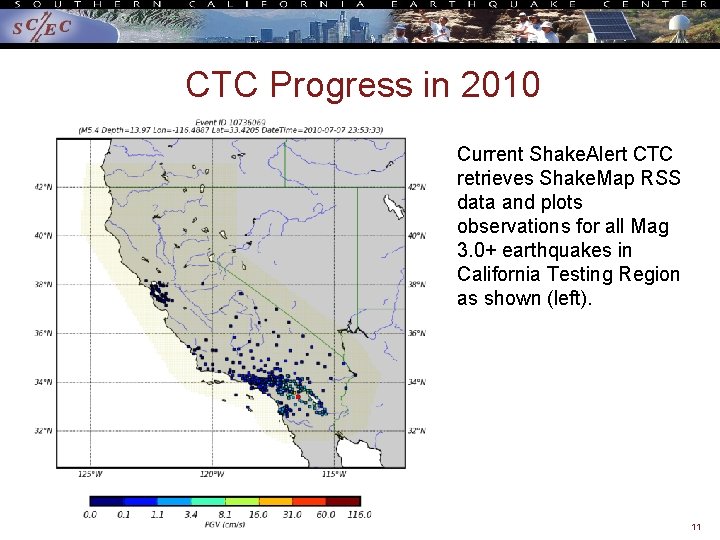
CTC Progress in 2010 Current Shake. Alert CTC retrieves Shake. Map RSS data and plots observations for all Mag 3. 0+ earthquakes in California Testing Region as shown (left). 11
CTC Progress in 2010 1. 2. 3. 4. 5. 6. Operating algorithm evaluation system with California-based performance reports and raw data available (2008 -Present) Changed our automated software testing infrastructure from web-based (Joomla) to server-based (CSEP) system. Added Shake. Map RSS reader into CSEP for use as a source of authorized observational data that will be used to evaluate earthquake parameter and ground motion forecasts. Implemented a prototype EEW forecast evaluation test as plotting of PGV used in Shake. Maps for each event. Began nightly automated retrieval of observational data from Shake. Map RSS and create observation-based ground motion maps. Started implementation of ground motion forecast evaluation defined in 2008 CISN Testing Document. 12
CISN Testing Center (CTC) Forecast Evaluation Processing System Shake. Map RSS Feed Ground Motion Observations Retrieve Data Filter Catalog Earthquake Catalog Filtered Earthquake Catalog Observed ANSS EQ Parameter and Ground Motion Data ANSS Earthquake Catalog Evaluation tests comparing Forecasts and Observations CISN Decision Modules Shake. Alert Earthquake Parameter Forecast Load Reports Shake. Alert Ground Motion Forecast CISN User Modules Shake. Alert Forecast Information CISN EEW Testing Center (CTC) and Web Site
CTC Progress in 2010 1. 2. 3. 4. 5. 6. Operating algorithm evaluation system with California-based performance reports and raw data available (2008 -Present) Changed our automated software testing infrastructure from web-based (Joomla) to server-based (CSEP) system. Added Shake. Map RSS reader into CSEP for use as a source of authorized observational data that will be used to evaluate earthquake parameter and ground motion forecasts. Implemented a prototype EEW forecast evaluation test as plotting of PGV used in Shake. Maps for each event. Began nightly automated retrieval of observational data from Shake. Map RSS and create observation-based ground motion maps. Started implementation of ground motion forecast evaluation defined in 2008 CISN Testing Document. 14
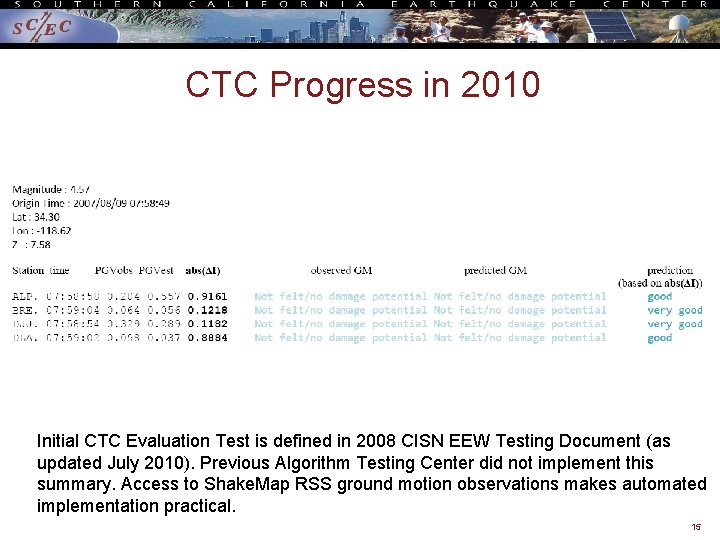
CTC Progress in 2010 Initial CTC Evaluation Test is defined in 2008 CISN EEW Testing Document (as updated July 2010). Previous Algorithm Testing Center did not implement this summary. Access to Shake. Map RSS ground motion observations makes automated implementation practical. 15
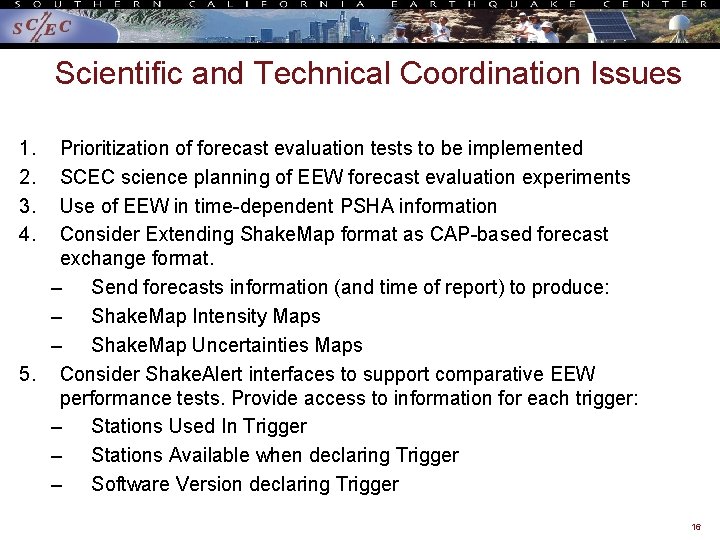
Scientific and Technical Coordination Issues 1. 2. 3. 4. Prioritization of forecast evaluation tests to be implemented SCEC science planning of EEW forecast evaluation experiments Use of EEW in time-dependent PSHA information Consider Extending Shake. Map format as CAP-based forecast exchange format. – Send forecasts information (and time of report) to produce: – Shake. Map Intensity Maps – Shake. Map Uncertainties Maps 5. Consider Shake. Alert interfaces to support comparative EEW performance tests. Provide access to information for each trigger: – Stations Used In Trigger – Stations Available when declaring Trigger – Software Version declaring Trigger 16
End 17
Proposed CTC Evaluation Tests 18
Design of an Experiment Rigorous CISN EEW testing will involve the following definitions: – – – Define a forecast Define testing area Define input data used in forecasts Define reference observation data Define measures of success forecasts 19
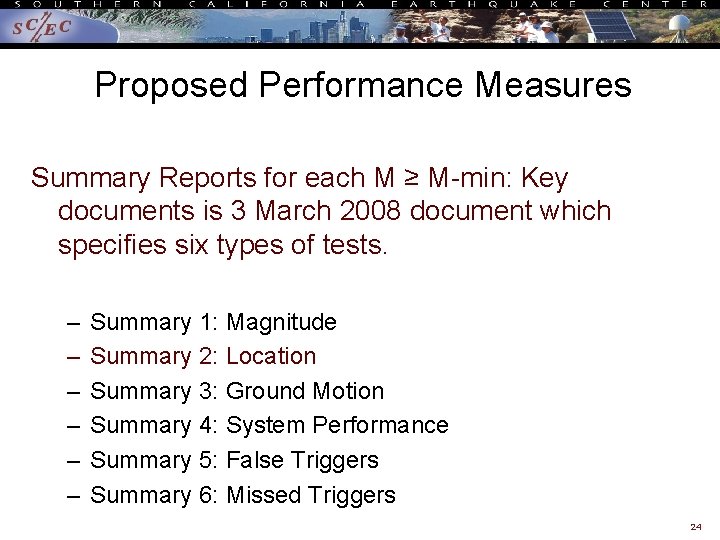
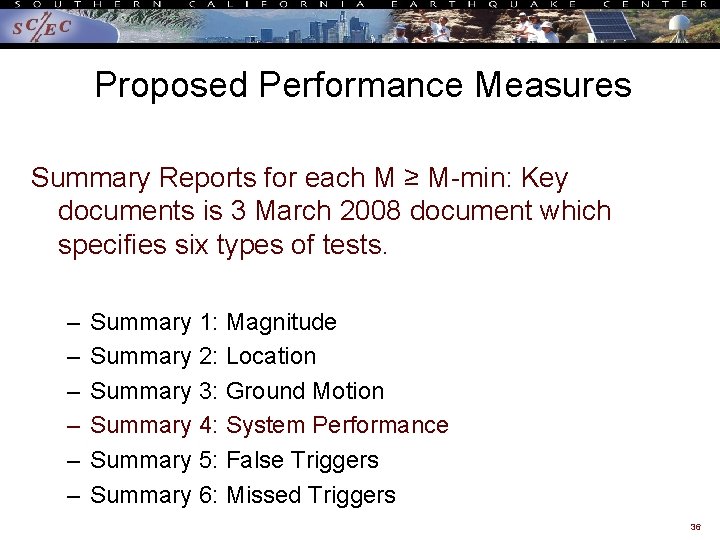
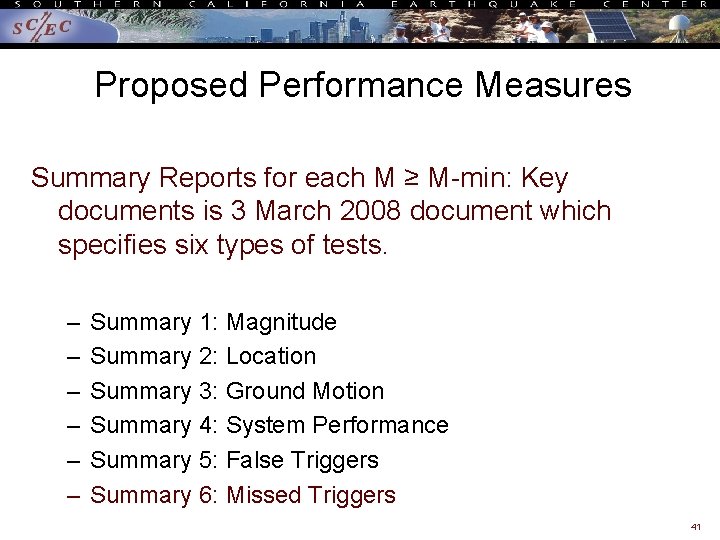
Proposed Performance Measures Summary Reports for each M ≥ M-min: Key documents is 3 March 2008 document which specifies six types of tests. – – – Summary 1: Magnitude Summary 2: Location Summary 3: Ground Motion Summary 4: System Performance Summary 5: False Triggers Summary 6: Missed Triggers 20
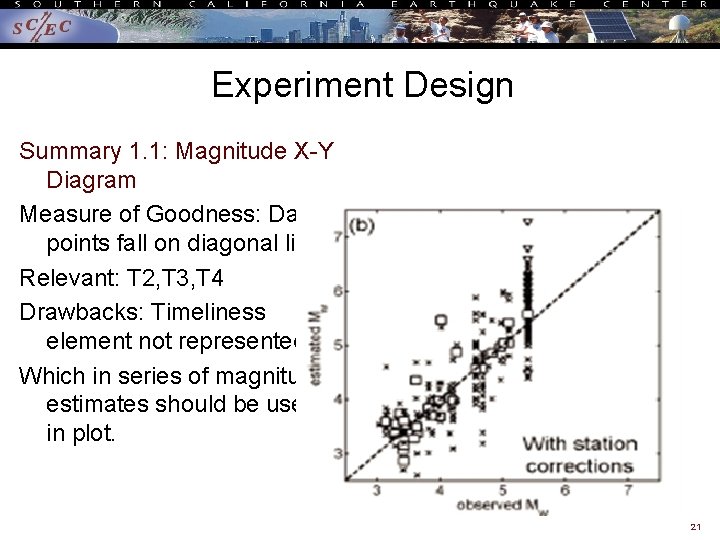
Experiment Design Summary 1. 1: Magnitude X-Y Diagram Measure of Goodness: Data points fall on diagonal line Relevant: T 2, T 3, T 4 Drawbacks: Timeliness element not represented Which in series of magnitude estimates should be used in plot. 21
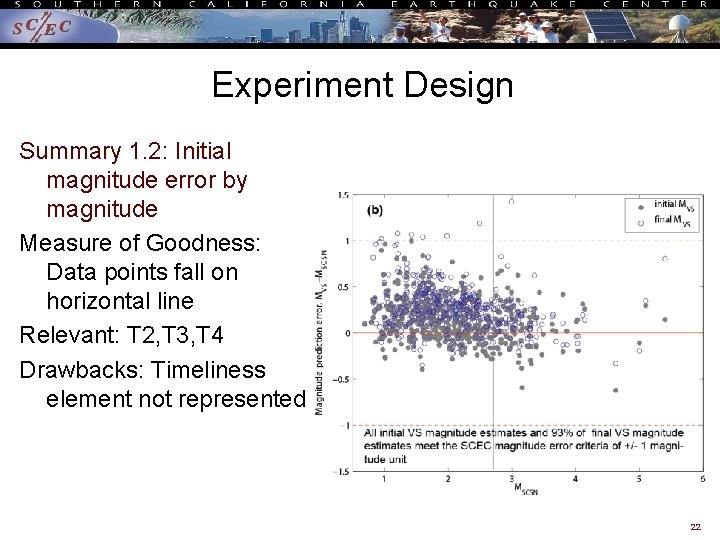
Experiment Design Summary 1. 2: Initial magnitude error by magnitude Measure of Goodness: Data points fall on horizontal line Relevant: T 2, T 3, T 4 Drawbacks: Timeliness element not represented 22
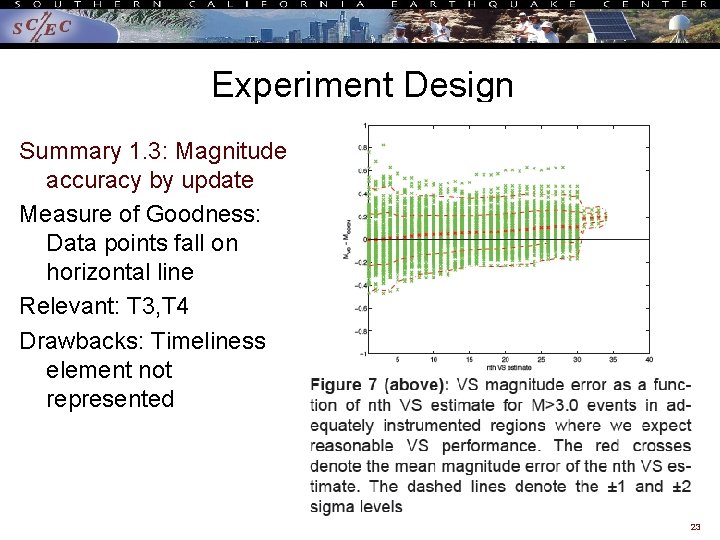
Experiment Design Summary 1. 3: Magnitude accuracy by update Measure of Goodness: Data points fall on horizontal line Relevant: T 3, T 4 Drawbacks: Timeliness element not represented 23
Proposed Performance Measures Summary Reports for each M ≥ M-min: Key documents is 3 March 2008 document which specifies six types of tests. – – – Summary 1: Magnitude Summary 2: Location Summary 3: Ground Motion Summary 4: System Performance Summary 5: False Triggers Summary 6: Missed Triggers 24
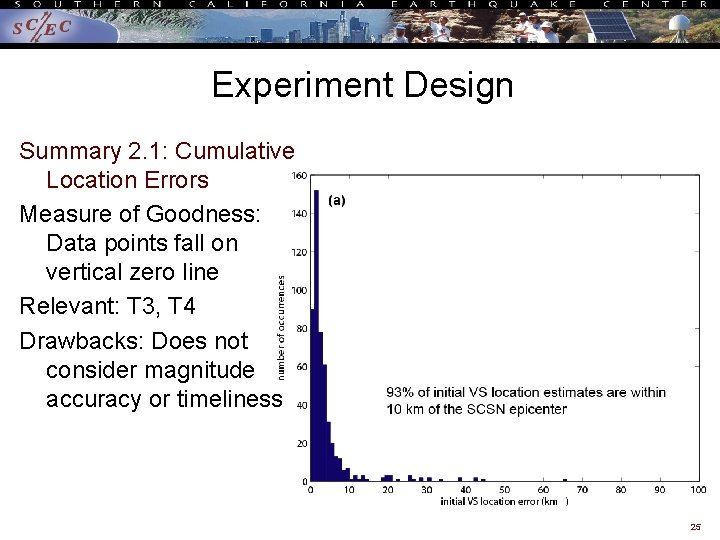
Experiment Design Summary 2. 1: Cumulative Location Errors Measure of Goodness: Data points fall on vertical zero line Relevant: T 3, T 4 Drawbacks: Does not consider magnitude accuracy or timeliness 25
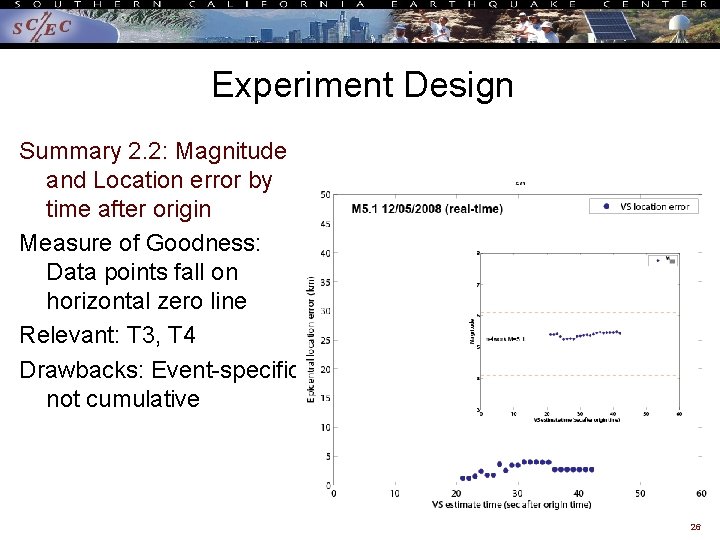
Experiment Design Summary 2. 2: Magnitude and Location error by time after origin Measure of Goodness: Data points fall on horizontal zero line Relevant: T 3, T 4 Drawbacks: Event-specific not cumulative 26
Proposed Performance Measures Summary Reports for each M ≥ M-min: Key documents is 3 March 2008 document which specifies six types of tests. – – – Summary 1: Magnitude Summary 2: Location Summary 3: Ground Motion Summary 4: System Performance Summary 5: False Triggers Summary 6: Missed Triggers 27
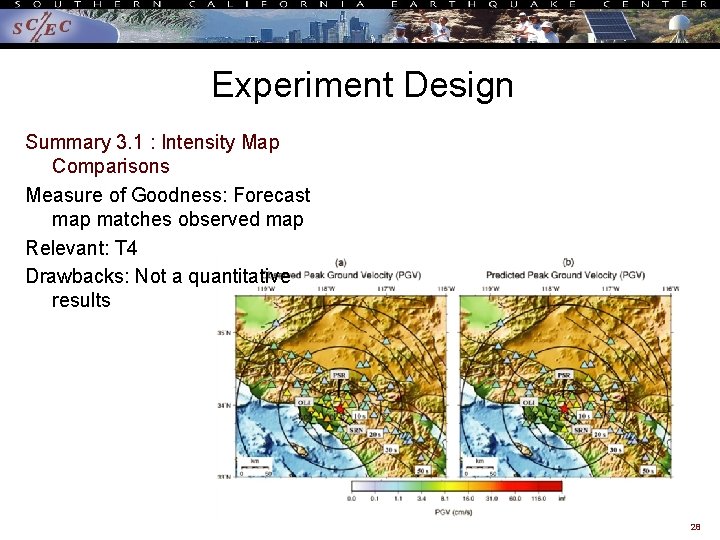
Experiment Design Summary 3. 1 : Intensity Map Comparisons Measure of Goodness: Forecast map matches observed map Relevant: T 4 Drawbacks: Not a quantitative results 28
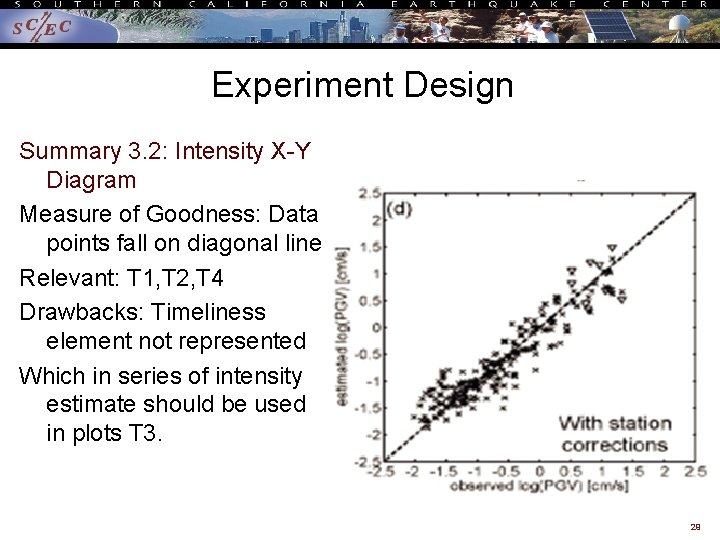
Experiment Design Summary 3. 2: Intensity X-Y Diagram Measure of Goodness: Data points fall on diagonal line Relevant: T 1, T 2, T 4 Drawbacks: Timeliness element not represented Which in series of intensity estimate should be used in plots T 3. 29
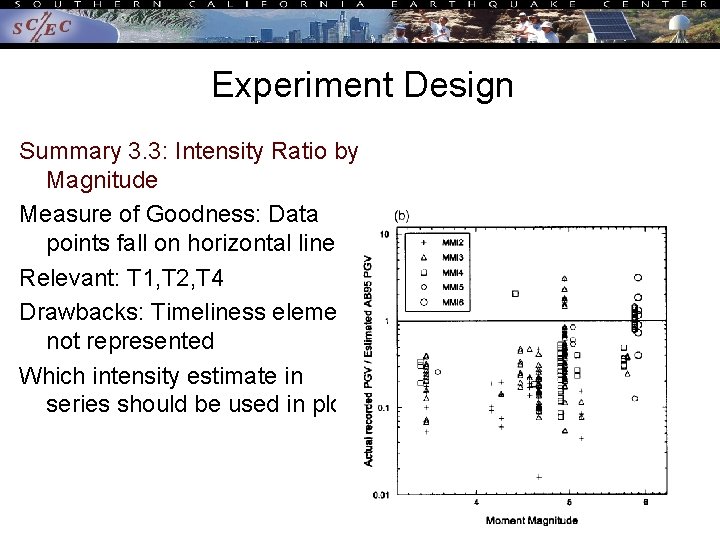
Experiment Design Summary 3. 3: Intensity Ratio by Magnitude Measure of Goodness: Data points fall on horizontal line Relevant: T 1, T 2, T 4 Drawbacks: Timeliness element not represented Which intensity estimate in series should be used in plot. 30
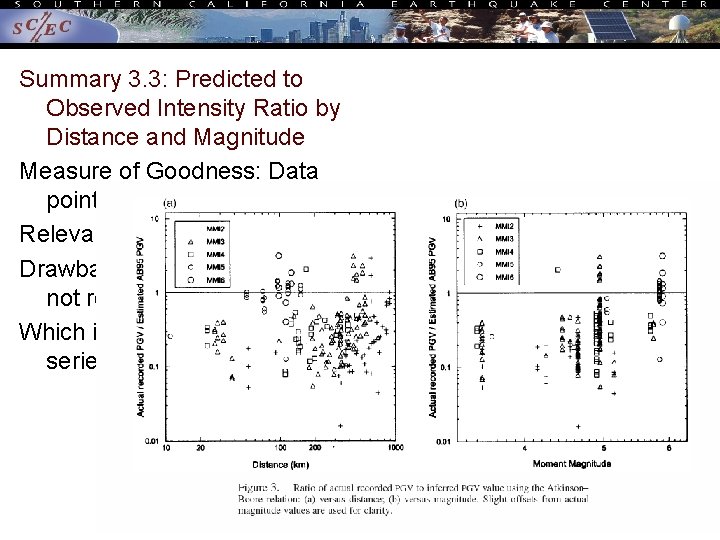
Summary 3. 3: Predicted to Observed Intensity Ratio by Distance and Magnitude Measure of Goodness: Data points fall on horizontal line Relevant: T 1, T 2, T 4 Drawbacks: Timeliness element not represented Which intensity estimate in series should be used in plot. 31
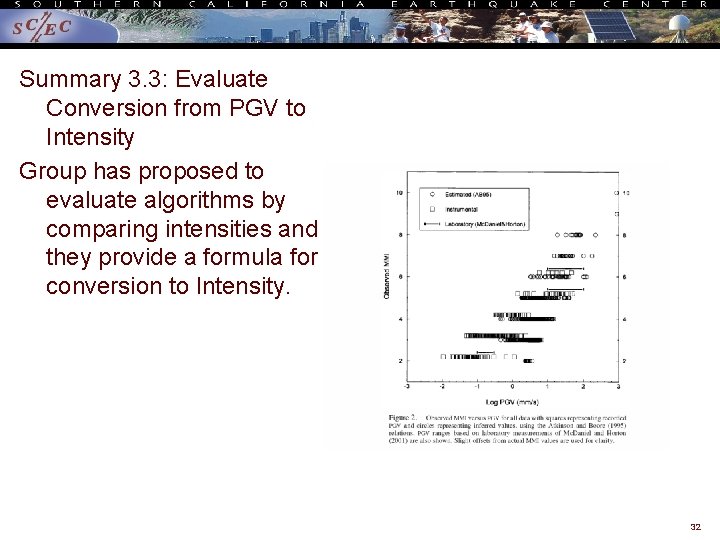
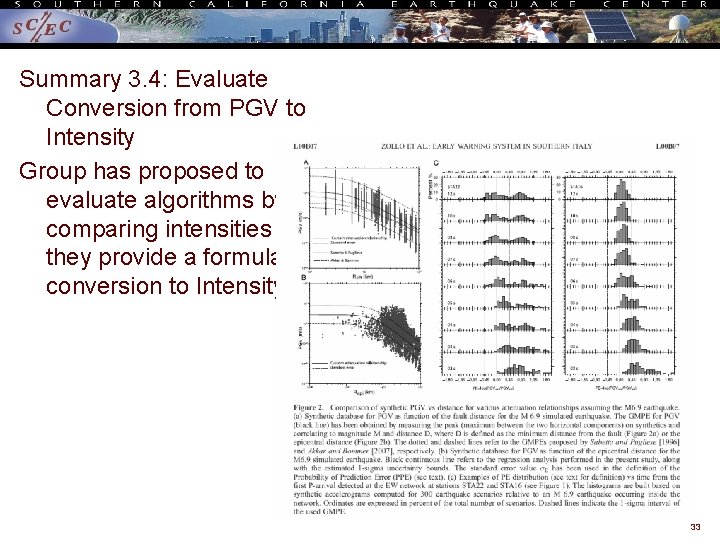
Summary 3. 3: Evaluate Conversion from PGV to Intensity Group has proposed to evaluate algorithms by comparing intensities and they provide a formula for conversion to Intensity. 32
Summary 3. 4: Evaluate Conversion from PGV to Intensity Group has proposed to evaluate algorithms by comparing intensities and they provide a formula for conversion to Intensity. 33
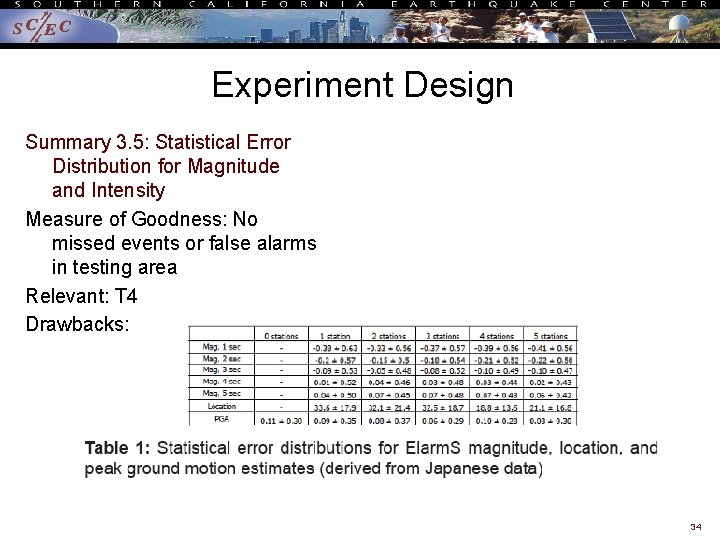
Experiment Design Summary 3. 5: Statistical Error Distribution for Magnitude and Intensity Measure of Goodness: No missed events or false alarms in testing area Relevant: T 4 Drawbacks: 34
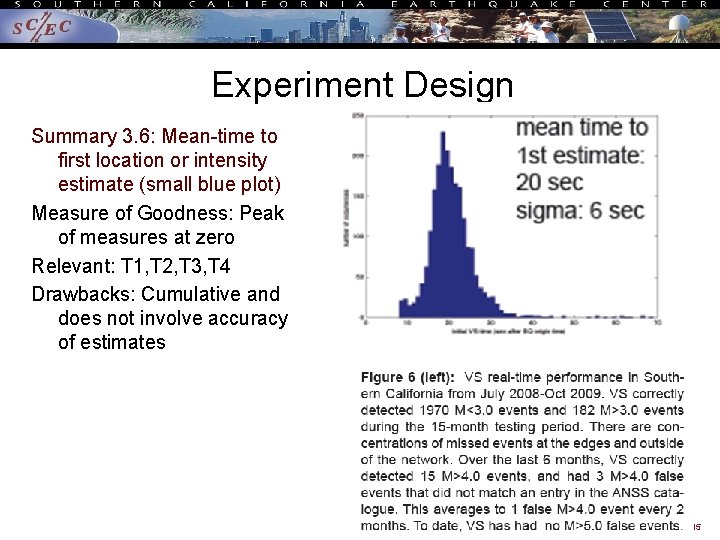
Experiment Design Summary 3. 6: Mean-time to first location or intensity estimate (small blue plot) Measure of Goodness: Peak of measures at zero Relevant: T 1, T 2, T 3, T 4 Drawbacks: Cumulative and does not involve accuracy of estimates 35
Proposed Performance Measures Summary Reports for each M ≥ M-min: Key documents is 3 March 2008 document which specifies six types of tests. – – – Summary 1: Magnitude Summary 2: Location Summary 3: Ground Motion Summary 4: System Performance Summary 5: False Triggers Summary 6: Missed Triggers 36
Experiment Design No examples for System Performance Summary defined as Summary 4. 1: Ratio of reporting versus non-reporting stations: 37
Proposed Performance Measures Summary Reports for each M ≥ M-min: Key documents is 3 March 2008 document which specifies six types of tests. – – – Summary 1: Magnitude Summary 2: Location Summary 3: Ground Motion Summary 4: System Performance Summary 5: False Triggers Summary 6: Missed Triggers 38
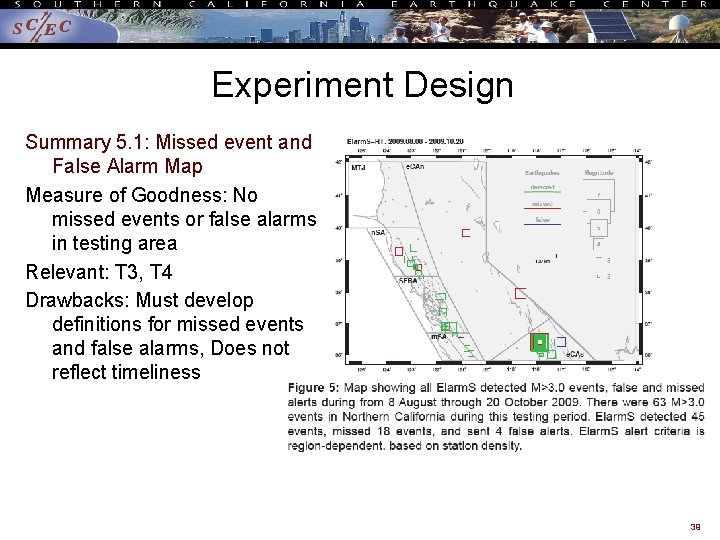
Experiment Design Summary 5. 1: Missed event and False Alarm Map Measure of Goodness: No missed events or false alarms in testing area Relevant: T 3, T 4 Drawbacks: Must develop definitions for missed events and false alarms, Does not reflect timeliness 39
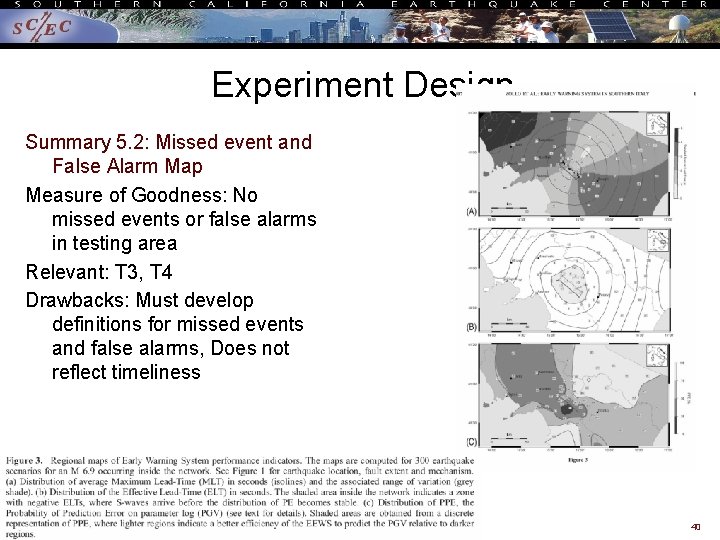
Experiment Design Summary 5. 2: Missed event and False Alarm Map Measure of Goodness: No missed events or false alarms in testing area Relevant: T 3, T 4 Drawbacks: Must develop definitions for missed events and false alarms, Does not reflect timeliness 40
Proposed Performance Measures Summary Reports for each M ≥ M-min: Key documents is 3 March 2008 document which specifies six types of tests. – – – Summary 1: Magnitude Summary 2: Location Summary 3: Ground Motion Summary 4: System Performance Summary 5: False Triggers Summary 6: Missed Triggers 41
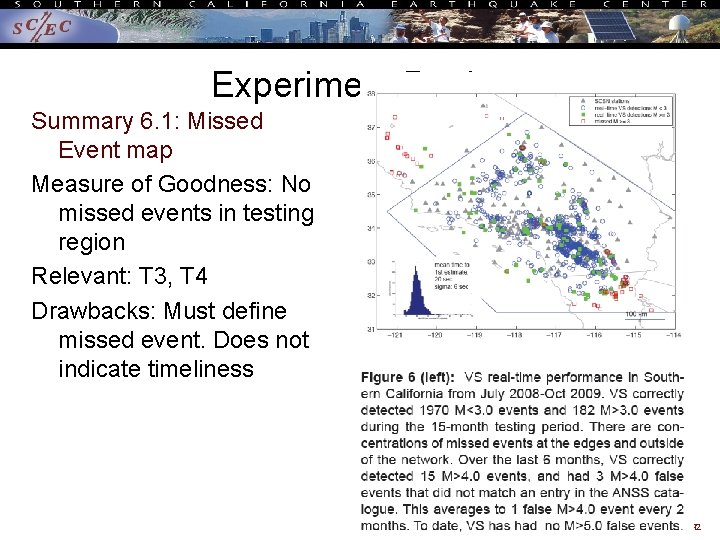
Experiment Design Summary 6. 1: Missed Event map Measure of Goodness: No missed events in testing region Relevant: T 3, T 4 Drawbacks: Must define missed event. Does not indicate timeliness 42
End 43