
Shades Creek Sediment TMDL Cahaba River Basin Birmingham
Shades Creek Sediment TMDL Cahaba River Basin Birmingham, AL
Sediment Problem on Shades Creek • Included on 303(d) List as not supporting designated use of Fish and Wildlife due to siltation, turbidity and habitat alteration • Siltation implies deposition of fine-grained materials on channel bed hampers oxygenation of coarser bed material, creating poor habitat • Turbidity implies excessive amounts of finegrained materials transported in water column
TMDL Approach • In absence of a numerical target, loads and bed material composition measured in Shades Creek are compared to unimpaired or “reference” streams in Ecoregion 67 (Ridge and Valley) • Available TSS data collected in early 1980’s; TSS load about 52. 6 T/yr/km 2 • Numerical modeling using Ann. AGNPS and CONCEPTS used to confirm existing loads

Expressing the TMDL • 40 CFR 130. 2 allows TMDL to be expressed in units other than mass per time • TMDL expressed as mean annual yield in units of T/yr/km 2 • Calculate percent reduction necessary to achieve loading conditions in reference streams • Embeddedness target: 13. 4% bed materials finer than 2 mm

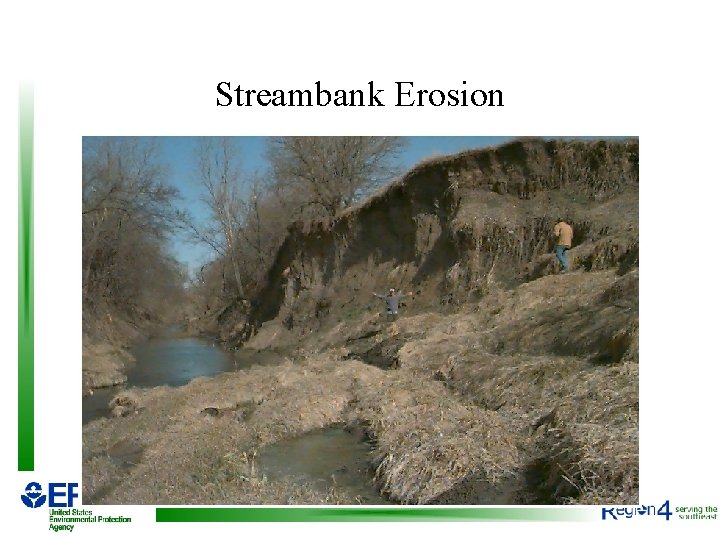
Sediment Sources in Shades Creek • Point Sources – NPDES Regulated Facilities – WWTPs located on tributaries – given WLA based on permit limits for TSS and design flow – MS 4 area – given WLA based on mean annual yield – Contruction • Nonpoint Sources – Runoff from watershed – Instream processes (primarily bank sloughing and not bed erosion due to bedrock)
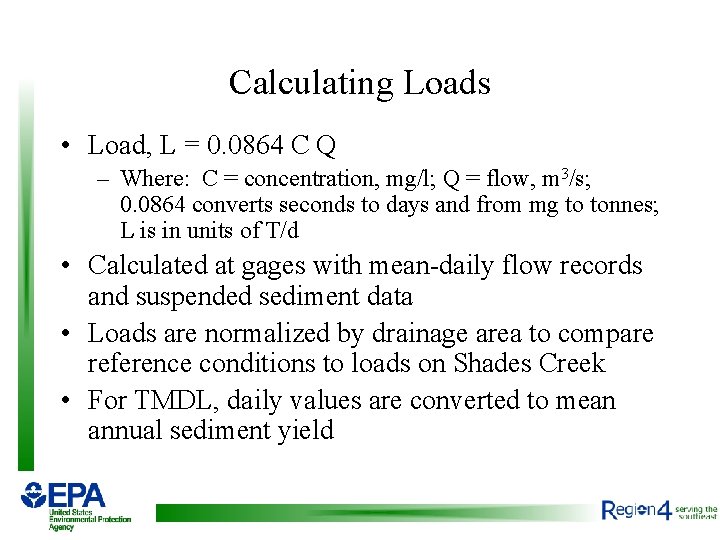
Calculating Loads • Load, L = 0. 0864 C Q – Where: C = concentration, mg/l; Q = flow, m 3/s; 0. 0864 converts seconds to days and from mg to tonnes; L is in units of T/d • Calculated at gages with mean-daily flow records and suspended sediment data • Loads are normalized by drainage area to compare reference conditions to loads on Shades Creek • For TMDL, daily values are converted to mean annual sediment yield
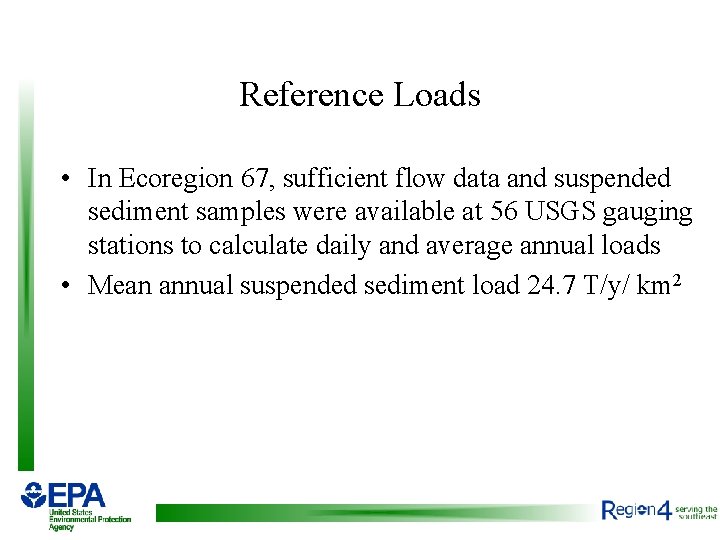
Reference Loads • In Ecoregion 67, sufficient flow data and suspended sediment samples were available at 56 USGS gauging stations to calculate daily and average annual loads • Mean annual suspended sediment load 24. 7 T/y/ km 2
Sediment Load Target from ARS Oxford, Ms Research Lab, Dr. Simon
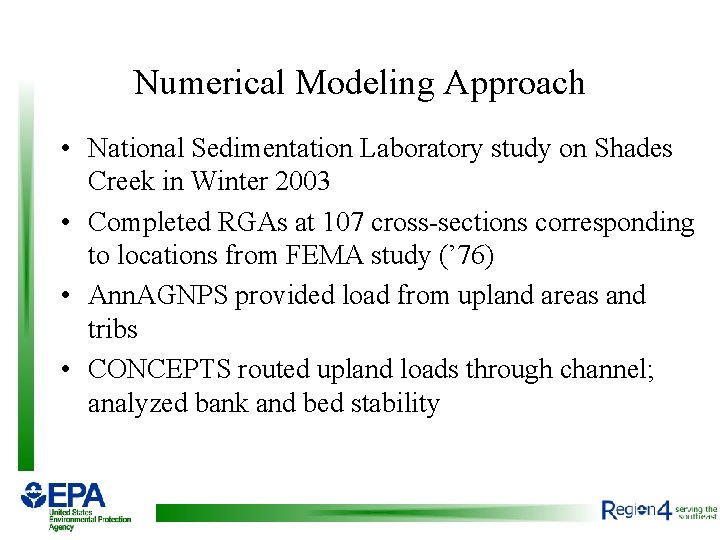
Numerical Modeling Approach • National Sedimentation Laboratory study on Shades Creek in Winter 2003 • Completed RGAs at 107 cross-sections corresponding to locations from FEMA study (’ 76) • Ann. AGNPS provided load from upland areas and tribs • CONCEPTS routed upland loads through channel; analyzed bank and bed stability
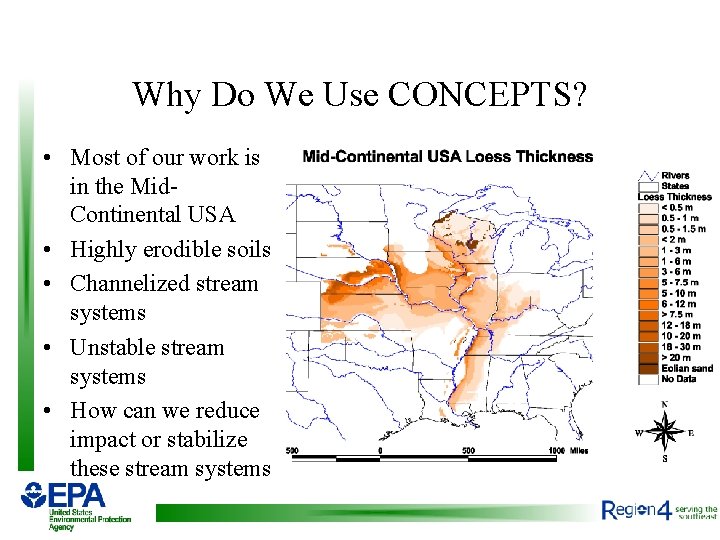
Why Do We Use CONCEPTS? • Most of our work is in the Mid. Continental USA • Highly erodible soils • Channelized stream systems • Unstable stream systems • How can we reduce impact or stabilize these stream systems
Hydraulics – Flow Variable Calculation • Flow area is divided into sections affected only by left floodplain, left bank, bed, right bank, and right floodplain • Flow variables are calculated for each section
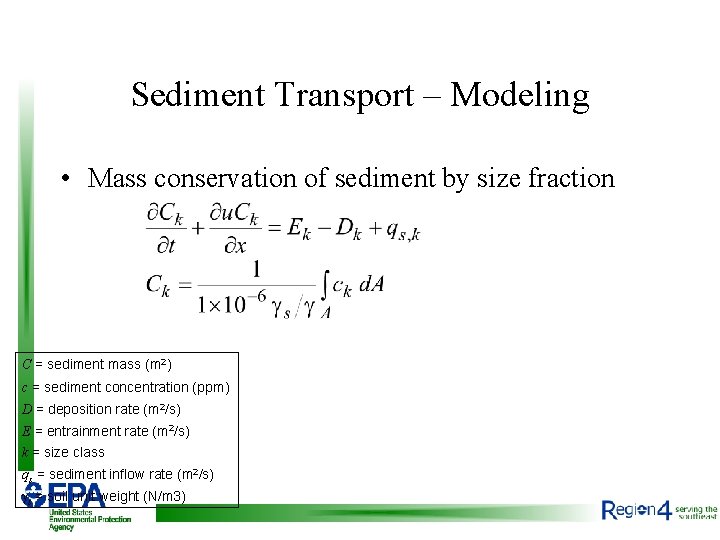
Sediment Transport – Modeling • Mass conservation of sediment by size fraction C = sediment mass (m 2) c = sediment concentration (ppm) D = deposition rate (m 2/s) E = entrainment rate (m 2/s) k = size class qs = sediment inflow rate (m 2/s) gs = soil unit weight (N/m 3)
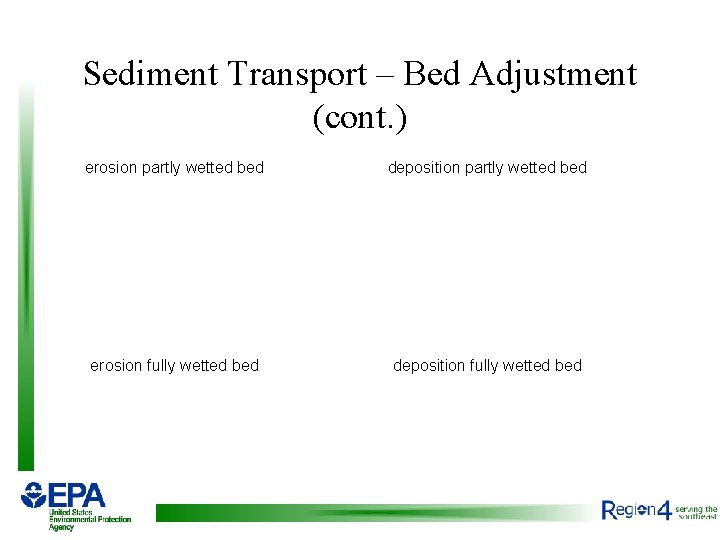
Sediment Transport – Bed Adjustment (cont. ) erosion partly wetted bed deposition partly wetted bed erosion fully wetted bed deposition fully wetted bed
Streambank Erosion
Streambank Erosion – Streambank Stability • Weight is the primary force tending to move the failure block • Mobilized shear at the slip surface is the primary resisting force • Shear strength is affected by – Pore-water pressures – Vegetation • Mechanical reinforcement • Reduction of soil moisture through canopy interception and evapotranspiration • Increase soil moisture through stem flow
AGricultural Non. Point Source model (AGNPS). • AGNPS = suite of models developed to assist in quantifying impacts of agricultural non-point source pollution on water quality and environment. • Models concerned with runoff modeling are AGNPS and Ann. AGNPS. • Both utilize TR-55 (USSCS, 1986) to simulate runoff generation. • Uses distributed parameter inputs and operates on a cell basis. • AGNPS data-intensive but contains tools such as a geographic information system and a database management system.
Modeling Results • 67% of sediment load is from instream processes; 33% from watershed • CONCEPTS predicts sediment yield at gage of 42. 9 T/yr/km 2 (within 20% of measured value) • Results used to identified stable and unstable reaches based on Simon’s Channel Evolution Model • Ann. AGNPS and CONCEPTS implementation tools
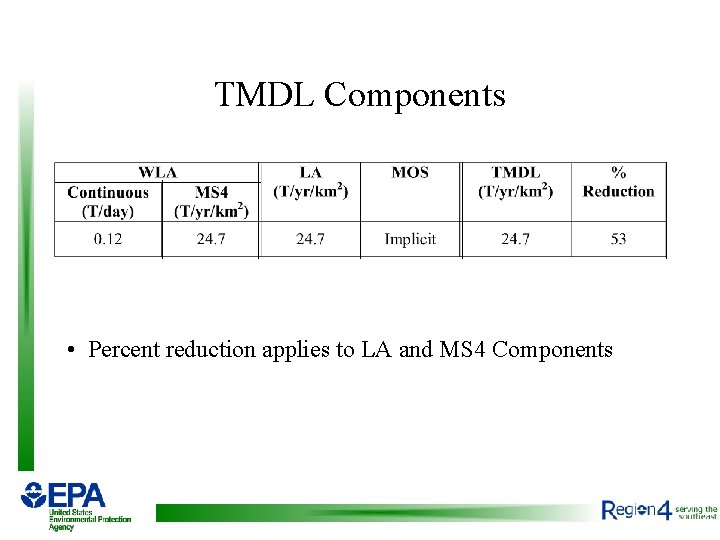
TMDL Components • Percent reduction applies to LA and MS 4 Components
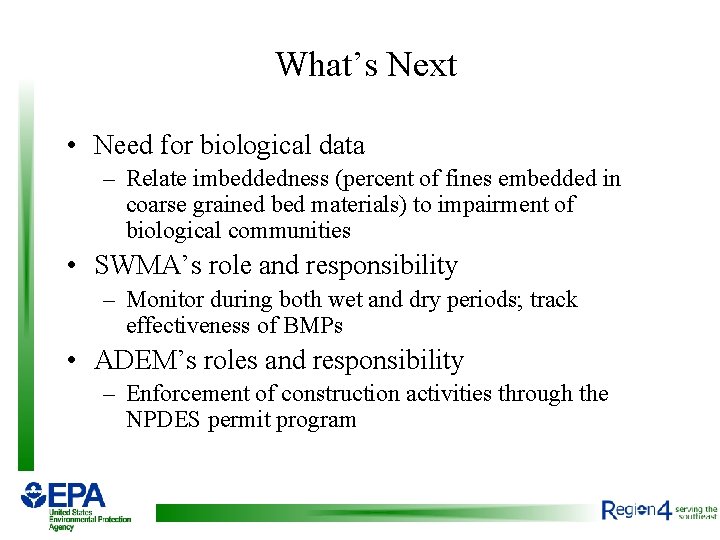
What’s Next • Need for biological data – Relate imbeddedness (percent of fines embedded in coarse grained bed materials) to impairment of biological communities • SWMA’s role and responsibility – Monitor during both wet and dry periods; track effectiveness of BMPs • ADEM’s roles and responsibility – Enforcement of construction activities through the NPDES permit program
- Slides: 20