
Sgt Peppers Lonely Hearts Club Band Date of
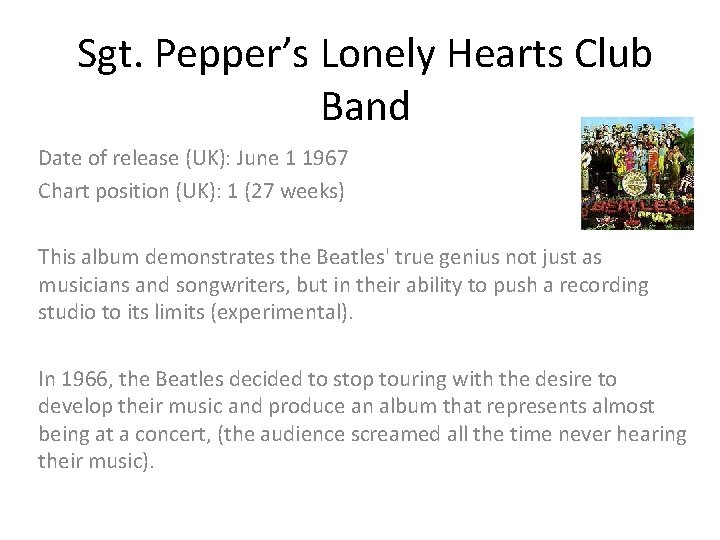
Sgt. Pepper’s Lonely Hearts Club Band Date of release (UK): June 1 1967 Chart position (UK): 1 (27 weeks) This album demonstrates the Beatles' true genius not just as musicians and songwriters, but in their ability to push a recording studio to its limits (experimental). In 1966, the Beatles decided to stop touring with the desire to develop their music and produce an album that represents almost being at a concert, (the audience screamed all the time never hearing their music).
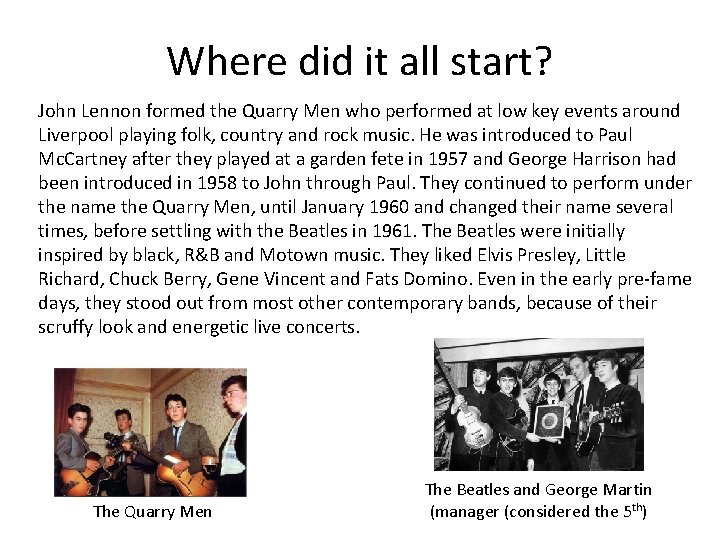
Where did it all start? John Lennon formed the Quarry Men who performed at low key events around Liverpool playing folk, country and rock music. He was introduced to Paul Mc. Cartney after they played at a garden fete in 1957 and George Harrison had been introduced in 1958 to John through Paul. They continued to perform under the name the Quarry Men, until January 1960 and changed their name several times, before settling with the Beatles in 1961. The Beatles were initially inspired by black, R&B and Motown music. They liked Elvis Presley, Little Richard, Chuck Berry, Gene Vincent and Fats Domino. Even in the early pre-fame days, they stood out from most other contemporary bands, because of their scruffy look and energetic live concerts. The Quarry Men The Beatles and George Martin (manager (considered the 5 th)
Producing the Album Before Sgt. Pepper, John Lennon had been the natural leader of the Beatles. It was Lennon who formed the group back in the 1950 s, and he had also been the group's most dominant song writer. By late 1966, this had changed. Mc. Cartney now wrote most of the songs, and seemed to have most of the ideas, while Lennon, for the first time, appeared to be more in the background (It was, for example, Mc. Cartney's idea to perform as the fictional Sgt. Pepper band on the album's opening and closing cut). The time devoted to Abbey studio recording gave unusual results, and the Beatles once again broke new barriers in their pursuit for new and exciting sounds. Classical orchestras and brass bands were ambitiously used to enhance the arrangements of songs like She's Leaving Home and A Day In The Life. The distorted vocal and organ on Lucy In The Sky With Diamonds created a whole new experience for the listener, while Harrison's Within You Without You blended Indian and western classical instruments, which never before had been recorded together.
Sgt. Pepper Title Track Instrumentation: Paul Mc. Cartney: Vocals, bass guitar, electric guitar John Lennon: Vocals (shouty-recitative like) – limited range of notes emphasises lyrics George Harrison: Electric guitar, vocals Ringo Starr: Drums French Horn Quartet: Quasi-fanfare – triads of arpeggios and acts as homophonic accompaniment. Orchestral warm-up: Represents beginning of concert Harmony: • G major tonality with intro starting on A 7 chord • Five by Five used (also in 8 Days A Week): I II IV I – G 7 Amaj C G • Bass plays extended cadence at end of chorus V-I x 3 Technology: Sound effects to create a 'live' atmosphere included audience applause and laughter (over the instrumental section with French horns) a sample from the play Beyond The Fringe, from London's Fortune Theatre in 1961, audience screaming (where Billy Shears is introduced) is taken from one of Beatles' concerts at the Hollywood Bowl in August 1965.
Sgt. Pepper continued… Lyrics: • ‘let me introduce to you’ – roll up bringing in ‘Billy Shears’ • ‘you’re such a lovely audience’ – sample audience laughter supports this • repeated ‘Sgt. Pepper’s lonely’ goes down in pitch, reinforced • band act as compères ‘we hope you will enjoy the show’
With A Little Help From My Friends Instrumentation: Ringo Starr: Vocals, drums (break between chorus/2 nd verse), tambourine John Lennon: Vocals, cow bell Paul Mc. Cartney: Vocals, piano (comping), bass guitar (descending riffs) George Harrison: Electric guitars Harmony: E major Suspensions/inversions (inventive harmony) Piano provides harmonic structure Technology: Phasing on the voice. Characteristics: Question and answer within the verse and chorus answers the verse, word painting e. g. ‘do you need anybody? ’ rises in pitch as a question – ‘I want somebody to love’ down in pitch as an answer.
Lucy In The Sky With Diamonds Instrumentation: John Lennon: Vocals, electric guitar, piano Paul Mc. Cartney: Organ (Hammond), bass guitar, vocals George Harrison: Electric guitar, acoustic guitar, tamboura (drone), vocals Ringo Starr: Drums, maracas Harmony: A and B flat in verse and G in the chorus Three distinct tonalities uncertain feel Chorus I IV V Technology: Double-tracking within the song Recorded voice at slow speed before playing the track back at normal speed. In addition, his microphone was put through a Leslie amplifier inside a Hammond organ was taped with a special organ stop to create the celeste-like sound. Characteristics: ¾ in verse and 4/4 in chorus drum picks up pace in bridge between verse and chorus. Water effect ‘boat on a river’ (word painting). Weirdness of song (psychedelic feel) with lyrics ‘tangerine trees and marmalade skies’.
Getting Better Instrumentation: Paul Mc. Cartney: Vocals (double tracked), bass guitar John Lennon: Electric guitar (distortion - choked), vocals George Harrison: Electric guitar, tamboura (drone), vocals Ringo Starr: Drums (lighter - comping), congas All: Handclaps beats 2 and 4 in the bridge Harmony: • G major (ironic since it’s quite cynical) • Chorus in C (subdominant) • Piano pedal tonic note (octaves) at the end Characteristics: Call and response between lead vocals and backing vocals, congas fade out and bass slides down an octave at the beginning. Not a heavy texture. Lennon interjects with ‘couldn’t get any better’ puts downer on Paul’s lyrics. 4/4 time and regular harmonic pace driving the song forward ‘getting better all the time’
Fixing a Hole Instrumentation: Paul Mc. Cartney: Vocals (ADT), bass guitar, electric guitar John Lennon: Vocals (shouty in places) George Harrison: Electric guitars (distortion – thickening texture), vocals Ringo Starr: Drums (hi-hat swing rhythm), maracas George Martin: Harpsichord (introduces the song) Harmony: • Blues scale (improvisation) on guitar in the bridge • Ghost notes on ‘hey, hey’ • Augmented chords • F major/minor Characteristics: ‘Ooohs’ move in minor 3 rds. Bass on beats 1 and 3 with syncopation. More prominent guitar pushes the song in the major section. Stereo positioning more prominent with the guitar from the left and vocals in the middle. ‘Stops my mind from wondering where it will go. . . ’ phasing.
She’s Leaving Home Instrumentation: Paul Mc. Cartney: Vocals (falsetto in chorus) John Lennon: Vocals (parents – double tracked) String Nonet: 2 x everything except the double bass and harp (introduction) Harmony: • E major unusual, would expect minor tonality • Augmented chords • Timbre different to rest of album, external musicians Characteristics: Harsh bowing (high pitch) on strings at ‘ Daddy, our baby’s gone’. Textural hollow created between the high voice and low strings in the chorus. Pizzicato in the verse and bowed in the chorus. Question and answer in the chorus ‘she’s leaving home - we gave her most of our lives’. Ballad and quite recitative like. All about loneliness carrying on this theme throughout the album.
Being For The Benefit Of Mr Kite Instrumentation: John Lennon: Vocals (double tracked), organ (harmonium) Paul Mc. Cartney: Bass guitar, electric guitar George Harrison: Tambourine, harmonica Ringo Starr: Drums, Harmonica (intro) George Martin: Organ, harmonica, glockenspiel, calliope – recordings from fairground 2 x other harmonicas Harmony: • C minor although intro is in B flat • Conveys mystery of the circus through augmented chords Characteristics: 3/4+6/8 time signature. Strange lyrics influenced by circus poster, bouncy rhythm reflecting the ‘show tonight on the trampoline’. ‘Henry the horse dances the waltz’ music changes into 3/4.
Within You, Without You Instrumentation: George Harrison: Vocals, sitar, tamboura (drone), acoustic guitar Musicians From Asian Music Circle: Dilrubas, svarmandal, tabla (keeps pace), tamboura String arrangement Harmony: • Pentatonic scales (raga) • Not improvisational (unlike traditional rag) Characteristics: Fusion of Western and Eastern instruments – highly unique. George Harrison studied under Ravi Shankar (Norah Jones’ Dad) in 1965, his 2 nd Indian composition. Some pitches are bent on the sitar. Recorded laughter at the end. The lyrics are inspired by Hindu religion, and the conception that all people are as one. It also reflects on the battle against materialistic values, hence the line: ‘The people who gain the world and lose their soul they don't know - they can't see – are you one of them? ’
When I’m Sixty-Four Instrumentation: Paul Mc. Cartney: Vocals - young (recorded at lower pitch and sped up), piano, bass guitar John Lennon: Electric guitar, vocals George Harrison: Vocals Ringo Starr: Drums, tubular bells 3 clarinets introduce the vocal melody Harmony: • C# major • Simple harmonic structure – has a minor bridge Characteristics: Call and response in vocals and counter melodies in the clarinet parts e. g. ‘when I get older, losing my hair, many years from now’ clarinet responds. Timbre of clarinets/piano (comping) gives overall Music Hall effect. Wrote for his Dad, and has a lighter mood in comparison to the rest of the album less pyschedelia.
Lovely Rita Instrumentation: Paul Mc. Cartney: Vocals (ADT), piano, bass guitar John Lennon: Vocals, mouth percussion, acoustic guitar George Harrison: Vocals, electric slide guitar, acoustic guitar Ringo Starr: Drums All: Comb and toilet paper George Martin: Piano (improvised) Harmony: • E major although intro starts on B (dominant) • Suspensions • Ends on A major leading into next track Characteristics: Synthesiser with wolf whistle in the first verse. Lightness of weight in rhythm creating ‘pop rock feel’. Piano solo played at slower speed when recorded to make sound faster played back. ‘Got the bill, and Rita paid it’ suggests that the traffic warden is older than him and the voice sounds younger; 3 rd higher.
Good Morning, Good Morning Instrumentation: John Lennon: Vocals, electric guitar Paul Mc. Cartney: Electric guitar, bass guitar (offbeat), vocals George Harrison: Electric guitar, vocals Ringo Starr: Drums, tambourine All: Jumping 3 saxophones, 2 trombones and a horn (overdubbed) Harmony: • A major Characteristics: Cockerel sound introduces track ‘wake up’ aspect. Irregular time signatures, drum played on every beat. Animal sounds and brass play out, in a particular order each animal escaping and successive animals are capable of frightening or preying its predecessor creating a wall of sound. Lyrics tell the story of a daily routine ‘going to work, don’t want to go, feeling low down’ – goes down in pitch.
Sgt. Pepper Reprise Instrumentation: John Lennon: Vocals, organ Paul Mc. Cartney: Vocals, bass guitar, electric guitar George Harrison: Vocals, electric guitar Ringo Starr: Vocals, drums, tambourine, maracas No brass just rock band structure Harmony: • F major – tone lower than title track • Changes to G major half way through leading directly into ‘A Day In The Life’ Characteristics: Quicker pace more rockier and drums introduce with more complex comping and other added percussion. Ends with cheering from the audience. ‘It’s getting very near the end’ suggests and encore i. e. Day in the Life.
A Day In The Life Instrumentation: John Lennon: Vocals, acoustic guitar, piano Paul Mc. Cartney: Vocals, piano, bass George Harrison: Maracas Ringo Starr: Drums, bongos, piano 40 -piece orchestra – recorded four times on all four tracks of a tape, then mixed down to one track. Thus it sounded like the equivalent of 160 musicians. Harmony: • G major but orchestra links going from E minor to E major • E on three pianos all octaves in fade out • Circle of 5 ths x 2 in 2 nd link with orchestra Characteristics: Two songs in one Lennon’s first then Mc. Cartney’s, ADT in both vocals. Descending bass owes to the melancholy nature of the lyrics. Piano chord carries through the orchestral links and the Ringo was told to keep pace within link. ‘I thought that I was late’ is followed by panting. Orchestra gliss going from quiet to loud at different speeds to the highest pitch creating tension, provides contrast too. Lennon’s lyrics ‘he was from the House of Lords’ rises in pitch portraying the power of the government. Fades out with ‘never could be any other way’ on a ‘locked groove’.
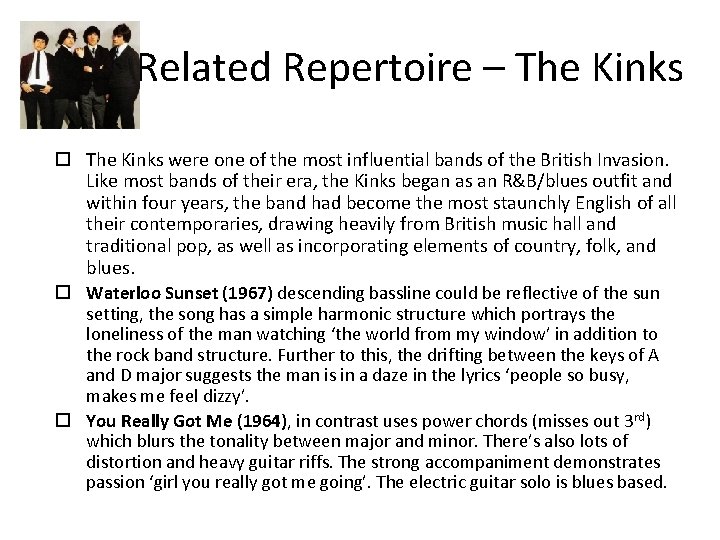
Related Repertoire – The Kinks were one of the most influential bands of the British Invasion. Like most bands of their era, the Kinks began as an R&B/blues outfit and within four years, the band had become the most staunchly English of all their contemporaries, drawing heavily from British music hall and traditional pop, as well as incorporating elements of country, folk, and blues. Waterloo Sunset (1967) descending bassline could be reflective of the sun setting, the song has a simple harmonic structure which portrays the loneliness of the man watching ‘the world from my window’ in addition to the rock band structure. Further to this, the drifting between the keys of A and D major suggests the man is in a daze in the lyrics ‘people so busy, makes me feel dizzy’. You Really Got Me (1964), in contrast uses power chords (misses out 3 rd) which blurs the tonality between major and minor. There’s also lots of distortion and heavy guitar riffs. The strong accompaniment demonstrates passion ‘girl you really got me going’. The electric guitar solo is blues based.
Related Repertoire – The Kinks Sunny Afternoon (1966), has a relaxed feel owing to the downbeat of the drums (accented first beat). Ray Davies’s voice blurs the words as he sings them attributing to the lazy mood. The lyrics ‘my girlfriend’s run off with my car, and gone back to her ma and pa’ have a melancholy timbre. All Day and All of the Night (1964), like ‘You Really Got Me’, has power chords, and the melodic line of the guitar supports the vocals by playing the tune (emphasis on lyrics). The guitar responds to the first two lines of each verse with the riff; call and response. The rising tonality at ‘girl I want to be with you all of the time’ increases the tension reflecting the passion he has for being with her. Compared to the Beatles, there are some similarities in the recording techniques, tonalities and lyrics of their tracks. The storytelling aspect of the Kinks lyrics is alike to the Beatles along with the vocal layering used, with similar vocal harmonies. The use of delay and the strange tonalities used to reflect the lyrics are similar in both bands.
- Slides: 19