
SGP BORCAL Overview September 2005 Craig Webb Ibrahim
SGP BORCAL Overview September 2005 Craig Webb, Ibrahim Reda, & Tom Stoffel U. S. DOE Atmospheric Radiation Measurement (ARM) Program
OUTLINE Introduction • ARM Program Needs Broadband Outdoor Radiometer Calibrations • Methodology Radiometer Calibration & Characterization • Functionality Quality Assurance of the BORCAL Process • Control Radiometer History Summary
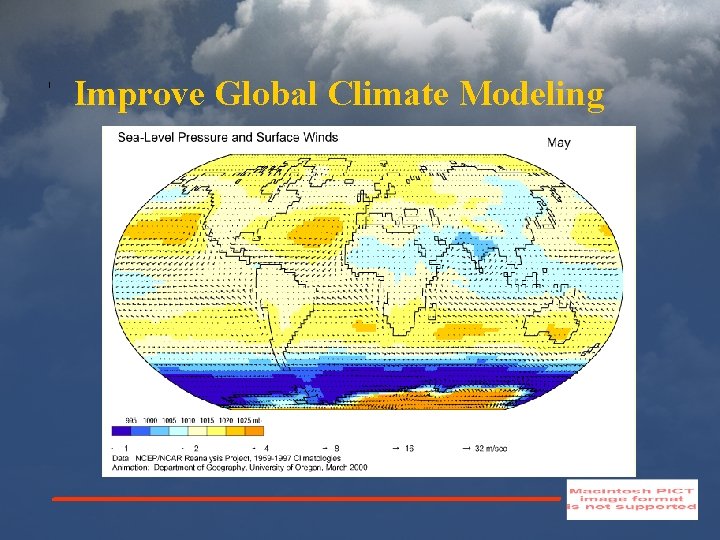
Improve Global Climate Modeling

Advance Climate Change Research by Providing Accurate Measurements Most ambitious meteorological measurement program since the International Geophysical Year of 1957.

ARM Climate Research Facilities
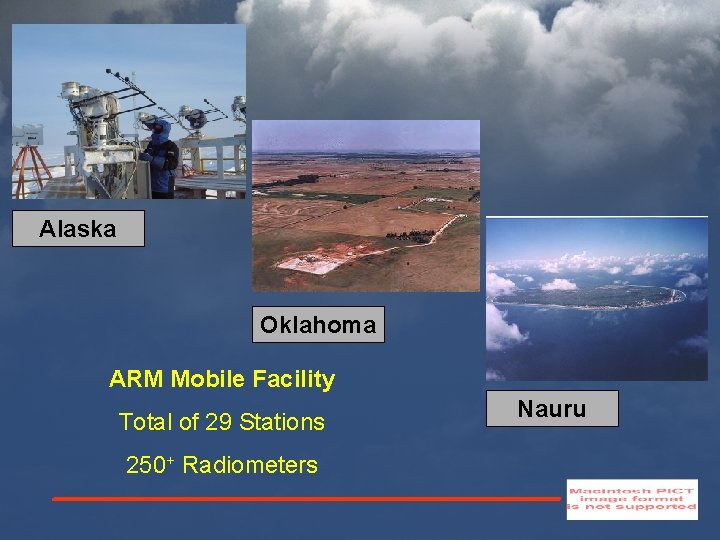
Alaska Oklahoma ARM Mobile Facility Total of 29 Stations 250+ Radiometers Nauru
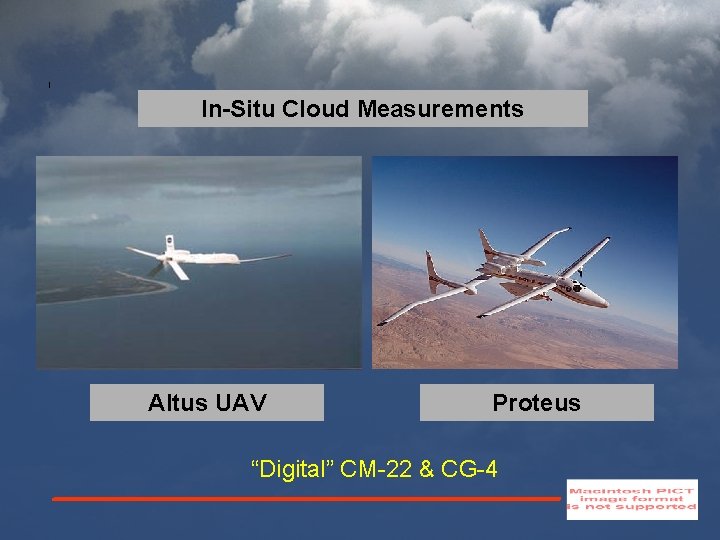
In-Situ Cloud Measurements Altus UAV Proteus “Digital” CM-22 & CG-4
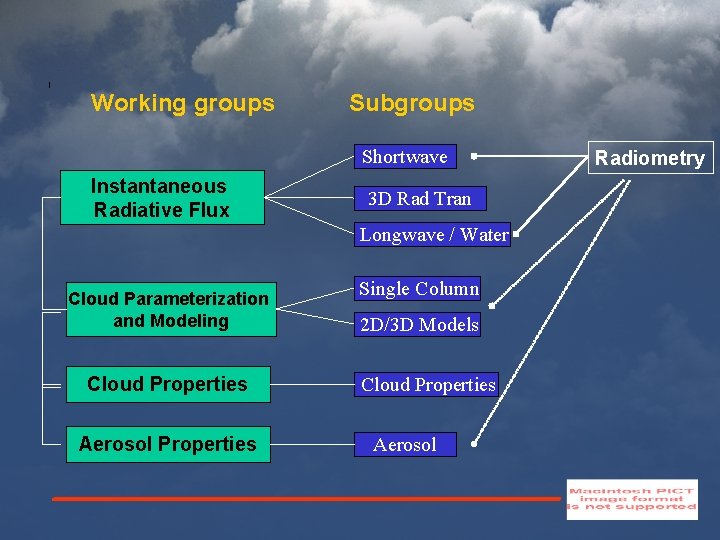
Working groups Subgroups Shortwave Instantaneous Radiative Flux 3 D Rad Tran Longwave / Water Cloud Parameterization and Modeling Cloud Properties Aerosol Properties Single Column 2 D/3 D Models Cloud Properties Aerosol Radiometry
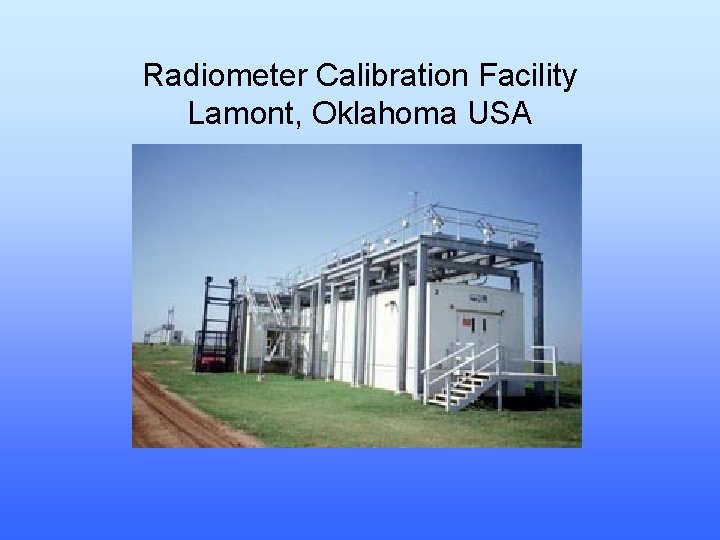
Radiometer Calibration Facility Lamont, Oklahoma USA
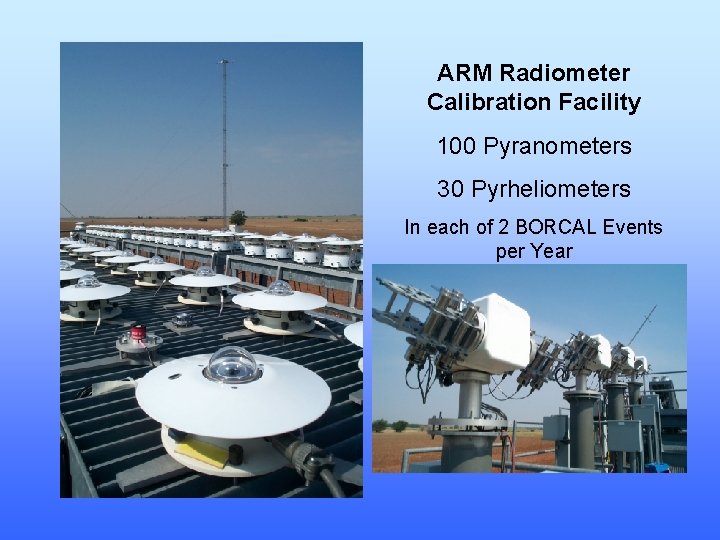
ARM Radiometer Calibration Facility 100 Pyranometers 30 Pyrheliometers In each of 2 BORCAL Events per Year
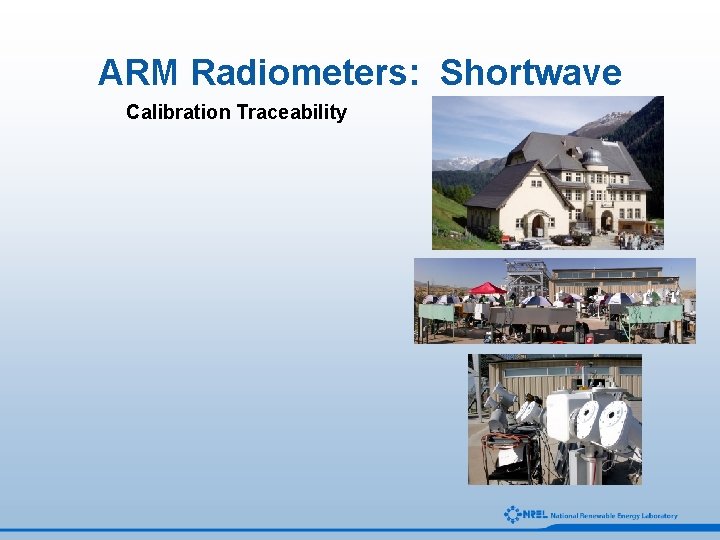
ARM Radiometers: Shortwave Calibration Traceability
ARM Radiometers: Longwave Calibration Traceability
BORCAL is the Process Broadband Outdoor Radiometer CALibration Based on component summation…
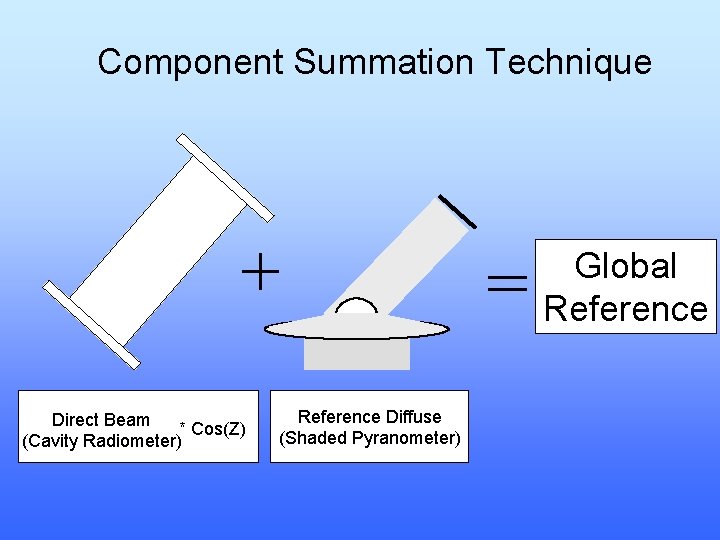
Component Summation Technique + Direct Beam * Cos(Z) (Cavity Radiometer) Reference Diffuse (Shaded Pyranometer) = Global Reference
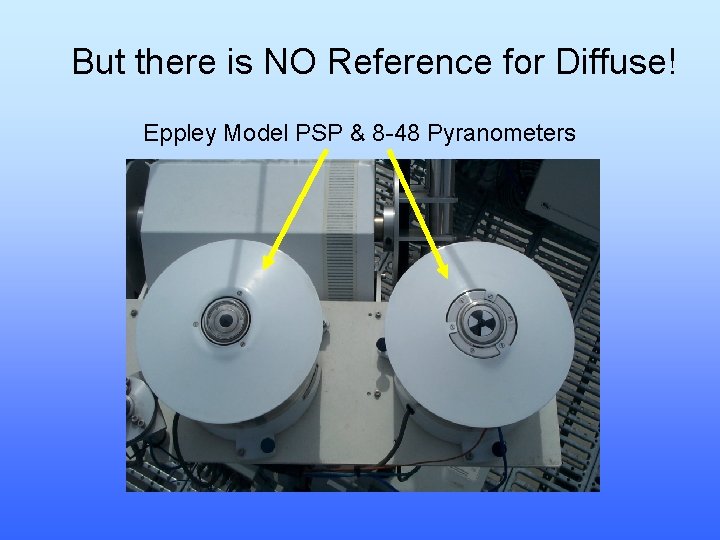
But there is NO Reference for Diffuse! Eppley Model PSP & 8 -48 Pyranometers
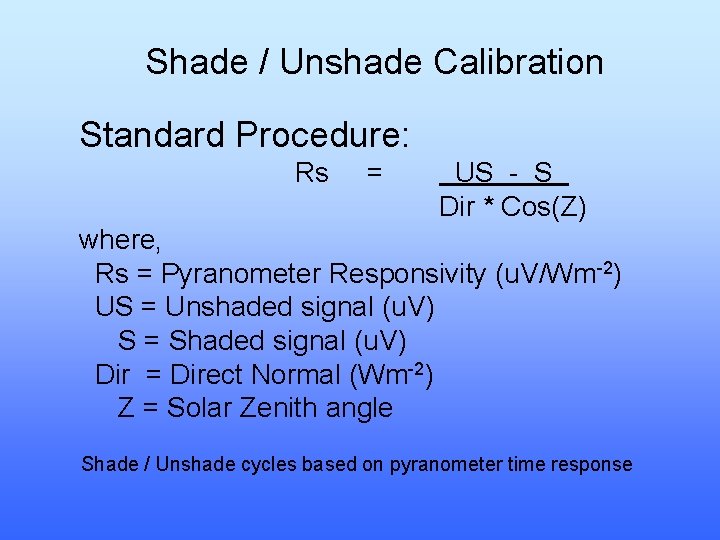
Shade / Unshade Calibration Standard Procedure: Rs = US - S Dir * Cos(Z) where, Rs = Pyranometer Responsivity (u. V/Wm-2) US = Unshaded signal (u. V) S = Shaded signal (u. V) Dir = Direct Normal (Wm-2) Z = Solar Zenith angle Shade / Unshade cycles based on pyranometer time response
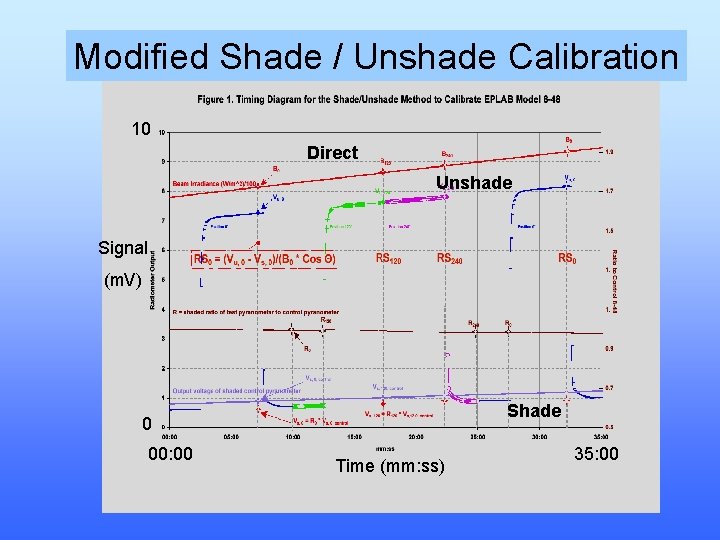
Modified Shade / Unshade Calibration 10 Direct Unshade Signal (m. V) Shade 0 00: 00 Time (mm: ss) 35: 00
RCC is the Software Mechanism Radiometer Calibration & Characterization Used to control the BORCAL process with Lab Windows and Access programs…
RCC Schematic
Responsivities 1. Rs (45 -55) Traditional - Pyranometers Mid-latitude USA (following Ed Flowers & Don Nelson/NOAA) 2. Rs (Composite) Traditional - Pyrheliometers (results depend on amount of data collected) 3. Rs (9 deg intervals) Discrete Characterization - Improve information available to the user.
Responsivities 4. Rs (45 +/-0. 3) Improved trend analyses by more repeatable results 5. Rs (2 deg interval) Improved Characterization 6. Rs (Z) Polynomial fit to AM & PM responses 7. Rs (Lat) Single Rs optimized for measurement station location
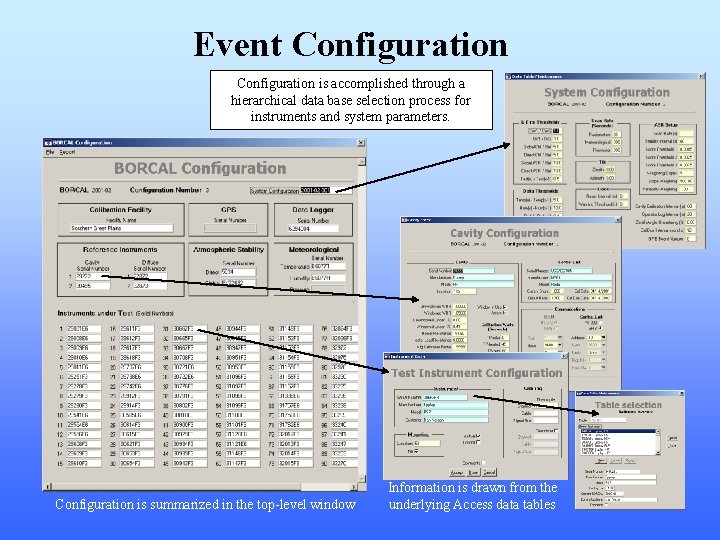
Event Configuration is accomplished through a hierarchical data base selection process for instruments and system parameters. Configuration is summarized in the top-level window Information is drawn from the underlying Access data tables
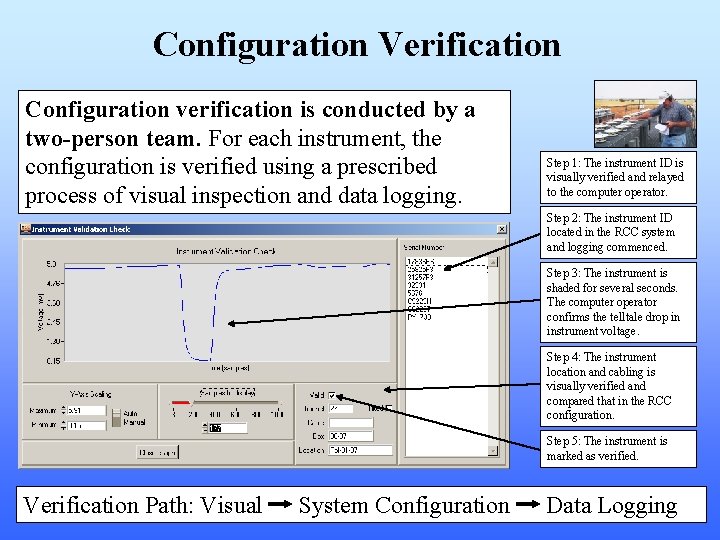
Configuration Verification Configuration verification is conducted by a two-person team. For each instrument, the configuration is verified using a prescribed process of visual inspection and data logging. Step 1: The instrument ID is visually verified and relayed to the computer operator. Step 2: The instrument ID located in the RCC system and logging commenced. Step 3: The instrument is shaded for several seconds. The computer operator confirms the telltale drop in instrument voltage. Step 4: The instrument location and cabling is visually verified and compared that in the RCC configuration. Step 5: The instrument is marked as verified. Verification Path: Visual System Configuration Data Logging
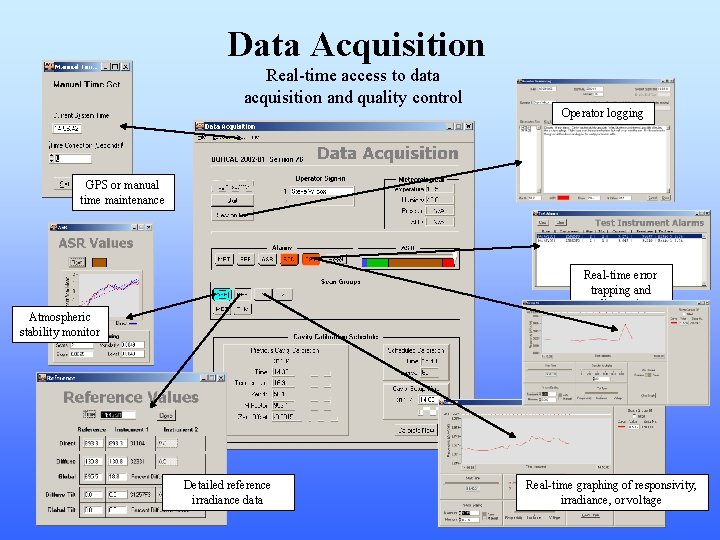
Data Acquisition Real-time access to data acquisition and quality control Operator logging GPS or manual time maintenance Real-time error trapping and diagnosis Atmospheric stability monitor Detailed reference irradiance data Real-time graphing of responsivity, irradiance, or voltage
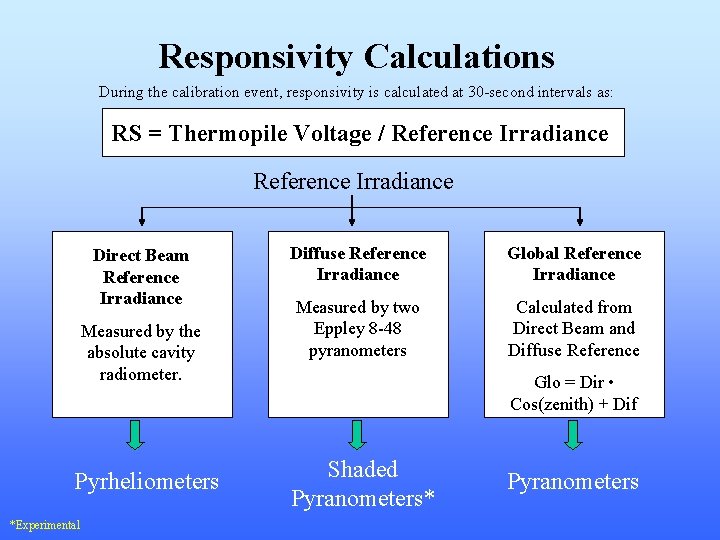
Responsivity Calculations During the calibration event, responsivity is calculated at 30 -second intervals as: RS = Thermopile Voltage / Reference Irradiance Direct Beam Reference Irradiance Measured by the absolute cavity radiometer. Pyrheliometers *Experimental Diffuse Reference Irradiance Global Reference Irradiance Measured by two Eppley 8 -48 pyranometers Calculated from Direct Beam and Diffuse Reference Glo = Dir • Cos(zenith) + Dif Shaded Pyranometers* Pyranometers
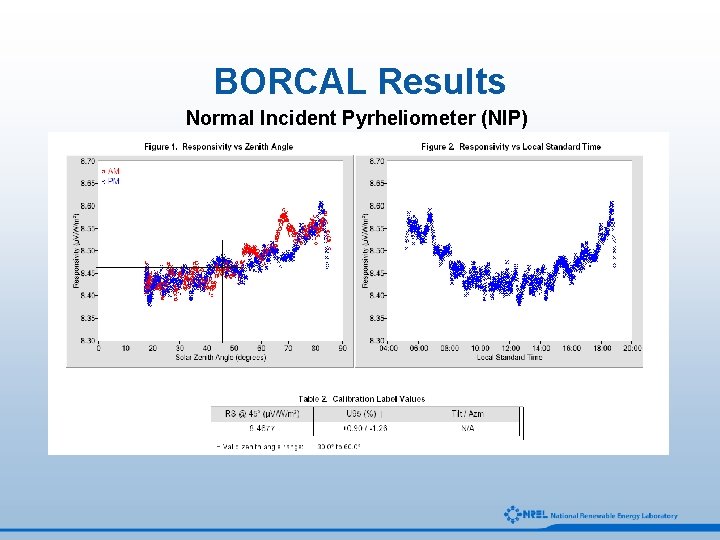
BORCAL Results Normal Incident Pyrheliometer (NIP)
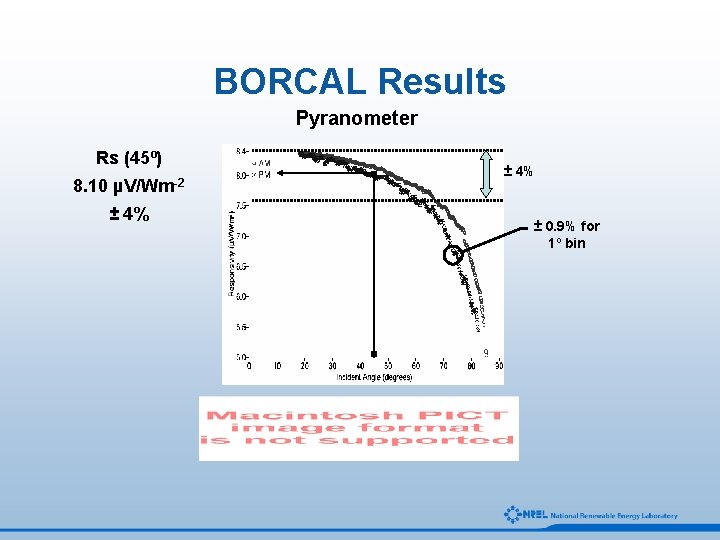
BORCAL Results Pyranometer Rs (45º) 8. 10 µV/Wm-2 ± 4% ± 0. 9% for 1º bin
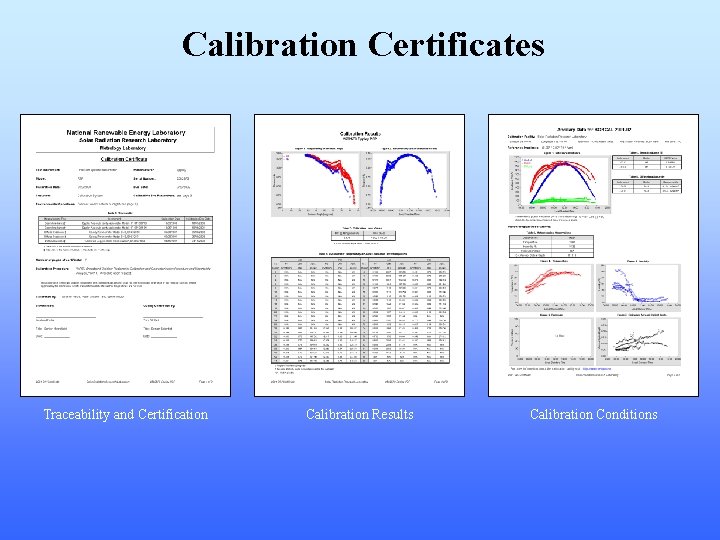
Calibration Certificates Traceability and Certification Calibration Results Calibration Conditions
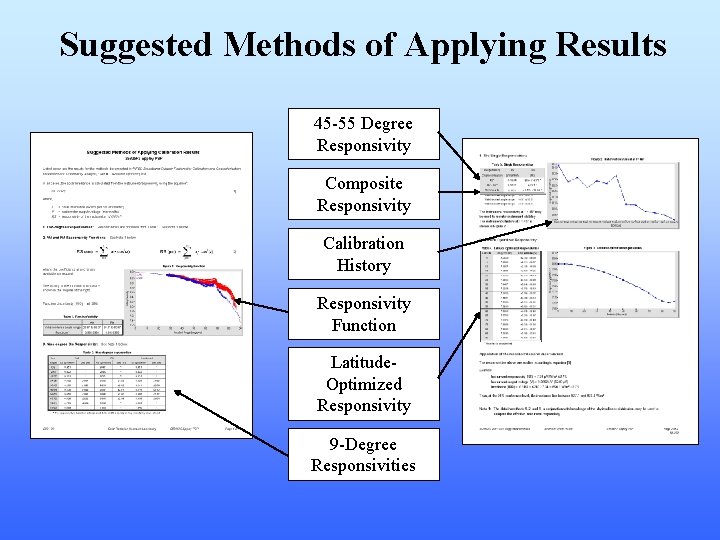
Suggested Methods of Applying Results 45 -55 Degree Responsivity Composite Responsivity Calibration History Responsivity Function Latitude. Optimized Responsivity 9 -Degree Responsivities
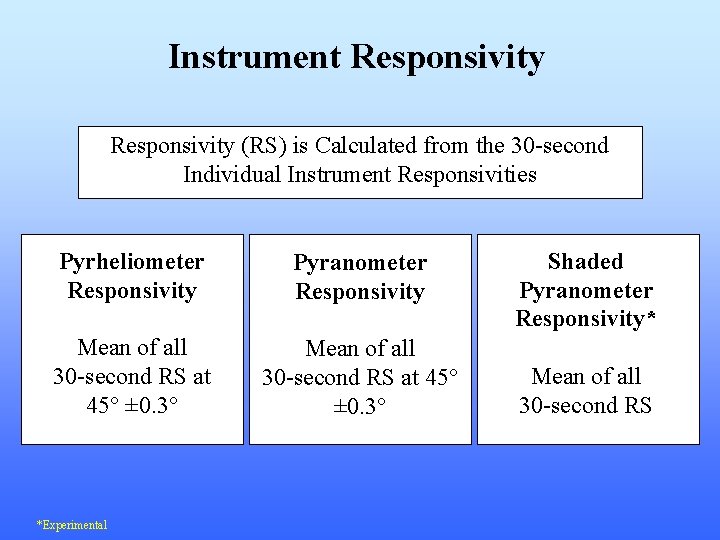
Instrument Responsivity (RS) is Calculated from the 30 -second Individual Instrument Responsivities Pyrheliometer Responsivity Pyranometer Responsivity Mean of all 30 -second RS at 45° ± 0. 3° *Experimental Shaded Pyranometer Responsivity* Mean of all 30 -second RS
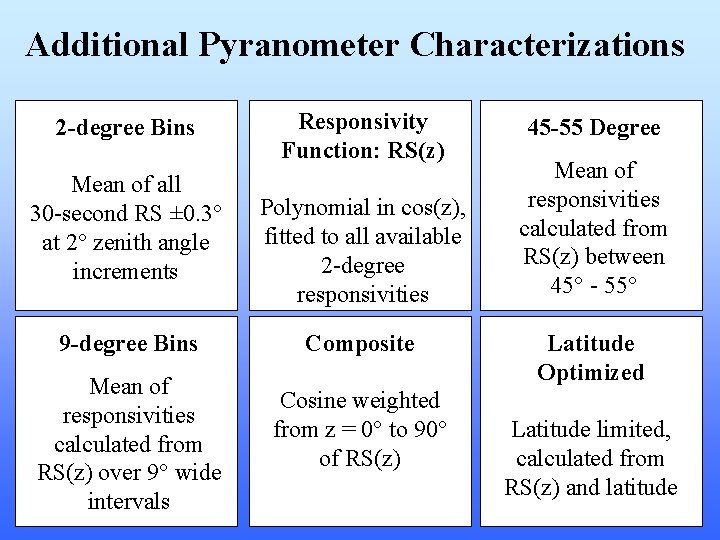
Additional Pyranometer Characterizations 2 -degree Bins Mean of all 30 -second RS ± 0. 3° at 2° zenith angle increments 9 -degree Bins Mean of responsivities calculated from RS(z) over 9° wide intervals Responsivity Function: RS(z) Polynomial in cos(z), fitted to all available 2 -degree responsivities Composite Cosine weighted from z = 0° to 90° of RS(z) 45 -55 Degree Mean of responsivities calculated from RS(z) between 45° - 55° Latitude Optimized Latitude limited, calculated from RS(z) and latitude
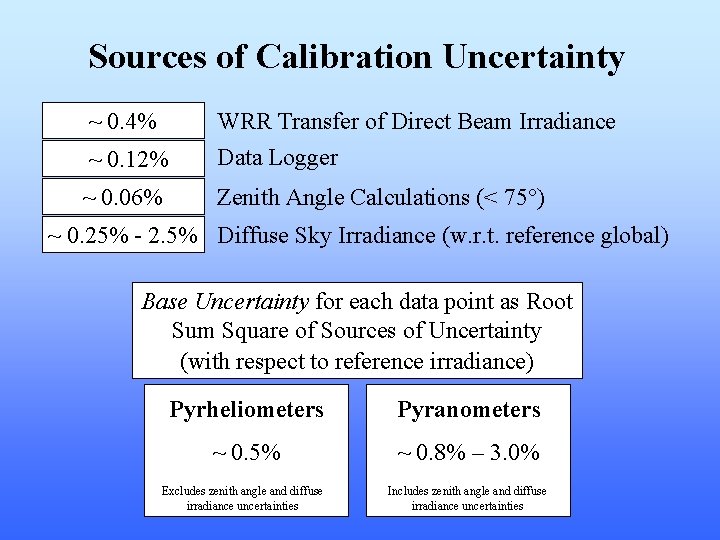
Sources of Calibration Uncertainty ~ 0. 4% WRR Transfer of Direct Beam Irradiance ~ 0. 12% Data Logger ~ 0. 06% Zenith Angle Calculations (< 75°) ~ 0. 25% - 2. 5% Diffuse Sky Irradiance (w. r. t. reference global) Base Uncertainty for each data point as Root Sum Square of Sources of Uncertainty (with respect to reference irradiance) Pyrheliometers Pyranometers ~ 0. 5% ~ 0. 8% – 3. 0% Excludes zenith angle and diffuse irradiance uncertainties Includes zenith angle and diffuse irradiance uncertainties
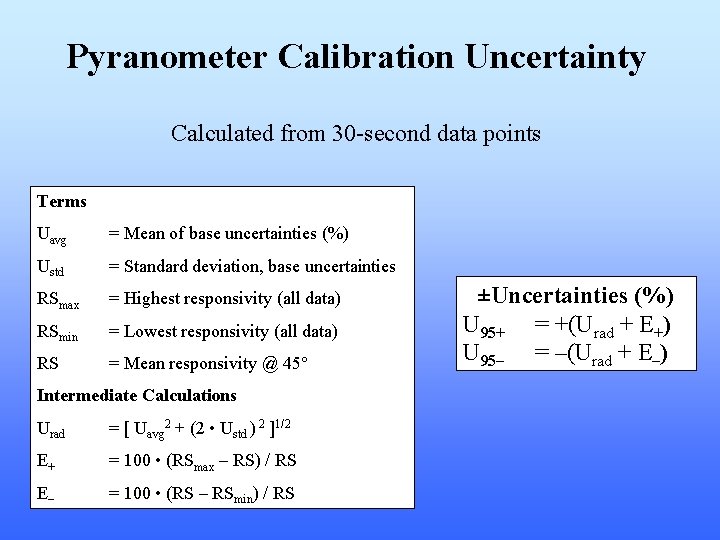
Pyranometer Calibration Uncertainty Calculated from 30 -second data points Terms Uavg = Mean of base uncertainties (%) Ustd = Standard deviation, base uncertainties RSmax = Highest responsivity (all data) RSmin = Lowest responsivity (all data) RS = Mean responsivity @ 45° Intermediate Calculations Urad = [ Uavg 2 + (2 • Ustd ) 2 ]1/2 E+ = 100 • (RSmax – RS) / RS E– = 100 • (RS – RSmin) / RS ±Uncertainties (%) U 95+ = +(Urad + E+) U 95– = –(Urad + E–)
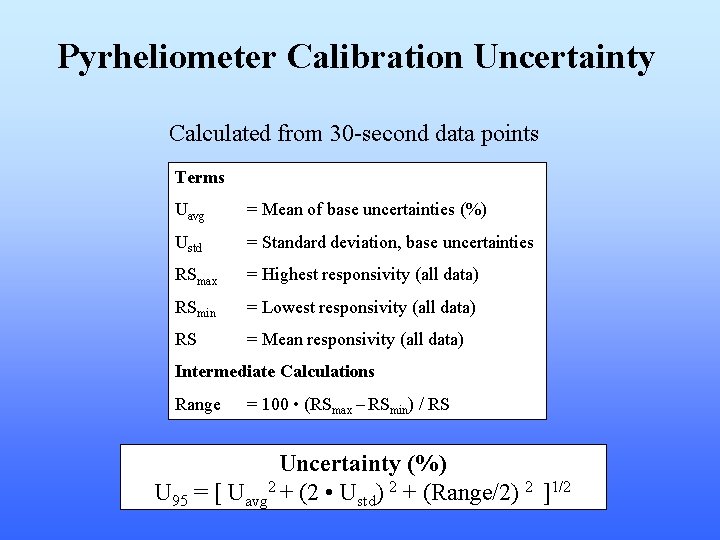
Pyrheliometer Calibration Uncertainty Calculated from 30 -second data points Terms Uavg = Mean of base uncertainties (%) Ustd = Standard deviation, base uncertainties RSmax = Highest responsivity (all data) RSmin = Lowest responsivity (all data) RS = Mean responsivity (all data) Intermediate Calculations Range = 100 • (RSmax – RSmin) / RS Uncertainty (%) U 95 = [ Uavg 2 + (2 • Ustd) 2 + (Range/2) 2 ]1/2
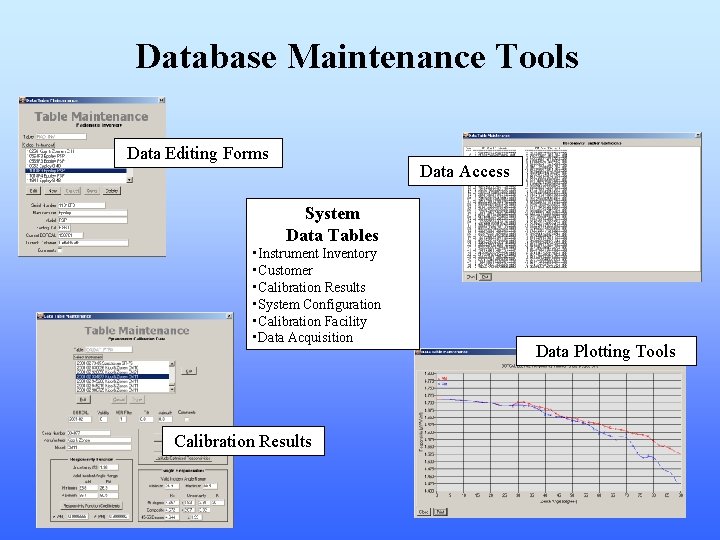
Database Maintenance Tools Data Editing Forms Data Access System Data Tables • Instrument Inventory • Customer • Calibration Results • System Configuration • Calibration Facility • Data Acquisition Calibration Results Data Plotting Tools

Data Exporting and Distribution Responsivity Data Export for Transferring Calibration Results Custom Exports with Selectable Parameters and Output Format Dedicated Export Format (AIM Database, Calibration Stickers)
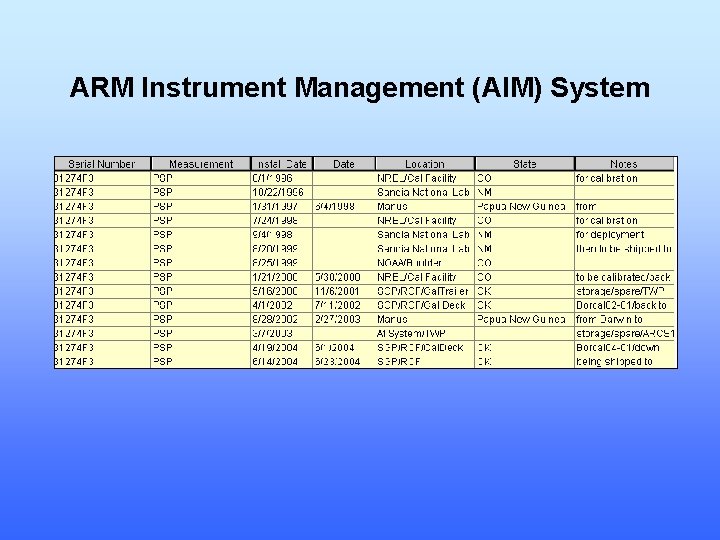
ARM Instrument Management (AIM) System
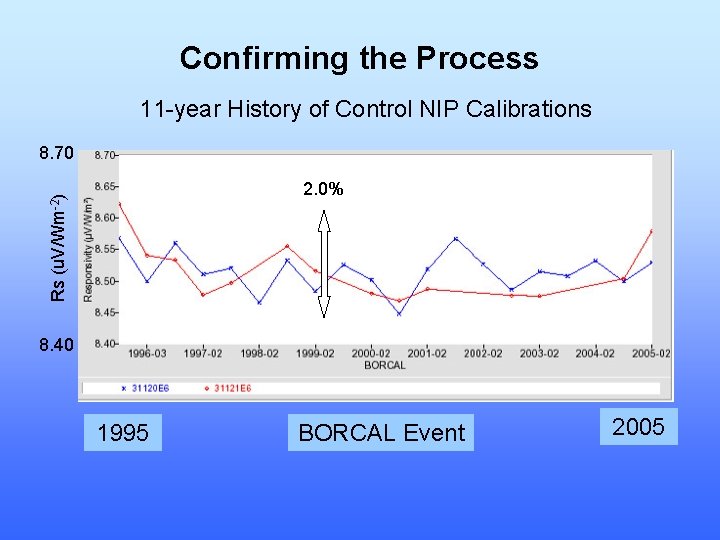
Confirming the Process 11 -year History of Control NIP Calibrations 8. 70 Rs (u. V/Wm-2) 2. 0% 8. 40 1995 BORCAL Event 2005
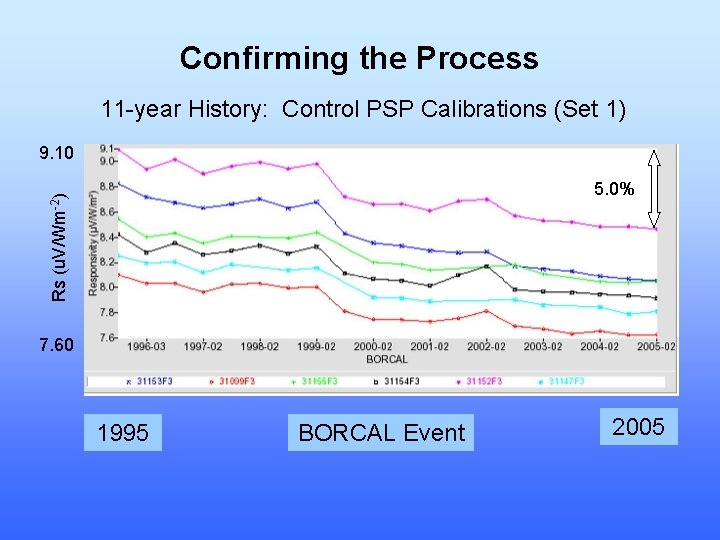
Confirming the Process 11 -year History: Control PSP Calibrations (Set 1) 9. 10 Rs (u. V/Wm-2) 5. 0% 7. 60 1995 BORCAL Event 2005
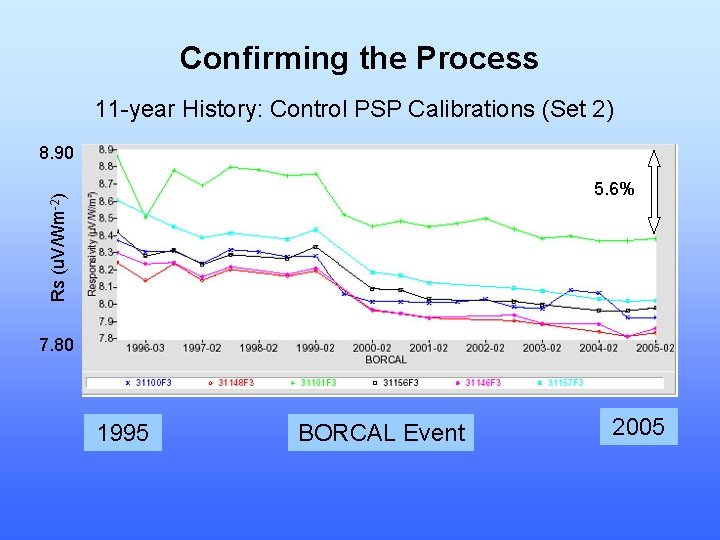
Confirming the Process 11 -year History: Control PSP Calibrations (Set 2) 8. 90 Rs (u. V/Wm-2) 5. 6% 7. 80 1995 BORCAL Event 2005
Summary • The Atmospheric Radiation Measurement (ARM) Program needs accurate broadband irradiance data from three climatic regions. • NREL has developed RCC software to semiautomate the BORCAL process for hundreds of shortwave radiometer calibrations each year. • The AIM Database contains BORCAL and deployment information for all ARM radiometers (http: //www. nrel. gov/aim) • Control Radiometer calibration history shows longterm performance of BORCAL process and radiometer responsivities.

Thanks! Questions for Craig or Reda? More information available from http: //www. arm. gov
- Slides: 42