
SGA QUALITATIVE STUDY 1 Allison B Taylor MSW

SGA QUALITATIVE STUDY 1 Allison B. Taylor, MSW, Ph. D Institute for Community Inclusion UMass Boston
SUMMARY ØOverview - purpose and methods ØParticipant Demographics ØEmerging themes – decisions about work 2
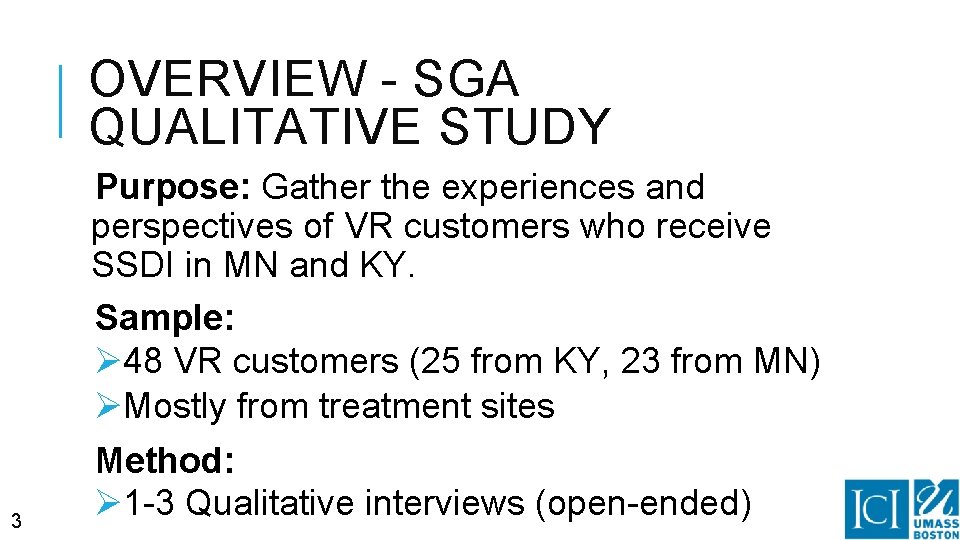
OVERVIEW - SGA QUALITATIVE STUDY Purpose: Gather the experiences and perspectives of VR customers who receive SSDI in MN and KY. Sample: Ø 48 VR customers (25 from KY, 23 from MN) ØMostly from treatment sites 3 Method: Ø 1 -3 Qualitative interviews (open-ended)
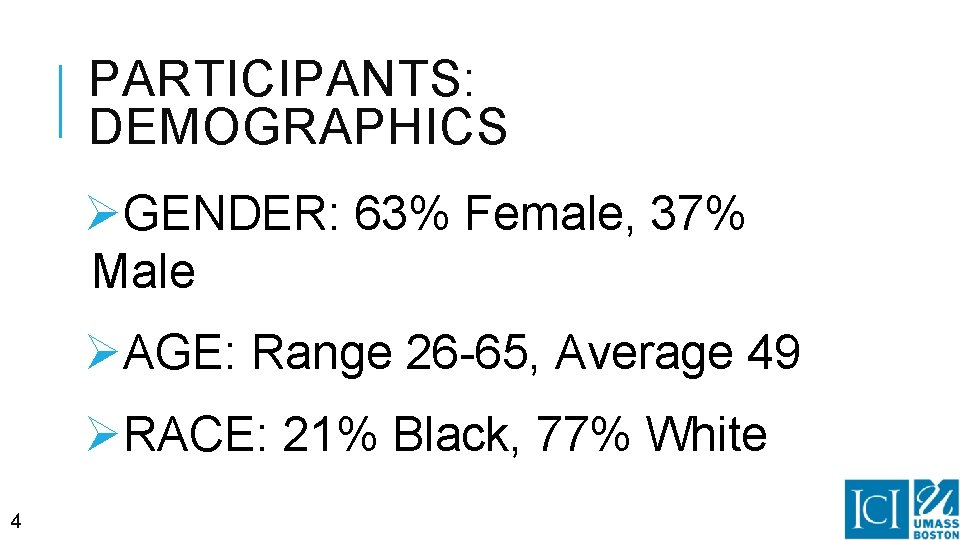
PARTICIPANTS: DEMOGRAPHICS ØGENDER: 63% Female, 37% Male ØAGE: Range 26 -65, Average 49 ØRACE: 21% Black, 77% White 4
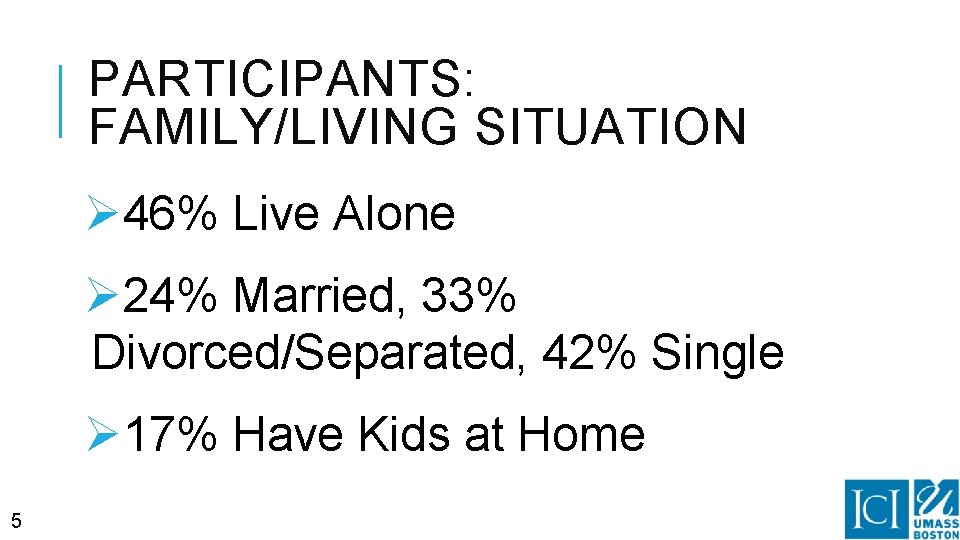
PARTICIPANTS: FAMILY/LIVING SITUATION Ø 46% Live Alone Ø 24% Married, 33% Divorced/Separated, 42% Single Ø 17% Have Kids at Home 5
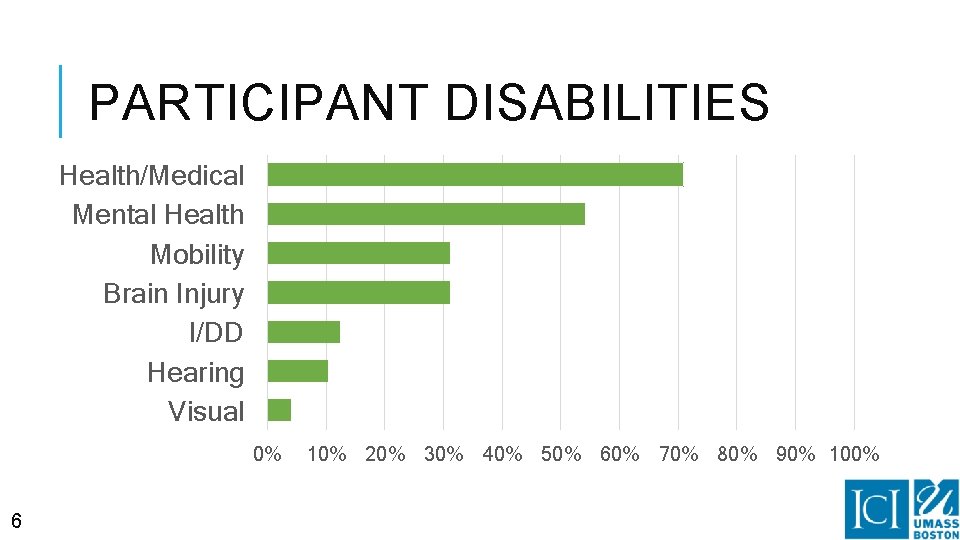
PARTICIPANT DISABILITIES Health/Medical Mental Health Mobility Brain Injury I/DD Hearing Visual 0% 6 10% 20% 30% 40% 50% 60% 70% 80% 90% 100%
RESEARCH QUESTIONS: OVERALL ØWhat are customers’ experiences and perspectives? Job search VR SSDI Work 7
RESEARCH QUESTIONS: DECISIONS/MOTIVATIONS ØHow do SSDI recipients make decisions about working? E. g. : 8 Seeking work Seeking help from VR Working above or below SGA Other decisions: education, changing careers, etc.
RESEARCH QUESTIONS: DECISIONS/MOTIVATIONS ØWhat factors influences these decisions? ØWhat is the role of VR? 9
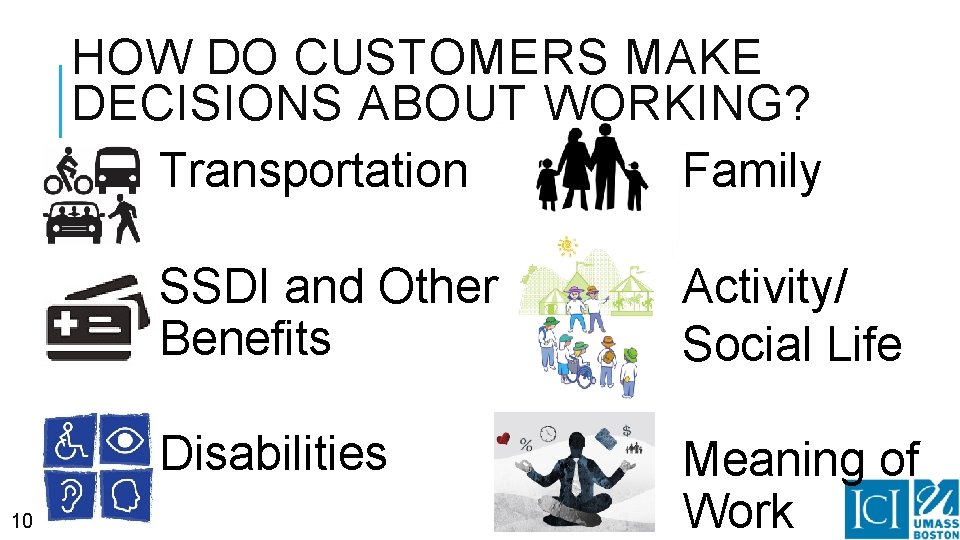
HOW DO CUSTOMERS MAKE DECISIONS ABOUT WORKING? Transportation Family 10 SSDI and Other Benefits Activity/ Social Life Disabilities Meaning of Work
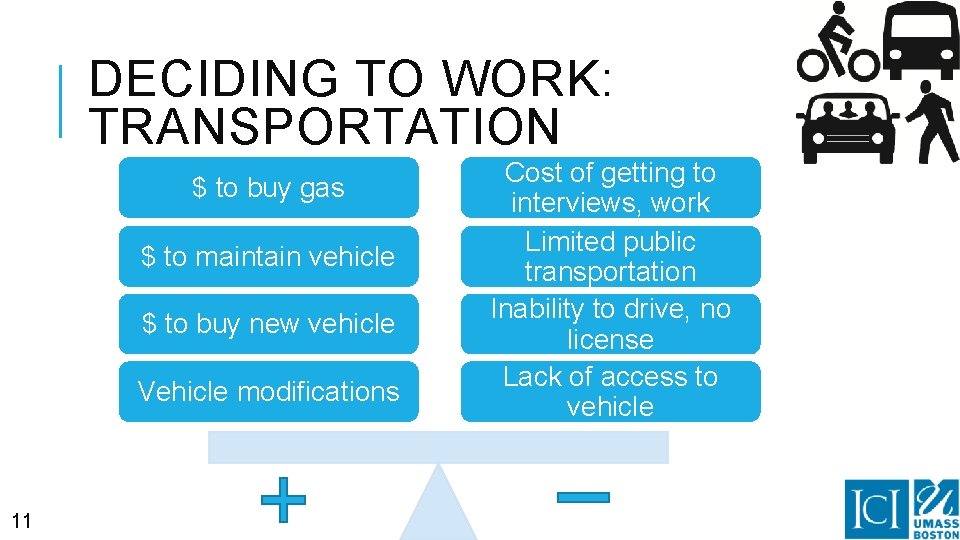
DECIDING TO WORK: TRANSPORTATION $ to buy gas $ to maintain vehicle $ to buy new vehicle Vehicle modifications 11 Cost of getting to interviews, work Limited public transportation Inability to drive, no license Lack of access to vehicle
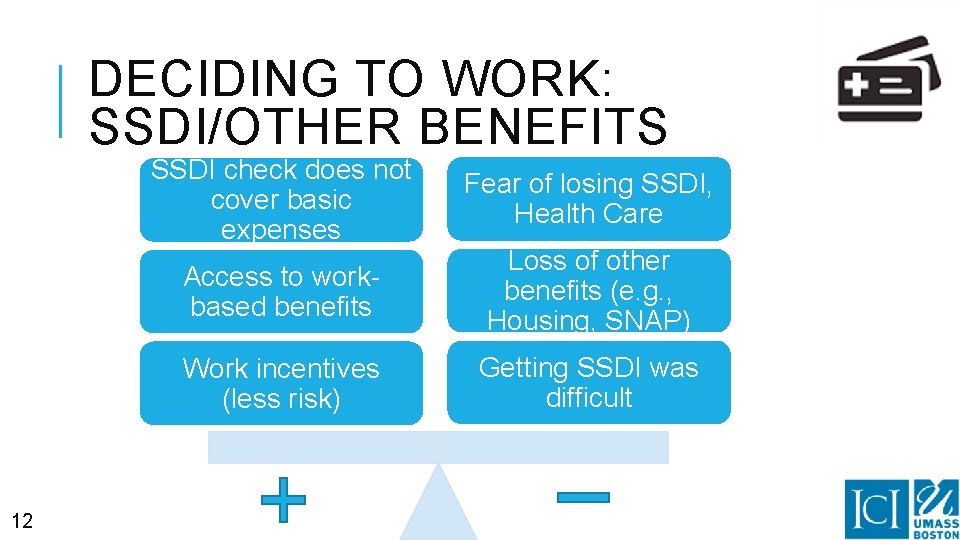
DECIDING TO WORK: SSDI/OTHER BENEFITS SSDI check does not cover basic expenses 12 Fear of losing SSDI, Health Care Access to workbased benefits Loss of other benefits (e. g. , Housing, SNAP) Work incentives (less risk) Getting SSDI was difficult
M, 30 S (KY): “THE FEAR OF NOT KNOWING” Importance of benefits counseling: “So even the fear of losing the little I was getting, the fear of not knowing. … I didn’t know if…I could do a full day of work…. Everything was just so uncertain. It would have been really nice to have a little bit of certainty in…understanding what happens with SSI and SSDI and Medicare or Medicaid when you start working…. 13 I don’t think they told me in as much detail [the first time] as I was told last time at VR. They were really
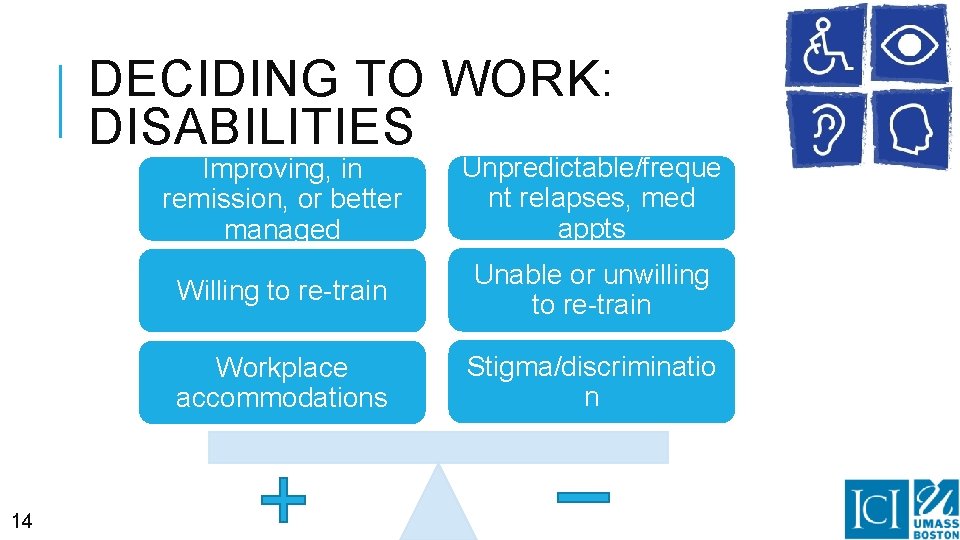
DECIDING TO WORK: DISABILITIES 14 Improving, in remission, or better managed Unpredictable/freque nt relapses, med appts Willing to re-train Unable or unwilling to re-train Workplace accommodations Stigma/discriminatio n
F, 50 S (KY): “IF I CAN WALK…” Condition improving/in remission: “‘Once I'm able to walk, ’ I said, ‘well, if I can walk, I'm getting off of SSDI. I want to go back to work. ’ So that's when some lady I met was telling me about this program. So that's when I went to talk to them about that. ” 15
F, 40 S (KY): “IF I’M ABLE TO” 16 “I thought [benefits counseling] was very helpful, so if it got to where I can't afford the expenses of the college, I know that I could still--I'd do a little bit of work and not lose my benefits. If I'm able to. But I don't know if anybody would hire me because I'm not able to work eight-hour shifts. I can clean around the house a little bit and I get so sick. I'm sick for two or three days. ”
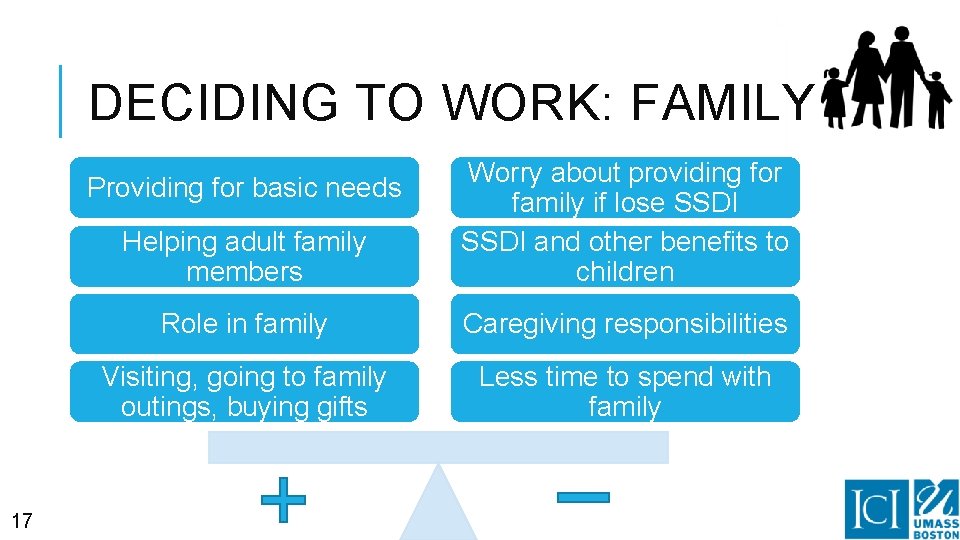
DECIDING TO WORK: FAMILY Helping adult family members Worry about providing for family if lose SSDI and other benefits to children Role in family Caregiving responsibilities Visiting, going to family outings, buying gifts Less time to spend with family Providing for basic needs 17
F, 50 S (KY): “I NEED TO…BE A PARENT” Caregiving responsibilities: “I have to go to temp services because it's flexible…. I need to…be able to work and then be able to be a parent, like with homework, stuff like this. ” Being a role model: “I’m trying to be as self-sufficient as I can because I have children, and I want to be a good example. ” 18 Providing for basic needs: “I'm divorced and in a situation with these two children. I just try to work as much as I can so we can be able to make it and be able to handle it, because just on this Social Security, on my own now,
F, 60 S (KY): “CAN’T SPOIL MY GRANDCHILDREN” “[My husband] retired at 62, but he was forced back into full-time… He had taken a part-time job and I was supposed to get the other part-time job. And because I didn’t, he was forced back into full-time work while I sit here. And he’s paying the bills. I still am responsible for half of the mortgage, and I take care of the groceries. And with my medical expenses mounting, by the end of the month, I don’t have money left to do anything, and I can’t spoil my grandchildren. ” 19
M, 50 S (KY): “I MISS MY FAMILY TO DEATH” Visiting family: “[Having a job] helps me with all my free time. I don’t have to sit there 24 hours a day just watching the TV. I can go see my family now, which back in the day I didn’t have the money to go see them half the time, and now I can see them at least once or twice a week. And that’s been great because I miss my family to death. They live about 50 miles away from me, so it’s kind of hard sometimes with no money. So now I can go see them constant whenever I want to really on my days off. ” 20
DECIDING TO WORK: BEING ACTIVE/SOCIAL Social interaction at work Can afford Leisure/fun Counteracting boredom, depression or inactivity 21 Fear of being overwhelmed at work More leisure time when not working Less family time
F, 50 S (KY): “A REASON TO GET OUT OF BED” INTERVIEWER: And what would you think the pros and cons of going back to work are? RESPONDENT: I think, first of all, obviously the pros are the income. And to me the socialization is important. And…I guess basically a reason to get out of the bed, get showered and get out of the house every day. INTERVIEWER: Mm-hmm. And you mentioned socialization; can you talk more about that? RESPONDENT: It’s like me: I moved up here and my parents were gone for three months in [another state]. They just got back a couple days ago, and I really don’t have any friends--I mean I have friends, but we don’t socialize; we’ll talk on the phone. And it’s very, very lonely and isolating. And even at work, it’s just me with one patient. But it’s better than sitting here by myself and 22 watching TV. And I enjoy the elderly. I can relate to them better than people my
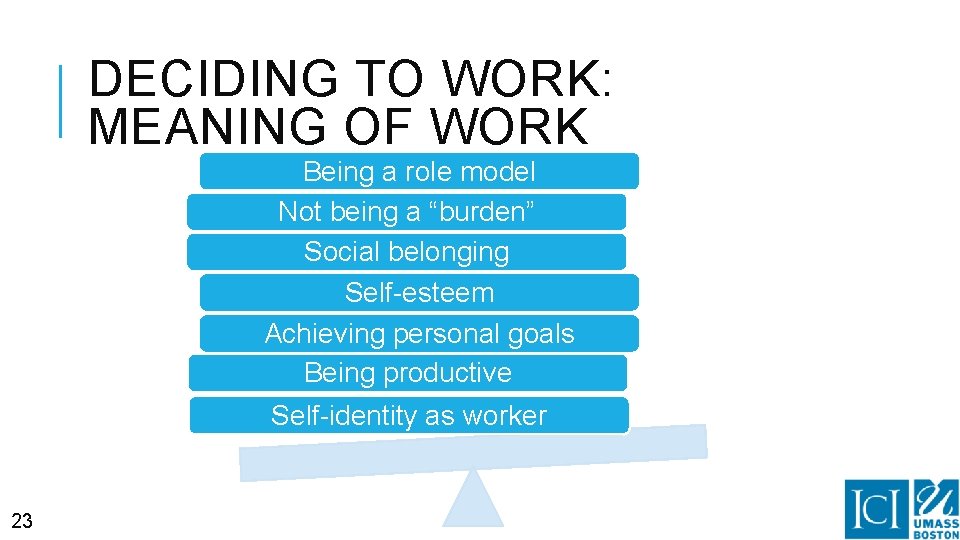
DECIDING TO WORK: MEANING OF WORK Being a role model Not being a “burden” Social belonging Self-esteem Achieving personal goals Being productive Self-identity as worker 23
F, 40 S (KY): “PART OF THE SOCIETY” INTERVIEWER: And what do you think it would be like to work and go off disability? RESPONDENT: Well, for one, my self-esteem would be built because I know that I would be doing something to help other people and that I belong somewhere, that I'm needed somewhere. And the feeling to be needed, that goes a long, long way. …I want to feel like I belong. I want to feel like I'm part of the society. And when you're on disability, you're this little group over here outside the circle with the rest of the world. INTERVIEWER: Does going to school help you feel like you're part of the society? RESPONDENT: Oh yeah, because none of them kids know that I'm on disability. I got a 4. 0; I got straight As… Those students, when they find out the grades that I have, they come to me and ask me to help them. That makes me feel so good to 24 know that them kids are looking up to me for something. It makes me feel part of
M, 50 S (KY): “IT FILLS A BIG VOID” INTERVIEWER: And what do you think has been the most helpful aspect of the services from voc rehab? RESPONDENT: Just getting to talk to someone and talking about your problems and getting a job and working. It fills a big void in my life. INTERVIEWER: Can you say more about that? 25 RESPONDENT: Well, I’d just like to thank the people every day that help me out there - [the rehab counselor, job placement person, and benefits counselor]. It’s just a great deal out here. If anybody’s out there that needs help, they ought to check into stuff like this. … It’s just been great
CONCLUSION A few final notes: Our study participants want to work. These are complex decisions, not just based on economics. Ambivalence is common. VR plays an important role. 26
- Slides: 26