
SFIA VERSION 4 What is SFIA What is

- Slides: 32
SFIA VERSION 4
What is SFIA? What is SFIAplus? Recent evolution
Defining the skills we need Traditionally Programming Analysis/Design Operations Support Management
Our changing world Constant evolution in IT – “Commodity technical skills are going overseas” New “Skills profile” – Business aware, good communicator, able to manage business relationships, creative, innovative, leadership ability (Computing)
Defining the skills we need Yesterday Today Programming Innovation Analysis/Design Transformation Operations Communication Support Leadership…. Management
Understand the Strategic context What are strategic business objectives? How does IT enable them? How are they supported by the current people development processes?
Managing the IT resources in different environments What skills have we got? What level of skill? Basic? Expert? How many? How can we evaluate? What do we need?
Create Skills Directory Determine the key Skills Establish a measurement framework Create a skills matrix Re-invent the wheel?
Skills Framework “SFIA describes what people do, not necessarily what their jobs are called” introduction to SFIA
IET e. Skills IMIS BCS it. SMF
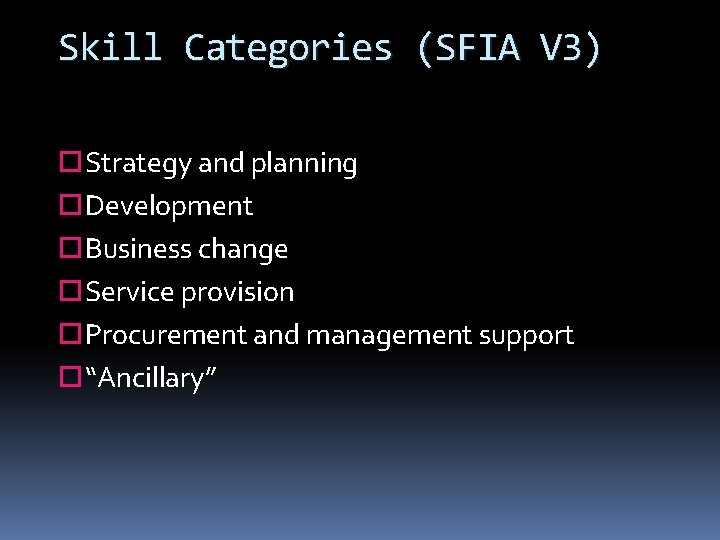
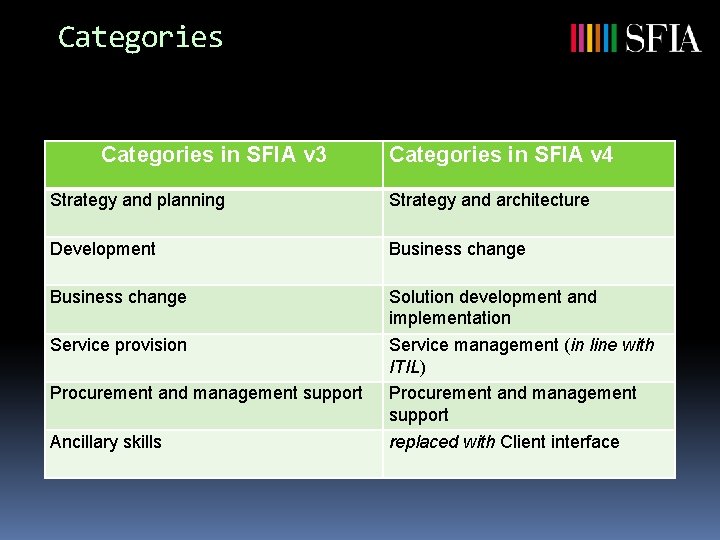
Skill Categories (SFIA V 3) Strategy and planning Development Business change Service provision Procurement and management support “Ancillary”
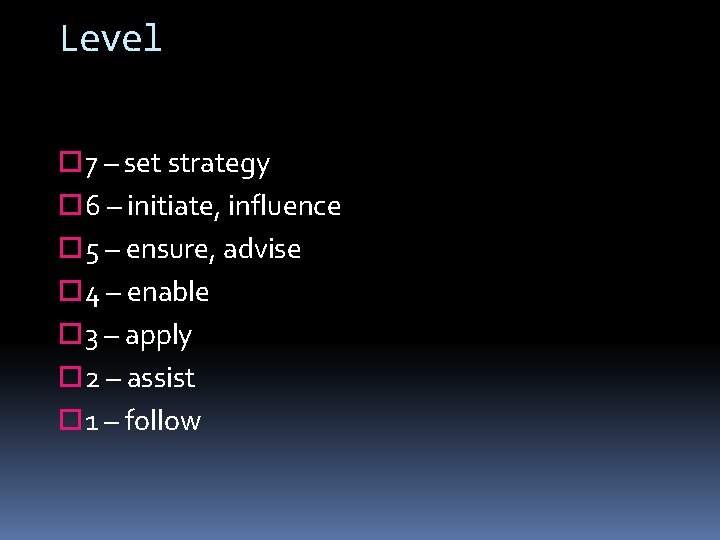
Level 7 – set strategy 6 – initiate, influence 5 – ensure, advise 4 – enable 3 – apply 2 – assist 1 – follow
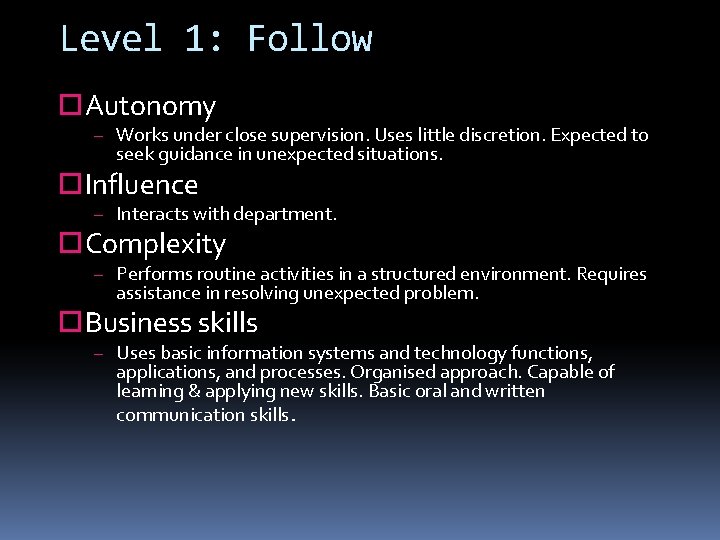
Level 1: Follow Autonomy – Works under close supervision. Uses little discretion. Expected to seek guidance in unexpected situations. Influence – Interacts with department. Complexity – Performs routine activities in a structured environment. Requires assistance in resolving unexpected problem. Business skills – Uses basic information systems and technology functions, applications, and processes. Organised approach. Capable of learning & applying new skills. Basic oral and written communication skills.
Level 7: set strategy, inspire, mobilise Autonomy – Authority and responsibility for significant area of work, including policy formation and application. Fully accountable. Influence – Decisions critical to organisational success. Develops long-term strategic relationships with customers and industry leaders. Complexity – Strategic. Highest level management and leadership skills. Deep understanding of IT industry and emerging technologies. Business skills – Full range of strategic management and leadership skills. Broad and deep knowledge, etc
How is it used? Role Profiles Skill Needs Gap Analysis Resource Planning Benchmark
Significant Dates 1990: ISM v 2 1996: ISM v 3 March 2000: First release of SFIA July 2000: SFIA version 1. 1 June 2001: SFIA version 2 (including telecoms skills) 19 May 2003: SFIA Foundation established November 2005: SFIA version 3 (including Business change, Information security and alignment with ITIL) December 2008: SFIA version 4
Policy and Aims The policy of the SFIA Foundation is that SFIA should record industry best practice, not attempt to lead it. For each release our aims are: Evolution not revolution Review of the coverage Revision of the descriptors to reflect best practice and current terminology Addition of new skills Identification of any “obsolete” skills The Skills are more important than the categorisation Open consultation process
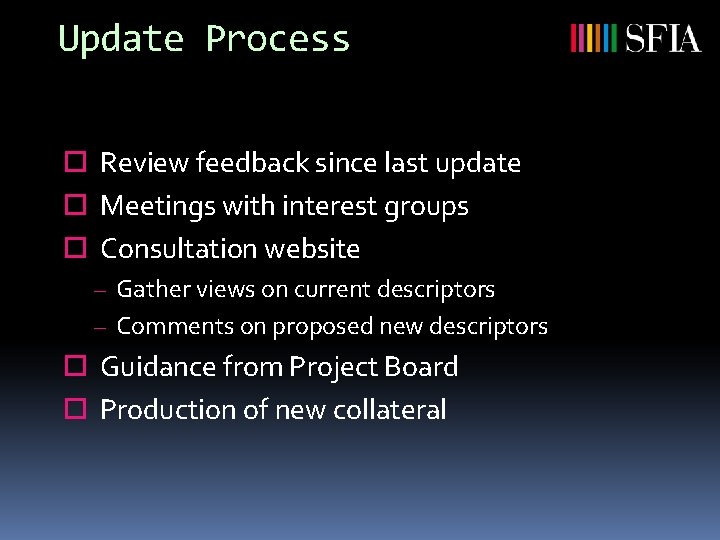
Update Process Review feedback since last update Meetings with interest groups Consultation website – Gather views on current descriptors – Comments on proposed new descriptors Guidance from Project Board Production of new collateral
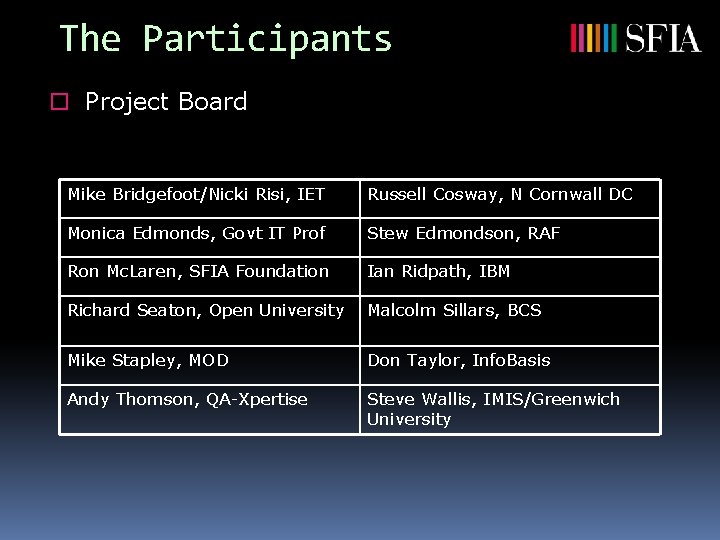
The Participants Project Board Mike Bridgefoot/Nicki Risi, IET Russell Cosway, N Cornwall DC Monica Edmonds, Govt IT Prof Stew Edmondson, RAF Ron Mc. Laren, SFIA Foundation Ian Ridpath, IBM Richard Seaton, Open University Malcolm Sillars, BCS Mike Stapley, MOD Don Taylor, Info. Basis Andy Thomson, QA-Xpertise Steve Wallis, IMIS/Greenwich University
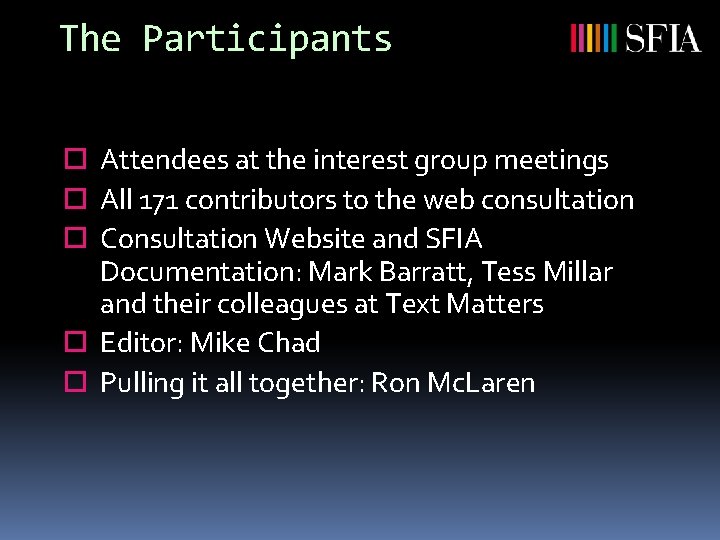
The Participants Attendees at the interest group meetings All 171 contributors to the web consultation Consultation Website and SFIA Documentation: Mark Barratt, Tess Millar and their colleagues at Text Matters Editor: Mike Chad Pulling it all together: Ron Mc. Laren
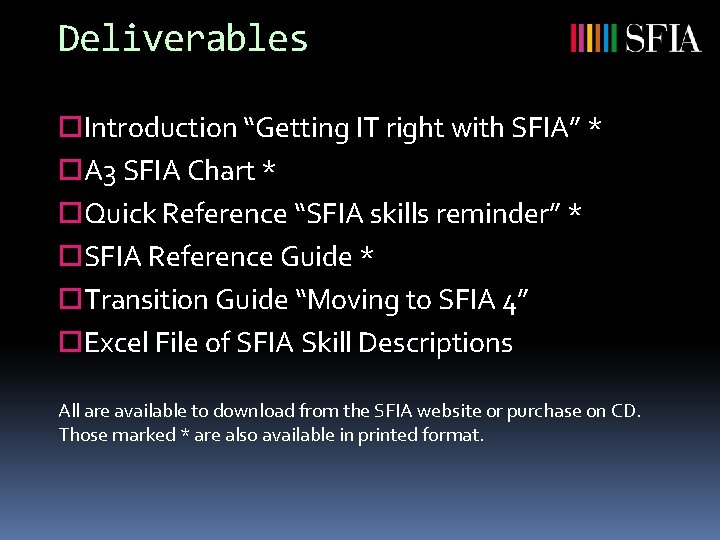
Deliverables Introduction “Getting IT right with SFIA” * A 3 SFIA Chart * Quick Reference “SFIA skills reminder” * SFIA Reference Guide * Transition Guide “Moving to SFIA 4” Excel File of SFIA Skill Descriptions All are available to download from the SFIA website or purchase on CD. Those marked * are also available in printed format.
“The right people with the right skills in the right place at the right time”
Categories in SFIA v 3 Categories in SFIA v 4 Strategy and planning Strategy and architecture Development Business change Solution development and implementation Service management (in line with ITIL) Procurement and management support replaced with Client interface Service provision Procurement and management support Ancillary skills
SFIA levels Seven levels, as before Minor improvements to wording of generic level definitions
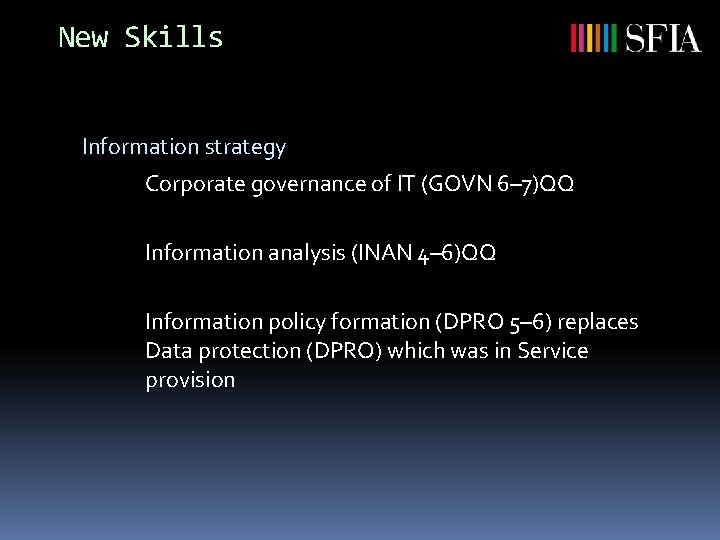
New Skills Information strategy Corporate governance of IT (GOVN 6– 7)QQ Information analysis (INAN 4– 6)QQ Information policy formation (DPRO 5– 6) replaces Data protection (DPRO) which was in Service provision
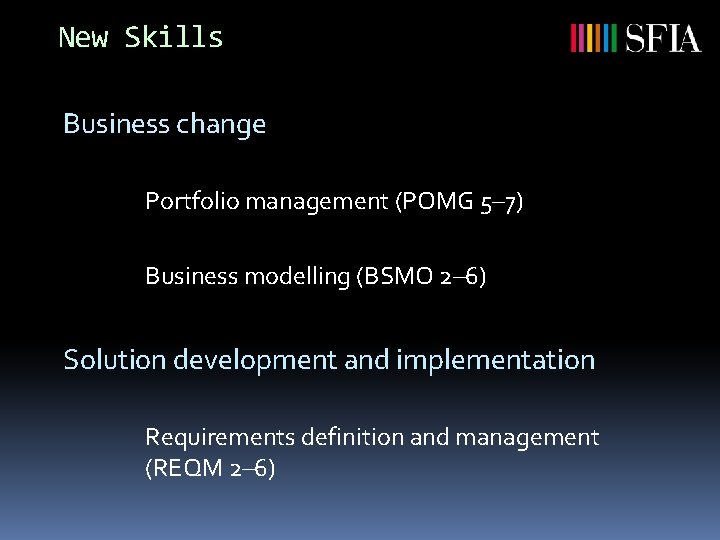
New Skills Business change Portfolio management (POMG 5– 7) Business modelling (BSMO 2– 6) Solution development and implementation Requirements definition and management (REQM 2– 6)
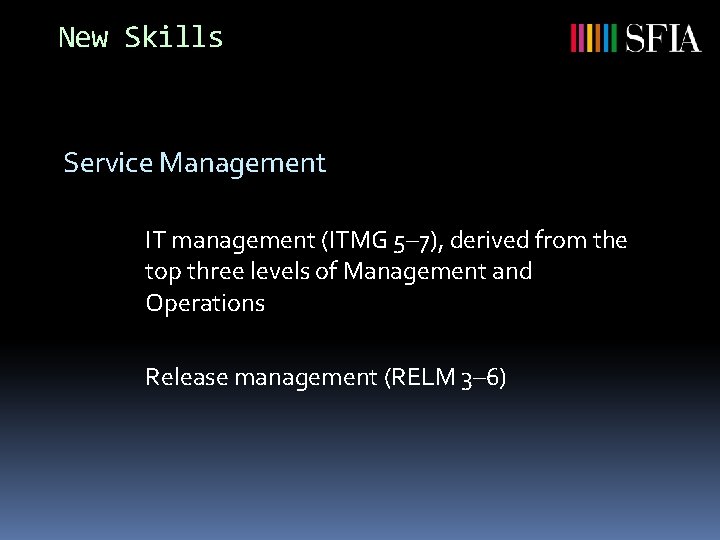
New Skills Service Management IT management (ITMG 5– 7), derived from the top three levels of Management and Operations Release management (RELM 3– 6)
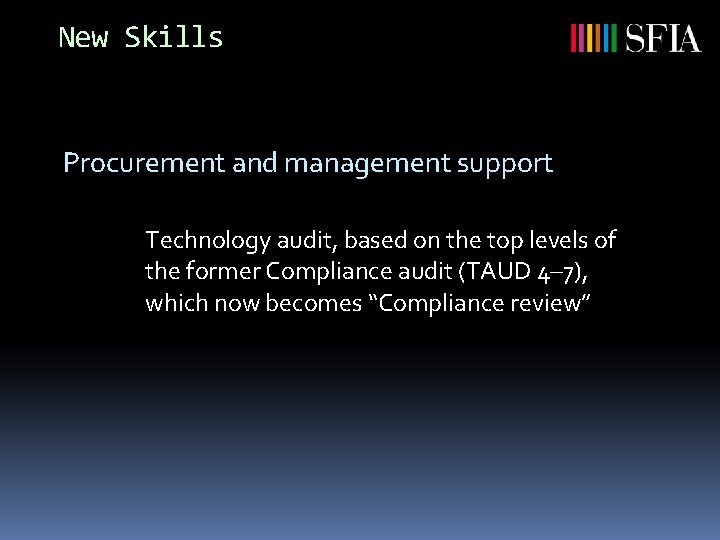
New Skills Procurement and management support Technology audit, based on the top levels of the former Compliance audit (TAUD 4– 7), which now becomes “Compliance review”
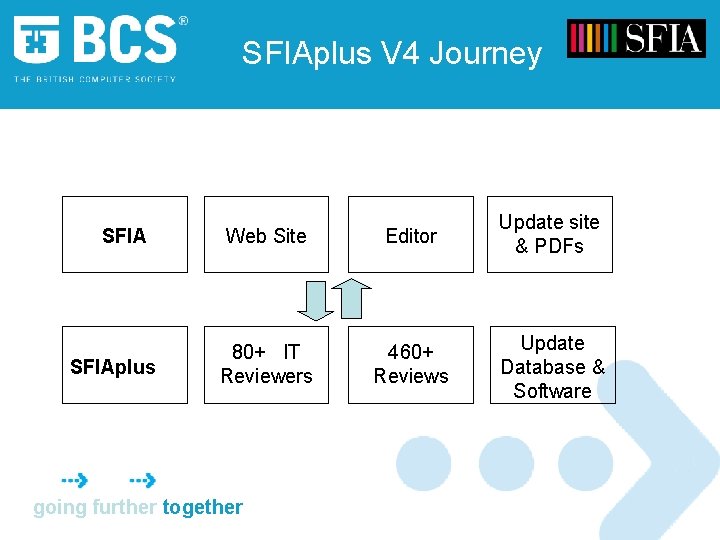
SFIAplus V 4 Journey SFIAplus Web Site Editor Update site & PDFs 80+ IT Reviewers 460+ Reviews Update Database & Software going further together
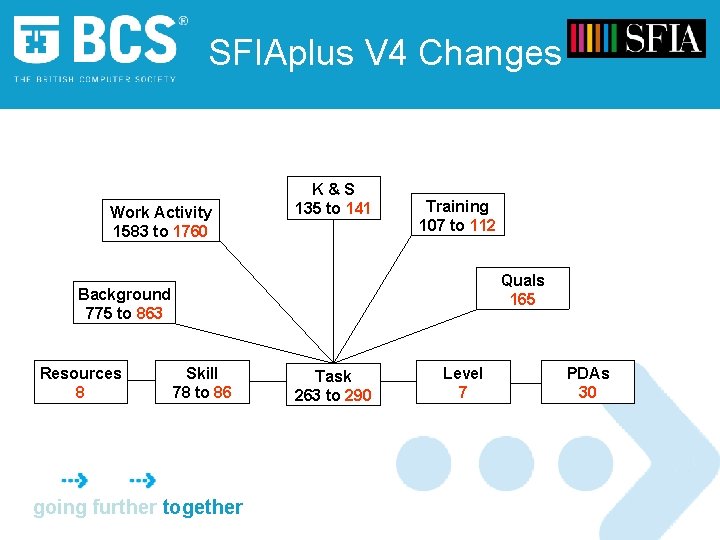
SFIAplus V 4 Changes Work Activity 1583 to 1760 K&S 135 to 141 Training 107 to 112 Quals 165 Background 775 to 863 Resources 8 Skill 78 to 86 going further together Task 263 to 290 Level 7 PDAs 30
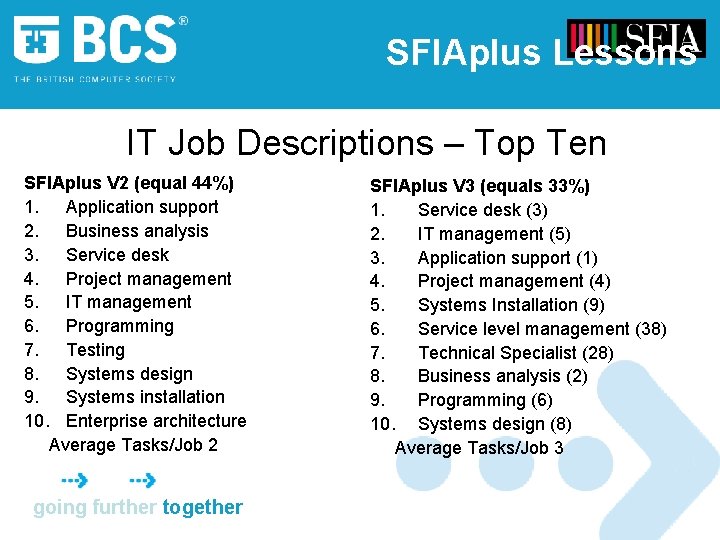
SFIAplus Lessons IT Job Descriptions – Top Ten SFIAplus V 2 (equal 44%) 1. Application support 2. Business analysis 3. Service desk 4. Project management 5. IT management 6. Programming 7. Testing 8. Systems design 9. Systems installation 10. Enterprise architecture Average Tasks/Job 2 going further together SFIAplus V 3 (equals 33%) 1. Service desk (3) 2. IT management (5) 3. Application support (1) 4. Project management (4) 5. Systems Installation (9) 6. Service level management (38) 7. Technical Specialist (28) 8. Business analysis (2) 9. Programming (6) 10. Systems design (8) Average Tasks/Job 3
www. sfia. org. uk