
SFIA i CD Mapping Phase 2 3 Report



- Slides: 27
SFIA - i. CD Mapping Phase 2 & 3 Report May 31, 2019 IT Human Resources Platform Department IT Knowledge Center(IKC) Information-technology Promotion Agency, Japan(IPA)
Contents 1. SFIA Skills vs i. CD Tasks 2. Levels 2
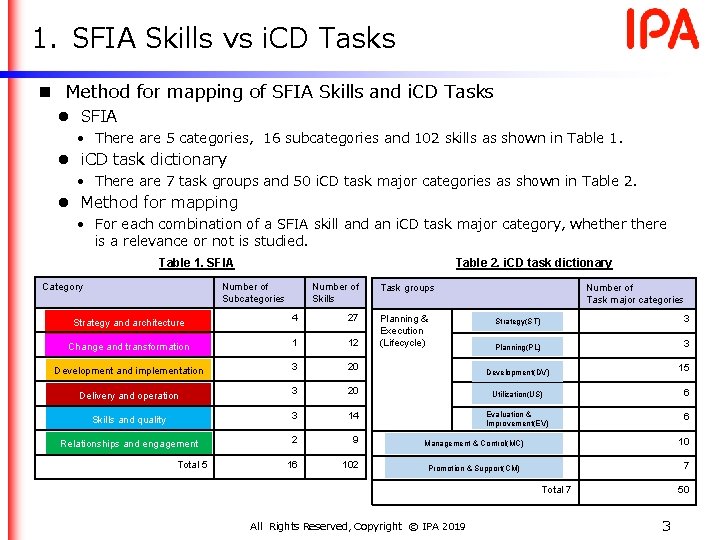
1. SFIA Skills vs i. CD Tasks n Method for mapping of SFIA Skills and i. CD Tasks l SFIA • There are 5 categories, 16 subcategories and 102 skills as shown in Table 1. l i. CD task dictionary • There are 7 task groups and 50 i. CD task major categories as shown in Table 2. l Method for mapping • For each combination of a SFIA skill and an i. CD task major category, whethere is a relevance or not is studied. Table 1. SFIA Category Table 2. i. CD task dictionary Number of Subcategories Number of Skills Task groups Number of Task major categories Strategy and architecture 4 27 Change and transformation 1 12 Development and implementation 3 20 Delivery and operation 3 20 Utilization(US) 6 Skills and quality 3 14 Evaluation & Improvement(EV) 6 Relationships and engagement 2 9 16 102 Total 5 Planning & Execution (Lifecycle) Strategy(ST) 3 Planning(PL) 3 15 Development(DV) 10 Management & Control(MC) 7 Promotion & Support(CM) Total 7 All Rights Reserved, Copyright © IPA 2019 50 3
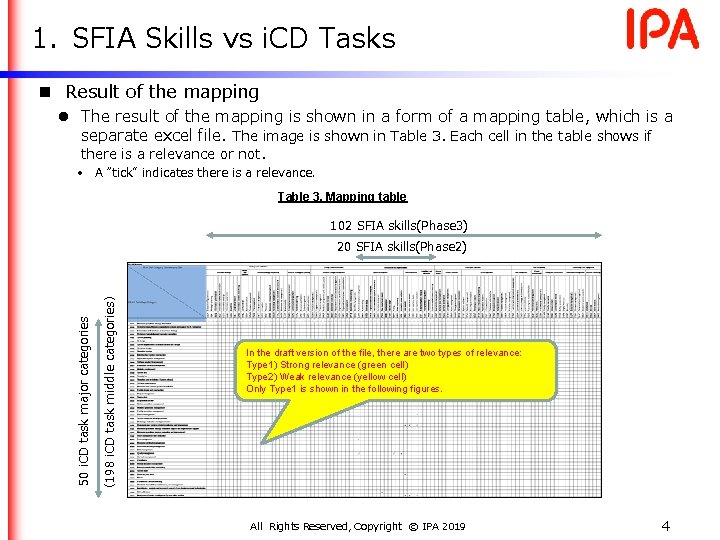
1. SFIA Skills vs i. CD Tasks n Result of the mapping l The result of the mapping is shown in a form of a mapping table, which is a separate excel file. The image is shown in Table 3. Each cell in the table shows if there is a relevance or not. • A “tick” indicates there is a relevance. Table 3. Mapping table 102 SFIA skills(Phase 3) (198 i. CD task middle categories) 50 i. CD task major categories 20 SFIA skills(Phase 2) In the draft version of the file, there are two types of relevance: Type 1) Strong relevance (green cell) Type 2) Weak relevance (yellow cell) Only Type 1 is shown in the following figures. All Rights Reserved, Copyright © IPA 2019 4
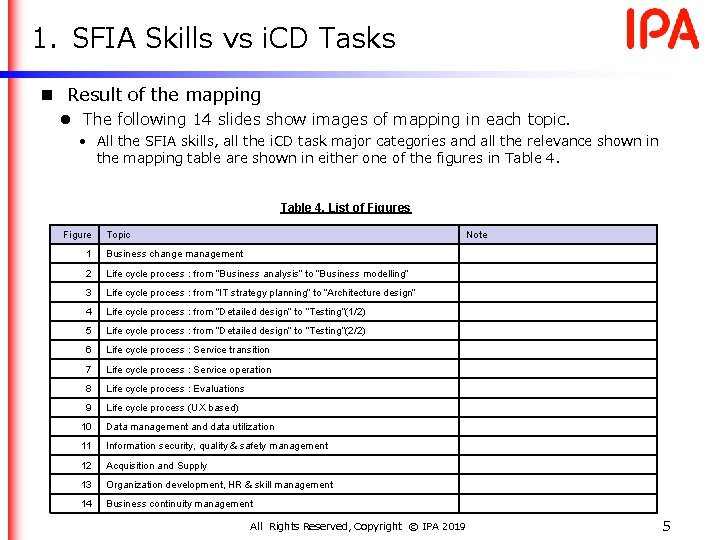
1. SFIA Skills vs i. CD Tasks n Result of the mapping l The following 14 slides show images of mapping in each topic. • All the SFIA skills, all the i. CD task major categories and all the relevance shown in the mapping table are shown in either one of the figures in Table 4. List of Figures Figure Topic Note 1 Business change management 2 Life cycle process : from “Business analysis” to “Business modelling” 3 Life cycle process : from “IT strategy planning” to “Architecture design” 4 Life cycle process : from “Detailed design” to “Testing”(1/2) 5 Life cycle process : from “Detailed design” to “Testing”(2/2) 6 Life cycle process : Service transition 7 Life cycle process : Service operation 8 Life cycle process : Evaluations 9 Life cycle process (UX based) 10 Data management and data utilization 11 Information security, quality & safety management 12 Acquisition and Supply 13 Organization development, HR & skill management 14 Business continuity management All Rights Reserved, Copyright © IPA 2019 5
1. SFIA Skills vs i. CD Tasks Business change management Figure 1 Business analysis Business modelling IT strategy planning Figure 2 Requirements Architecture definition design Figure 3 Detailed design Systems integration Testing Figure 4 Service transition Service operation Figure 6 Figure 7 Evaluations Figure 8 Figure 5 Figure 9 Life cycle process (UX based) Figure 10 Data management and data utilization Figure 11 Information security, quality & safety management Figure 12 Acquisition and Supply Figure 13 Organization development and HR management Figure 14 Business continuity management List of Figures All Rights Reserved, Copyright © IPA 2019 6
1. SFIA Skills vs i. CD Tasks Category SFIA Subcategory Change and transformation Business change management POMG) Portfolio management PGMG) Programme management PRMG) Project management PROF) Portfolio, programme and project support Skill Strategy and architecture Information strategy CIPM) Change implementation planning and management BPTS) Business process testing CNSL) Consultancy TECH) Specialist advice BENM) Benefits management Dotted line shows there is a weak relevance. Solid line shows there is a relevance. Task group i. CD Task major category Development DV 15) Project management This is a copy of a skill in Figure 4. The name is the same as SFIA skill PRMG, but DV 15 is about management of systems development. Figure 1. Business change management All Rights Reserved, Copyright © IPA 2019 7
1. SFIA Skills vs i. CD Tasks SFIA Change and transformation Business change management BUAN) Business analysis BSMO) Business modelling Strategy and architecture Business strategy and planning DEMM) Demand management INOV) Innovation RSCH) Research STPL) Enterprise and business architecture BPRE) Business process improvement ITMG) IT management Technical strategy and planning EMRG) Emerging technology monitoring Business(+technology) analysis Business analysis and modelling i. CD Strategy ST 01) Business operations strategy formulation ST 02) Understanding of business operations strategy and support for its formulation Promotion & Support CM 02) Reuse CM 05) Investigation, analysis, and technical support of new businesses and technologies CM 04) Standards formulation, maintenance, and management Figure 2. Life cycle process : from “Business analysis” to “Business modelling” All Rights Reserved, Copyright © IPA 2019 8
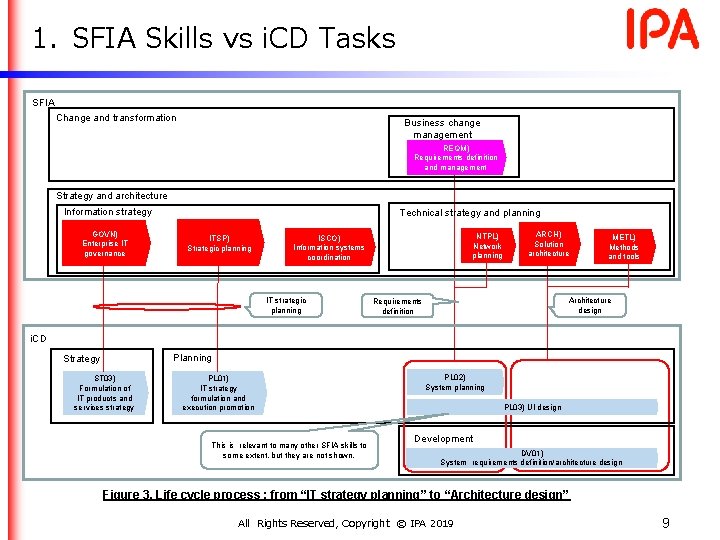
1. SFIA Skills vs i. CD Tasks SFIA Change and transformation Business change management REQM) Requirements definition and management Strategy and architecture Information strategy GOVN) Enterprise IT governance Technical strategy and planning ITSP) Strategic planning NTPL) Network planning ISCO) Information systems coordination IT strategic planning ARCH) Solution architecture METL) Methods and tools Architecture design Requirements definition i. CD Planning Strategy ST 03) Formulation of IT products and services strategy PL 01) IT strategy formulation and execution promotion This is relevant to many other SFIA skills to some extent, but they are not shown. PL 02) System planning PL 03) UI design Development DV 01) System requirements definition/architecture design Figure 3. Life cycle process : from “IT strategy planning” to “Architecture design” All Rights Reserved, Copyright © IPA 2019 9
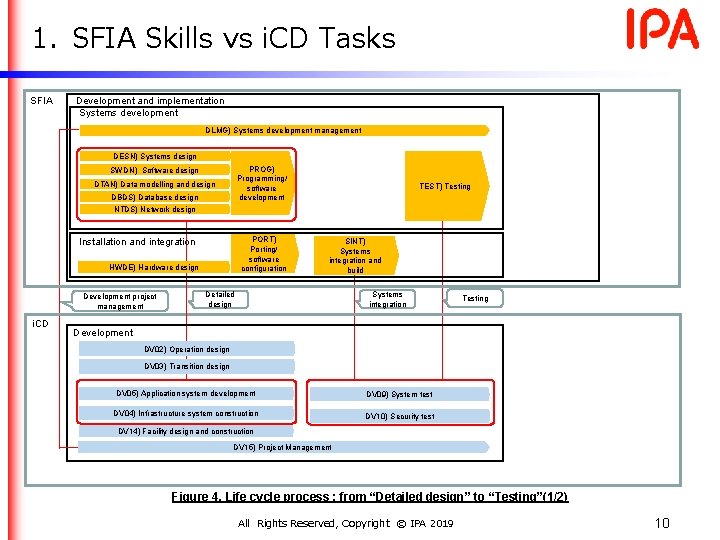
1. SFIA Skills vs i. CD Tasks SFIA Development and implementation Systems development DLMG) Systems development management DESN) Systems design PROG) Programming/ software development SWDN) Software design DTAN) Data modelling and design DBDS) Database design TEST) Testing NTDS) Network design PORT) Porting/ software configuration Installation and integration HWDE) Hardware design Development project management i. CD SINT) Systems integration and build Systems integration Detailed design Testing Development DV 02) Operation design DV 03) Transition design DV 05) Application system development DV 09) System test DV 04) Infrastructure system construction DV 10) Security test DV 14) Facility design and construction DV 15) Project Management Figure 4. Life cycle process : from “Detailed design” to “Testing”(1/2) All Rights Reserved, Copyright © IPA 2019 10
1. SFIA Skills vs i. CD Tasks SFIA Development and implementation Systems development INCA) Information content authoring ADEV) Animation development This is a copy of skills in Figure 4. DESN) Systems design SWDN) Software design DTAN) Data modelling and design DBDS) Database design PROG) Programming/ software development NTDS) Network design RESD) Real-time/embedded systems development Website / Software product / Embedded systems development (design, integration, testing) i. CD Development DV 08) Website development DV 06) Software product development DV 07) Embedded software development Figure 5. Life cycle process : from “Detailed design” to “Testing”(2/2) All Rights Reserved, Copyright © IPA 2019 11
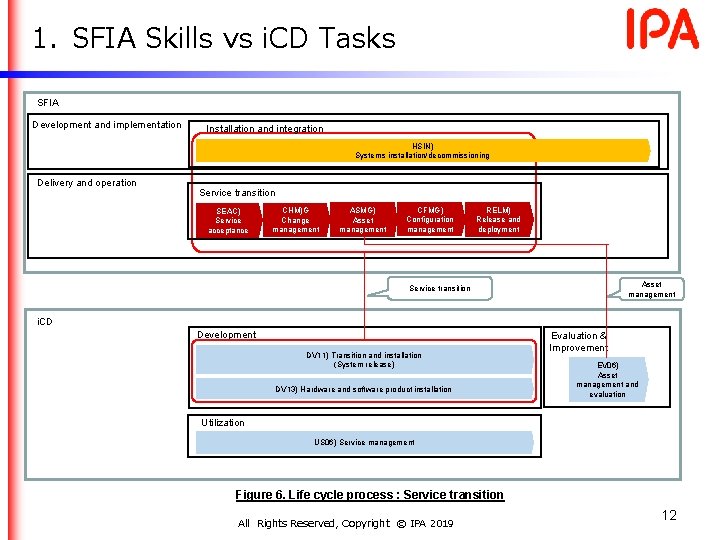
1. SFIA Skills vs i. CD Tasks SFIA Development and implementation Installation and integration HSIN) Systems installation/decommissioning Delivery and operation Service transition SEAC) Service acceptance CHM)G Change management ASMG) Asset management CFMG) Configuration management RELM) Release and deployment Asset management Service transition i. CD Development DV 11) Transition and installation (System release) DV 13) Hardware and software product installation Evaluation & Improvement EV 06) Asset management and evaluation Utilization US 06) Service management Figure 6. Life cycle process : Service transition All Rights Reserved, Copyright © IPA 2019 12
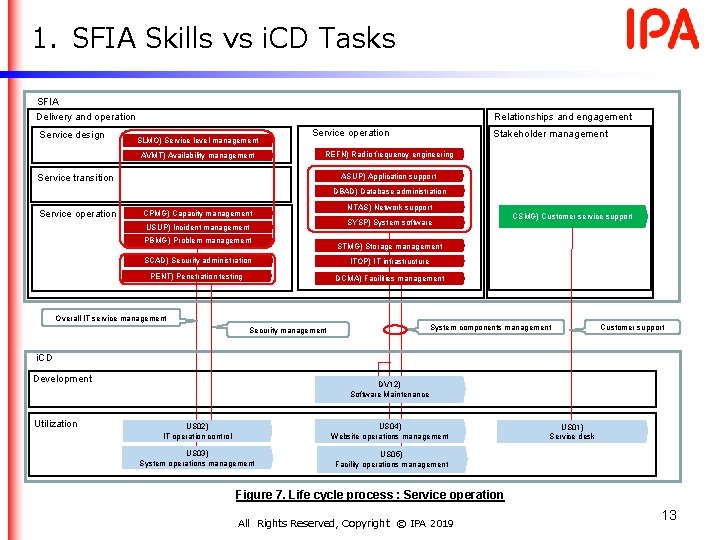
1. SFIA Skills vs i. CD Tasks SFIA Delivery and operation Service design Relationships and engagement SLMO) Service level management AVMT) Availability management Service operation Stakeholder management REFN) Radio frequency engineering Service transition ASUP) Application support DBAD) Database administration Service operation CPMG) Capacity management USUP) Incident management PBMG) Problem management NTAS) Network support SYSP) System software CSMG) Customer service support STMG) Storage management SCAD) Security administration ITOP) IT infrastructure PENT) Penetration testing DCMA) Facilities management Overall IT service management System components management Security management Customer support i. CD Development Utilization DV 12) Software Maintenance US 02) IT operation control US 04) Website operations management US 03) System operations management US 05) Facility operations management US 01) Service desk Figure 7. Life cycle process : Service operation All Rights Reserved, Copyright © IPA 2019 13
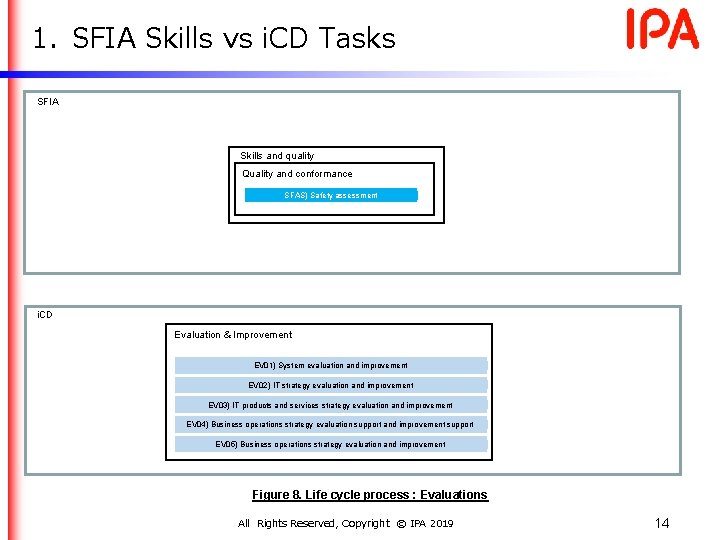
1. SFIA Skills vs i. CD Tasks SFIA Skills and quality Quality and conformance SFAS) Safety assessment i. CD Evaluation & Improvement EV 01) System evaluation and improvement EV 02) IT strategy evaluation and improvement EV 03) IT products and services strategy evaluation and improvement EV 04) Business operations strategy evaluation support and improvement support EV 05) Business operations strategy evaluation and improvement Figure 8. Life cycle process : Evaluations All Rights Reserved, Copyright © IPA 2019 14
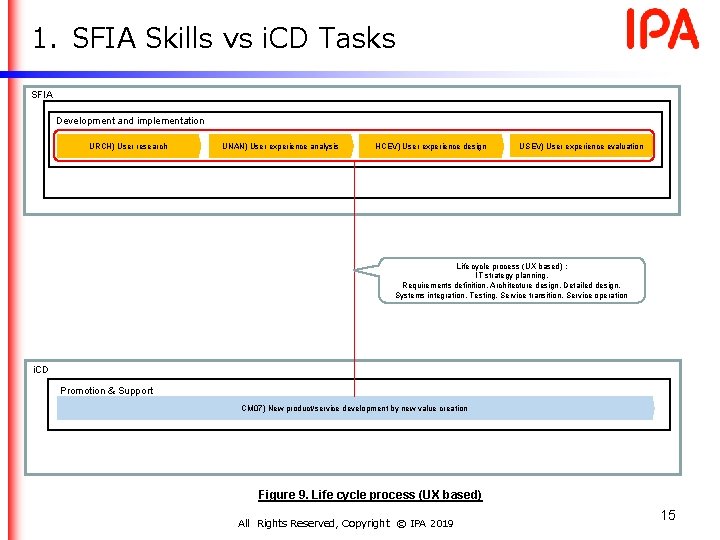
1. SFIA Skills vs i. CD Tasks SFIA Development and implementation URCH) User research UNAN) User experience analysis HCEV) User experience design USEV) User experience evaluation Life cycle process (UX based) : IT strategy planning, Requirements definition, Architecture design, Detailed design, Systems integration, Testing, Service transition, Service operation i. CD Promotion & Support CM 07) New product/service development by new value creation Figure 9. Life cycle process (UX based) All Rights Reserved, Copyright © IPA 2019 15
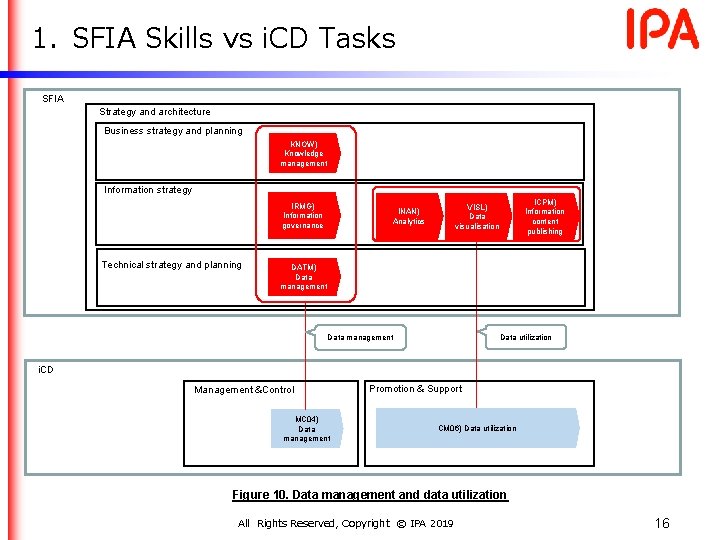
1. SFIA Skills vs i. CD Tasks SFIA Strategy and architecture Business strategy and planning KNOW) Knowledge management Information strategy IRMG) Information governance Technical strategy and planning ICPM) Information content publishing VISL) Data visualisation INAN) Analytics DATM) Data management Data utilization Data management i. CD Management &Control MC 04) Data management Promotion & Support CM 06) Data utilization Figure 10. Data management and data utilization All Rights Reserved, Copyright © IPA 2019 16
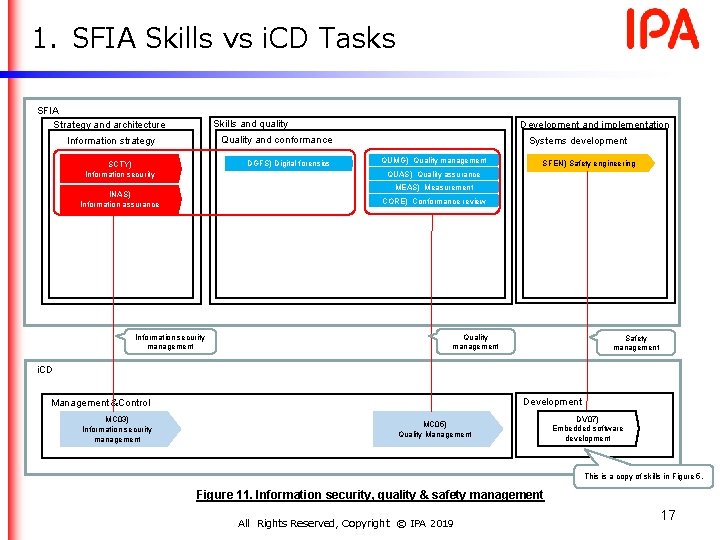
1. SFIA Skills vs i. CD Tasks SFIA Strategy and architecture Skills and quality Information strategy Quality and conformance SCTY) Information security DGFS) Digital forensics Development and implementation Systems development QUMG) Quality management SFEN) Safety engineering QUAS) Quality assurance MEAS) Measurement INAS) Information assurance CORE) Conformance review Information security management Quality management Safety management i. CD Development Management &Control MC 03) Information security management MC 05) Quality Management DV 07) Embedded software development This is a copy of skills in Figure 5. Figure 11. Information security, quality & safety management All Rights Reserved, Copyright © IPA 2019 17
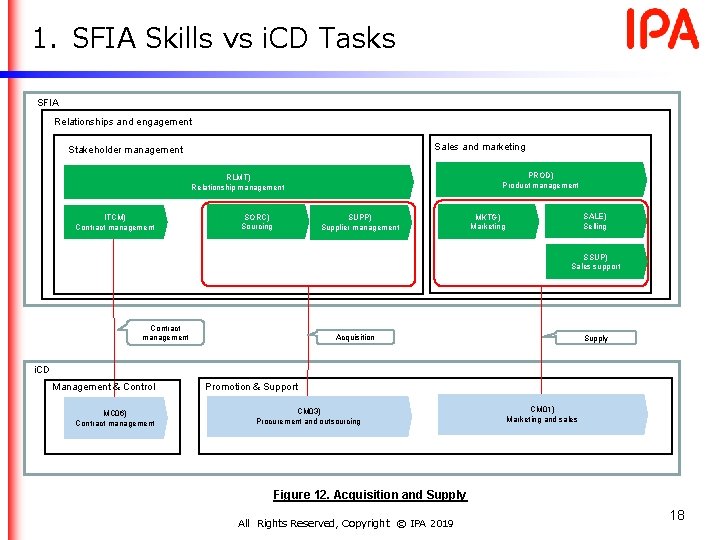
1. SFIA Skills vs i. CD Tasks SFIA Relationships and engagement Sales and marketing Stakeholder management PROD) Product management RLMT) Relationship management ITCM) Contract management SORC) Sourcing SUPP) Supplier management SALE) Selling MKTG) Marketing SSUP) Sales support Contract management Acquisition Supply i. CD Management & Control MC 06) Contract management Promotion & Support CM 03) Procurement and outsourcing CM 01) Marketing and sales Figure 12. Acquisition and Supply All Rights Reserved, Copyright © IPA 2019 18
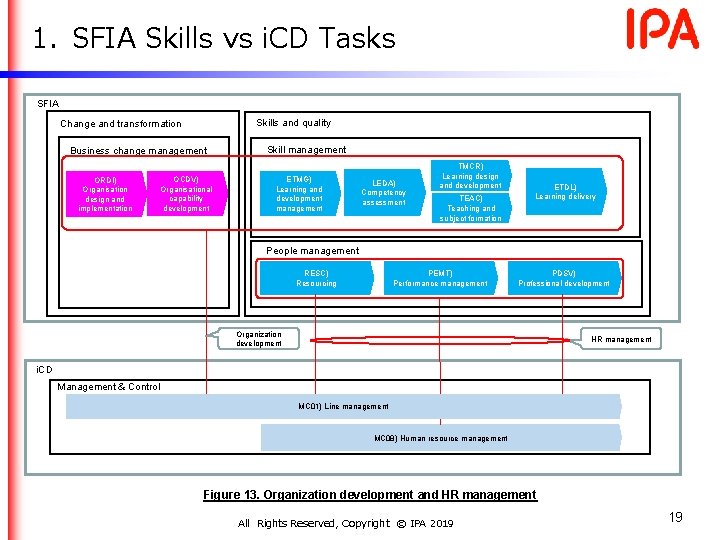
1. SFIA Skills vs i. CD Tasks SFIA Skills and quality Change and transformation Business change management ORDI) Organisation design and implementation OCDV) Organisational capability development Skill management ETMG) Learning and development management LEDA) Competency assessment TMCR) Learning design and development TEAC) Teaching and subject formation ETDL) Learning delivery People management RESC) Resourcing PEMT) Performance management PDSV) Professional development Organization development HR management i. CD Management & Control MC 01) Line management MC 08) Human resource management Figure 13. Organization development and HR management All Rights Reserved, Copyright © IPA 2019 19
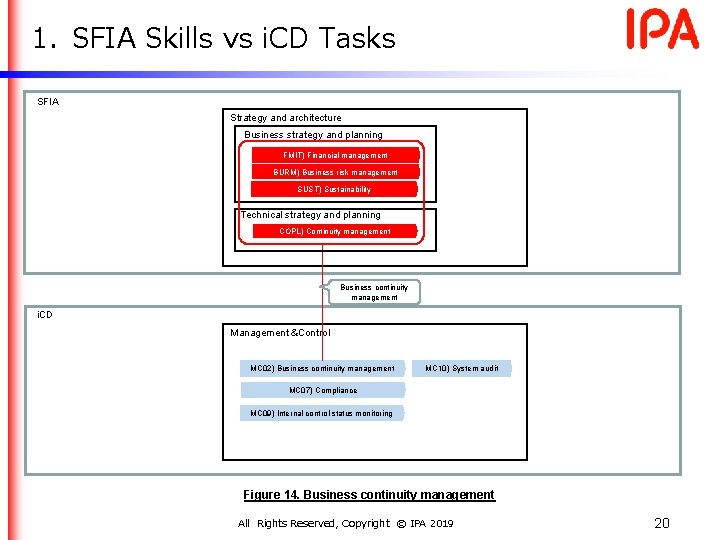
1. SFIA Skills vs i. CD Tasks SFIA Strategy and architecture Business strategy and planning FMIT) Financial management BURM) Business risk management SUST) Sustainability Technical strategy and planning COPL) Continuity management Business continuity management i. CD Management &Control MC 02) Business continuity management MC 10) System audit MC 07) Compliance MC 09) Internal control status monitoring Figure 14. Business continuity management All Rights Reserved, Copyright © IPA 2019 20
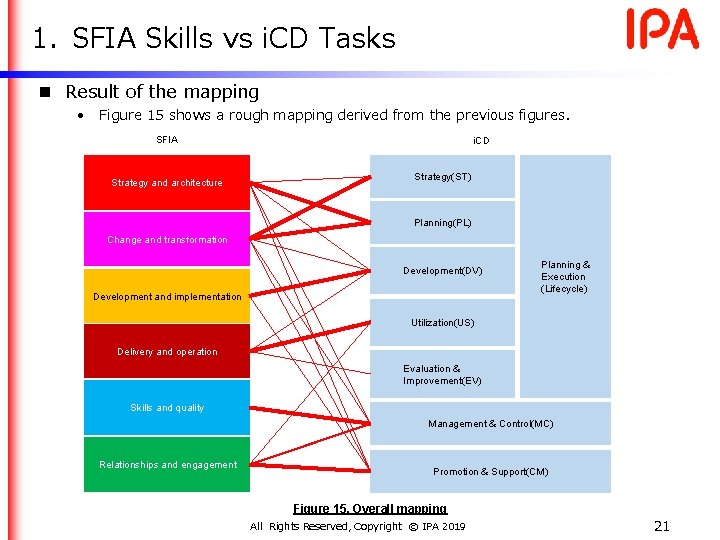
1. SFIA Skills vs i. CD Tasks n Result of the mapping • Figure 15 shows a rough mapping derived from the previous figures. SFIA Strategy and architecture i. CD Strategy(ST) Planning(PL) Change and transformation Development(DV) Development and implementation Planning & Execution (Lifecycle) Utilization(US) Delivery and operation Evaluation & Improvement(EV) Skills and quality Management & Control(MC) Relationships and engagement Promotion & Support(CM) Figure 15. Overall mapping All Rights Reserved, Copyright © IPA 2019 21
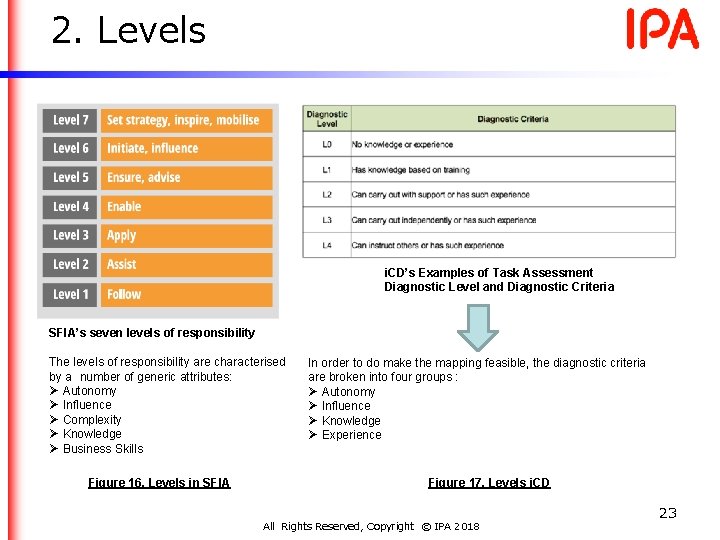
2. Levels n Method for mapping of SFIA Skill Levels and i. CD Task Levels l SFIA • The levels are described for each skill. This is done through a mix of the Generic Responsibilities, the Skills Description and the Level Description for the skill. Refer to Figure 16. l i. CD task dictionary • The levels are not described for each task and only an example of very brief description, or task evaluation diagnostic criteria common to all the tasks are given. Refer to Figure 17. l Method for mapping • Therefore, it is reasonable to compare the key points of “Generic Responsibilities” of SFIA and the “diagnostic criteria of i. CD task dictionary”. 22
2. Levels i. CD’s Examples of Task Assessment Diagnostic Level and Diagnostic Criteria SFIA’s seven levels of responsibility The levels of responsibility are characterised by a number of generic attributes: Ø Autonomy Ø Influence Ø Complexity Ø Knowledge Ø Business Skills Figure 16. Levels in SFIA In order to do make the mapping feasible, the diagnostic criteria are broken into four groups : Ø Autonomy Ø Influence Ø Knowledge Ø Experience Figure 17. Levels i. CD All Rights Reserved, Copyright © IPA 2018 23
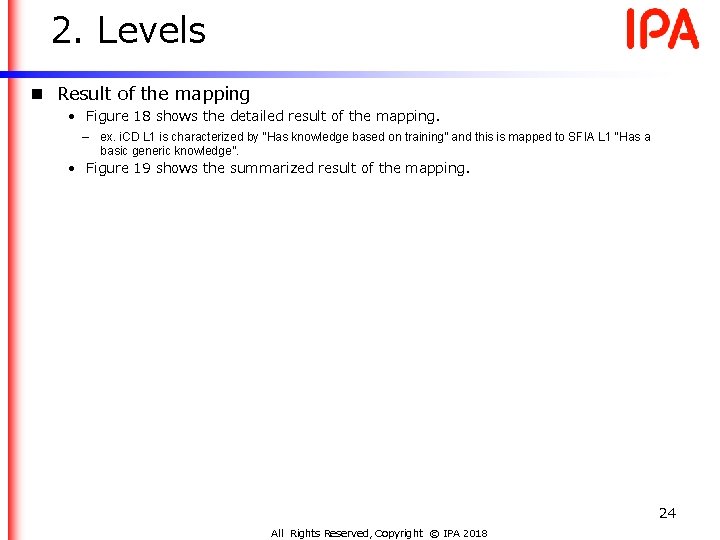
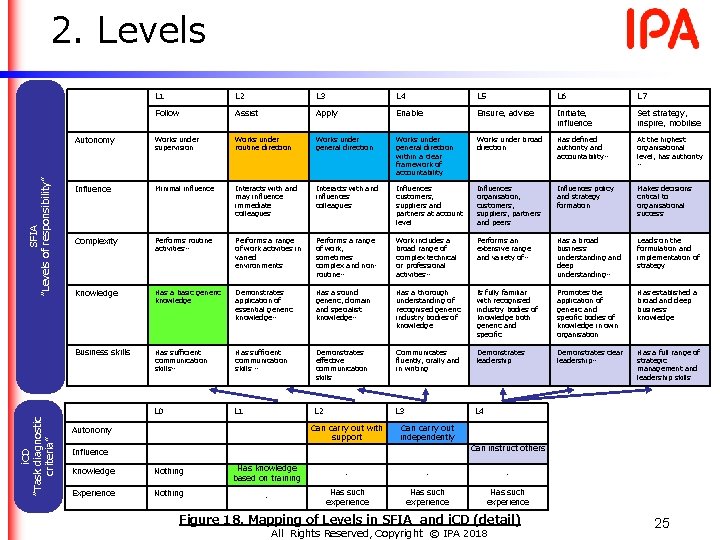
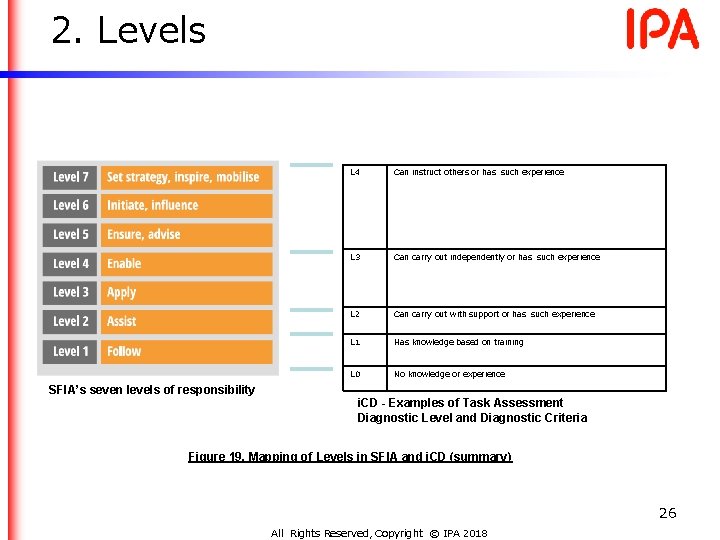
2. Levels n Result of the mapping • Figure 18 shows the detailed result of the mapping. – ex. i. CD L 1 is characterized by “Has knowledge based on training” and this is mapped to SFIA L 1 “Has a basic generic knowledge”. • Figure 19 shows the summarized result of the mapping. 24 All Rights Reserved, Copyright © IPA 2018
i. CD “Task diagnostic criteria” SFIA “Levels of responsibility” 2. Levels L 1 L 2 L 3 L 4 L 5 L 6 L 7 Follow Assist Apply Enable Ensure, advise Initiate, influence Set strategy, inspire, mobilise Autonomy Works under supervision. Works under routine direction. Works under general direction within a clear framework of accountability. Works under broad direction. Has defined authority and accountability… At the highest organisational level, has authority … Influence Minimal influence. Interacts with and may influence immediate colleagues. Interacts with and influences colleagues. Influences customers, suppliers and partners at account level. Influences organisation, customers, suppliers, partners and peers Influences policy and strategy formation. Makes decisions critical to organisational success. Complexity Performs routine activities… Performs a range of work activities in varied environments. Performs a range of work, sometimes complex and nonroutine… Work includes a broad range of complex technical or professional activities… Performs an extensive range and variety of… Has a broad business understanding and deep understanding… Leads on the formulation and implementation of strategy. Knowledge Has a basic generic knowledge. Demonstrates application of essential generic knowledge… Has a sound generic, domain and specialist knowledge… Has a thorough understanding of recognised generic industry bodies of knowledge Is fully familiar with recognised industry bodies of knowledge both generic and specific. Promotes the application of generic and specific bodies of knowledge in own organisation. Has established a broad and deep business knowledge Business skills Has sufficient communication skills… Has sufficient communication skills … Demonstrates effective communication skills. Communicates fluently, orally and in writing Demonstrates leadership. Demonstrates clear leadership…. Has a full range of strategic management and leadership skills. L 0 L 1 L 2 L 3 L 4 Can carry out with support Can carry out independently Has knowledge based on training - - Has such experience Autonomy Influence Knowledge Nothing Experience Nothing Can instruct others Figure 18. Mapping of Levels in SFIA and i. CD (detail) All Rights Reserved, Copyright © IPA 2018 25
2. Levels SFIA’s seven levels of responsibility L 4 Can instruct others or has such experience L 3 Can carry out independently or has such experience L 2 Can carry out with support or has such experience L 1 Has knowledge based on training L 0 No knowledge or experience i. CD - Examples of Task Assessment Diagnostic Level and Diagnostic Criteria Figure 19. Mapping of Levels in SFIA and i. CD (summary) 26 All Rights Reserved, Copyright © IPA 2018
END 27