
SEYMOUR PAPERT CONSTRUCTIONISM ETEC 562 Group C Jennifer
- Slides: 14
SEYMOUR PAPERT CONSTRUCTIONISM ETEC 562: Group C Jennifer Lamb, Brian Cde. Baca, Melissa Wilson, Rhonda Riskey
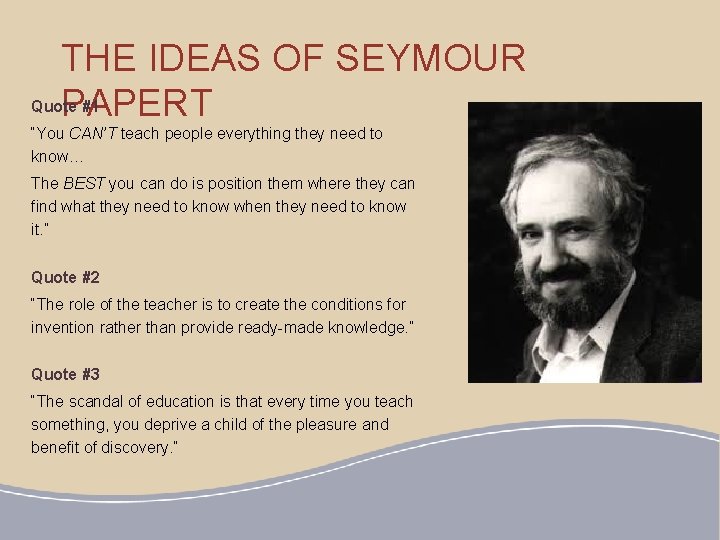
THE IDEAS OF SEYMOUR Quote #1 PAPERT “You CAN’T teach people everything they need to know… The BEST you can do is position them where they can find what they need to know when they need to know it. ” Quote #2 “The role of the teacher is to create the conditions for invention rather than provide ready-made knowledge. ” Quote #3 “The scandal of education is that every time you teach something, you deprive a child of the pleasure and benefit of discovery. ”
KEY ELEMENTS OF Project-based Learning (PBL) - learner-centered activities providing an CONSTRUCTIONIS active learning process in which students collaborate, communicate, make decisions, and evaluate peers in the creation of a process or product (Staff, M 2001). Assessment - authentic evaluation of student’s abilities over time such as a portfolio displaying a student’s projects and artifacts over time (Staff, 2001). Lifelong learning - teachers and students alike must continually learn throughout their lives. Teachers are facilitating the learning process through engaging activities for students. The teacher is guiding and directing students as students construct their own knowledge. (the guide on the side and not the sage on the stage). If this is true then we will be lifelong learners continually building our knowledge (Staff, 2001).
KEY ELEMENTS OF CONSTRUCTIONISM Learning by making - students demonstrate learning and knowledge through the construction of authentic tangible artifacts (Papert & Harel, 1991). Engagement - learning is achieved through collaboration, interaction, and reflection. This is an active process in which learning is constructed by doing and participating (Donaldson, 2014). Learner-centered - exploration of the learning environment to provide build upon prior knowledge. The learning is based around the student’s framework through exploring the learning environment and the real-world (Papert & Harel, 1991).
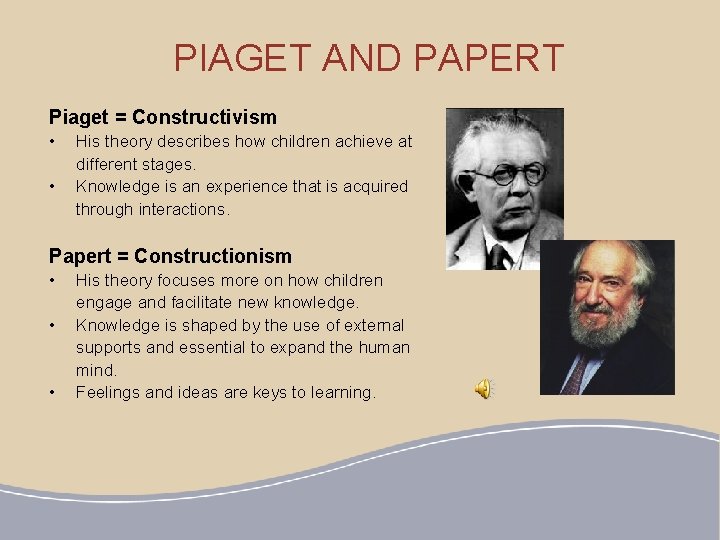
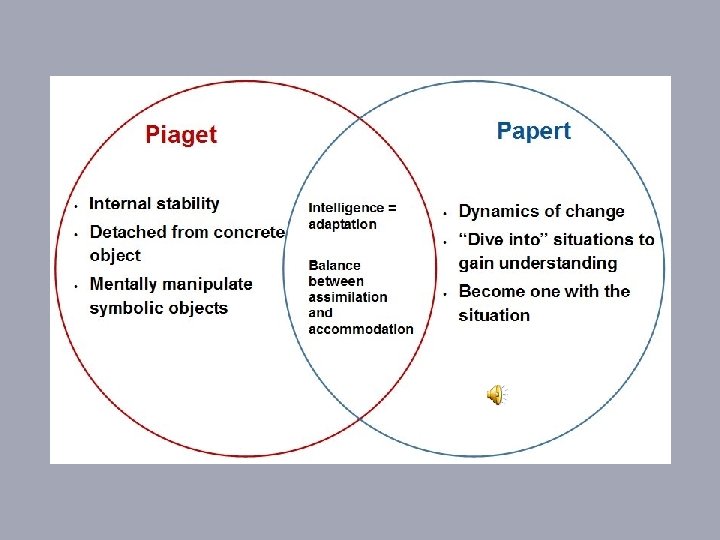
PIAGET AND PAPERT Piaget = Constructivism • • His theory describes how children achieve at different stages. Knowledge is an experience that is acquired through interactions. Papert = Constructionism • • • His theory focuses more on how children engage and facilitate new knowledge. Knowledge is shaped by the use of external supports and essential to expand the human mind. Feelings and ideas are keys to learning.
PAPERT AND 21 ST CENTURY LEARNING
THE DANGERS OF PLAYGROUND EQUIPMENT After receiving a letter and watching a news clip about the dangers of playground equipment on hot summer days, students will work collaboratively to research, design, and conduct experiments, draw conclusions and present their recommendations to the Parks and Recreation Commission. This real world scenario will help students master the scientific concepts of absorption and reflection of light with regards to temperature and will sharpen scientific inquiry skills. It also encompasses the use of technology as it seamlessly integrates several aspects such as kinesthetic learning. Click here to view video.
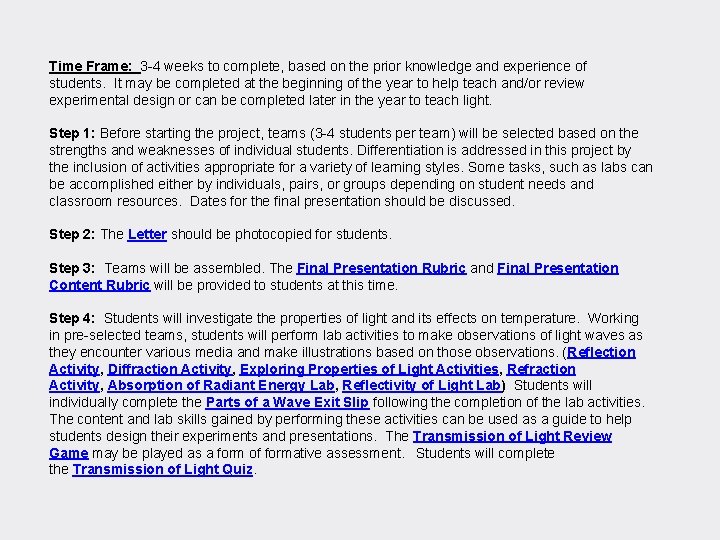
Time Frame: 3 -4 weeks to complete, based on the prior knowledge and experience of students. It may be completed at the beginning of the year to help teach and/or review experimental design or can be completed later in the year to teach light. Step 1: Before starting the project, teams (3 -4 students per team) will be selected based on the strengths and weaknesses of individual students. Differentiation is addressed in this project by the inclusion of activities appropriate for a variety of learning styles. Some tasks, such as labs can be accomplished either by individuals, pairs, or groups depending on student needs and classroom resources. Dates for the final presentation should be discussed. Step 2: The Letter should be photocopied for students. Step 3: Teams will be assembled. The Final Presentation Rubric and Final Presentation Content Rubric will be provided to students at this time. Step 4: Students will investigate the properties of light and its effects on temperature. Working in pre-selected teams, students will perform lab activities to make observations of light waves as they encounter various media and make illustrations based on those observations. (Reflection Activity, Diffraction Activity, Exploring Properties of Light Activities, Refraction Activity, Absorption of Radiant Energy Lab, Reflectivity of Light Lab) Students will individually complete the Parts of a Wave Exit Slip following the completion of the lab activities. The content and lab skills gained by performing these activities can be used as a guide to help students design their experiments and presentations. The Transmission of Light Review Game may be played as a form of formative assessment. Students will complete the Transmission of Light Quiz.
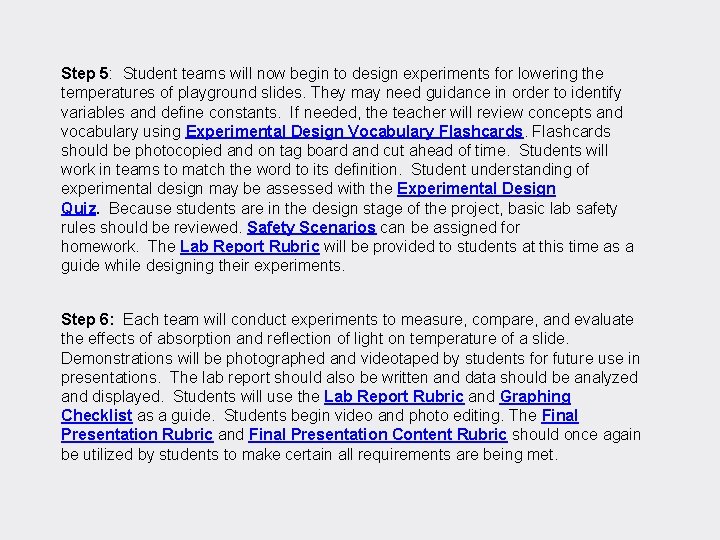
Step 5: Student teams will now begin to design experiments for lowering the temperatures of playground slides. They may need guidance in order to identify variables and define constants. If needed, the teacher will review concepts and vocabulary using Experimental Design Vocabulary Flashcards should be photocopied and on tag board and cut ahead of time. Students will work in teams to match the word to its definition. Student understanding of experimental design may be assessed with the Experimental Design Quiz. Because students are in the design stage of the project, basic lab safety rules should be reviewed. Safety Scenarios can be assigned for homework. The Lab Report Rubric will be provided to students at this time as a guide while designing their experiments. Step 6: Each team will conduct experiments to measure, compare, and evaluate the effects of absorption and reflection of light on temperature of a slide. Demonstrations will be photographed and videotaped by students for future use in presentations. The lab report should also be written and data should be analyzed and displayed. Students will use the Lab Report Rubric and Graphing Checklist as a guide. Students begin video and photo editing. The Final Presentation Rubric and Final Presentation Content Rubric should once again be utilized by students to make certain all requirements are being met.
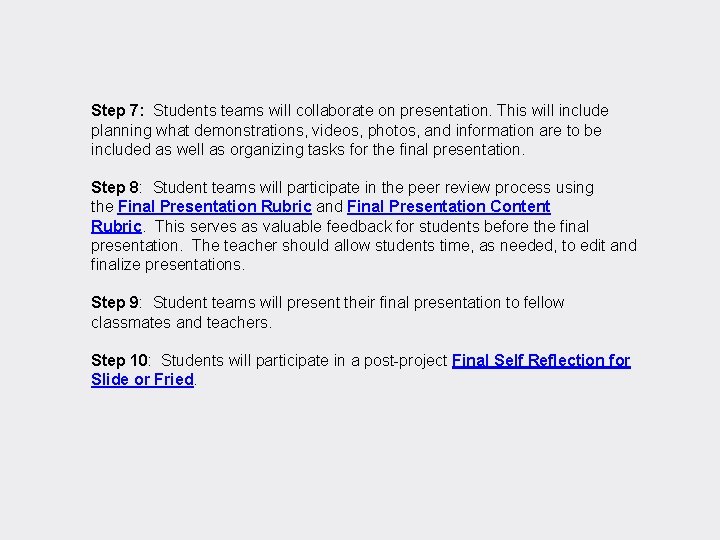
Step 7: Students teams will collaborate on presentation. This will include planning what demonstrations, videos, photos, and information are to be included as well as organizing tasks for the final presentation. Step 8: Student teams will participate in the peer review process using the Final Presentation Rubric and Final Presentation Content Rubric. This serves as valuable feedback for students before the final presentation. The teacher should allow students time, as needed, to edit and finalize presentations. Step 9: Student teams will present their final presentation to fellow classmates and teachers. Step 10: Students will participate in a post-project Final Self Reflection for Slide or Fried.
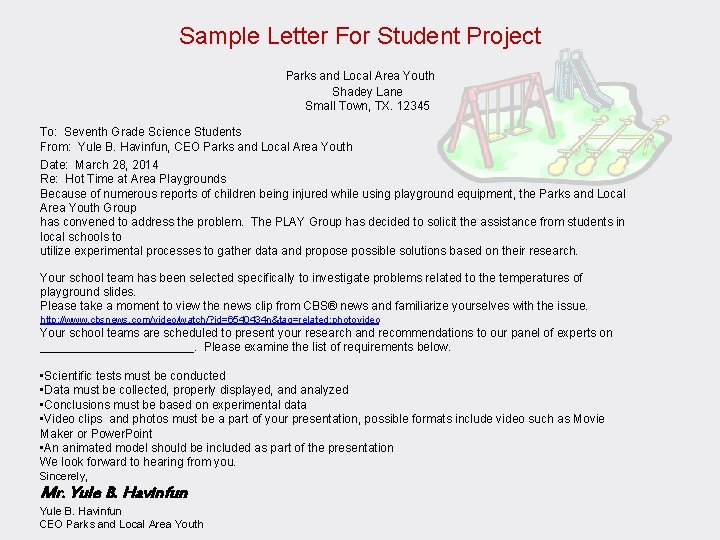
Sample Letter For Student Project Parks and Local Area Youth Shadey Lane Small Town, TX. 12345 To: Seventh Grade Science Students From: Yule B. Havinfun, CEO Parks and Local Area Youth Date: March 28, 2014 Re: Hot Time at Area Playgrounds Because of numerous reports of children being injured while using playground equipment, the Parks and Local Area Youth Group has convened to address the problem. The PLAY Group has decided to solicit the assistance from students in local schools to utilize experimental processes to gather data and propose possible solutions based on their research. Your school team has been selected specifically to investigate problems related to the temperatures of playground slides. Please take a moment to view the news clip from CBS® news and familiarize yourselves with the issue. http: //www. cbsnews. com/video/watch/? id=6540434 n&tag=related; photovideo Your school teams are scheduled to present your research and recommendations to our panel of experts on ____________. Please examine the list of requirements below. • Scientific tests must be conducted • Data must be collected, properly displayed, and analyzed • Conclusions must be based on experimental data • Video clips and photos must be a part of your presentation, possible formats include video such as Movie Maker or Power. Point • An animated model should be included as part of the presentation We look forward to hearing from you. Sincerely, Mr. Yule B. Havinfun CEO Parks and Local Area Youth
PLAYGROUND LESSON PLAN RESOURCES Technology: Desktop Computer or Laptop computer with Microsoft programs such as Word and Power. Point TI-84 Graphing Calculator with Easy Data software Temperature Probe Light Sensor Probe and Easy Link connector Video recorder with sound and editing software (such as Flip. Video®) Digital Camera with editing software Websites: Reflection Activity http: //www. fifeschools. com/cjh/staff/laker/documents/reflectionlab. pdf Diffraction Activity http: //www. exploratorium. edu/snacks/diffraction/index. html Exploring Light Activities http: //www 1. curriculum. edu. au/sciencepd/light/refr_exploring. htm Entry Event News Segment http: //www. cbsnews. com/video/watch/? id=6540434 n&tag=related; photovideo Community: Member of Parks and Recreation Committee to serve on presentation panel (if possible) Materials: Tag Board to photocopy Experimental Design Vocabulary Flashcards Projector for presentations and Transmission of Light Review Game Computers with internet access, word processing programs, media presentation programs, and spreadsheet and graphing capabilities Printers (and ink) for the computers Video cameras with editing software to include videos in presentations Digital Cameras with editing software to include pictures in presentations TEKS: 112. 19 A. 1 -4 E. b. 1 A. B. 2 A-E. 126. 15
SOURCES Ackermann, Edith. Piaget’s Constructivism, Papert’s Constructionism: What’s the difference? . March 27, 2014. Donaldson, J. (2014, January 23). The rebirth of constructionism. Retrieved from http: //www. hybridpedagogy. com/journal/constructionism-reborn Papert, S. & Harel, I. (1991). Situating constructionism. Retrieved from http: //www. papert. org/articles/Situating. Constructionism. html Staff, E. (2001, November 01). Seymour Papert: Project-based learning. Retrieved from http: //www. edutopia. org/seymour-papert-project-based-learning Stager, G. (2014). The Daily Papert. Retrieved from http: //dailypapert. com/ Stager, G. (2014). Seymour Papert: Inventor of everything. Retrieved from https: //www. youtube. com/watch? v=6 -d. FTmd. X 1 k. U&list=FLs-K 2 CO 0 Lc. Nqw. Fo. BPB 8 Mzag&index=2 Interaction Design and Children (IDC). (2013). Tribute Panel on Seymour Papert. Retrieved from http: //idc 2013. org/seymour-papert-panel/