
Sexually Transmitted Infections Syphilis What is it n
- Slides: 66
Sexually Transmitted Infections
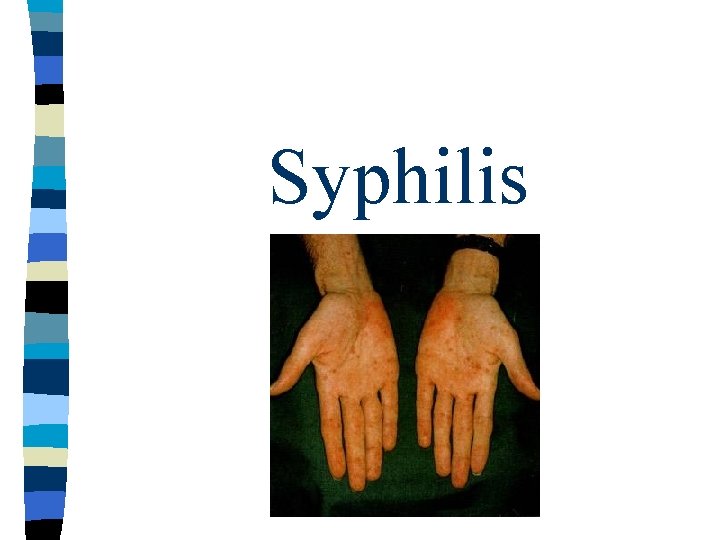
Syphilis
What is it? n Cause by the ______ Treponema pallidum n Can be very serious, even deadly. If untreated. n It is the _____prevalent of the STI’s at this time with 70, 000 cases annually in the US.
How do you get it? n Contracted during – Vaginal intercourse – Anal intercourse – Oral intercourse
Incubation period n 10 days to 3 months n Average incubation period is 21 days
Symptoms
First stage n Appear 1 -12 weeks after sex n. A painless, reddish-brown sore on the mouth or genitals appear – Lasting _______ n Sore goes away but ______ is still present
Second stage n Starts to appear 2 -10 weeks after sore appear and lasts 2 -6 weeks n. A _____anywhere on the body n ________ n Rash symptoms ad flu-like symptoms disappear, but syphilis is still present
Latent stage n No symptoms, but 25% of those infected may have relapse of second stage symptoms n May last 10 -20 years
Late stage n May occur 1 -2 years after _____ of infection or 30 -40 years later n Ulcers or gummas (soft rubbery tumors) form on internal organs n _______damage can result in insanity or death in 20% of the people that get to this stage
Diagnosis n If sore is present, they obtain a sample of the ____ from the sore for examination. n There is also a ______ test. – + test can occur 7 days after sore appears. – However the disease can incubate from 10 -90 days n Diagnosis can also be made by examining the ______.
Treatment or cure? n Can be cured! n Antibiotics – Injection – orally
What if you don’t get treated? n You can give it to your partner(s). n. A mother with syphilis can give it to her baby during pregnancy. n Heart disease, brain damage, blindness and death may result.
HPV Human Papillomavirus
Some facts… n The most common sexually transmitted infection (STI). n There are more than 100 strains, but 40 HPV types can infect the genital areas of men and women n You cannot see HPV. Most people who become infected with HPV do not even know they have it.
n Genital HPV is passed on through genital contact, most often during ______and _____ sex. n. A person can have HPV even if years have passed since he or she had sex. n Most ______ persons do not realize they are infected or that they are passing the virus to a sex partner.
n HPV can cause normal cells on infected skin or ________ to turn abnormal. n Most of the time, you cannot see or feel these cell changes. n In some cases, the body ______off HPV naturally and the infected cells then go back to normal. n Sometimes, low-risk types of HPV can cause visible changes that take the form of genital warts.
n HPV infection. – Approximately 20 million Americans are currently ____ with HPV, and another 6. 2 million people become newly infected each year. At least 50% of sexually active men and women acquire genital HPV infection at some point in their lives. n Genital warts. – About 1% of sexually active adults in the U. S. have genital warts at any one time. n Cervical cancer. – The American Cancer Society estimates that in 2008, 11, 070 women will be diagnosed with cervical cancer in the U. S.
n Other HPV-related cancers are much less common than cervical cancer. The American Cancer Society estimates that in 2008, there will be: – 3, 460 women diagnosed with vulvar cancer; – 2, 210 women diagnosed with vaginal and other female genital cancers; – 1, 250 men diagnosed with penile and other male genital cancers; and – 3, 050 women and 2, 020 men diagnosed with anal cancer.
GARDASIL n GARDASIL is the only _________ vaccine that helps protect against 4 types of human papillomavirus (HPV): – 2 types that cause 70% of cervical cancer cases – 2 more types that cause 90% of genital warts cases. – GARDASIL is for girls and young women ages 9 to 26. n GARDASIL may not fully protect everyone, and does not prevent all types of cervical cancer, so it’s important to continue routine cervical cancer screenings. n GARDASIL does not treat _______ or genital warts. n GARDASIL will not ______ against diseases caused by other HPV types or against diseases not caused by HPV. n GARDASIL is given as 3 injections over 6 months. http: //www. gardasil. com/hpvtypes/hpv-transmission/
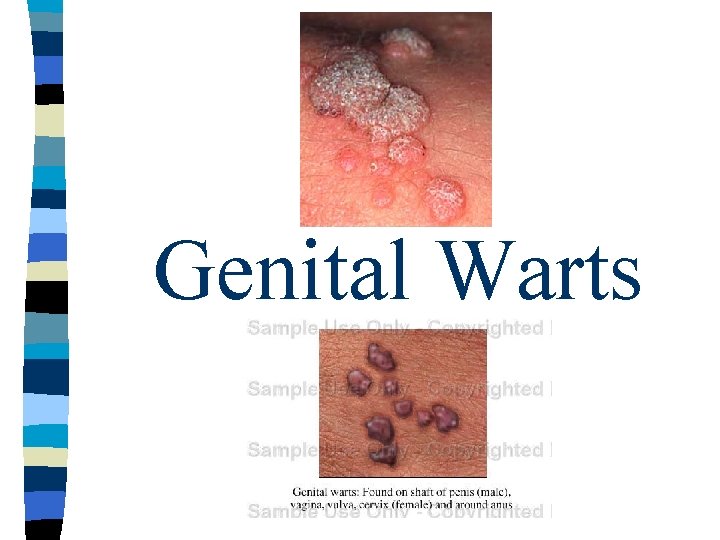
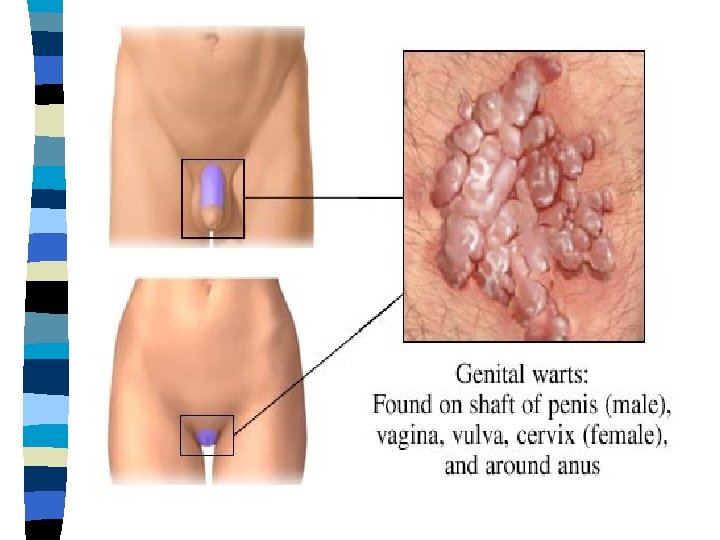
Genital Warts
Illustration copyright 2002 Nucleus Communications, Inc. All rights reserved. http: //www. nucleusinc. com
What is it? n Cause by the human papilloma virus (HPV) (Types 6 and 11 cause most visible genital warts) n It is the fastest growing STI with over 5. 5 million new cases each year. n Estimates show 20 million Americans have genital warts.
How do you get it? n Spread n Or by _______ to ______ contact during – Oral Intercourse – Anal Intercourse – Vaginal Intercourse
Incubation period n Symptoms usually show up _____ months after having sex n It may take even longer with some people
Symptoms n Small ______ (warts) sometimes occurring in clusters like cauliflower n Warts may go away by themselves, but usually takes several months n Are the color of your skin and painless n May feel _____ while growing n Some HPV infections are asymptomatic and the person can still give it to their partner.
Diagnosis n Usually _______ visually. n Can also be diagnosed with a PAP smear. n There is no _______ to diagnosis asymptomatic infections. * PAP smears are recommended all sexually active women.
Treatment n Involves ______ of skin cells that contain virus particles. n Most common treatment is a mild acid applied to the warts. n Removal sometimes takes several treatments over a few months
Treatment n More serious warts can be treated by freezing, laser, or surgery. n The can recur after they have been removed.
What if you don’t get treated? n You can give _____ warts to your sexual partner(s). n A mother with warts can ______ it to her baby during childbirth. n More warts grow and are _______ to get rid of. n HPV is associated with cervical cancer in women.
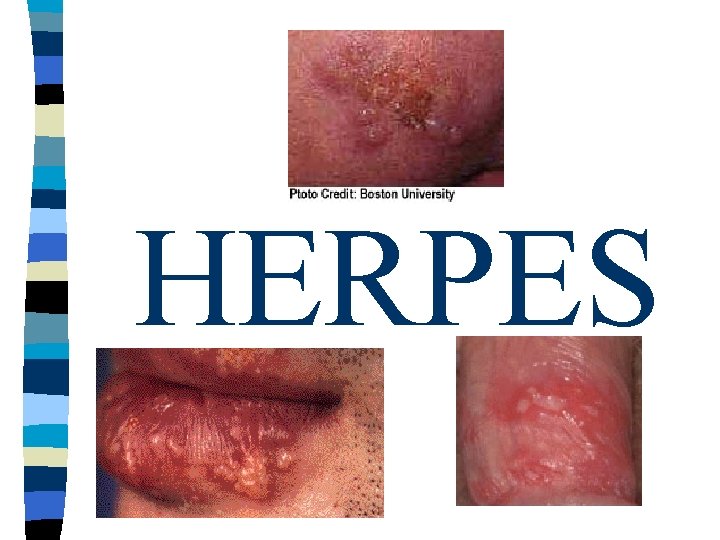
HERPES
What is it? n Herpes Simplex is a ______ estimated to affect 45 million people in the US. n There about 1 million new cases of herpes diagnosed each year.
How do you get it? n Spread by skin to skin contact n During – Anal – Vaginal – Oral n Oral ____ can be spread to the genital regions during oral sex
Incubation Period n Symptoms having sex show up 2 -30 days after n Many HSV infections are without symptoms. n Some patients may be _____ for weeks or months before suffering the first episode of herpes lesions
Symptoms- mild to severe n Flu-like groin feelings; swollen lymph nodes in n Itching or _____ before the blisters appear n Small, painful blisters on the sex organs and mouth
n Blisters last and average of 10 days n Blisters go away, but herpes is still present n Blisters may appear again
Diagnosis n Clinician swabs some of the fluid and cells from the lesion. n Culture is then sent to the lab.
Treatment n There is NO cure. n Anti-viral pills and ointments will lessen the severity and duration of the first outbreak. n May also lesson the severity and duration of outbreaks or prevent outbreaks.
What if you don’t get treated? n You n. A can give it to your partner(s). mother can give it to her _______during childbirth and therefore must have a cesarean section if she has an active lesion at the time of labor.
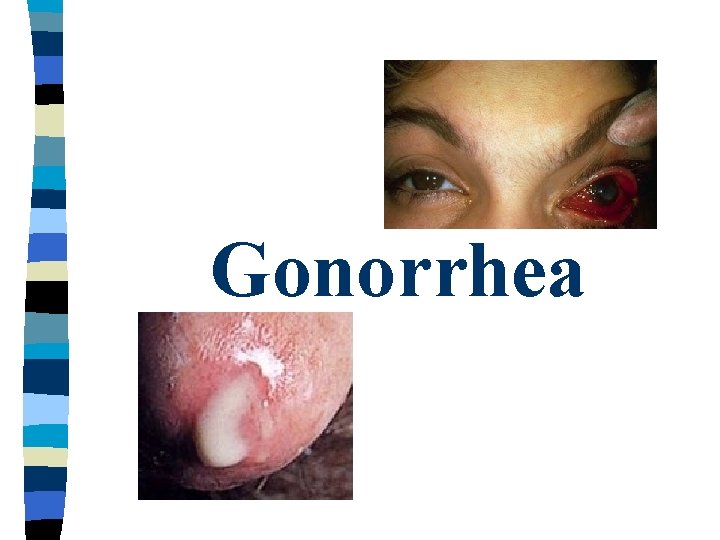
Gonorrhea
What is it? n Caused by the ______ Neiseria gonorrhoeae n It is considered the oldest STI (first reported in 1879) n About year. 650, 000 new cases occur each
How do you get it? n Vaginal intercourse n Anal intercourse n Oral intercourse
Symptoms n. Most men and women have NO symptoms!
WOMEN n Unusually vagina n Burning or ______ during urination n Bleeding n Cramps n heavy discharge from the _______periods and pain in lower abdomen Sore _____ that doesn’t go away
MEN n Thick yellow or white drip from the penis n Burning n Sore or pain during urination throat that doesn’t go away
Diagnosis n. A clinician uses a ____ to remove cells from the cervix in women n Swab of the ______ in men. n Cultures are sent to the lab.
Treatment n. Antibiotics • Injection • Orally by:
What if you don’t get treated? n You can give gonorrhea to your sexual partner(s) n A more serious _____ can occur, possibly damage to the reproductive organs. n Both men and women may no longer be able to have children. n A mother can give it to her child during childbirth, causing blindness.
Chlamydia
What is it? n Caused by the ______ Chlamydia trachomatis. n Estimated that 2 -4 million cases occur annually in the US and it t is most prevalent among young men and women who have multiple partners. n Leading cause of preventable infertility and ectopic pregnancy.
How do you get it? n. Spread during sexual intercourse with someone who has Chlamydia.
Incubation Period n If symptoms occur, then they usually show up 1 -2 weeks after having sexual intercourse.
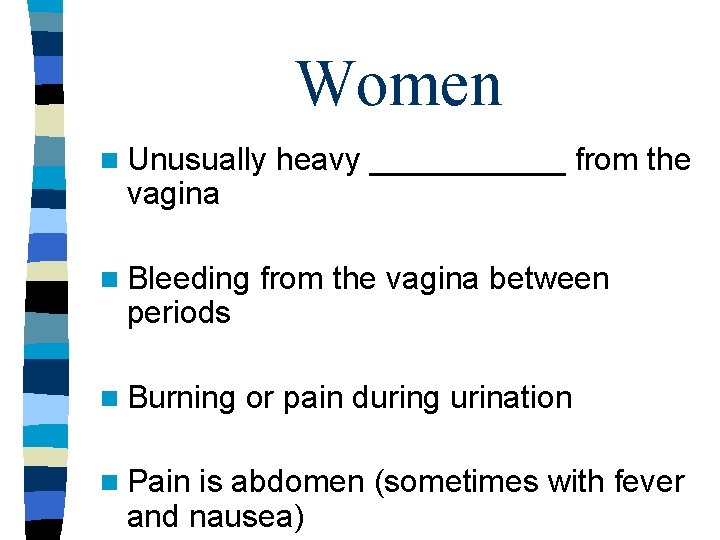
Women n Unusually vagina n Bleeding periods n Burning n Pain heavy ______ from the vagina between or pain during urination is abdomen (sometimes with fever and nausea)
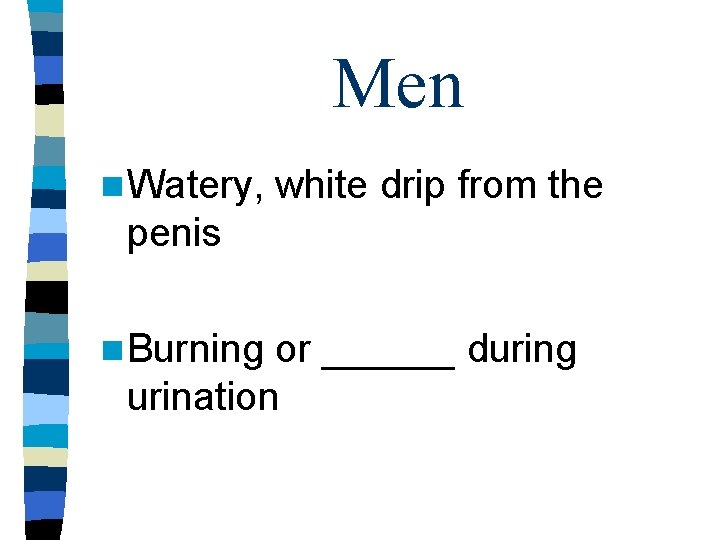
Men n Watery, white drip from the penis n Burning or ______ during urination
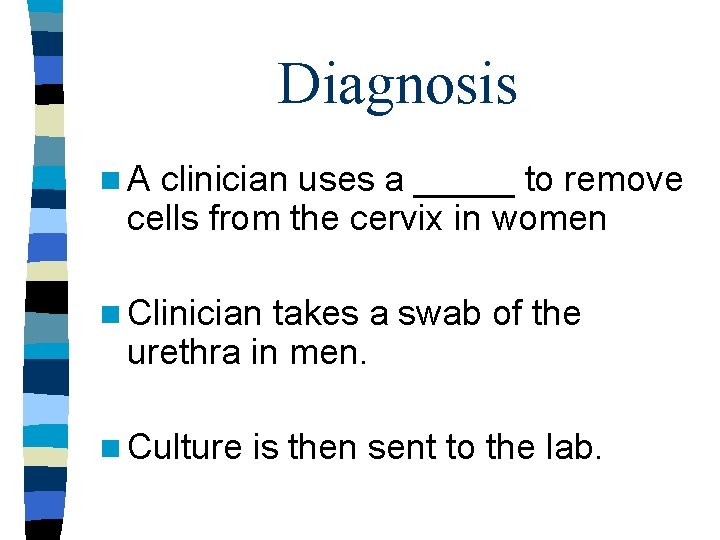
Diagnosis n. A clinician uses a _____ to remove cells from the cervix in women n Clinician takes a swab of the urethra in men. n Culture is then sent to the lab.
Treatment n. Antibiotics taken orally.
What if you don’t get treated? n You can give it to your partner(s). n A more serious ______ can occur, possibly damage to reproductive organs. n Both men & women may ___longer be able to bear children. n A mother can give it to her _______ during birth, causing blindness.
Symptoms n. Most women and some men have NO symptoms.
Hepatitis B
What is it? n Hepatitis B is an infection of the liver caused by a _____. n Most infected people get well, but sometimes hepatitis can lead to _____ cancer and cause death. n Estimated 77, 000 cases of sexually transmitted hepatitis B occur in the US each year.
How do you get it? n The hepatitis B is a virus that lives in body fluids, for example: » ______ » Semen » Vaginal Fluid » ______ n Hepatitis B _____ easily from person to person through these body fluids.
You can get it by… n Having vaginal, anal, or oral ______ with someone who has the virus. n Sharing needles-ear-piercing, tattoo, and ______ drug needles can all spread the virus. n Being born to a mother who has the virus in her body.
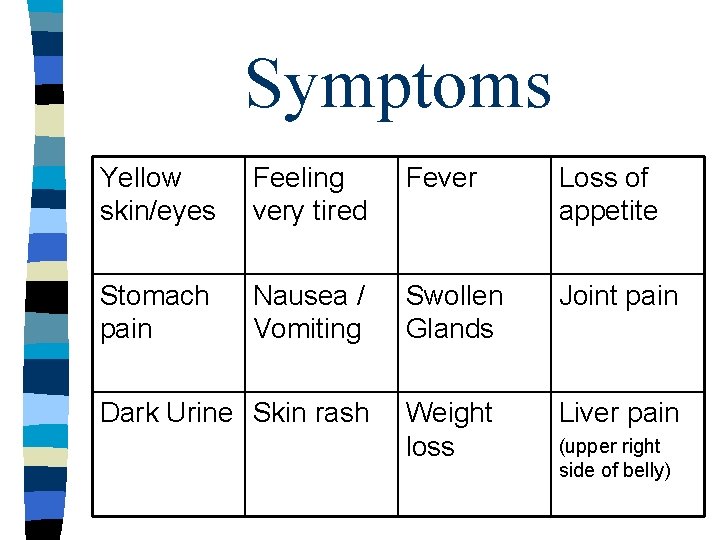
Symptoms Yellow skin/eyes Feeling very tired Fever Loss of appetite Stomach pain Nausea / Vomiting Swollen Glands Joint pain Weight loss Liver pain Dark Urine Skin rash (upper right side of belly)
Diagnosis n. A simple _____ test can tell if you have hepatitis B now or in the past. n Some n Get people have ____ symptoms. tested if you think you have been exposed to the virus.
Treatment n There is no cure for hepatitis B. n There is a ______ that will protect you from getting it. n The vaccination is given in three shots over a 6 -month period. n If you are ______to hepatitis B and have not been vaccinated you can get a special shot tight away to help you.
What if you don’t get treated? n Some people who get hepatitis B may get well on their own. n Others may get _____ but still have the virus in their bodies. n So even though they feel fine, they can _____the virus on to others. n Sometimes the virus can _____the liver and lead to liver cancer or death.