
SEXUALLY TRANSMITTED INFECTIONS PATTI BALLER CNM MSN NEONP
SEXUALLY TRANSMITTED INFECTIONS PATTI BALLER, CNM, MSN NEONP, April 27, 2018
OBJECTIVES 1. Be able to identify risk factors, signs and symptoms for chlamydia, gonorrhea, herpes simplex virus, human papilloma virus, trichomonas, and syphilis. 2. Discuss diagnostic tests for these STI’s. 3. Become familiar with current CDC treatment guidelines. 4. Discuss follow up and prevention of STI’s. 2
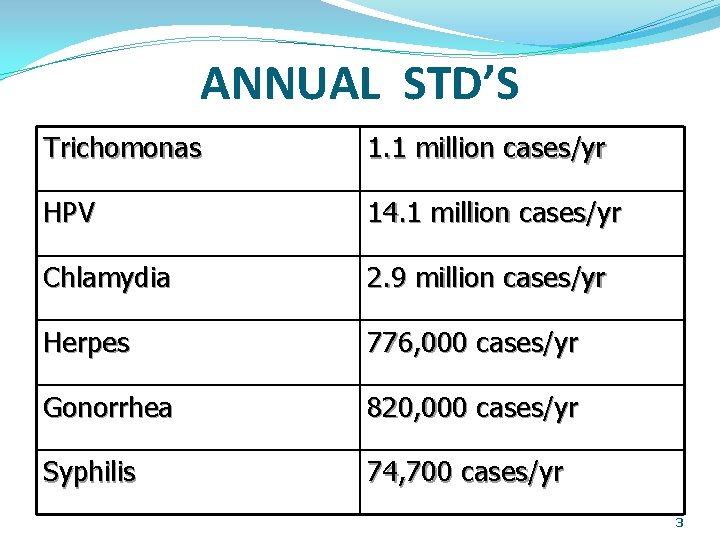
ANNUAL STD’S Trichomonas 1. 1 million cases/yr HPV 14. 1 million cases/yr Chlamydia 2. 9 million cases/yr Herpes 776, 000 cases/yr Gonorrhea 820, 000 cases/yr Syphilis 74, 700 cases/yr 3
CHLAMYDIA �Incidence � 2016, 1, 598, 354 cases- CDC � 497. 3 cases/100, 000, increase of 4. 7% since 2015. � 657. 3 cases/100, 000 females � 330. 5 cases/100, 000 males � 2. 9 million new cases in US/yr. �Most common bacterial STD in US. 4
RISK FACTORS �Adolescence and young adults (15 -24) �Early onset of sexual activity �History of STD infection �Presence of another STD or partner with STD. �Use of OCP’s �Inconsistent or no barrier contraception �Recent history of new sex partner �Multiple sex partners �Females (1 in 20 of reproductive age) �AA 5. 6 times the rate of Caucasians �Often coexists with gonorrhea (15 -50%) 5
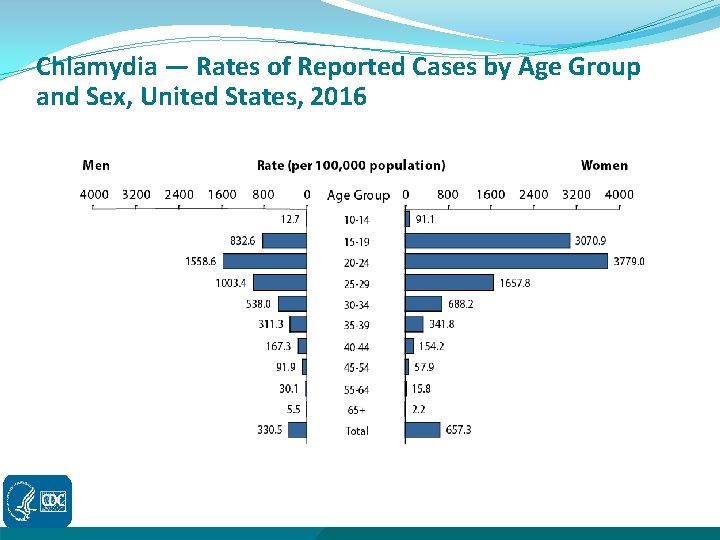
Chlamydia — Rates of Reported Cases by Age Group and Sex, United States, 2016
SIGNS AND SYMPTOMS �Mucopurulent cervicitis or discharge* �Cervix edematous and friable* �Dysuria �Urinary frequency �Discharge clear, white, or amber �Adnexal, uterine or cervical pain � 75% of women and 50% of men report no sxs. �Men: mucopurulent or clear D/C, dysuria. 7
CDC RECOMMENDATIONS FOR SCREENING �Annually: �All sexually active females < 25 years. �Women > 25 if risk factors are present. � Inconsistent or no use of barrier contraceptives. � New or multiple sex partners. � Older women and men with new or multiple partners. �All pregnant women at first prenatal visit. 8
DIAGNOSIS �Nucleic acid amplification tests (NAAT) recommended. �Culture in cases of child sexual abuse or tx failure and approved for all anatomic sites. �Can be done as part of Pap test. �Signs and symptoms. �> 10 WBC’s/HPF on wet mount (not diagnostic) �Urine tests-nucleic acid amplification tests � 1 st void urine � 1 st 10 ml only, otherwise dilutes specimen �Should not have voided within past 2 hrs. 9
TREATMENT �Azithromycin 1 gm. PO in a single dose (can also be used in pregnant women) or �Doxycycline 100 mg. PO bid x 7 days (Do not give to pregnant women) �Alternative is Amoxicillin 500 mg tid x 7 days in pregnancy. �Must tx for gonorrhea also if not tested for. 10
FOLLOW-UP �Pregnant women � Test of cure, by NAAT, 3 weeks after completion of therapy � Repeat testing for reinfection 3 months after completion of therapy �Nonpregnant women and men � Repeat testing 3 months after treatment is recommended to detect re-infection with C. trachomatis � If not possible, then repeat testing should be performed at next presentation for care within 12 months � Test of cure (3 weeks after therapy) is not recommended, but can be considered when compliance is in question, � symptoms persist, � re-infection is suspected, or � erythromycin is used. � 11
PREVENTION COUNSELING �Nature of the infection �Chlamydia is commonly asymptomatic in men and women �In women, there is an increased risk of upper reproductive tract damage with reinfection. �Transmission issues �Effective treatment of chlamydia may reduce HIV transmission and acquisition. �Abstain from sexual intercourse until partners are treated and for 7 days after a single dose of azithromycin or until completion of a 7 -day doxycycline or alternative regimen. �Discuss prevention strategies. 12
GONORRHEA �Incidence � 2016, 468, 514 cases-CDC, 145. 8 cases/100, 000 – rate increased 18. 5% from 2015. � 820, 000 new cases in US/yr. � 74% decline since 1975, reached historic low 2009, then increased every year since 2010. � 121/100, 000 females; 170. 7/100, 000 males. �Reported cases underestimates incidence. �Increasing proportion of gonococcal infections caused by resistant organisms. 13
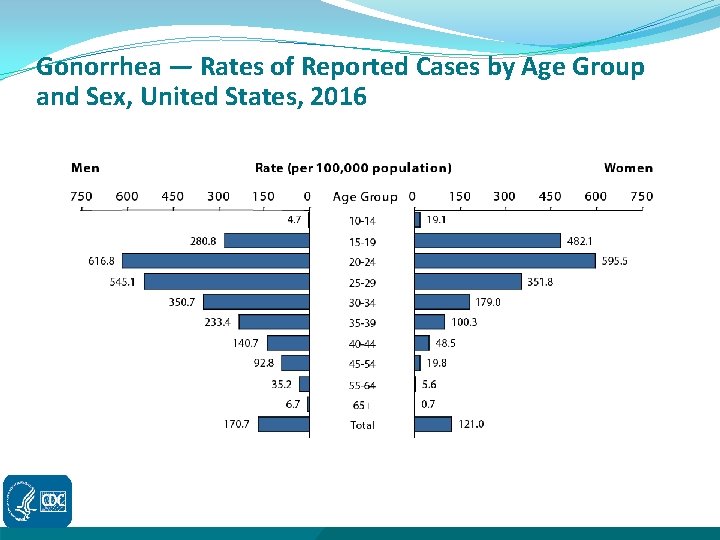
Gonorrhea — Rates of Reported Cases by Age Group and Sex, United States, 2016
RISK FACTORS �Men and women < 25 yo �Past or current history of illicit drug use �Past history of gonorrhea or other STDs �New or multiple partners �Partner with STD �Inconsistent condom use �Exchange of sex for drugs or money �No prenatal care �Gay and bisexual men �Minorities �Those living in high prevalence areas �Recent travel hx with sexual contacts outside of US. �Lower socio-economic status �Often coexists with chlamydia (10 -30%) 15
SIGNS AND SYMPTOMS �Most women asymptomatic �Dyspareunia �Lower abdominal pain or discomfort �Classic yellow-green or purulent D/C �Dysuria and frequency �Tender or inflamed Bartholin glands �Skene’s gland can present with periurethral pain and swelling. � 50% asymptomatic in men, but more noticeable. �Dysuria* �Purulent or mucopurulent penile D/C �Painful and swollen testicles. �Inflammation of epididymis. (Epididymitis) 16
SYNDROMES IN MEN AND WOMEN �Anorectal infection �Usually acquired by anal intercourse �Usually asymptomatic. �Symptoms: anal irritation, painful defecation, constipation, scant rectal bleeding, painless mucopurulent D/C, tenesmus, and anal pruritus. �Pharyngeal infection �May be sole site of infection if oral-genital contact is the only exposure. �Most often asymptomatic, but if symptoms present, may include pharyngitis, tonsillitis, fever, and cervical adenitis. 17
SYNDROMES IN MEN AND WOMEN (CONT) �Conjunctivitis �Usually a result of autoinoculation in adults. �Symptoms: eye irritation with purulent conjunctival exudate. �Disseminated gonococcal infection �Systemic gonococcal infection �Occurs infrequently. Women more than men. �Associated with strain that produces bacteremia without associated urogenital symptoms. �Clinical manifestations: skin lesions, arthralgias, tenosynovitis, arthritis, hepatitis, myocarditis, endocarditis, and meningitis. 18
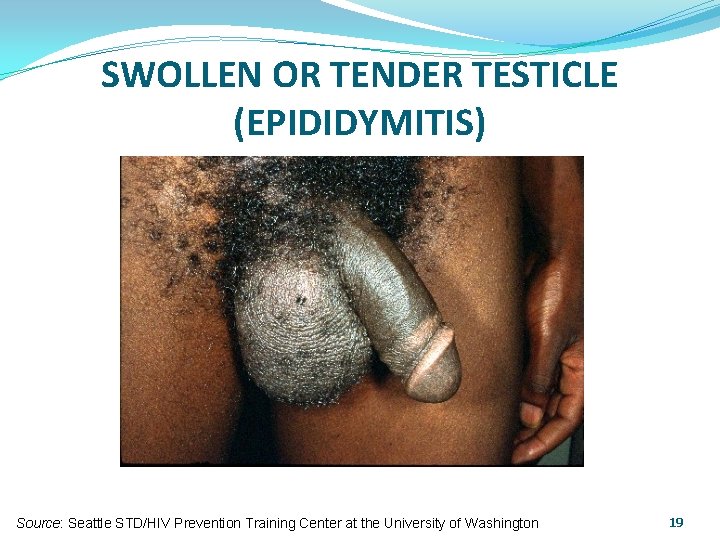
SWOLLEN OR TENDER TESTICLE (EPIDIDYMITIS) Source: Seattle STD/HIV Prevention Training Center at the University of Washington 19
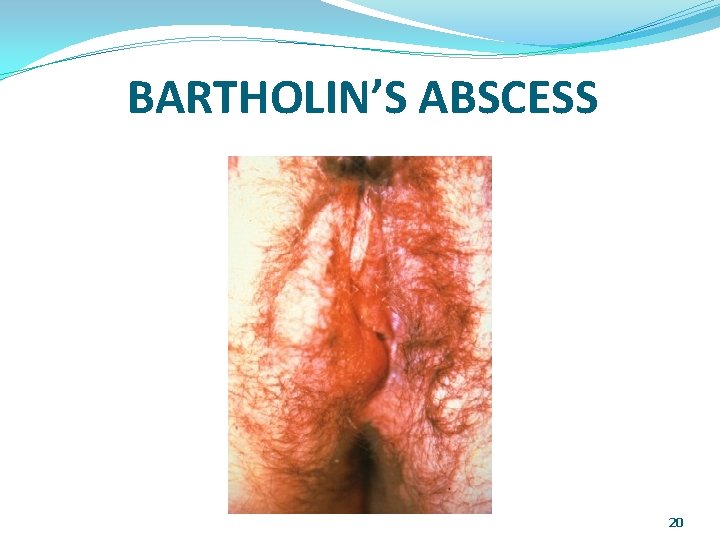
BARTHOLIN’S ABSCESS 20
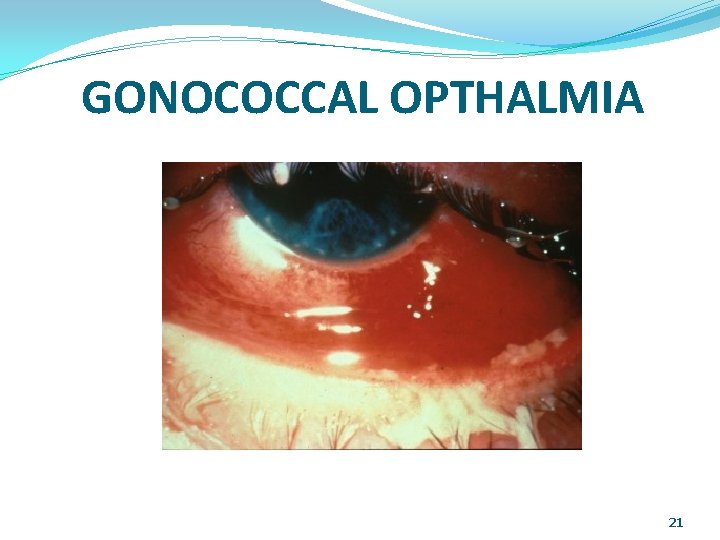
GONOCOCCAL OPTHALMIA 21
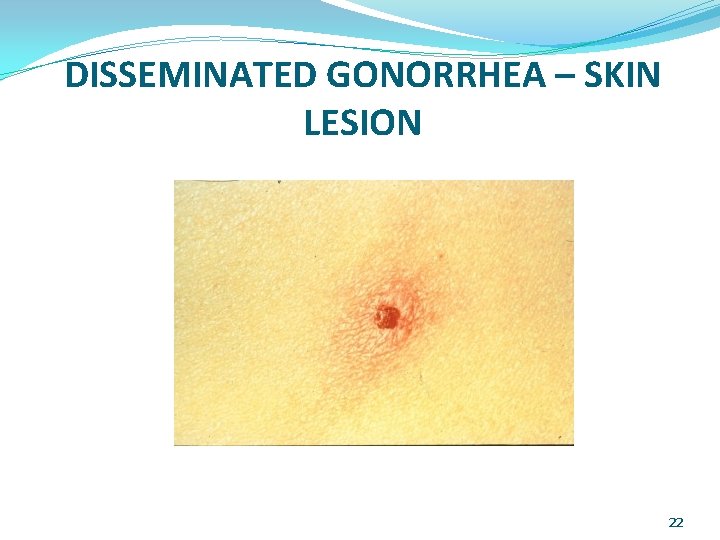
DISSEMINATED GONORRHEA – SKIN LESION 22
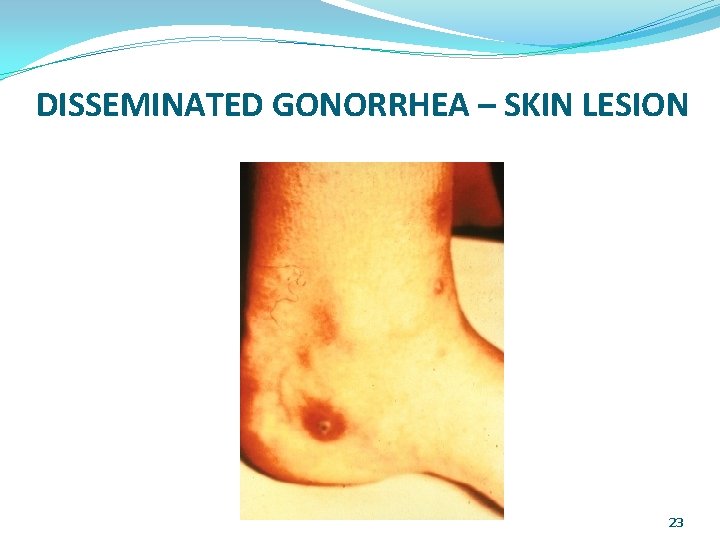
DISSEMINATED GONORRHEA – SKIN LESION 23
SCREENING �Annual screening recommended in sexually active women < 25 �Screen those > 25 at increased risk for infection. �New sex partner �More than one sex partner �A sex partner with concurrent partners �A sex partner who has an STD �CDC recommends MSM be screened annually at all anatomic sites of exposure. 24
DIAGNOSIS �Nucleic acid amplification tests (NAAT) recommended. �Culture requires endocervical (women) or urethral (men) swab specimens. �Culture in cases of child sexual abuse or tx failure. �Swab of all exposed sites. �Often tested along with chlamydia in same medium. �Can be done as part of Pap test. 25
TREATMENT �*Ceftriaxone 250 mg. IM in single dose plus Azithromycin 1 g PO x 1 dose is the only CDC recommended tx. �Same tx in pregnant women �No longer recommended to tx with quinolones due to high resistance or cefixime. 26
FOLLOW-UP �A test of cure is not recommended if recommended regimen is administered, except for infections of pharynx. �If TOC done, wait at least 1 week after tx completed. �A test of cure is recommended if an alternative regimen is administered �If symptoms persist, perform culture and sensitivity for N. gonorrhoeae �Most infections result from reinfection rather than treatment failure. �Repeat testing in 3 months 27
PATIENT EDUCATION �Nature of disease: Usually symptomatic in males and asymptomatic in females, complications of untreated infection. �Instruct to abstain from sexual activity for 7 days after tx and until all sex partners are treated. �All persons with gonorrhea should be tested for chlamydia, syphilis, and HIV. 28
HUMAN PAPILLOMA VIRUS (HPV) �Incidence �Most prevalent STD. �Estimated 79 million in US infected with HPV (1 in 4) � 14. 1 million new cases occur each yr (75% occur in 15 -24 yr olds) � 360, 000 new cases of external genital warts annually before HPV vaccines were introduced. �It is estimated that all sexually active men and women acquire genital HPV at some point in their lives. �By age 50, 80% of women will have acquired genital HPV infection. 29
HPV GENOTYPING SYSTEM �Low-risk types – usually cause genital warts (Condylomata Acuminata) �Most visible warts caused by HPV types 6 and 11 �Recurrent respiratory papillomatosis associated with HPV types 6 and 11 �High-risk types – can cause cervical and other cancers �HPV types 16 and 18 found in more than half of anogenital cancers and 70% of cervical cancers. �Strongly associated with oropharyngeal cancers. �Most women with high-risk HPV infection have normal Pap test results and never develop precancerous cell changes or cervical cancer 30
RISK FACTORS FOR WOMEN �Young age <25 �Sexual behavior �Risk increases with increasing lifetime number of male sex partners �Early age of first sexual intercourse - ≤ age 16 �Male partner has (or has had) multiple partners. �Immune status–HPV more likely to be detected in immune-suppressed women 31
RISK FACTORS FOR MEN �Greater lifetime number of sex partners �Greater number of recent sex partners �Being uncircumcised 32
GENITAL WARTS SYMPTOMS �Manifestations are variable- most infections are asymptomatic, subclinical, or unrecognized. �Cauliflower-like appearance. �Vulvar warts--dyspareunia, pruritis, burning discomfort �Penile warts--occasional itching �Urethral meatal warts--occasional hematuria or impairment of urinary stream �Vaginal warts--usually asymptomatic; occasional discharge/bleeding, obstruction of birth canal (secondary to increased wart growth during pregnancy) �Perianal warts--usually asymptomatic; pain, bleeding on defecation, itching �Most patients have fewer than 10 genital warts 33
ORAL HPV � 85% of sexually active adults aged 18 -44 years reported having had oral sex at least once with a partner of the opposite sex. �Cancers of oropharynx are 3 -4 x’s more common in men than women. �Oral HPV incidence 7. 3%, type 16 the most common type of oral cancer, which occurs in 4% of those with oral HPV. �Common sites are base of tongue and tonsils, specifically lingual and palatine areas. �Symptoms – persistent sore throat, earaches, hoarseness, enlarged lymph nodes, pain when swallowing, unexplained wt loss. Some have no signs or sxs. �No FDA test to diagnose HPV in mouth or throat. 34
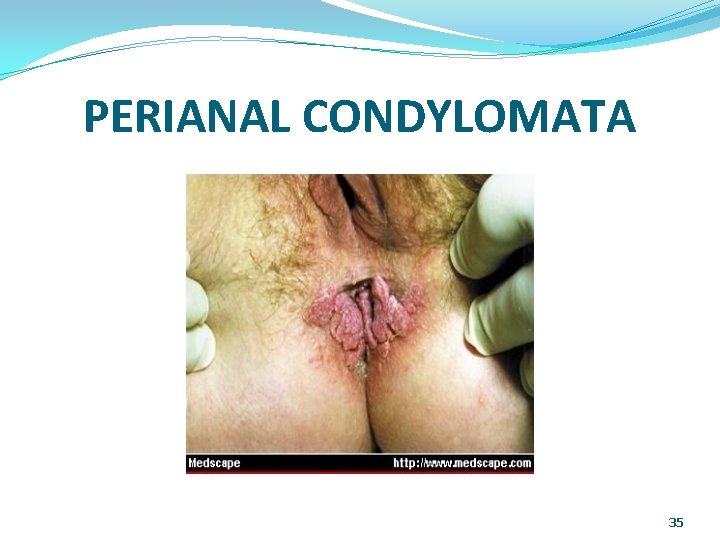
PERIANAL CONDYLOMATA 35
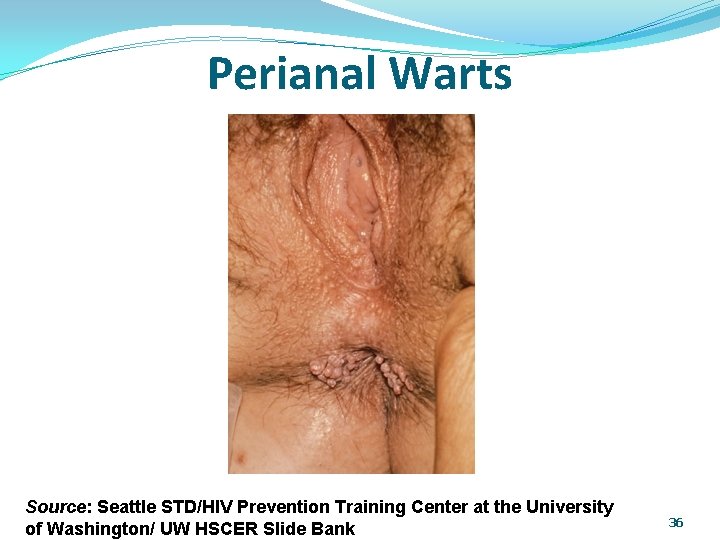
Perianal Warts Source: Seattle STD/HIV Prevention Training Center at the University of Washington/ UW HSCER Slide Bank 36
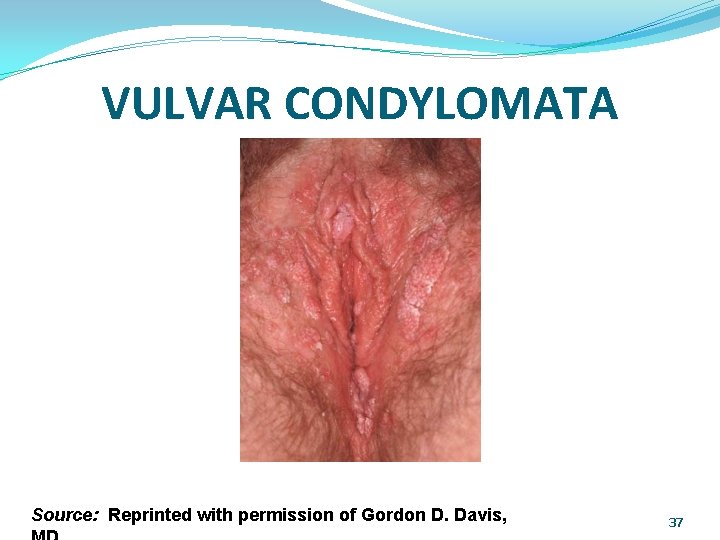
VULVAR CONDYLOMATA Source: Reprinted with permission of Gordon D. Davis, 37
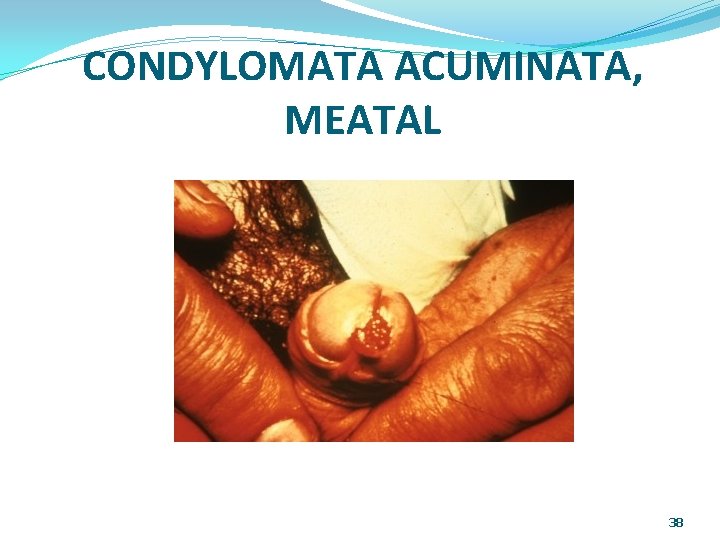
CONDYLOMATA ACUMINATA, MEATAL 38
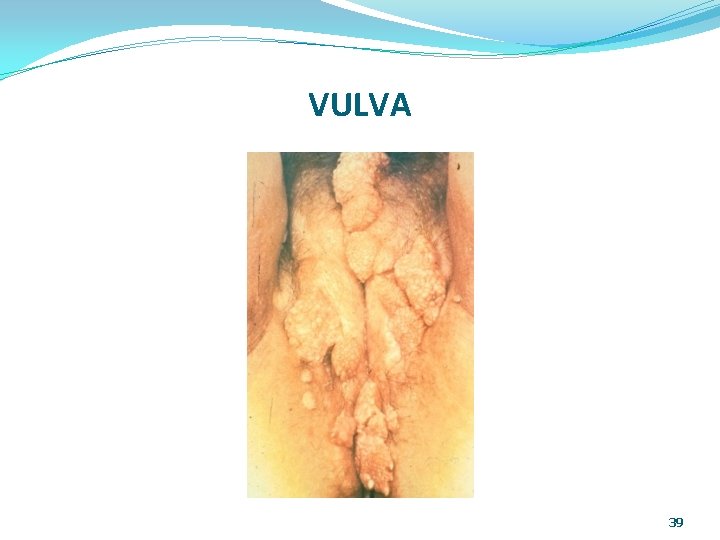
VULVA 39
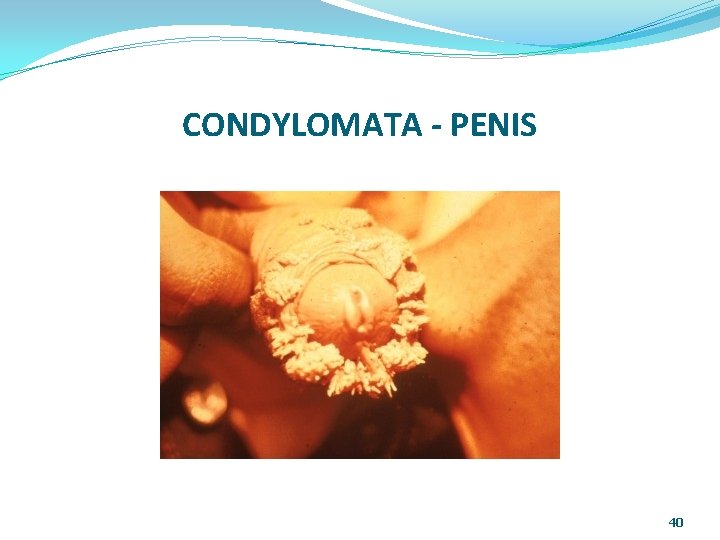
CONDYLOMATA - PENIS 40
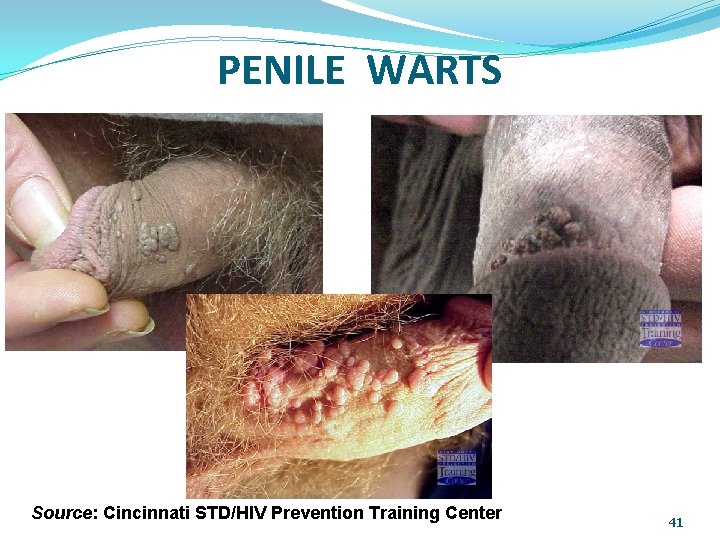
PENILE WARTS Source: Cincinnati STD/HIV Prevention Training Center 41
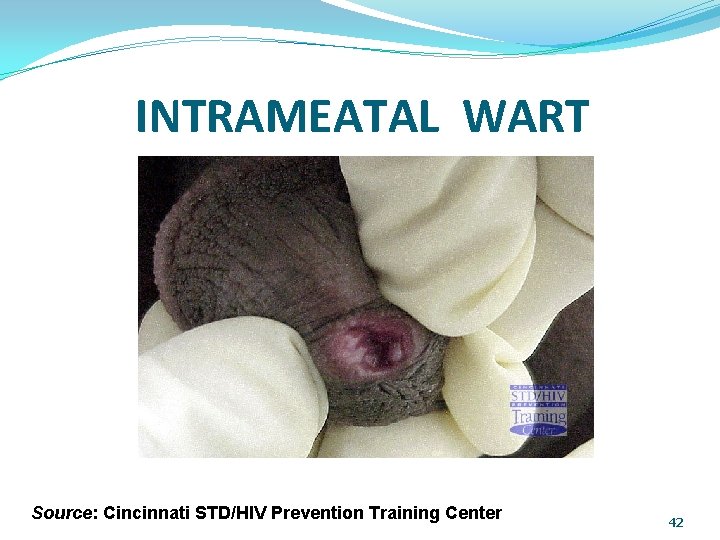
INTRAMEATAL WART Source: Cincinnati STD/HIV Prevention Training Center 42
DIAGNOSIS OF GENITAL WARTS �Diagnosis is usually made by history and visual inspection with bright light. �Diagnosis can be confirmed by biopsy when: �Diagnosis is uncertain �Patient is immunocompromised �Warts are pigmented, indurated, or fixed �Lesions do not respond or worsen with standard treatment �There is persistent ulceration or bleeding 43
DIAGNOSIS OF GENITAL WARTS (CONT) � Use of type-specific HPV DNA tests for routine diagnosis and management of genital warts is not recommended. � Acetic acid evaluation (acetowhitening) of external genitalia is not recommended (Has low positive predictive value) and does not influence clinical management. � External genital warts are not an indication for cervical colposcopy or increased frequency of Pap test screening. 44
HPV Treatment �Primary goal for treatment of visible warts is the removal of symptomatic warts. �Treatment can induce wart free period in most patients. �The removal of warts may or may not decrease infectivity. � No laboratory marker of infectivity � Variable results utilizing viral DNA 45
TREATMENT-EXTERNAL GENITAL WARTS �No evidence indicates that currently available txs. eradicate or affect the natural history of HPV infection. �If left untreated, visible genital warts may resolve on their own, remain unchanged, or increase in size or number. �No evidence indicates that the presence or tx. of visible warts is associated with the development of cervical cancer. 46
GENITAL WARTS- TREATMENT �Source of therapy guided by preference of patient, experience of provider, and available resources. �No evidence that any regimen is superior �*Acceptable alternative may be to observe. �Tx modality should be changed if pt has not improved substantially. �Majority respond within 3 mos of tx 47
TREATMENT – EXTERNAL WARTS Patient-applied Podofilox 0. 5% solution or gel Or Imiquimod 3. 75% or 5% cream Or Sinecatechins 15% ointment Provider-administered Cryotherapy or Trichloroacetic or Bichloroacetic acid 80 -90% or Surgical removal 48
TREATMENT (CONT) Vaginal warts Cryotherapy or TCA/BCA 80 -90% or surgical removal. Urethral meatal warts Cryotherapy or surgical removal Anal and cervical warts Cryotherapy or TCA/BCA 80 -90% Or Surgical removal 49
GENITAL WARTS - Treatment in Pregnancy �Imiquimod, sinecatechins, podofilox should not be used in pregnancy. �Cryotherapy, TCA, BCA, and surgical removal may be used. �Genital warts can proliferate and become friable during pregnancy. Not usually removed during pregnancy. �HPV types 6 and 11 can cause respiratory papillomatosis in infants and children. �Vaginal delivery not contraindicated unless pelvic outlet obstruction. 50
HPV ASSOCIATED CERVICAL CANCERS AND PRECANCERS �Usually subclinical �Detected by Pap test, colposcopy, or biopsy �Usually caused by high-risk HPV types �Most of the time high-risk HPV types do not cause any abnormalities. �Most women infected with high-risk HPV types have normal Pap test results. �Often regress spontaneously without treatment 51
HPV CANCERS �Each year, HPVs cause about 39, 000 cancers in men and women. �Median age of cancer diagnosis occurs at younger age. �Cancers caused by HPV: � Cervical- 100%, vulvar -69%, vaginal -75%, penile -63%, oropharyngeal -70%, and anal -91%. �Oropharyngeal - 10, 000 people each year. (M: F 4: 1) � 70% are due to HPV � 90% of cases due to HPV 16. 52
SCREENING FOR CERVICAL CELL ABNORMALITIES � Cytology (Pap test) – Considered Gold Standard � Useful screening test to detect cervical dysplasia (not HPV per se) � Provides indirect evidence of HPV because it detects squamous epithelial cell changes that are almost always due to HPV � HPV testing � FDA-approved for two optional uses: � � To triage women with atypical cells of undetermined significance (ASC-US) Pap test results As an adjunct to the Pap test to screen for cervical cancer in women 30 years or older. 53
DIAGNOSIS OF CERVICAL CELL ABNORMALITIES � Indication for colposcopy is guided by physical exam or Pap test findings with or without HPV DNA test findings. (See ASCCP (American Society for Colposcopy and Cervical Pathology) Guidelines) � Indications for cervical biopsy include: � Visible lesions on the cervix � Pap test with HSIL � Pap test with ASC-H or LSIL with colposcopic abnormalities 54
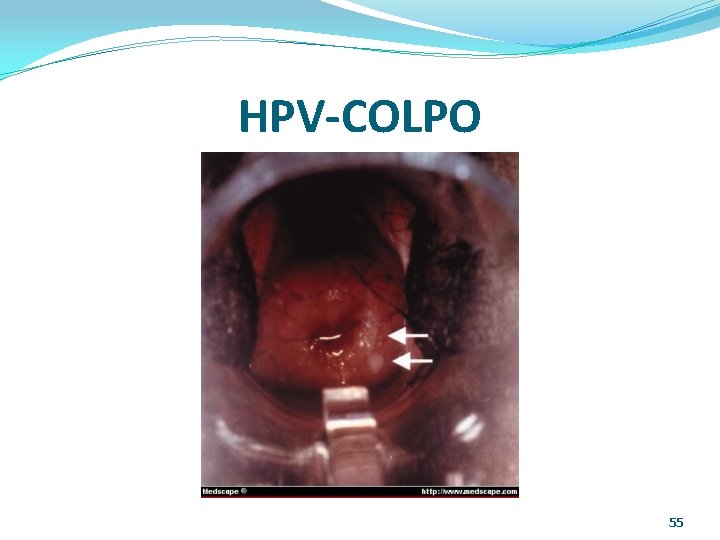
HPV-COLPO 55
HPV VACCINE (GARDASIL 9) � 9 valent HPV vaccine protects against HPV 6, 11, 16, 18, 31, 33, 45, 52, and 58. �Approved by FDA in December, 2014. �Lasts at least 10 years. �Neither a live or attenuated vaccine. �Prepared from virus-like particles (VLP) specific for the protein of the 9 HPV types. �Does not contain thimerosal or mercury as preservative. �Recommended for female and males ages 9 -26. � Average cost $350 for 2 dose series. 56
HPV VACCINE �Prevents 90% of anal, cervical, vaginal and vulvar cancers caused by 16, 18, 31, 33, 45, 52, and 58. �Found in studies to be 97% effective in preventing these cancers. �Has decreased vaccine type HPV prevalence 56% in adolescents 14 -19 yo since 2006, 34% in 20 -24 yo and 45% in 18 -26 yo. �Almost 100% effective in preventing genital warts caused by HPV 6 and 11. 90% effective in men. �Category B drug but not recommended during pregnancy (Vaccine pregnancy registry 800 -986 -8999). �Adverse reactions – Injection site pain (most common), swelling, erythema, mild fever, headache, and pruritus. 57
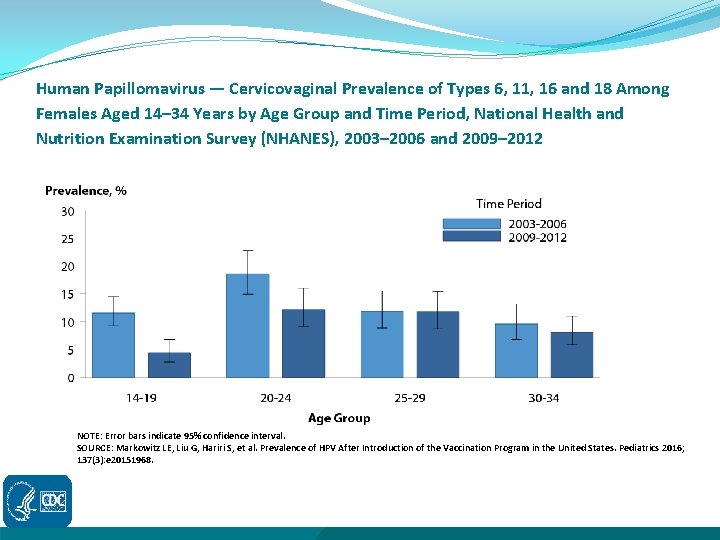
Human Papillomavirus — Cervicovaginal Prevalence of Types 6, 11, 16 and 18 Among Females Aged 14– 34 Years by Age Group and Time Period, National Health and Nutrition Examination Survey (NHANES), 2003– 2006 and 2009– 2012 NOTE: Error bars indicate 95% confidence interval. SOURCE: Markowitz LE, Liu G, Hariri S, et al. Prevalence of HPV After Introduction of the Vaccination Program in the United States. Pediatrics 2016; 137(3): e 20151968.
HPV VACCINE (CONT) �Gardasil is not a treatment. �Can be given to women with 1 or more of these HPV types. �Can be given at same time as Tdap, Td, MCV 4, flu and hepatitis B vaccines. �Not necessary to restart series if a dose is missed; resume the series from where it was discontinued. �Gardasil 9 can be used to complete series for males and females. �If 1 st dose given prior to age 15, only needs 2 doses, at least 5 mos apart. 59
HERPES �Incidence � 50 million people are infected with HSV-2. (15. 7% of population) � 87. 4% of 14 -49 yo infected with HSV 2 have never received a clinical diagnosis. � 1 in 6 people in the US ages 14 -49 (1 in 5 women and 1 in 10 men) have HSV-2. � 776, 000 new HSV-2 infections each year in US. �Decrease in cases over last 10 yrs from 21% to 15. 7%. � 10 -20% of first episode cases of genital herpes are caused by HSV-1 esp in younger patients. �Most cases of recurrent genital herpes are caused by HSV-2 (95%). 60
RISK FACTORS �Early sexual activity �H/O STDs �Multiple sex partners �Partner diagnosed with genital HSV infection 61
DEFINITIONS OF INFECTION TYPES First Clinical Episode �Primary infection �First infection ever with either HSV-1 or HSV-2 �No antibody present when symptoms appear �Disease is more severe than recurrent disease �Non-primary infection �Newly acquired HSV-1 or HSV-2 infection in an individual previously seropositive to the other virus �Symptoms usually milder than primary infection �Antibody to new infection may take several weeks to a few months to appear 62
DEFINITIONS OF INFECTION TYPES Recurrent symptomatic infection �Antibody present when symptoms appear �Disease usually mild and short in duration Asymptomatic infection �Serum antibody is present �No known history of clinical outbreaks 63
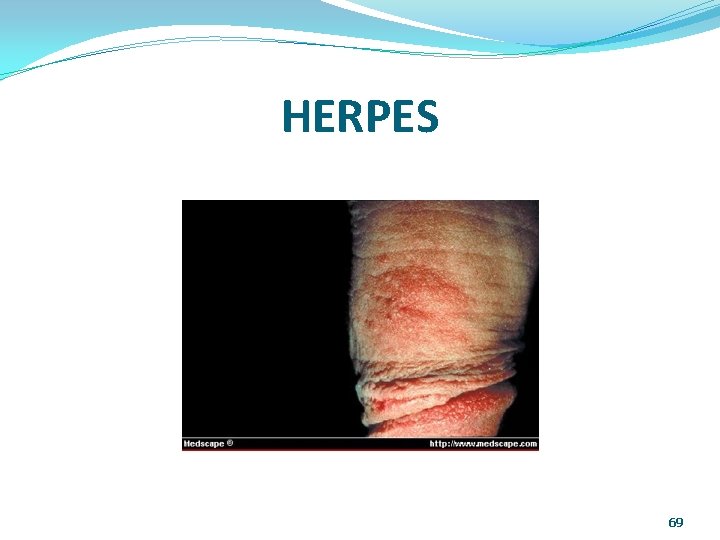
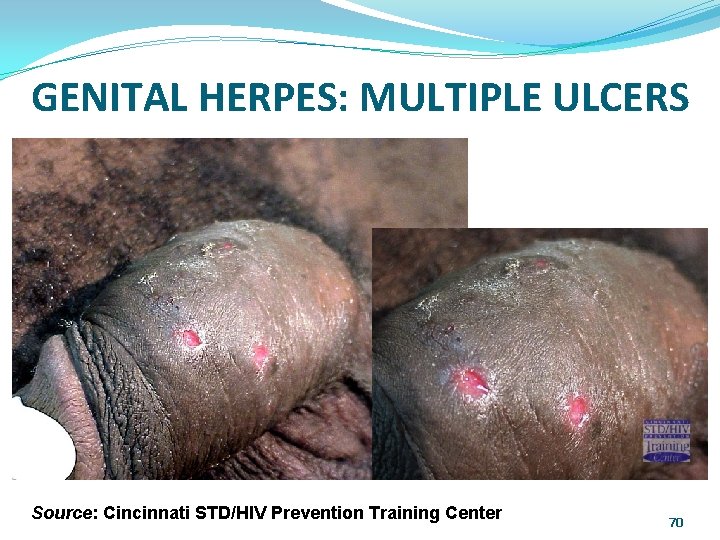
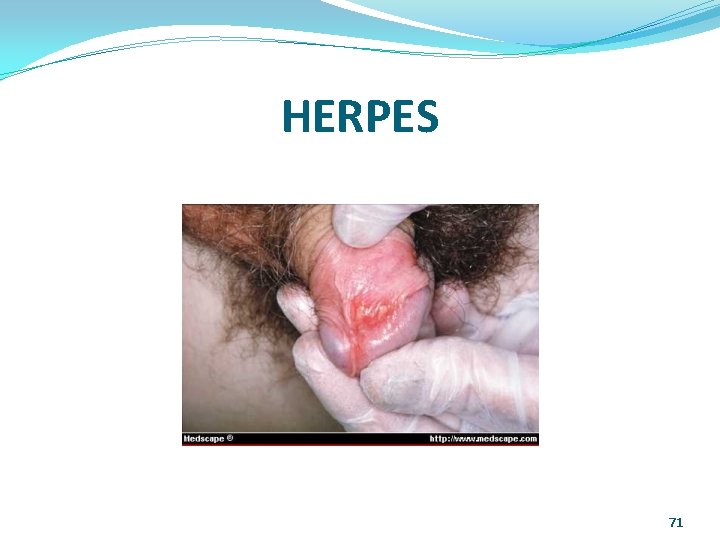
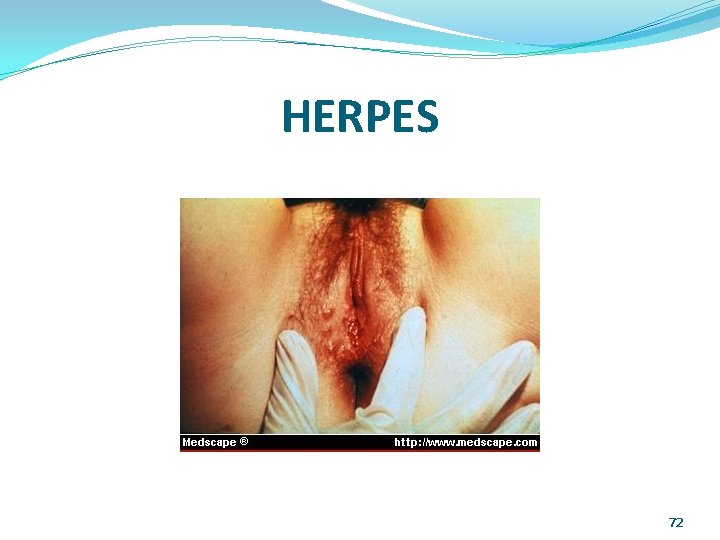
SIGNS AND SYMPTOMS �PRIMARY INFECTION �Numerous bilateral painful genital lesions on an erythematous base. Lesion progression: papules to vesicles to pustules to ulcers to crusts to healed. �Lesions are more severe, last longer, and have higher titers of virus than recurrent infections. �Duration of lesions: 14 -28 days �Inguinal adenopathy: present �Systemic signs: malaise, myalgia, headache, fever. �Local signs: pain, itching, vaginal or urethral D/C, dysuria, dyspareunia. 64
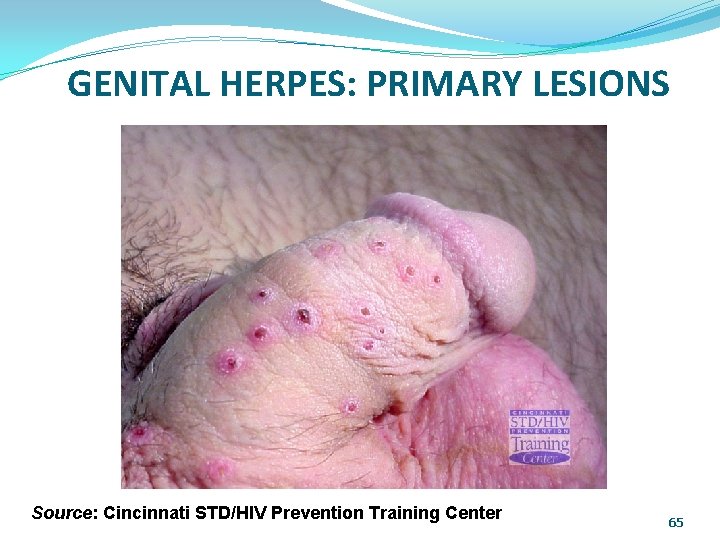
GENITAL HERPES: PRIMARY LESIONS Source: Cincinnati STD/HIV Prevention Training Center 65
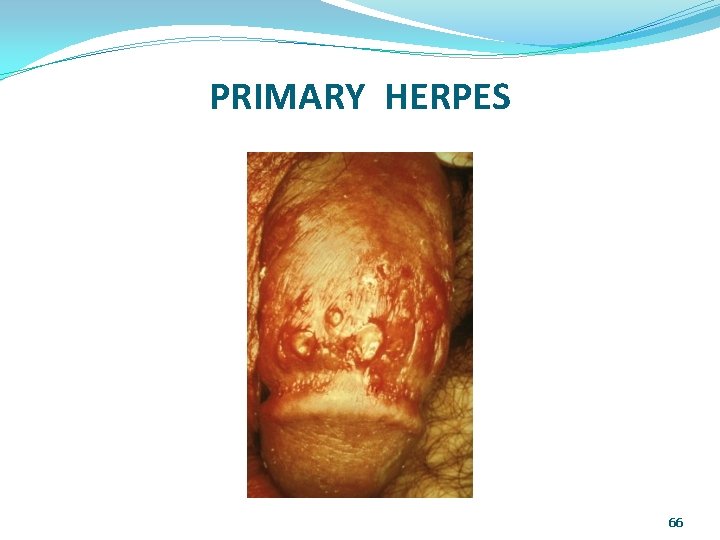
PRIMARY HERPES 66
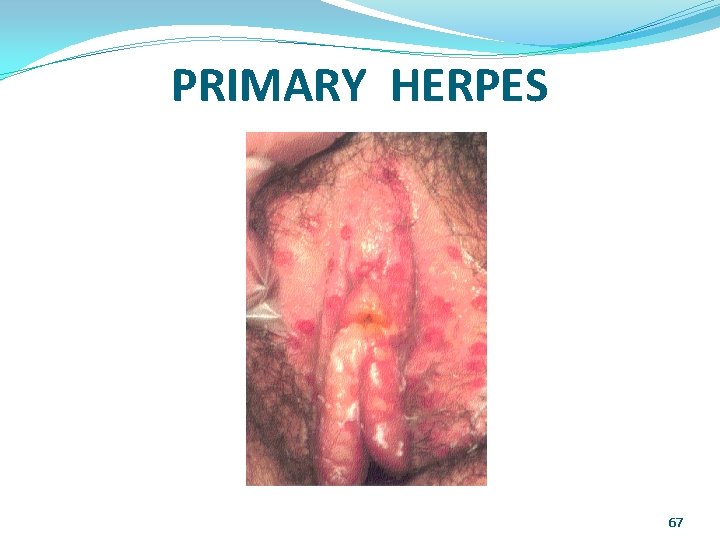
PRIMARY HERPES 67
SIGNS AND SYMPTOMS �RECURRENT �Scattered 1 -3 painful lesions on an erythematous base. �Confined to 1 specific area �Lesions tend to be smaller than primary lesions �Duration of lesions: 5 -10 days �Inguinal adenopathy, viremia, systemic signsabsent. �Local signs present, also may get prodromal sxs. (itching, burning, tingling, numbness, pain) before lesions appear. �Prodromal sxs usually begin 12 -24 hrs before lesions. 68
HERPES 69
GENITAL HERPES: MULTIPLE ULCERS Source: Cincinnati STD/HIV Prevention Training Center 70
HERPES 71
HERPES 72
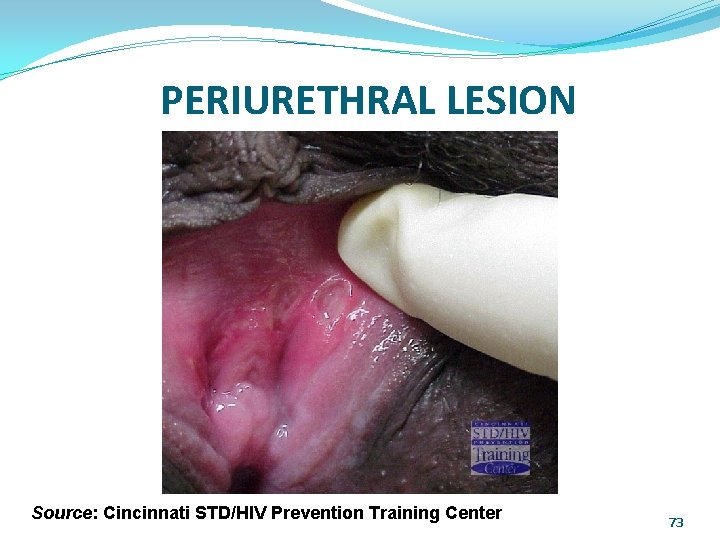
PERIURETHRAL LESION Source: Cincinnati STD/HIV Prevention Training Center 73
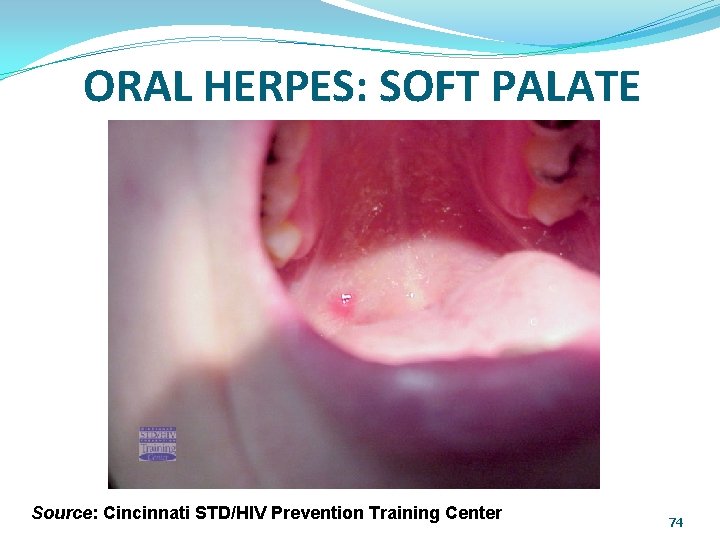
ORAL HERPES: SOFT PALATE Source: Cincinnati STD/HIV Prevention Training Center 74
DIAGNOSIS �Clinical diagnosis is insensitive and nonspecific �Clinical diagnosis should be confirmed by laboratory testing: �Virologic tests �Type-specific serologic tests 75
EVALUATION OF GENITAL, ANAL OR PERIANAL ULCERS PER CDC �All patients with genital, anal or perianal ulcers should be evaluated with a serologic test for syphilis and a diagnostic evaluation for genital herpes. �Persons with genital herpes should be tested for HIV infection. 76
VIROLOGIC TESTS � Viral culture (gold standard) � � � Preferred test if genital ulcers or other mucocutaneous lesions are present Highly specific (>99%) Sensitivity depends on stage of lesion; declines rapidly as lesions begin to heal Positive more often in primary infection (80%– 90%) than with recurrences (30%) Cultures should be typed (HSV 1 or HSV 2) NAAT’s such as Polymerase Chain Reaction (PCR) � � � More sensitive than viral culture; FDA cleared and clinically available. May be a reasonable choice for diagnosing genital lesions; the assays are FDA-cleared for use with anogenital specimens and commercially available Preferred test for detecting HSV in spinal fluid 77
TYPE-SPECIFIC SEROLOGIC TESTS �Type-specific and nonspecific antibodies to HSV develop during the first several weeks to few months following infection and persist indefinitely. �Presence of HSV-2 antibody indicates anogenital infection. �Presence of HSV-1 does not distinguish anogenital from orolabial infection. 78
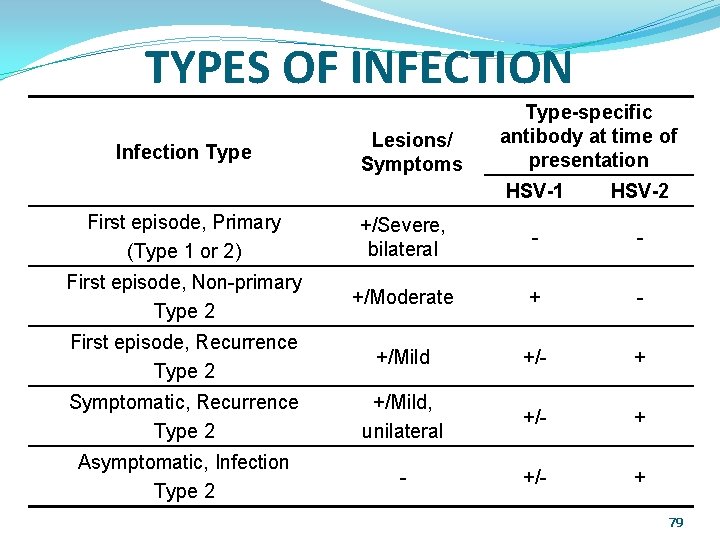
TYPES OF INFECTION Infection Type Lesions/ Symptoms Type-specific antibody at time of presentation HSV-1 HSV-2 First episode, Primary (Type 1 or 2) +/Severe, bilateral - - First episode, Non-primary Type 2 +/Moderate + - First episode, Recurrence Type 2 +/Mild +/- + Symptomatic, Recurrence Type 2 +/Mild, unilateral +/- + Asymptomatic, Infection Type 2 - +/- + 79
TREATMENT �Acyclovir (Zovirax) �Famciclovir (Famvir) �Valacyclovir (Valtrex) �Topical therapy not effective or recommended. �Liver function and renal tests not necessary. �Side effects (H/A, nausea and diarrhea) decrease over time, efficacy increases over time. 80
TREATING GENITAL HERPES �Initial infection (1 st clinical episode)- All patients should be treated. �Treat for 10 days whether primary or nonprimary infection. �Episodic therapy for recurrent herpes �Optimal for pts with prodromal sxs and infrequent or mild episodes. �Reduces viral shedding and healing period by 1 -2 days. �Pt should have drug at home to start at first sign or sx of recurrence. �Tx must be initiated during prodrome or within 1 day of onset of lesions. � 1, 2 or 3 day txs for recurrent episodes are easier to use than 5 day txs. �Follow-up in 2 weeks for culture or serologic testing results, answer questions, RX’s and F/U of herpes lesions. 81
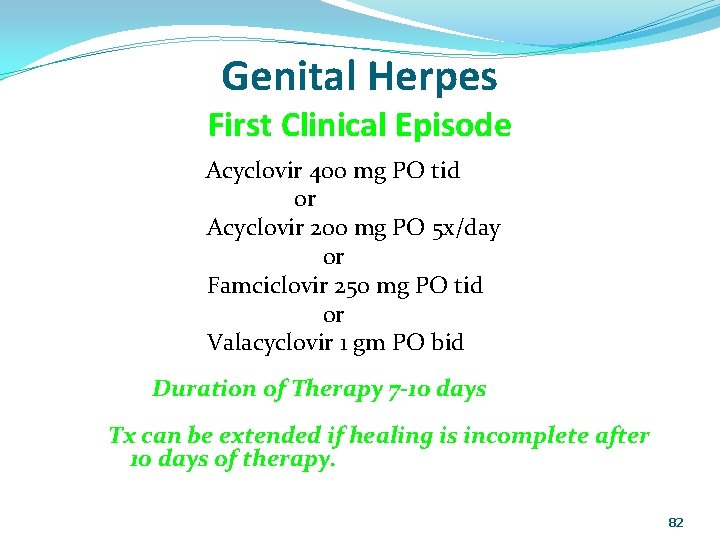
Genital Herpes First Clinical Episode Acyclovir 400 mg PO tid or Acyclovir 200 mg PO 5 x/day or Famciclovir 250 mg PO tid or Valacyclovir 1 gm PO bid Duration of Therapy 7 -10 days Tx can be extended if healing is incomplete after 10 days of therapy. 82
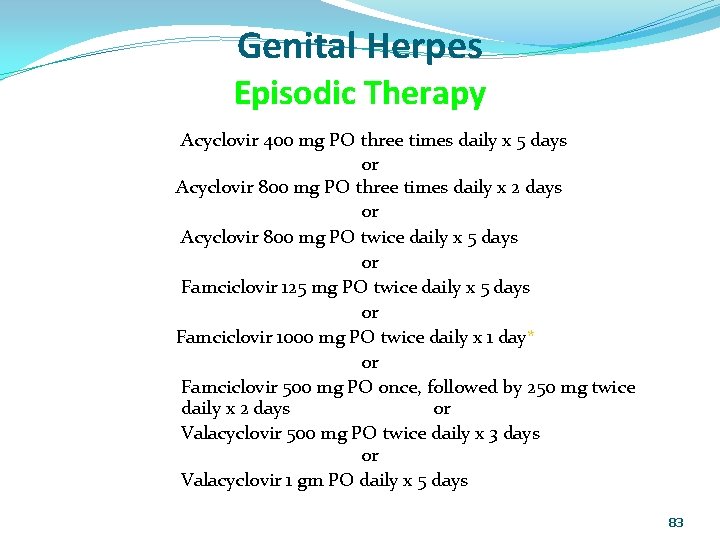
Genital Herpes Episodic Therapy Acyclovir 400 mg PO three times daily x 5 days or Acyclovir 800 mg PO three times daily x 2 days or Acyclovir 800 mg PO twice daily x 5 days or Famciclovir 125 mg PO twice daily x 5 days or Famciclovir 1000 mg PO twice daily x 1 day* or Famciclovir 500 mg PO once, followed by 250 mg twice daily x 2 days or Valacyclovir 500 mg PO twice daily x 3 days or Valacyclovir 1 gm PO daily x 5 days 83
TREATING GENITAL HERPES (CONT) �Suppressive therapy �Daily medication reduces the number of symptomatic outbreaks by 70 -80%. �Subclinical viral shedding is also significantly reduced (90%), which may in turn decrease HSV transmission. � ACOG recommends tx partner if preg woman is negative. �Recommended when recurrences are: � Frequent or uncomfortable � The cause of anxiety, depression, or social withdrawal � Interfere with sexual activities, family and social relationships, work performance, or travel. 84
Genital Herpes Daily Suppression Acyclovir 400 mg PO bid or Famciclovir 250 mg PO bid or Valacyclovir 500 mg PO qd or Valacyclovir 1 gm PO daily - for use with patients with ≥ 10 outbreaks/year. 85
PATIENT COUNSELING AND EDUCATION �Counseling should include: �Natural history of the infection �Treatment options �Transmission and prevention issues �Neonatal HSV prevention issues �Emphasize potential for recurrent episodes, asymptomatic viral shedding, and sexual transmission 86
TRICHOMONIASIS Incidence � 3. 7 million people have infection, but only 30% develop symptoms. � 1, 090, 000 million new cases in US/yr. �Accounts for 25% of all vaginal infections. �Most common curable STD �More common in women than men. �Older women more likely than younger women. 87
RISK FACTORS �Women (young and older women > 40 yo 11%) �African-Americans 13% �Multiple partners �Exchanging sex for payment �Illicit drug use �History of STD’s �Lower SE status �Lack of condom use 88
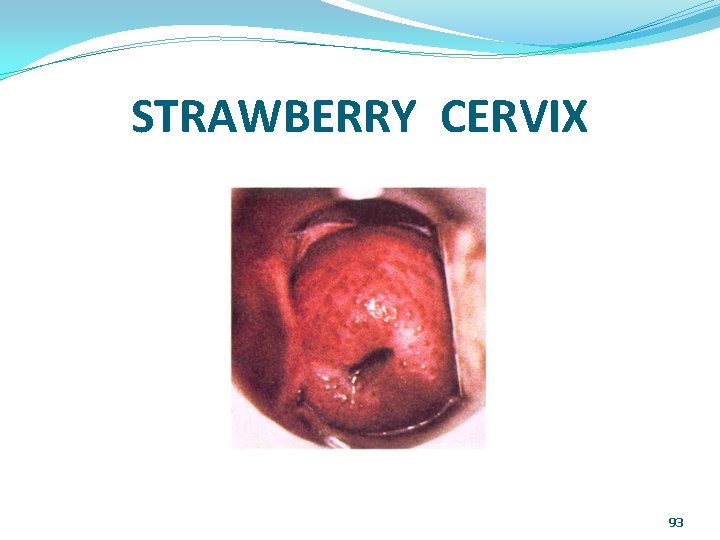
SIGNS AND SYMPTOMS � 70% of infected people are asymptomatic �Symptoms can come and go. �Without tx, infection can last months or years. �Pruritus* �Diffuse, malodorous D/C �Dyspareunia �Profuse, frothy gray or yellow-green D/C* �Petechiae of cervix (strawberry cx. )- occurs in < 3% of cases �Vaginal and vulvar irritation �Dysuria, frequency �Abdominal discomfort �Erythema of vulva and cervix �Friable cervix 89
SIGNS and SYMPTOMS FOR MEN �Itching or irritation inside penis �Burning after urination or ejaculation �Some D/C from the penis 90
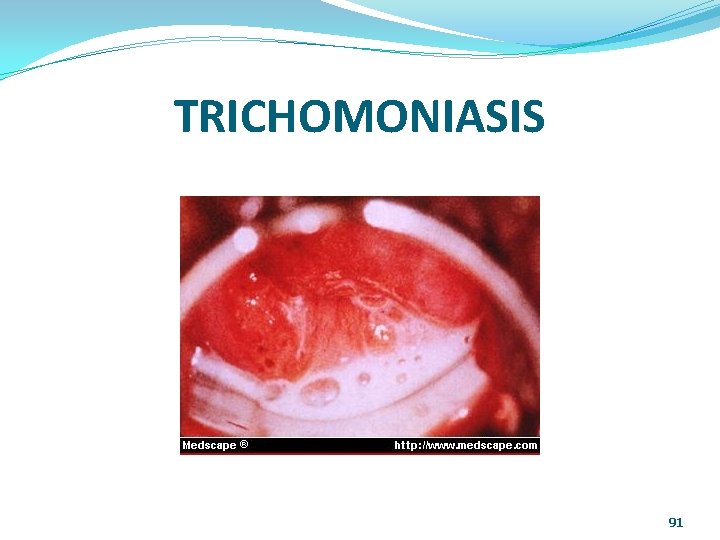
TRICHOMONIASIS 91
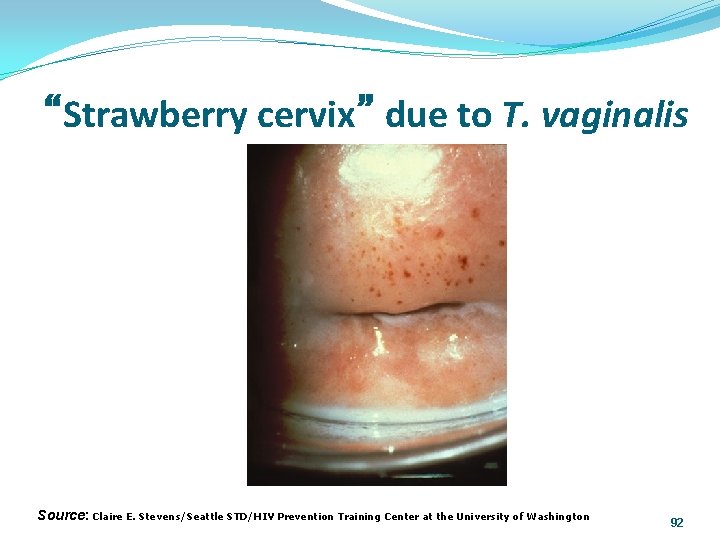
“Strawberry cervix” due to T. vaginalis Source: Claire E. Stevens/Seattle STD/HIV Prevention Training Center at the University of Washington 92
STRAWBERRY CERVIX 93
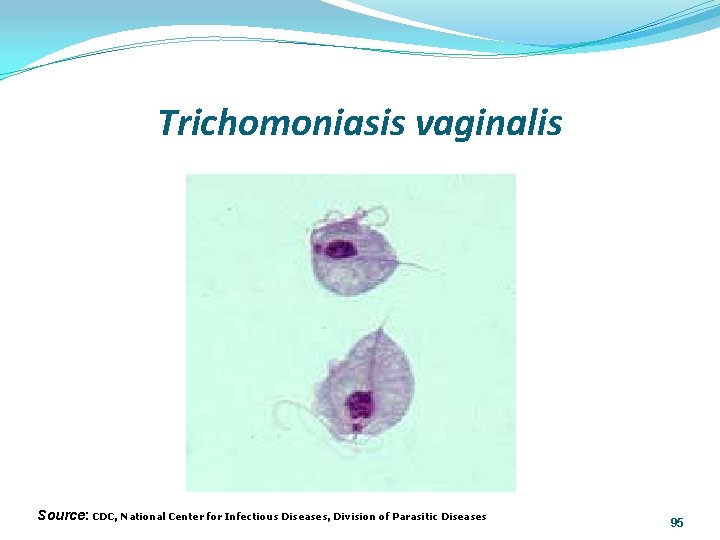
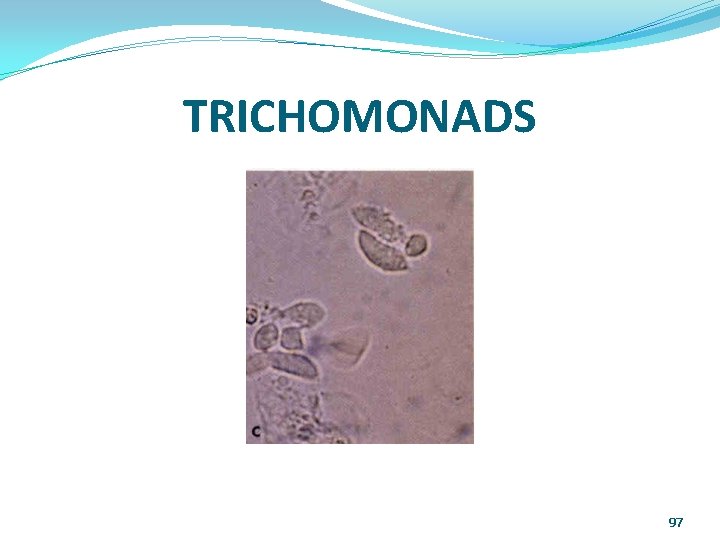
DIAGNOSIS �Wet prep- motile flagellated trichomonads, >10 WBC’s per HPF (Sensitivity 51 -65%), followed by culture if NAAT test is available. �Culture was considered the gold standard, until NAAT tests �NAAT is highly sensitive and specific 95 -100% (detects 3 -5 x’s more than wet mount) �Mix 1 drop 3% H 2 O 2 with vaginal secretions on slide- will produce foaming bubbles. �Urinalysis �Pap smears 70% but false negatives and false positives can occur. 94
Trichomoniasis vaginalis Source: CDC, National Center for Infectious Diseases, Division of Parasitic Diseases 95
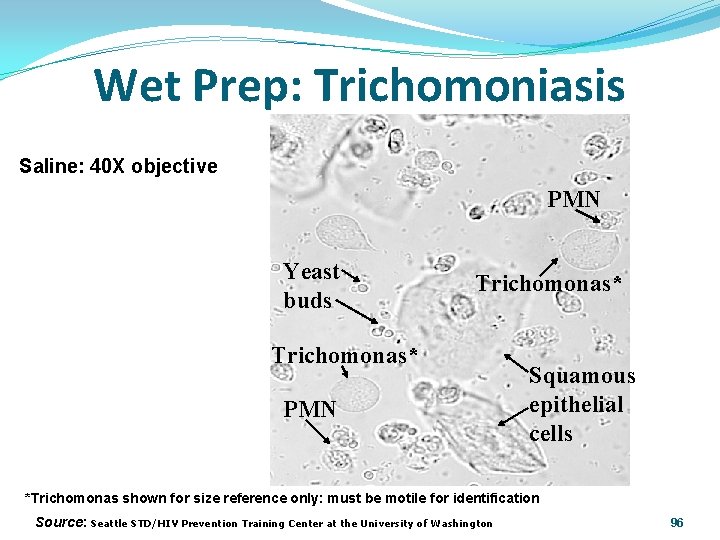
Wet Prep: Trichomoniasis Saline: 40 X objective PMN Yeast buds Trichomonas* PMN Squamous epithelial cells *Trichomonas shown for size reference only: must be motile for identification Source: Seattle STD/HIV Prevention Training Center at the University of Washington 96
TRICHOMONADS 97
TREATMENT �Metronidazole (Flagyl, Protostat) 2 gms. PO in a single dose (including pregnant women at any stage) �In breastfeeding women – pump breasts during tx and for 12 -24 hours after last dose and discard milk. OR �Tinidazole (Tindamax) 2 gms. PO x 1 dose �In breastfeeding women – pump breasts during tx and for 3 days after last dose and discard milk. 98
PATIENT EDUCATION and F/U �No ETOH during tx. Length of time depends on drug given. � 1 in 5 people get infected again within 3 mos. �Repeat testing in 3 months for sexually active women. (Repeat testing can be done by NAAT as soon as 2 weeks after tx) �Partners need to be treated. �Wait to have sex until all symptoms go away (about 1 week) �Correctly use condoms. 99
SYPHILIS - INCIDENCE � 2016, 88, 042 of all cases reported to CDC; 27, 814 cases of primary and secondary syphilis; Ohio had 716 cases in 2016, increase from 2015 - 560. �New cases (all stages) increased 17. 8% in 2016. Highest recorded since 1993. � 80. 6% of primary and secondary cases in 2016 occurred in men. �Rate in men increased 14. 7% and in women rate increased 35. 7% between 2015 and 2016 for primary and secondary syphilis. �Congenital syphilis-2016, 15. 7 cases per 100, 000 live births; 628 cases in 2016, a 27. 6% increase from 2016. Ohio had 11 reported cases in 2016; had 17 cases in 2015. 100
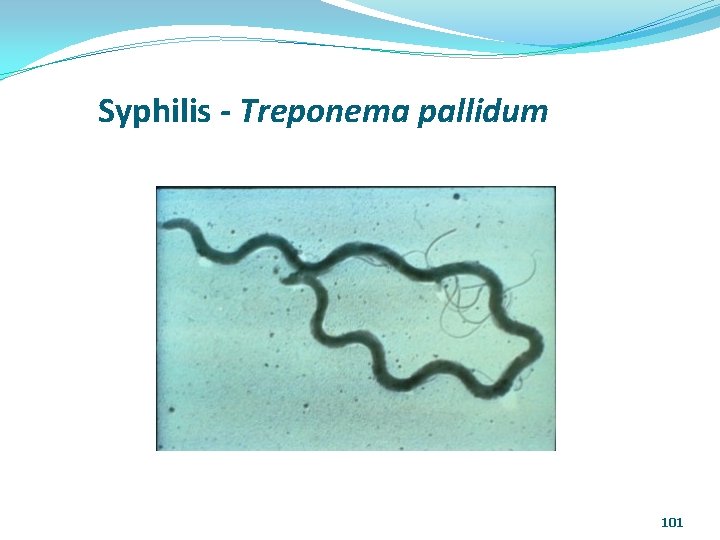
Syphilis - Treponema pallidum 101
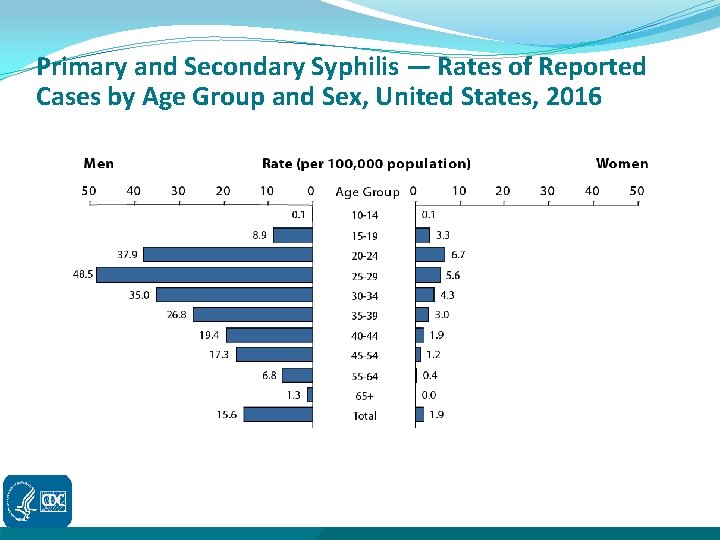
Primary and Secondary Syphilis — Rates of Reported Cases by Age Group and Sex, United States, 2016
RISK FACTORS �HIV infection or other STD �Illicit drug use. �Trading sex for drugs or money. �Multiple partners �Gay men, bisexual men, and men having sex with men - accounts for 83% of cases �African-Americans and Hispanics 103
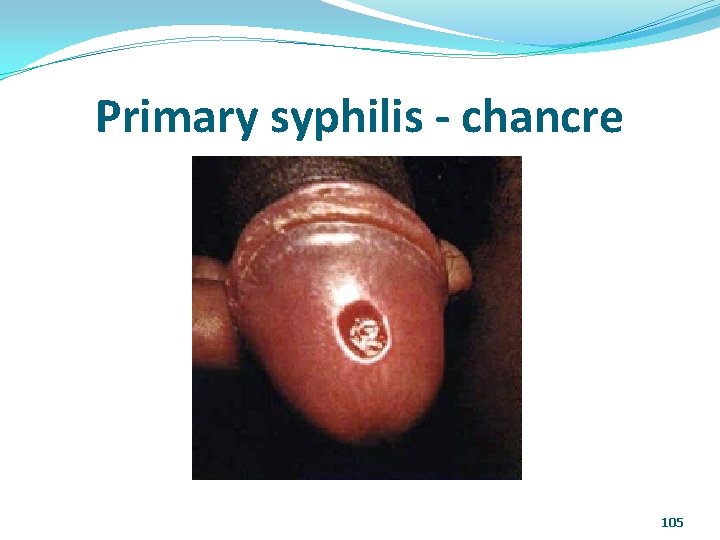
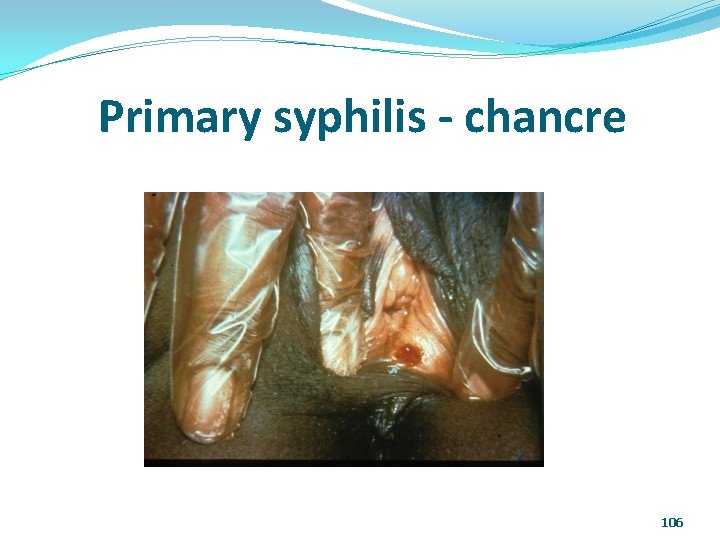
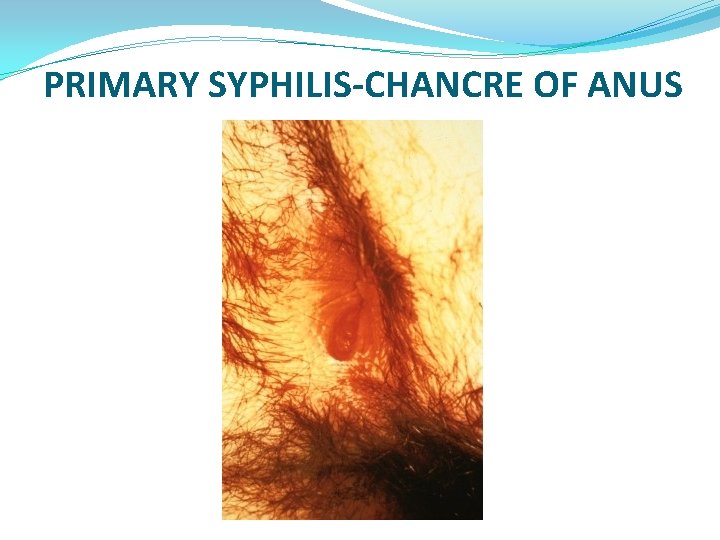
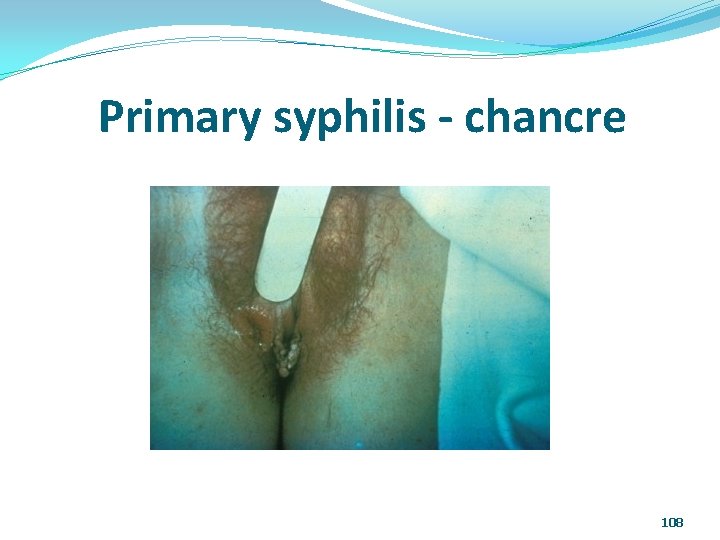
Primary SIGNS/SYMPTOMS �Lasts an average of 1 -6 weeks �Painless, hard chancre major indicator of primary syphilis at the site of entry. Progresses from papule to ulcer. Laden with spirochetes, smooth base and raised borders. It is highly infectious and heals spontaneously within 3 to 6 weeks, regardless of whether treated or not. �May go undetected, because it is painless, round, small and appears in hard to inspect areas of the body. �Usually no symptoms, other than, chancre will be manifested. �Regional lymphadenopathy classically rubbery, painless, and bilateral. 104
Primary syphilis - chancre 105
Primary syphilis - chancre 106
PRIMARY SYPHILIS-CHANCRE OF ANUS
Primary syphilis - chancre 108
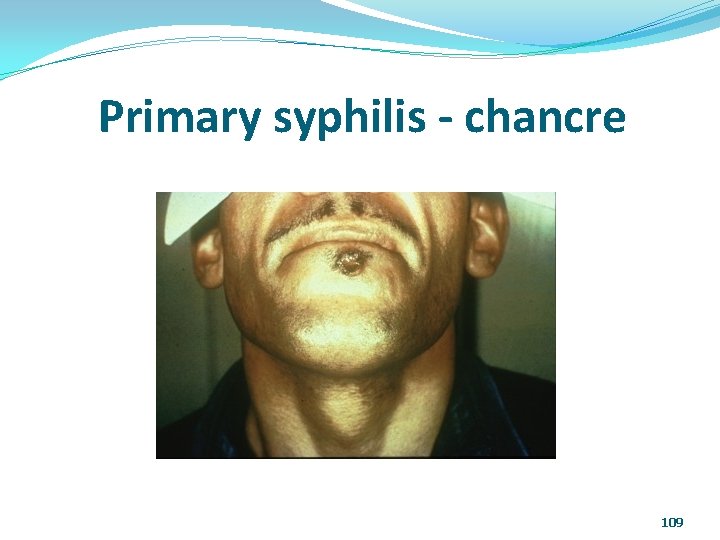
Primary syphilis - chancre 109
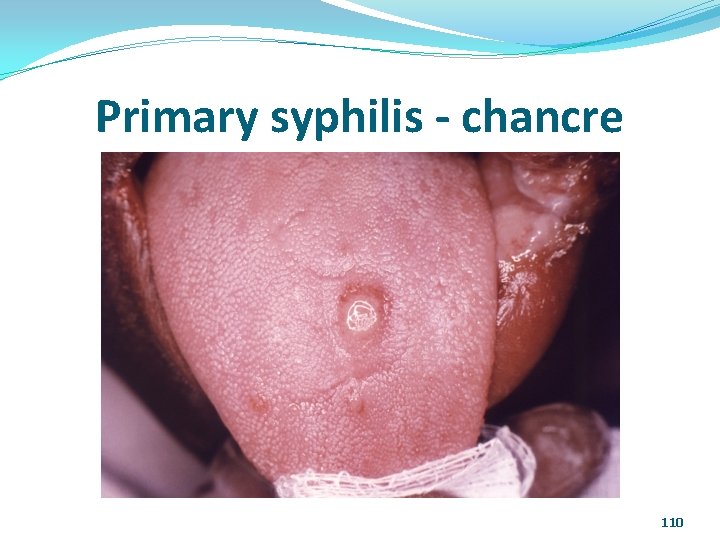
Primary syphilis - chancre 110
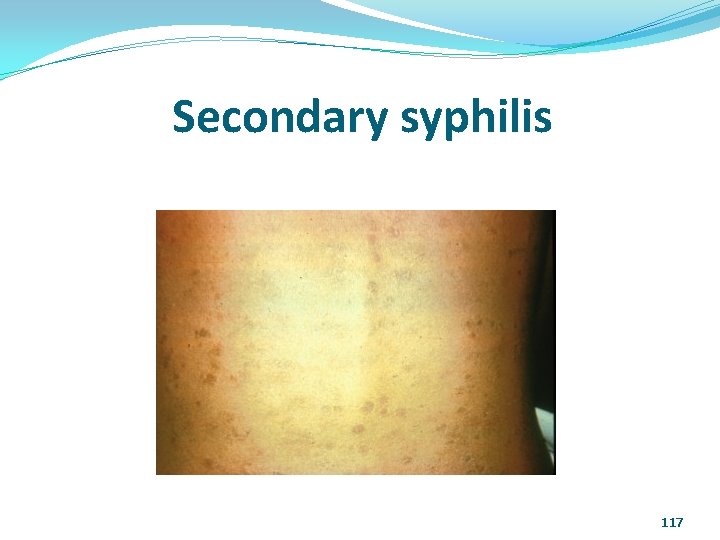
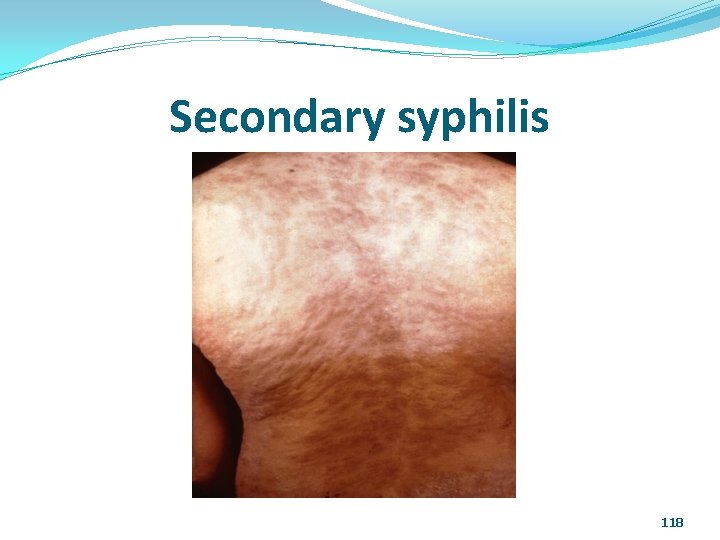
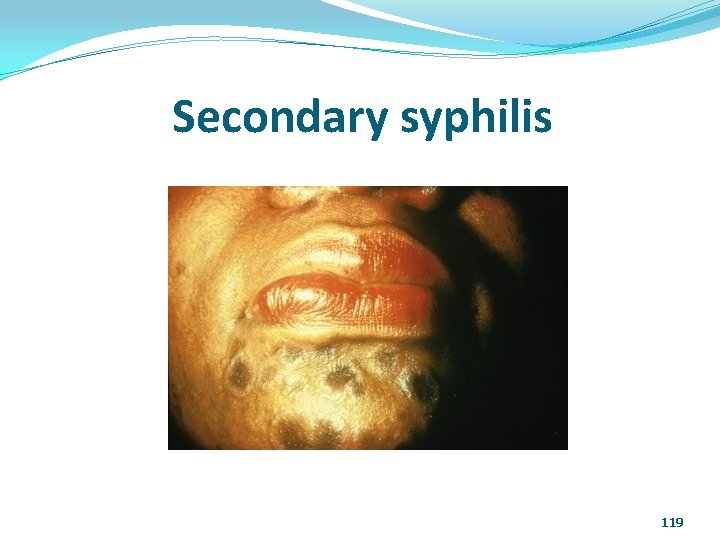
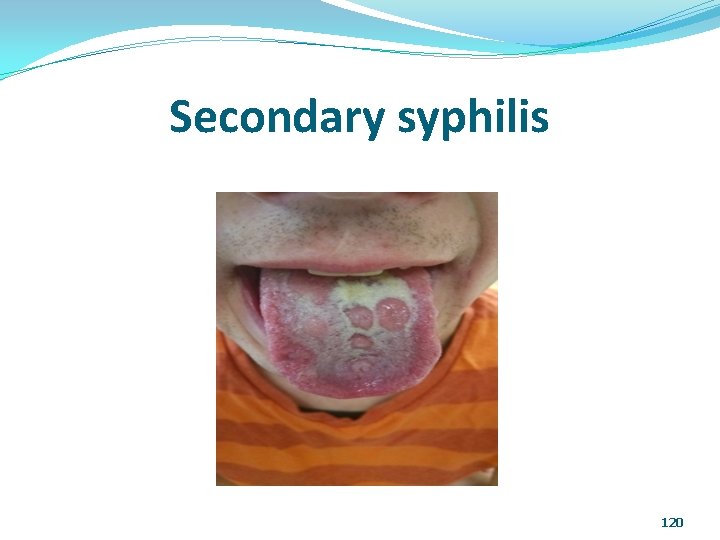
SIGNS/SYMPTOMS Secondary �Occurs 3 -6 weeks after appearance of primary lesion. Therefore, primary and secondary stages may overlap. �Typically starts with a nonpruritic, symmetric, macular rash on one or more areas of the body that includes the palms and soles. May last 3 wks to 6 mos. � Other sxs: fever, sore throat, alopecia, H/A, malaise, wt loss, muscle aches, mucous membrane ulcerations, condylomata lata, and lymphadenopathy. �Symptoms of secondary syphilis clear within 2 -6 weeks, but may take up to 6 months. �Serologic tests usually highest in this stage. 111
CLINICAL MANIFESTATIONS �A rash occurs in 75%-100% of secondary syphilis cases. The rash can be macular, papular, squamous, pustular (rarely), or a combination. Rashes are usually nonpruritic, and they characteristically involve the palms and soles. Any new onset macular, papular, or squamous rash should be evaluated to rule out secondary syphilis. � Lymphadenopathy occurs in 50%-86% of cases. � Malaise is a common constitutional symptom. � Mucous patches, present in 6%-30% of cases, are flat patches involving oral cavity, pharynx, larynx, and genitals. � Condylomata lata (25%) are moist, heaped, wart-like papules that occur in warm, moist areas (most commonly: tongue, underarm, gluteal folds, perineum, perianal); these lesions are very infectious. � Alopecia (10%) is patchy, occipital or bitemporal, and causes loss of lateral eyebrows. 112
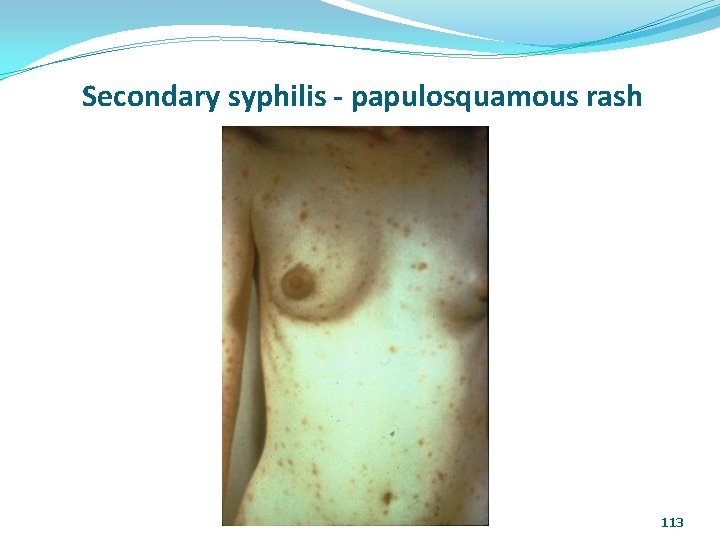
Secondary syphilis - papulosquamous rash 113
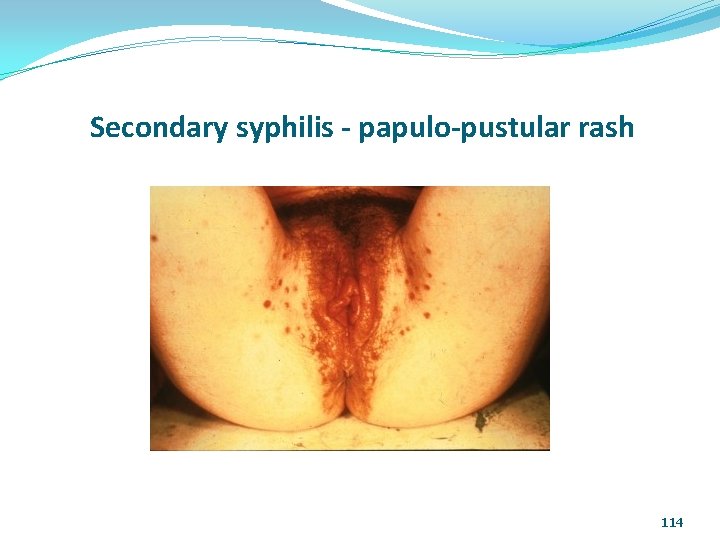
Secondary syphilis - papulo-pustular rash 114
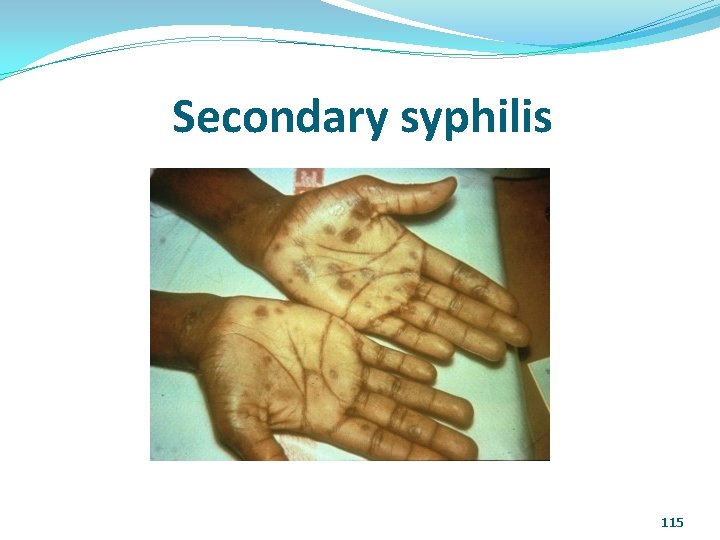
Secondary syphilis 115
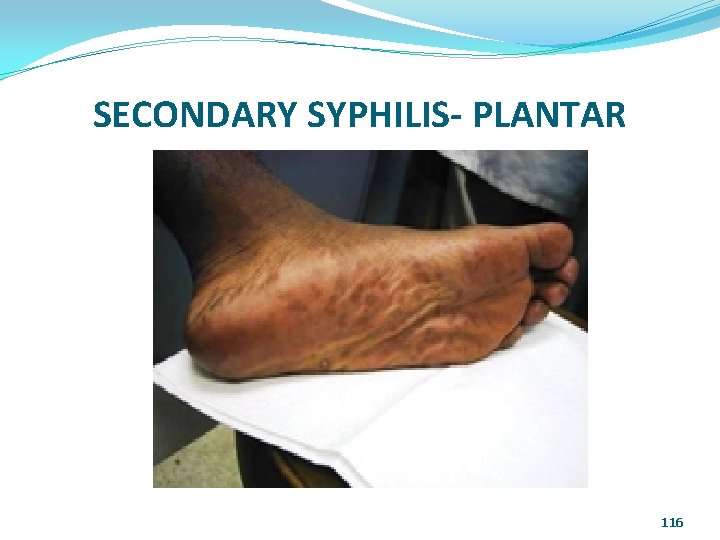
SECONDARY SYPHILIS- PLANTAR 116
Secondary syphilis 117
Secondary syphilis 118
Secondary syphilis 119
Secondary syphilis 120
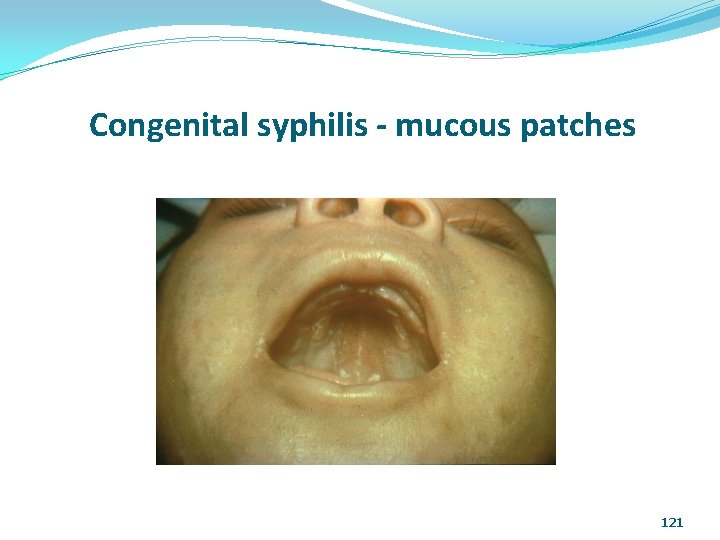
Congenital syphilis - mucous patches 121
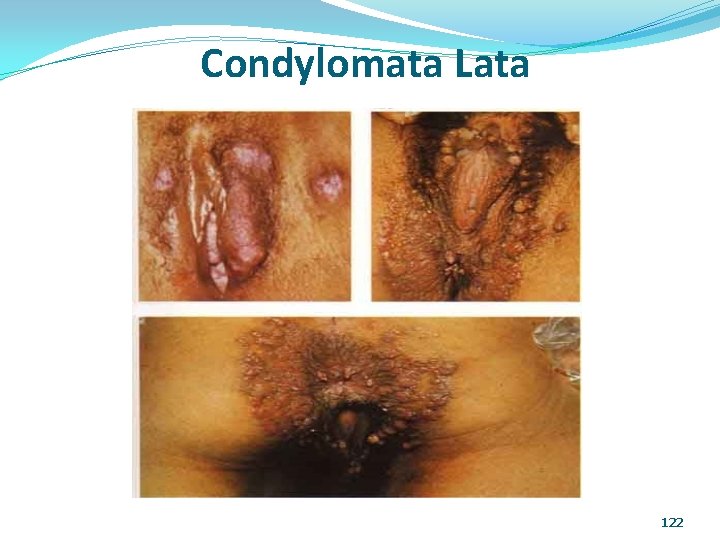
Condylomata Lata 122
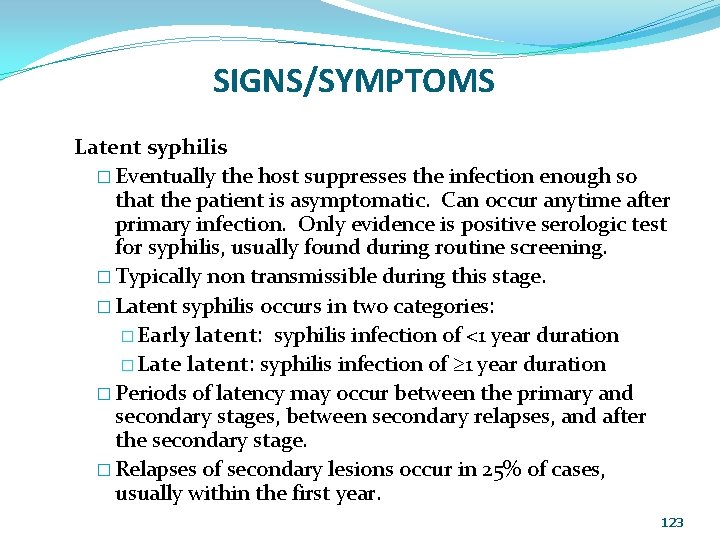
SIGNS/SYMPTOMS Latent syphilis � Eventually the host suppresses the infection enough so that the patient is asymptomatic. Can occur anytime after primary infection. Only evidence is positive serologic test for syphilis, usually found during routine screening. � Typically non transmissible during this stage. � Latent syphilis occurs in two categories: � Early latent: syphilis infection of <1 year duration � Late latent: syphilis infection of 1 year duration � Periods of latency may occur between the primary and secondary stages, between secondary relapses, and after the secondary stage. � Relapses of secondary lesions occur in 25% of cases, usually within the first year. 123
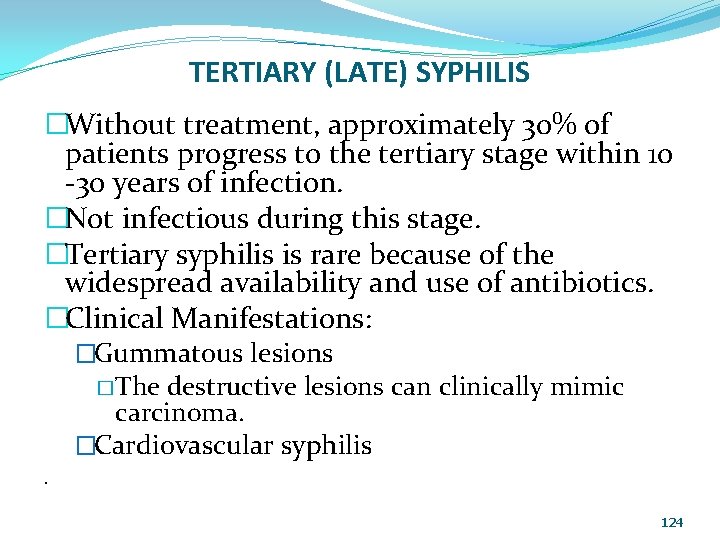
TERTIARY (LATE) SYPHILIS �Without treatment, approximately 30% of patients progress to the tertiary stage within 10 -30 years of infection. �Not infectious during this stage. �Tertiary syphilis is rare because of the widespread availability and use of antibiotics. �Clinical Manifestations: �Gummatous lesions �The . destructive lesions can clinically mimic carcinoma. �Cardiovascular syphilis 124
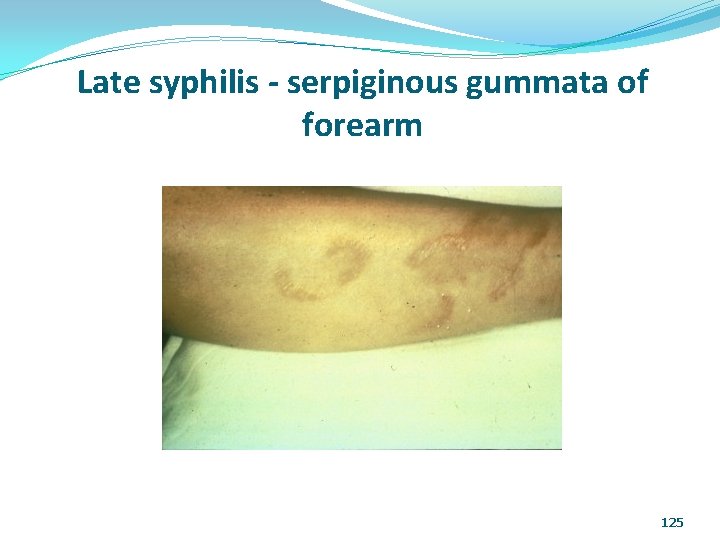
Late syphilis - serpiginous gummata of forearm 125
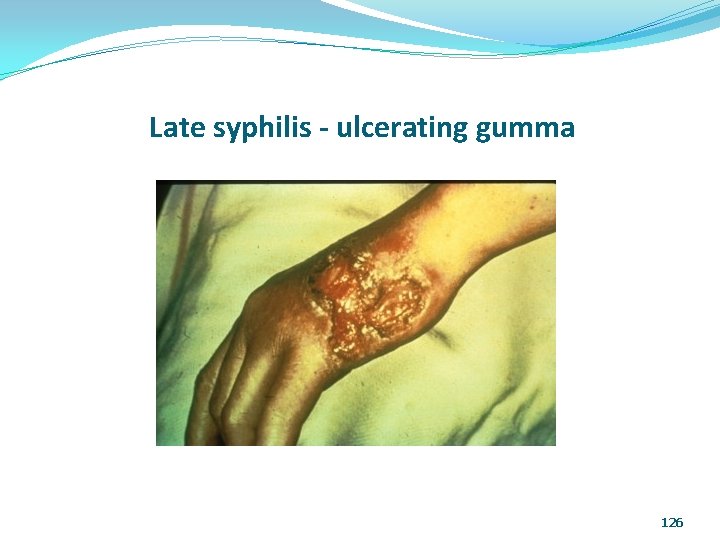
Late syphilis - ulcerating gumma 126
NEUROSYPHILIS Neurosyphilis � Neurosyphilis occurs when T. pallidum invades the central nervous system. � This may occur at any stage of syphilis, and neurosyphilis can be asymptomatic. � Early forms of neurosyphilis usually occur a few months to a few years after infection. � Clinical manifestations include signs of meningitis or stroke-like sxs, auditory or ophthalmic abnormalities that typically involves cranial nerves III, VII and VIII (ie, cranial nerve palsies), acute or chronic altered mental status, loss of vibratory sense. � Late manifestations – tabes dorsalis and general paresis. � Can only be diagnosed with cerebrospinal fluid exam. 127
DIAGNOSIS �Nontreponemal tests: RPR, VDRL �Diagnosis made by positive nontreponemal test with confirmation by direct treponemal test. �Nontreponemal tests correlates with disease activity, tracking reinfection and follow tx response. �Inexpensive, easy to perform, and sensitive. � 4 -fold decline in titer indicates adequate treatment (ie, 1: 32 to 1: 8 or 1: 16 to 1: 4). � Use same test for repeat titers �May persist at low titer for life. (Serofast reaction, usually 1: 2) 128
DIAGNOSIS (CONT) � 1 -2% of general population, will have false-positive result. Also occur as a result of infection with Epstein-Barr virus, hepatitis B, herpes simplex virus, HIV, mycoplasma, mycobacteria, and pneumococcus. Also can occur with autoimmune conditions, primary biliary cirrhosis, immunizations, injection drug use, older age, and pregnancy. �Treponemal tests: Fluorescent treponemal antibody absorption (FTA-ABS), microhemagglutination assay for antibody to Treponema pallidum (MHA-TP), or Treponema pallidum particle agglutination assay (TP-PA). �Specificity of 95 -98%. �Remain positive for life after treatment, less useful for long-term follow-up. � May revert to negative in 15 -25% of patients tx for primary infection after 2 -3 years. 129
TREATMENT �Primary, secondary, and early latent syphilis in adults without neurologic involvement � Benzathine penicillin G (Bicillin L-A), 2. 4 million units IM in a single dose (Be sure to use correct PCN, not C-R) � Penicillin allergic: Doxycycline 100 mg orally twice daily for 14 days, OR tetracycline 500 mg orally 4 times daily for 14 days �Late latent or latent syphilis of unknown duration in adults without neurologic involvement �Benzathine penicillin G 7. 2 million units total, administered as 3 doses of 2. 4 million units IM each at 1 -week intervals �Penicillin allergic: Doxycycline 100 mg orally twice daily for 28 days, OR tetracycline 500 mg orally 4 times daily for 28 days 130
Jarisch-Herxheimer Reaction �Self-limited reaction to PCN therapy �Fever, malaise, nausea/vomiting, H/A, myalgias; may be associated with chills and exacerbation of secondary rash �Occurs within 2 -24 hours after therapy and is self-limiting. �Not an allergic reaction to penicillin �More frequent after treatment with penicillin and treatment of early syphilis �Antipyretics and NSAIDS can be used to manage symptoms, but they have not been proven to prevent this reaction. �Pregnant women should be informed of this possible reaction, that it may precipitate early labor, and to call obstetrician if problems develop. 131
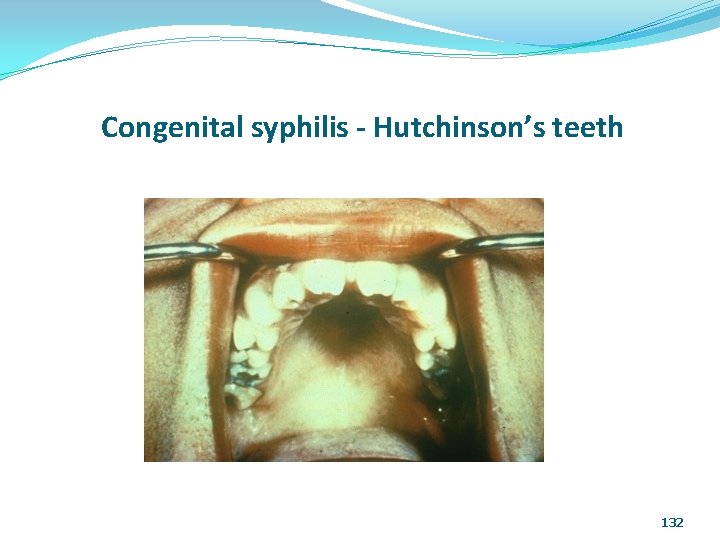
Congenital syphilis - Hutchinson’s teeth 132
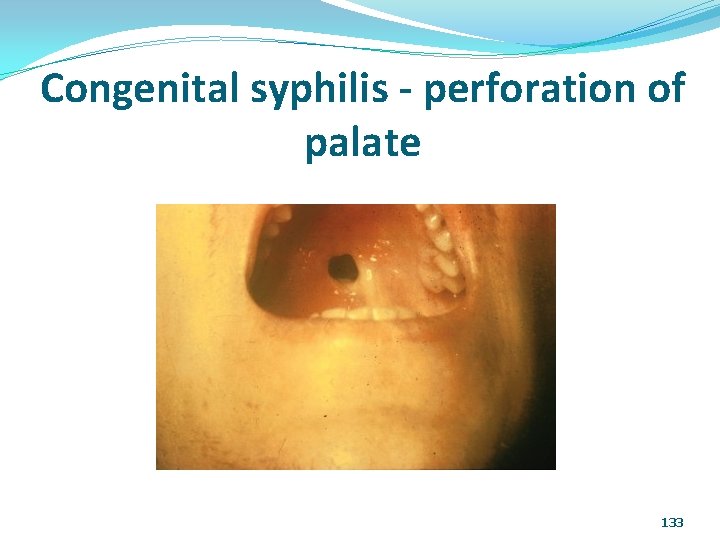
Congenital syphilis - perforation of palate 133
Follow-Up �All persons with syphilis should be tested for HIV infection. �Primary or secondary syphilis �Reexamine and titers at 6, 12, and 24 months. �Follow-up titers should be compared to the maximum or baseline nontreponemal titer obtained on day of treatment. �Fourfold decrease in titer within 6 -12 mos. after treatment. �Latent syphilis �Reexamine at 6, 12, and 24 months. �HIV-infected patients � 3, 6, 9, 12 and 24 months for primary or secondary syphilis � 6, 12, 18, and 24 months for latent syphilis �Neurosyphilis �Serologic testing as above �Repeat CSF examination at 6 -month intervals until normal 134
MANAGEMENT OF PARTNERS �Sexual contact with person who has primary, secondary, or early latent syphilis within 90 days preceding dx should be treated, even if serologic tests are negative. �> 90 days, tx if serologic tests not available or F/U is uncertain. If tests are negative, no tx is needed. 135
REFERENCES �Centers for Disease Control and Prevention. Sexually Transmitted Diseases Treatment Guidelines 2015. MMWR 2015; 64(no. RR-3). �https: //www. cdc. gov/std/ �http: //www. ashasexualhealth. org/ �https: //www. niaid. nih. gov/ �JAMA 2002; 287: 2120 -2129 �https: //www. guttmacher. org/ �http: //www. asccp. org/store-detail 2/asccp-mobile-app 136
- Slides: 136