
Sexually transmitted diseases chlamydia gonorrhea Mirela Grdovi Mentor




- Slides: 30
Sexually transmitted diseases: chlamydia & gonorrhea Mirela Grdović Mentor: A. Žmegač Horvat
Sexually transmitted disease (STD), Sexually transmitted infection (STI), Venereal disease (VD) l illness that has a significant probability of transmission between humans by means of sexual contact, including vaginal intercourse, oral and anal sex l some STIs can be transmitted via IV drug needles, childbirth or breastfeeding
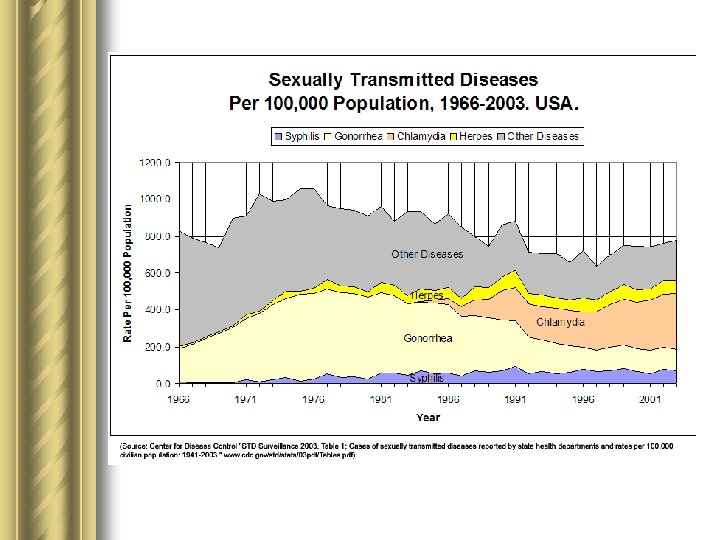
STD statistics l major public health concern in both industrialised and developing countries l WHO: in 1996 more than 1 million people infected daily l 60% of infections occur in young people (<25 years) l more frequent in 14 to 19 -year-old girls than boys (2: 1), equalizes by age 20 l STIs among sexually active adolescent girls: chlamydia (10 -25%), gonorrhea (3 -18%) l STIs among adolescent boys: chlamydia (9 -11%), gonorrhea (2 -3%)
General risk factors l l l l being sexually active starting sexual activity at an early age having high-risk sex currently having an STD having a history of an STD having multiple sex partners using alcohol or recreational drugs injecting drugs being young being female being African-American having sex with men meeting people in public places or online for sex
Common signs/symptoms of STIs l l l l itching around vagina and/or discharge from vagina discharge from penis pain during sex or when urinating pain in pelvic area sore throat in people who have oral sex pain in or around anus for people who have anal sex chancre sores (painless red sores) on genital area, anus, tounge and/or throat
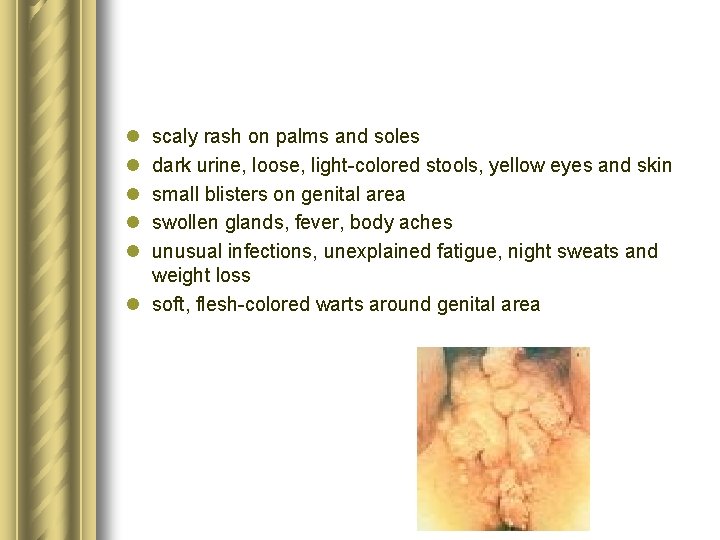
l l l scaly rash on palms and soles dark urine, loose, light-colored stools, yellow eyes and skin small blisters on genital area swollen glands, fever, body aches unusual infections, unexplained fatigue, night sweats and weight loss l soft, flesh-colored warts around genital area
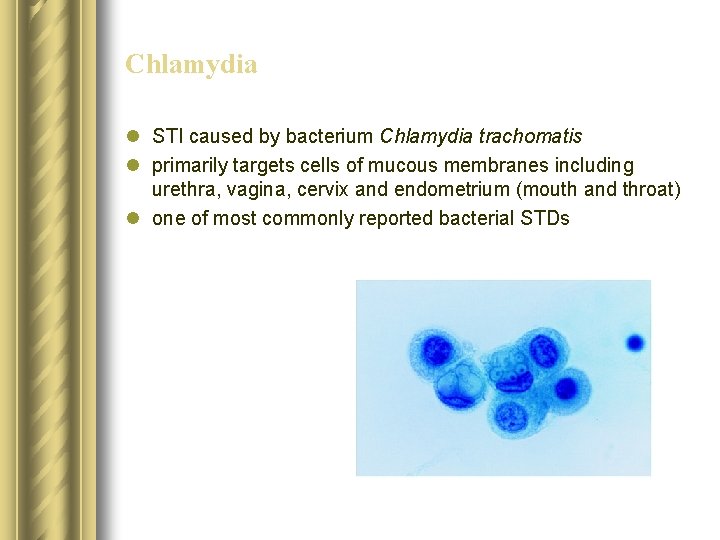
Chlamydia l STI caused by bacterium Chlamydia trachomatis l primarily targets cells of mucous membranes including urethra, vagina, cervix and endometrium (mouth and throat) l one of most commonly reported bacterial STDs
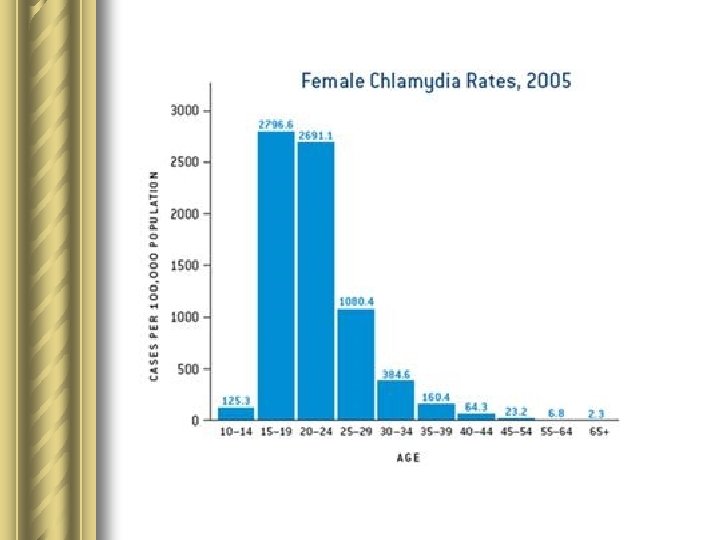
Facts and statistics l l very common STD highest chlamydia rate in women between age 15 and 24 lower rate in men highest rate in black women between 15 and 19 (lack of access to healthcare and distrust of the healthcare system) l 4. 5 times higher in Hispanics than in whites and 2. 9 times higher in American Indians than in whites
Symptoms and signs - appear between 1 and 3 weeks after exposure (may not emerge until much later) -“silent disease” - 70 -75% asymptomatic women
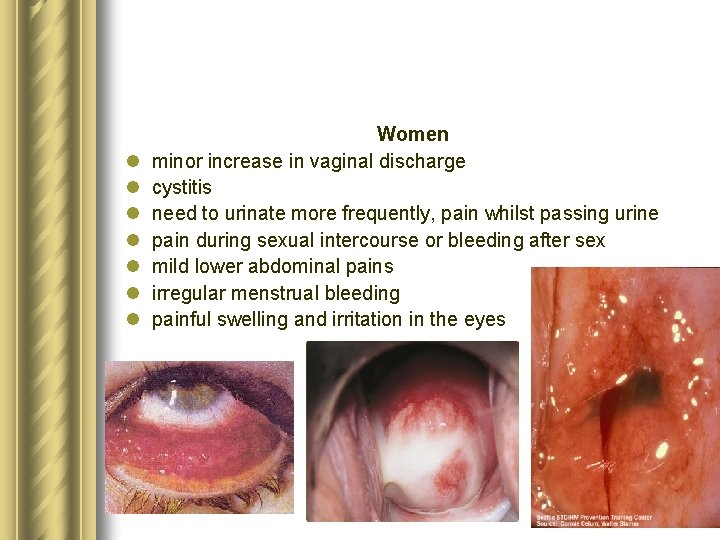
l l l l Women minor increase in vaginal discharge cystitis need to urinate more frequently, pain whilst passing urine pain during sexual intercourse or bleeding after sex mild lower abdominal pains irregular menstrual bleeding painful swelling and irritation in the eyes
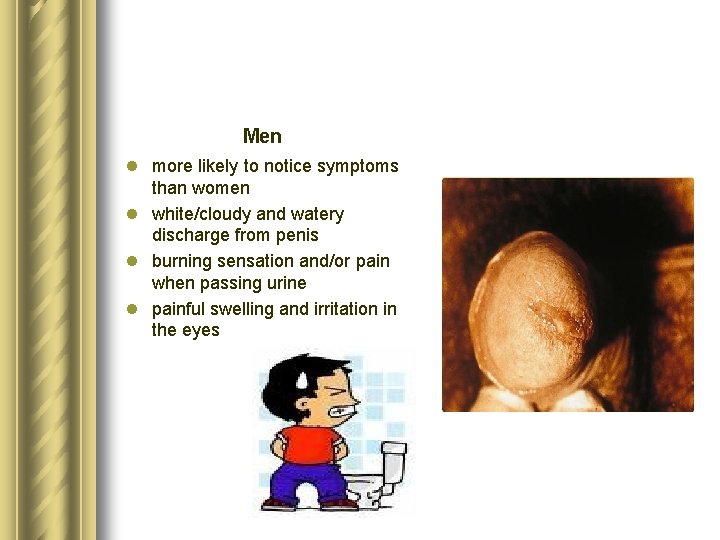
Men l more likely to notice symptoms than women l white/cloudy and watery discharge from penis l burning sensation and/or pain when passing urine l painful swelling and irritation in the eyes
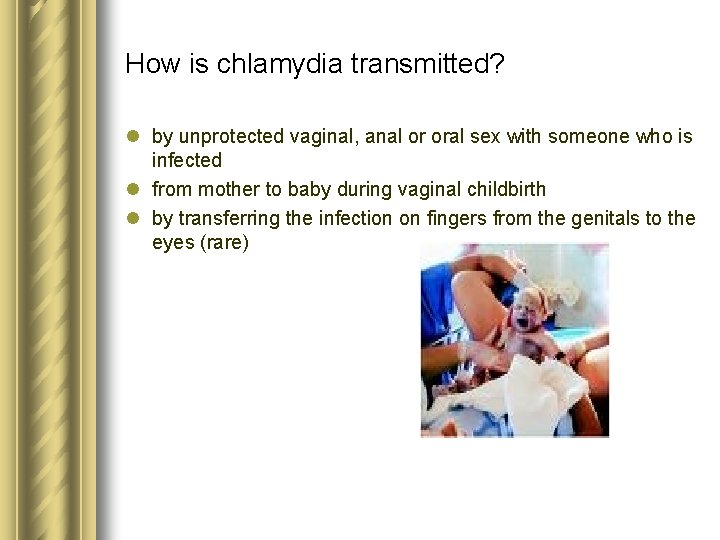
How is chlamydia transmitted? l by unprotected vaginal, anal or oral sex with someone who is infected l from mother to baby during vaginal childbirth l by transferring the infection on fingers from the genitals to the eyes (rare)
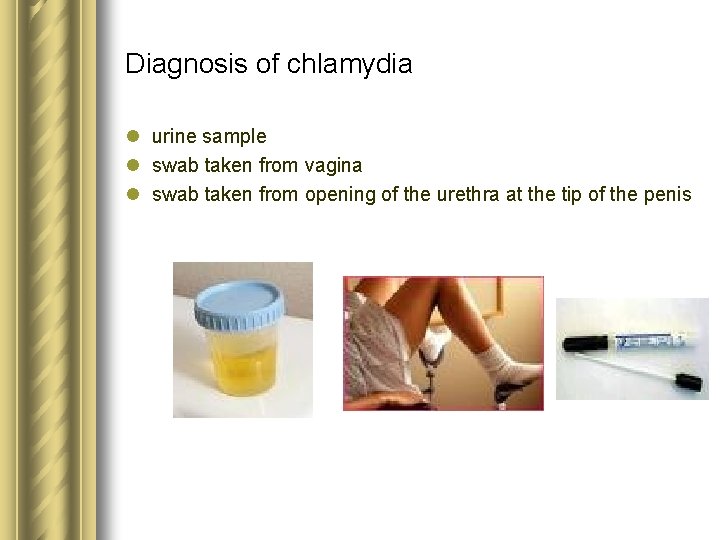
Diagnosis of chlamydia l urine sample l swab taken from vagina l swab taken from opening of the urethra at the tip of the penis
Treatment l short course of antibiotics: azithromycin, doxycycline or erythromycin l one-time dose taken daily or multiple times a day for 5 -10 days l resolves within one to two weeks l sexual abstinence during that period
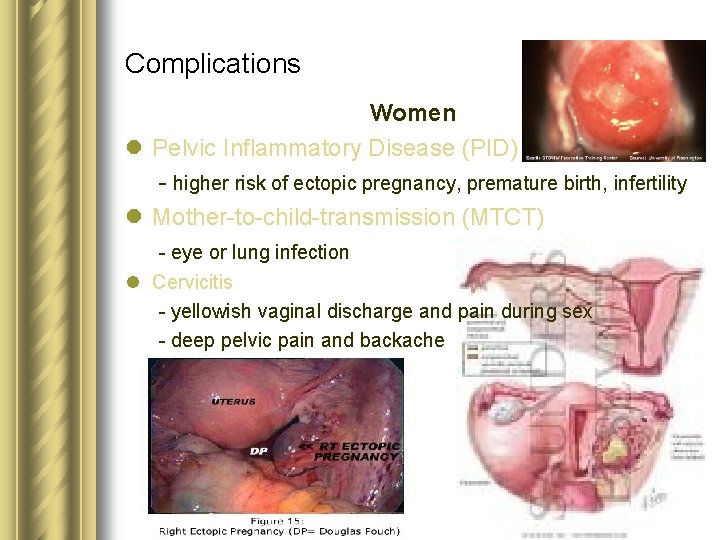
Complications Women l Pelvic Inflammatory Disease (PID) - higher risk of ectopic pregnancy, premature birth, infertility l Mother-to-child-transmission (MTCT) - eye or lung infection l Cervicitis - yellowish vaginal discharge and pain during sex - deep pelvic pain and backache
Men l Epididymitis - infertility l Urethritis - yellow pus-like discharge at the tip of the penis - kidney problems
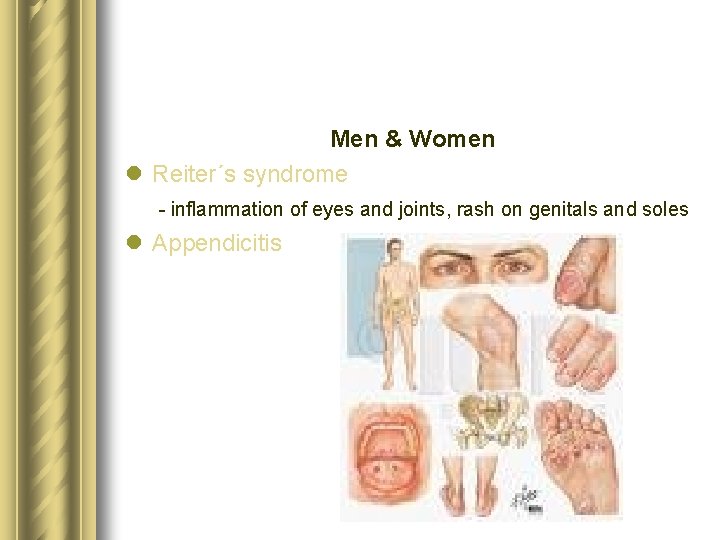
Men & Women l Reiter´s syndrome - inflammation of eyes and joints, rash on genitals and soles l Appendicitis
Other health problems l l l l HIV other STIs chronic pelvic pain prostatitis rectal inflammation eye infections in newborns
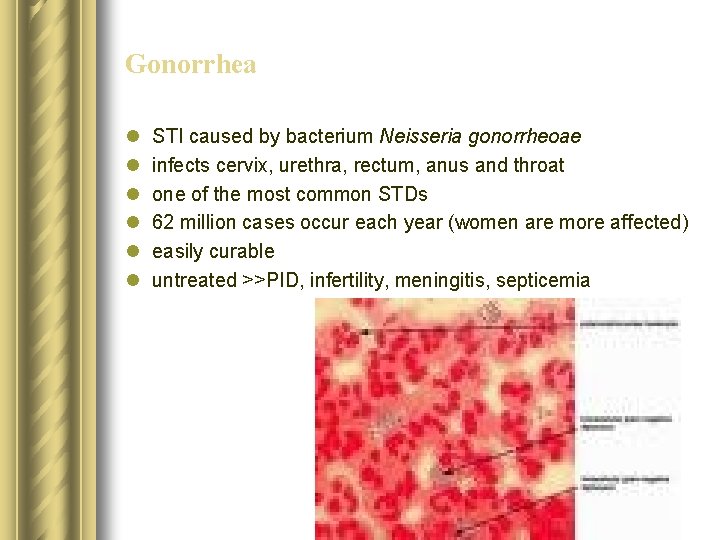
Gonorrhea l l l STI caused by bacterium Neisseria gonorrheoae infects cervix, urethra, rectum, anus and throat one of the most common STDs 62 million cases occur each year (women are more affected) easily curable untreated >>PID, infertility, meningitis, septicemia
Symptoms Women l change in vaginal discharge - yellow or greenish color, strong smell l burning sensation or pain whilst passing urine l irritation and/or discharge from the anus
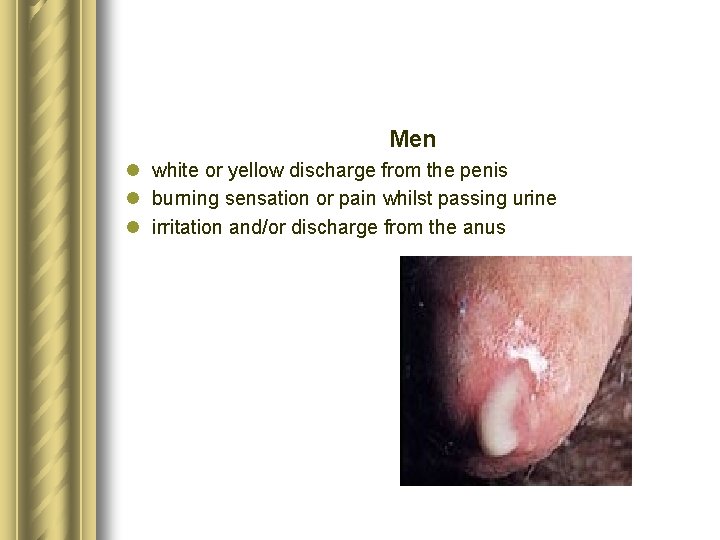
Men l white or yellow discharge from the penis l burning sensation or pain whilst passing urine l irritation and/or discharge from the anus
How is gonorrhea passed on? l through penetrative sex, including: -vaginal sex -anal sex -oral sex
Diagnosis & Treatment l swab taken from any infected area - cervix, urethra, anus or throat l women - internal pelvic examination l swab taken from the rectum/throat l antibiotics in tablet, liquid or injection form l sexual abstinence during the treatment period
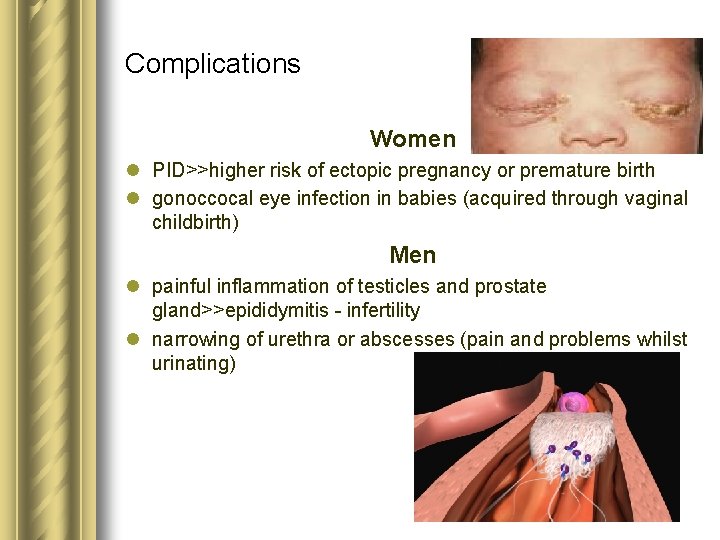
Complications Women l PID>>higher risk of ectopic pregnancy or premature birth l gonoccocal eye infection in babies (acquired through vaginal childbirth) Men l painful inflammation of testicles and prostate gland>>epididymitis - infertility l narrowing of urethra or abscesses (pain and problems whilst urinating)
STD prevention l l l l using condoms mutual monogamy limiting the number of sex partners talking with your partner getting regular screenings for STDs using spermicides - not recommended sexual abstinence until partner has been treated avoid douching
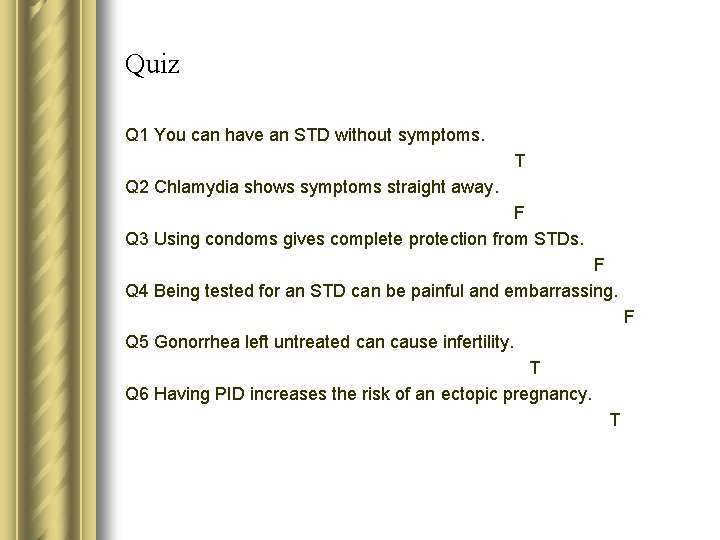
Quiz Q 1 You can have an STD without symptoms. T Q 2 Chlamydia shows symptoms straight away. F Q 3 Using condoms gives complete protection from STDs. F Q 4 Being tested for an STD can be painful and embarrassing. F Q 5 Gonorrhea left untreated can cause infertility. T Q 6 Having PID increases the risk of an ectopic pregnancy. T
Q 7 STDs can be passed on from mother to child. T Q 8 Women are more likely to notice chlamydia symptoms than men. F Q 9 45% of women infected with chlamydia are asymptomatic. F Q 10 Untreated chlamydia infection doesn´t cause any complications. F Q 11 Best ways to avoid getting an STD a)monogamous relationship b)getting tested before having sex for the first time c)using a condom every time you have sex d)sexual abstinence d) b) a) c)
References l l l http: //www. avert. org/chlamydia. htm http: //www. avert. org/gonorrhea. htm http: //www. avert. org/stdstastisticsworldwide. htm http: //en. wikipedia. org/wiki/Sexually_transmitted_disease http: //www. cdc. gov/STD/ http: //www. mayoclinic. com/health/std