
Sexuality in Adulthood Chapter 14 Learning Objectives Being
Sexuality in Adulthood Chapter 14
Learning Objectives • • • Being Single Cohabitation Marriage Divorce Sex in the Later Years Sex and Disability

Being Single Being single is the most common lifestyle among people in their early 20 s • Decline in marriage rates • Pursuing educational and career goals • Cohabitating • Getting married later • Less social stigma for single people today • Many are not single by choice • Many single people are lonely • Most are well adjusted and content
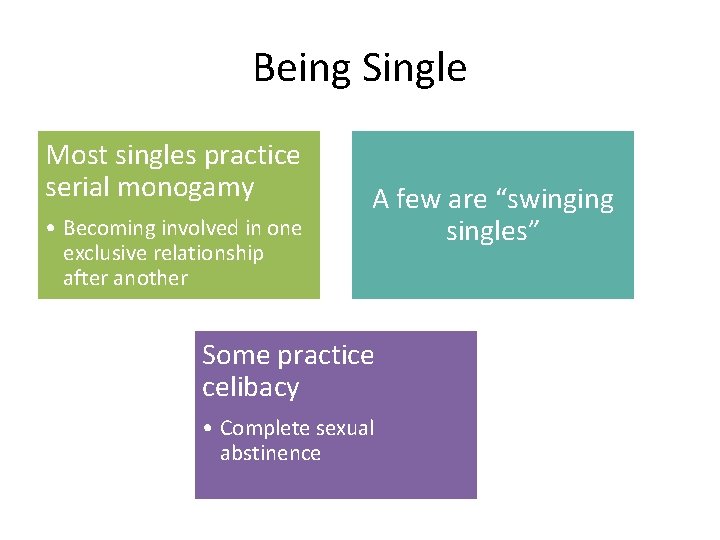
Being Single Most singles practice serial monogamy • Becoming involved in one exclusive relationship after another A few are “swinging singles” Some practice celibacy • Complete sexual abstinence
Being Single Critical Thinking Why do you think the relationship between sexual hookups and self-esteem is different for college men and women in the Felder and Carey (2010) study? Why do you think that parental discouragement of relationships apparently contributed to hookups with oral sex for college women?
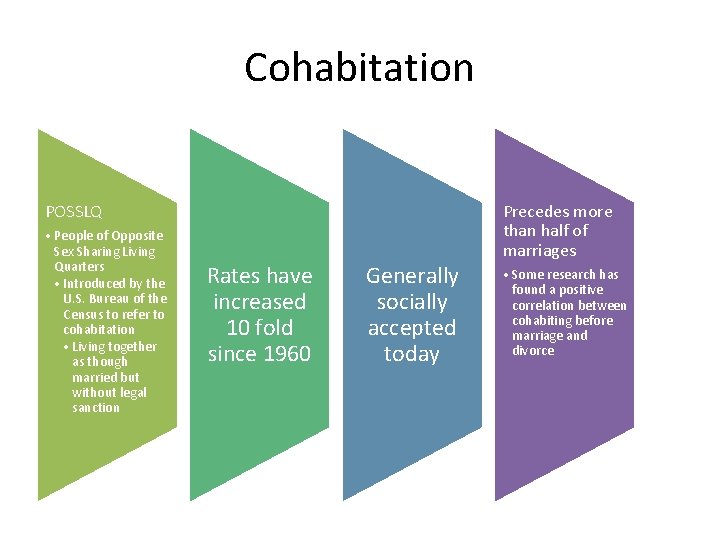
Cohabitation POSSLQ • People of Opposite Sex Sharing Living Quarters • Introduced by the U. S. Bureau of the Census to refer to cohabitation • Living together as though married but without legal sanction Precedes more than half of marriages Rates have increased 10 fold since 1960 Generally socially accepted today • Some research has found a positive correlation between cohabiting before marriage and divorce
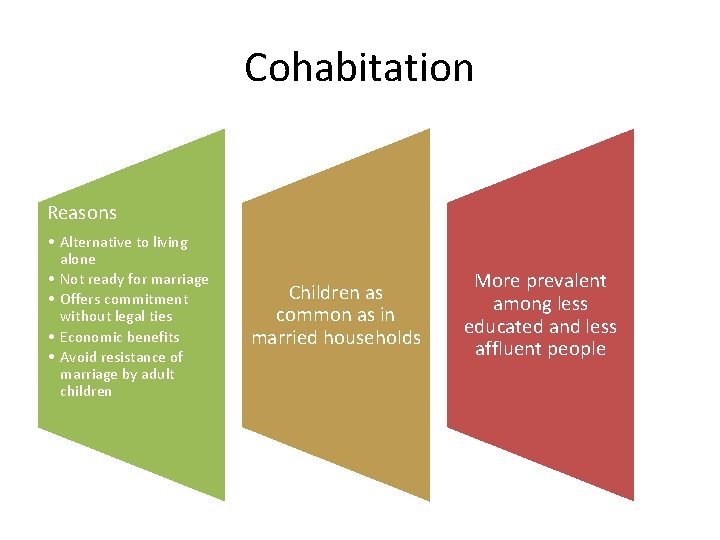
Cohabitation Reasons • Alternative to living alone • Not ready for marriage • Offers commitment without legal ties • Economic benefits • Avoid resistance of marriage by adult children Children as common as in married households More prevalent among less educated and less affluent people
Critical Thinking Why might cohabitating couples run a greater risk of divorce than couples who did not cohabit before marriage?
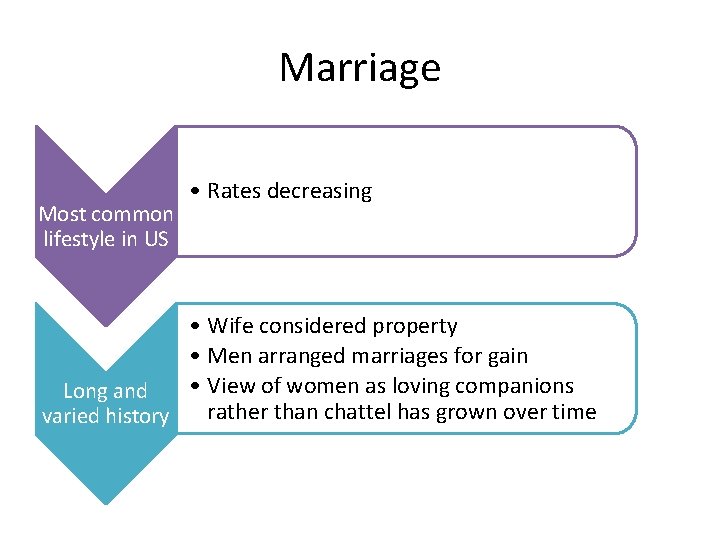
Marriage Most common lifestyle in US • Rates decreasing • Wife considered property • Men arranged marriages for gain • View of women as loving companions Long and rather than chattel has grown over time varied history
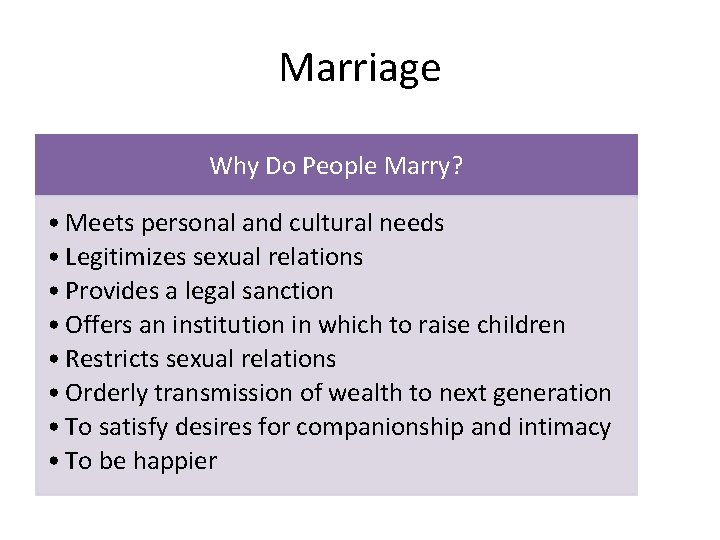
Marriage Why Do People Marry? • Meets personal and cultural needs • Legitimizes sexual relations • Provides a legal sanction • Offers an institution in which to raise children • Restricts sexual relations • Orderly transmission of wealth to next generation • To satisfy desires for companionship and intimacy • To be happier
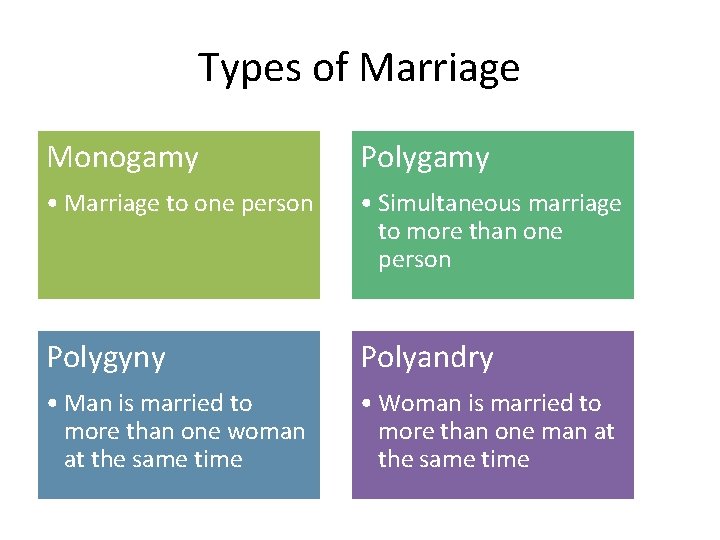
Types of Marriage Monogamy Polygamy • Marriage to one person • Simultaneous marriage to more than one person Polygyny Polyandry • Man is married to more than one woman at the same time • Woman is married to more than one man at the same time
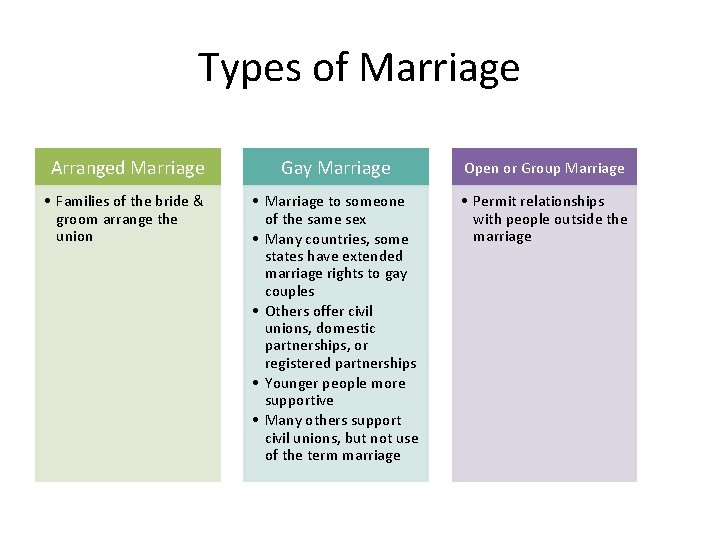
Types of Marriage Arranged Marriage Gay Marriage Open or Group Marriage • Families of the bride & groom arrange the union • Marriage to someone of the same sex • Many countries, some states have extended marriage rights to gay couples • Others offer civil unions, domestic partnerships, or registered partnerships • Younger people more supportive • Many others support civil unions, but not use of the term marriage • Permit relationships with people outside the marriage
Critical Thinking Some have suggested that the term marriage should be restricted to a religious ceremony and status, and that the term civil union should be restricted to a civil union and status. However, the religious status would also include the civil benefits. What do you think?
Whom Do We Marry In the choice of their marriage partner, most people practice homogamy Some marriages also show a mating gradient • The practice of marrying people who are similar • Racial and ethnic background, education, religion, age, social background and standing • Tendency for women to “marry up” (in social and economic status) and for men to “marry down”
Marital Sex Western views restrictive prior to sexual revolution of 1960 s and 1970 s • Foreplay lasts longer and is more varied • Frequency of coitus has not changed significantly since the 1950 s • Frequency declines with years of marriage • Older couples engage in coitus less frequently • More varied coital positions are used today • Coitus lasts longer today • Sexual satisfaction • Orgasmic consistency is higher today for men and women • Women in their 40 s are somewhat more likely to reach orgasm consistently • Emotional satisfaction is linked to sexual satisfaction
Marital Satisfaction Commitment Adequate income Sharing in housework Generosity towards one’s spouse Support of family and friends Agreement on raising children Sexual satisfaction
Critical Thinking • Agree or disagree with the following statement, and support your answer: • Marriage is an oldfashioned, outdated lifestyle that has become irrelevant for today’s sophisticated young people.
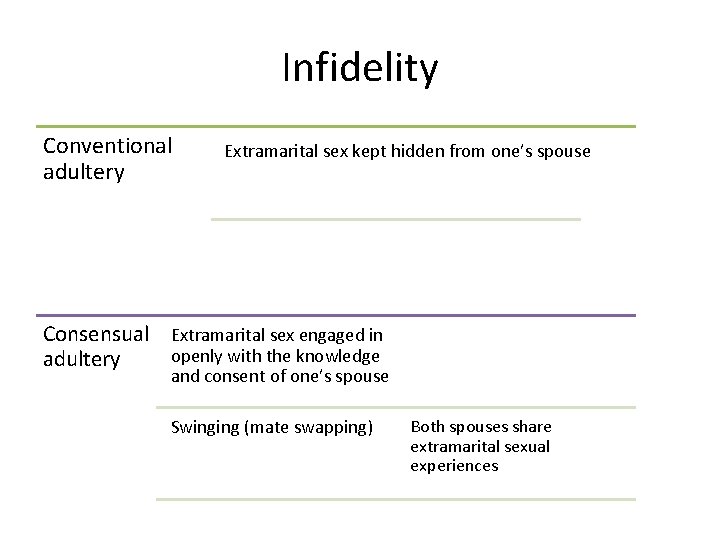
Infidelity Conventional adultery Extramarital sex kept hidden from one’s spouse Consensual Extramarital sex engaged in openly with the knowledge adultery and consent of one’s spouse Swinging (mate swapping) Both spouses share extramarital sexual experiences
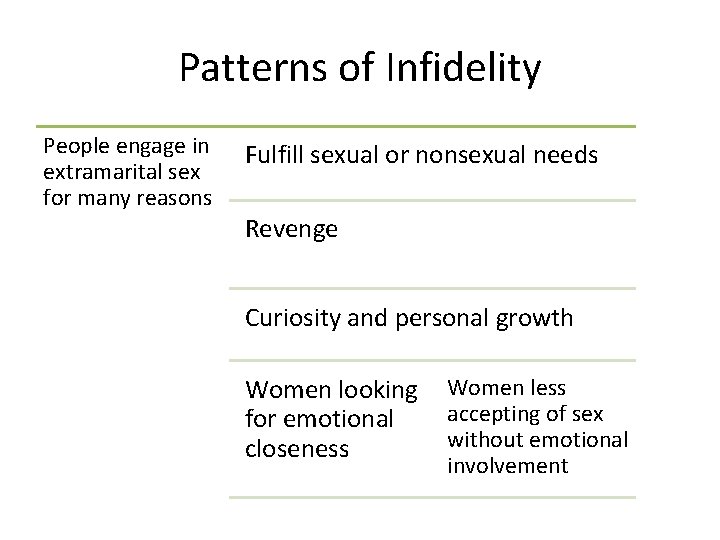
Patterns of Infidelity People engage in extramarital sex for many reasons Fulfill sexual or nonsexual needs Revenge Curiosity and personal growth Women looking for emotional closeness Women less accepting of sex without emotional involvement
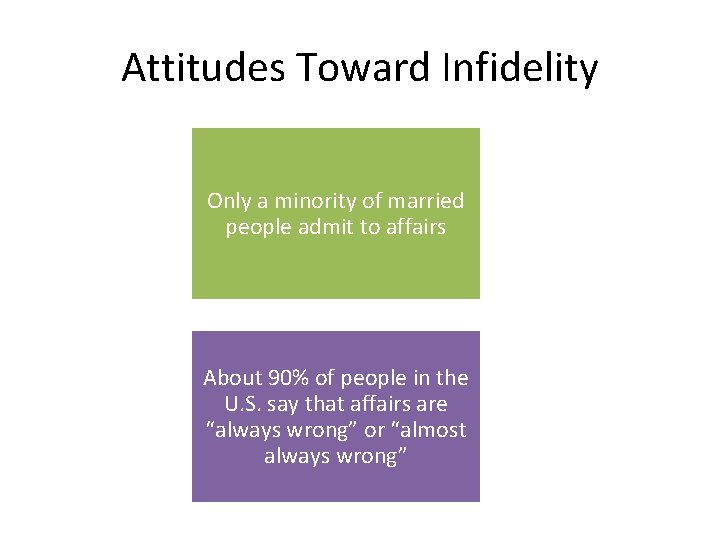
Attitudes Toward Infidelity Only a minority of married people admit to affairs About 90% of people in the U. S. say that affairs are “always wrong” or “almost always wrong”
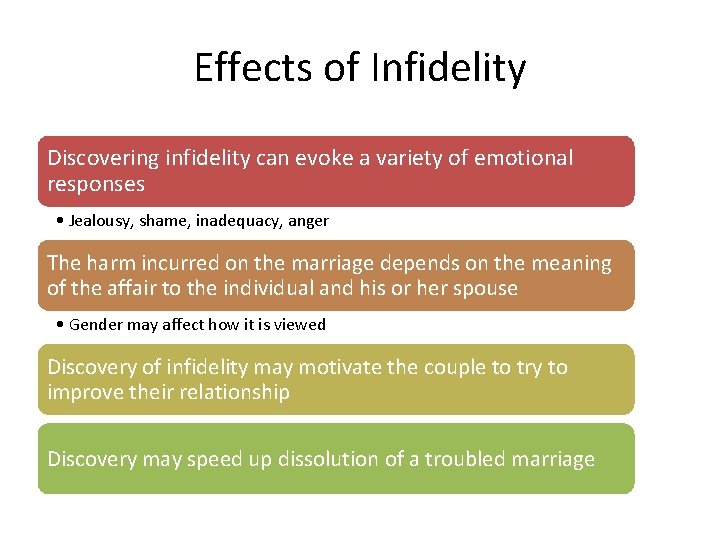
Effects of Infidelity Discovering infidelity can evoke a variety of emotional responses • Jealousy, shame, inadequacy, anger The harm incurred on the marriage depends on the meaning of the affair to the individual and his or her spouse • Gender may affect how it is viewed Discovery of infidelity may motivate the couple to try to improve their relationship Discovery may speed up dissolution of a troubled marriage
Divorce Between 40 -50% of marriages in the US end in divorce Reasons include Relaxation of legal restrictions on divorce Increased economic independence of women People have higher expectations of marriage compared to previous generations Problems with communication and a lack of understanding are the most common reasons given for divorce Important predictors are a husband’s criticism, defensiveness, contempt, and stonewalling
Divorce A woman’s income drops by 24% and a man’s declines by about 6% Divorced and separated people have high rates of physical and mental illness and suicide Effects on the child Divorce is hardest for children in the first year following the breakup Boys greater problems earlier Girls greater problems later Adjustment is easier when both parents maintain their parenting responsibilities and set aside their differences in the presence of children
Divorce Staying Together for the Children Studies show that parental bickering and fighting is linked to the same kinds of problems children experience when their parents separate or divorce Exposure to marital conflict is stressful and has health consequences
Divorce Blended families Stepfamilies increasingly common with the rise in divorce and remarriage Can be a positive situation Many disband due to conflict Higher incidence of sexual abuse by stepparents
Sex in the Later Years Sexual daydreaming, sex drive, and sexual activity decline with age • Negative attitudes towards sex increase Do not necessarily lose their sexuality Sexual activity among older people influenced by • Physical structures and changes • Psychological well-being • Feelings of intimacy • Cultural expectations
Sex in the Later Years Female Physical Changes • Many changes result from a decline in estrogen production • Less vaginal lubrication occurs • Vaginal walls lose elasticity • Orgasms may not feel as physically intense
Sex in the Later Years Male Physical Changes • Changes may result from a decline in testosterone levels • After age 50, men take progressively longer to achieve erection • Erections become less firm • Men may need more time to reach orgasm • The refractory period tends to become longer with age • Orgasms may not feel as physically intense
Sex in the Later Years Patterns of Sexual Activity • Frequency declines with age • Broaden sexual repertoire to accommodate physical changes of aging • Oral-genital stimulation • Fantasy • Pornography • Anal stimulation • Sex toys • Availability of an interested & supportive partner is most determinate factor in continued activity
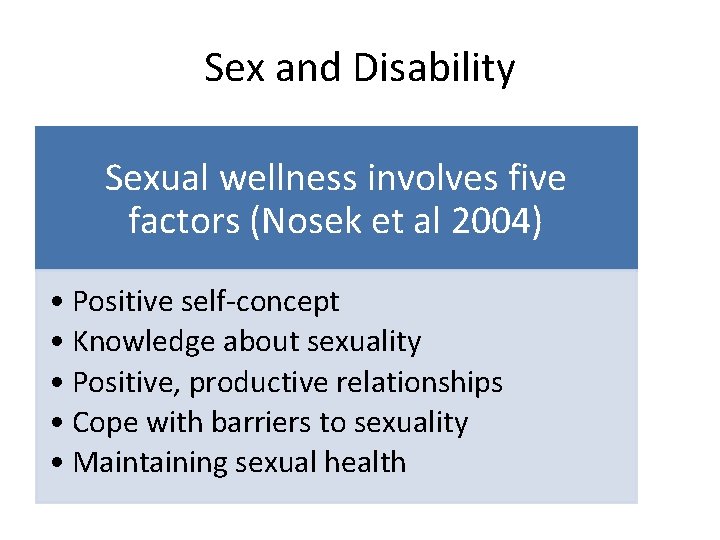
Sex and Disability Sexual wellness involves five factors (Nosek et al 2004) • Positive self-concept • Knowledge about sexuality • Positive, productive relationships • Cope with barriers to sexuality • Maintaining sexual health
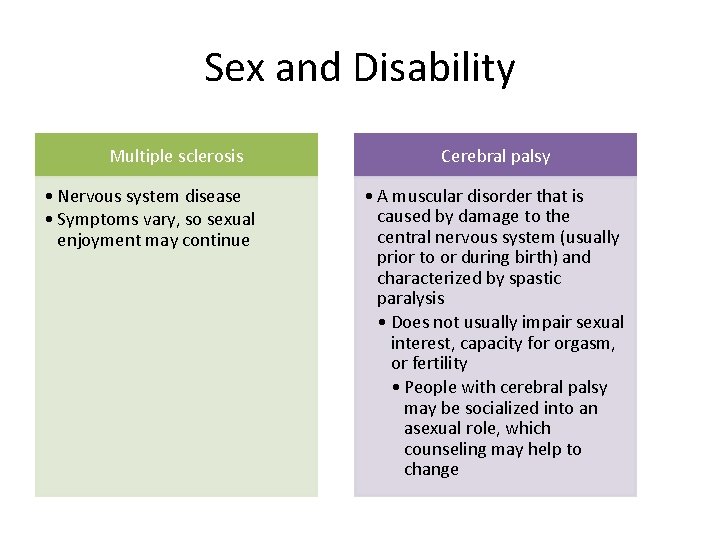
Sex and Disability Multiple sclerosis • Nervous system disease • Symptoms vary, so sexual enjoyment may continue Cerebral palsy • A muscular disorder that is caused by damage to the central nervous system (usually prior to or during birth) and characterized by spastic paralysis • Does not usually impair sexual interest, capacity for orgasm, or fertility • People with cerebral palsy may be socialized into an asexual role, which counseling may help to change
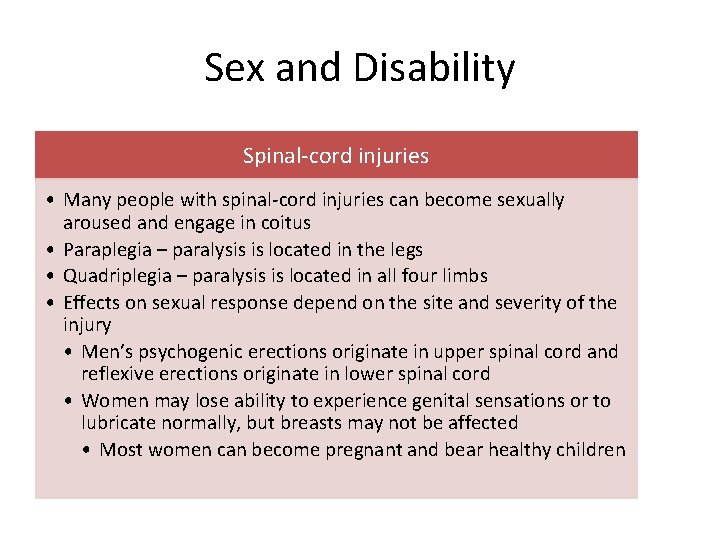
Sex and Disability Spinal-cord injuries • Many people with spinal-cord injuries can become sexually aroused and engage in coitus • Paraplegia – paralysis is located in the legs • Quadriplegia – paralysis is located in all four limbs • Effects on sexual response depend on the site and severity of the injury • Men’s psychogenic erections originate in upper spinal cord and reflexive erections originate in lower spinal cord • Women may lose ability to experience genital sensations or to lubricate normally, but breasts may not be affected • Most women can become pregnant and bear healthy children
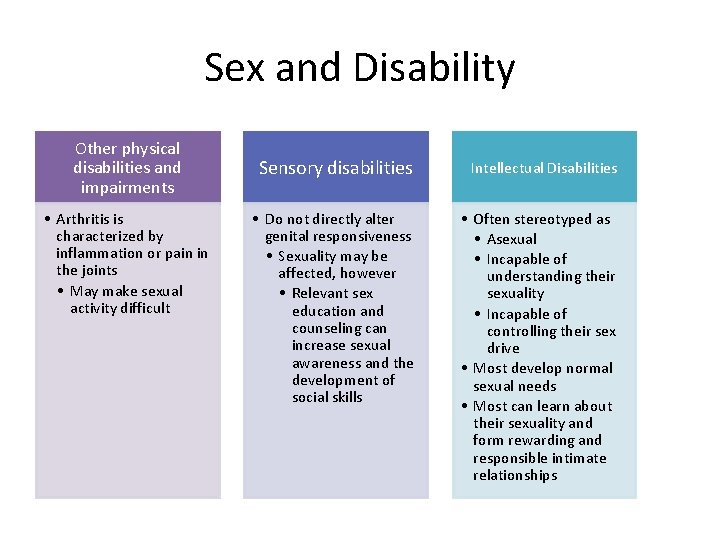
Sex and Disability Other physical disabilities and impairments • Arthritis is characterized by inflammation or pain in the joints • May make sexual activity difficult Sensory disabilities Intellectual Disabilities • Do not directly alter genital responsiveness • Sexuality may be affected, however • Relevant sex education and counseling can increase sexual awareness and the development of social skills • Often stereotyped as • Asexual • Incapable of understanding their sexuality • Incapable of controlling their sex drive • Most develop normal sexual needs • Most can learn about their sexuality and form rewarding and responsible intimate relationships
- Slides: 33