
Sexual Variants Disorder PSY 230 Sexual Disorder Research
- Slides: 48
Sexual Variants Disorder PSY 230
Sexual Disorder Research Much less is known about sexual abuse and dysfunction than other disorders because: 1. There are far fewer researchers in the field 2. Many sexually related issues are among the most divisive in our culture and researchers are often confronted by opposition 3. Sex taboo makes gathering information problematic
Origins of sex taboos • Degeneracy Theory (Simon Tissot 1750’s) semen is necessary for male physical and sexual vigor…so do not waste it via masturbation or non-procreative sex which “wastes the vital fluid”. They did not know about Testosterone back then • Abstinence Theory ( Rev. Sylvester Graham 1830’s America) advocate the “ 3 cornerstones for public health: healthy Food (Graham’s crackers), physical fitness, and sexual abstinence. o Dr John Harvey Kellogg (was an influential physician who published numerous books about the dangers of masturbation and the 39 signs of the “secret vice”; published to help parents detect child masturbation. He recommended extreme measures for treatment of persistent child masturbation and pushed for minimal consumption of meat to lower libido…Kellogg’s Corn Flakes as an anti-masturbatory food • While these puritanical (by today’s standards) ideas have changed to a large degree (Boy Scouts Manual dropped antimasturbation warnings in 1972 but Jocelyn Elders was fired as Surgeon general in 1994 for suggesting masturbation be covered in sex education curriculums and the Roman Catholic Church still considers it a sin)… the obvious early discomfort with sexual matters so clearly evident in centuries past is still very much present in today’s American culture.
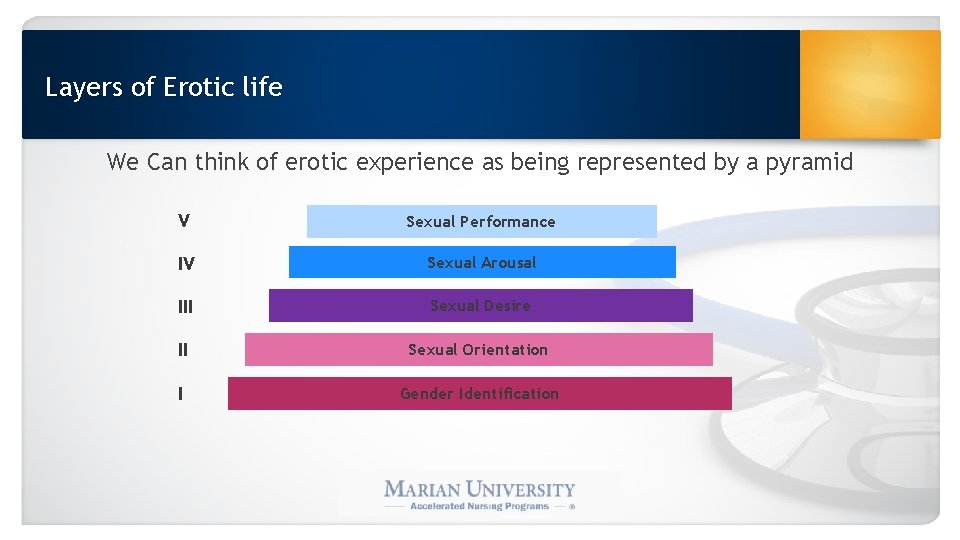
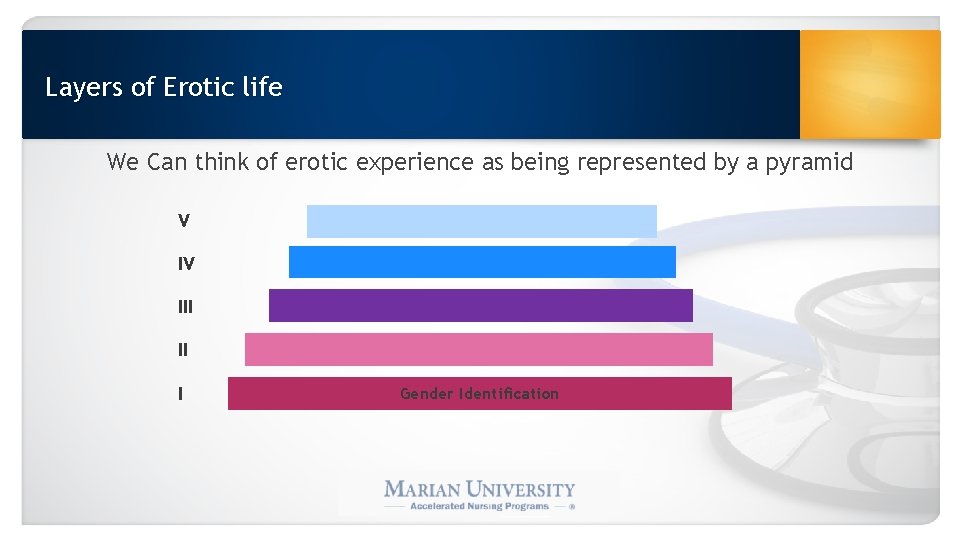
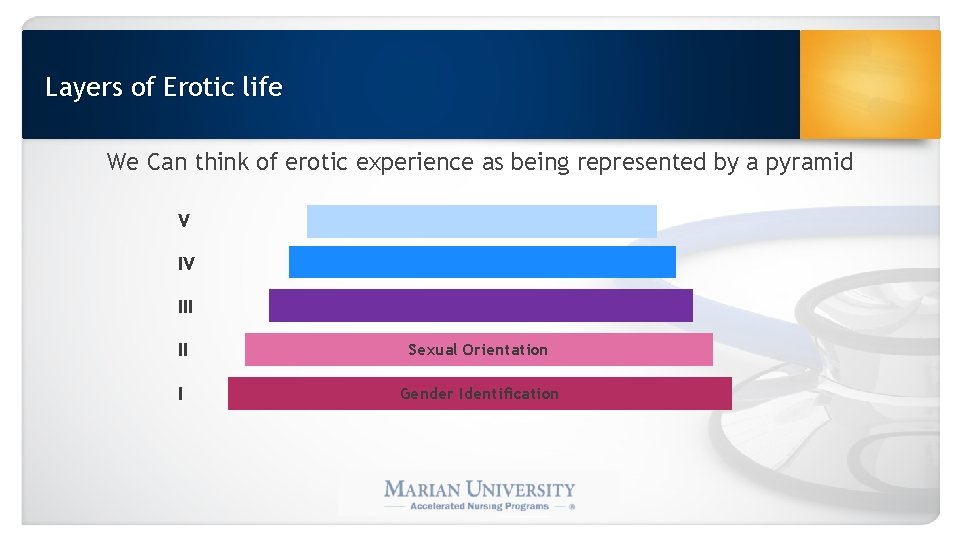
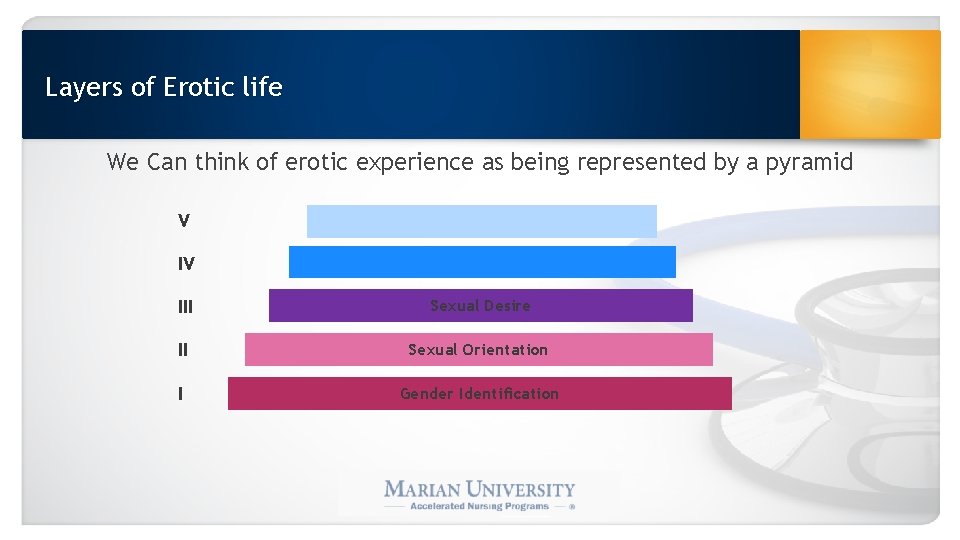
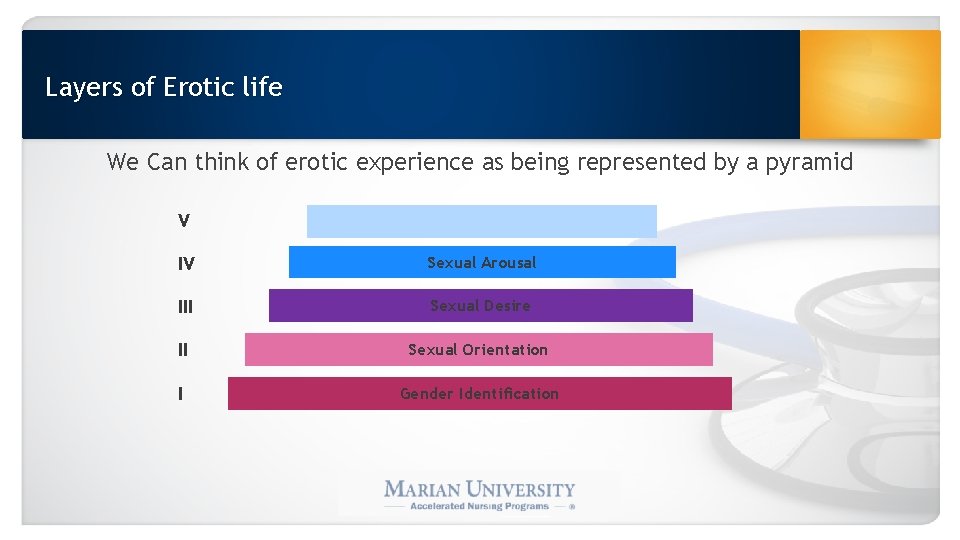
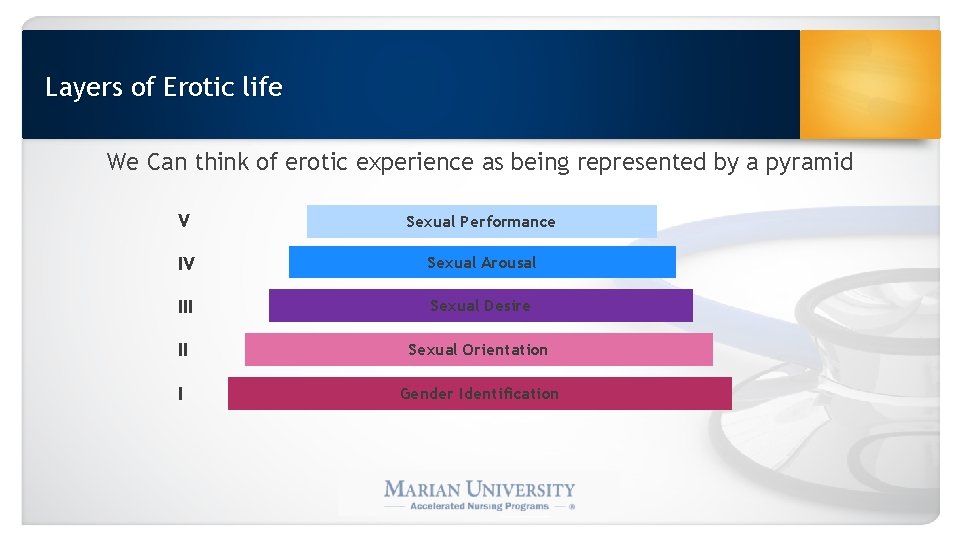
Layers of Erotic life We Can think of erotic experience as being represented by a pyramid V Sexual Performance IV Sexual Arousal III Sexual Desire II Sexual Orientation I Gender Identification
Layers of Erotic life • What is “normal ” at any layer of experience is open to change and cultural variation. Our dictum of harm and dysfunction still applies and some sexual acts are universally considered pathological (e. g. Jeffery Dahlmer) but often what is “normal” is very much in the eye of the beholder.
Layers of Erotic life We Can think of erotic experience as being represented by a pyramid V IV III II I Gender Identification
Gender Dysphoria Disorder In the DSM 5. 0 this disorder replaces what was Gender Identity Disorder and involves conflicts between a person’s anatomical sex and their gender identity or self identification as male or female
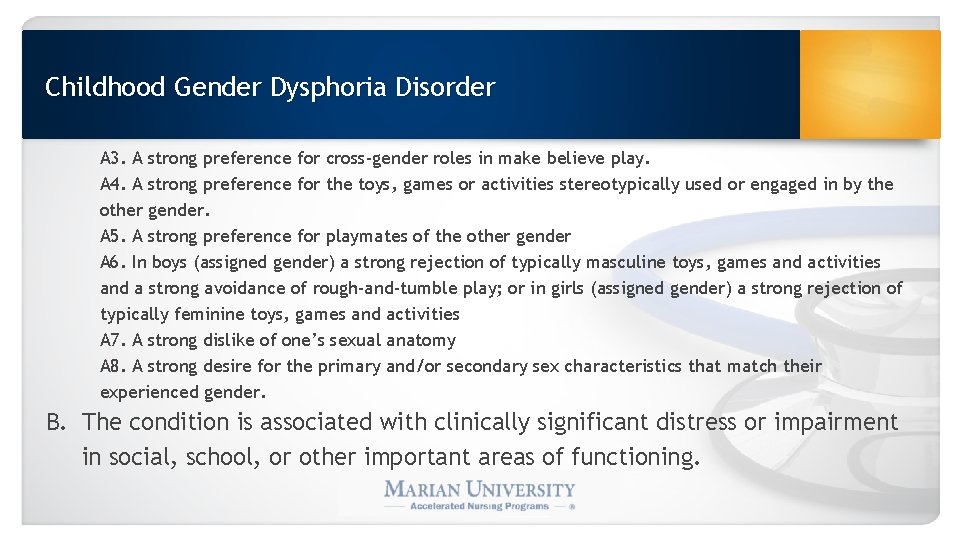
Childhood Gender Dysphoria Disorder A. A marked incongruence between one’s experienced/expressed gender and assigned gender of at least 6 months duration, as manifested by at least six of the following (one of which must be criterion A 1) A 1. A strong desire to be the other gender or an insistence that one is the other gender ( or some alternate gender different from one’s assigned gender). A mere preference for cross-gender toys, activities and games is not sufficient A 2. In boys (assigned gender) a strong preference for cross-dressing or simulating female attire, or in girls (assigned gender) a strong preference for wearing only typical masculine clothing and a strong resistance to wearing feminine clothing
Childhood Gender Dysphoria Disorder A 3. A strong preference for cross-gender roles in make believe play. A 4. A strong preference for the toys, games or activities stereotypically used or engaged in by the other gender. A 5. A strong preference for playmates of the other gender A 6. In boys (assigned gender) a strong rejection of typically masculine toys, games and activities and a strong avoidance of rough-and-tumble play; or in girls (assigned gender) a strong rejection of typically feminine toys, games and activities A 7. A strong dislike of one’s sexual anatomy A 8. A strong desire for the primary and/or secondary sex characteristics that match their experienced gender. B. The condition is associated with clinically significant distress or impairment in social, school, or other important areas of functioning.
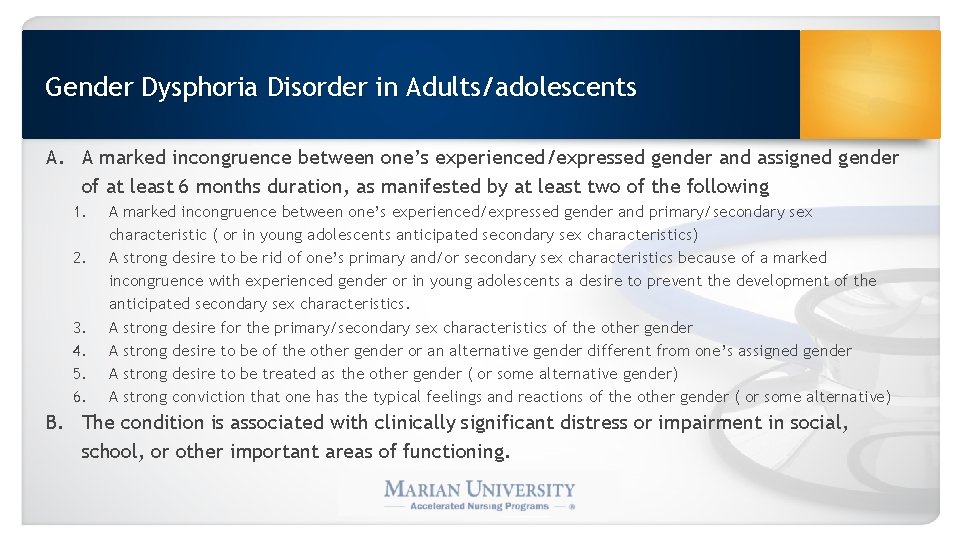
Gender Dysphoria Disorder in Adults/adolescents A. A marked incongruence between one’s experienced/expressed gender and assigned gender of at least 6 months duration, as manifested by at least two of the following 1. 2. 3. 4. 5. 6. A marked incongruence between one’s experienced/expressed gender and primary/secondary sex characteristic ( or in young adolescents anticipated secondary sex characteristics) A strong desire to be rid of one’s primary and/or secondary sex characteristics because of a marked incongruence with experienced gender or in young adolescents a desire to prevent the development of the anticipated secondary sex characteristics. A strong desire for the primary/secondary sex characteristics of the other gender A strong desire to be of the other gender or an alternative gender different from one’s assigned gender A strong desire to be treated as the other gender ( or some alternative gender) A strong conviction that one has the typical feelings and reactions of the other gender ( or some alternative) B. The condition is associated with clinically significant distress or impairment in social, school, or other important areas of functioning.
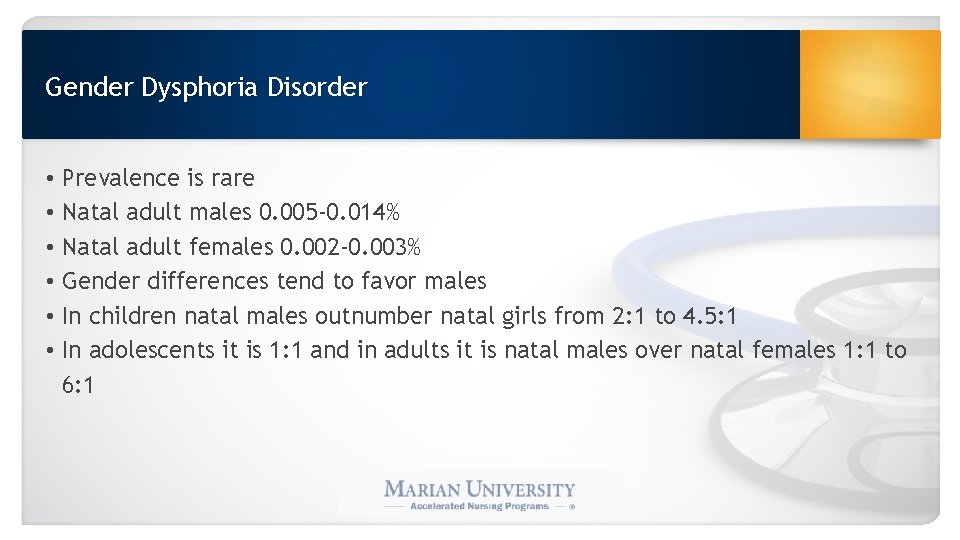
Gender Dysphoria Disorder • • • Prevalence is rare Natal adult males 0. 005 -0. 014% Natal adult females 0. 002 -0. 003% Gender differences tend to favor males In children natal males outnumber natal girls from 2: 1 to 4. 5: 1 In adolescents it is 1: 1 and in adults it is natal males over natal females 1: 1 to 6: 1
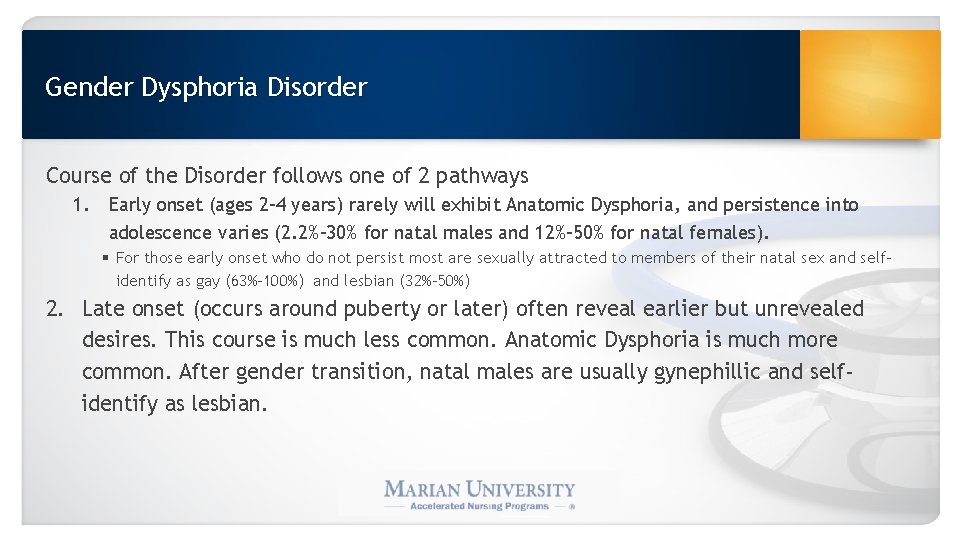
Gender Dysphoria Disorder Course of the Disorder follows one of 2 pathways 1. Early onset (ages 2 -4 years) rarely will exhibit Anatomic Dysphoria, and persistence into adolescence varies (2. 2%-30% for natal males and 12%-50% for natal females). § For those early onset who do not persist most are sexually attracted to members of their natal sex and selfidentify as gay (63%-100%) and lesbian (32%-50%) 2. Late onset (occurs around puberty or later) often reveal earlier but unrevealed desires. This course is much less common. Anatomic Dysphoria is much more common. After gender transition, natal males are usually gynephillic and selfidentify as lesbian.
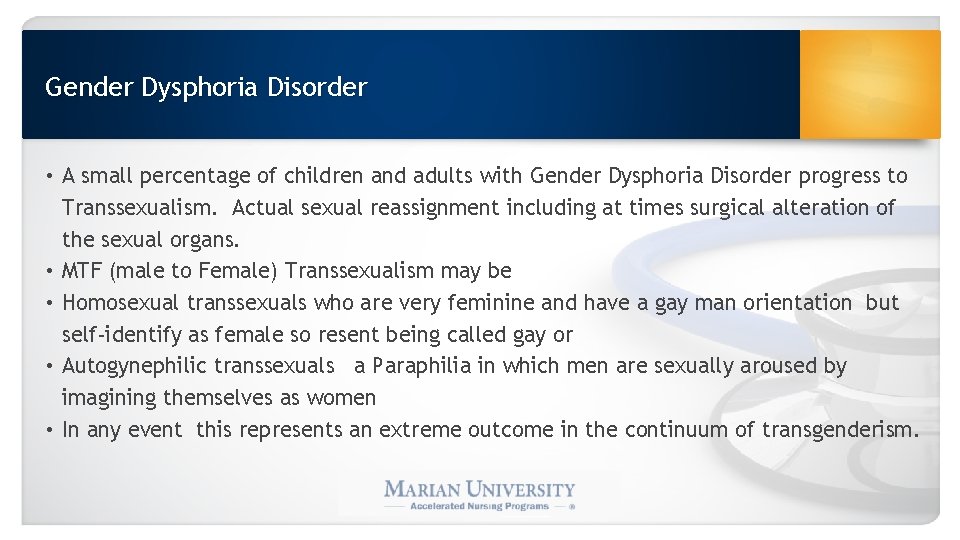
Gender Dysphoria Disorder • A small percentage of children and adults with Gender Dysphoria Disorder progress to Transsexualism. Actual sexual reassignment including at times surgical alteration of the sexual organs. • MTF (male to Female) Transsexualism may be • Homosexual transsexuals who are very feminine and have a gay man orientation but self-identify as female so resent being called gay or • Autogynephilic transsexuals a Paraphilia in which men are sexually aroused by imagining themselves as women • In any event this represents an extreme outcome in the continuum of transgenderism.
Therapy • Therapies vary and controversy exists about how to approach the disorder. Therapy aimed at supporting behavior consistent with anatomy is seen as painful and harmful by some. Transitioning to the psychological gender is typically endorsed by many but not all. Surgical sex re-assignment is the only treatment that has shown to be reliably effective.
Social Controversy • As professional psychologists we do not engage in religious debate, political allegiance's or philosophical imperatives. We are scientists who stick to the research based facts in hand. • Regardless of a person’s emotional views of transgender children, there must be no mistake that life is difficult for these vulnerable children.
Layers of Erotic life We Can think of erotic experience as being represented by a pyramid V IV III II Sexual Orientation I Gender Identification
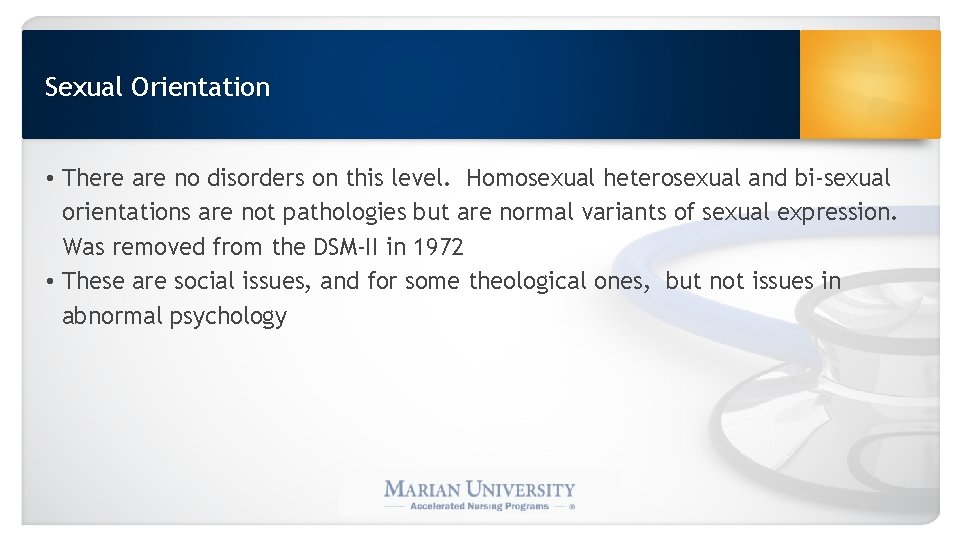
Sexual Orientation • There are no disorders on this level. Homosexual heterosexual and bi-sexual orientations are not pathologies but are normal variants of sexual expression. Was removed from the DSM-II in 1972 • These are social issues, and for some theological ones, but not issues in abnormal psychology
Layers of Erotic life We Can think of erotic experience as being represented by a pyramid V IV III Sexual Desire II Sexual Orientation I Gender Identification
Upper strata of erotic life • As we progress up the pyramid of erotic life we begin to now encounter possible problems that occur during varying stages of the Human Sexual response Cycle which has 4 phases: 1. Desire fantasies and interest about sexual activity reflecting a sense of interest in sexual activity 2. Excitement (arousal) stage is characterized by a subjective sense of sexual pleasure and by physiological changes that accompany this subjective pleasure including penile erection in males and vaginal lubrication in females 3. Orgasm the stage during which there is a release of sexual tension and a peaking of sexual pleasure 4. Resolution during which stage a person has a sense of relaxation and well-being
Sexual Desire Disorders • Male Hypoactive Sexual Desire Disorder is defined as persistently deficient or absent sexual thoughts, fantasies, or desire for sexual activity persisting for at least 6 months. o Must cause significant distress in the individual o Not due to another disorder • Can be lifelong and is acquired secondary to psychological or biological factors. Depression and relationship problems are the most common causes. • Though low sexual interest is a common complaint for men (17% of those seeking treatment for sexual problems) only 1. 8% meet the 6 month period to qualify for the diagnosis • What about for women? • The DSM 5. 0 rolled sexual desire and arousal experiences in women into one disorder.
Sexual Desire • What about wanting sex too much? ? Is this a disorder? Is there something called nymphomania? Sexual obsession? Sexual compulsion? 1. What is TOO MUCH? 2. A person who finds sex highly rewarding may “do it” a lot, but obsessions are ego dystonic remember…liking sex is ego syntonic • Compulsion involves reduction of anxiety through ego dystonic rituals and active individuals exercise volition without anxiety buildup with abstinence. • There is no diagnostic category corresponding to excessive sexual behavior
Layers of Erotic life We Can think of erotic experience as being represented by a pyramid V IV Sexual Arousal III Sexual Desire II Sexual Orientation I Gender Identification
Sexual Arousal Disorders - ED Male Erectile Disorder (ED) At least one of the following three symptoms must be experienced on almost all or all occasions of sexual activity (70%100%) A. Marked difficulty in obtaining an erection during sexual activity 1. Marked difficulty in maintaining an erection through the completion of sexual activity 2. Marked decrease in erectile rigidity 3. Symptoms have persisted for at least 6 months B. Symptoms cause clinically significant distress in the individual C. Not related to another mental disorder, severe relationship distress or other medical or substance induced conditions.
ED • Frequency of reports increases with age with 7% of 18 -19 year old men and 18% of 50 - 59 year old men reporting ED. • Primary ED is the diagnosis when a man has never been able to engage successfully in intercourse and is quite rare • Secondary ED refers to conditions where at least one successful attempt exists but current ED prevails
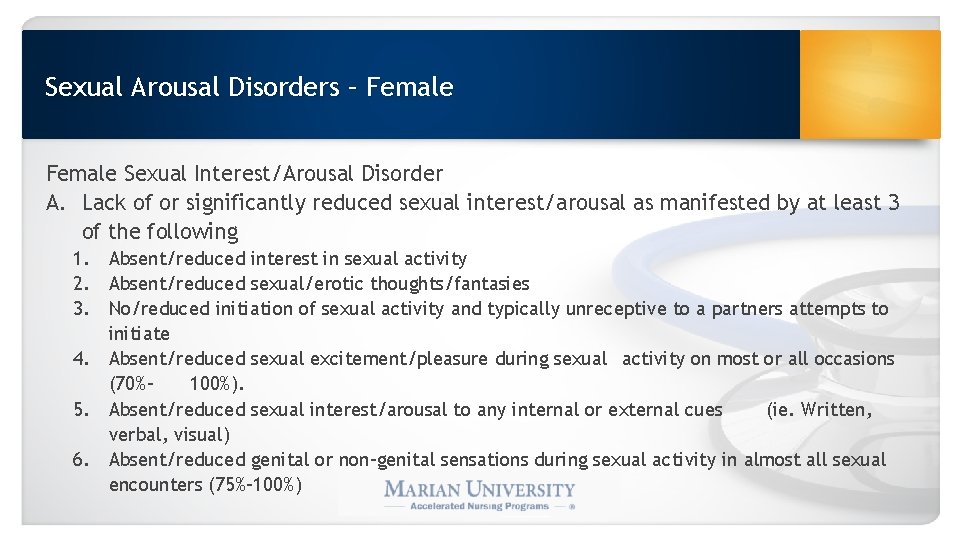
Sexual Arousal Disorders – Female Sexual Interest/Arousal Disorder A. Lack of or significantly reduced sexual interest/arousal as manifested by at least 3 of the following 1. Absent/reduced interest in sexual activity 2. Absent/reduced sexual/erotic thoughts/fantasies 3. No/reduced initiation of sexual activity and typically unreceptive to a partners attempts to initiate 4. Absent/reduced sexual excitement/pleasure during sexual activity on most or all occasions (70%100%). 5. Absent/reduced sexual interest/arousal to any internal or external cues (ie. Written, verbal, visual) 6. Absent/reduced genital or non-genital sensations during sexual activity in almost all sexual encounters (75%-100%)
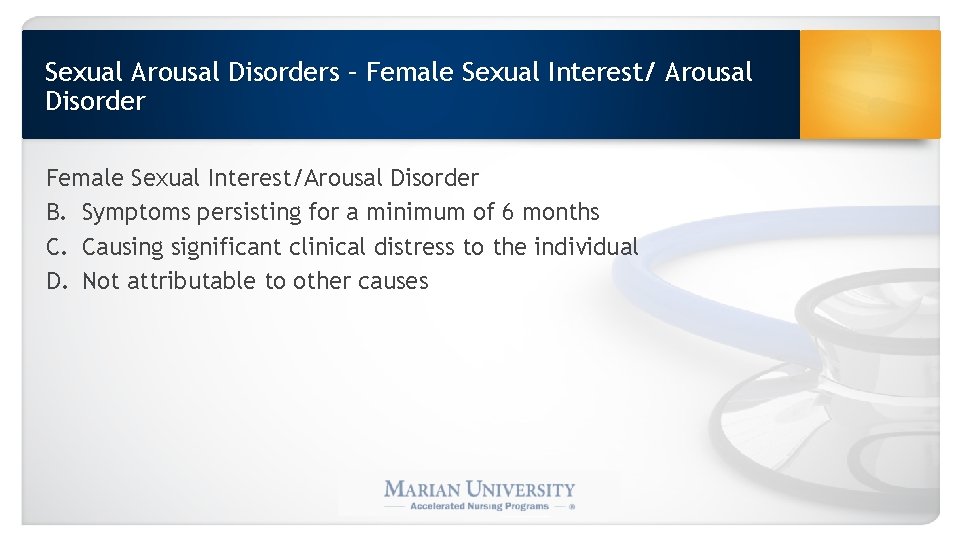
Sexual Arousal Disorders – Female Sexual Interest/ Arousal Disorder Female Sexual Interest/Arousal Disorder B. Symptoms persisting for a minimum of 6 months C. Causing significant clinical distress to the individual D. Not attributable to other causes
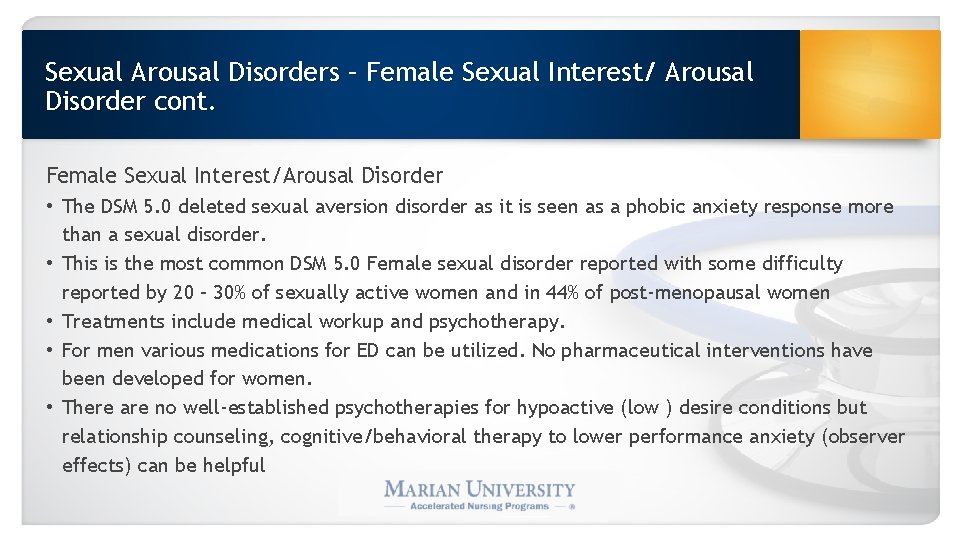
Sexual Arousal Disorders – Female Sexual Interest/ Arousal Disorder cont. Female Sexual Interest/Arousal Disorder • The DSM 5. 0 deleted sexual aversion disorder as it is seen as a phobic anxiety response more than a sexual disorder. • This is the most common DSM 5. 0 Female sexual disorder reported with some difficulty reported by 20 – 30% of sexually active women and in 44% of post-menopausal women • Treatments include medical workup and psychotherapy. • For men various medications for ED can be utilized. No pharmaceutical interventions have been developed for women. • There are no well-established psychotherapies for hypoactive (low ) desire conditions but relationship counseling, cognitive/behavioral therapy to lower performance anxiety (observer effects) can be helpful
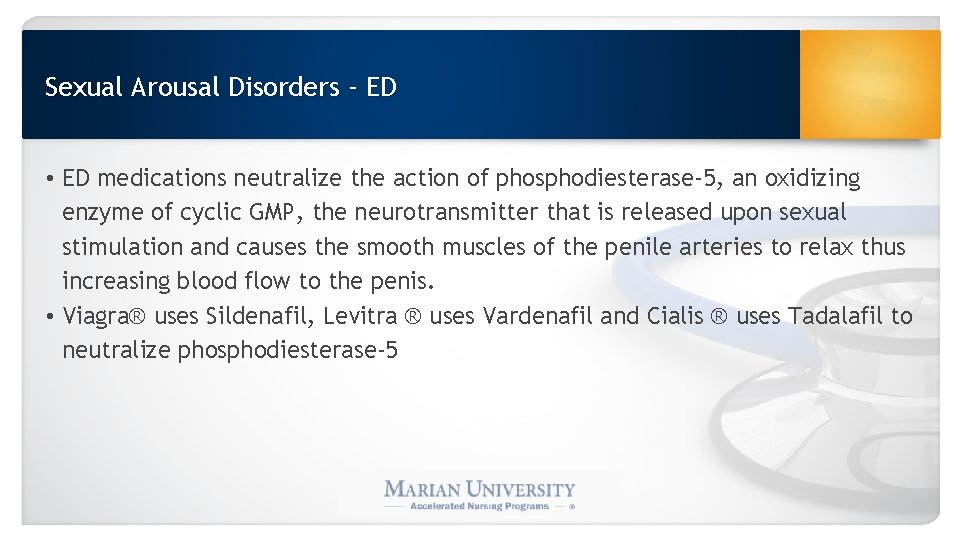
Sexual Arousal Disorders - ED • ED medications neutralize the action of phosphodiesterase-5, an oxidizing enzyme of cyclic GMP, the neurotransmitter that is released upon sexual stimulation and causes the smooth muscles of the penile arteries to relax thus increasing blood flow to the penis. • Viagra® uses Sildenafil, Levitra ® uses Vardenafil and Cialis ® uses Tadalafil to neutralize phosphodiesterase-5
Sexual Arousal Disorders – Female and Male Erectile Disorder and Female Sexual Interest/Arousal Disorder • Both deal with insufficient arousal levels. Now lets turn to arousal disorders that deal with sexual arousal that is sufficient but is associated with “atypical” stimuli.
Sexual Arousal Disorders - Paraphilias • Disorders characterized by intense sexual arousal, urges or fantasies associated with interaction with 3 categories o nonhuman objects, o suffering or humiliation, or o non-consenting persons • Arousal may be acted upon or remain in fantasy but has persisted for at least 6 months. Mild forms of the disorders likely occur in the lives of many people. There are no good prevalence data on any of the paraphilia's.
Paraphilias – Fetishistic Disorder A. Over a period of at least 6 months , recurrent and intense sexual arousal for the use of either nonliving objects or intense focus on non-genital body parts B. Significant clinical distress or impairment in important areas of living C. The fetishistic objects are not limited to cross dressing or devices specifically designed to to create tactile genital stimulation (e. g. vibrator)
Paraphilias – Fetishistic Disorder cont. Fetishistic Disorder • The objects in these disorders are usually required by the individual or highly preferred for sexual arousal. • Almost exclusively a male disorder. • Some men may break the law ( theft, burglary even assault) to obtain the fetish objects. • The most common hypothesis regarding etiology of fetish is that it is the result of classical conditioning with the fetish object as the CS.
Paraphilias – Transvestic Disorder A. Over a period of at least 6 months recurrent and intense sexual arousal from crossdressing as manifested by fantasies, urges or behavior B. The symptoms cause significant clinical distress or impairment in important areas of daily functioning. • Some gay men dress as women (in drag) but not for sexual arousal so they do not have the disorder. • It seems to involve auto-gynephilia (sexual arousal of heterosexual men by thoughts or fantasy of themselves being a woman)
Paraphilias – Sexual Sadism Disorder Suffering or Humiliation Category Sexual Sadism Disorder • Obtaining recurrent intense sexual arousal over at least a 6 month period from fantasizes or acts associated with inflicting physical pain and/or psychological suffering on another. • Causing clinically significant distress or impairment in functioning
S&M • Sadism is usually a male disorder and rates are unknown The DSM 5. 0 requires that the victim be non-consenting or that the sadistic experience is marked by distress or interpersonal difficulties. • A closely related but less severe pattern is Bondage and Discipline (B&D). Many people(5% -15% of men and women) report some sexual arousal of this type.
Paraphilias – Sexual Masochism Disorder Suffering or Humiliation Category Sexual Masochism Disorder A. Obtaining recurrent intense sexual arousal over at least a 6 month period from fantasies or acts associated with being humiliated, bound or made to suffer B. Causing clinically significant distress or impairment in functioning More common than sadism, consensual sadomasochistic relating occurs in both genders. One potentially dangerous variant involves autoerotic asphyxia…self-strangulation for sexual arousal.
Paraphilias – Exhibitionism Nonconsenting Persons Category Exhibitionism A. Over a period of at least 6 months obtaining recurrent and intense sexual arousal by exposing one’s genitals to a unsuspecting person as manifested by urges, fantasies or behavior B. The individual has acted upon these urges with a nonconsenting person or the urges/fantasies cause significant clinical distress or functional impairment C. The individual is at least 18 years old The element of shock appears to be the key to arousal and victims typically are young or middle age females. The disorder often begins in late adolescence or young adulthood and is exclusively male. This is the most often report sexual offense reported to authorities and estimates are that up to 20% of females have been targeted by exhibitionism or voyeurism
Paraphilia - Voyeurism Nonconsenting Persons Category Voyeurism A. Over a period of at least 6 months recurrent intense sexual arousal from observing an unsuspecting person who is naked, disrobing or engaging in sexual activity as manifested by urges, fantasies or behavior B. The individual has acted upon these urges with a non-consenting person or the urges and fantasies cause significant distress or impairment C. The person is at least 18 years of age Male dominate disorder and clients frequently masturbate during “peeping” episodes. These offenses typically occur during adolescence or young adulthood and exhibitionism is often a co-morbid disorder. Sadomasochistic and cross-dressing interests are also common. Likely the most common illegal sexual activity but voyeurs typically do not engage in any other criminal acts.
Paraphilia - Frotteuristic Disorder Nonconsenting Persons Category Frotteuristic Disorder A. Over a period of at least 6 months obtaining recurrent intense sexual arousal from touching or rubbing against a nonconsenting person manifested as urges, fantasies or behavior B. The individual has acted upon these urges with a non-consenting person or the urges and fantasies cause significant distress or impairment C. Often co-occurs with voyeurism and exhibitionism There is no indication that these individuals escalate into more serious sexual violations of others. Those with Frotteuristic disorder typical are not in distress due to their urges and fantasies so it is diagnosed if the acts occur.
Paraphilia - Pedophilic Disorder Non-consenting Partners Category Pedophilic Disorder A. Over a period of at least 6 months recurrent intense sexually arousing urges, fantasies or acts involving sexual contact with a prepubescent child (generally 13 years old and younger) B. The individual has acted upon these urges or the urges and fantasies cause significant distress or impairment C. The person is at least 16 years of age and at least 5 years older than their victim
Paraphilia - Pedophilic Disorder Non-consenting Partners Category Pedophilic Disorder • The issue of child sexual abuse is of great importance. Early sexual abuse is a risk factor for a range of emotional problems in later life. It is estimated that 19. 7% of women and 7. 9% of men have suffered some type of sexual abuse prior to age 18 years. The data are controversial due to varying age inclusions, acts considered sexual abuse and consensual acts by minors all being debated. • Further issues arise regarding the veracity of recovered childhood memories of sexual abuse and court testimony. For our class we therefore focus on the nature of the Disorder itself and not the illegal acts committed.
Paraphilia - Pedophilic Disorder Non-consenting Partners Category Pedophilic Disorder • The DSM 5. 0 rejected a call to tie the diagnosis not to age of child but level of actual sexual maturation and to also include men with hebephilia (attraction to children in the early stages of maturation). • Pedophilic acts typically include manual and oral contact with the child’s gentiles with anal or vaginal sex much more rare. Physical injury from penetration is not the goal (as in sadism) but occurs as a byproduct of the act. • Nearly all pedophiles are men and 2/3 of their victims are girls typically between the ages of 8 and 11. • The disorder typically emerges in adolescence and persists over the lifetime of the individual.
Paraphilia - Pedophilic Disorder Non-consenting Partners Category Pedophilic Disorder • Recent neurological findings are of interest Pedophilic men • Have generally lower IQ, 3 X the rate of non-right-handedness, higher rates of head injuries with loss of consciousness, and some level of anomalous brain development associated with normal sexual development.
Layers of Erotic life We Can think of erotic experience as being represented by a pyramid V Sexual Performance IV Sexual Arousal III Sexual Desire II Sexual Orientation I Gender Identification
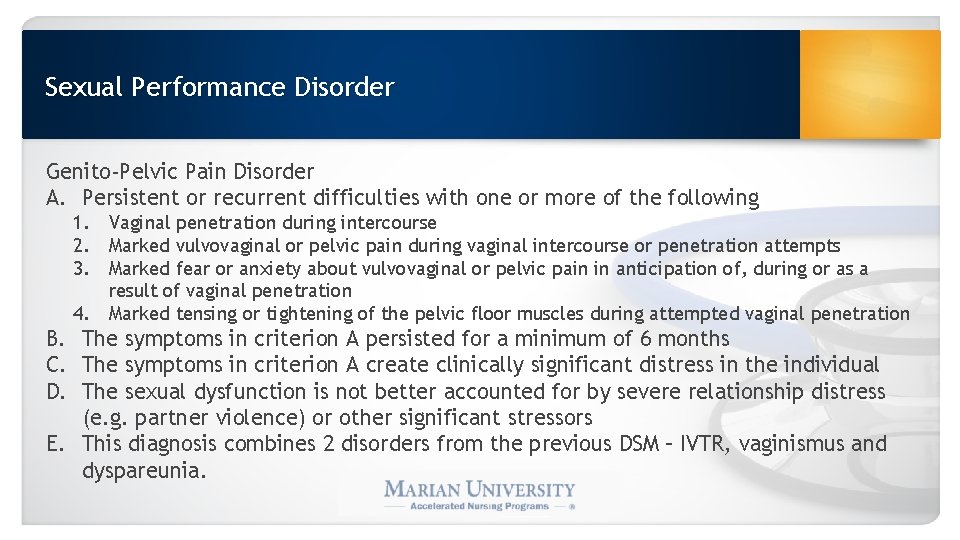
Sexual Performance Disorder Genito-Pelvic Pain Disorder A. Persistent or recurrent difficulties with one or more of the following 1. Vaginal penetration during intercourse 2. Marked vulvovaginal or pelvic pain during vaginal intercourse or penetration attempts 3. Marked fear or anxiety about vulvovaginal or pelvic pain in anticipation of, during or as a result of vaginal penetration 4. Marked tensing or tightening of the pelvic floor muscles during attempted vaginal penetration B. The symptoms in criterion A persisted for a minimum of 6 months C. The symptoms in criterion A create clinically significant distress in the individual D. The sexual dysfunction is not better accounted for by severe relationship distress (e. g. partner violence) or other significant stressors E. This diagnosis combines 2 disorders from the previous DSM – IVTR, vaginismus and dyspareunia.
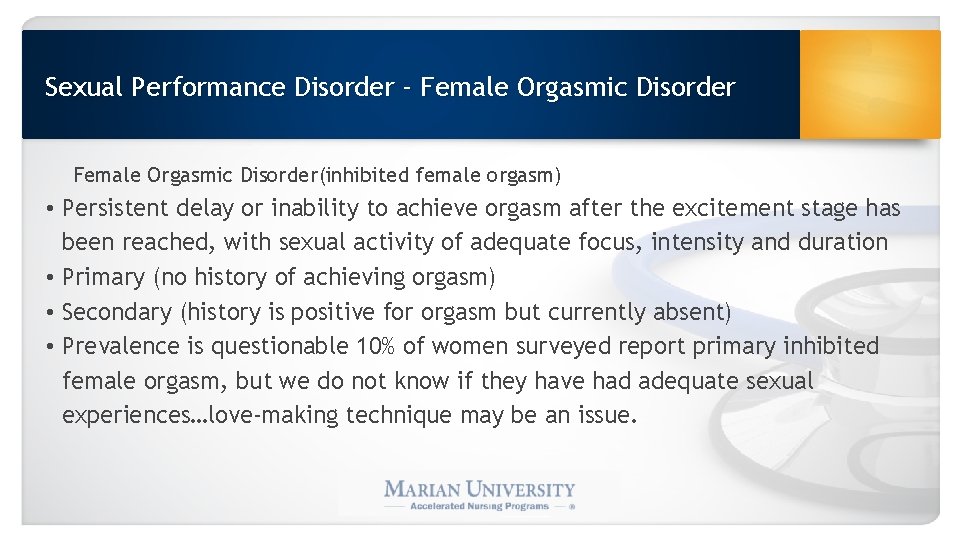
Sexual Performance Disorder - Female Orgasmic Disorder(inhibited female orgasm) • Persistent delay or inability to achieve orgasm after the excitement stage has been reached, with sexual activity of adequate focus, intensity and duration • Primary (no history of achieving orgasm) • Secondary (history is positive for orgasm but currently absent) • Prevalence is questionable 10% of women surveyed report primary inhibited female orgasm, but we do not know if they have had adequate sexual experiences…love-making technique may be an issue.
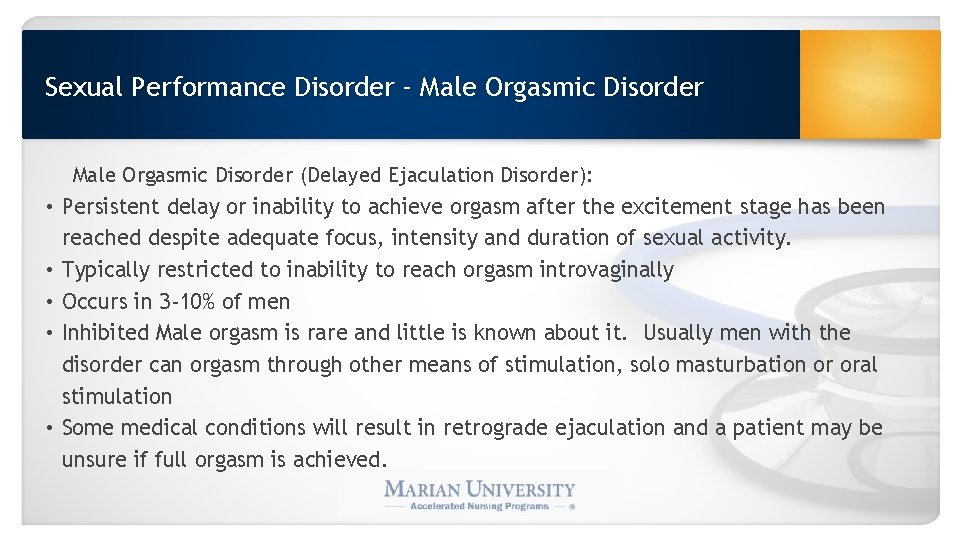
Sexual Performance Disorder - Male Orgasmic Disorder (Delayed Ejaculation Disorder): • Persistent delay or inability to achieve orgasm after the excitement stage has been • • reached despite adequate focus, intensity and duration of sexual activity. Typically restricted to inability to reach orgasm introvaginally Occurs in 3 -10% of men Inhibited Male orgasm is rare and little is known about it. Usually men with the disorder can orgasm through other means of stimulation, solo masturbation or oral stimulation Some medical conditions will result in retrograde ejaculation and a patient may be unsure if full orgasm is achieved.
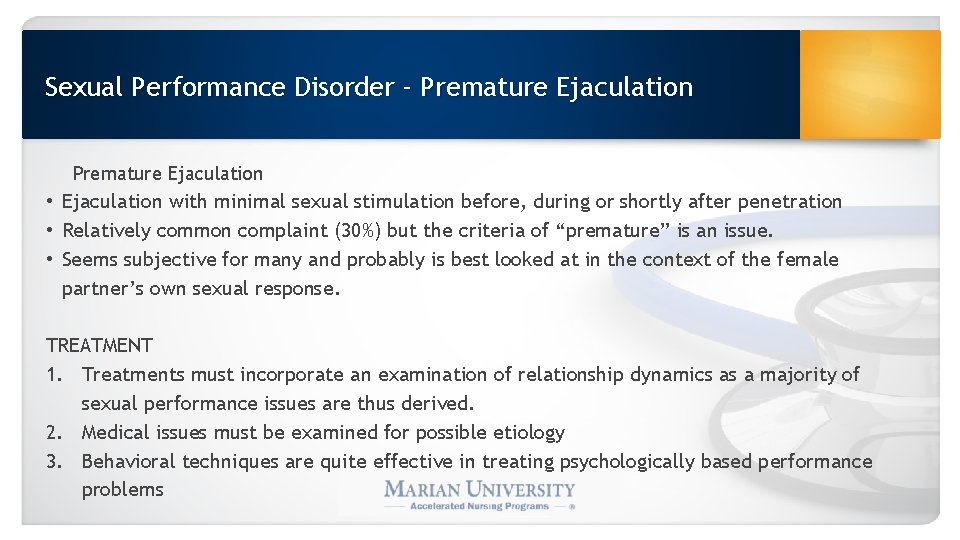
Sexual Performance Disorder - Premature Ejaculation • Ejaculation with minimal sexual stimulation before, during or shortly after penetration • Relatively common complaint (30%) but the criteria of “premature” is an issue. • Seems subjective for many and probably is best looked at in the context of the female partner’s own sexual response. TREATMENT 1. Treatments must incorporate an examination of relationship dynamics as a majority of sexual performance issues are thus derived. 2. Medical issues must be examined for possible etiology 3. Behavioral techniques are quite effective in treating psychologically based performance problems