
SEXUAL OFFENDER REGISTRATION REVIEW BOARD SORRB Tracy Alvord
SEXUAL OFFENDER REGISTRATION REVIEW BOARD (SORRB) Tracy Alvord, MS, LPC Executive Director
■ AWA Tiering – Based on conviction alone ■ Georgia Classification – Evidence-based models considering all available information and using researched actuarials (Static-99 R and Static-02 R) ■ Study published by the US Department of Justice – November 2012 ■ Outcome – AWA classification scheme is likely to result in a system that is less effective in protecting the public than the classification system. ■ Study looked at 10 -year recidivism rate and found: – A higher Classification (what Georgia does) was significantly associated with sexual recidivism in the expected, positive direction. In other words, Classification of Sexually Dangerous Predator was associated with higher odds of sexual recidivism. – A higher Tier (AWA) was significant associated with sexual recidivism in the unexpected negative direction. In other words, AWA tier 3 was associated with lower odds of sexual recidivism. SORRB Leveling v. Tiering (AWA)
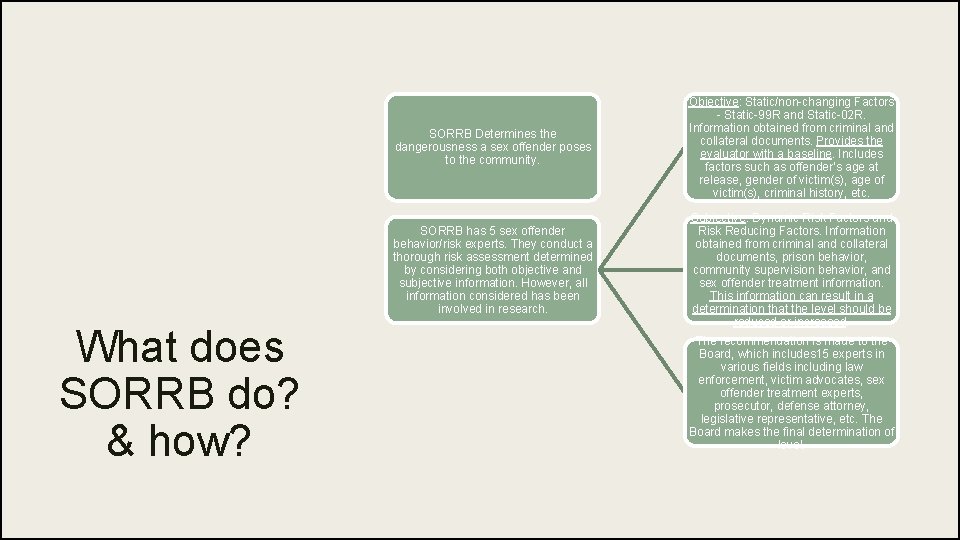
What does SORRB do? & how? SORRB Determines the dangerousness a sex offender poses to the community. Objective: Static/non-changing Factors - Static-99 R and Static-02 R. Information obtained from criminal and collateral documents. Provides the evaluator with a baseline. Includes factors such as offender’s age at release, gender of victim(s), age of victim(s), criminal history, etc. SORRB has 5 sex offender behavior/risk experts. They conduct a thorough risk assessment determined by considering both objective and subjective information. However, all information considered has been involved in research. Subjective: Dynamic Risk Factors and Risk Reducing Factors. Information obtained from criminal and collateral documents, prison behavior, community supervision behavior, and sex offender treatment information. This information can result in a determination that the level should be reduced or increased. The recommendation is made to the Board, which includes 15 experts in various fields including law enforcement, victim advocates, sex offender treatment experts, prosecutor, defense attorney, legislative representative, etc. The Board makes the final determination of level.
DYNAMIC RISK FACTORS ■ Found to be significantly predictive of sexual recidivism: – Any deviant sexual interest – Sexual interest in children – Paraphilic interests – Sexual preoccupation – Antisocial personality – Antisocial traits (self-regulation problems, employment instability, substance abuse, intoxicated during offense, hostility) – Antisocial history/history of rule violations – Intimacy deficits – Negative social influencers
WHAT ARE THE LEVELS AND WHAT DO THEY MEAN? v. LEVEL 1 – requires light monitoring v. LEVEL 2 – requires substantial monitoring v. SEXUALLY DANGEROUS PREDATOR – requires intensive monitoring
LEVEL 1 ■ Approximately 55% of sex offenders leveled in Georgia are a LEVEL 1 (low risk). Recidivism rates are between 0. 9 to 9. 7% ■ Example Level 1 offender – 19 year old male has “consensual” sex with 15 -year old female. Scores in the low range on the objective assessments. No known pattern or history of sexual offending. No/few dynamic risk factors. ■ Example Level 1 offender – Father molested his daughter. No known pattern or history of sexual offending. Scores in the low range on the objective assessments. No/few dynamic risk factors.
LEVEL 2 ■ Approximately 35% of sex offenders leveled in Georgia are a LEVEL 2 (moderate risk). Recidivism rates are between 11. 0 to 19. 2% ■ Example Level 2 offender – Molested 3 stepchildren. Scores in moderate range on objective assessments. Criminal history and non-compliance with supervision. ■ Example Level 2 offender - Raped an adult female in 1994. Scores in the low range on the objective assessments. Determined to be a higher risk due to dynamic risk factors that include: the offender being in and out of prison for violence against females, cruelty to animals, fleeing police, and drug/alcohol offenses.
SEXUALLY DANGEROUS PREDATOR (SDP) ■ Approximately 10% of sex offenders leveled in Georgia are a SDP (high risk) – 1054. Recidivism rates are between 20. 5 to >53. 5%. – 412 of the 1054 SDPs have been removed from EMS as of this presentation. ■ Example SDP – 1993 conviction molesting 2 boys he knew – he had removed door knobs so they could not escape. 2001 conviction for molesting a boy that was a stranger – gave him a ride and alcohol. Scored high on objective assessments. ■ Example SDP reduced to Level 2 – 2004 conviction for exposing to 6 children he did not know. Released in 2009. History of exposing, public masturbation, voyeurism, and other paraphilias. Requested reevaluation. Risk determined to be reduced due to risk reducing factors. Offender provided information regarding completion of sex offender intensive treatment, information to suggest positive social influencers, and a polygraph suggesting no sexually deviant acts since his release in 2009 (10 years offense free – considered especially relevant with the use of objective testing – polygraph).
GPS – Why? ■ The National Institute of Justice sponsored a research project examining the impact that GPS monitoring has on the recidivism rates of sex offenders in California. The results showed that during the 1 -year study period, participants in the GPS group demonstrated significantly better outcomes for both compliance and recidivism. In terms of compliance, the hazard ratio of a sex-related violation was nearly 3 x’s greater for the parolees on traditional supervision (control group) compared to the parolees on the GPS supervision.


- Slides: 14