
SEXUAL ABUSE AND EXPLOITATIO N A training module
SEXUAL ABUSE AND EXPLOITATIO N A training module for assessment teams and enumerators conducting MSNAs May 2020
PSEA: What you need to know Learning objectives Assessment teams and enumerators – along with all humanitarian workers – are responsible for creating and maintaining an environment that prevents sexual exploitation and abuse, for upholding internationally agreed standards on PSEA and for implementing their organization’s code of conduct. In practice, this means that you need to know: - What is sexual exploitation and abuse? What are the six core principles of PSEA? What is safeguarding? - What is your responsibility, as an aid worker – and specifically as an aid worker collecting data in peoples’ homes and communities – to report any concerns or suspicions regarding sexual abuse or exploitation by a fellow aid worker (whether from your agency or not)? How do you report your concerns? - In the context of an MSNA, what should you do in case of disclosures? What referral pathways are in place and who should you contact?

01 PSEA BASICS
PSEA BASICS: True or False? 1. For aid workers, safeguarding is basically the same as protection FALSE. In the humanitarian sector, we understand ‘protection’ as protecting people from all types of harm that may arise. It is often part of NGO programming. ‘Safeguarding’ is the specific responsibility of organizations to make sure that their staff, operations and programmes do no harm
PSEA BASICS: True or False? 2. International aid workers are seen by local communities as having more power than they do. They need to be aware of how they use (or abuse) this power. Volunteers, short-term staff and contractors are not seen as having power because they often come from the same communities. FALSE. All workers associated with the humanitarian response, from international staff to national staff, volunteers, community mobilizers and contractors are perceived as having power. This may derive from age, gender, wealth, or (perceived or real) influence over decision-making around the allocation of good or services. There is always a power imbalance between NGO workers and beneficiaries. It is easy to misunderstand take advantage of beneficiaries’ vulnerability. All aid workers therefore have a responsibility for safeguarding, the prevention of and protection from sexual exploitation and abuse.
PSEA BASICS: True or False? 3. Sexual abuse is when a person forces, or threatens to force, someone with less power to participate in sexual activities against their will. TRUE
PSEA BASICS: True or False? 4. Sexual exploitation is when a person demands that someone with less power participate in sexual activities in exchange for money, food, water, shelter, medicine or other essential goods or services. TRUE. This includes survival sex work, child sex work, trafficking, the creation and dissemination of sexually explicit videos and/or pictures.
PSEA BASICS: True or False? 5. Safeguarding is when aid workers ensure that our staff are protected from harm, by recruiting and training adequate numbers of security officers, and making sure that the staff compound is safe FALSE.
PSEA BASICS: True or False? 6. Safeguarding is the responsibility of organizations to make sure their staff, operations, and programmes do no harm to adults at-risk or children, nor expose them to abuse or exploitation. TRUE.
PSEA BASICS: True or False? 7. Protection from sexual exploitation and abuse is only the responsibility of managers, human resources staff and technical specialists focused on gender issues. FALSE. All workers involved in a humanitarian response should know how to keep children, adults and staff safe. There should be learning opportunities to consistently develop and maintain the necessary measures, attitudes, skills, and knowledge amongst staff, partners, and all those that contribute to your organization’s work. The communities you work with should understand your commitments to safeguarding and what to do if concerns arise.
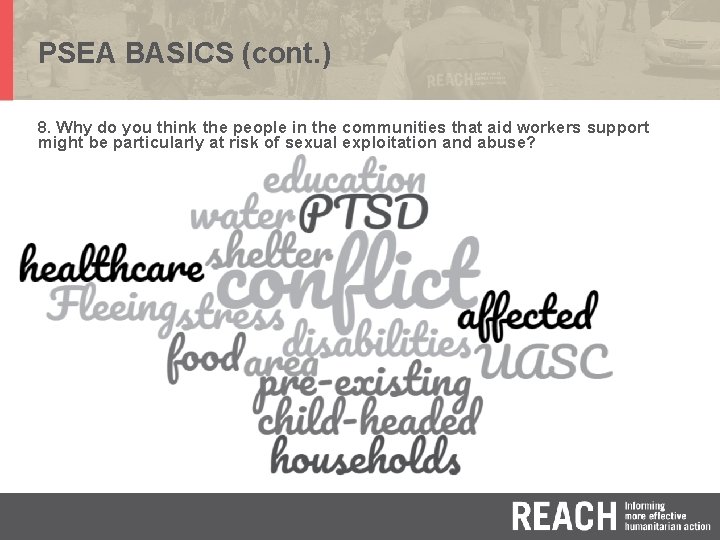
PSEA BASICS (cont. ) 8. Why do you think the people in the communities that aid workers support might be particularly at risk of sexual exploitation and abuse?

PSEA: IASC SIX CORE PRINCIPLES To help guide aid workers like you, and to keep local communities safe, there a few important principles that all aid workers must follow: 1. Sexual exploitation and abuse by humanitarian workers constitute acts of gross misconduct and are therefore grounds for termination of employment. 2. Sexual activity with children (persons under the age of 18) is prohibited regardless of the age of majority or age of consent locally. Mistaken belief regarding the age of a child is not a defence. 3. Exchange of money, employment, goods, or services for sex, including sexual favours or other forms of humiliating, degrading or exploitative behaviour is prohibited. This includes exchange of assistance that is due to beneficiaries. 4. Any sexual relationship between those providing humanitarian assistance and protection and a person benefitting from such humanitarian assistance and protection that involves improper use of rank or position is prohibited. Such relationships undermine the credibility and integrity of humanitarian aid work. 5. Where a humanitarian worker develops concerns or suspicions regarding sexual abuse or exploitation by a fellow worker, whether in the same agency or not, he or she must report such concerns via established agency reporting mechanisms. 6. Humanitarian workers are obliged to create and maintain an environment which prevents sexual exploitation and abuse and promotes the implementation of their code of conduct. Managers at all levels have particular responsibilities to support and develop systems which maintain this environment.
02 PSEA IN ACTIO N
![Understanding the IASC PSEA Core principles: Case studies for discussion 1. [Manager, Intl. NGO].](http://slidetodoc.com/presentation_image_h2/d81d94786d86858af8bb61edd1594843/image-14.jpg "Understanding the IASC PSEA Core principles: Case studies for discussion 1. [Manager, Intl. NGO].")
Understanding the IASC PSEA Core principles: Case studies for discussion 1. [Manager, Intl. NGO]. John applied for a job working as a driver for us. Yes, I told him that I’d give him the job if he slept with me. Anyway, it doesn’t count because he refused and nothing happened (…) It was only a joke! He should take it as a compliment: he’s a very attractive young man!”. DISCUSSION. Even if John refuses to engage in sexual activities, the Manager is guilty of attempting to abuse her power and position by making such a suggestion. Remember that women and girls can be perpetrators, and men and boys experience abuse and exploitation too.
Understanding the IASC PSEA Core principles: Case studies for discussion 2. [Team Lead, National NGO]. “I honestly had no idea that she was underage. The girls here look much older than back home. It was dark and I had been drinking. ” DISCUSSION. As per principle 2, the fact that the aid worker claims not to have known that the girl was a child is not a valid defence. Sexual activity with under 18 s is prohibited, regardless of the local age of consent. Further, all aid workers are required to uphold their obligations when it comes to sexual exploitation and abuse 24/7, not only during official working hours.
Understanding the IASC PSEA Core principles: Case studies for discussion 3. [Day contractor, hired locally]. “I’m 25. I first met Evelyn when I visited her home to conduct the household survey. She is nearly 16. I really like her. I’ve been going back to visit regularly since then, driving the big white car to her place, bringing sweets and other gifts for her family. Her parents like me: they are happy that Evelyn has met an NGO worker and we’re from the same ethnic group. I want to ask her parents for permission to marry her. ” DISCUSSION. Evelyn is only 15 years old. The day contractor is prohibited from having sex with anyone under 18, regardless of the local age of consent. A relationship between Evelyn and the aid worker would be strongly discouraged because it is seen as based on inherently unequal power dynamics and could potentially undermine the integrity and credibility of humanitarian work – for example, if the day contractor is seen bringing gifts to Evelyn’s family but not to the neighbours.
Understanding the IASC PSEA Core principles: Case studies for discussion 4. [Aid worker, Intl NGO]. “Yes, I paid for a sex worker’s services, but so what? She’s a consenting adult: I’m sure she’s over 18. They [local sex workers] are more than happy when the rich UN and NGO staff arrive – we pay far more than the local men. It’s a win-win situation. This has nothing to do with PSEA. ” DISCUSSION. Exchange of money for sex is prohibited. There is a major power imbalance between the aid worker and the sex worker. Humanitarian responses take place in areas affected by conflict, disasters and poverty, where people will often do anything to access essentials goods and services. It is also important to maintain the credibility and integrity of humanitarian work in the eyes of the local population.
Understanding the IASC PSEA Core principles: Case studies for discussion 5. [Temporary staff, hired locally]. “My boss [Manager, International NGO] asked me to invite 20 or so young women to a party he was holding for his friends (mostly ex-pats) at his villa over the weekend. I didn’t feel like I could say no. He paid the girls, and he also gave me cash and more work with his NGO for helping him out”. DISCUSSION. Sexual exploitation includes situations where staff or related personal facilitate exploitation and/ or abuse, even when they themselves don’t engage in SEA directly. In this scenario, both the County Director and the local staff have breached the PSEA principles, especially in view of the fact that the contractor profited from his or her actions (both by receiving cash and further employment).
03 PSEA IN MSNAs: Your responsibiliti es
You are not expected to have the skills and training required to investigate or interview victims or survivors, and it’s not your job. If disclosures about PSEA arise in the context of household surveys, focus group discussions or key informant interviews, assessment teams and enumerators need to know what to do and what steps to take. It is not the role of assessment teams or enumerators conducting MSNAs to gather detailed information on the incidence or prevalence of highly sensitive and illegal issues such as sexual abuse and exploitation. All humanitarian workers must report alleged, witnessed or suspected sexual abuse or exploitation. Failure to do so represents a breach of the IASC PSEA Core Principles and your agency’s Code of Conduct. However, you – along with all humanitarian workers – have a responsibility to report any concerns or suspicions regarding PSEA, and if disclosures do arise in the context of your work, then you need some straightforward advice to help you know what to do and who to contact. As a member of an assessment team or an enumerator, you have a right to be given the appropriate information regarding referral pathways and complaints mechanisms. These will vary from context to context, but it is essential that you are equipped with the information you need to fulfil your AAP obligations.
What to do if a beneficiary tells you that they are being exploited or abused by an aid worker? 1. Check that the person is not in immediate danger. 2. Be calm and patient, listen to what they are saying. Try to control your own reactions (shock, anger, disbelief…), keep your face calm and your voice steady. Don’t express your own opinions, give advice or refuse to believe them. 3. Take notes of what they tell you, preferably in their own words. Don’t probe or ask questions: let them say want they want to say. 4. Reassure them that they have done the right thing by telling you, and let them know that they can trust you. 5. Don’t promise to keep secrets. Explain that you need to talk to someone who’s job it is to keep them safe. 6. Don’t investigate yourself or follow up in any way: just report the incident as soon as possible via your agency’s reporting mechanism. Don’t discuss the incident with anyone else.
MANDATORY REPORTING Where a humanitarian worker develops concerns or suspicions regarding sexual abuse or exploitation by a fellow worker, whether in the same agency or not, he or she must report such concerns via established agency reporting mechanisms. • Who here signed a code of conduct? [Raise hands] • ALL STAFF are bound by their agency’s code of conduct, with no exceptions. This means anyone employed, contracted or otherwise designated or charged with the provision of goods, products, skills or services to beneficiaries on behalf of their organization whether for pay, a fee for service arrangement, as an in-kind contribution or as a volunteer. • Your agency’s code of conduct adheres to internationally agreed minimum standards for PSEA. One important provision is the requirement to report. • In practice, this means that you MUST report any witnessed or alleged incidence of sexual exploitation or abuse, as defined above. • Even if just a suspicion or a rumour, you must report. It is not your role to investigate or follow up: your agency’s designated team are responsible for taking the next steps. • Failure to report is a breach of your code of conduct, and you could be subject to punitive measures if it emerges at a later date that you knew something but turned a blind eye. • Mandatory reporting on PSEA actually frees you from having to make a decision on whether to report or not. It’s simple: if you see or hear anything (witnessed or alleged), you must report.
TO REPORT OR NOT TO REPORT? Day contractor, National NGO Programme Officer, Intl NGO “I saw our Team Leader take a local girl’s Whats. App number. He did check that it was ok with her father first. A couple of weeks later, two other colleagues said they heard him bragging about how easy it had been to convince the girl to send him sexually explicit photos. I’m not sure whether to report: I think the other colleagues just don’t like him, and it’ll be very embarrassing for me if I’m wrong. He is my boss, after all. ” “The guys in our team download and watch porn on their work laptops in the evenings. Last week, in the office, they sent me a draft of a document we’re working on together, and several graphic screenshots were attached to the file. I’m the only girl in the team and I feel like they were trying to humiliate and embarrass me. ” Aid worker, Intl NGO Driver, hired locally “There’s this older guy in one of our partner agencies who is always hanging around the latrine block in the camp. He shouldn’t even be using those latrines because we have our own by the offices. I heard a rumour that he gave a teenage boy a phone last week. Why would he do that? ” “So the Country Director asks me to drive him down town a few times a week. I know what he’s doing: everyone knows the bar and what it’s for. I mentioned to my boss that I was uncomfortable making so many trips to the bar in our big white jeep, and that the local population was talking. He said it was nothing. Then a woman in the team said that my boss and the Country Director go to brothels together on their annual trip to Geneva”.
RESOURCES AND FURTHER READING • “No Excuse for Abuse”: Preventing Sexual Exploitation and Abuse in Humanitarian Action. https: //www. interaction. org/blog/no-excuse-forabuse/ and https: //www. youtube. com/watch? v=48 MCG 22 F qr. E • IASC Six Core Principles Relating to Sexual Exploitation and Abuse. https: //interagencystandingcommittee. org/interagency-standing-committee/iasc-six-coreprinciples-relating-sexual-exploitation-andabuse • Overview, links and guidance on Code of Conduct and Referral Mechanisms [FACILITATOR TO ADD]
THANK YOU FOR YOUR ATTENTION Name Lastname Mobile Telephone Desktop Telephone name. lastname@reach-initiative. org skype user name www. reach-initiative. org IMPACT Initiatives @REACH_info
- Slides: 25