
SexTyping of Leisure Activities A Test of Two





- Slides: 28
Sex-Typing of Leisure Activities: A Test of Two Theories Presented to ACR 2003, Toronto ON • George M. Zinkhan, University of Georgia • Penelope Prenshaw, Millsaps College • Angeline Grace Close, University of Georgia
Leisure as Consumption and tourist behavior is a salient aspect of tourism Hoch (2002). Purpose: ü Study the relationship between gender schema and leisure activities ü Test rival predictions about gender schema ü Test competing theories: Bem (1981) v. s. Spence (1984)
Research Questions • Does one gender sex-type leisure activities to a greater extent than the other? • What are the predictors of sex typing? • Which of the two competeting theories best explains sex-typing of leisure activities?
Literature Review • Differences exist in leisure behavior between men and women. • Gender ideologies structure perceptions of leisure. • Are bases of differences are biological and/or the result of socialization experiences ?
Hypotheses • H 1: Men are more likely to sex-type leisure activities than women. • H 2: “Masculine” men and “feminine” women, as defined by the Bem Sex Role Inventory, are more likely to sex-type leisure activities than are men and women with nontraditional gender-role attitudes. • H 3: Men and women with traditional gender-role attitudes will label leisure activities as either “more masculine” or “more feminine”.
Gender • Sociological concept referring to a category scheme • Mutually exclusive categories (Sherif 1982) • Cultural definitions of appropriate male or female behavior (Henderson 1989) • Masculinity-femininity dimension
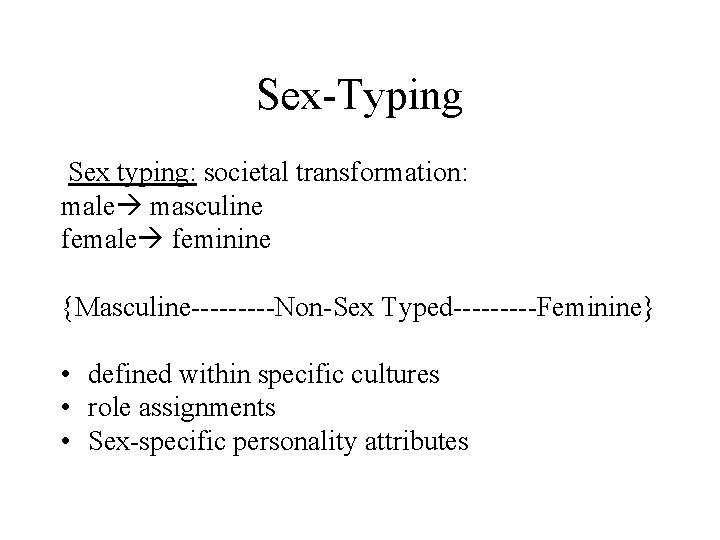
Sex-Typing Sex typing: societal transformation: male masculine female feminine {Masculine-----Non-Sex Typed-----Feminine} • defined within specific cultures • role assignments • Sex-specific personality attributes
Competing Theories Sex-typing of leisure activities is related to two individual difference measures: • Gender personality (Bem 1981) • Gender-role attitudes (Spence 1984)
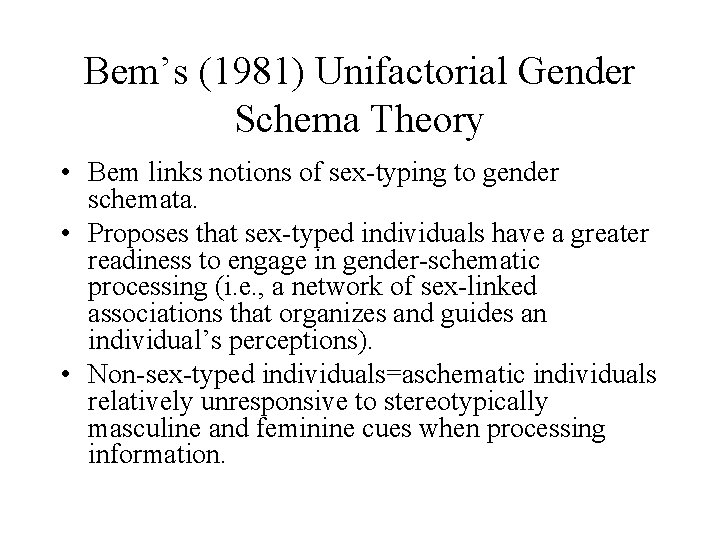
Bem’s (1981) Unifactorial Gender Schema Theory • Bem links notions of sex-typing to gender schemata. • Proposes that sex-typed individuals have a greater readiness to engage in gender-schematic processing (i. e. , a network of sex-linked associations that organizes and guides an individual’s perceptions). • Non-sex-typed individuals=aschematic individuals relatively unresponsive to stereotypically masculine and feminine cues when processing information.
Bem’s Theory Operationalized • (BSRI) • Self-report measure • Individuals can be classified into one of three categories: • (a) masculine sex-typed • (b) feminine sex-typed • (c) non-sex-typed
Spence’s (1984) Multi-factorial Theory of Gender Identity • Opposes Bem’s view • Emerging sense of gender identity stimulates adoption of gender-stereotyped behaviors/beliefs • Once gender identity is firmly established, other factors (i. e. , gender role attitudes) protect/confirm sense of gender identity • Variables leading to individual differences= situational factors, internal dispositions, attitudes toward maintaining traditional gender role distinctions, personal preferences, and perceptions (realistic or unrealistic) of the consequences of acting in certain ways.
Spence’s (1984) Multi-factorial Theory of Gender Identity, cont. Variables leading to individual differences: • situational factors • internal dispositions • attitudes toward maintaining traditional gender role distinctions • personal preferences • perceptions (realistic or unrealistic) of the consequences of acting in certain ways
Method • 271 R’s (2 samples) • Mailed to 200 Adult Girl Scout Council Members • Administered to business students • Rs are provided with a list of 75 leisure activities • List derived from past taxonomies of participation
Leisure Activities Tested Some of the 75 activities include: Media Related Activities Sports
Sex-typing Measures • 7 point scale • asked to indicate whether they felt the activity was: extremely masculine neutral extremely feminine /------------/-----------/------/ somewhat in between
Gender Role Attitude Measures • Attitudes Toward Women Scale (Spence and Helmreich 1978) • 15 item instrument of statements describing the rights, roles, and privileges women ought to have or be permitted to have • Agreement with each statement on a 4 -point scale from “agree strongly” to “disagree strongly” • Low scores= more traditional, conservative attitude toward gender roles
Measures Masculinity-Femininity: Personal attribute questionnaire (Spence and Helmreich and Stapp 1975) a) M-scale: 8 items describing characteristics descriptive of masculine personality traits b) F-scale: 8 items describing qualities more characteristic of feminine personality traits • Respondents indicated on a 5 -point scale the extent to which each phrase describes him or her • summed M score and a F score for each • Sex-typed individuals score high on one sexual dimension & low on the other
Regression • determine the degree of sex-typing • OLS • Sex Typing = f (Biological Sex, Gender. Role Attitudes, Gender Identity)
Findings Neutral (i. e. , not sex-typed by > half of the sample): • many leisure activities are not sex-typed. • 33 were identified as neutral (greater than 50% of the sample). • Neutrality found of media-related: watching TV, listening to the music, going to movies, renting movies and reading magazines • outdoor activities: jogging, bicycling, playing tennis and swimming. • individual activities: reading a book for pleasure, taking a nap, and doing crossword puzzles
Findings Masculine (i. e. , sex-typed by >half of the sample): • Requiring physical activity (e. g. , playing football, playing basketball, working out at a gym) • Outdoor activities (e. g. , hunting, fishing, canoeing) • Passive activities (reading newspapers, taking a nap)
Findings Feminine (i. e. , sex-typed by > half of the sample): • Sewing, aerobics, shopping, cooking, talking on the phone • Cultural activities (e. g. , attendance at the ballet, opera and theater plays, visiting art museums, playing the piano, and painting or drawing)
Findings Masculine (i. e. , sex-typed by > half of the sample): • Sports (participating and viewing) (e. g. , football, basketball, billiards, golf, skiing) • Outdoor (e. g. , hunting, fishing, camping, hiking, archery, rafting, canoeing, sailing) • Woodworking, collecting • Games (e. g. , chess, checkers, cards)
Findings • Higher proportion of males sex-typed leisure activities for both sexes • Chi-square tests: the sex difference was statistically significant (p<. 05) for most masculine -typed activities (23 of 28) • Greater consensus between the sexes for the feminine-typed activities • More females identified more as neutral (Significant (p <. 05) for 48 of the activities sextyped as “either”)
Findings • We do not find support for Bem’s (1981) theory • We do find partial support for Spence’s (1984) theory • Males sex-type leisure activities to a greater extent than females • Sex and gender-role attitudes are significant (p <. 05) predictors of sex-typing
Conclusions • Relationship exists between gender schema and sex-typing of leisure (consumption) activities • Brings competing psychological (e. g. , Bem) and sociological (e. g. , Spence) theories into a consumer behavior perspective • We find that leisure activities, as a subset of consumption experiences, may be sex-typed-- especially by males.
Changing Roles • As gender roles change in society, these patterns may change. • “Appropriate” roles less defined • Women: hunt, bet on football games • Men: knit, fine arts performances • Fostering an androgynous society
Further Research Test gender theory via: • Tourists’ consumption habits (and other patterns) of natives • “Hotspots” or experimental experiences • Is the Internet a leisure activity that may be sex-typed? Implications? • Expand activities (e. g. , online gaming, Kazaa, fantasy sports, chat, IM, e-dating)
Thank you! • Please refer to tables 1 -3 Dr. Zinkhan and I welcome your feedback/questions! • aclose@terry. uga. edu • gzinkhan@terry. uga. edu