
Sex education in the Kindergarten classroom By Chloe
Sex education in the Kindergarten classroom By Chloe Garcia Winter 2018
Class expectations ● REspect (Selves, Each Other, Subject Matter, The Space) ○ Do not pressure others to participate or share ○ Taking Up Space and Talking Time ● Safety vs. Discomfort ○ Threat to physical and mental health, Harm ○ Discomfort can be a sign of learning or understanding Emil Briones, Dentistry PPT
What is the role of a kindergarten teacher in sex education? What are your concerns?
Overview/Review of the Context -Mandatory -Rumours say that it is being officially implemented as of Fall 2018 but this may not be the case -It will be assigned to stakeholders who are prepared to teach it -A community approach will be recommended
Teaching sexuality in Kindergarten: • They are asking the questions anyways as The big question they discover and are curious about their But aren’t they too young? “ 60% of sexual abuse/assault victims are under the age of 17” (sex assault. ca) Statcan. ca states: “Research has shown that children who suffer violence often do not report it, either because they are unable to do so, or because they are afraid to report incidents to the authorities” (United Nations, 2006) • • • bodies They live within a hypersexualized and connected culture Misinformation can have repercussions later Assault and abuse starts at a young age Children need the language to report abuse, and the ability to ‘name’ the problem and ask for help. The Dutch have implemented a successful ‘early start’ program.
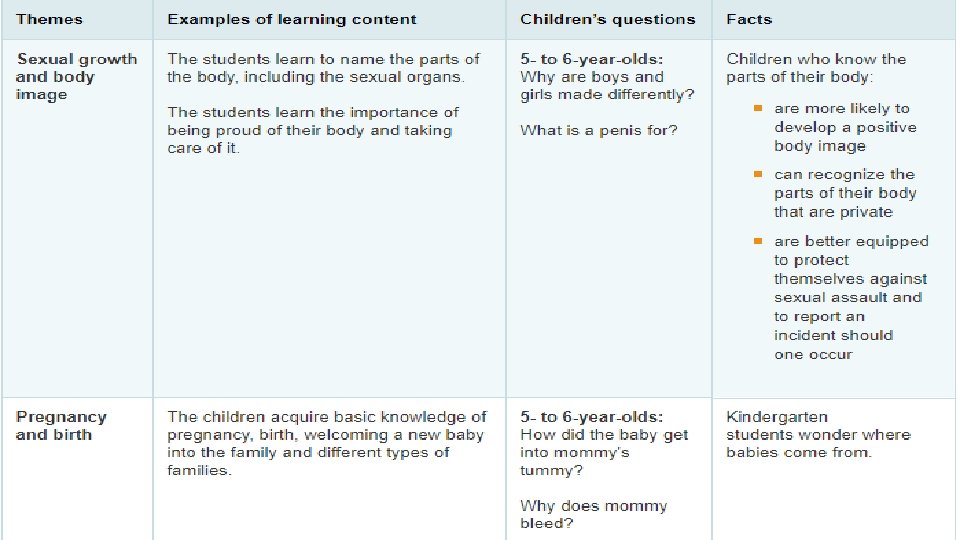
Teaching sexuality in Kindergarten:
Sexual Growth and Body Image: Examples of learning content ❖How to recognize their body parts: ▪ Learning about body parts and organs of different sexes ▪ Introduce hygiene and body care Good for health and body image! ❖How to embrace their body and take care of it ▪ Naming physical and emotional bodies related to their bodies, including when feelings are pleasant vs unpleasant ▪ Knowing how to say no and seek out help Helps children understand their body and provide tools to protect themselves.
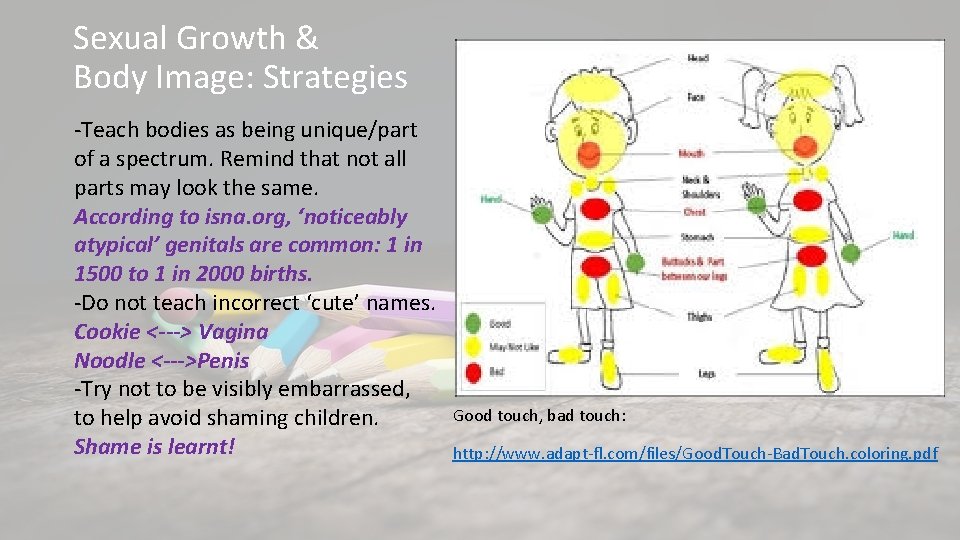
Sexual Growth & Body Image: Strategies -Teach bodies as being unique/part of a spectrum. Remind that not all parts may look the same. According to isna. org, ‘noticeably atypical’ genitals are common: 1 in 1500 to 1 in 2000 births. -Do not teach incorrect ‘cute’ names. Cookie <---> Vagina Noodle <--->Penis -Try not to be visibly embarrassed, to help avoid shaming children. Shame is learnt! Good touch, bad touch: http: //www. adapt-fl. com/files/Good. Touch-Bad. Touch. coloring. pdf
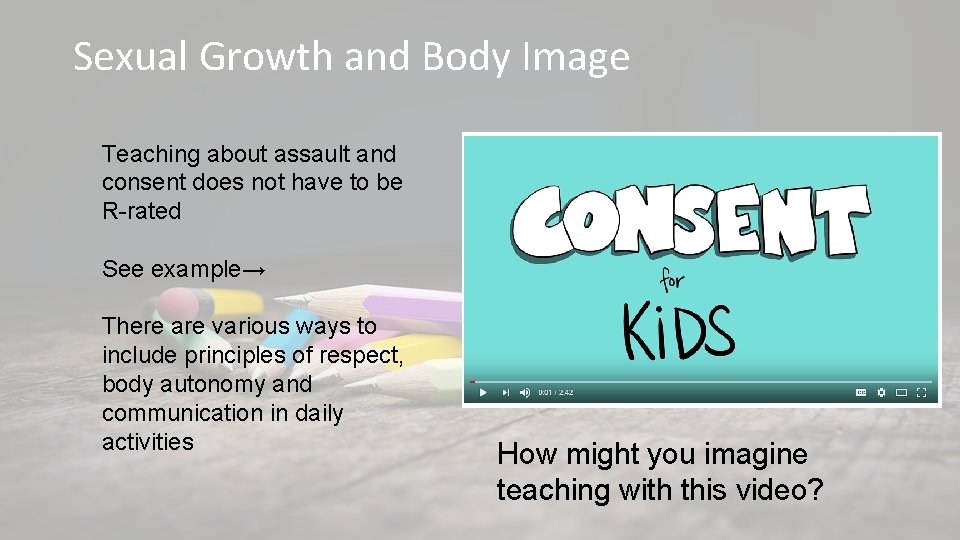
Sexual Growth and Body Image Teaching about assault and consent does not have to be R-rated See example→ There are various ways to include principles of respect, body autonomy and communication in daily activities How might you imagine teaching with this video?
Sexual Growth and Body Image: Teaching approach -Teaching about assault should be descriptive over terminology-based. Example: When someone touches you here, and you feel this way…. -Teaching about assault means saying that some grown-ups can be wrong, and that there are secrets that kids should not have to keep. -Have activities that model consent, e. g. asking for consent on a regular basis, learning it can be taken away, learning no and yes, etc. -Teach about bad touch/good touch (assault related topics) with another adult in a room. If a child discloses, see your principal immediately.
Sexual Growth and Body Image: Resources -RAINN has a comprehensive set of guidelines: https: //www. rainn. org/articles/talking-your-kids-about-sexual-assault -ourkidscenter. com offer examples about how to speak to children and teach ‘touching safety’. -Organizations like Planned. Parenthood. com and Sexualityandu. ca have great teaching resources to help you plan your lesson. -Use videos and books: http: //www. pbs. org/newshour/updates/spring-fever/ https: //www. youtube. com/watch? v=h 3 nh. M 9 Ul. Jjc&t=32 s -Use games to model behavior (communication based) -edu. gov. mb. ca- Offer lesson plans and activity sheets - ACCM Teachers’ Toolkit: http: //sexedtoolkit. com/
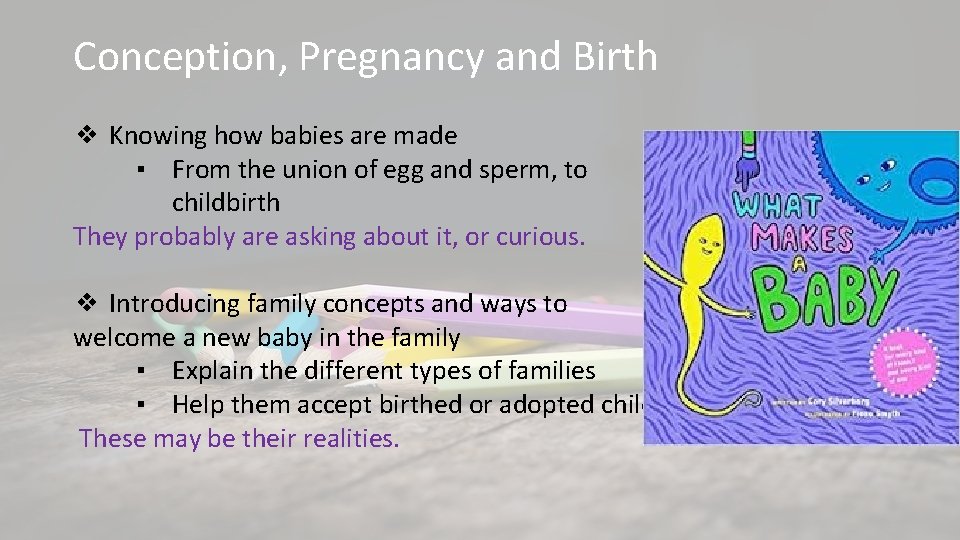
Conception, Pregnancy and Birth ❖ Knowing how babies are made ▪ From the union of egg and sperm, to childbirth They probably are asking about it, or curious. ❖ Introducing family concepts and ways to welcome a new baby in the family ▪ Explain the different types of families ▪ Help them accept birthed or adopted children These may be their realities.
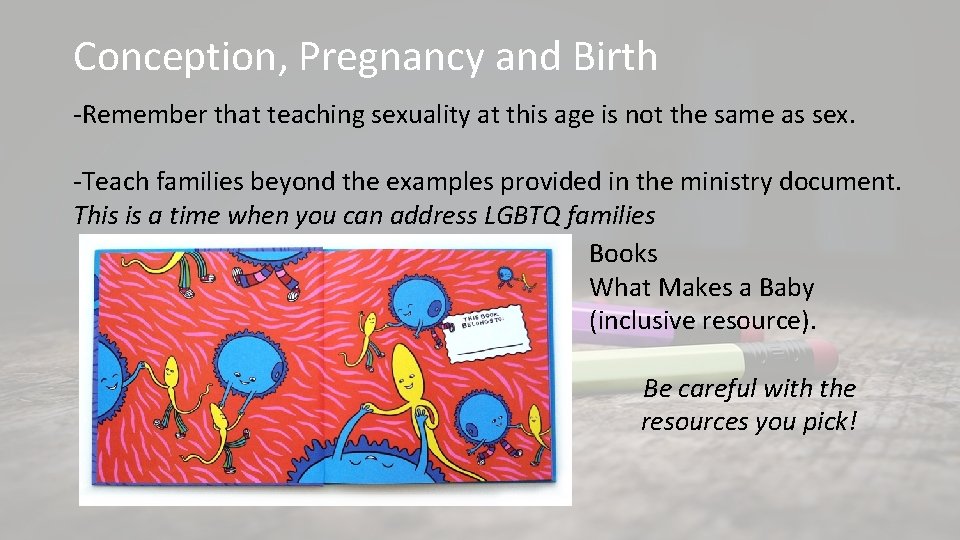
Conception, Pregnancy and Birth -Remember that teaching sexuality at this age is not the same as sex. -Teach families beyond the examples provided in the ministry document. This is a time when you can address LGBTQ families Books What Makes a Baby (inclusive resource). Be careful with the resources you pick!
Some links • https: //ourkidscenter. com/learn/h ow-to-educate-children-aboutabuse/ • www. sexassault. ca • http: //www. education. gouv. qc. ca/ en/references/publications/results /detail/article/learning-content-insexuality-education-1/ • www. Statcan. ca • www. plannedparenthood. ca • www. sexualityandu. ca • www. ISNA. org • http: //www. edu. gov. mb. ca/k 12/cu r/physhlth/hs_k 8/blms/index. html#kblm • http: //www. pbs. org/newshour/up dates/spring-fever/ • https: //www. youtube. com/watch? v=h 3 nh. M 9 Ul. Jjc&t=32 s • https: //www. rainn. org/articles/talk ing-your-kids-about-sexual-assault
- Slides: 14