
Seventh Edition Economics N Gregory Mankiw CHAPTER 1




- Slides: 31
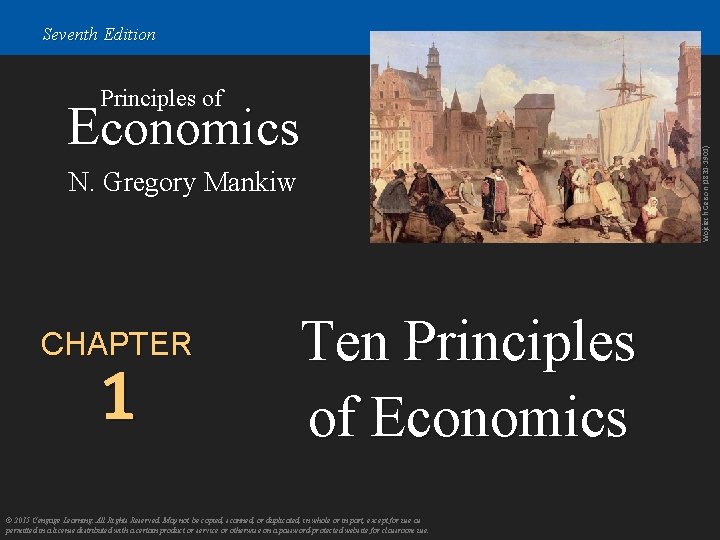
Seventh Edition Economics N. Gregory Mankiw CHAPTER 1 Ten Principles of Economics © 2015 Cengage Learning. All Rights Reserved. May not be copied, scanned, or duplicated, in whole or in part, except for use as permitted in a license distributed with a certain product or service or otherwise on a password-protected website for classroom use. Wojciech Gerson (1831 -1901) Principles of
In this chapter, look for the answers to these questions • What kinds of questions does economics address? • What are the principles of how people make decisions? • What are the principles of how people interact? • What are the principles of how the economy as a whole works? © 2015 Cengage Learning. All Rights Reserved. May not be copied, scanned, or duplicated, in whole or in part, except for use as permitted in a license distributed with a certain product or service or otherwise on a password-protected website for classroom use.
What Economics Is All About § Scarcity: the limited nature of society’s resources § Economics: the study of how society manages its scarce resources, e. g. § how people decide what to buy, how much to work, save, and spend § how firms decide how much to produce, how many workers to hire § how society decides how to divide its resources between national defense, consumer goods, protecting the environment, and other needs © 2015 Cengage Learning. All Rights Reserved. May not be copied, scanned, or duplicated, in whole or in part, except for use as permitted in a license distributed with a certain product or service or otherwise on a password-protected website for classroom use. 2
The principles of HOW PEOPLE MAKE DECISIONS ©lithian/Shutterstock. com
PRINCIPLE 1 People Face Tradeoffs All decisions involve tradeoffs. Examples: § Going to a party the night before your midterm leaves less time for studying. § Having more money to buy stuff requires working longer hours, which leaves less time for leisure. § Protecting the environment requires resources that could otherwise be used to produce consumer goods. © 2015 Cengage Learning. All Rights Reserved. May not be copied, scanned, or duplicated, in whole or in part, except for use as permitted in a license distributed with a certain product or service or otherwise on a password-protected website for classroom use. 4
PRINCIPLE 1 People Face Tradeoffs § Society faces an important tradeoff: efficiency vs. equality § Efficiency: when society gets the most from its scarce resources § Equality: when prosperity is distributed uniformly among society’s members § Tradeoff: To achieve greater equality, could redistribute income from wealthy to poor. But this reduces incentive to work and produce, shrinks the size of the economic “pie. ” © 2015 Cengage Learning. All Rights Reserved. May not be copied, scanned, or duplicated, in whole or in part, except for use as permitted in a license distributed with a certain product or service or otherwise on a password-protected website for classroom use. 5
PRINCIPLE 2 The Cost of Something Is What You Give Up to Get It § Making decisions requires comparing the costs and benefits of alternative choices. § The opportunity cost of any item is whatever must be given up to obtain it. § It is the relevant cost for decision making. © 2015 Cengage Learning. All Rights Reserved. May not be copied, scanned, or duplicated, in whole or in part, except for use as permitted in a license distributed with a certain product or service or otherwise on a password-protected website for classroom use. 6
PRINCIPLE 2 The Cost of Something Is What You Give Up to Get It Examples: The opportunity cost of… …going to college for a year is not just the tuition, books, and fees, but also the foregone wages. …seeing a movie is not just the price of the ticket, but the value of the time you spend in theater. © 2015 Cengage Learning. All Rights Reserved. May not be copied, scanned, or duplicated, in whole or in part, except for use as permitted in a license distributed with a certain product or service or otherwise on a password-protected website for classroom use. 7
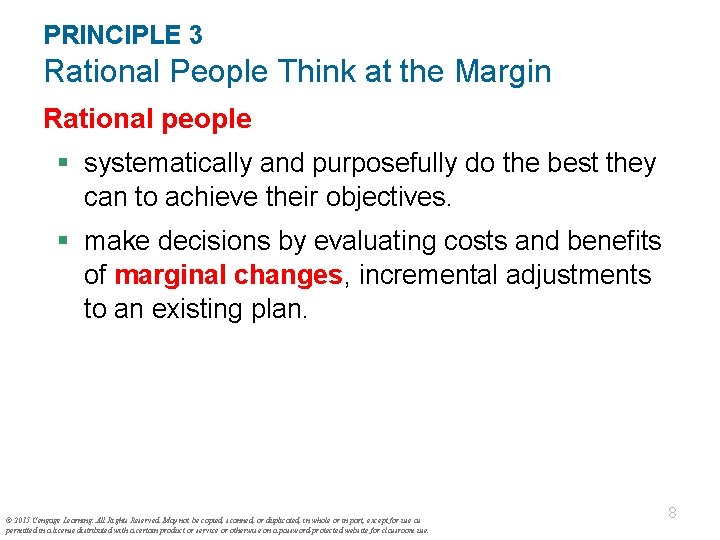
PRINCIPLE 3 Rational People Think at the Margin Rational people § systematically and purposefully do the best they can to achieve their objectives. § make decisions by evaluating costs and benefits of marginal changes, incremental adjustments to an existing plan. © 2015 Cengage Learning. All Rights Reserved. May not be copied, scanned, or duplicated, in whole or in part, except for use as permitted in a license distributed with a certain product or service or otherwise on a password-protected website for classroom use. 8
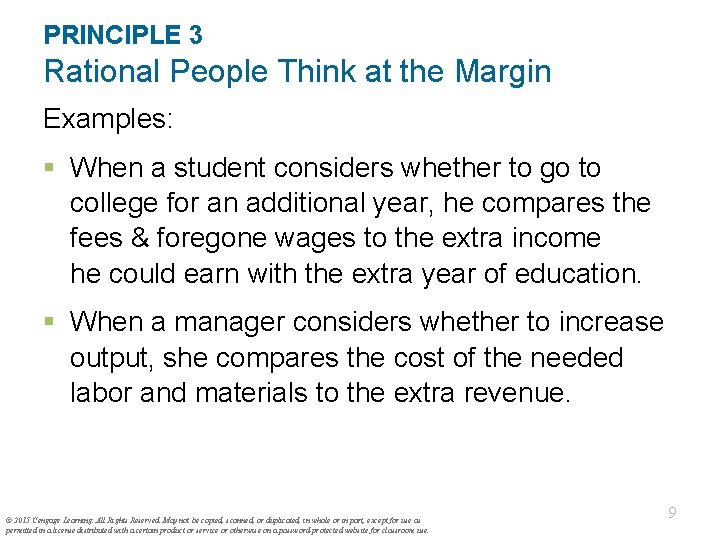
PRINCIPLE 3 Rational People Think at the Margin Examples: § When a student considers whether to go to college for an additional year, he compares the fees & foregone wages to the extra income he could earn with the extra year of education. § When a manager considers whether to increase output, she compares the cost of the needed labor and materials to the extra revenue. © 2015 Cengage Learning. All Rights Reserved. May not be copied, scanned, or duplicated, in whole or in part, except for use as permitted in a license distributed with a certain product or service or otherwise on a password-protected website for classroom use. 9
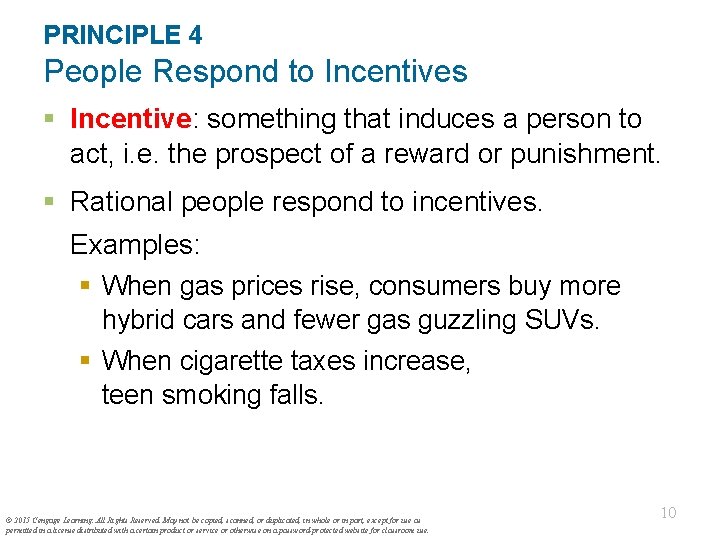
PRINCIPLE 4 People Respond to Incentives § Incentive: something that induces a person to act, i. e. the prospect of a reward or punishment. § Rational people respond to incentives. Examples: § When gas prices rise, consumers buy more hybrid cars and fewer gas guzzling SUVs. § When cigarette taxes increase, teen smoking falls. © 2015 Cengage Learning. All Rights Reserved. May not be copied, scanned, or duplicated, in whole or in part, except for use as permitted in a license distributed with a certain product or service or otherwise on a password-protected website for classroom use. 10
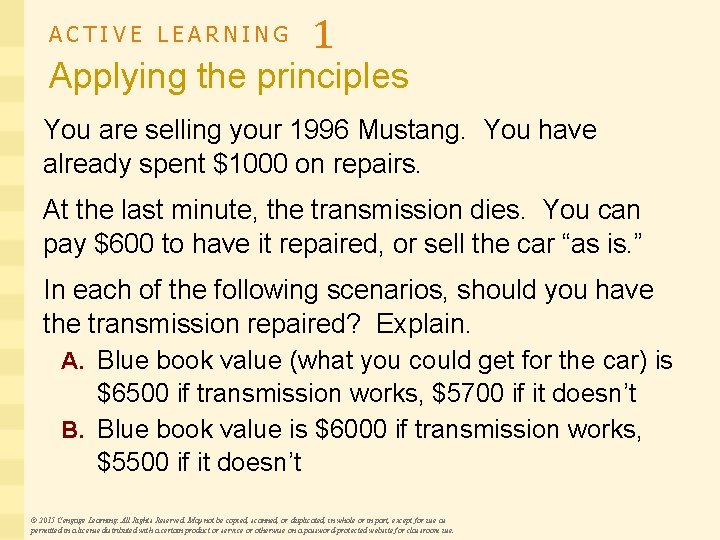
ACTIVE LEARNING 1 Applying the principles You are selling your 1996 Mustang. You have already spent $1000 on repairs. At the last minute, the transmission dies. You can pay $600 to have it repaired, or sell the car “as is. ” In each of the following scenarios, should you have the transmission repaired? Explain. A. Blue book value (what you could get for the car) is $6500 if transmission works, $5700 if it doesn’t B. Blue book value is $6000 if transmission works, $5500 if it doesn’t © 2015 Cengage Learning. All Rights Reserved. May not be copied, scanned, or duplicated, in whole or in part, except for use as permitted in a license distributed with a certain product or service or otherwise on a password-protected website for classroom use.
ACTIVE LEARNING Answers 1 Cost of fixing transmission = $600 A. Blue book value is $6500 if transmission works, $5700 if it doesn’t Benefit of fixing transmission = $800 ($6500 – 5700). Get the transmission fixed. B. Blue book value is $6000 if transmission works, $5500 if it doesn’t Benefit of fixing the transmission is only $500. Do not pay $600 to fix it. © 2015 Cengage Learning. All Rights Reserved. May not be copied, scanned, or duplicated, in whole or in part, except for use as permitted in a license distributed with a certain product or service or otherwise on a password-protected website for classroom use.
ACTIVE LEARNING Observations 1 § The $1000 you previously spent on repairs is irrelevant. What matters is the cost and benefit of the marginal repair (the transmission). § The change in incentives from scenario A to scenario B caused your decision to change. © 2015 Cengage Learning. All Rights Reserved. May not be copied, scanned, or duplicated, in whole or in part, except for use as permitted in a license distributed with a certain product or service or otherwise on a password-protected website for classroom use.
The principles of HOW PEOPLE INTERACT ©Pressmaster/Shutterstock. com
PRINCIPLE 5 Trade Can Make Everyone Better Off § Rather than being self-sufficient, people can specialize in producing one good or service and exchange it for other goods. § Countries also benefit from trade and specialization: § Get a better price abroad for goods they produce § Buy other goods more cheaply from abroad than could be produced at home © 2015 Cengage Learning. All Rights Reserved. May not be copied, scanned, or duplicated, in whole or in part, except for use as permitted in a license distributed with a certain product or service or otherwise on a password-protected website for classroom use. 15
PRINCIPLE 6 Markets Are Usually A Good Way to Organize Economic Activity § Market: a group of buyers and sellers (need not be in a single location) § “Organize economic activity” means determining § what goods to produce § how to produce them § how much of each to produce § who gets them © 2015 Cengage Learning. All Rights Reserved. May not be copied, scanned, or duplicated, in whole or in part, except for use as permitted in a license distributed with a certain product or service or otherwise on a password-protected website for classroom use. 16
PRINCIPLE 6 Markets Are Usually A Good Way to Organize Economic Activity § A market economy allocates resources through the decentralized decisions of many households and firms as they interact in markets. § Famous insight by Adam Smith in The Wealth of Nations (1776): Each of these households and firms acts as if “led by an invisible hand” to promote general economic well-being. © 2015 Cengage Learning. All Rights Reserved. May not be copied, scanned, or duplicated, in whole or in part, except for use as permitted in a license distributed with a certain product or service or otherwise on a password-protected website for classroom use. 17
PRINCIPLE 6 Markets Are Usually A Good Way to Organize Economic Activity § The invisible hand works through the price system: § The interaction of buyers and sellers determines prices. § Each price reflects the good’s value to buyers and the cost of producing the good. § Prices guide self-interested households and firms to make decisions that, in many cases, maximize society’s economic well-being. © 2015 Cengage Learning. All Rights Reserved. May not be copied, scanned, or duplicated, in whole or in part, except for use as permitted in a license distributed with a certain product or service or otherwise on a password-protected website for classroom use. 18
PRINCIPLE 7 Governments Can Sometimes Improve Market Outcomes § Important role for govt: enforce property rights (with police, courts) § People are less inclined to work, produce, invest, or purchase if large risk of their property being stolen. © 2015 Cengage Learning. All Rights Reserved. May not be copied, scanned, or duplicated, in whole or in part, except for use as permitted in a license distributed with a certain product or service or otherwise on a password-protected website for classroom use. 19
PRINCIPLE 7 Governments Can Sometimes Improve Market Outcomes § Market failure: when the market fails to allocate society’s resources efficiently § Causes of market failure: § Externalities, when the production or consumption of a good affects bystanders (e. g. pollution) § Market power, a single buyer or seller has substantial influence on market price (e. g. monopoly) § Public policy may promote efficiency. © 2015 Cengage Learning. All Rights Reserved. May not be copied, scanned, or duplicated, in whole or in part, except for use as permitted in a license distributed with a certain product or service or otherwise on a password-protected website for classroom use. 20
PRINCIPLE 7 Governments Can Sometimes Improve Market Outcomes § Govt may alter market outcome to promote equity. § If the market’s distribution of economic well-being is not desirable, tax or welfare policies can change how the economic “pie” is divided. © 2015 Cengage Learning. All Rights Reserved. May not be copied, scanned, or duplicated, in whole or in part, except for use as permitted in a license distributed with a certain product or service or otherwise on a password-protected website for classroom use. 21
ACTIVE LEARNING 2 Discussion Question In each of the following situations, what is the government’s role? Does the government’s intervention improve the outcome? a. Public schools for K-12 b. Workplace safety regulations c. Public highways d. Patent laws, which allow drug companies to charge high prices for life-saving drugs © 2015 Cengage Learning. All Rights Reserved. May not be copied, scanned, or duplicated, in whole or in part, except for use as permitted in a license distributed with a certain product or service or otherwise on a password-protected website for classroom use.
The principles of HOW THE ECONOMY AS A WHOLE WORKS ©nopporn/Shutterstock. com
PRINCIPLE 8 A Country’s Standard of Living Depends on Its Ability to Produce Goods & Services § Huge variation in living standards across countries and over time: § Average income in rich countries is more than ten times average income in poor countries. § The U. S. standard of living today is about eight times larger than 100 years ago. © 2015 Cengage Learning. All Rights Reserved. May not be copied, scanned, or duplicated, in whole or in part, except for use as permitted in a license distributed with a certain product or service or otherwise on a password-protected website for classroom use. 24
PRINCIPLE 8 A Country’s Standard of Living Depends on Its Ability to Produce Goods & Services § The most important determinant of living standards: productivity, the amount of goods and services produced per unit of labor. § Productivity depends on the equipment, skills, and technology available to workers. § Other factors (e. g. , labor unions, competition from abroad) have far less impact on living standards. © 2015 Cengage Learning. All Rights Reserved. May not be copied, scanned, or duplicated, in whole or in part, except for use as permitted in a license distributed with a certain product or service or otherwise on a password-protected website for classroom use. 25
PRINCIPLE 9 Prices Rise When the Government Prints Too Much Money § Inflation: increases in the general level of prices. § In the long run, inflation is almost always caused by excessive growth in the quantity of money, which causes the value of money to fall. § The faster the govt creates money, the greater the inflation rate. © 2015 Cengage Learning. All Rights Reserved. May not be copied, scanned, or duplicated, in whole or in part, except for use as permitted in a license distributed with a certain product or service or otherwise on a password-protected website for classroom use. 26
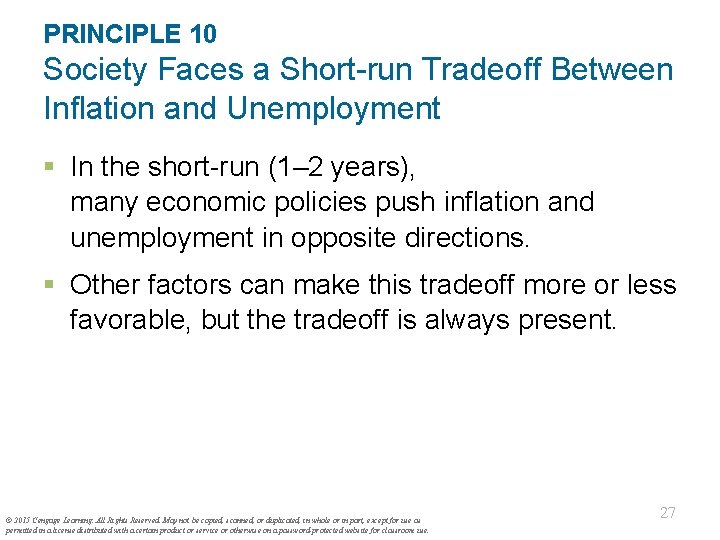
PRINCIPLE 10 Society Faces a Short-run Tradeoff Between Inflation and Unemployment § In the short-run (1– 2 years), many economic policies push inflation and unemployment in opposite directions. § Other factors can make this tradeoff more or less favorable, but the tradeoff is always present. © 2015 Cengage Learning. All Rights Reserved. May not be copied, scanned, or duplicated, in whole or in part, except for use as permitted in a license distributed with a certain product or service or otherwise on a password-protected website for classroom use. 27
Summary The principles of decision making are: • People face tradeoffs. • The cost of any action is measured in terms of foregone opportunities. • Rational people make decisions by comparing marginal costs and marginal benefits. • People respond to incentives. © 2015 Cengage Learning. All Rights Reserved. May not be copied, scanned, or duplicated, in whole or in part, except for use as permitted in a license distributed with a certain product or service or otherwise on a password-protected website for classroom use.
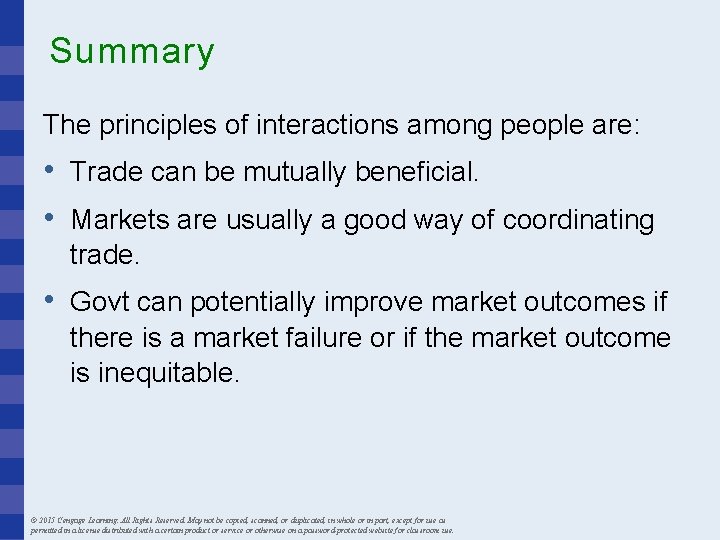
Summary The principles of interactions among people are: • Trade can be mutually beneficial. • Markets are usually a good way of coordinating trade. • Govt can potentially improve market outcomes if there is a market failure or if the market outcome is inequitable. © 2015 Cengage Learning. All Rights Reserved. May not be copied, scanned, or duplicated, in whole or in part, except for use as permitted in a license distributed with a certain product or service or otherwise on a password-protected website for classroom use.
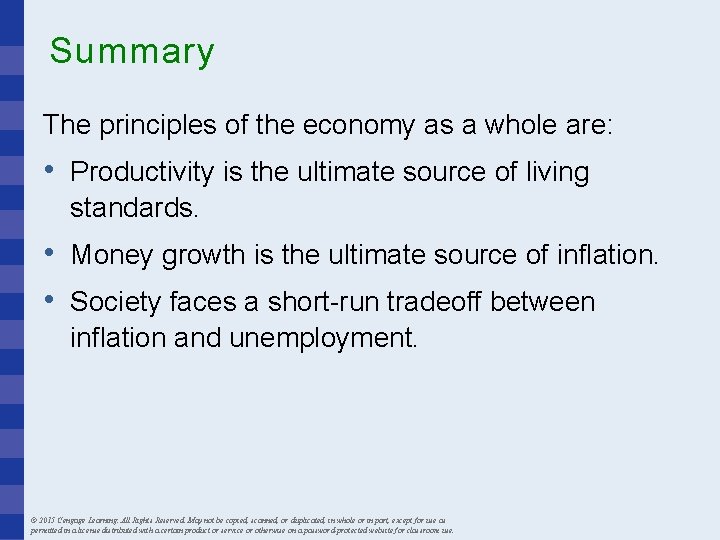
Summary The principles of the economy as a whole are: • Productivity is the ultimate source of living standards. • Money growth is the ultimate source of inflation. • Society faces a short-run tradeoff between inflation and unemployment. © 2015 Cengage Learning. All Rights Reserved. May not be copied, scanned, or duplicated, in whole or in part, except for use as permitted in a license distributed with a certain product or service or otherwise on a password-protected website for classroom use.