
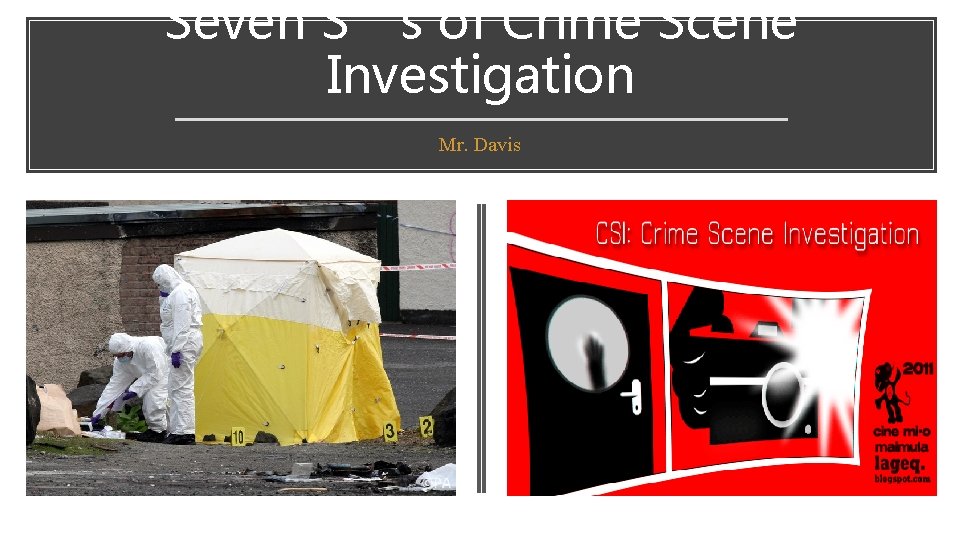
Seven Ss of Crime Scene Investigation Mr Davis

- Slides: 15
Seven S’s of Crime Scene Investigation Mr. Davis
Seven S’s of Crime Scene Investigation • 1. Secure the scene • 2. Separate the witnesses • 3. Scan the scene • 4. See the scene • 5. Sketch the scene • 6. Search for evidence • 7. Secure and collect evidence
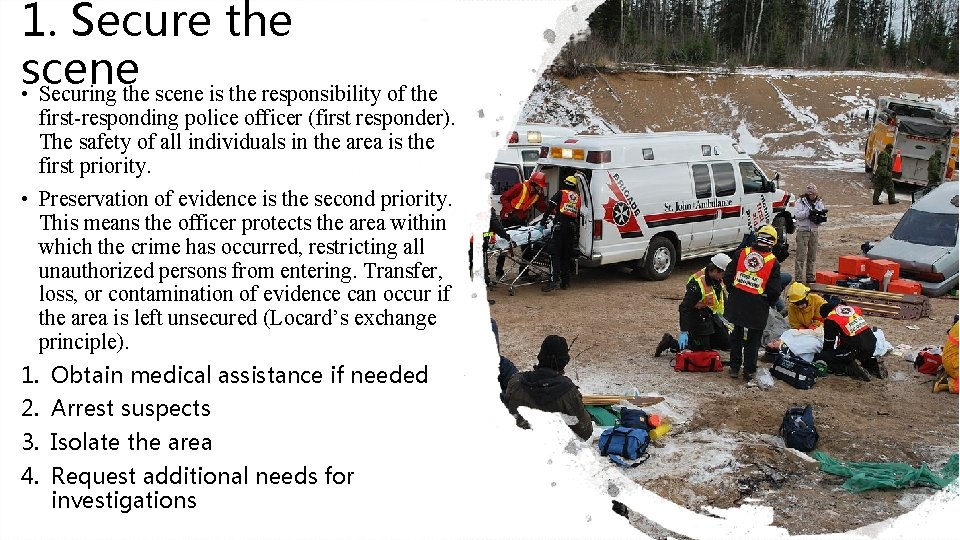
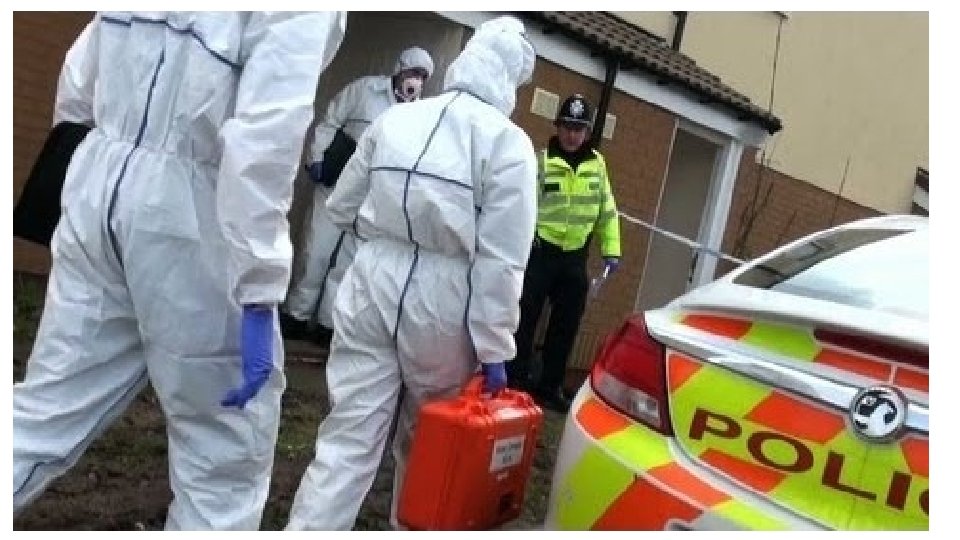
1. Secure the scene • Securing the scene is the responsibility of the first-responding police officer (first responder). The safety of all individuals in the area is the first priority. • Preservation of evidence is the second priority. This means the officer protects the area within which the crime has occurred, restricting all unauthorized persons from entering. Transfer, loss, or contamination of evidence can occur if the area is left unsecured (Locard’s exchange principle). 1. Obtain medical assistance if needed 2. Arrest suspects 3. Isolate the area 4. Request additional needs for investigations
• Separating the witnesses is the next priority. Witnesses must not be allowed to talk to each other. Their accounts of the events will be compared. This separation is done to avoid witnesses working together to create a story (collusion). The following questions need to be asked of each witness: • When did the crime occur? • Who called in the crime? • Who is the victim? 2. SEPARATING THE WITNESSES • Can the perpetrator be identified? • What did you see happen? • Where were you when you observed the crime scene?
5 3. SCANNING THE SCENE • The forensic examiners need to scan the scene to determine where photos should be taken. A determination may be made of a primary crime scene and secondary crime scene and priorities assigned regarding examination. Forensic Science - 2018
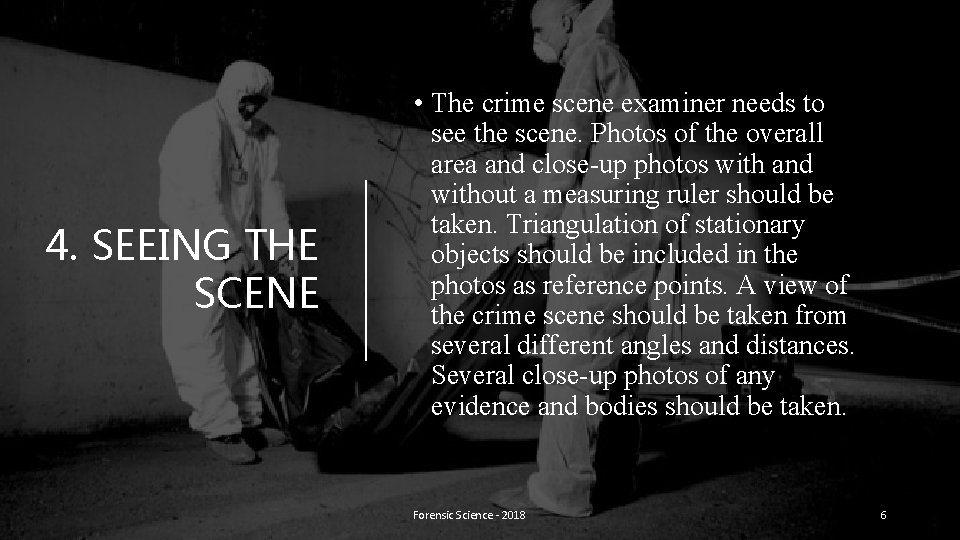
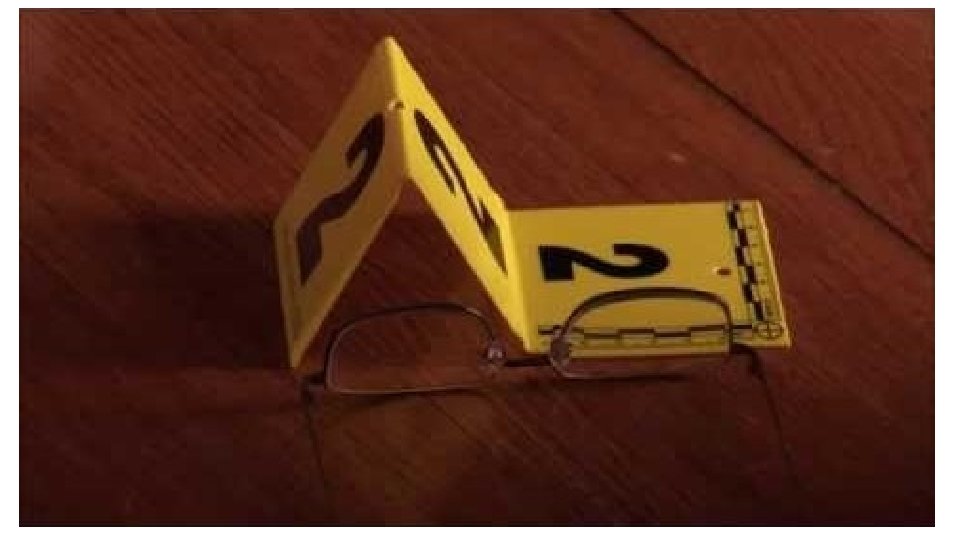
4. SEEING THE SCENE • The crime scene examiner needs to see the scene. Photos of the overall area and close-up photos with and without a measuring ruler should be taken. Triangulation of stationary objects should be included in the photos as reference points. A view of the crime scene should be taken from several different angles and distances. Several close-up photos of any evidence and bodies should be taken. Forensic Science - 2018 6
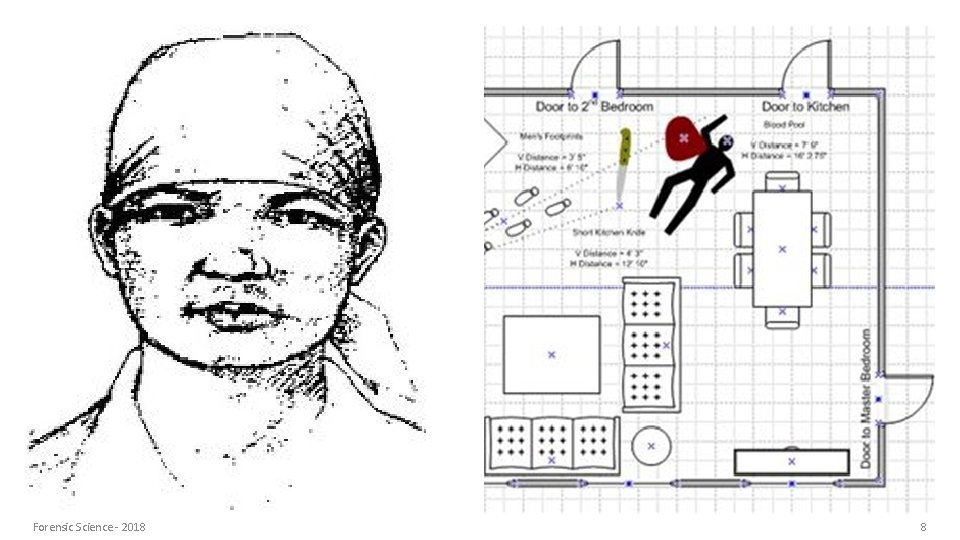
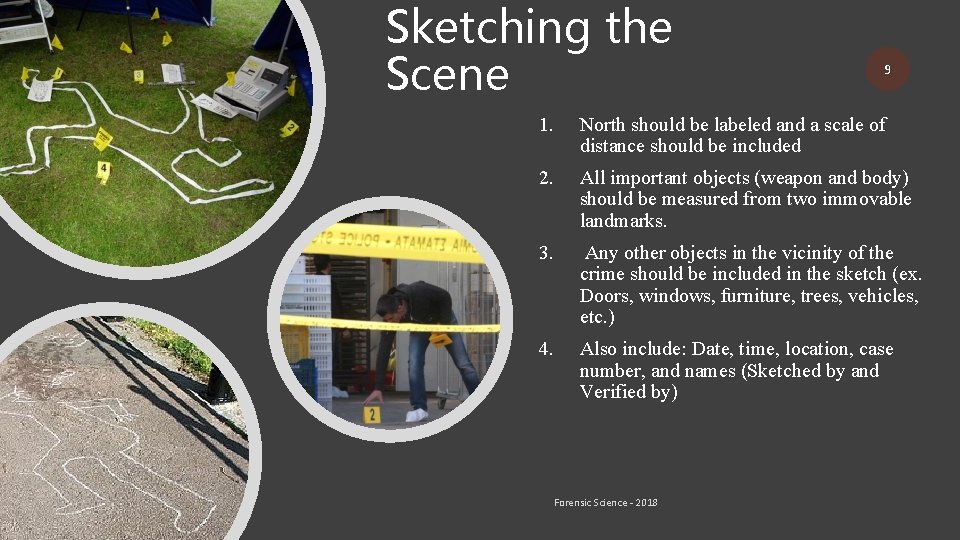
5. SKETCHING THE SCENE Forensic Science - 2018 • An accurate rough sketch of the crime scene is made, noting the position of the body (if any) and any other evidence. All objects should be measured from two immovable landmarks. On the sketch, north should be labeled and a scale of distance should be provided. Any other objects near the crime scene should be included in the sketch. This includes doors, windows, and furniture. • If the crime scene is outdoors, the position of trees, vehicles, hedges, and other structures or objects should be included in the sketch. 7
Forensic Science - 2018 8
Sketching the Scene 9 1. North should be labeled and a scale of distance should be included 2. All important objects (weapon and body) should be measured from two immovable landmarks. 3. Any other objects in the vicinity of the crime should be included in the sketch (ex. Doors, windows, furniture, trees, vehicles, etc. ) 4. Also include: Date, time, location, case number, and names (Sketched by and Verified by) Forensic Science - 2018
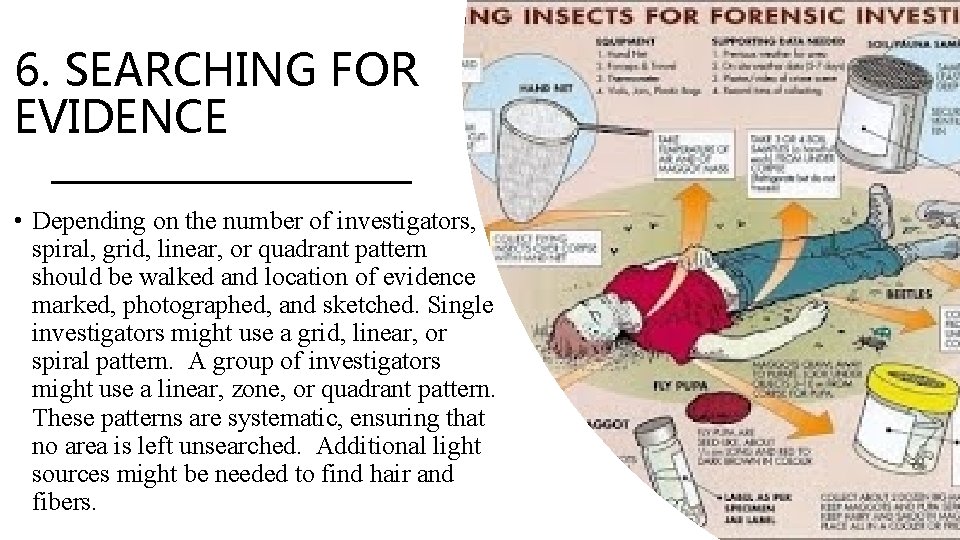
6. SEARCHING FOR EVIDENCE • Depending on the number of investigators, a spiral, grid, linear, or quadrant pattern should be walked and location of evidence marked, photographed, and sketched. Single investigators might use a grid, linear, or spiral pattern. A group of investigators might use a linear, zone, or quadrant pattern. These patterns are systematic, ensuring that no area is left unsearched. Additional light sources might be needed to find hair and fibers.
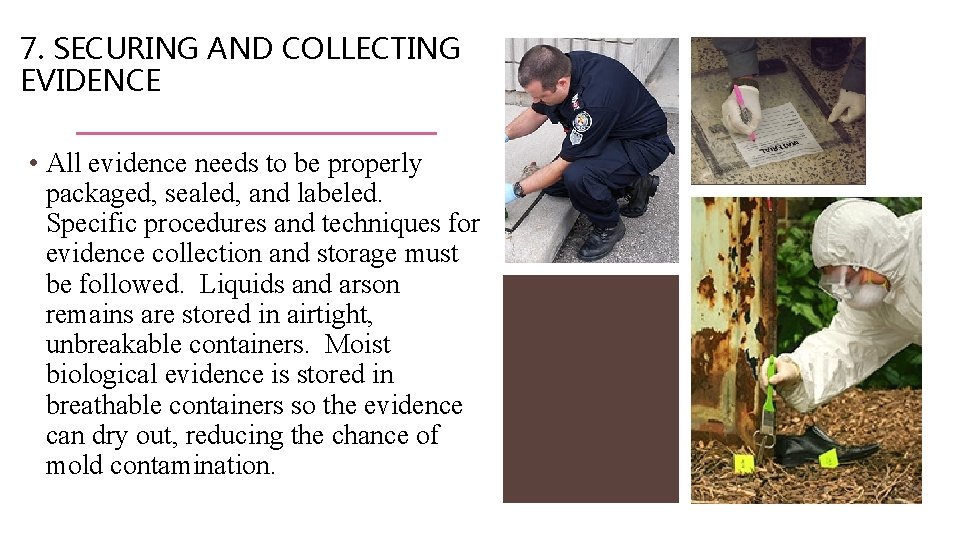
7. SECURING AND COLLECTING EVIDENCE • All evidence needs to be properly packaged, sealed, and labeled. Specific procedures and techniques for evidence collection and storage must be followed. Liquids and arson remains are stored in airtight, unbreakable containers. Moist biological evidence is stored in breathable containers so the evidence can dry out, reducing the chance of mold contamination.