
Seven Researchbased Principles for Smart Teaching Dr Susan

Seven Research-based Principles for Smart Teaching Dr. Susan A. Ambrose Senior Vice Provost for Educational Innovation Professor of Education & History Northeastern University Colorado State University May 2018
Agenda I. Set the context II. Briefly introduce the 7 principles of learning III. Share two final thoughts IV. Discussion
Objectives for the Session By the end of this session, you should be able to – Identify one principle of learning that you resonate with, and – Identify one principle that you want to learn more about because you believe it could have a big impact on your students’ learning

The Context
Why Is This Important? As Kuh and colleagues noted (2005), most of those educating our university students are “wellintentioned, gifted amateurs”. . . who have not been educated or trained as teachers.
The 7 Principles of Learning are. . . Grounded in Research literature Work with faculty (over 35 years) Broadly applicable, across Domains, Students (ages and stages) and Contexts Generative Help faculty devise effective teaching strategies that are appropriate to a particular situation
What exactly is Learning? Learning is a process that leads to change, which occurs as a result of experience and increases the potential for improved performance and future learning. There are three critical components to this definition: • Learning is a process, not a product. • Learning involves change in knowledge, beliefs, behaviors and/or attitudes – and must have a lasting impact on how the student thinks and acts. • Learning is not something done to students, but rather something students themselves do. Ambrose et. all. (2010) adapted from Mayer (2002)
Why a “learner-centered” approach? Learning results from what the student does and thinks and only from what the student does and thinks. The teacher can advance learning only by influencing what the student does to learn. Herb Simon (2001) Teachers possess the power to create conditions that can help students learn a great deal – or keep them from learning much at all. Teaching is the intentional act of creating such conditions. Parker Palmer (1998) •
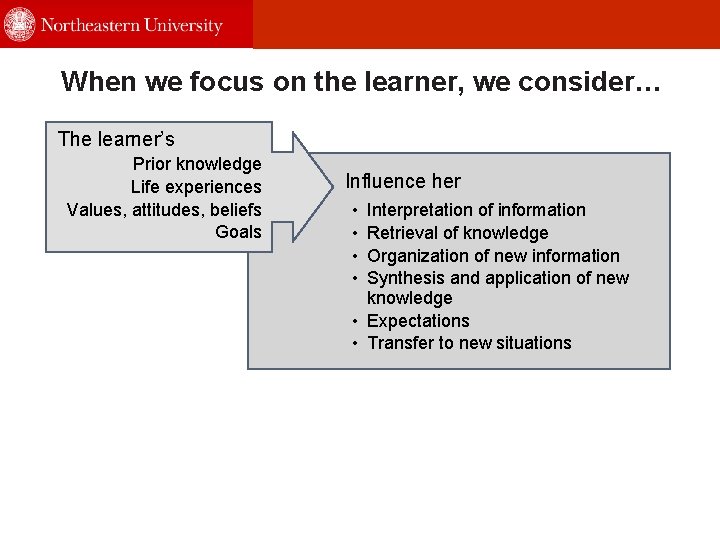
When we focus on the learner, we consider… The learner’s Prior knowledge Life experiences Values, attitudes, beliefs Goals Influence her • • Interpretation of information Retrieval of knowledge Organization of new information Synthesis and application of new knowledge • Expectations • Transfer to new situations
This shifts the perspective for faculty. . . From How we teach to How people learn

The Principles at a Glance 1. Students’ prior knowledge can help or hinder learning. 2. How students organize knowledge influences how they learn and apply what they know. 3. Students’ motivation determines, directs, and sustains what they do to learn. 4. To develop mastery, students must acquire component skills, practice integrating them, and know when to apply them. 5. Goal-directed practice coupled with targeted feedback enhances the quality of students’ learning. 6. Students’ current level of development interacts with the social, emotional, and intellectual climate of the course to impact learning. 7. To become self-directed learners, students must learn to monitor and adjust their approaches to learning.
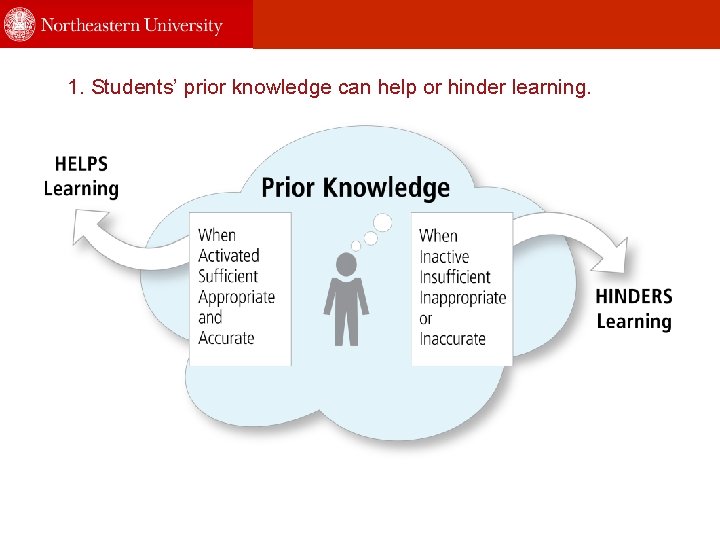
1. Students’ prior knowledge can help or hinder learning.
Students blank slates They come into our courses with facts, models, attitudes, beliefs, and assumptions. They build on and interpret incoming information through the lens of their existing knowledge – even if that knowledge is inaccurate, insufficient, inappropriate or inactive.
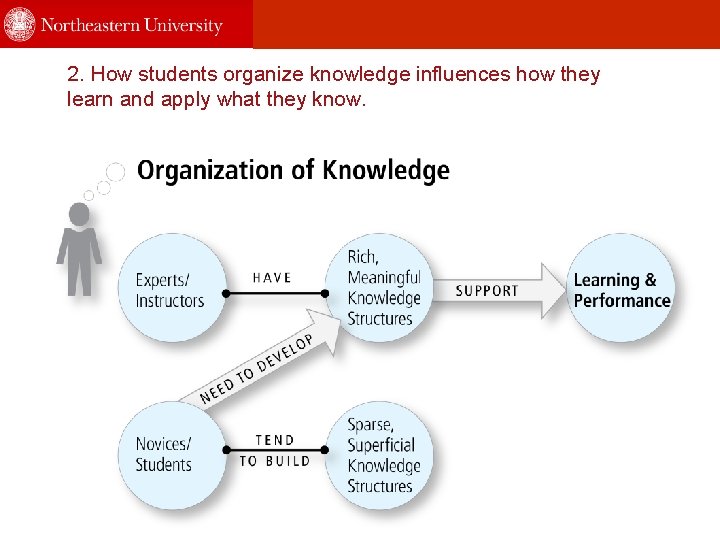
2. How students organize knowledge influences how they learn and apply what they know.
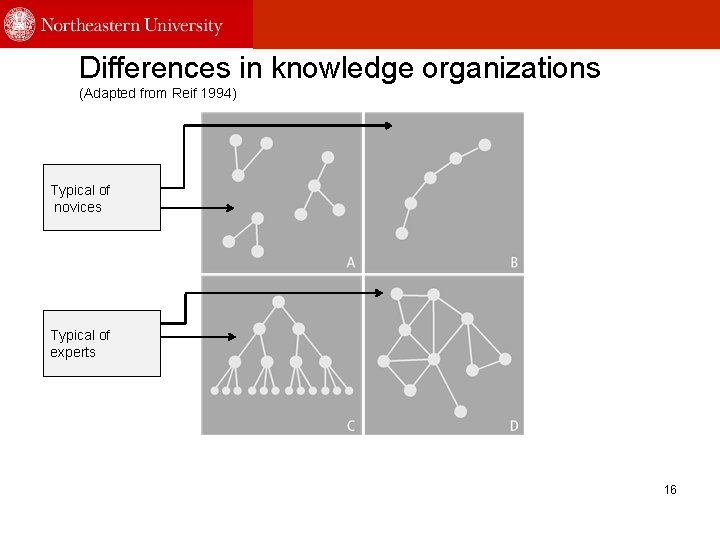
Differences in knowledge organizations (Adapted from Reif 1994) Typical of novices Typical of experts 16
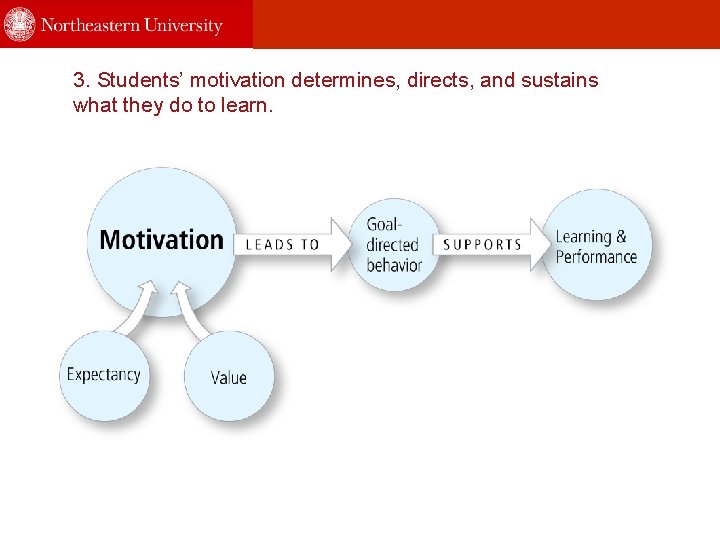
3. Students’ motivation determines, directs, and sustains what they do to learn.
Motivation will be enhanced if. . . Learners believe they have a reasonable expectation of attaining success. Learners perceive the value (relevance, importance, utility) of a particular task or goal.
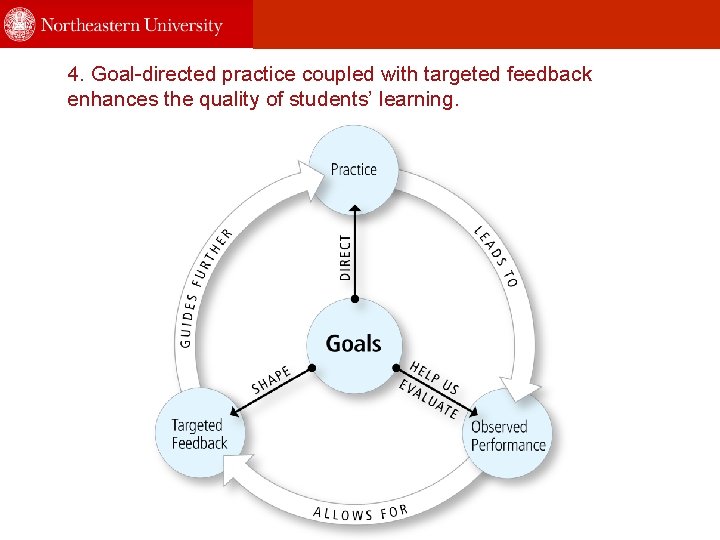
4. Goal-directed practice coupled with targeted feedback enhances the quality of students’ learning.
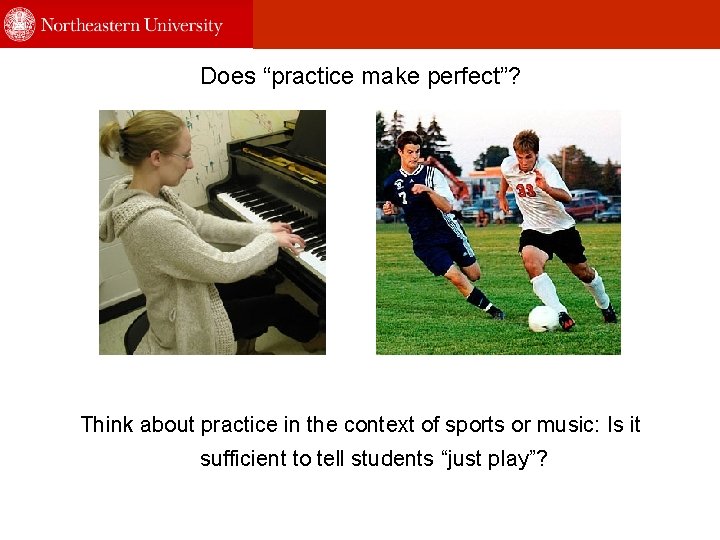
Does “practice make perfect”? Think about practice in the context of sports or music: Is it sufficient to tell students “just play”?
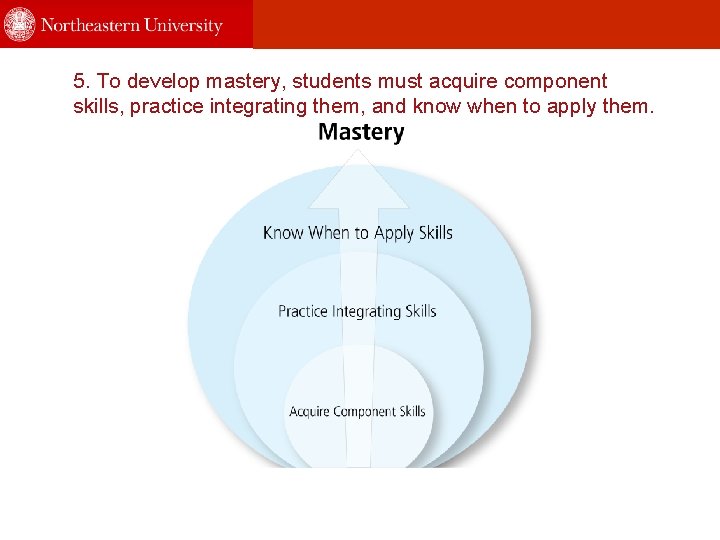
5. To develop mastery, students must acquire component skills, practice integrating them, and know when to apply them.
Why is “teaching toward mastery” difficult? Because of Expert Blind Spot, which occurs when expert instructors are blind to the learning needs of novice students, e. g. , we. . . • • • Over-estimate what novices know and can do Under-estimate how long novices will take Do not see the steps/pieces novices must learn Mis-predict where novices will have difficulty Presume that novices do things the way we do Hinds (1999); Nathan & Koedinger (2000); Nickerson (1999) 22
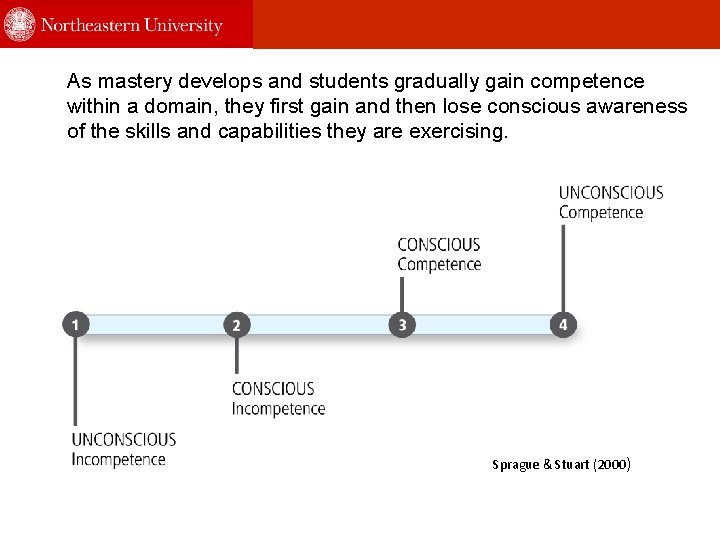
As mastery develops and students gradually gain competence within a domain, they first gain and then lose conscious awareness of the skills and capabilities they are exercising. Sprague & Stuart (2000)
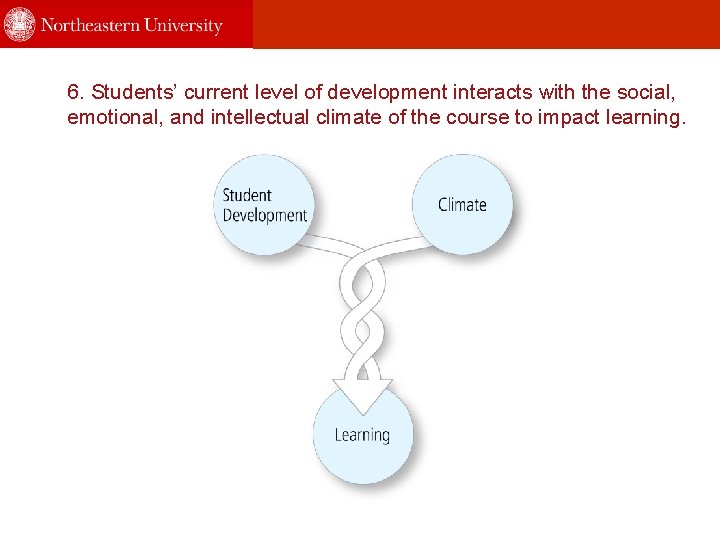
6. Students’ current level of development interacts with the social, emotional, and intellectual climate of the course to impact learning.
Why care about development and climate? We teach students, not just content! Undergraduate students are complex! For example, they are 1. 2. 3. 4. 5. 6. 7. Developing Competence Managing Emotions Developing Autonomy Establishing Identity Freeing Interpersonal Relationships Developing Purpose Developing Integrity Chickering (1969; Chickering and Reisser (1993)
Furthermore, we need to understand address students’ beliefs/views that impact learning For example. . . • Their beliefs about intelligence: e. g. , fixed vs. malleable • Their views about learning: e. g. , quick vs. gradual • Their definition of knowledge: e. g. , declarative vs. procedural vs. contextual; certain vs. ambiguous; simple vs. complex Dweck & Leggett (1988); Schoenfeld (1983); Schommer (1990) 26
And then there adult returning professionals who, for example, • Harbor doubts about their learning capabilities, e. g. , underestimating their capabilities • Struggle with confidence and competence, which are mutually enhancing – competence allows a person to become more confident, which provides emotional support for an effort to learn new skills and knowledge • Care about personal relevance, e. g. , connecting to who they are, what they care about, what they will be able to do • Want control – they are autonomous in many aspects of their daily lives Wlodkowski (2008)
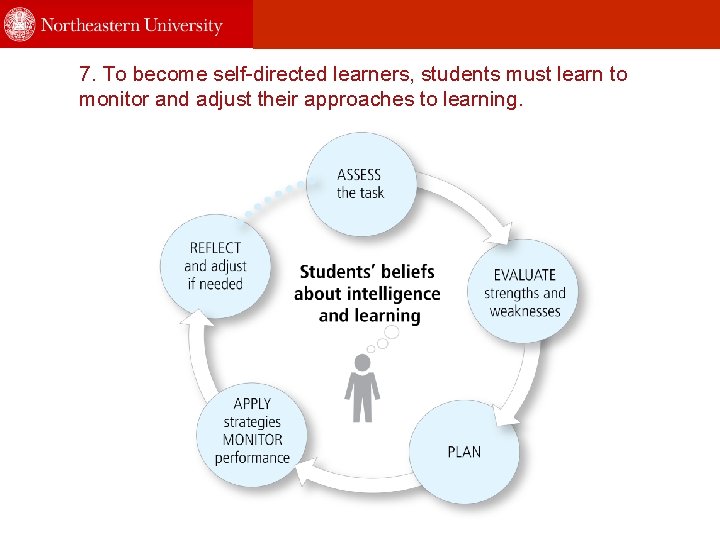
7. To become self-directed learners, students must learn to monitor and adjust their approaches to learning.
Unfortunately. . . Most college age students do not naturally engage metacognitive skills or self-directed learning strategies, despite the fact that doing so can pay big dividends for students’ life-long learning. The good news is that many adult students already possess metacognitive skills to self-regulate their learning (Wlodkowski, 2008).
The Principles at a Glance 1. Students’ prior knowledge can help or hinder learning. 2. How students organize knowledge influences how they learn and apply what they know. 3. Students’ motivation determines, directs, and sustains what they do to learn. 4. To develop mastery, students must acquire component skills, practice integrating them, and know when to apply them. 5. Goal-directed practice coupled with targeted feedback enhances the quality of students’ learning. 6. Students’ current level of development interacts with the social, emotional, and intellectual climate of the course to impact learning. 7. To become self-directed learners, students must learn to monitor and adjust their approaches to learning.
2 Final Thoughts Remember. . . • Teaching is a process of progressive refinement. • Effective teachers are not born that way! 31
- Slides: 31