
SEVEN LAYER MODELOSI MODEL 1 INTRODUCTION International standard

- Slides: 13
SEVEN LAYER MODEL(OSI MODEL) 1
INTRODUCTION Ø International standard organization (ISO) established a committee in 1977 to develop an architecture for systems communication. Ø Open System Interconnection (OSI) reference model is the result of this effort. Ø This model allows any two different systems to communicate Regardless of their underlying architecture. 4
CONT. . Ø The OSI model describes how data flows from one computer, through a network to another computer. Ø The OSI model is not a protocol; it is a model for understanding and designing a network architecture that is flexible and robust. Ø The OSI model consists of seven separate but related layers, each of which defines a part of the process of moving information across a network. 5
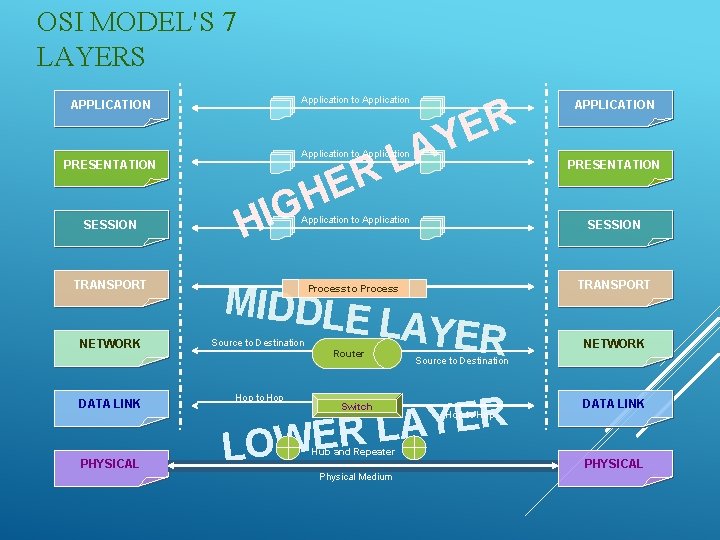
OSI MODEL'S 7 LAYERS APPLICATION PRESENTATION SESSION TRANSPORT NETWORK DATA LINK PHYSICAL Application to Application R E Y A L R E H G HI Application to Application MIDDLE LAYER Process to Process Source to Destination Router Hop to Hop Hub and Repeater Physical Medium PRESENTATION SESSION TRANSPORT NETWORK Source to Destination R E Y A L R E W O L Switch APPLICATION Hop to Hop DATA LINK PHYSICAL 6
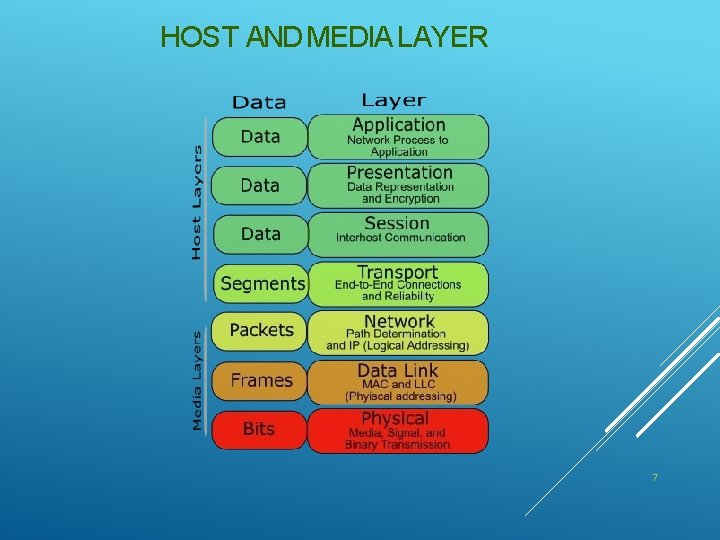
HOST AND MEDIA LAYER 7
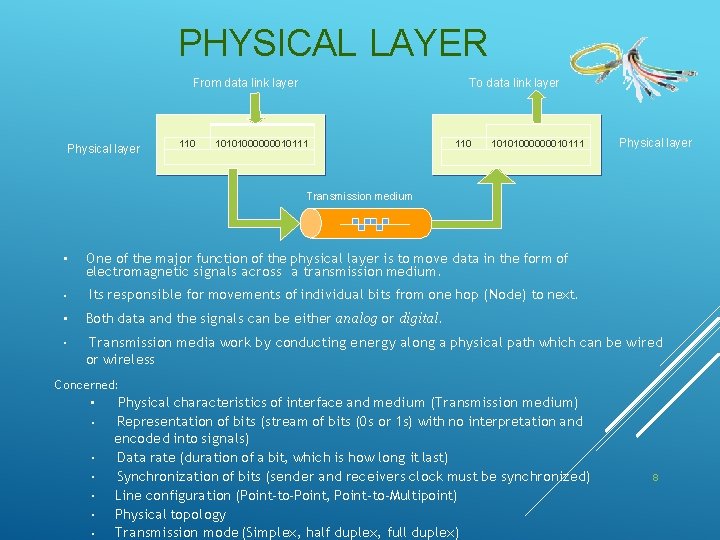
PHYSICAL LAYER From data link layer Physical layer 110 To data link layer 10101000000010111 110 10101000000010111 Physical layer Transmission medium • • One of the major function of the physical layer is to move data in the form of electromagnetic signals across a transmission medium. Its responsible for movements of individual bits from one hop (Node) to next. • Both data and the signals can be either analog or digital. • Transmission media work by conducting energy along a physical path which can be wired or wireless Concerned: • Physical characteristics of interface and medium (Transmission medium) • • • Representation of bits (stream of bits (0 s or 1 s) with no interpretation and encoded into signals) Data rate (duration of a bit, which is how long it last) Synchronization of bits (sender and receivers clock must be synchronized) Line configuration (Point-to-Point, Point-to-Multipoint) Physical topology Transmission mode (Simplex, half duplex, full duplex) 8
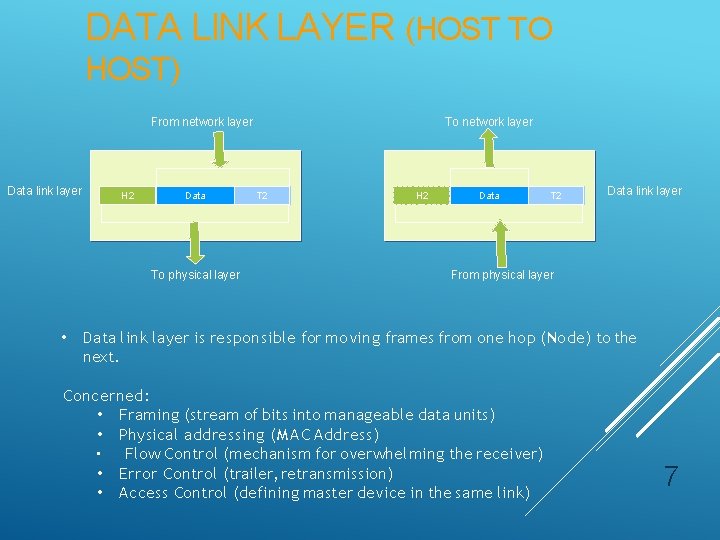
DATA LINK LAYER (HOST TO HOST) From network layer Data link layer H 2 Data To physical layer • To network layer T 2 H 2 Data T 2 Data link layer From physical layer Data link layer is responsible for moving frames from one hop (Node) to the next. Concerned: • Framing (stream of bits into manageable data units) • Physical addressing (MAC Address) • Flow Control (mechanism for overwhelming the receiver) • Error Control (trailer, retransmission) • Access Control (defining master device in the same link) 7
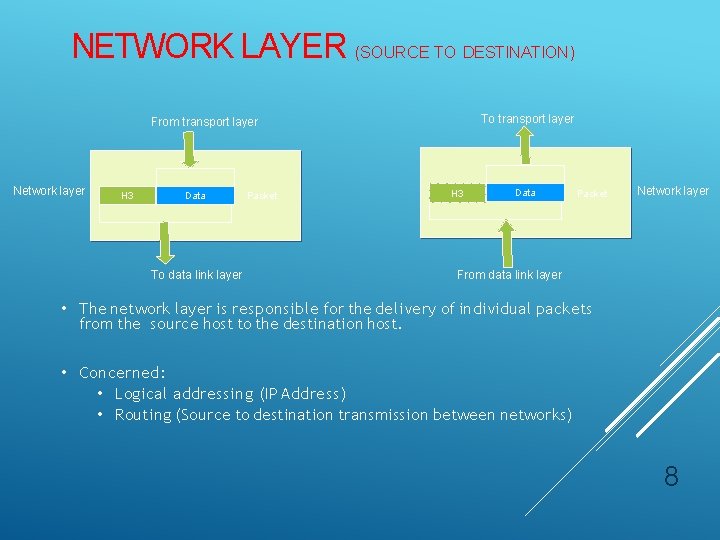
NETWORK LAYER (SOURCE TO DESTINATION) To transport layer From transport layer Network layer H 3 Data To data link layer Packet H 3 Data Packet Network layer From data link layer • The network layer is responsible for the delivery of individual packets from the source host to the destination host. • Concerned: • Logical addressing (IP Address) • Routing (Source to destination transmission between networks) 8
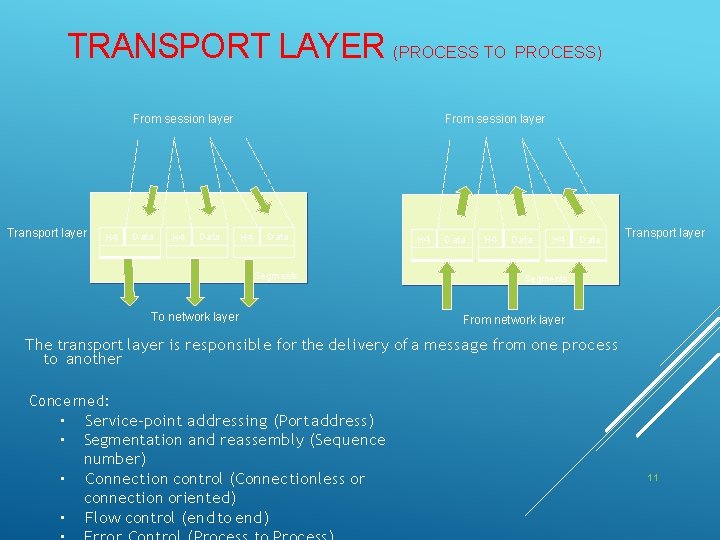
TRANSPORT LAYER (PROCESS TO PROCESS) From session layer Transport layer H 4 Data From session layer H 4 Data Segments To network layer H 4 Data Transport layer Segments From network layer The transport layer is responsible for the delivery of a message from one process to another Concerned: • • Service-point addressing (Port address) Segmentation and reassembly (Sequence number) Connection control (Connectionless or connection oriented) Flow control (end to end) 11
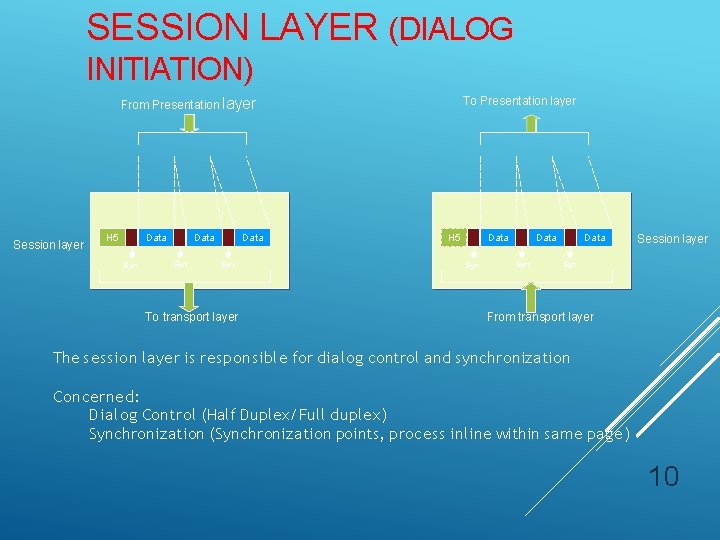
SESSION LAYER (DIALOG INITIATION) To Presentation layer From Presentation layer Session layer Data H 5 Syn Data Syn To transport layer Data H 5 Syn Data Session layer Syn From transport layer The session layer is responsible for dialog control and synchronization Concerned: Dialog Control (Half Duplex/Full duplex) Synchronization (Synchronization points, process inline within same page) 10
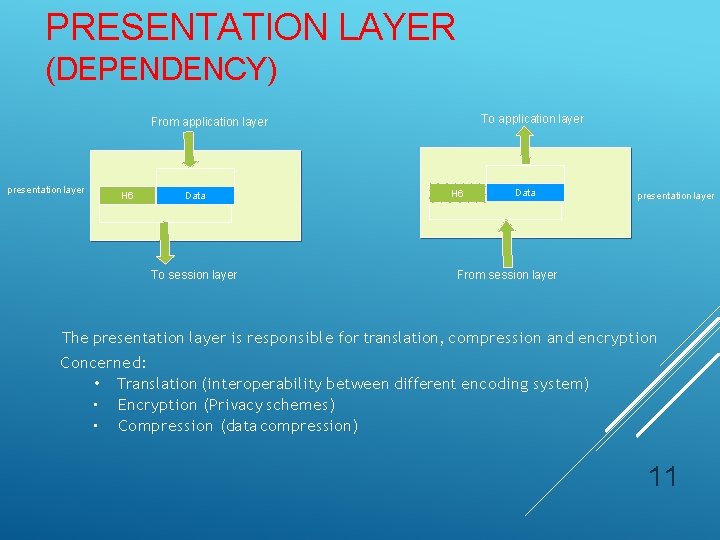
PRESENTATION LAYER (DEPENDENCY) To application layer From application layer presentation layer H 6 Data To session layer H 6 Data presentation layer From session layer The presentation layer is responsible for translation, compression and encryption Concerned: • Translation (interoperability between different encoding system) • Encryption (Privacy schemes) • Compression (data compression) 11
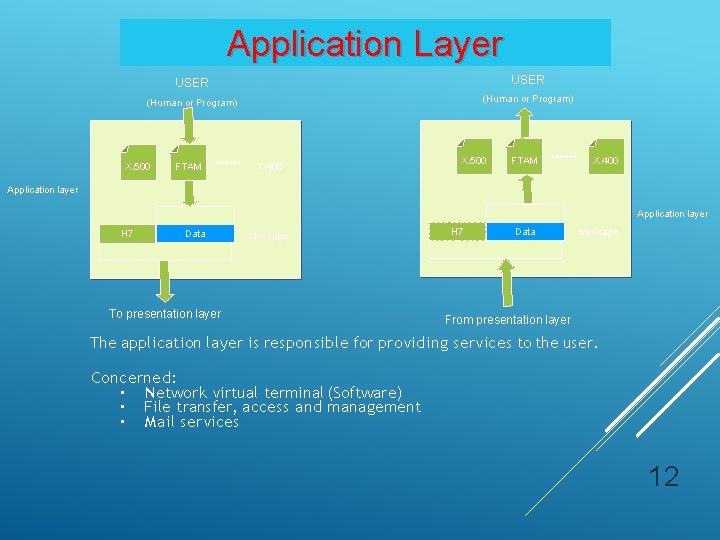
Application Layer USER (Human or Program) X. 500 FTAM X. 400 Application layer H 7 Data Message To presentation layer H 7 Data Message From presentation layer The application layer is responsible for providing services to the user. Concerned: • Network virtual terminal (Software) • File transfer, access and management • Mail services 12
THE END 13