
Settlement Geography Concepts Settlement grouping of people building

Settlement Geography
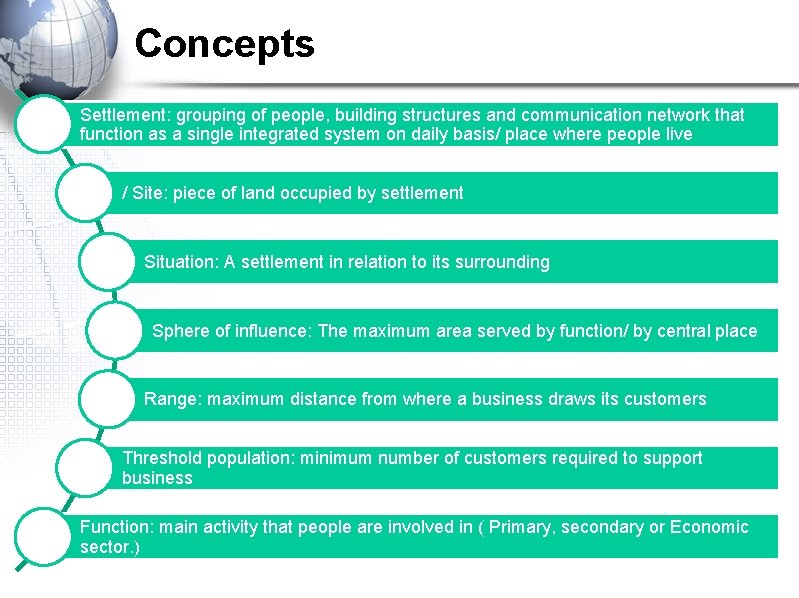
Concepts Settlement: grouping of people, building structures and communication network that function as a single integrated system on daily basis/ place where people live / Site: piece of land occupied by settlement Situation: A settlement in relation to its surrounding Sphere of influence: The maximum area served by function/ by central place Range: maximum distance from where a business draws its customers Threshold population: minimum number of customers required to support business Function: main activity that people are involved in ( Primary, secondary or Economic sector. )
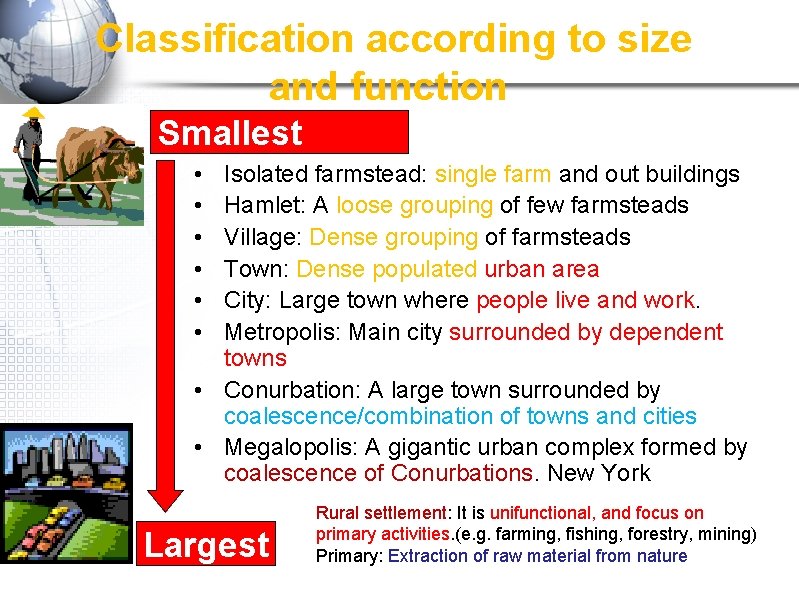
Classification according to size and function Smallest • • • Isolated farmstead: single farm and out buildings Hamlet: A loose grouping of few farmsteads Village: Dense grouping of farmsteads Town: Dense populated urban area City: Large town where people live and work. Metropolis: Main city surrounded by dependent towns • Conurbation: A large town surrounded by coalescence/combination of towns and cities • Megalopolis: A gigantic urban complex formed by coalescence of Conurbations. New York Largest Rural settlement: It is unifunctional, and focus on primary activities. (e. g. farming, fishing, forestry, mining) Primary: Extraction of raw material from nature
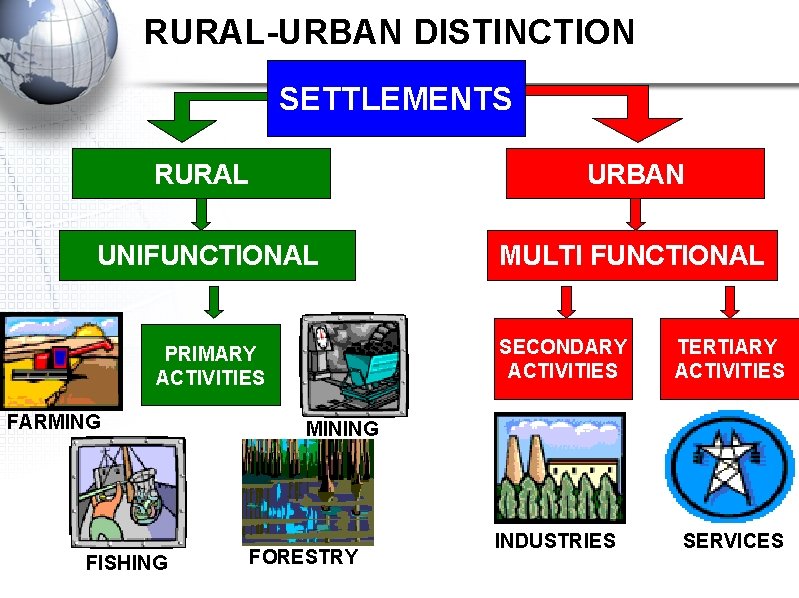
RURAL-URBAN DISTINCTION SETTLEMENTS RURAL URBAN UNIFUNCTIONAL MULTI FUNCTIONAL SECONDARY ACTIVITIES PRIMARY ACTIVITIES FARMING FISHING TERTIARY ACTIVITIES MINING FORESTRY INDUSTRIES SERVICES
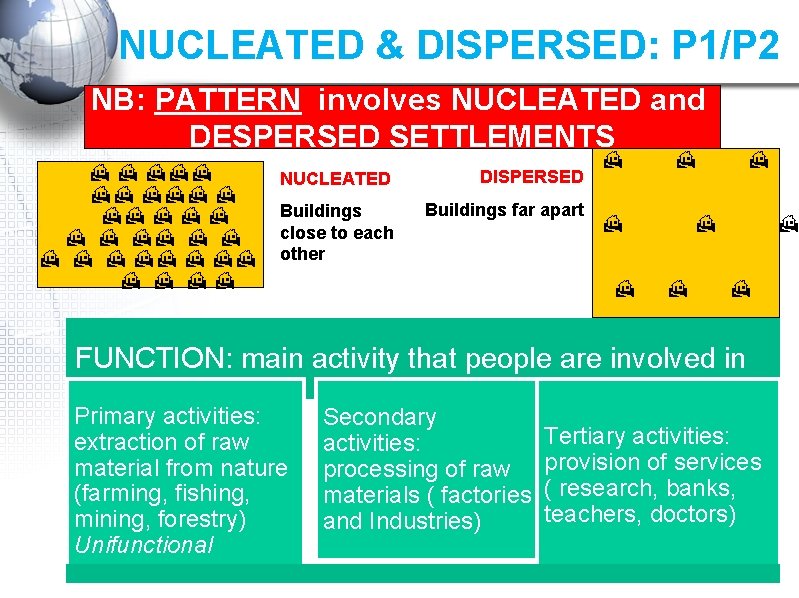
NUCLEATED & DISPERSED: P 1/P 2 NB: PATTERN involves NUCLEATED and DESPERSED SETTLEMENTS NUCLEATED DISPERSED Buildings close to each other Buildings far apart FUNCTION: main activity that people are involved in Primary activities: extraction of raw material from nature (farming, fishing, mining, forestry) Unifunctional Secondary activities: processing of raw materials ( factories and Industries) Tertiary activities: provision of services ( research, banks, teachers, doctors)
RURAL SETTLEMENT Rural settlements : unifunctional and are associated with Primary activities
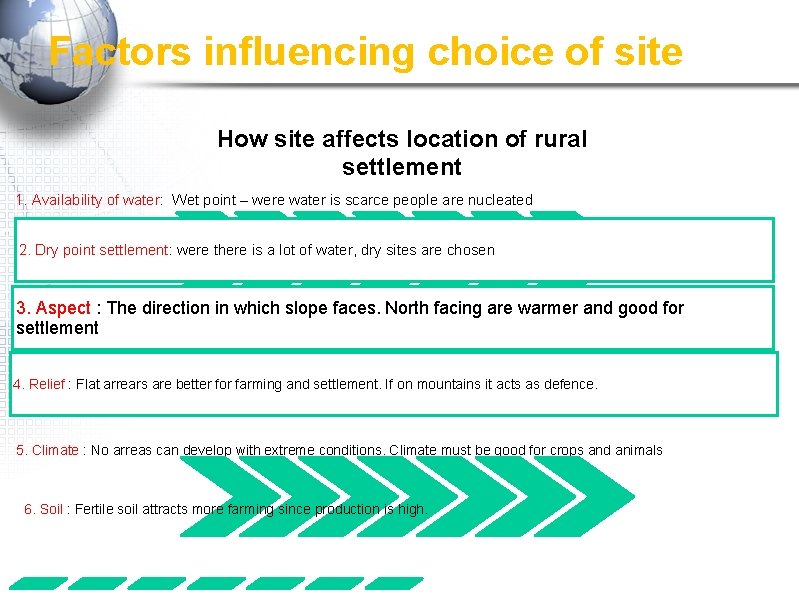
Factors influencing choice of site How site affects location of rural settlement 1. Availability of water: Wet point – were water is scarce people are nucleated 2. Dry point settlement: were there is a lot of water, dry sites are chosen 3. Aspect : The direction in which slope faces. North facing are warmer and good for settlement 4. Relief : Flat arrears are better for farming and settlement. If on mountains it acts as defence. 5. Climate : No arreas can develop with extreme conditions. Climate must be good for crops and animals 6. Soil : Fertile soil attracts more farming since production is high.
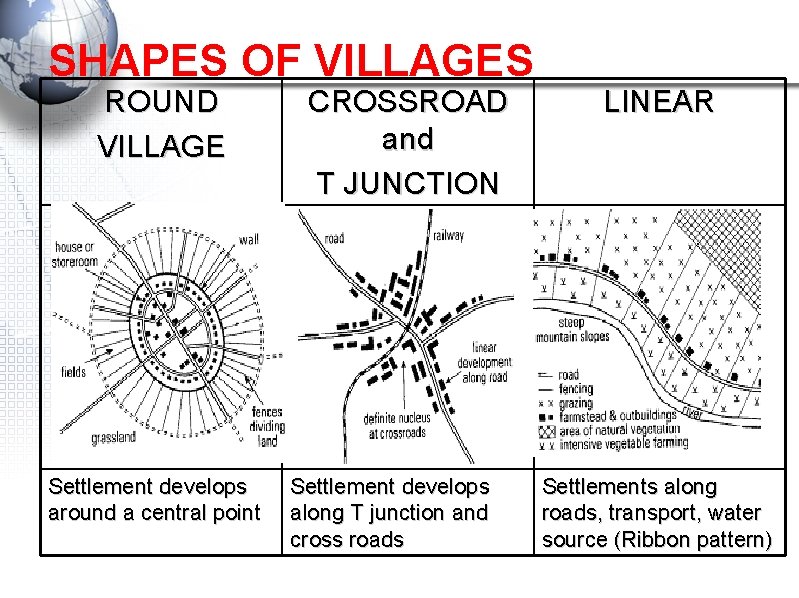
SHAPES OF VILLAGES ROUND VILLAGE Settlement develops around a central point CROSSROAD and T JUNCTION Settlement develops along T junction and cross roads LINEAR Settlements along roads, transport, water source (Ribbon pattern)
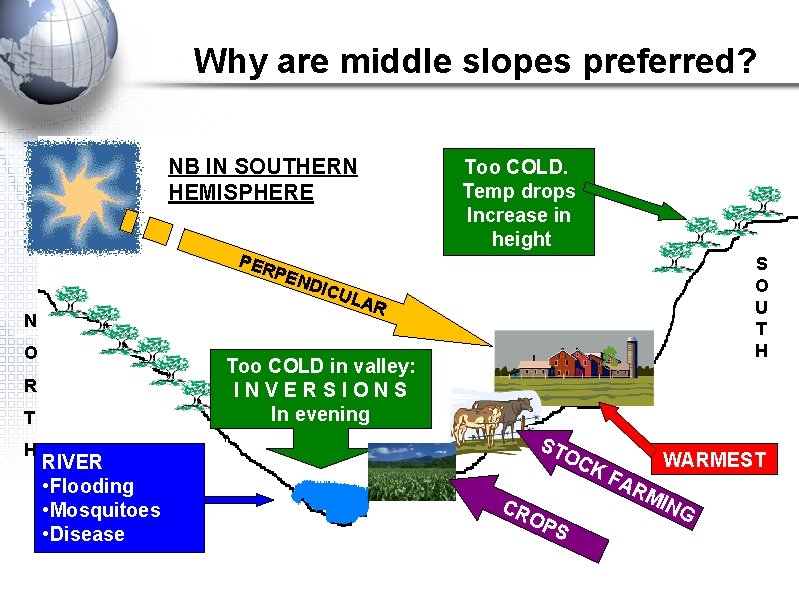
Why are middle slopes preferred? NB IN SOUTHERN HEMISPHERE PER PEN Too COLD. Temp drops Increase in height S O U T H DIC U N O Too COLD in valley: INVERSIONS In evening R T H LAR RIVER • Flooding • Mosquitoes • Disease ST CR OP OC S KF AR WARMEST MIN G
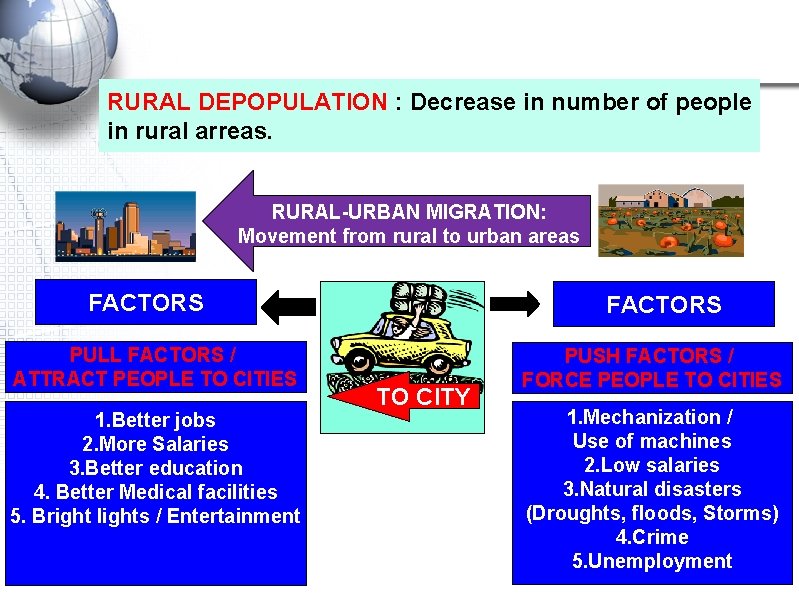
RURAL DEPOPULATION : Decrease in number of people in rural arreas. RURAL-URBAN MIGRATION: Movement from rural to urban areas FACTORS PULL FACTORS / ATTRACT PEOPLE TO CITIES 1. Better jobs 2. More Salaries 3. Better education 4. Better Medical facilities 5. Bright lights / Entertainment FACTORS TO CITY PUSH FACTORS / FORCE PEOPLE TO CITIES 1. Mechanization / Use of machines 2. Low salaries 3. Natural disasters (Droughts, floods, Storms) 4. Crime 5. Unemployment
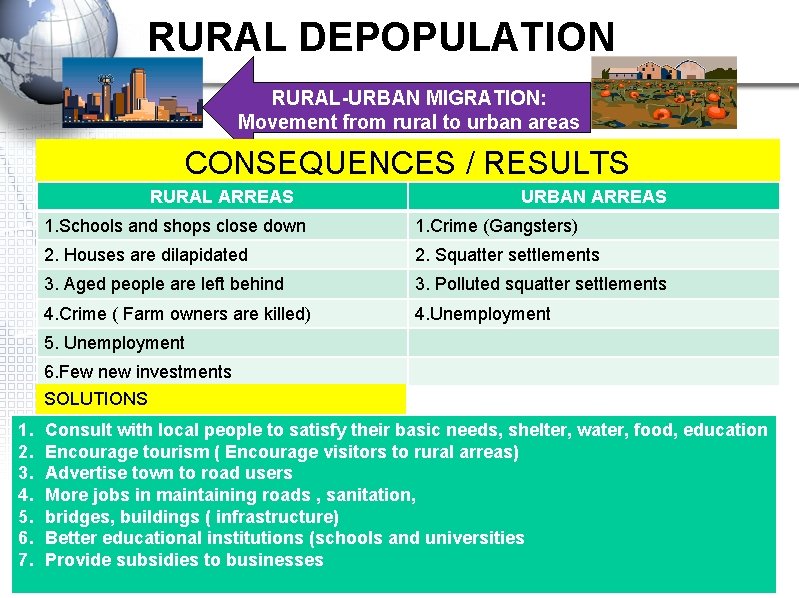
RURAL DEPOPULATION RURAL-URBAN MIGRATION: Movement from rural to urban areas CONSEQUENCES / RESULTS RURAL ARREAS URBAN ARREAS 1. Schools and shops close down 1. Crime (Gangsters) 2. Houses are dilapidated 2. Squatter settlements 3. Aged people are left behind 3. Polluted squatter settlements 4. Crime ( Farm owners are killed) 4. Unemployment 5. Unemployment 6. Few new investments SOLUTIONS 1. 2. 3. 4. 5. 6. 7. Consult with local people to satisfy their basic needs, shelter, water, food, education Encourage tourism ( Encourage visitors to rural arreas) Advertise town to road users More jobs in maintaining roads , sanitation, bridges, buildings ( infrastructure) Better educational institutions (schools and universities Provide subsidies to businesses
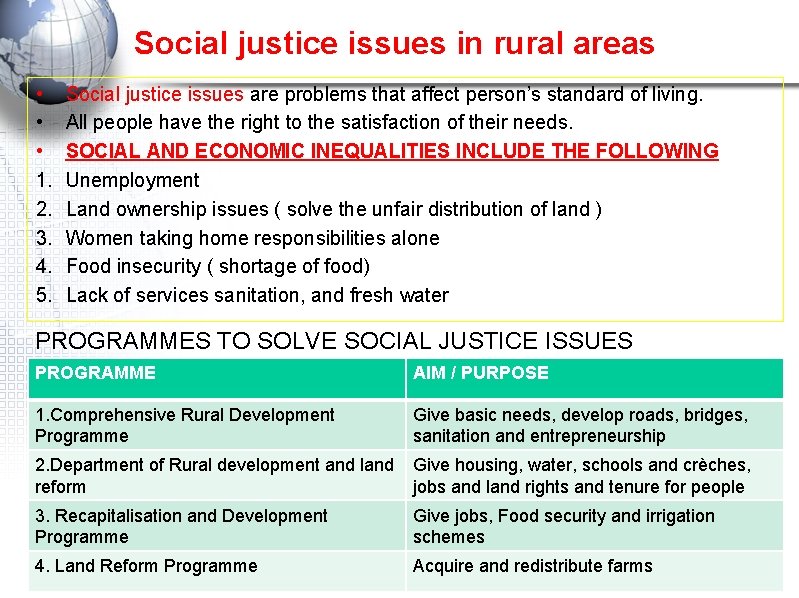
Social justice issues in rural areas • • • 1. 2. 3. 4. 5. Social justice issues are problems that affect person’s standard of living. All people have the right to the satisfaction of their needs. SOCIAL AND ECONOMIC INEQUALITIES INCLUDE THE FOLLOWING Unemployment Land ownership issues ( solve the unfair distribution of land ) Women taking home responsibilities alone Food insecurity ( shortage of food) Lack of services sanitation, and fresh water PROGRAMMES TO SOLVE SOCIAL JUSTICE ISSUES PROGRAMME AIM / PURPOSE 1. Comprehensive Rural Development Programme Give basic needs, develop roads, bridges, sanitation and entrepreneurship 2. Department of Rural development and land reform Give housing, water, schools and crèches, jobs and land rights and tenure for people 3. Recapitalisation and Development Programme Give jobs, Food security and irrigation schemes 4. Land Reform Programme Acquire and redistribute farms
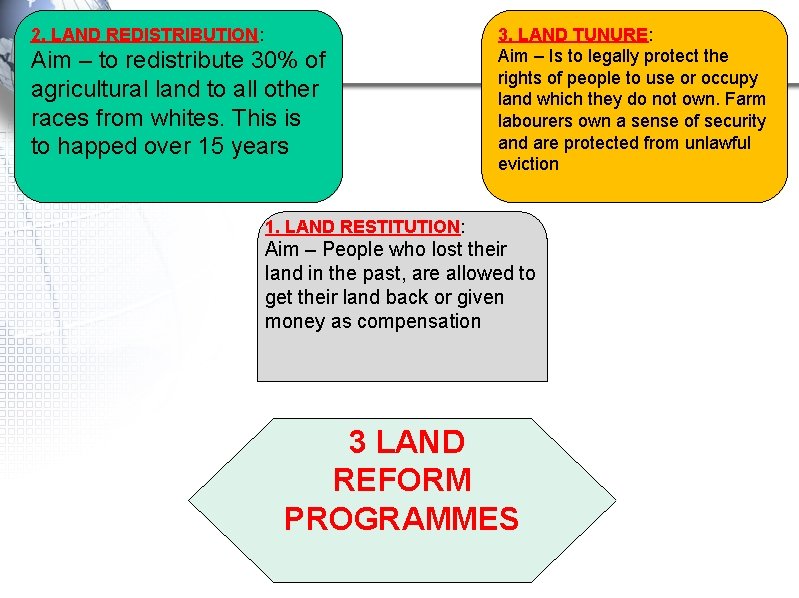
2. LAND REDISTRIBUTION: Aim – to redistribute 30% of agricultural land to all other races from whites. This is to happed over 15 years 3. LAND TUNURE: Aim – Is to legally protect the rights of people to use or occupy land which they do not own. Farm labourers own a sense of security and are protected from unlawful eviction 1. LAND RESTITUTION: Aim – People who lost their land in the past, are allowed to get their land back or given money as compensation 3 LAND REFORM PROGRAMMES
URBAN SETTLEMENT CLASSIFICATION OF URBAN SETTLEMENTS ACCORDING TO FUNCTIONS
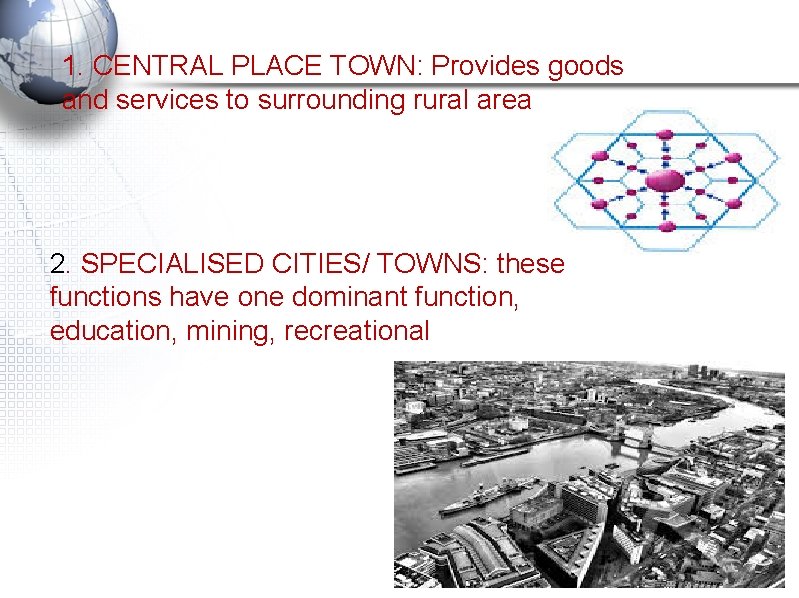
1. CENTRAL PLACE TOWN: Provides goods and services to surrounding rural area 2. SPECIALISED CITIES/ TOWNS: these functions have one dominant function, education, mining, recreational
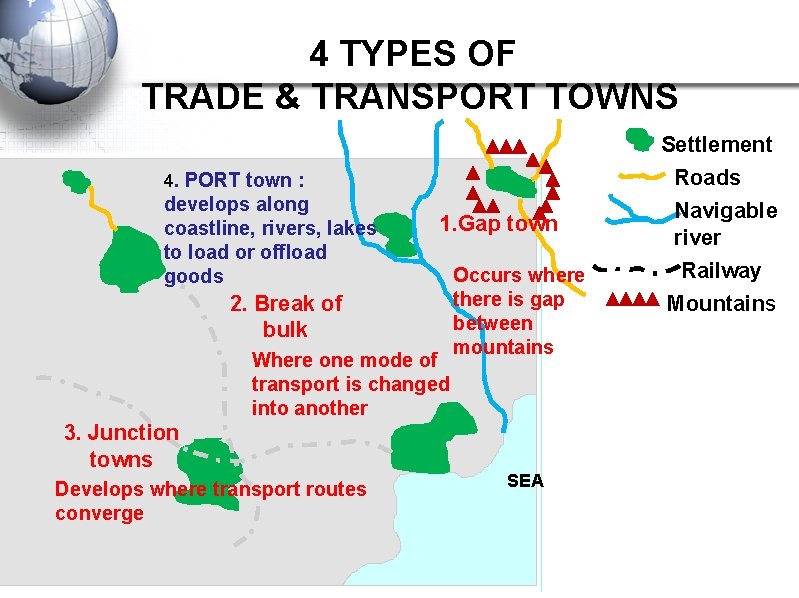
4 TYPES OF TRADE & TRANSPORT TOWNS Settlement Roads 4. PORT town : develops along coastline, rivers, lakes to load or offload goods 1. Gap town 2. Break of bulk Where one mode of transport is changed into another 3. Junction towns Develops where transport routes converge Occurs where there is gap between mountains SEA Navigable river Railway Mountains
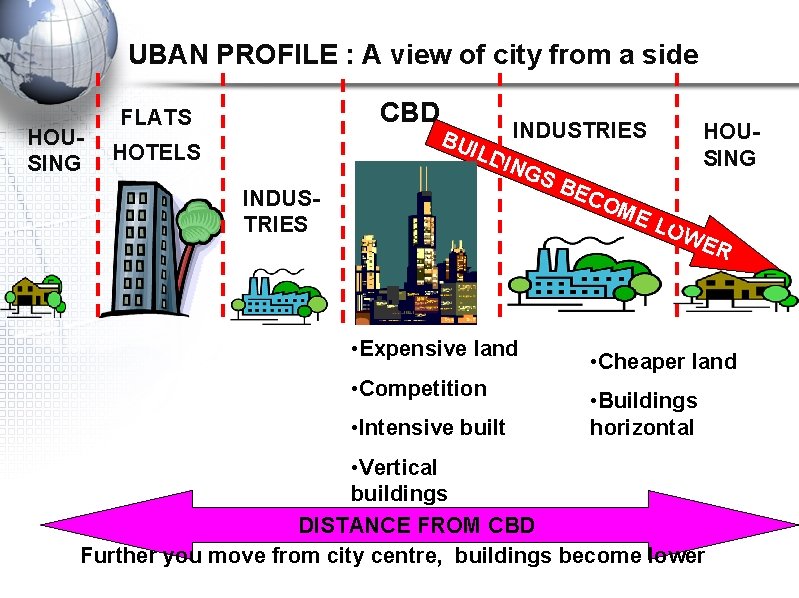
UBAN PROFILE : A view of city from a side HOUSING CBD FLATS BU INDUSTRIES ILD HOTELS INDUSTRIES ING SB • Expensive land • Competition • Intensive built EC O ME HOUSING LO WE R • Cheaper land • Buildings horizontal • Vertical buildings DISTANCE FROM CBD Further you move from city centre, buildings become lower
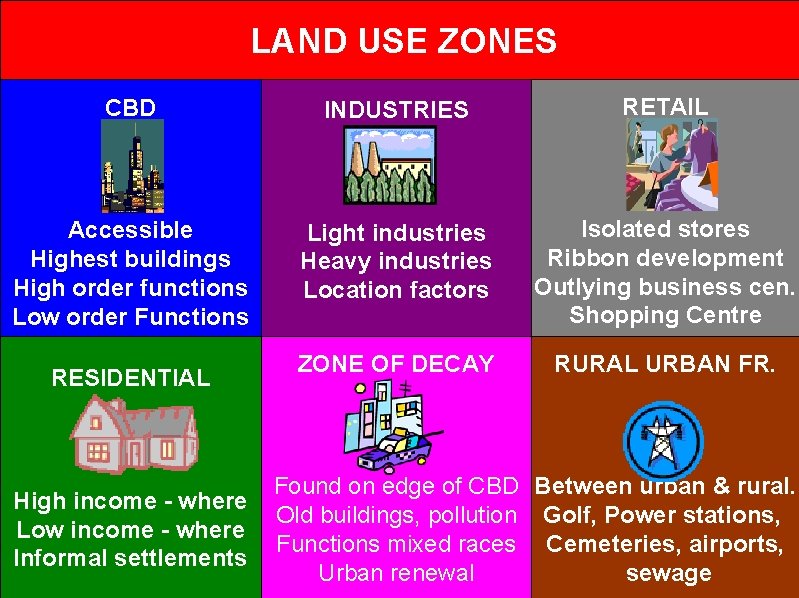
LAND USE ZONES CBD INDUSTRIES RETAIL Accessible Highest buildings High order functions Low order Functions Light industries Heavy industries Location factors Isolated stores Ribbon development Outlying business cen. Shopping Centre ZONE OF DECAY RURAL URBAN FR. RESIDENTIAL High income - where Low income - where Informal settlements Found on edge of CBD Between urban & rural. Old buildings, pollution Golf, Power stations, Functions mixed races Cemeteries, airports, Urban renewal sewage
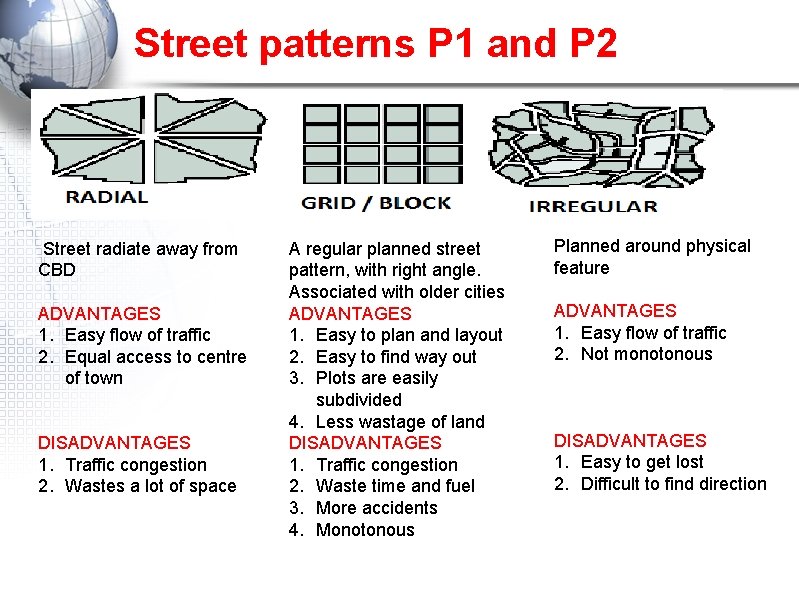
Street patterns P 1 and P 2 Street radiate away from CBD ADVANTAGES 1. Easy flow of traffic 2. Equal access to centre of town DISADVANTAGES 1. Traffic congestion 2. Wastes a lot of space A regular planned street pattern, with right angle. Associated with older cities ADVANTAGES 1. Easy to plan and layout 2. Easy to find way out 3. Plots are easily subdivided 4. Less wastage of land DISADVANTAGES 1. Traffic congestion 2. Waste time and fuel 3. More accidents 4. Monotonous Planned around physical feature ADVANTAGES 1. Easy flow of traffic 2. Not monotonous DISADVANTAGES 1. Easy to get lost 2. Difficult to find direction
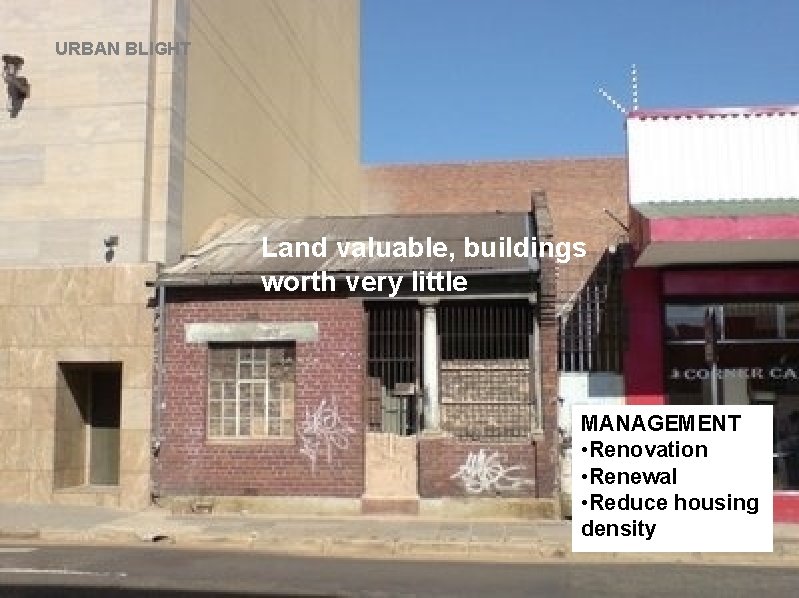
URBAN BLIGHT Land valuable, buildings worth very little MANAGEMENT • Renovation • Renewal • Reduce housing density
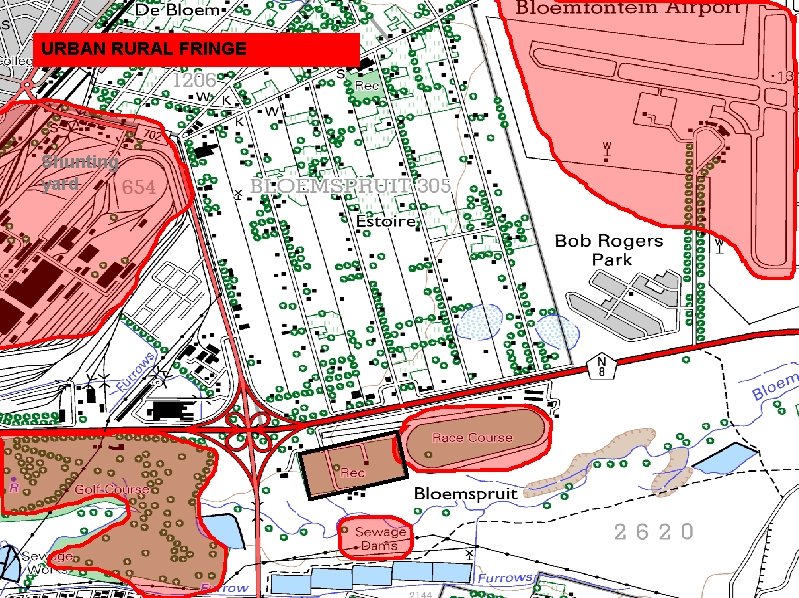
URBAN RURAL FRINGE Shunting yard
- Slides: 21