
Setting up the system to answer Evaluation Questions




- Slides: 46
Setting up the system to answer Evaluation Questions for Rural Development Programmes Evaluation. WORKS! 2015
Outline • • • Legal requ irements Purpose an d types of EQs How to an swer EQs? 4 Steps in setting up the system Exercises to answer E Qs 2
Legal requirements Regulation (EU) No 1303/2013, art. 54: • Evaluation shall be carried out to improve the quality of design and implementation of programmes, as well as to assess effectiveness, efficiency and impact. Regulation (EU) No 1305/2014, art. 68: • M&E shall aim to demonstrate achievements of RD policy and assess its impacts, effectiveness, efficiency and relevance and contribute to better targeted support for RD Commission Implementing Regulation (EU) No 808/2014, Art. 14 and Annex V: • Common evaluation questions are part of CMES. Non-binding guidance: Working document: Common evaluation questions for rural development programmes 2014 -2020. §§§ 3
The purpose of Evaluation Questions is to… Define the focus of evaluations Demonstrate the progress, achievements, results, impact, relevance, effectiveness and efficiency of rural development policy Explore causal- effect: „To what extent. . has the change happened. . . due to the programme“ Reflect the programme intervention logic, i. e. SWOT, needs, objectives, measures, etc. 4
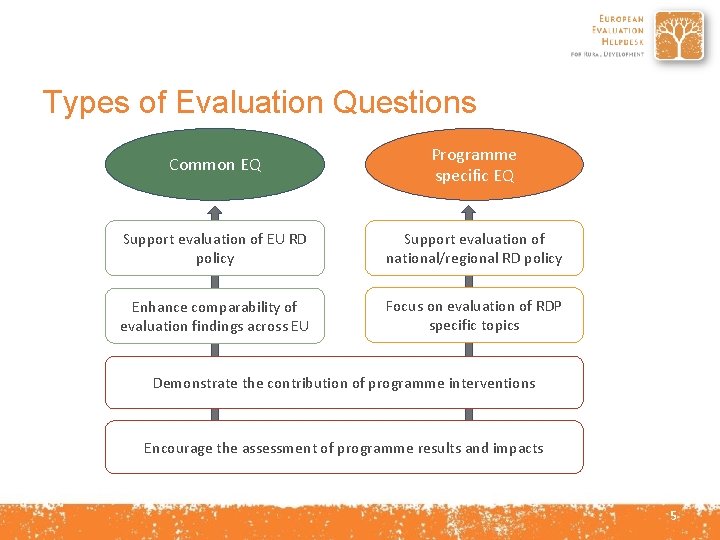
Types of Evaluation Questions Common EQ Programme specific EQ Support evaluation of EU RD policy Support evaluation of national/regional RD policy Enhance comparability of evaluation findings across EU Focus on evaluation of RDP specific topics Demonstrate the contribution of programme interventions Encourage the assessment of programme results and impacts 5
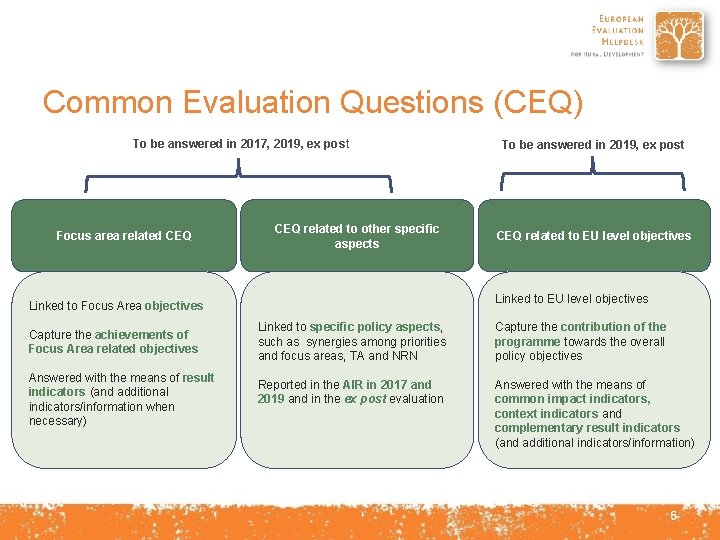
Common Evaluation Questions (CEQ) To be answered in 2017, 2019, ex post Focus area related CEQ related to other specific aspects Answered with the means of result indicators (and additional indicators/information when necessary) CEQ related to EU level objectives Linked to Focus Area objectives Capture the achievements of Focus Area related objectives To be answered in 2019, ex post Linked to specific policy aspects, such as synergies among priorities and focus areas, TA and NRN Capture the contribution of the programme towards the overall policy objectives Reported in the AIR in 2017 and 2019 and in the ex post evaluation Answered with the means of common impact indicators, context indicators and complementary result indicators (and additional indicators/information) 6
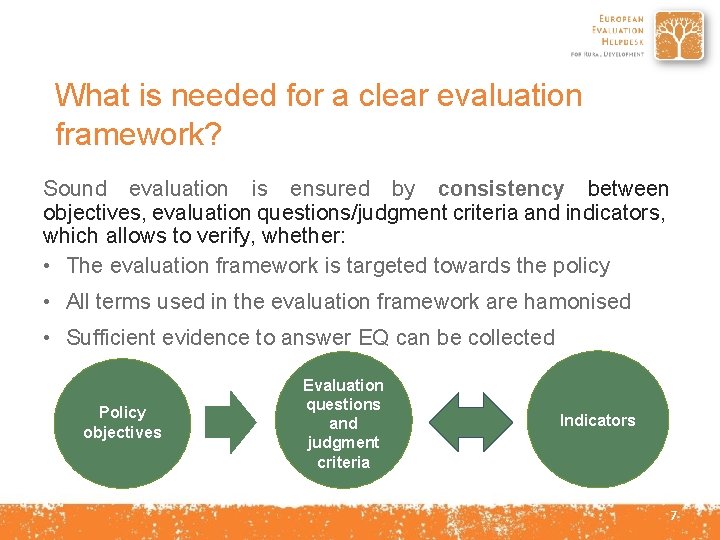
What is needed for a clear evaluation framework? Sound evaluation is ensured by consistency between objectives, evaluation questions/judgment criteria and indicators, which allows to verify, whether: • The evaluation framework is targeted towards the policy • All terms used in the evaluation framework are hamonised • Sufficient evidence to answer EQ can be collected Policy objectives Evaluation questions and judgment criteria Indicators 7
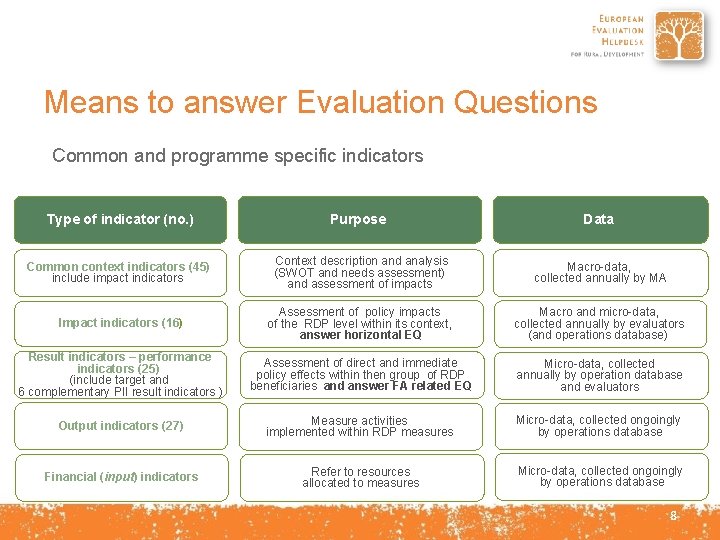
Means to answer Evaluation Questions Common and programme specific indicators 8 of indicator (no. ) Type Purpose Data Common context indicators (45) include impact indicators Context description and analysis (SWOT and needs assessment) and assessment of impacts Macro-data, collected annually by MA Impact indicators (16) Assessment of policy impacts of the RDP level within its context, answer horizontal EQ Macro and micro-data, collected annually by evaluators (and operations database) Result indicators – performance indicators (25) (include target and 6 complementary PII result indicators ) Assessment of direct and immediate policy effects within then group of RDP beneficiaries and answer FA related EQ Micro-data, collected annually by operation database and evaluators Output indicators (27) Measure activities implemented within RDP measures Micro-data, collected ongoingly by operations database Financial (input) indicators Refer to resources allocated to measures Micro-data, collected ongoingly by operations database 8
Programme specific EQs (PSEQs). . . are formulated by Member States when: • CEQs do not capture the full range of achievements of objectives of the programme or focus area • National (territorial) priorities are not covered by CEQs • Programme shows potential indirect, secondary, unexpected or negative effects • Specific evaluation topics included in the evaluation plan (e. g. RDP delivery, administration etc. ) 9
Programme specific indicators(PSI). . . are formulated by Member States, • When common context indicators do not cover the specific characteristics of the programme area • To answer programme specific evaluation questions • When the programme shows RDP specific direct/indirect, primary/secondary, unexpected or negative effects • When CEQs cannot be answered by common indicators in satisfactory manner (additional indicators) 10
Development of PSEQ and PSI Examples: • In the assessment of RDP contribution to reduction of weaknesses stated in SWOT analysis (not covered by common indicators), and not negatively affected the strengths mentioned in SWOT = weakness becomes the base formulation the PSEQ and PSI, e. g. insufficient water management infrastructure • In the assessment of the RDP effect on context indicators, in case they represent important socio-economic or environmental objective of the programme area (descrease the unemployment rate, increase the labour productivity etc. ) = context indicator becomes the base to formulate PSEQ and turns into programme specific result or impact indicator, 11
4 Steps in setting up the system to answer evaluation questions 12
Step 1 Ensuring coherence and relevance of the RDP intervention logic 13
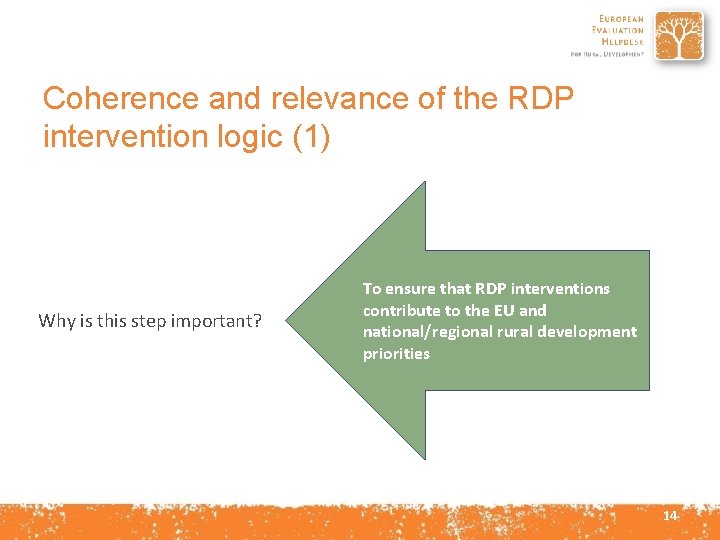
Coherence and relevance of the RDP intervention logic (1) Why is this step important? To ensure that RDP interventions contribute to the EU and national/regional rural development priorities 14
Coherence and relevance of the RDP intervention logic (2) Objectives and headline targets of the EU 2020 Strategy, CAP objectives and rural development priorities SWOT and needs assessment Overall RDP objective(s) Relevance Coherence Expected impacts RDP specific objectives FA level Expected results Measure Objectives Expected outputs Inputs (€) Measures, activities, projects 15
Step 2 Ensuring consistency of the EQs and indicators with the intervention logic 16
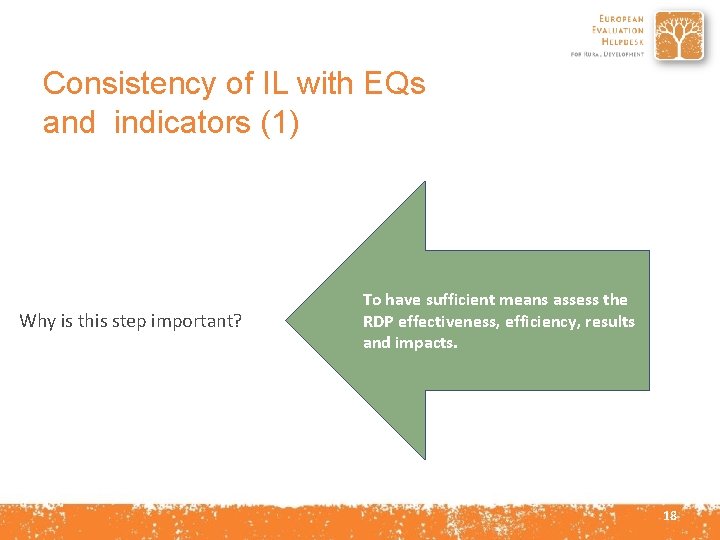
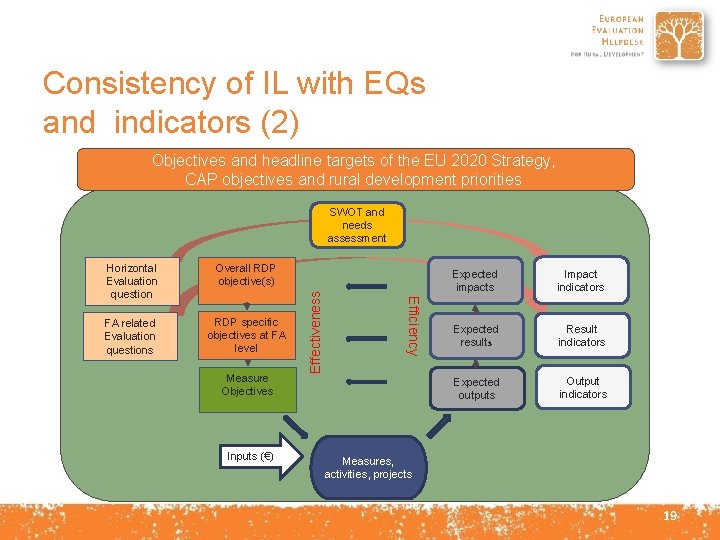
Consistency of IL with EQs and indicators (1) Why is this step important? To have sufficient means assess the RDP effectiveness, efficiency, results and impacts. 18
Consistency of IL with EQs and indicators (2) Objectives and headline targets of the EU 2020 Strategy, CAP objectives and rural development priorities Overall RDP objective(s) FA related Evaluation questions RDP specific objectives at FA level Measure Objectives Inputs (€) Efficiency Horizontal Evaluation question Effectiveness SWOT and needs assessment Expected impacts Impact indicators Expected results Result indicators Expected outputs Output indicators Measures, activities, projects 19
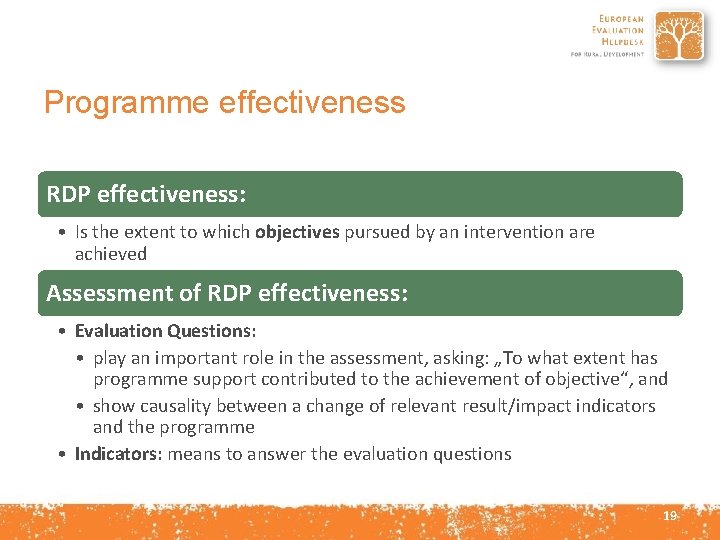
Programme effectiveness RDP effectiveness: • Is the extent to which objectives pursued by an intervention are achieved Assessment of RDP effectiveness: • Evaluation Questions: • play an important role in the assessment, asking: „To what extent has programme support contributed to the achievement of objective“, and • show causality between a change of relevant result/impact indicators and the programme • Indicators: means to answer the evaluation questions 19
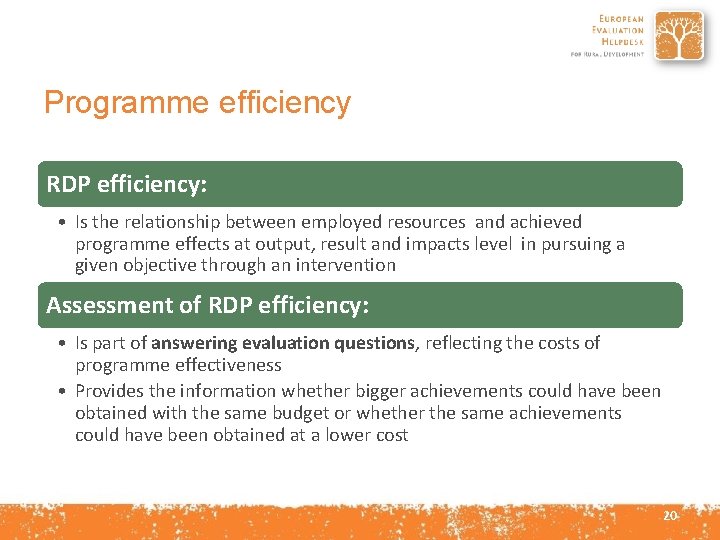
Programme efficiency RDP efficiency: • Is the relationship between employed resources and achieved programme effects at output, result and impacts level in pursuing a given objective through an intervention Assessment of RDP efficiency: • Is part of answering evaluation questions, reflecting the costs of programme effectiveness • Provides the information whether bigger achievements could have been obtained with the same budget or whether the same achievements could have been obtained at a lower cost 20
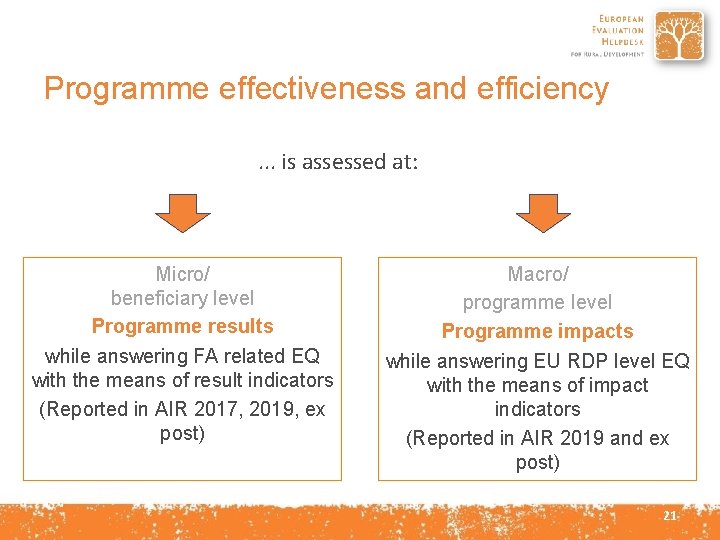
Programme effectiveness and efficiency. . . is assessed at: Micro/ beneficiary level Programme results while answering FA related EQ with the means of result indicators (Reported in AIR 2017, 2019, ex post) Macro/ programme level Programme impacts while answering EU RDP level EQ with the means of impact indicators (Reported in AIR 2019 and ex post) 21
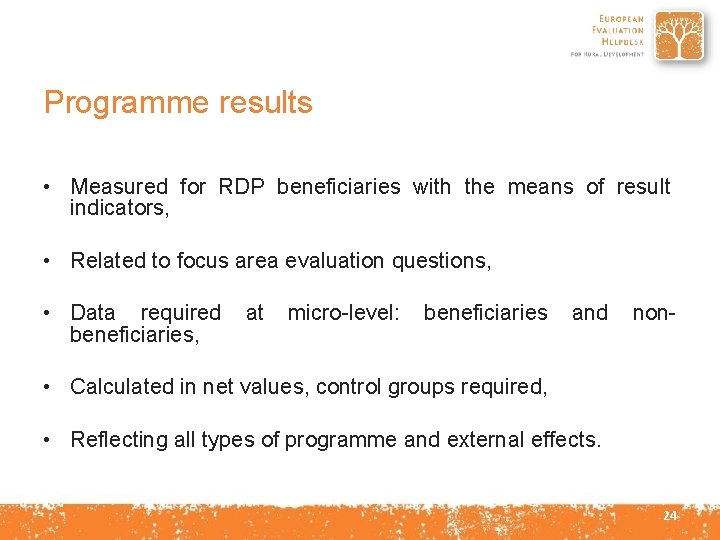
Programme results • Measured for RDP beneficiaries with the means of result indicators, • Related to focus area evaluation questions, • Data required beneficiaries, at micro-level: beneficiaries and non- • Calculated in net values, control groups required, • Reflecting all types of programme and external effects. 24
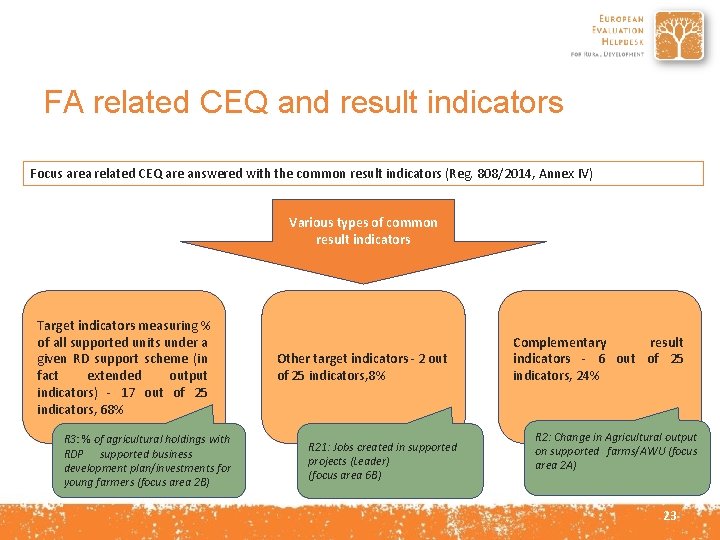
FA related CEQ and result indicators Focus area related CEQ are answered with the common result indicators (Reg. 808/2014, Annex IV) Various types of common result indicators Target indicators measuring % of all supported units under a given RD support scheme (in fact extended output indicators) - 17 out of 25 indicators, 68% R 3: % of agricultural holdings with RDP supported business development plan/investments for young farmers (focus area 2 B) Other target indicators - 2 out of 25 indicators, 8% R 21: Jobs created in supported projects (Leader) (focus area 6 B) Complementary result indicators - 6 out of 25 indicators, 24% R 2: Change in Agricultural output on supported farms/AWU (focus area 2 A) 23
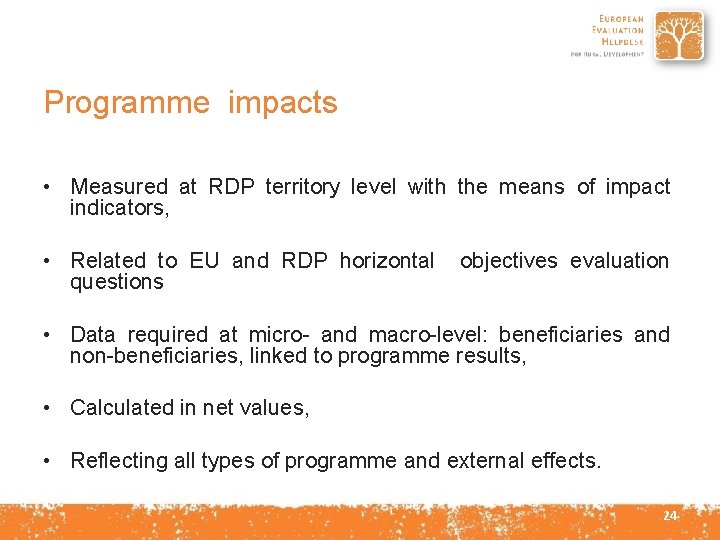
Programme impacts • Measured at RDP territory level with the means of impact indicators, • Related to EU and RDP horizontal questions objectives evaluation • Data required at micro- and macro-level: beneficiaries and non-beneficiaries, linked to programme results, • Calculated in net values, • Reflecting all types of programme and external effects. 24
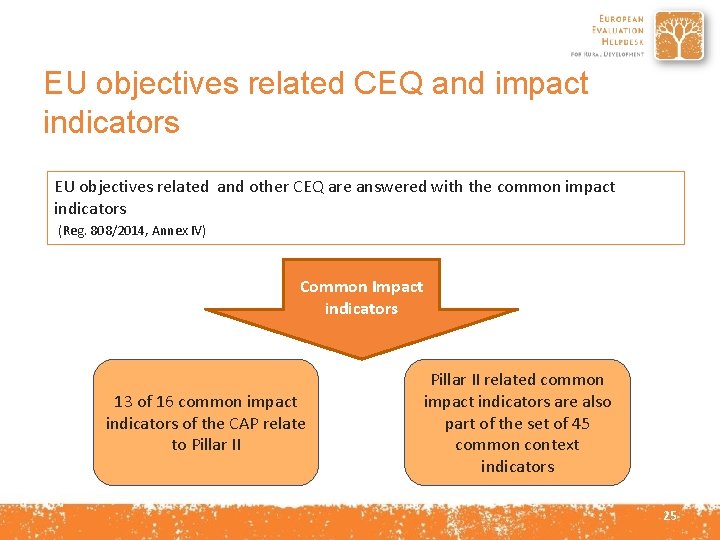
EU objectives related CEQ and impact indicators EU objectives related and other CEQ are answered with the common impact indicators (Reg. 808/2014, Annex IV) Common Impact indicators 13 of 16 common impact indicators of the CAP relate to Pillar II related common impact indicators are also part of the set of 45 common context indicators 25
Step 3 Decide on the evaluation approach and select evaluation methods 26
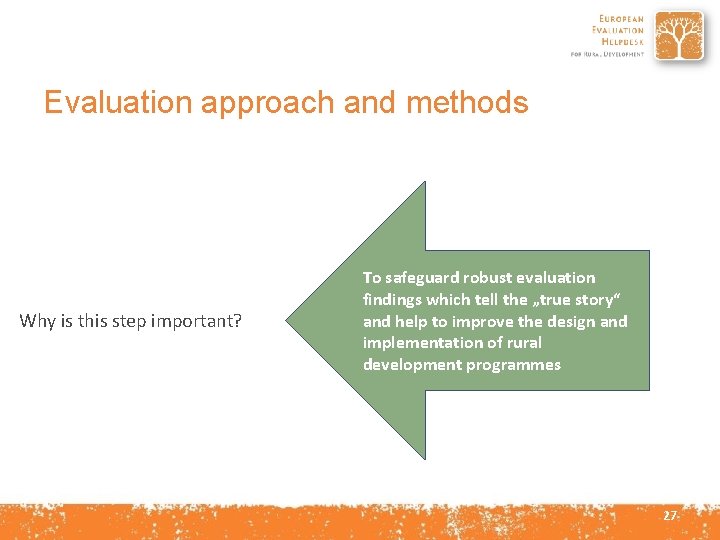
Evaluation approach and methods Why is this step important? To safeguard robust evaluation findings which tell the „true story“ and help to improve the design and implementation of rural development programmes 27
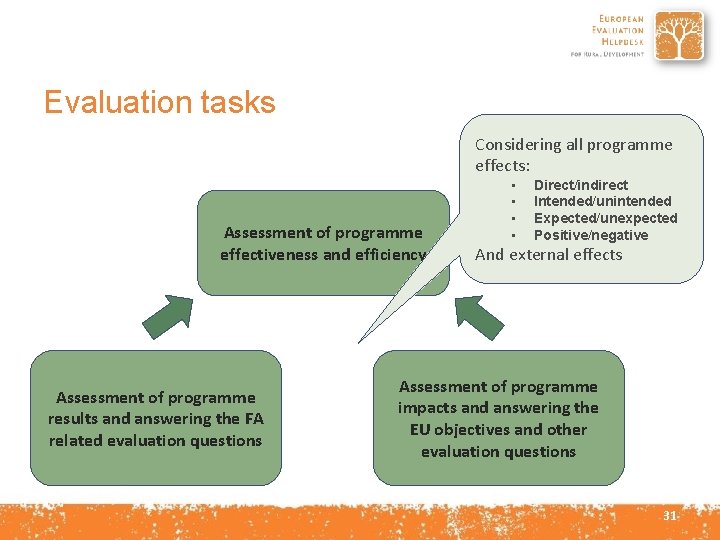
Evaluation tasks Considering all programme effects: Assessment of programme effectiveness and efficiency Assessment of programme results and answering the FA related evaluation questions • • Direct/indirect Intended/unintended Expected/unexpected Positive/negative And external effects Assessment of programme impacts and answering the EU objectives and other evaluation questions 31
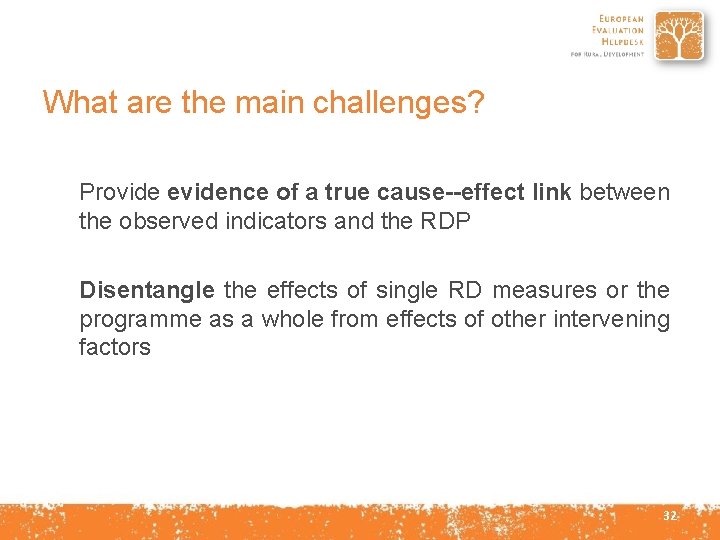
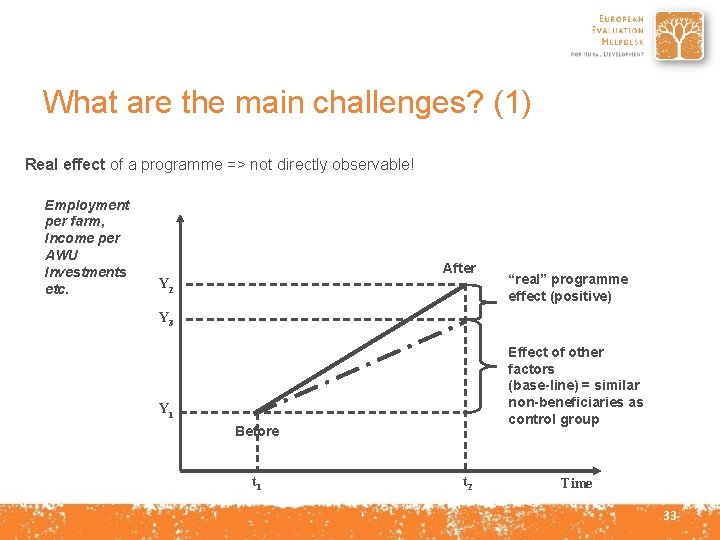
What are the main challenges? Provide evidence of a true cause--effect link between the observed indicators and the RDP Disentangle the effects of single RD measures or the programme as a whole from effects of other intervening factors 32
What are the main challenges? (1) Real effect of a programme => not directly observable! Employment per farm, Income per AWU Investments etc. After Y 2 “real” programme effect (positive) Y 3 Effect of other factors (base-line) = similar non-beneficiaries as control group Y 1 Before t 1 t 2 Time 33
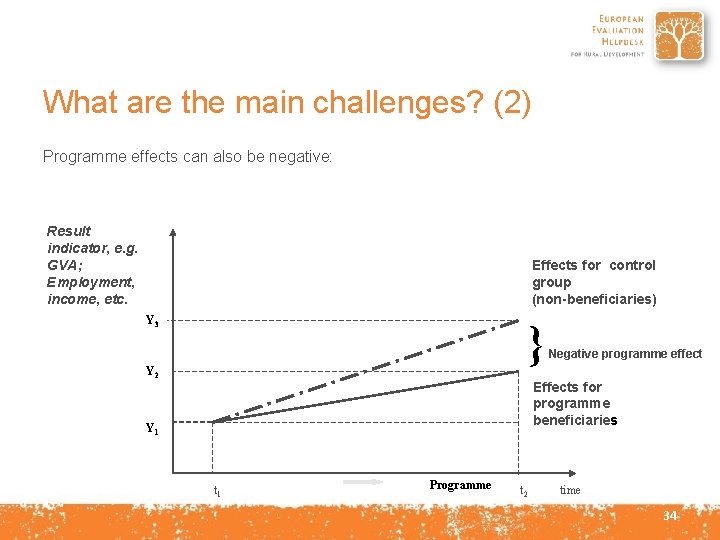
What are the main challenges? (2) Programme effects can also be negative: Result indicator, e. g. GVA; Employment, income, etc. Effects for control group (non-beneficiaries) Y 3 } Y 2 Negative programme effect Effects for programme beneficiaries Y 1 t 1 Programme t 2 time 34
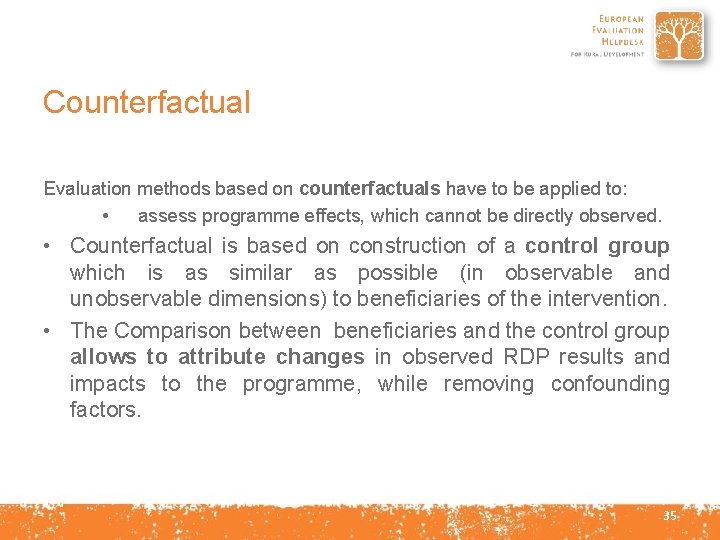
Counterfactual Evaluation methods based on counterfactuals have to be applied to: • assess programme effects, which cannot be directly observed. • Counterfactual is based on construction of a control group which is as similar as possible (in observable and unobservable dimensions) to beneficiaries of the intervention. • The Comparison between beneficiaries and the control group allows to attribute changes in observed RDP results and impacts to the programme, while removing confounding factors. 35
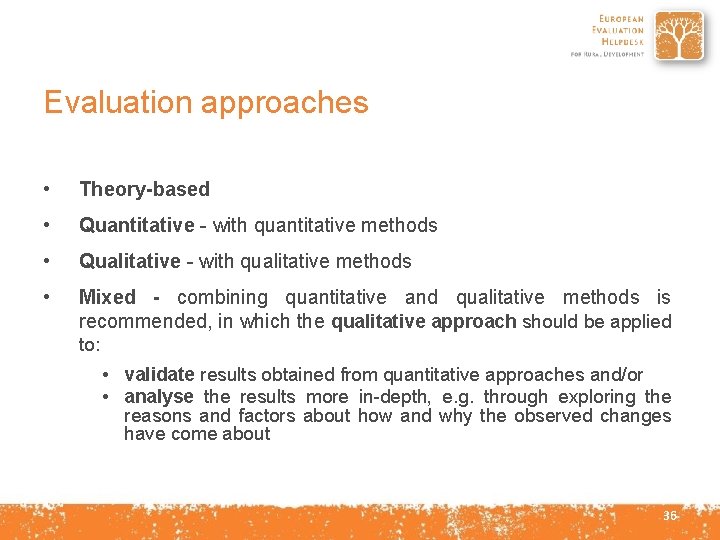
Evaluation approaches • Theory-based • Quantitative - with quantitative methods • Qualitative - with qualitative methods • Mixed - combining quantitative and qualitative methods is recommended, in which the qualitative approach should be applied to: • validate results obtained from quantitative approaches and/or • analyse the results more in-depth, e. g. through exploring the reasons and factors about how and why the observed changes have come about 36
Evaluation methods Quantitative methods Qualitative methods Focus groups Quasi-experimental design Interviews Non-experimental design Surveys Naïve estimates of counterfactuals Case studies NOT RECOMMENDED! Mixed methods 34
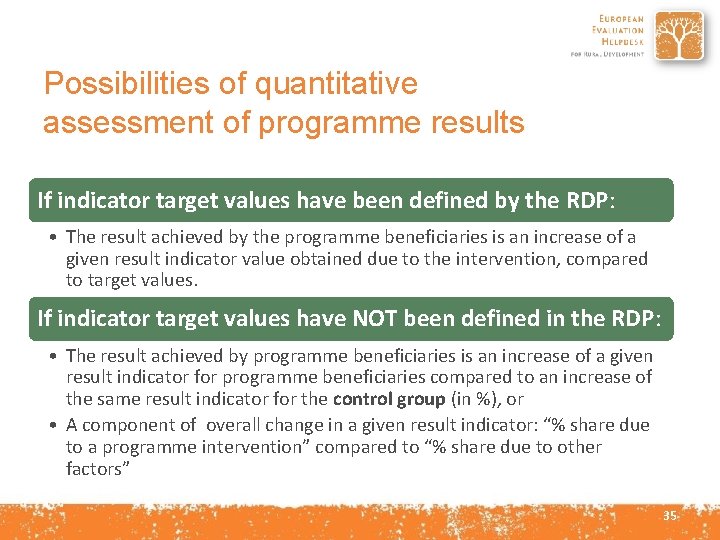
Possibilities of quantitative assessment of programme results If indicator target values have been defined by the RDP: • The result achieved by the programme beneficiaries is an increase of a given result indicator value obtained due to the intervention, compared to target values. If indicator target values have NOT been defined in the RDP: • The result achieved by programme beneficiaries is an increase of a given result indicator for programme beneficiaries compared to an increase of the same result indicator for the control group (in %), or • A component of overall change in a given result indicator: “% share due to a programme intervention” compared to “% share due to other factors” 35
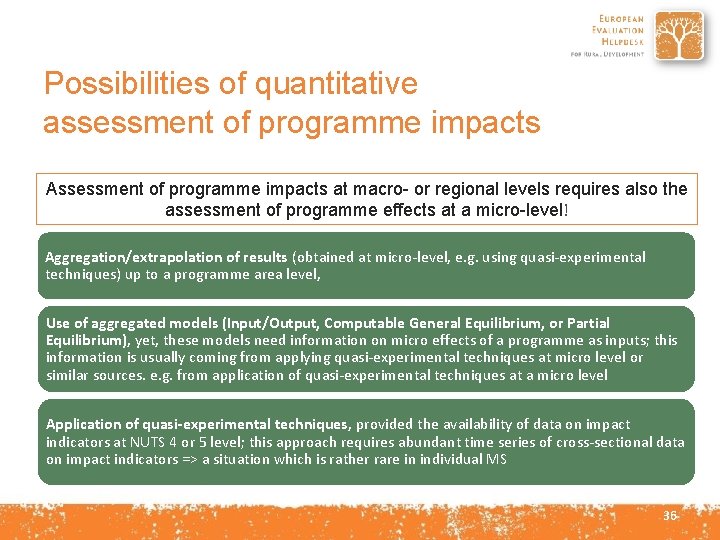
Possibilities of quantitative assessment of programme impacts Assessment of programme impacts at macro- or regional levels requires also the assessment of programme effects at a micro-level! Aggregation/extrapolation of results (obtained at micro-level, e. g. using quasi-experimental techniques) up to a programme area level, Use of aggregated models (Input/Output, Computable General Equilibrium, or Partial Equilibrium), yet, these models need information on micro effects of a programme as inputs; this information is usually coming from applying quasi-experimental techniques at micro level or similar sources. e. g. from application of quasi-experimental techniques at a micro level Application of quasi-experimental techniques, provided the availability of data on impact indicators at NUTS 4 or 5 level; this approach requires abundant time series of cross-sectional data on impact indicators => a situation which is rather rare in individual MS 36
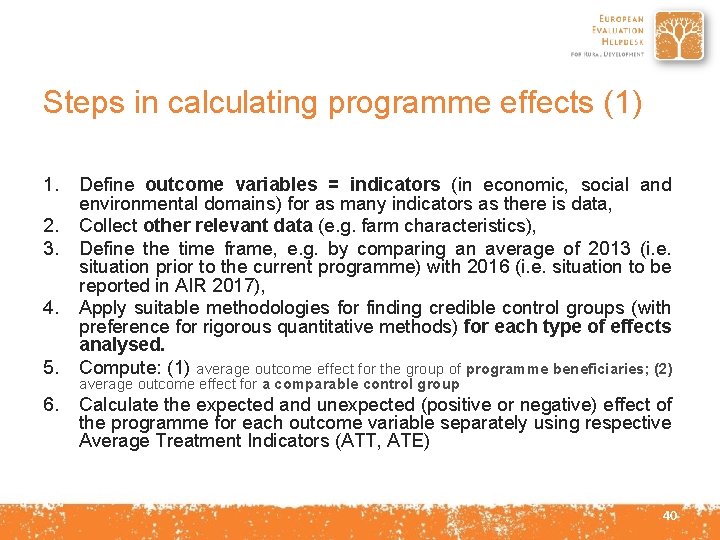
Steps in calculating programme effects (1) 1. 2. 3. 4. 5. 6. Define outcome variables = indicators (in economic, social and environmental domains) for as many indicators as there is data, Collect other relevant data (e. g. farm characteristics), Define the time frame, e. g. by comparing an average of 2013 (i. e. situation prior to the current programme) with 2016 (i. e. situation to be reported in AIR 2017), Apply suitable methodologies for finding credible control groups (with preference for rigorous quantitative methods) for each type of effects analysed. Compute: (1) average outcome effect for the group of programme beneficiaries; (2) average outcome effect for a comparable control group Calculate the expected and unexpected (positive or negative) effect of the programme for each outcome variable separately using respective Average Treatment Indicators (ATT, ATE) 40
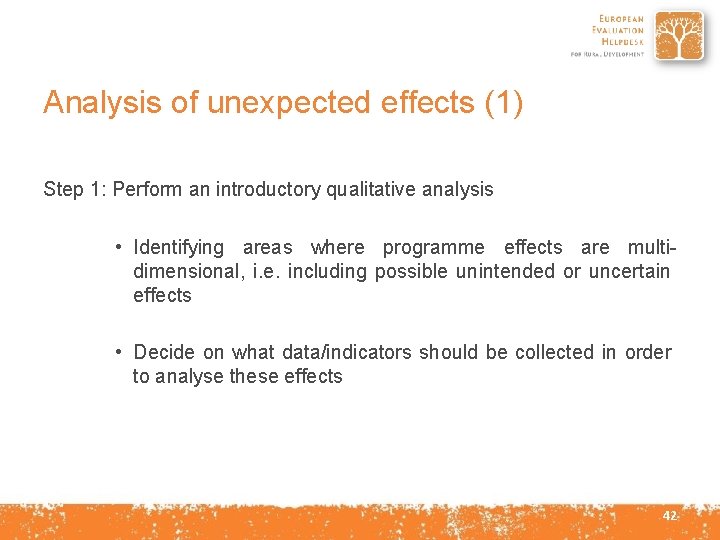
Analysis of unexpected effects (1) Step 1: Perform an introductory qualitative analysis • Identifying areas where programme effects are multidimensional, i. e. including possible unintended or uncertain effects • Decide on what data/indicators should be collected in order to analyse these effects 42
Analysis of unexpected effects (2) Step 2: Select suitable methodologies to be applied in analysing unintended effects • The level of difficulty differs according to what subjects (beneficiaries or non-beneficiaries) were identified as those affected by the programme • Should Unintended effects affect programme beneficiaries, the selection of methodologies should follow standard counterfactual procedures (see: ex-post evaluation guidelines) • Should some unintended effects come about due to general equilibrium effects, (e. g. substitution or displacement effects) and affect programme non-beneficiaries, some modifications of standard counterfactual methods are necessary (see: ex-post evaluation guidelines) 39
Step 4 Ensure data quality and accessibility 40
Data Why is this step important? To ensure that high quality data are available to calculate indicators, assess effectiveness and efficiency and provide evidence based answers to EQ 41 45
Data needs • Data on variables describing basic characteristics, endowment, economic situation and performance of RDP beneficiaries and non -beneficiaries before the support from RDP (i. e. for AIR 2017 - year 2013 and last monitoring year – 2016) • For each programme beneficiary: amount of support received in years 2014 -year of assessment • For each programme beneficiary: the amount of RDP support received per year, the branch and purpose of support • For each unit (beneficiaries and non-beneficiaries: The value of any other support obtained between 2014 and the year of assessment 46
Data sources (1) AIR 2017 – assessment of programme results (micro-level): • Data on beneficiaries and non-beneficiaries collected on the basis of primary data /secondary data and/or own surveys. • The FADN database combined with anonymous data from the PA • Outside the agricultural sector, the availability of secondary data becomes scarce : • Various national statistics on households, municipalities, small businesses are available but their accessibility varies strongly among Member States • In many cases, own surveys will be the only source of information for the evaluation of non-agricultural RD activities 47
Data sources (2) AIR 2019 and ex-post evaluation – assessment of programme impacts (RDP level) • Regional- and macro-economic data collected for individual regions (e. g. NUTS 4 – NUTS 3), communities (e. g. NUTS 5) or villages • The results generated at these levels can be thereafter aggregated into RDP or national level • In several MS detailed (secondary) data on regions (NUTS 3 - NUTS 5) can only be obtained from respective statistical offices • Data on small communities or villages may be collected through surveys • Data on RD support at programme area level or at national level can be collected from the paying agencies 48
Overview of steps in setting up the system to answer EQ Setting up the system Ensuring coherence and relevance of the RDP intervention logic Ensuring consistency of the EQs and indicators with the intervention logic Conducting the evaluation and answering EQ Observing Manage data collection Analysing Decide on the evaluation approach and select evaluation methods conduct the calculation of indicators in line with selected methods Judging Ensure data quality and accessibility Interpret evaluation findings Answer evaluation questions Develop conclusions and recommendations 45
Thank you for your attention! European Evaluation Helpdesk for Rural Development Boulevard Saint Michel 77 -79 B-1040 Brussels Tel. +32 2 7375130 E-mail info@ruralevaluation. eu http: //enrd. ec. europa. eu/evaluation 46