
Setting up a K12 Chinese IB Curriculum Daegu
Setting up a K-12 Chinese IB Curriculum Daegu International School, Korea October 25, 2014 Penny Pan
CONTENT 内容 ✴ ✴ ✴ Planning the streaming and leveling Planning curriculum content Planning assessments
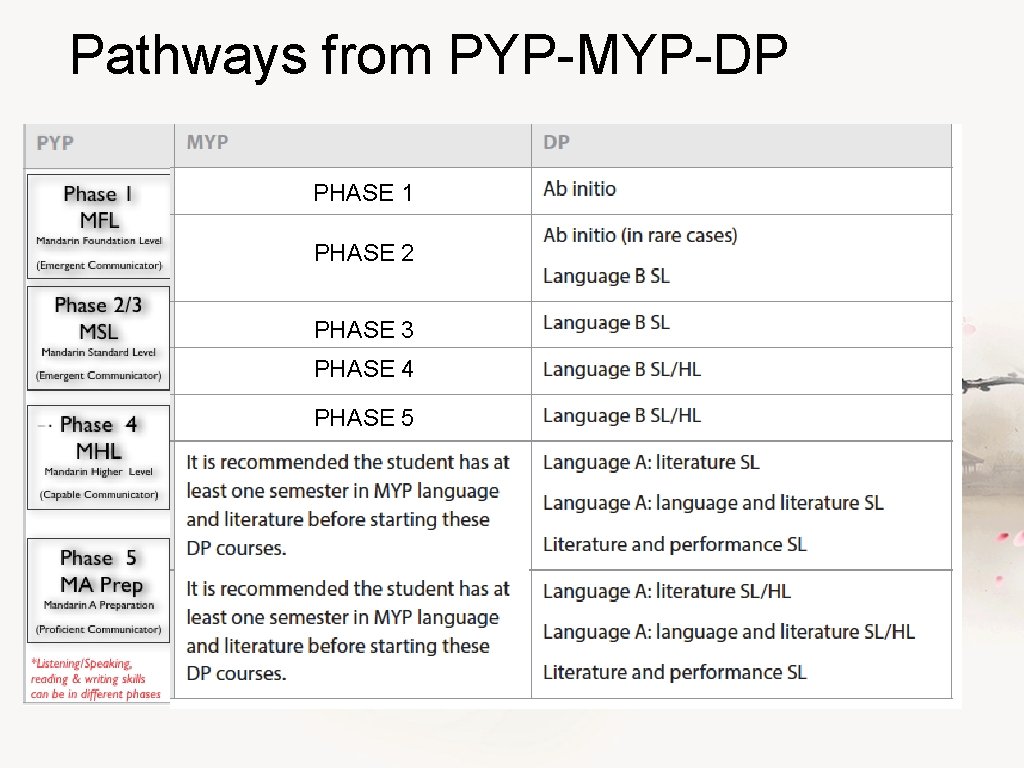
PART 1 Planning the streaming and leveling • PYP - All-in-one Language Scope & Sequence • MYP - Language Acquisition Phase 1 - 6 • DP - Language A & B HL, SL & Ab initio
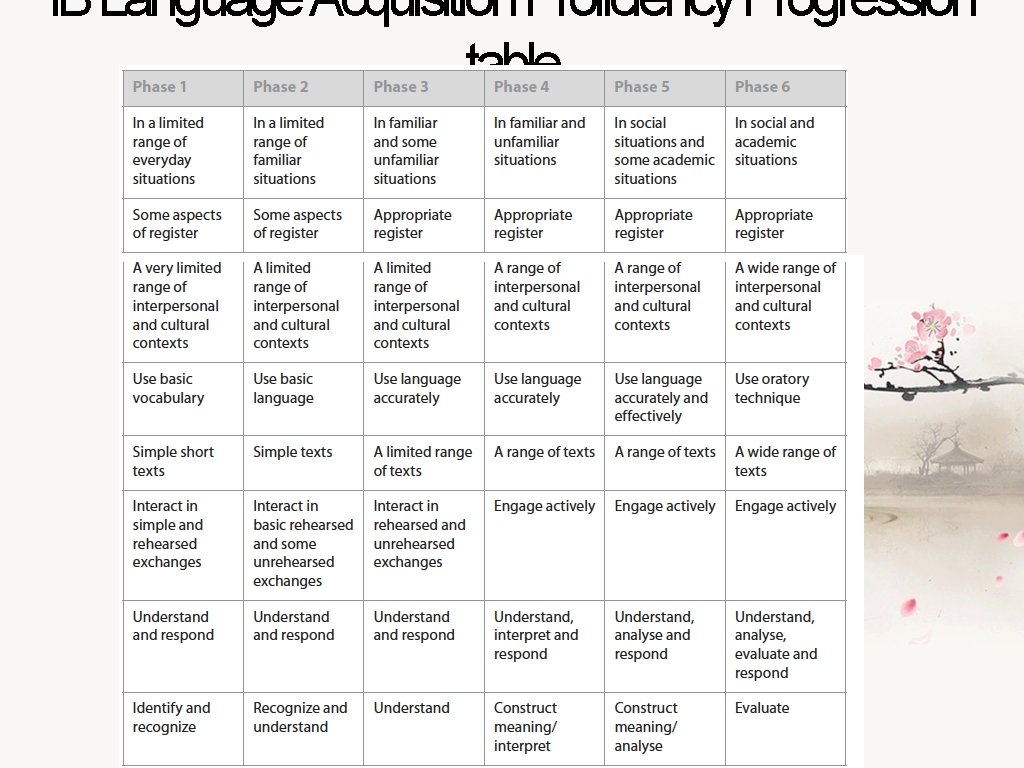
IB Language Acquisition Proficiency Progression table
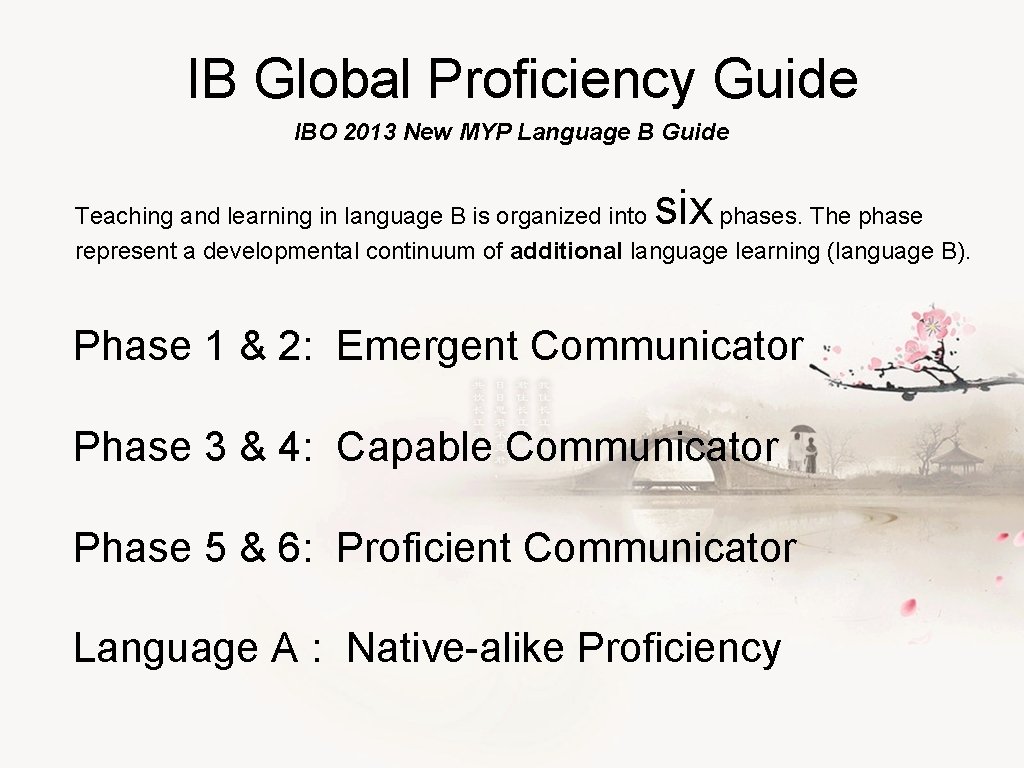
IB Global Proficiency Guide IBO 2013 New MYP Language B Guide six Teaching and learning in language B is organized into phases. The phase represent a developmental continuum of additional language learning (language B). Phase 1 & 2: Emergent Communicator Phase 3 & 4: Capable Communicator Phase 5 & 6: Proficient Communicator Language A : Native-alike Proficiency
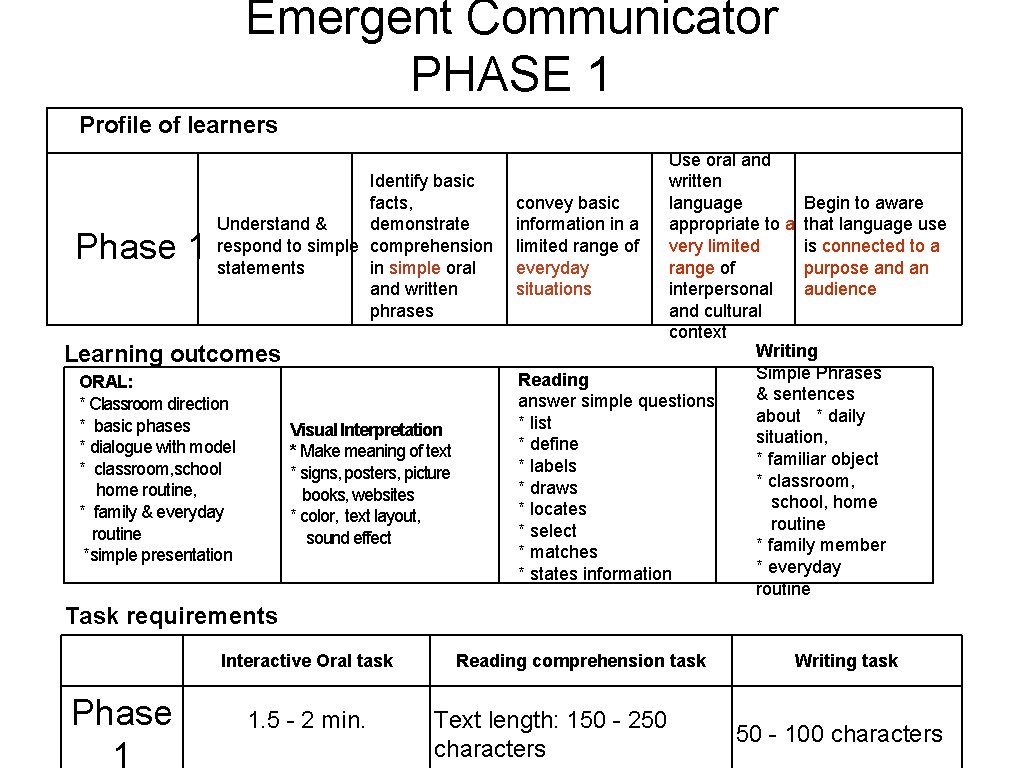
Emergent Communicator PHASE 1 Profile of learners Phase 1 Identify basic facts, demonstrate Understand & respond to simple comprehension statements in simple oral and written phrases Learning outcomes ORAL: * Classroom direction * basic phases * dialogue with model * classroom, school home routine, * family & everyday routine *simple presentation Visual Interpretation * Make meaning of text * signs, posters, picture books, websites * color, text layout, sound effect Use oral and written convey basic Begin to aware language information in a appropriate to a that language use limited range of is connected to a very limited everyday purpose and an range of situations audience interpersonal and cultural context Writing Simple Phrases Reading & sentences answer simple questions about * daily * list situation, * define * familiar object * labels * classroom, * draws school, home * locates routine * select * family member * matches * everyday * states information routine Task requirements Interactive Oral task Phase 1. 5 - 2 min. Reading comprehension task Text length: 150 - 250 characters Writing task 50 - 100 characters
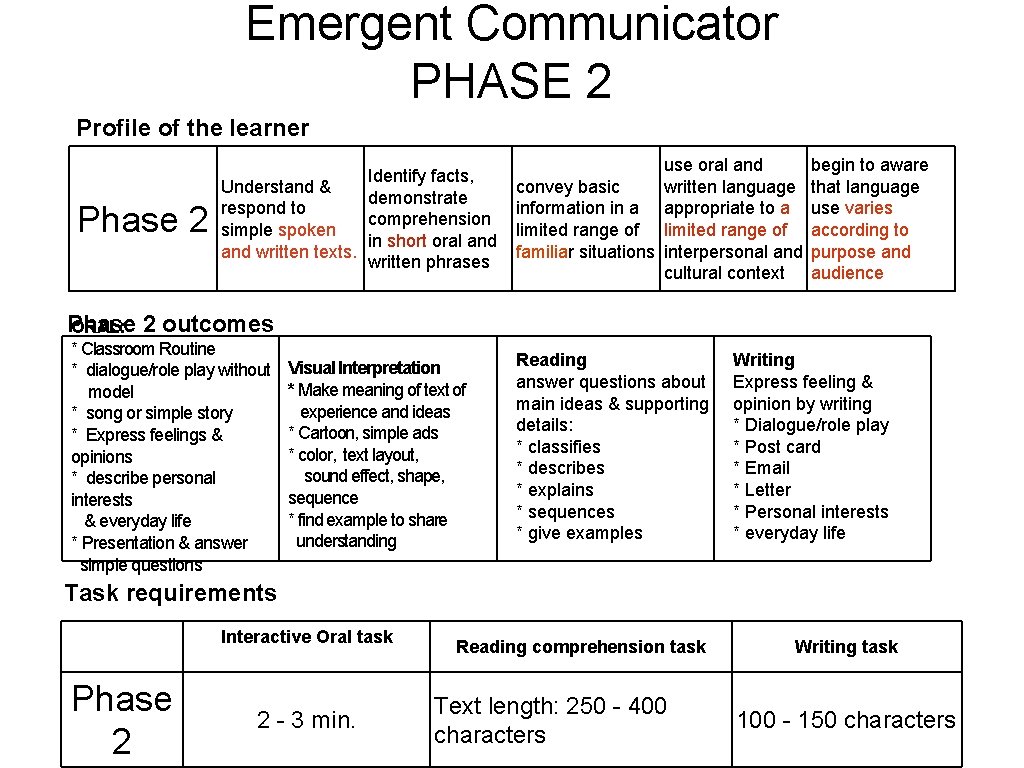
Emergent Communicator PHASE 2 Profile of the learner Phase 2 Identify facts, Understand & demonstrate respond to comprehension simple spoken in short oral and written texts. written phrases use oral and written language convey basic information in a appropriate to a limited range of familiar situations interpersonal and cultural context begin to aware that language use varies according to purpose and audience Phase ORAL: 2 outcomes * Classroom Routine * dialogue/role play without model * song or simple story * Express feelings & opinions * describe personal interests & everyday life * Presentation & answer simple questions Visual Interpretation * Make meaning of text of experience and ideas * Cartoon, simple ads * color, text layout, sound effect, shape, sequence * find example to share understanding Reading answer questions about main ideas & supporting details: * classifies * describes * explains * sequences * give examples Writing Express feeling & opinion by writing * Dialogue/role play * Post card * Email * Letter * Personal interests * everyday life Task requirements Interactive Oral task Phase 2 2 - 3 min. Reading comprehension task Text length: 250 - 400 characters Writing task 100 - 150 characters
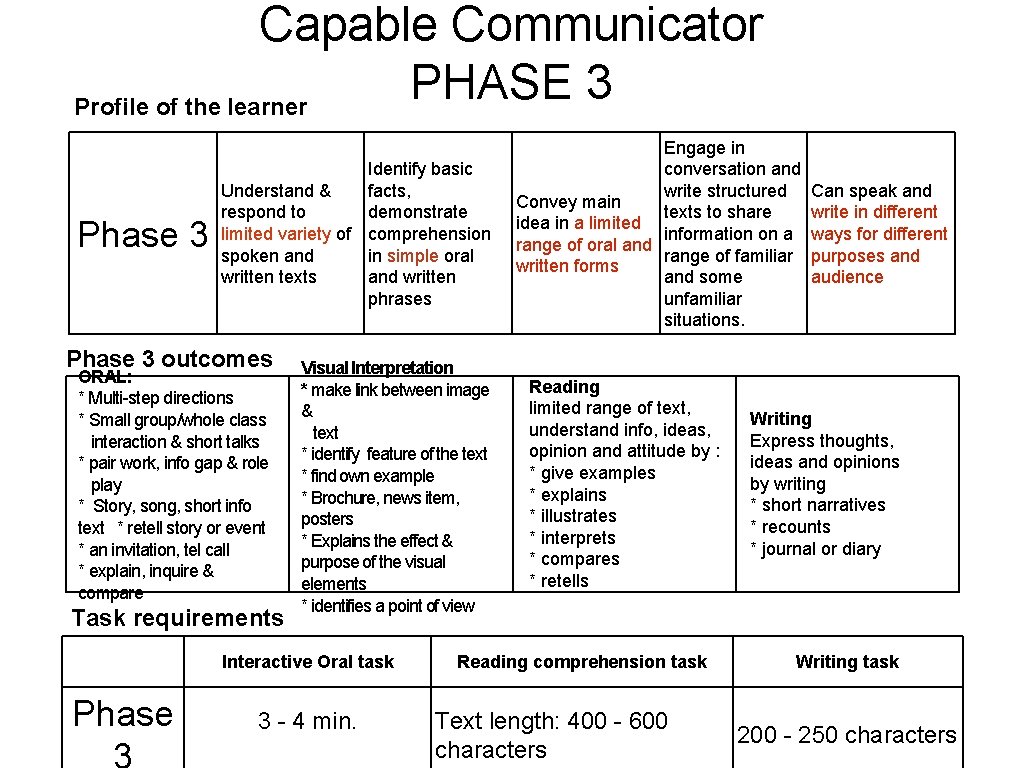
Capable Communicator PHASE 3 Profile of the learner Phase 3 Identify basic Understand & facts, respond to demonstrate limited variety of comprehension spoken and in simple oral written texts and written phrases Phase 3 outcomes ORAL: * Multi-step directions * Small group/whole class interaction & short talks * pair work, info gap & role play * Story, song, short info text * retell story or event * an invitation, tel call * explain, inquire & compare Task requirements Visual Interpretation * make link between image & text * identify feature of the text * find own example * Brochure, news item, posters * Explains the effect & purpose of the visual elements * identifies a point of view Interactive Oral task Phase 3 - 4 min. Engage in conversation and write structured Convey main texts to share idea in a limited information on a range of oral and range of familiar written forms and some unfamiliar situations. Reading limited range of text, understand info, ideas, opinion and attitude by : * give examples * explains * illustrates * interprets * compares * retells Reading comprehension task Text length: 400 - 600 characters Can speak and write in different ways for different purposes and audience Writing Express thoughts, ideas and opinions by writing * short narratives * recounts * journal or diary Writing task 200 - 250 characters
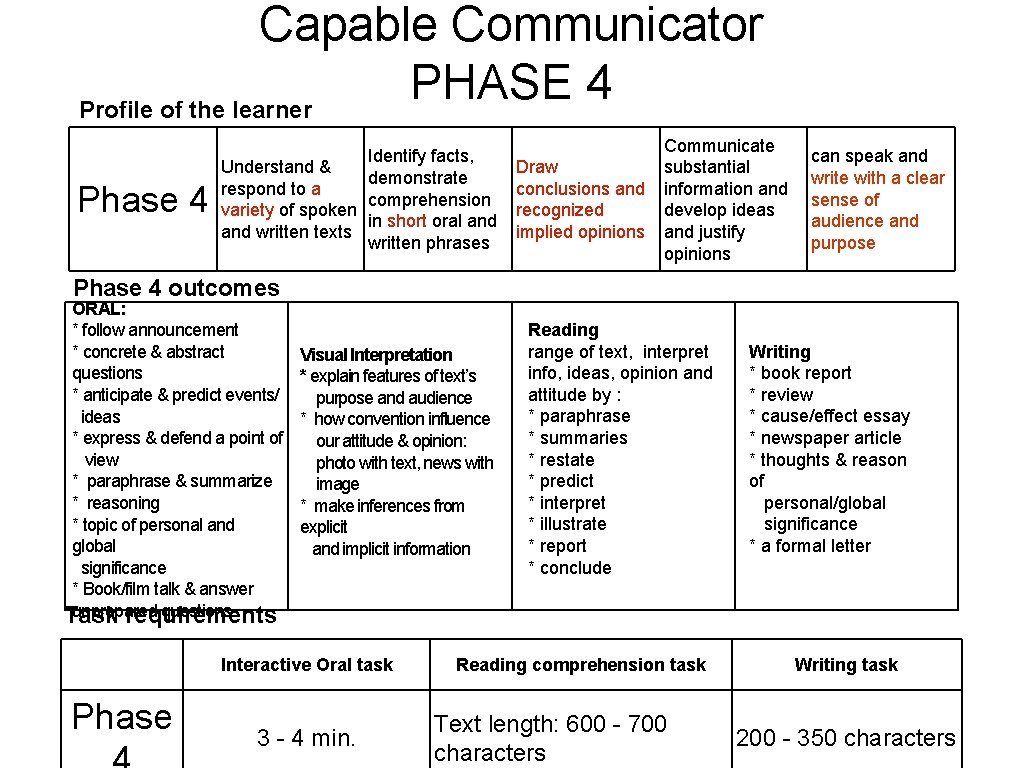
Capable Communicator PHASE 4 Profile of the learner Phase 4 Identify facts, Understand & demonstrate respond to a comprehension variety of spoken in short oral and written texts written phrases Draw conclusions and recognized implied opinions Communicate substantial information and develop ideas and justify opinions can speak and write with a clear sense of audience and purpose Phase 4 outcomes ORAL: * follow announcement * concrete & abstract questions * anticipate & predict events/ ideas * express & defend a point of view * paraphrase & summarize * reasoning * topic of personal and global significance * Book/film talk & answer unprepared questions Task requirements Visual Interpretation * explain features of text’s purpose and audience * how convention influence our attitude & opinion: photo with text, news with image * make inferences from explicit and implicit information Interactive Oral task Phase 3 - 4 min. Reading range of text, interpret info, ideas, opinion and attitude by : * paraphrase * summaries * restate * predict * interpret * illustrate * report * conclude Reading comprehension task Text length: 600 - 700 characters Writing * book report * review * cause/effect essay * newspaper article * thoughts & reason of personal/global significance * a formal letter Writing task 200 - 350 characters
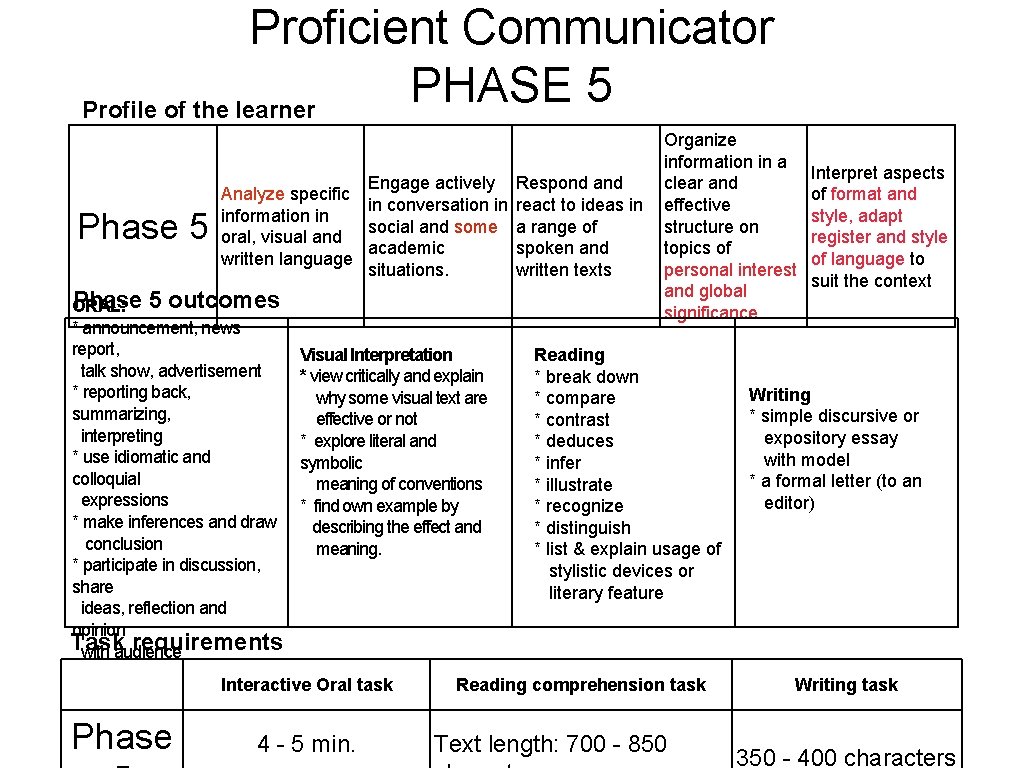
Proficient Communicator PHASE 5 Profile of the learner Phase 5 Engage actively Analyze specific in conversation in information in social and some oral, visual and academic written language situations. Phase 5 outcomes ORAL: * announcement, news report, talk show, advertisement * reporting back, summarizing, interpreting * use idiomatic and colloquial expressions * make inferences and draw conclusion * participate in discussion, share ideas, reflection and opinion Task requirements with audience Visual Interpretation * view critically and explain why some visual text are effective or not * explore literal and symbolic meaning of conventions * find own example by describing the effect and meaning. Interactive Oral task Phase 4 - 5 min. Respond and react to ideas in a range of spoken and written texts Organize information in a clear and effective structure on topics of personal interest and global significance Reading * break down * compare * contrast * deduces * infer * illustrate * recognize * distinguish * list & explain usage of stylistic devices or literary feature Reading comprehension task Text length: 700 - 850 Interpret aspects of format and style, adapt register and style of language to suit the context Writing * simple discursive or expository essay with model * a formal letter (to an editor) Writing task 350 - 400 characters
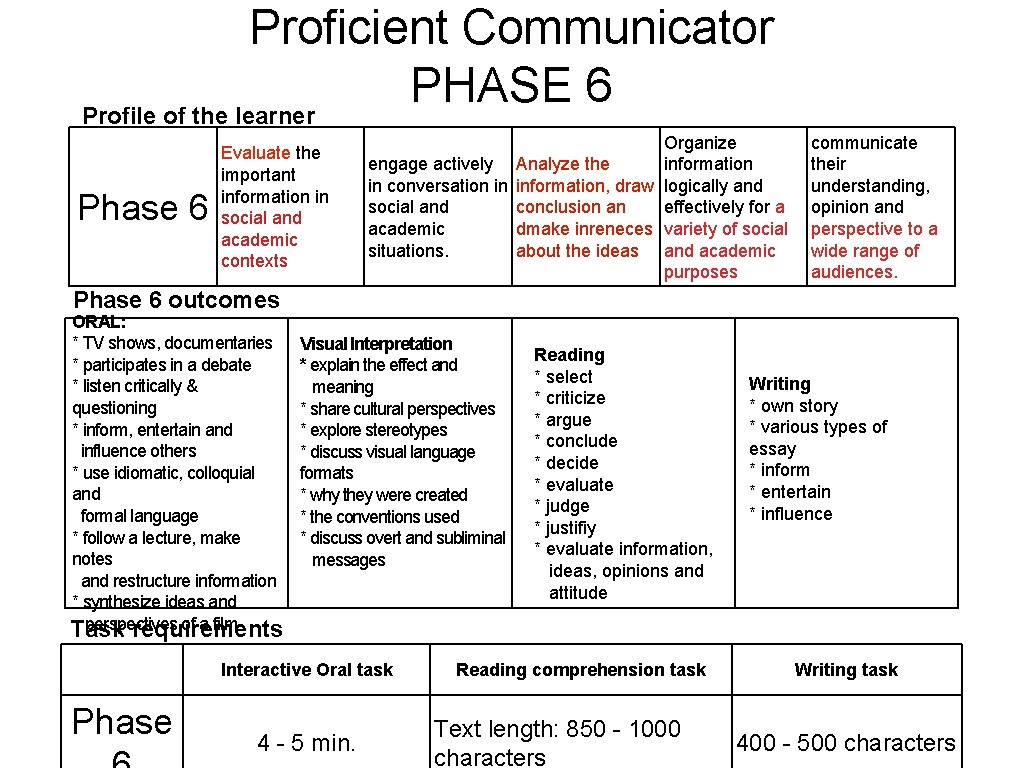
Proficient Communicator PHASE 6 Profile of the learner Phase 6 Evaluate the important information in social and academic contexts Organize engage actively Analyze the information in conversation in information, draw logically and social and conclusion an effectively for a academic dmake inreneces variety of social situations. about the ideas and academic purposes communicate their understanding, opinion and perspective to a wide range of audiences. Phase 6 outcomes ORAL: * TV shows, documentaries * participates in a debate * listen critically & questioning * inform, entertain and influence others * use idiomatic, colloquial and formal language * follow a lecture, make notes and restructure information * synthesize ideas and perspectives of a film Task requirements Visual Interpretation * explain the effect and meaning * share cultural perspectives * explore stereotypes * discuss visual language formats * why they were created * the conventions used * discuss overt and subliminal messages Interactive Oral task Phase 4 - 5 min. Reading * select * criticize * argue * conclude * decide * evaluate * judge * justifiy * evaluate information, ideas, opinions and attitude Reading comprehension task Text length: 850 - 1000 characters Writing * own story * various types of essay * inform * entertain * influence Writing task 400 - 500 characters
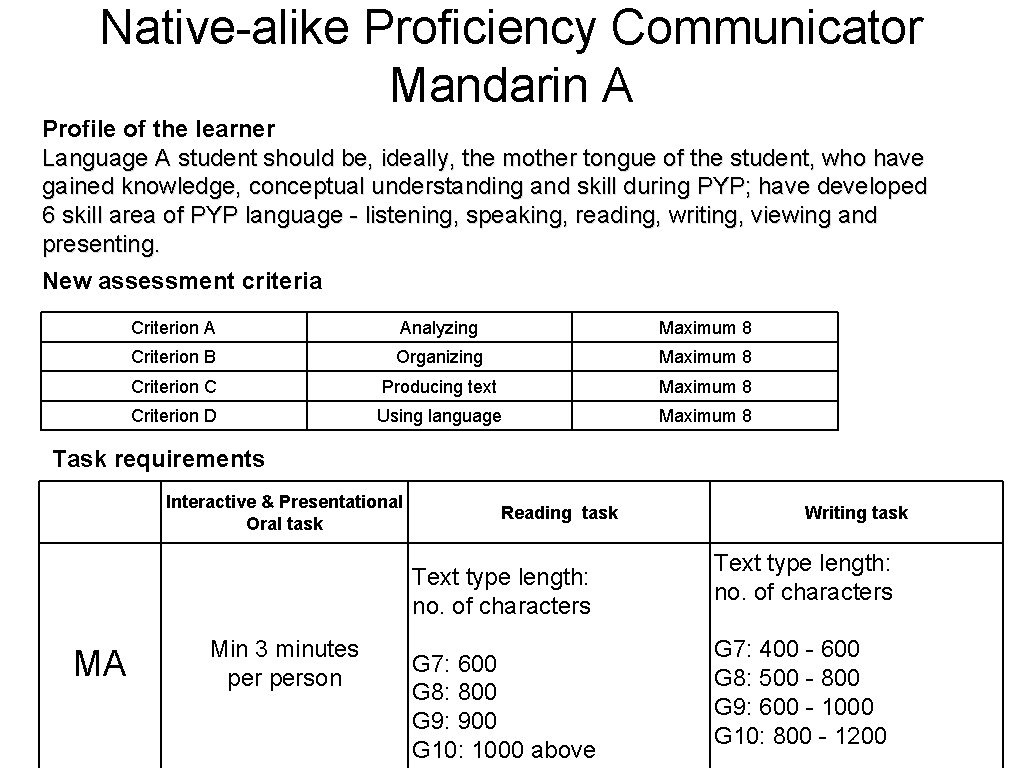
Native-alike Proficiency Communicator Mandarin A Profile of the learner Language A student should be, ideally, the mother tongue of the student, who have gained knowledge, conceptual understanding and skill during PYP; have developed 6 skill area of PYP language - listening, speaking, reading, writing, viewing and presenting. New assessment criteria Criterion A Analyzing Maximum 8 Criterion B Organizing Maximum 8 Criterion C Producing text Maximum 8 Criterion D Using language Maximum 8 Task requirements Interactive & Presentational Oral task Reading task Text type length: no. of characters MA Min 3 minutes person G 7: 600 G 8: 800 G 9: 900 G 10: 1000 above Writing task Text type length: no. of characters G 7: 400 - 600 G 8: 500 - 800 G 9: 600 - 1000 G 10: 800 - 1200
Pathways from PYP-MYP-DP PHASE 1 PHASE 2 PHASE 3 PHASE 4 PHASE 5
PART 2 Planning curriculum content
Vocabulary IB Ab initio vocabulary list
Vocabulary & grammar S & S ���法技能�序
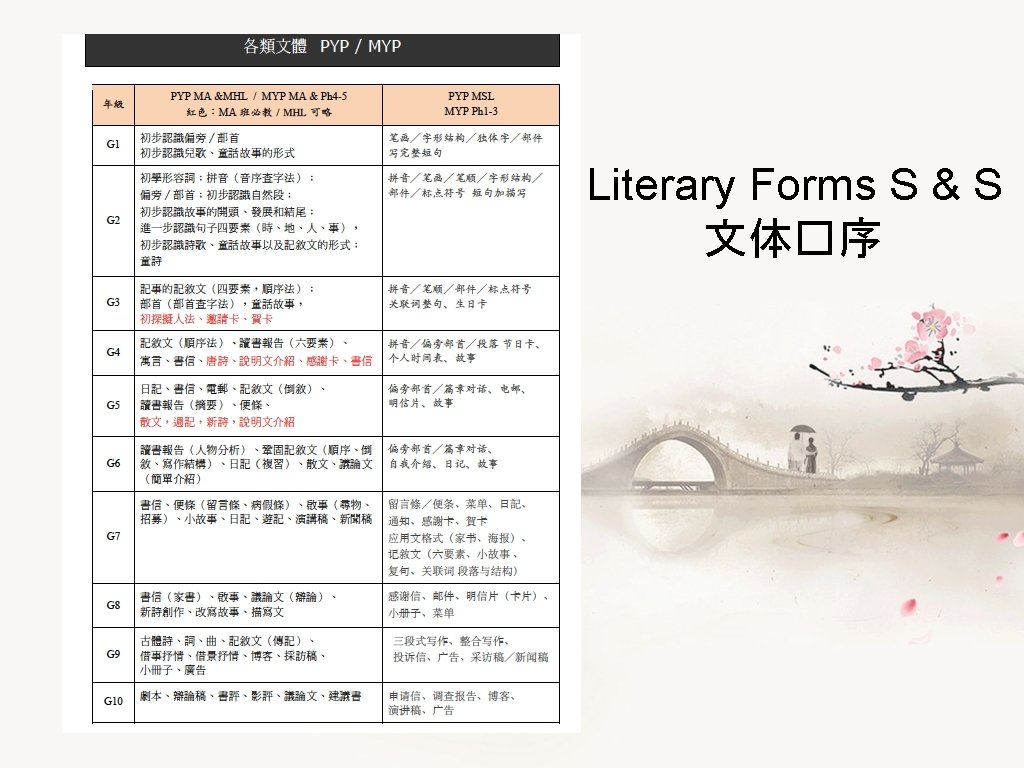
Literary Forms S & S 文体�序
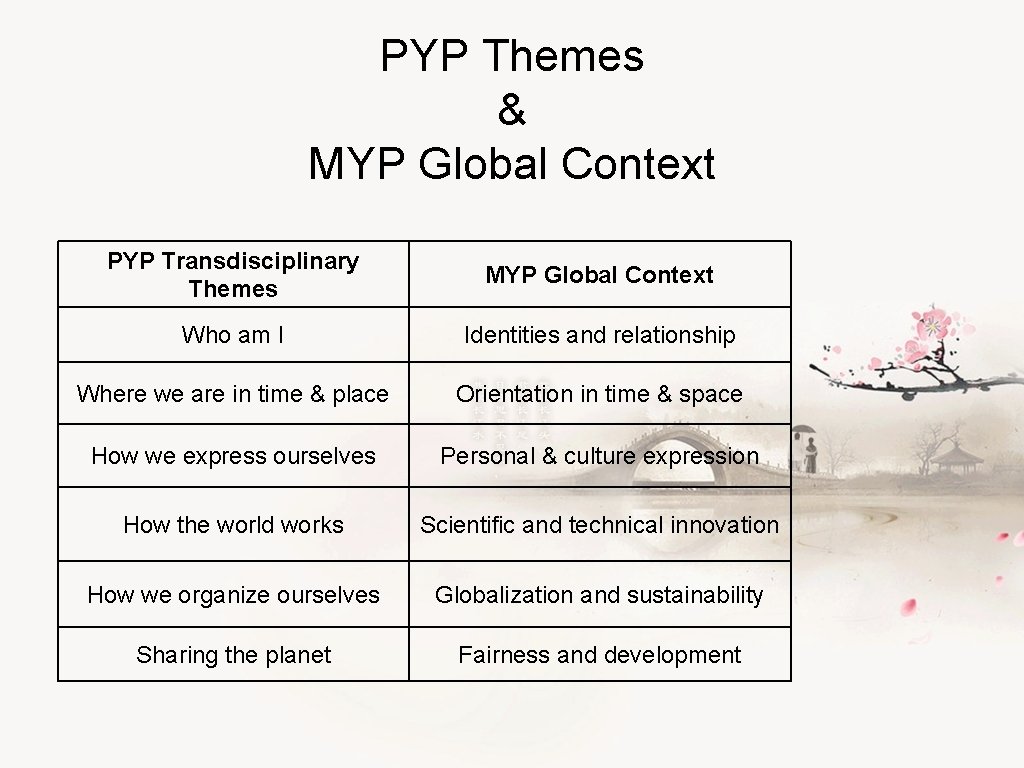
PYP Themes & MYP Global Context PYP Transdisciplinary Themes MYP Global Context Who am I Identities and relationship Where we are in time & place Orientation in time & space How we express ourselves Personal & culture expression How the world works Scientific and technical innovation How we organize ourselves Globalization and sustainability Sharing the planet Fairness and development
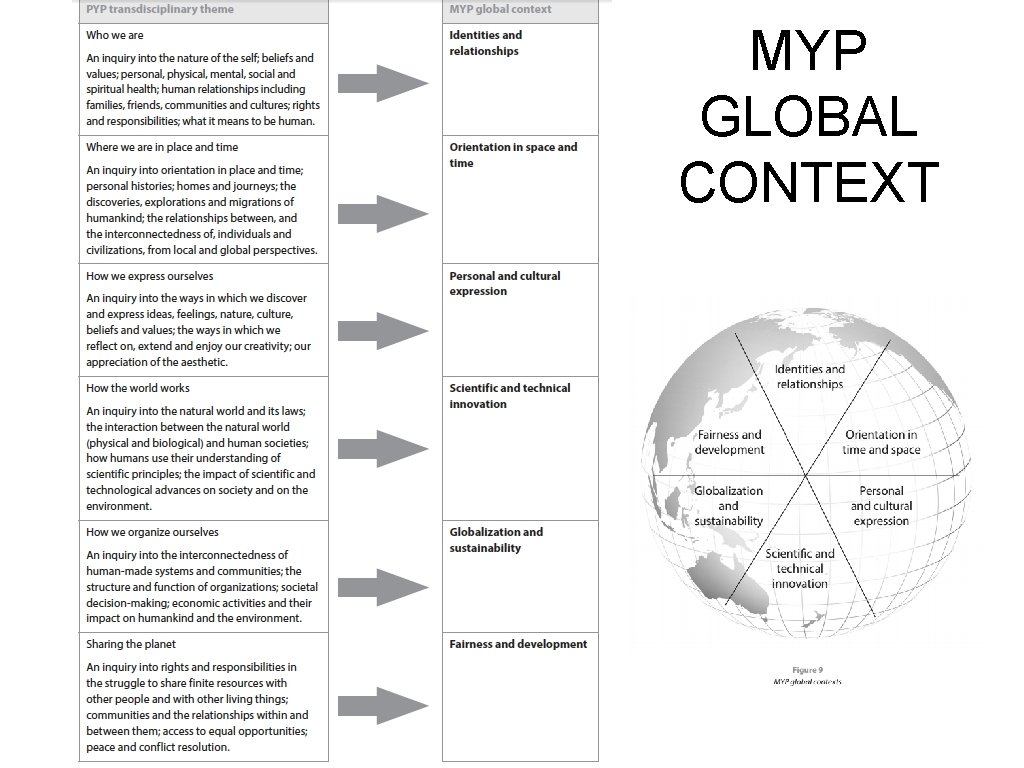
MYP GLOBAL CONTEXT
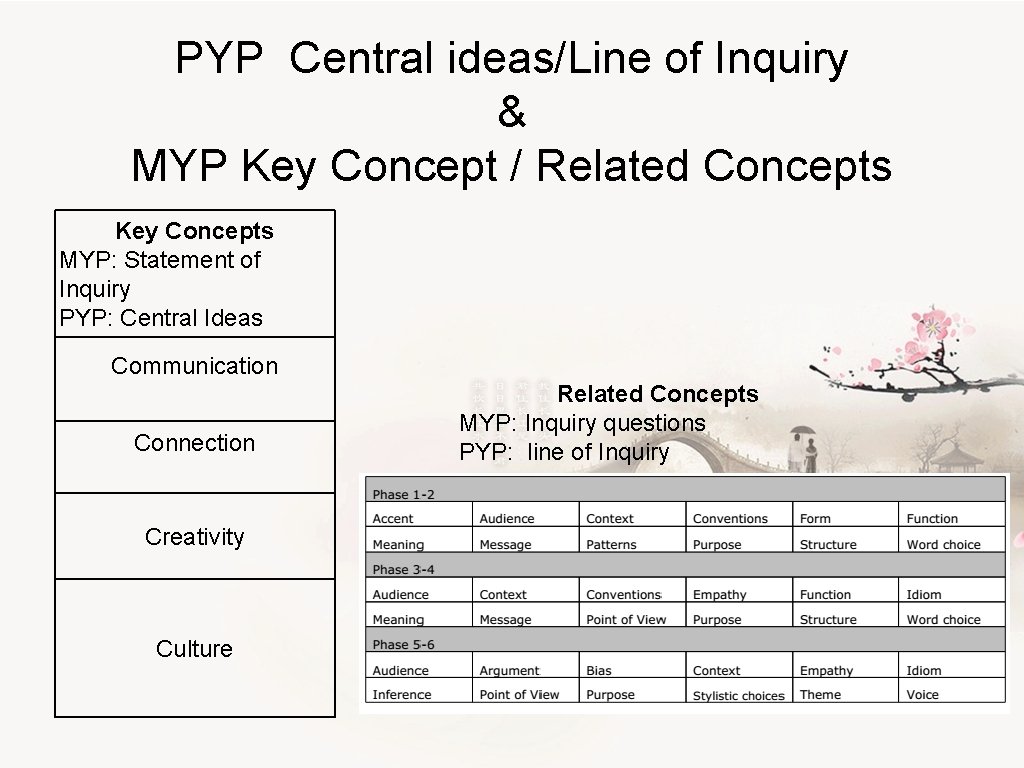
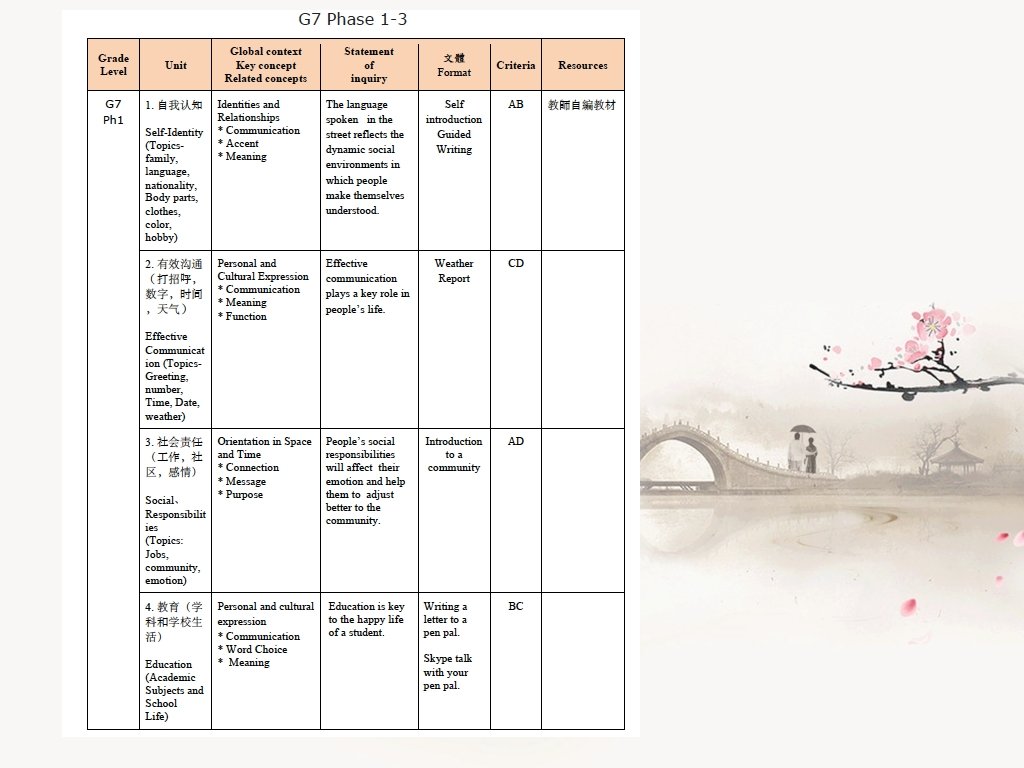
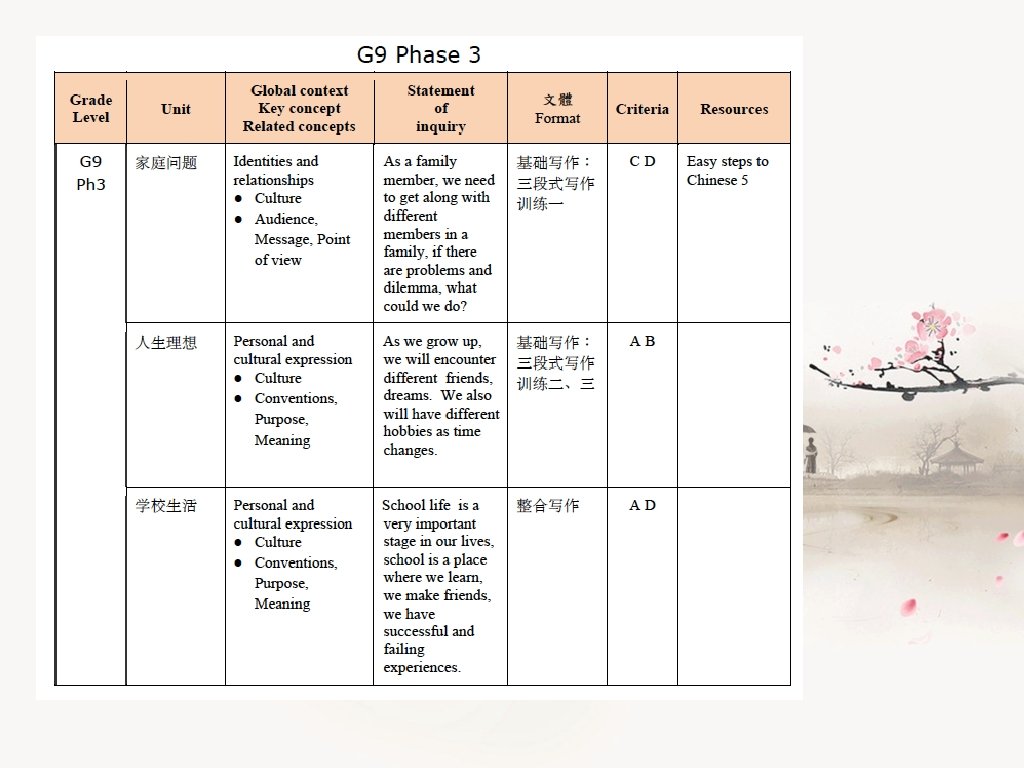
PYP Central ideas/Line of Inquiry & MYP Key Concept / Related Concepts Key Concepts MYP: Statement of Inquiry PYP: Central Ideas Communication Connection Creativity Culture Related Concepts MYP: Inquiry questions PYP: line of Inquiry
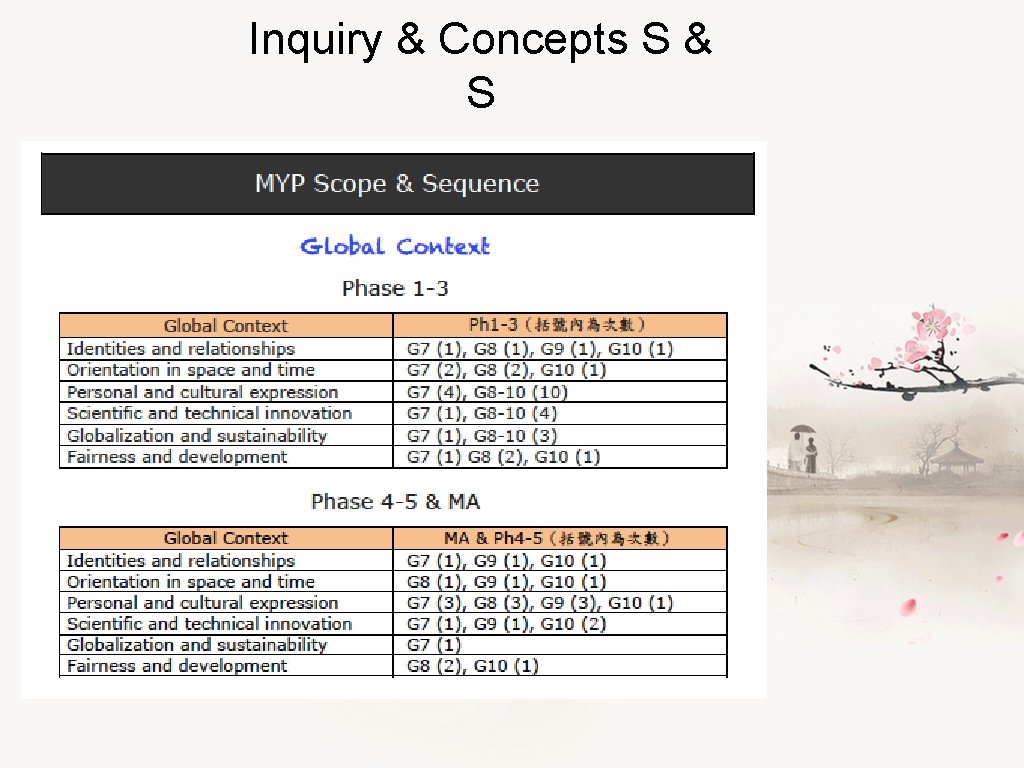
Inquiry & Concepts S & S
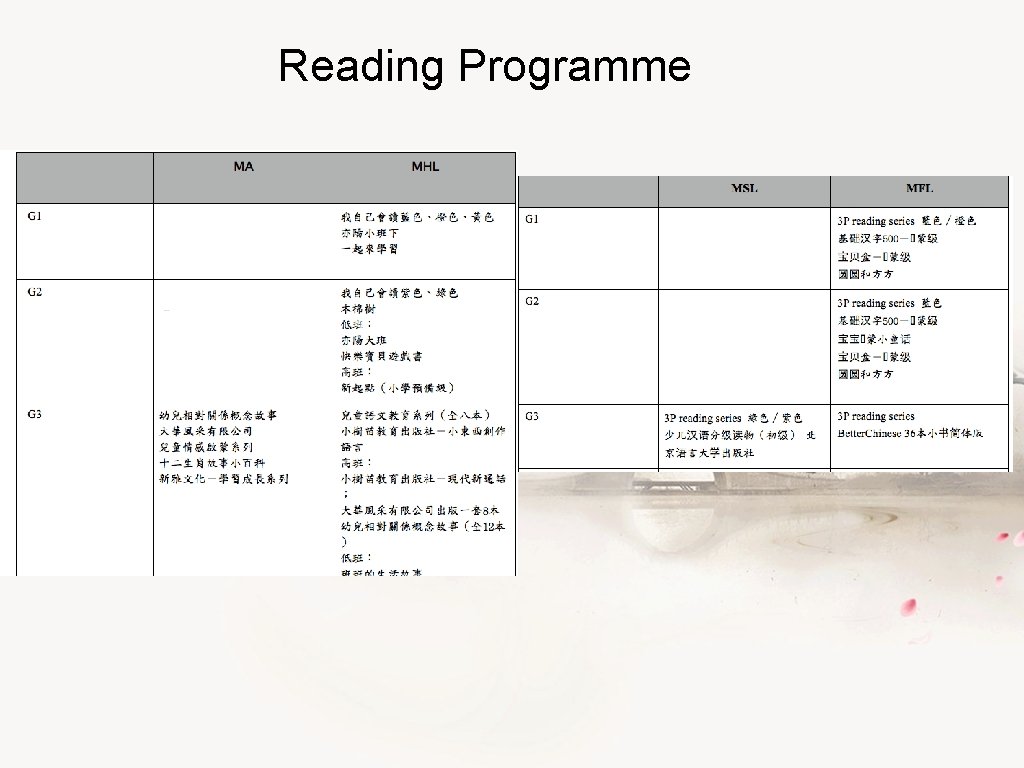
Reading Programme
PART 3 Planning Assessments
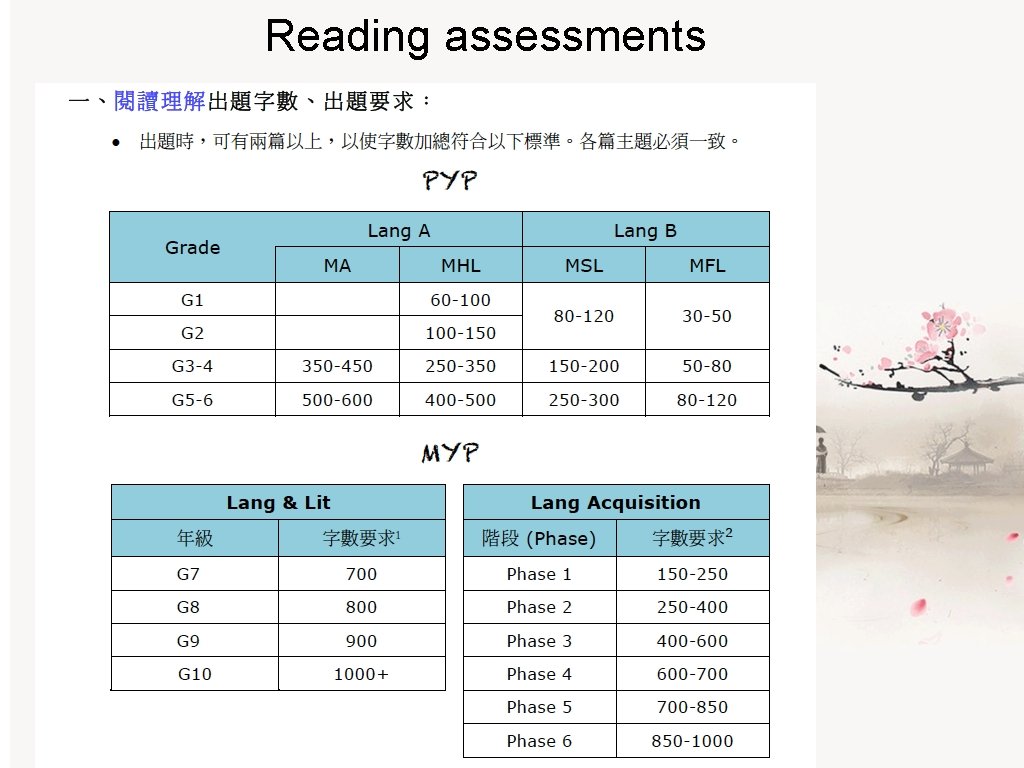
Reading assessments
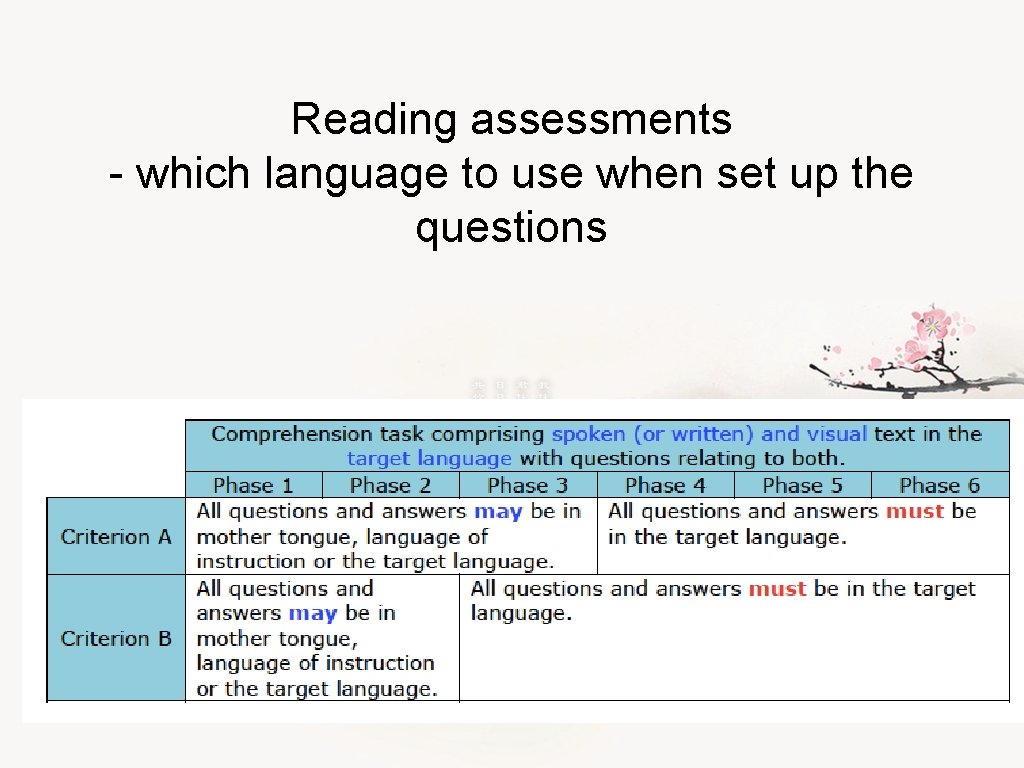
Reading assessments - which language to use when set up the questions
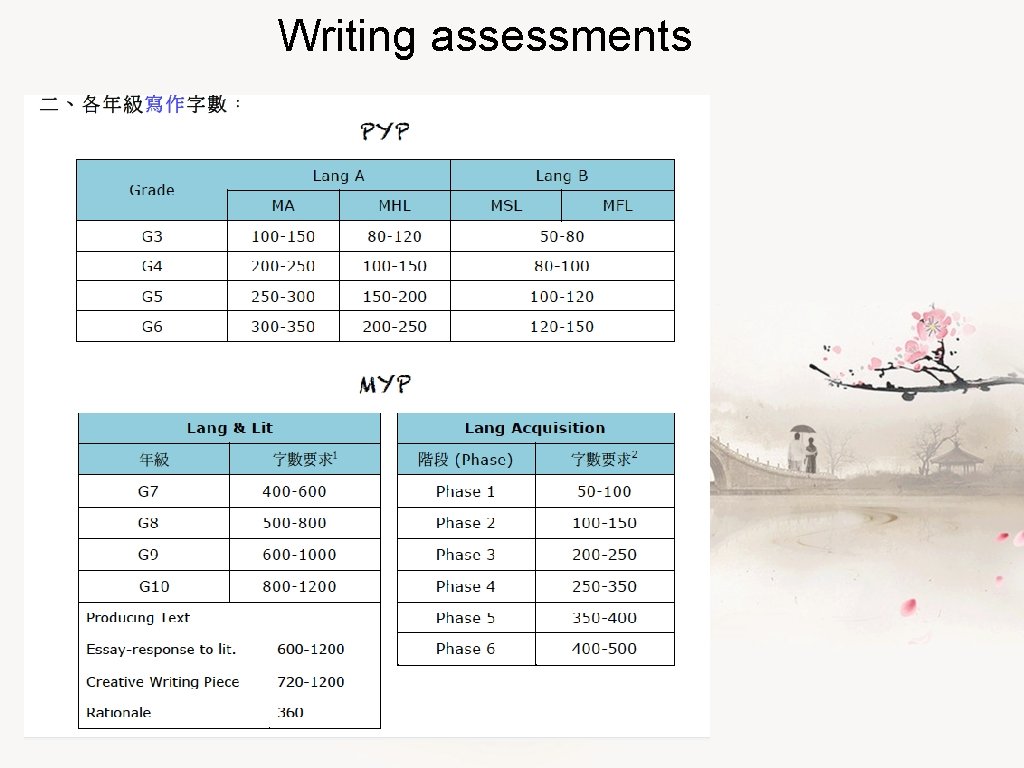
Writing assessments
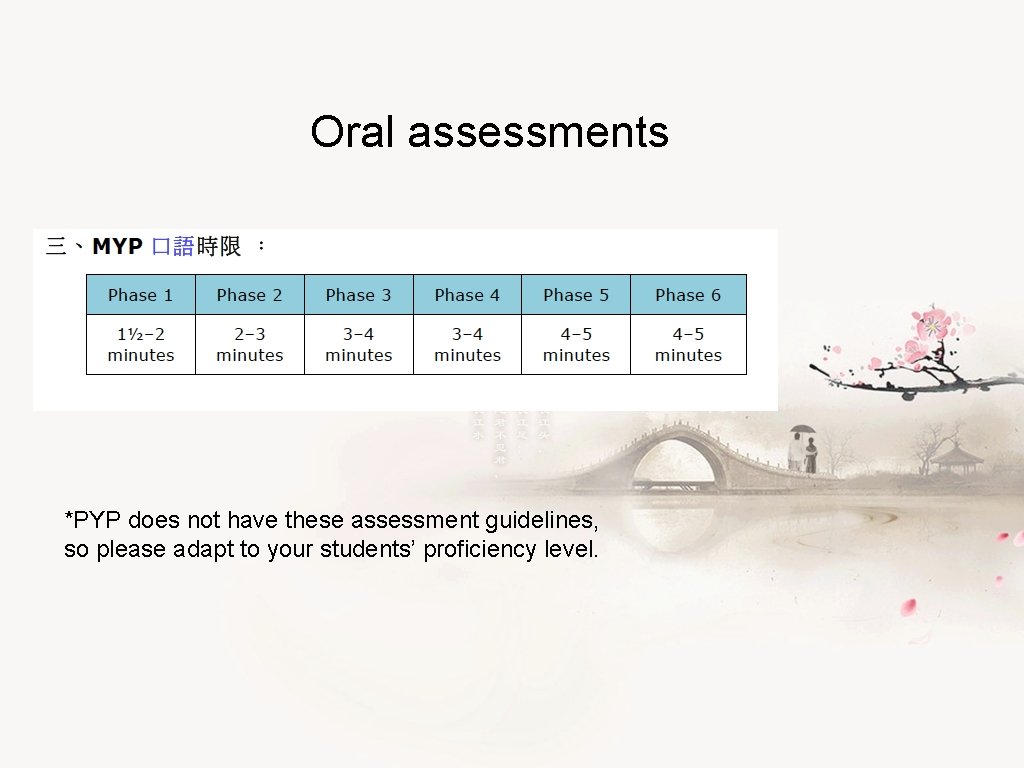
Oral assessments *PYP does not have these assessment guidelines, so please adapt to your students’ proficiency level.
MYP Mandarin B 評估 Assessment • 評估標準 Criteria • 作品範例 Examples
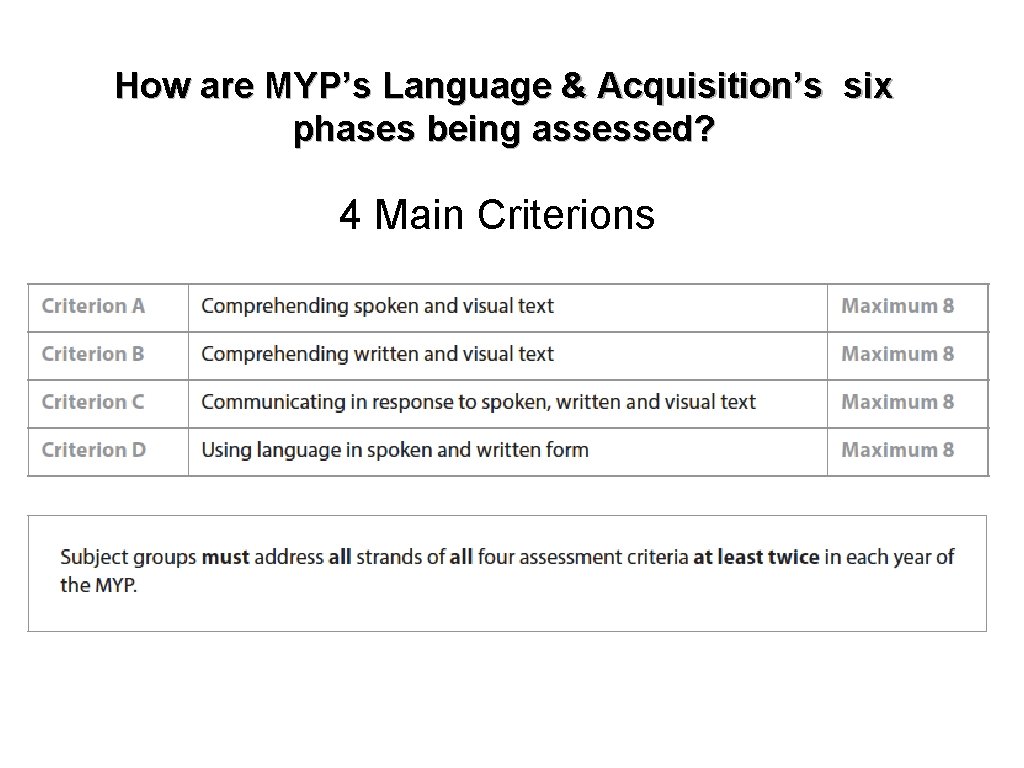
How are MYP’s Language & Acquisition’s six phases being assessed? 4 Main Criterions
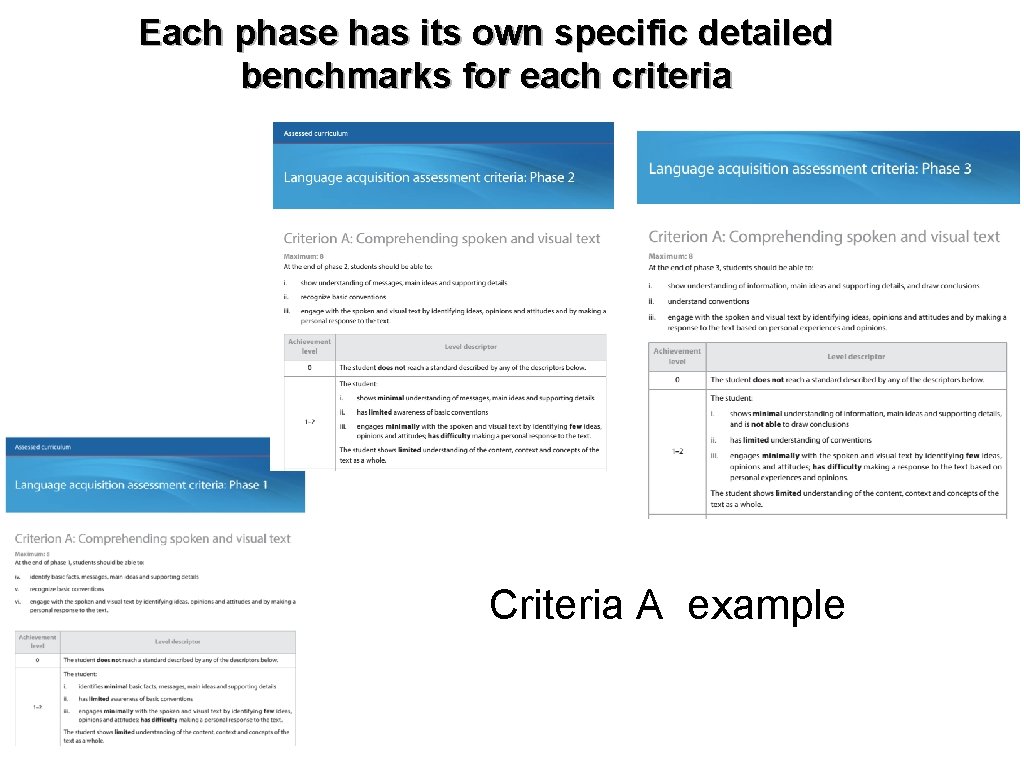
Each phase has its own specific detailed benchmarks for each criteria Criteria A example
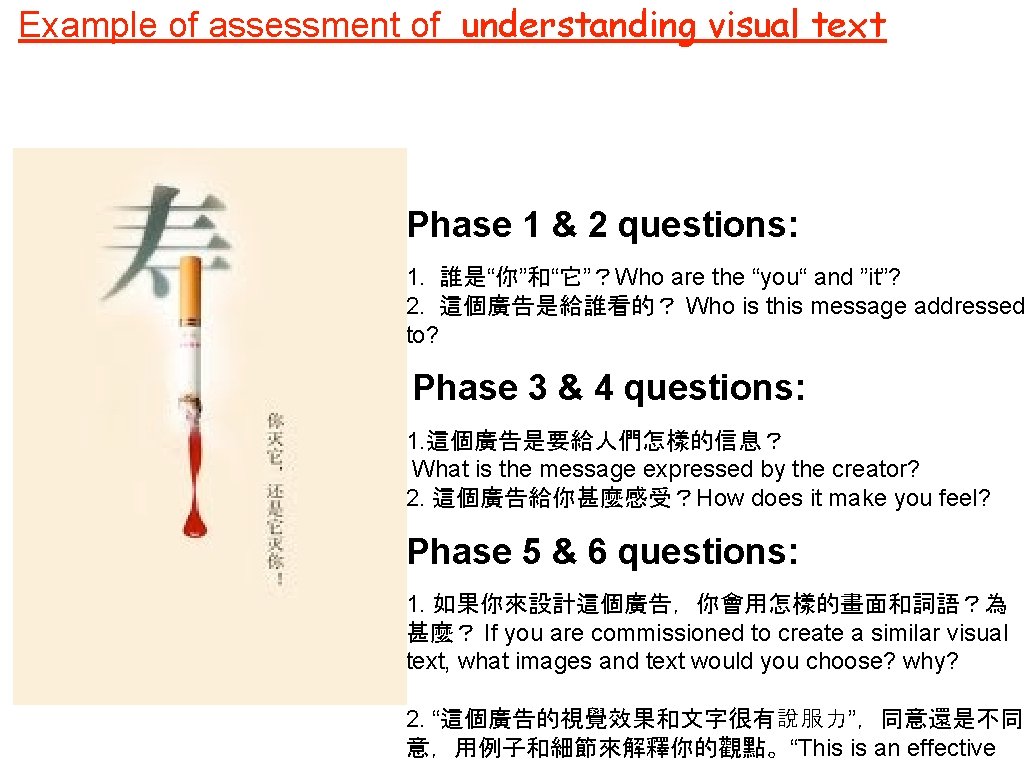
Example of assessment of understanding visual text Phase 1 & 2 questions: 1. 誰是“你”和“它”?Who are the “you“ and ”it”? 2. 這個廣告是給誰看的? Who is this message addressed to? Phase 3 & 4 questions: 1. 這個廣告是要給人們怎樣的信息? What is the message expressed by the creator? 2. 這個廣告給你甚麼感受?How does it make you feel? Phase 5 & 6 questions: 1. 如果你來設計這個廣告,你會用怎樣的畫面和詞語?為 甚麼? If you are commissioned to create a similar visual text, what images and text would you choose? why? 2. “這個廣告的視覺效果和文字很有說服力”,同意還是不同 意,用例子和細節來解釋你的觀點。“This is an effective
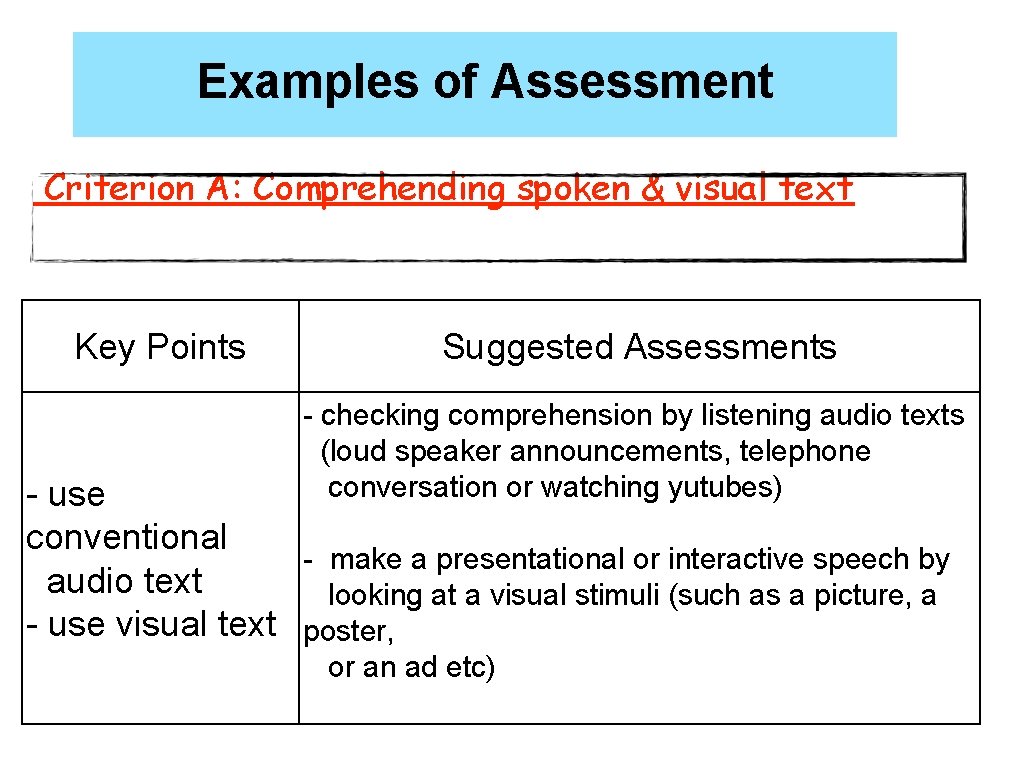
Examples of Assessment Criterion A: Comprehending spoken & visual text Key Points Suggested Assessments - checking comprehension by listening audio texts (loud speaker announcements, telephone conversation or watching yutubes) - use conventional - make a presentational or interactive speech by audio text looking at a visual stimuli (such as a picture, a - use visual text poster, or an ad etc)
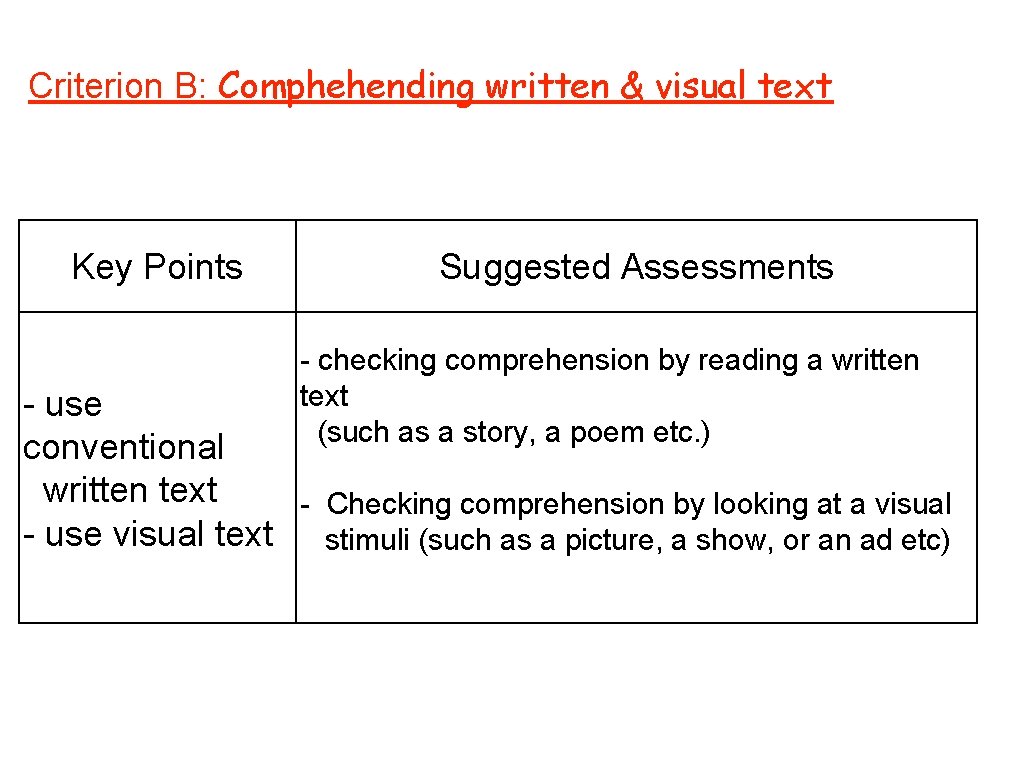
Criterion B: Comphehending written & visual text Key Points Suggested Assessments - checking comprehension by reading a written text (such as a story, a poem etc. ) - use conventional written text - Checking comprehension by looking at a visual - use visual text stimuli (such as a picture, a show, or an ad etc)
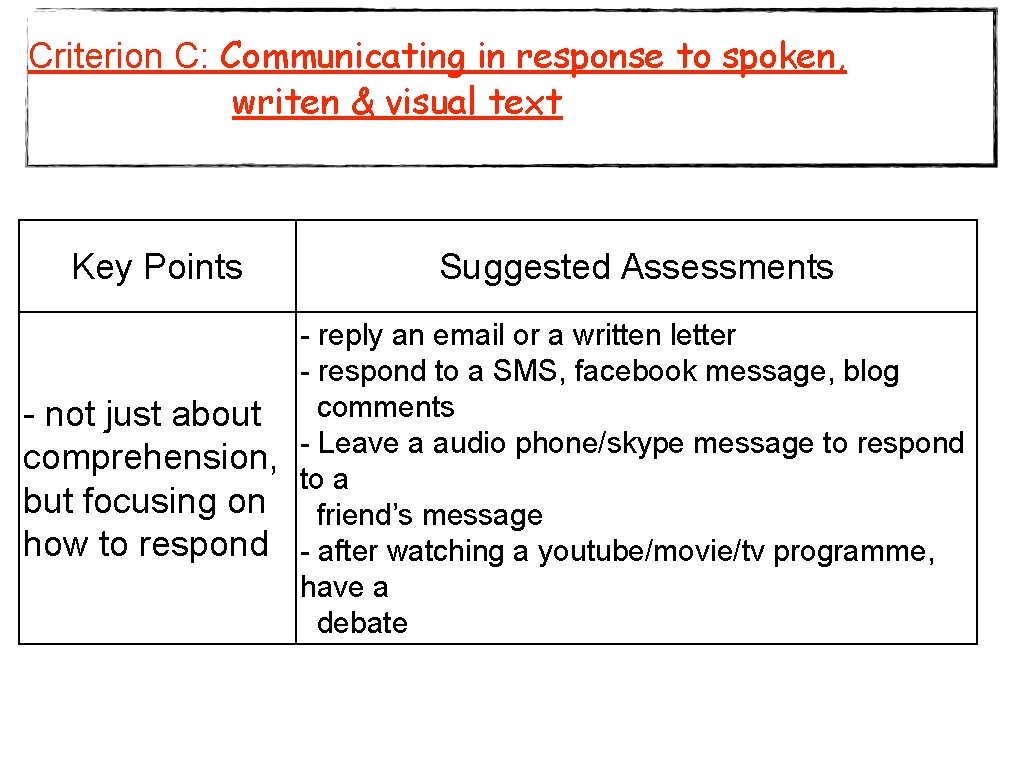
Criterion C: Communicating in response to spoken, writen & visual text Key Points Suggested Assessments - not just about comprehension, but focusing on how to respond - reply an email or a written letter - respond to a SMS, facebook message, blog comments - Leave a audio phone/skype message to respond to a friend’s message - after watching a youtube/movie/tv programme, have a debate
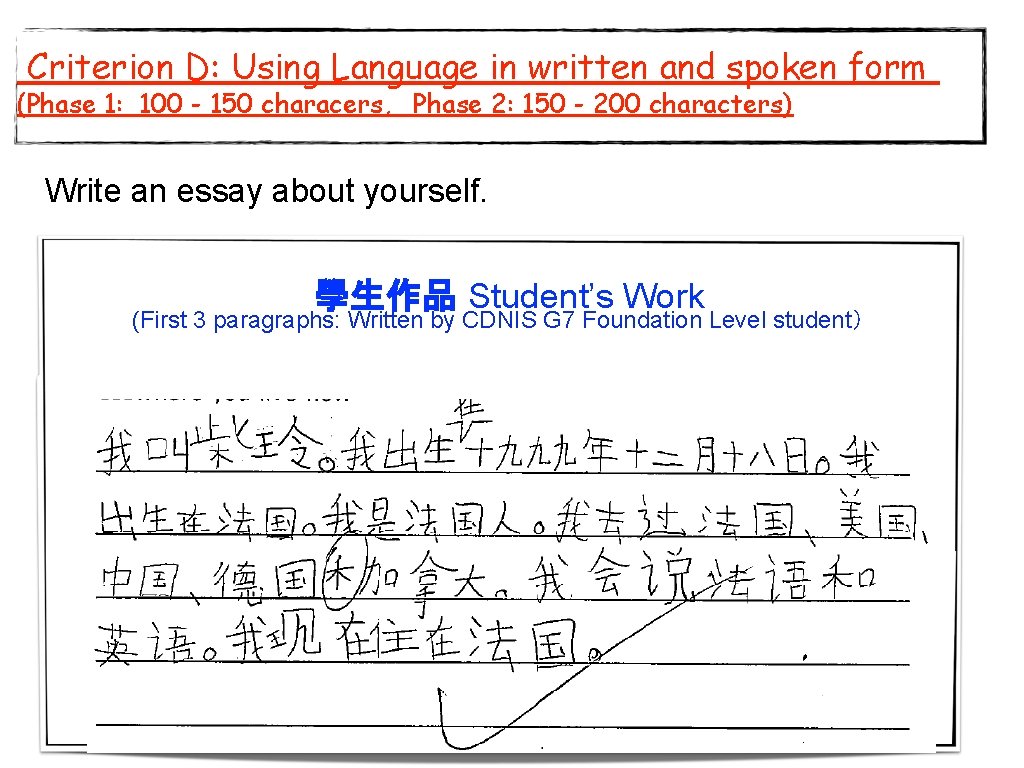
Criterion D: Using Language in written and spoken form (Phase 1: 100 - 150 characers, Phase 2: 150 - 200 characters) Write an essay about yourself. 學生作品 Student’s Work (First 3 paragraphs: Written by CDNIS G 7 Foundation Level student)
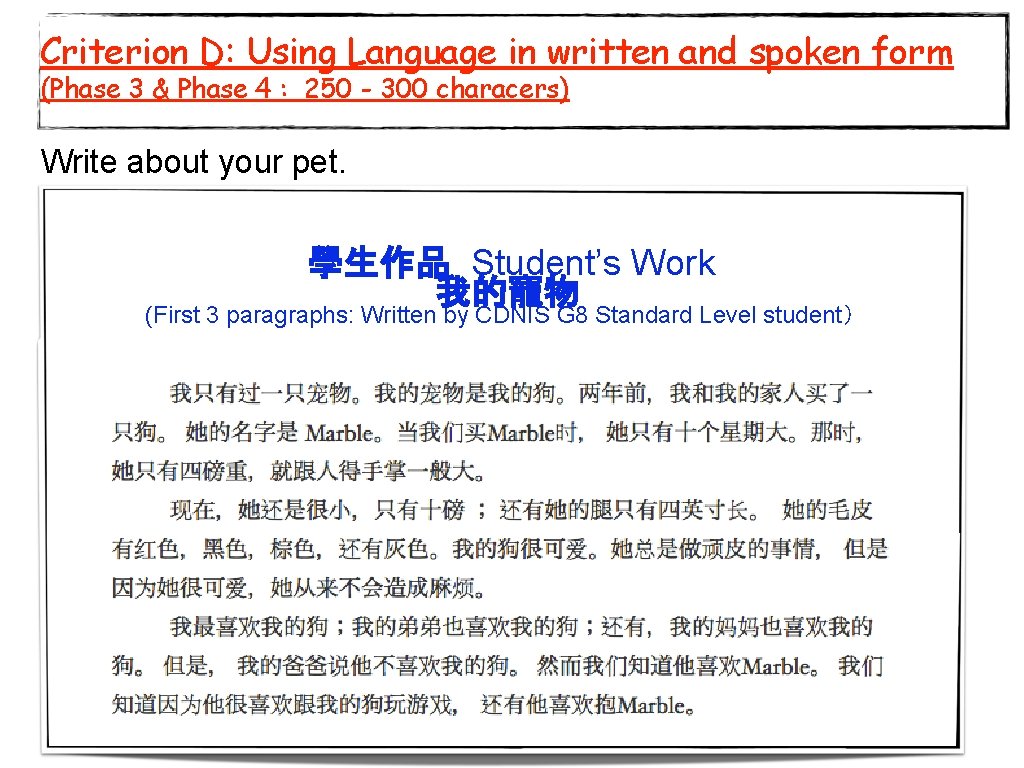
Criterion D: Using Language in written and spoken form (Phase 3 & Phase 4 : 250 - 300 characers) Write about your pet. 學生作品 Student’s Work 我的寵物 (First 3 paragraphs: Written by CDNIS G 8 Standard Level student)
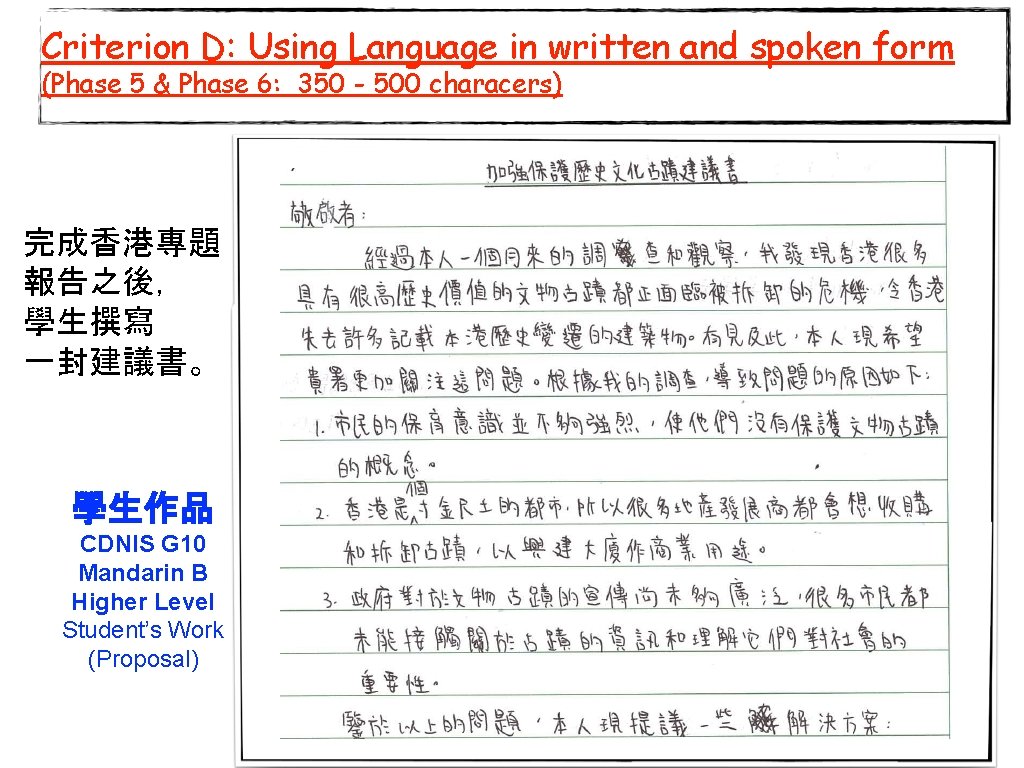
Criterion D: Using Language in written and spoken form (Phase 5 & Phase 6: 350 - 500 characers) 完成香港專題 報告之後, 學生撰寫 一封建議書。 學生作品 CDNIS G 10 Mandarin B Higher Level Student’s Work (Proposal)
MYP Chinese A 評估 Assessment • 評估標準 Criteria • 作品範例 Examples
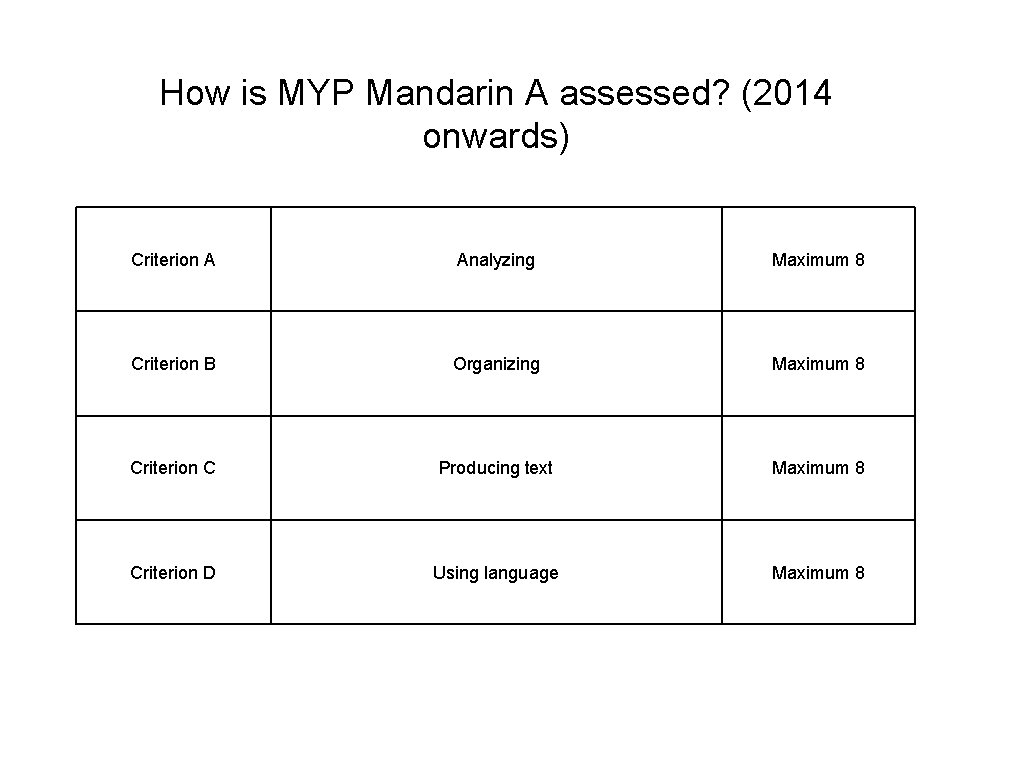
How is MYP Mandarin A assessed? (2014 onwards) Criterion A Analyzing Maximum 8 Criterion B Organizing Maximum 8 Criterion C Producing text Maximum 8 Criterion D Using language Maximum 8
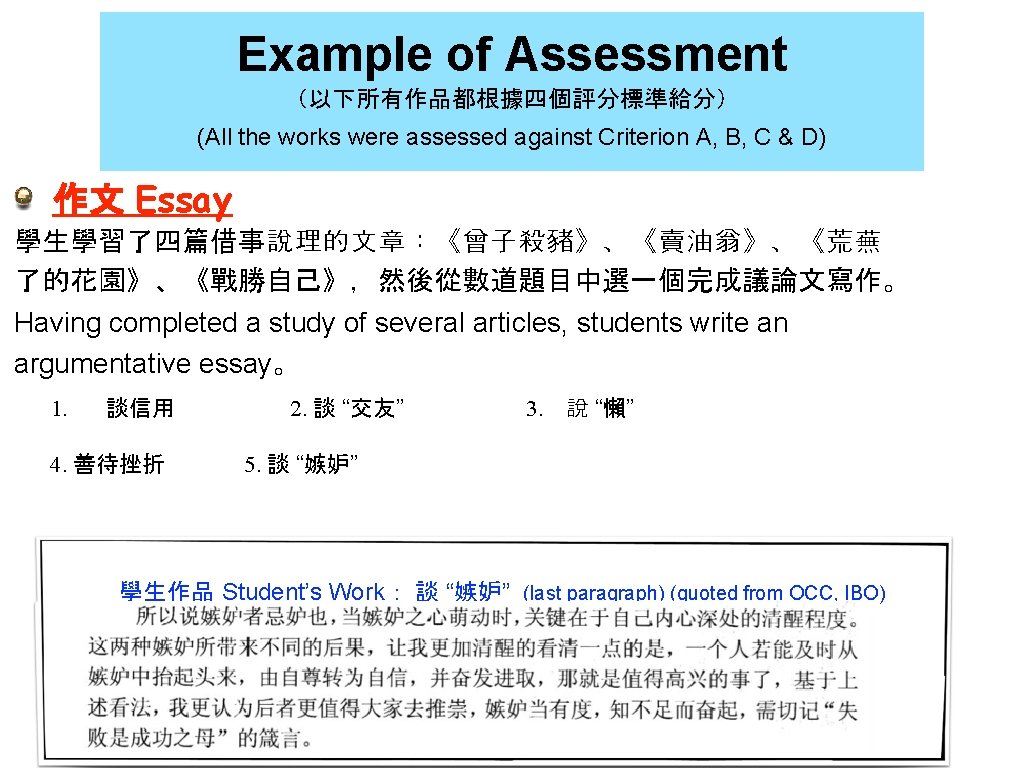
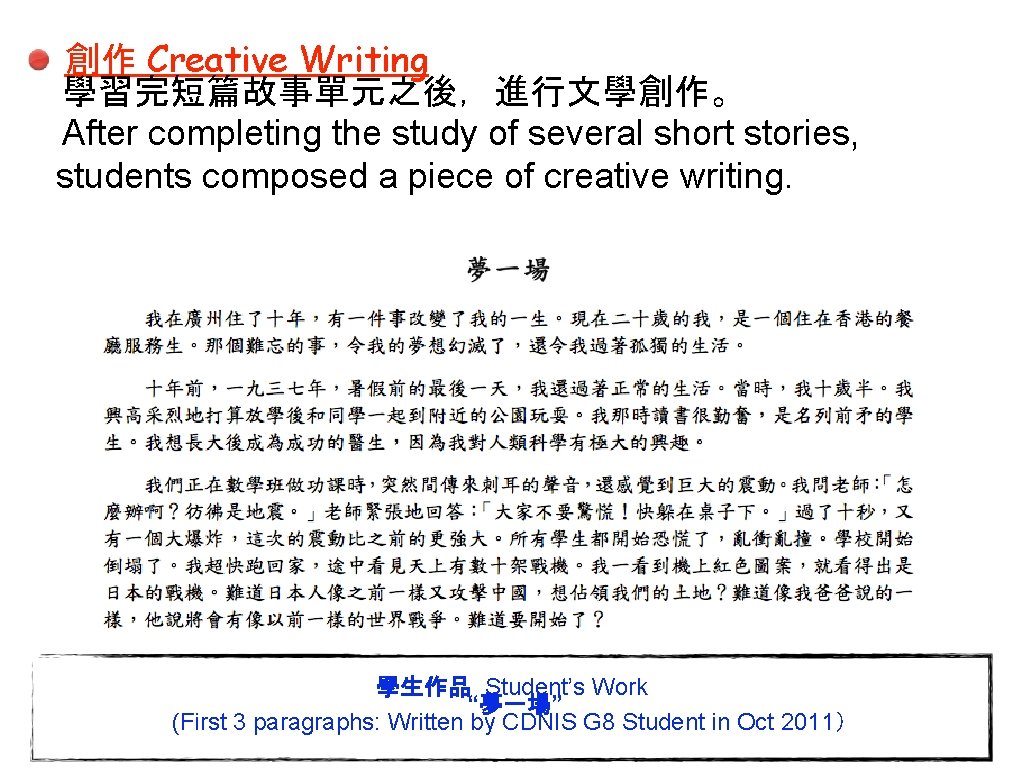
創作 Creative Writing 學習完短篇故事單元之後,進行文學創作。 After completing the study of several short stories, students composed a piece of creative writing. 學生作品 Student’s Work “夢一場” (First 3 paragraphs: Written by CDNIS G 8 Student in Oct 2011)
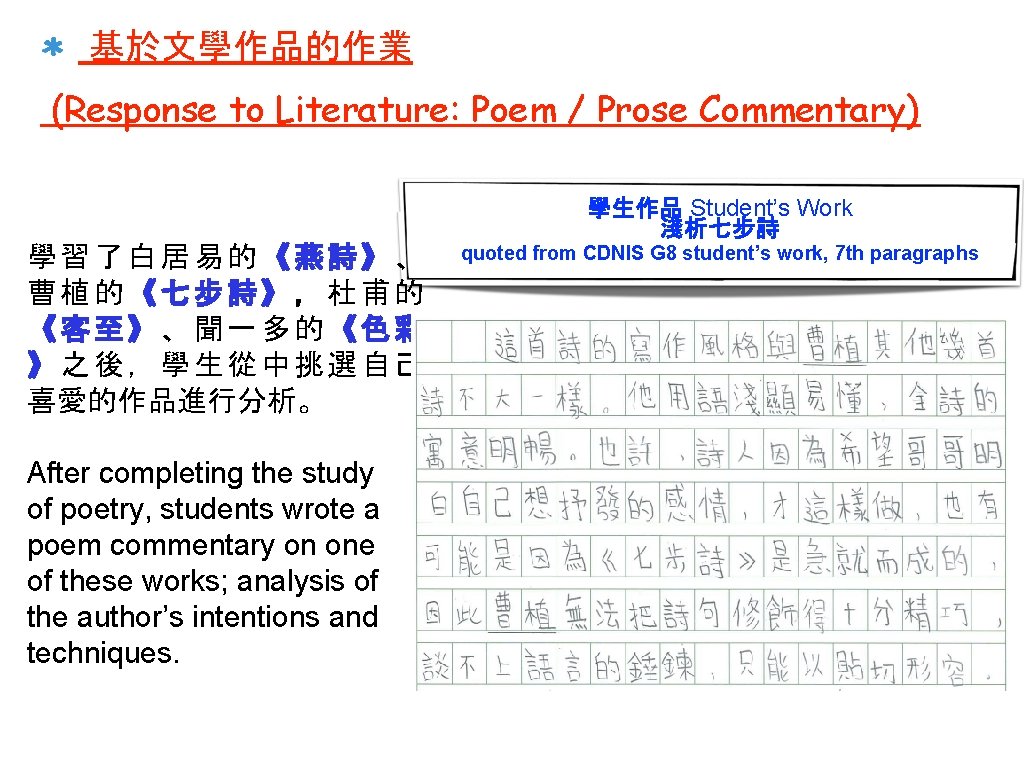
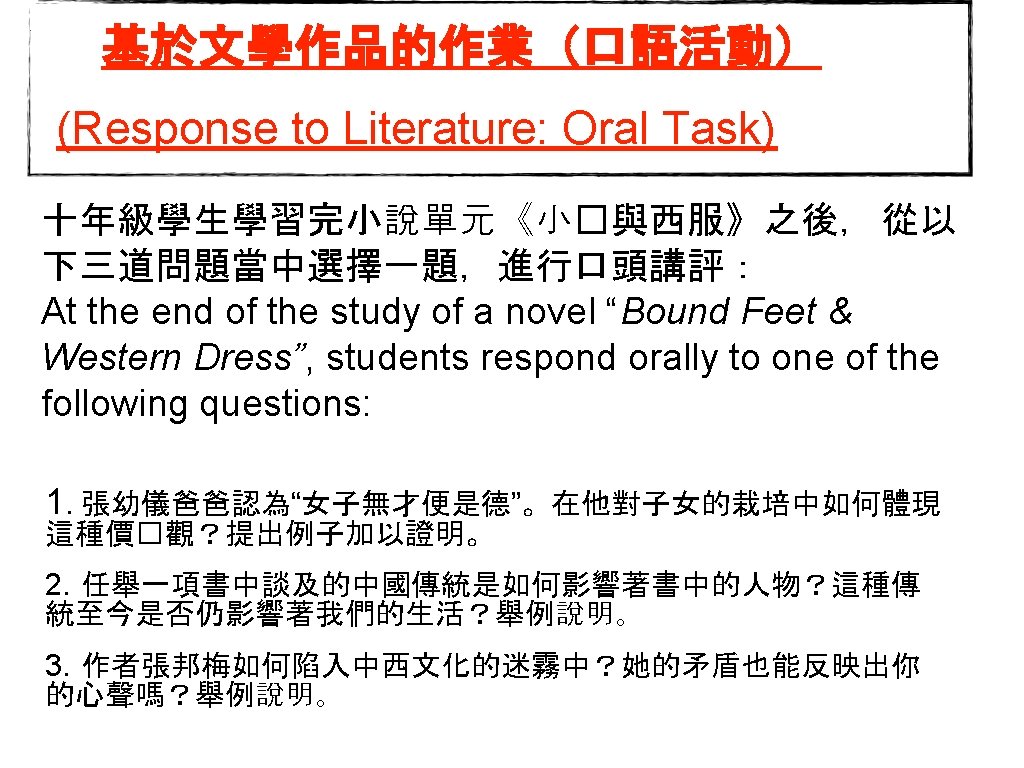
基於文學作品的作業 (Response to Literature: Poem / Prose Commentary) 學生作品 Student’s Work 淺析七步詩 學習了白居易的《燕詩》、 曹植的《七步詩》,杜甫的 《客至》、聞一多的《色彩 》之後,學生從中挑選自己 喜愛的作品進行分析。 After completing the study of poetry, students wrote a poem commentary on one of these works; analysis of the author’s intentions and techniques. quoted from CDNIS G 8 student’s work, 7 th paragraphs
Q&A
- Slides: 47