
Setting the Linac 4 RF cavities Part 1
- Slides: 18
Setting the Linac 4 RF cavities – Part 1 Jean-Baptiste Lallement – BE/ABP/HSL - for the Linac 4 team BE-OP shutdown lectures - 04/06/2020 - Linac 4 cavity phasing part 1 - JB Lallement 1
Linac 4 : A new injector for the CERN proton complex LINAC 2 LINAC 4 Protons H- 160 m. A 40 m. A 50 Me. V 160 Me. V 1 π. mm. mrad 0. 4 π. mm. mrad 100 μsec, 1 Hz 600 μsec, 1 Hz Since 1978 All new components No longitudinal matching at injection Fast chopping at 3 Me. V Energy painting BE-OP shutdown lectures - 04/06/2020 - Linac 4 cavity phasing part 1 - JB Lallement 2
The 3 Me. V pre-injector 45 ke. V H- ion source – Cesiated Development and optimisation on-going in a test stand. Delivering stably a 50 m. A beam (35 m. A within RFQ acceptance). 352. 2 MHz RFQ 3 m long structure. Designed and manufactured at CERN. Reliable operation since 2013. MEBT with fast beam chopper 3. 5 m long matching line from RFQ to DTL Fast and efficient beam chopping due to the combination of: Relatively low electric field applied between two plates. Kick transferred in the real space by a defocusing quadrupole. BE-OP shutdown lectures - 04/06/2020 - Linac 4 cavity phasing part 1 - JB Lallement 3
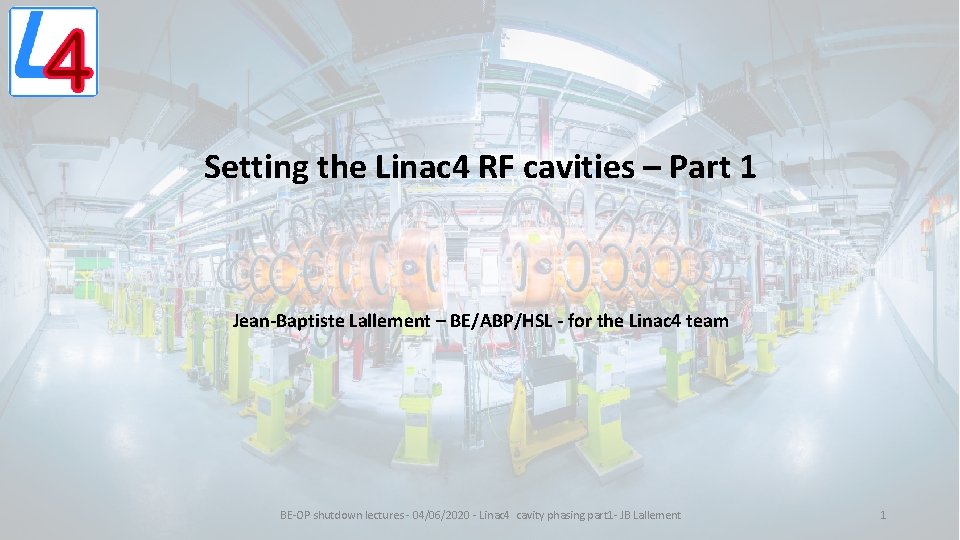
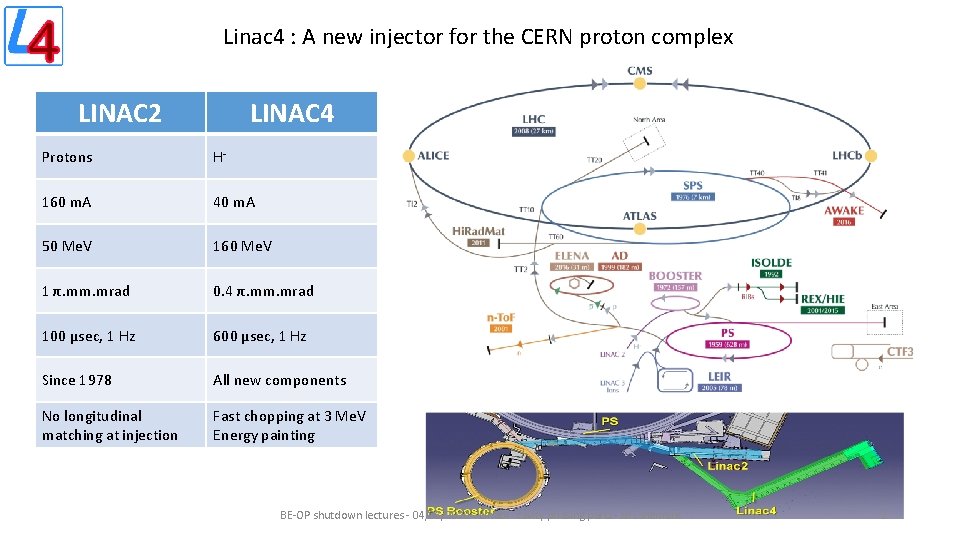
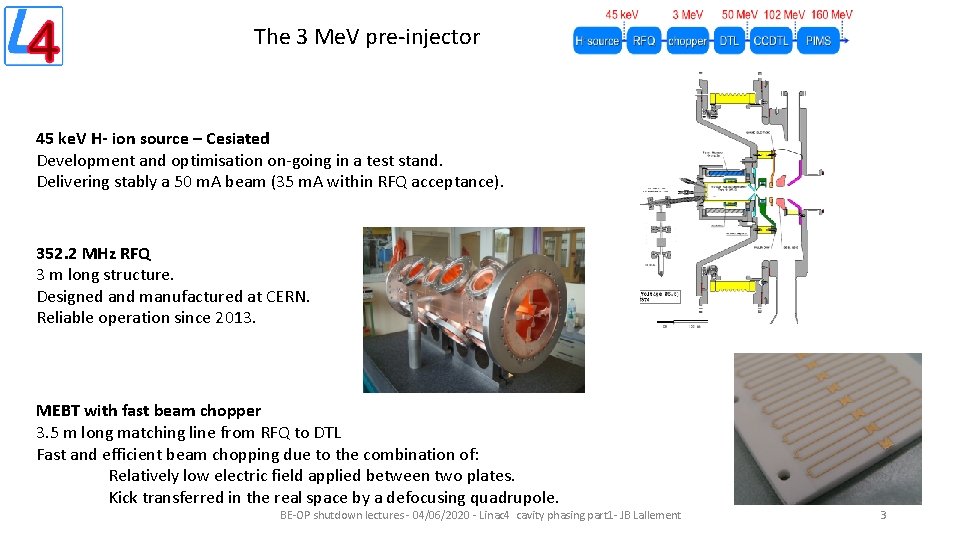
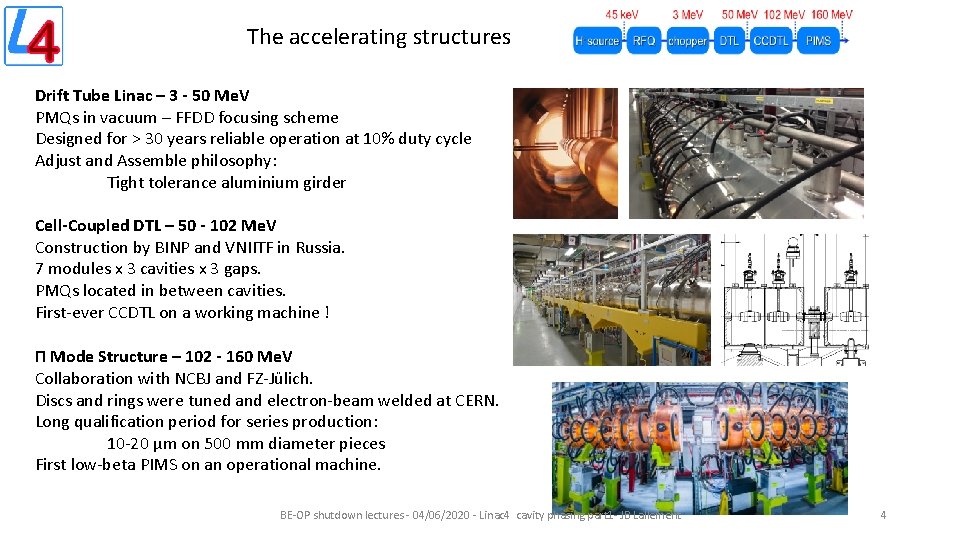
The accelerating structures Drift Tube Linac – 3 - 50 Me. V PMQs in vacuum – FFDD focusing scheme Designed for > 30 years reliable operation at 10% duty cycle Adjust and Assemble philosophy: Tight tolerance aluminium girder Cell-Coupled DTL – 50 - 102 Me. V Construction by BINP and VNIITF in Russia. 7 modules x 3 cavities x 3 gaps. PMQs located in between cavities. First-ever CCDTL on a working machine ! Π Mode Structure – 102 - 160 Me. V Collaboration with NCBJ and FZ-Jülich. Discs and rings were tuned and electron-beam welded at CERN. Long qualification period for series production: 10 -20 μm on 500 mm diameter pieces First low-beta PIMS on an operational machine. BE-OP shutdown lectures - 04/06/2020 - Linac 4 cavity phasing part 1 - JB Lallement 4
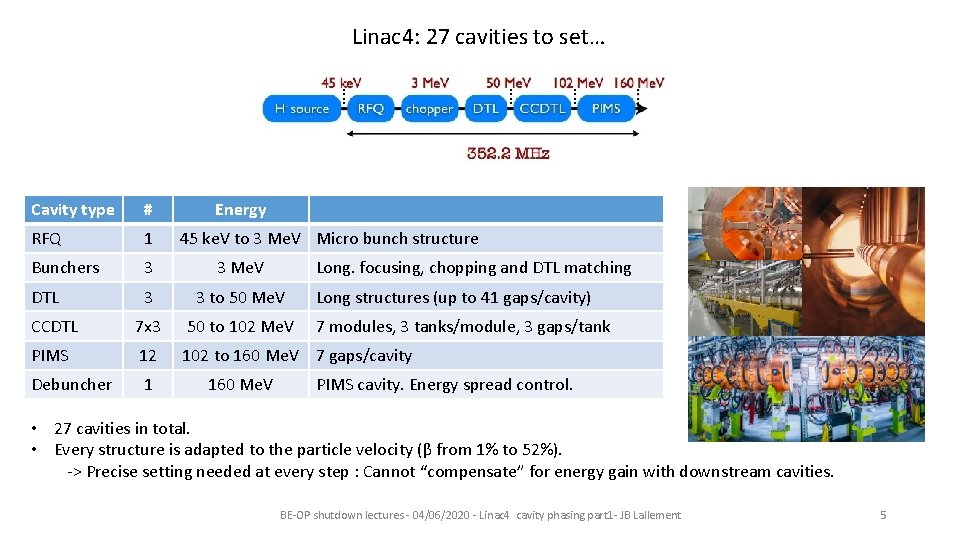
Linac 4: 27 cavities to set… Cavity type # Energy RFQ 1 Bunchers 3 3 Me. V DTL 3 3 to 50 Me. V CCDTL 7 x 3 50 to 102 Me. V PIMS 12 102 to 160 Me. V 7 gaps/cavity Debuncher 1 45 ke. V to 3 Me. V Micro bunch structure 160 Me. V Long. focusing, chopping and DTL matching Long structures (up to 41 gaps/cavity) 7 modules, 3 tanks/module, 3 gaps/tank PIMS cavity. Energy spread control. • 27 cavities in total. • Every structure is adapted to the particle velocity (β from 1% to 52%). -> Precise setting needed at every step : Cannot “compensate” for energy gain with downstream cavities. BE-OP shutdown lectures - 04/06/2020 - Linac 4 cavity phasing part 1 - JB Lallement 5
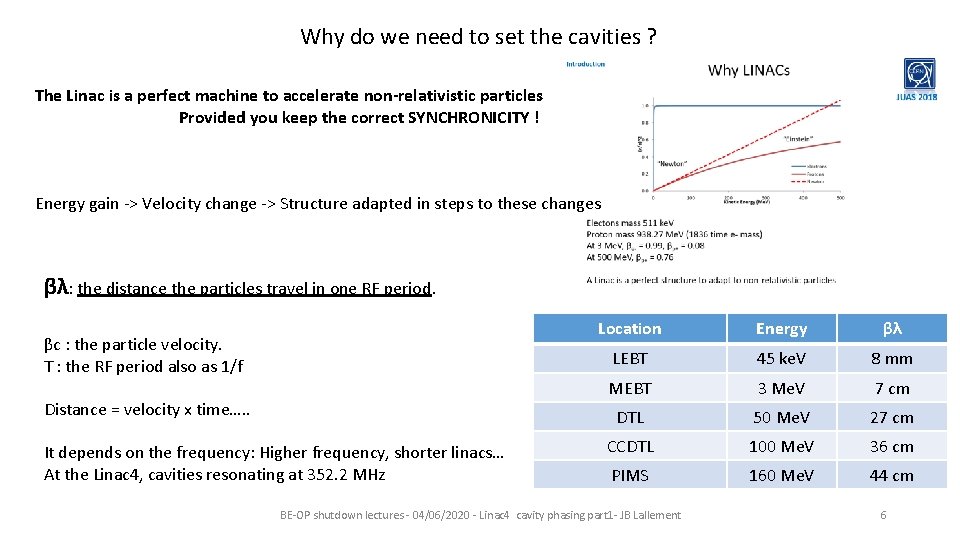
Why do we need to set the cavities ? The Linac is a perfect machine to accelerate non-relativistic particles Provided you keep the correct SYNCHRONICITY ! Energy gain -> Velocity change -> Structure adapted in steps to these changes βλ: the distance the particles travel in one RF period. βc : the particle velocity. T : the RF period also as 1/f Distance = velocity x time…. . It depends on the frequency: Higher frequency, shorter linacs… At the Linac 4, cavities resonating at 352. 2 MHz Location Energy βλ LEBT 45 ke. V 8 mm MEBT 3 Me. V 7 cm DTL 50 Me. V 27 cm CCDTL 100 Me. V 36 cm PIMS 160 Me. V 44 cm BE-OP shutdown lectures - 04/06/2020 - Linac 4 cavity phasing part 1 - JB Lallement 6
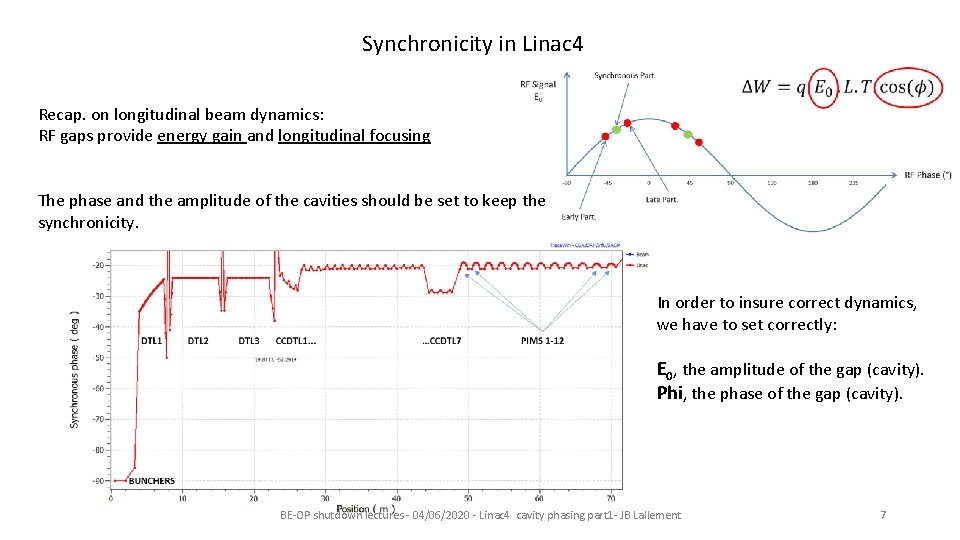
Synchronicity in Linac 4 Recap. on longitudinal beam dynamics: RF gaps provide energy gain and longitudinal focusing The phase and the amplitude of the cavities should be set to keep the synchronicity. In order to insure correct dynamics, we have to set correctly: E 0, the amplitude of the gap (cavity). Phi, the phase of the gap (cavity). BE-OP shutdown lectures - 04/06/2020 - Linac 4 cavity phasing part 1 - JB Lallement 7
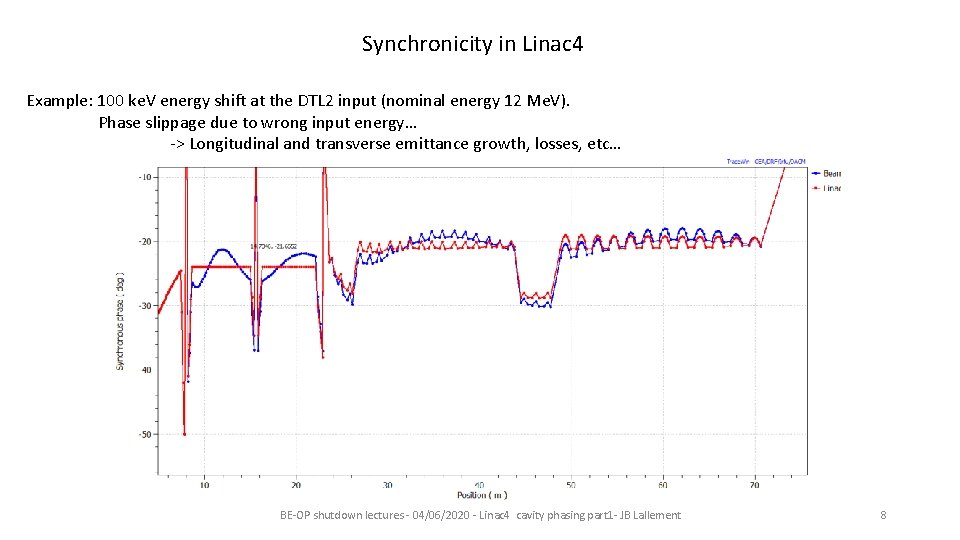
Synchronicity in Linac 4 Example: 100 ke. V energy shift at the DTL 2 input (nominal energy 12 Me. V). Phase slippage due to wrong input energy… -> Longitudinal and transverse emittance growth, losses, etc… BE-OP shutdown lectures - 04/06/2020 - Linac 4 cavity phasing part 1 - JB Lallement 8
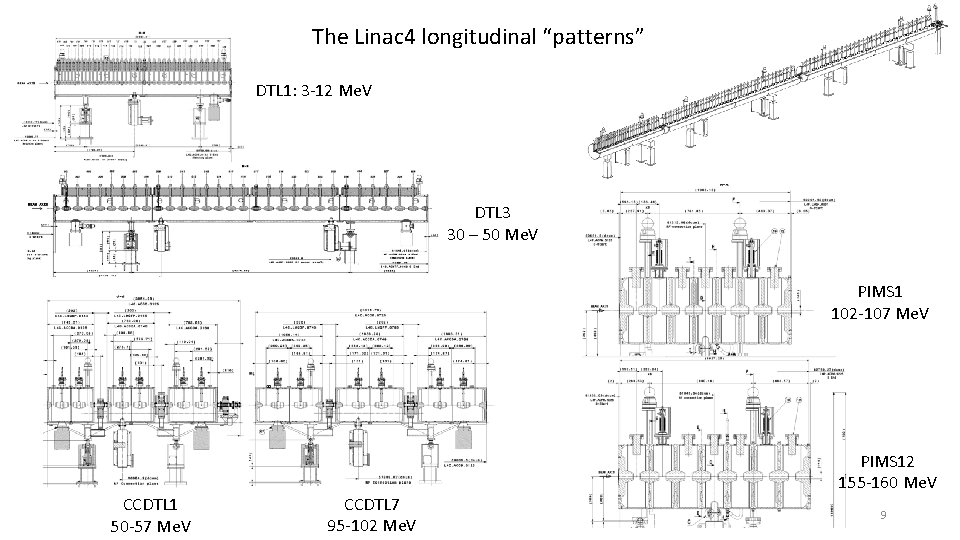
The Linac 4 longitudinal “patterns” DTL 1: 3 -12 Me. V DTL 3 30 – 50 Me. V PIMS 1 102 -107 Me. V CCDTL 1 50 -57 Me. V CCDTL 7 95 -102 Me. V PIMS 12 155 -160 Me. V 9
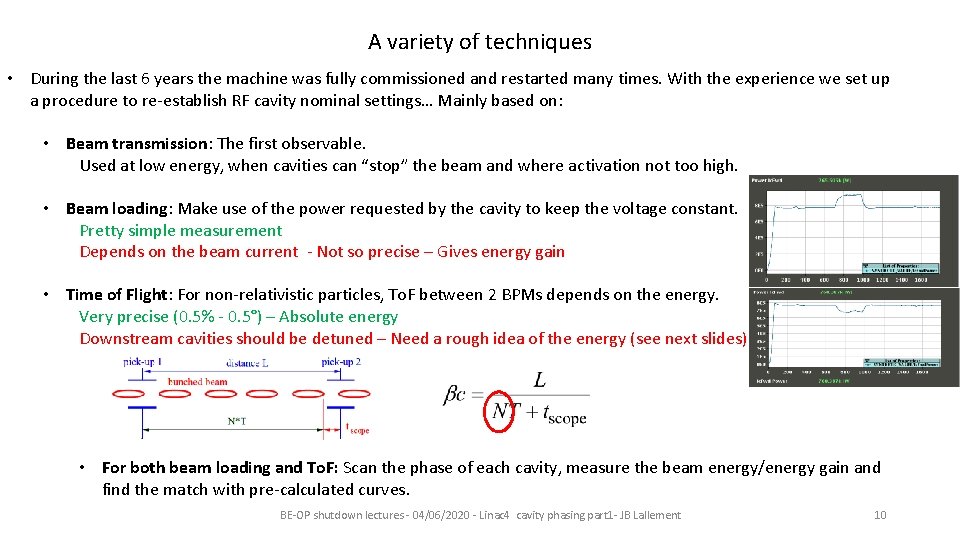
A variety of techniques • During the last 6 years the machine was fully commissioned and restarted many times. With the experience we set up a procedure to re-establish RF cavity nominal settings… Mainly based on: • Beam transmission: The first observable. Used at low energy, when cavities can “stop” the beam and where activation not too high. • Beam loading: Make use of the power requested by the cavity to keep the voltage constant. Pretty simple measurement Depends on the beam current - Not so precise – Gives energy gain • Time of Flight: For non-relativistic particles, To. F between 2 BPMs depends on the energy. Very precise (0. 5% - 0. 5°) – Absolute energy Downstream cavities should be detuned – Need a rough idea of the energy (see next slides) • For both beam loading and To. F: Scan the phase of each cavity, measure the beam energy/energy gain and find the match with pre-calculated curves. BE-OP shutdown lectures - 04/06/2020 - Linac 4 cavity phasing part 1 - JB Lallement 10
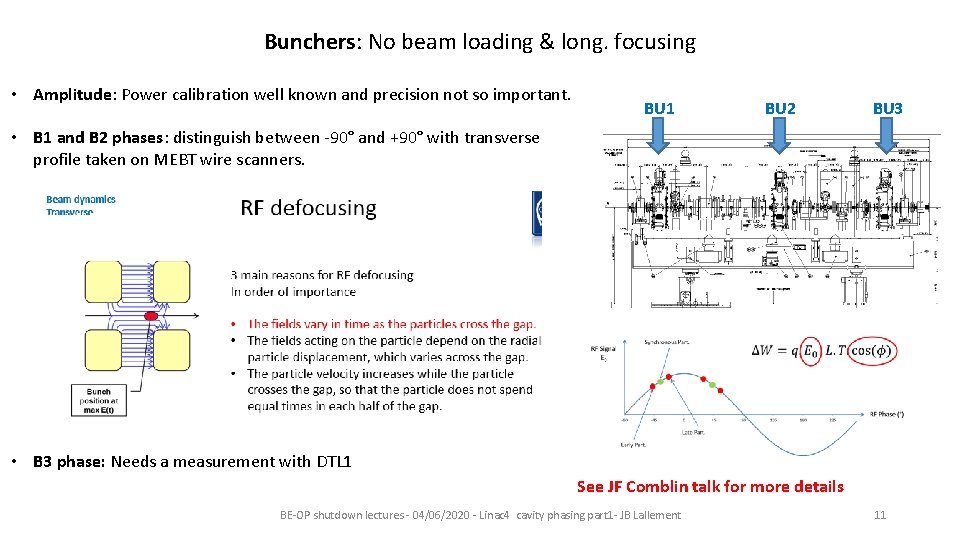
Bunchers: No beam loading & long. focusing • Amplitude: Power calibration well known and precision not so important. BU 1 BU 2 BU 3 • B 1 and B 2 phases: distinguish between -90° and +90° with transverse profile taken on MEBT wire scanners. • B 3 phase: Needs a measurement with DTL 1 See JF Comblin talk for more details BE-OP shutdown lectures - 04/06/2020 - Linac 4 cavity phasing part 1 - JB Lallement 11
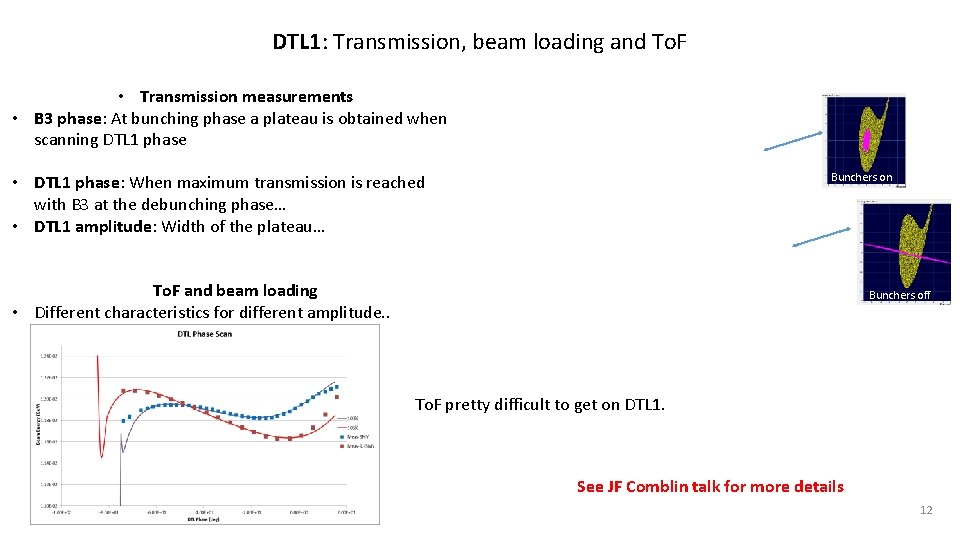
DTL 1: Transmission, beam loading and To. F • Transmission measurements • B 3 phase: At bunching phase a plateau is obtained when scanning DTL 1 phase Bunchers on • DTL 1 phase: When maximum transmission is reached with B 3 at the debunching phase… • DTL 1 amplitude: Width of the plateau… To. F and beam loading • Different characteristics for different amplitude. . Bunchers off To. F pretty difficult to get on DTL 1. See JF Comblin talk for more details 12
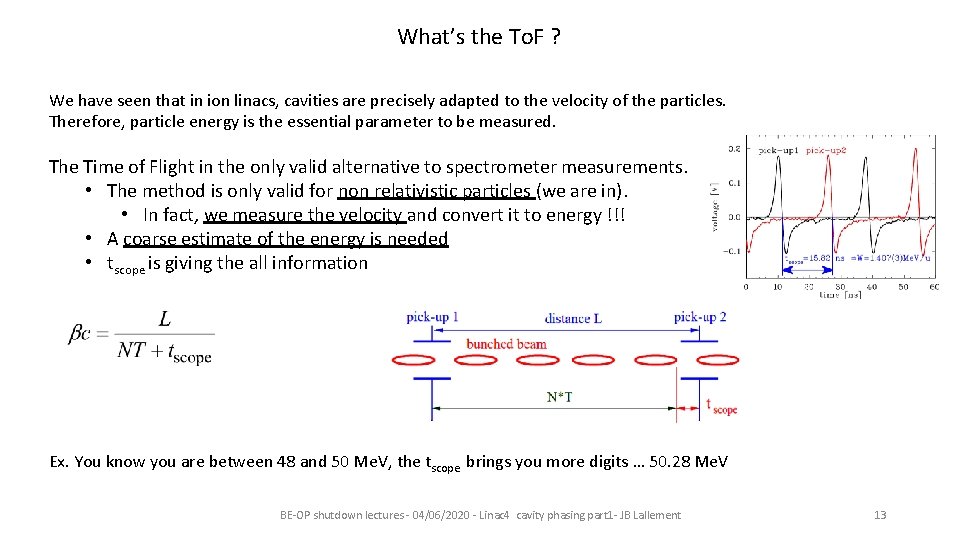
What’s the To. F ? We have seen that in ion linacs, cavities are precisely adapted to the velocity of the particles. Therefore, particle energy is the essential parameter to be measured. The Time of Flight in the only valid alternative to spectrometer measurements. • The method is only valid for non relativistic particles (we are in). • In fact, we measure the velocity and convert it to energy !!! • A coarse estimate of the energy is needed • tscope is giving the all information Ex. You know you are between 48 and 50 Me. V, the tscope brings you more digits … 50. 28 Me. V BE-OP shutdown lectures - 04/06/2020 - Linac 4 cavity phasing part 1 - JB Lallement 13
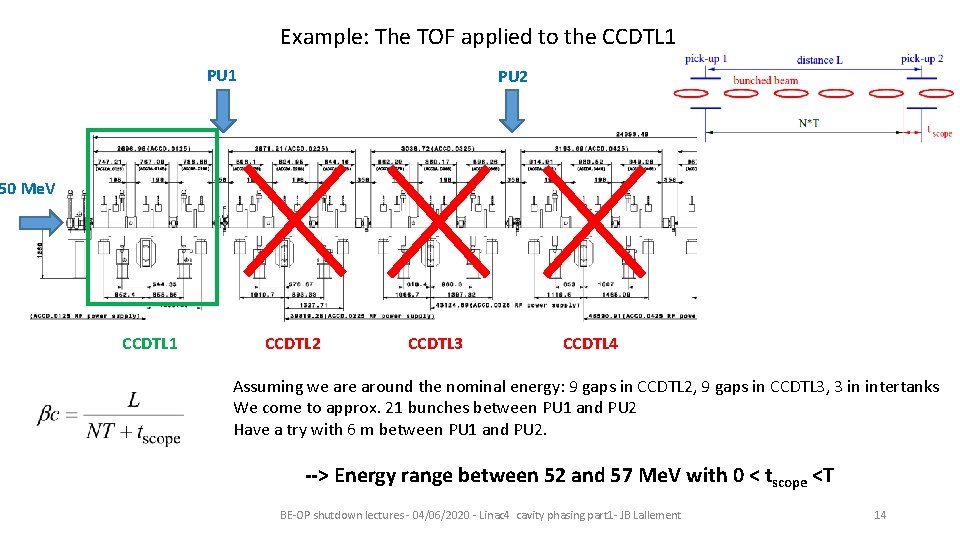
Example: The TOF applied to the CCDTL 1 PU 2 50 Me. V CCDTL 1 CCDTL 2 CCDTL 3 CCDTL 4 Assuming we around the nominal energy: 9 gaps in CCDTL 2, 9 gaps in CCDTL 3, 3 in intertanks We come to approx. 21 bunches between PU 1 and PU 2 Have a try with 6 m between PU 1 and PU 2. --> Energy range between 52 and 57 Me. V with 0 < tscope <T BE-OP shutdown lectures - 04/06/2020 - Linac 4 cavity phasing part 1 - JB Lallement 14
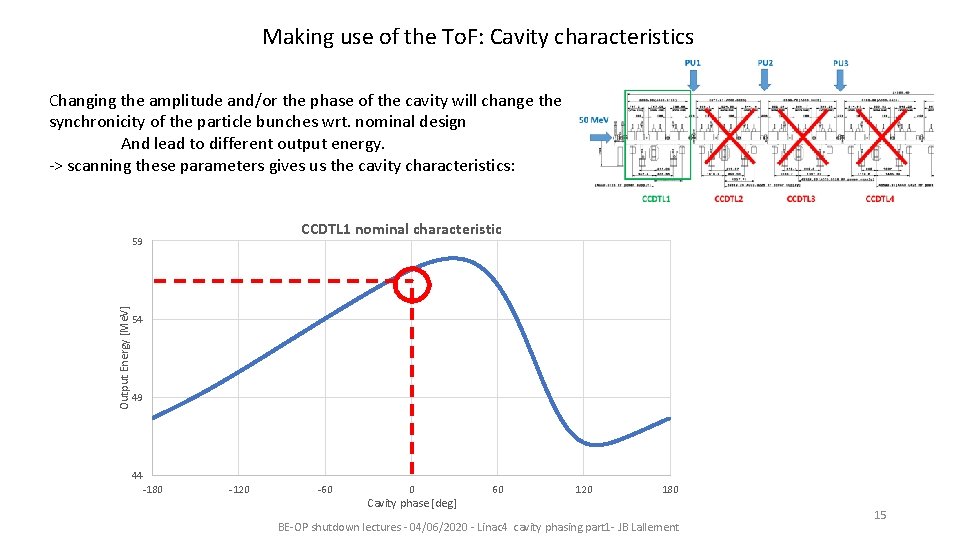
Making use of the To. F: Cavity characteristics Changing the amplitude and/or the phase of the cavity will change the synchronicity of the particle bunches wrt. nominal design And lead to different output energy. -> scanning these parameters gives us the cavity characteristics: CCDTL 1 nominal characteristic Output Energy [Me. V] 59 54 49 44 -180 -120 -60 0 Cavity phase [deg] 60 120 180 BE-OP shutdown lectures - 04/06/2020 - Linac 4 cavity phasing part 1 - JB Lallement 15
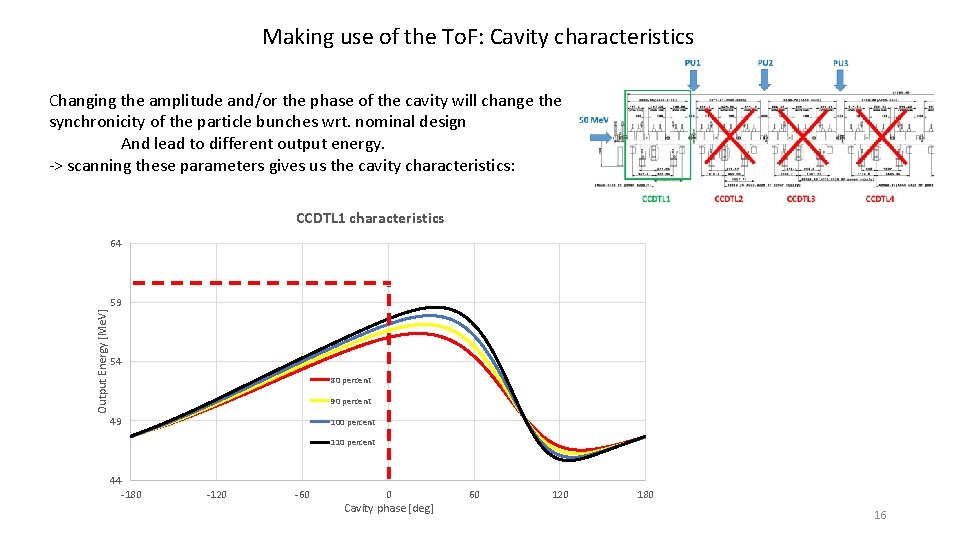
Making use of the To. F: Cavity characteristics Changing the amplitude and/or the phase of the cavity will change the synchronicity of the particle bunches wrt. nominal design And lead to different output energy. -> scanning these parameters gives us the cavity characteristics: CCDTL 1 characteristics 64 Output Energy [Me. V] 59 54 80 percent 90 percent 49 100 percent 110 percent 44 -180 -120 -60 0 Cavity phase [deg] 60 120 180 16
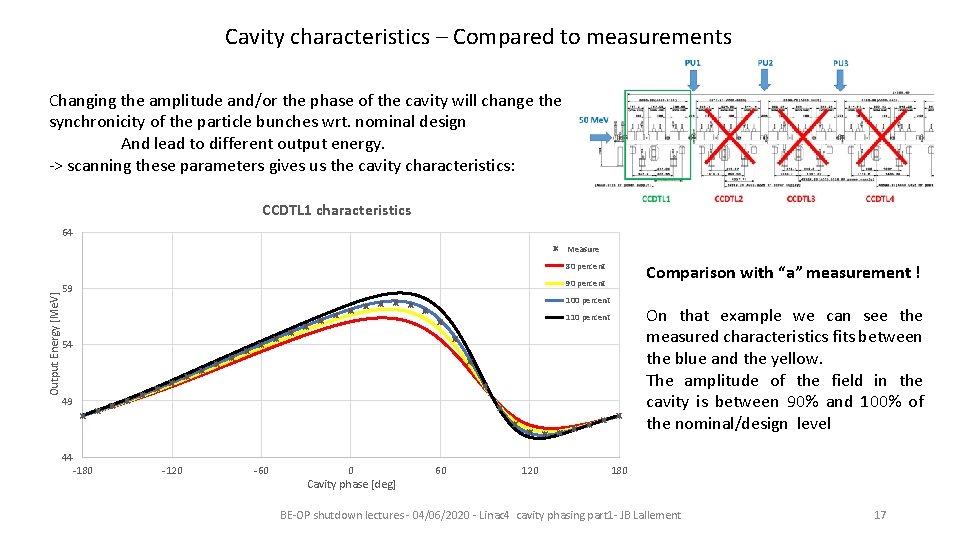
Cavity characteristics – Compared to measurements Changing the amplitude and/or the phase of the cavity will change the synchronicity of the particle bunches wrt. nominal design And lead to different output energy. -> scanning these parameters gives us the cavity characteristics: CCDTL 1 characteristics 64 Measure Output Energy [Me. V] 80 percent Comparison with “a” measurement ! 90 percent 59 100 percent On that example we can see the measured characteristics fits between the blue and the yellow. The amplitude of the field in the cavity is between 90% and 100% of the nominal/design level 110 percent 54 49 44 -180 -120 -60 0 Cavity phase [deg] 60 120 180 BE-OP shutdown lectures - 04/06/2020 - Linac 4 cavity phasing part 1 - JB Lallement 17
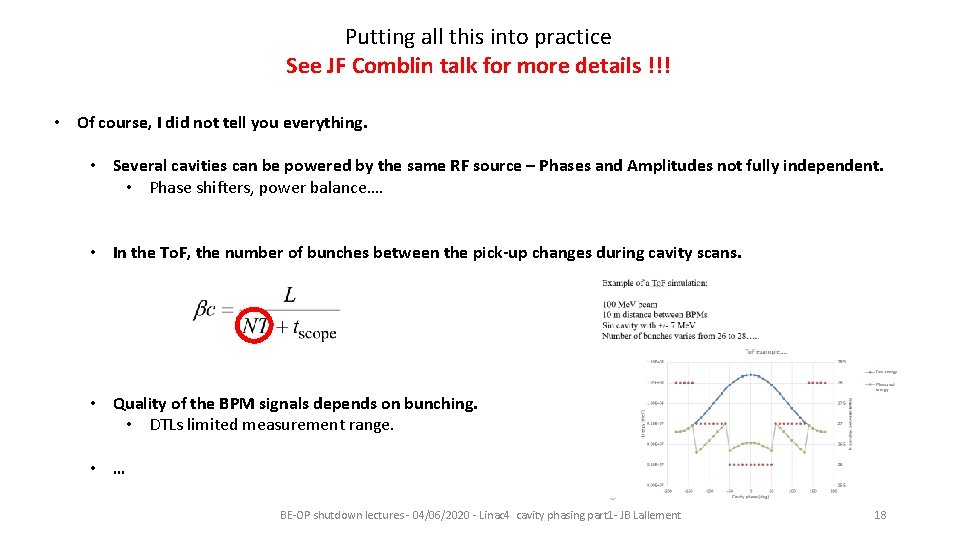
Putting all this into practice See JF Comblin talk for more details !!! • Of course, I did not tell you everything. • Several cavities can be powered by the same RF source – Phases and Amplitudes not fully independent. • Phase shifters, power balance…. • In the To. F, the number of bunches between the pick-up changes during cavity scans. • Quality of the BPM signals depends on bunching. • DTLs limited measurement range. • … BE-OP shutdown lectures - 04/06/2020 - Linac 4 cavity phasing part 1 - JB Lallement 18