
Setting Objectives and Providing Feedback Module 13 14
Setting Objectives and Providing Feedback Module 13 -14 pg. 175 - 185 Shelita Mc. Cadney Teacher Quality Team 601. 863. 6399
Research says… Setting Objectives and Providing Feedback *Yields a 23 percentile gain
i. Believe, i. Practice How do I set objectives in my classroom now? What is my purpose for setting objectives in the classroom? What questions do I do to communicate classroom objectives to my students? What q do I h uestions ave a settin bout g objec tives classr in my oom? 3
Marzano says… Student learn most efficiently when they know the goals or objectives of a specific lesson or learning activity. Students need a target for their learning. The objectives can be written many different ways.
Recommendations for classroom practice 1. Setting objectives that are not too specific 2. Personalizing objectives 3. Communicating objectives 4. Negotiating contracts
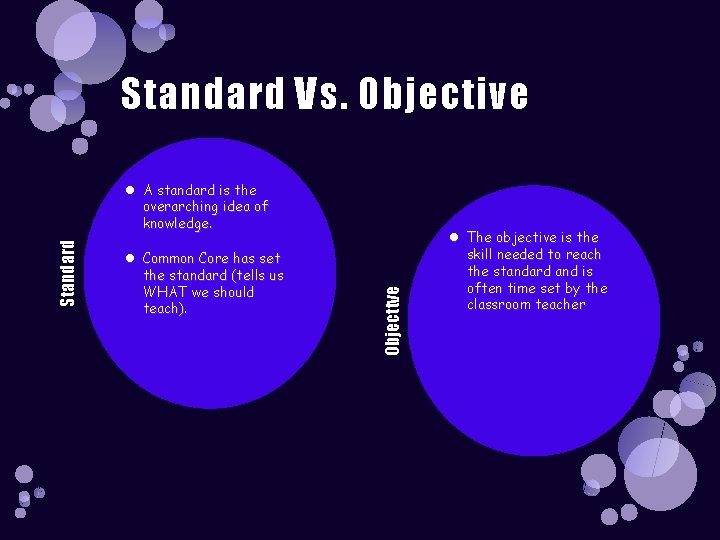
Standard Vs. Objective Common Core has set the standard (tells us WHAT we should teach). Objecttve Standard A standard is the overarching idea of knowledge. The objective is the skill needed to reach the standard and is often time set by the classroom teacher
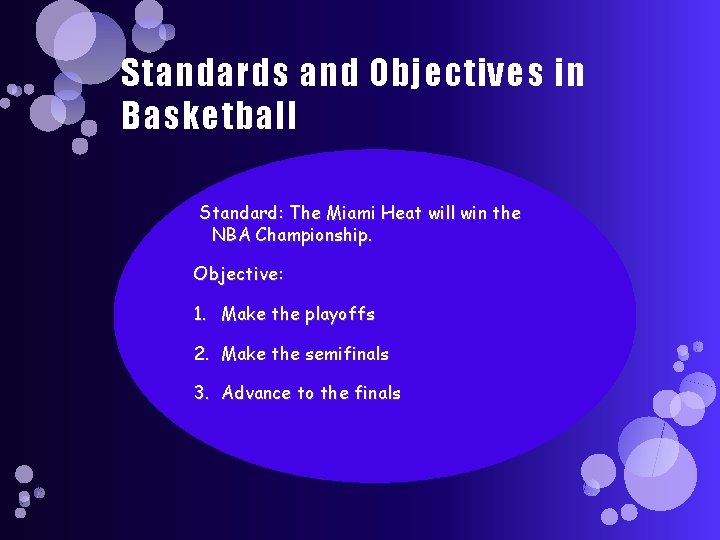
Standards and Objectives in Basketball Standard: The Miami Heat will win the NBA Championship. Objective: 1. Make the playoffs 2. Make the semifinals 3. Advance to the finals
Setting Objectives That Are Not Too Specific Objective should not constrain student learning Objective should be clear and concise in a flurry of rich learning Objective should give student focus
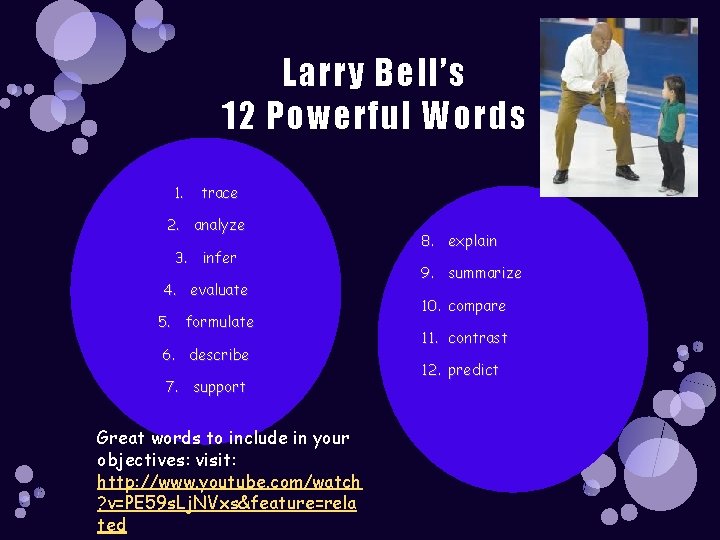
Larry Bell’s 12 Powerful Words 1. trace 2. analyze 3. infer 4. evaluate 5. formulate 6. describe 7. support Great words to include in your objectives: visit: http: //www. youtube. com/watch ? v=PE 59 s. Lj. NVxs&feature=rela ted 8. explain 9. summarize 10. compare 11. contrast 12. predict
Example CCS N-Q. 2 Define appropriate quantities for the purpose of descriptive modeling Objective: Given a contextual problem find the critical path using a digraph (N-Q. 2) Objective: Analyze and interpret results; make decisions based on results. (N-Q. 2) Objective: Given contextual problem find the shortest path using a dijkstra’s algorithm. (N-Q. 2)
Example CCS RL. 1. 1 – Ask and answer questions about key details in a text. Objective: Evaluate, compare and contrast characters within the text. (RL. 1. 1) Objective: Analyze the story problem and provide and explain possible solutions (RL. 1. 1)
Classroom Implications HCSD requires each to visibly post : 1. Classroom OBJECTIVE 2. Common Core reference or complete STANDARD written out in full text.
Personalizing Objectives Students define their own interests within a topic. Requires a flexible objective Ex: Understands basic ideas about networked computers …. . I want to know how the modem works I want to write more effective introductions with a clear, concise thesis statements. I want use good paragraph form in my writing and use strong supporting details
Communicate Objectives “ Communicating objectives effectively is probably just as important as designing them” Visible Written in student language Student time for copying the objective Communicate objectives to the parent (fig. 13. 3)
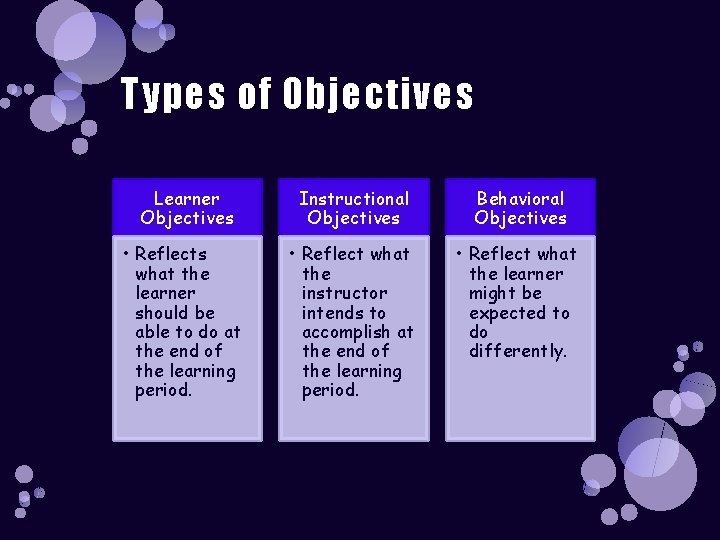
Types of Objectives Learner Objectives • Reflects what the learner should be able to do at the end of the learning period. Instructional Objectives Behavioral Objectives • Reflect what the instructor intends to accomplish at the end of the learning period. • Reflect what the learner might be expected to do differently.
Negotiate Contracts “Contracting with students to attain a specific goals is a variation on goal setting. ” Gives the student a great deal of control over learning Individualizes goal for learning (student action plan) May meet with students every other week to check student progress. Ex: teacher may contract with a student to study vocabulary words 20 minutes per week.
Essential Questions Does the objective reflect the goal of the lesson today? What will the learner be able to do at the end of the activity? Is my objective precise, observable, and measurable? It is realistically obtainable? *Do my activities and use of time align with my objective?
Assessing the Impact Rubric Impact on student (fig 13. 5) pg. 181 Rubric Assessing myself as a facilitator (13. 6) pg. 182
Providing Feedback Module 14 pg. 185
After 8, 000 studies. . It should be given specifically. “The most powerful single modification that enhances achievement is feedback”
Recommendations for Classroom Practice Using criterion-referenced feedback and explanations Using feedback from assessments Engaging students in peer feedback Ask students to self-assess
Why feedback Gap analysis – the disparity between the target and the realities
Focus on specific types of knowledge and skill Help students understand how well they are doing compared to the performance standard Give an explanation how the student exceeds, meets, or misses the standard How do I rank relative to the performance of other students. STAR Reports (Class Summary, Test Record) HCSD…. Feedback Should… Criterion Referenced Feedback and Explanations MCT 2 results Rubrics (fig. 14. 3, pg. 188)
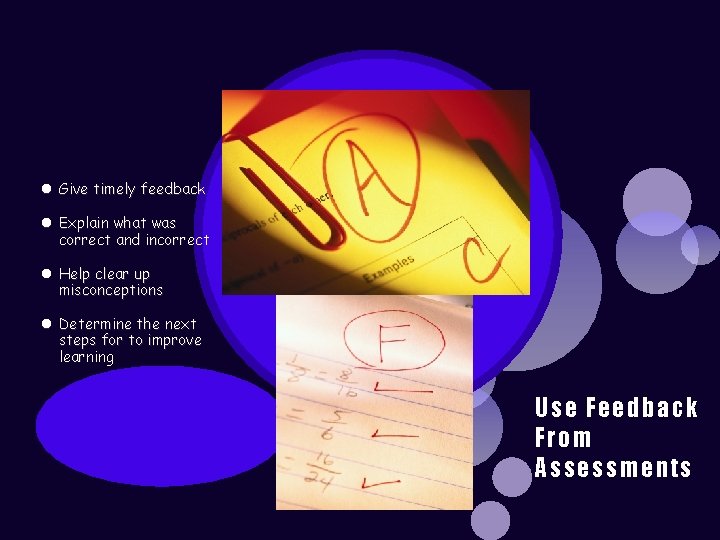
Give timely feedback Explain what was correct and incorrect Help clear up misconceptions Determine the next steps for to improve learning Use Feedback From Assessments
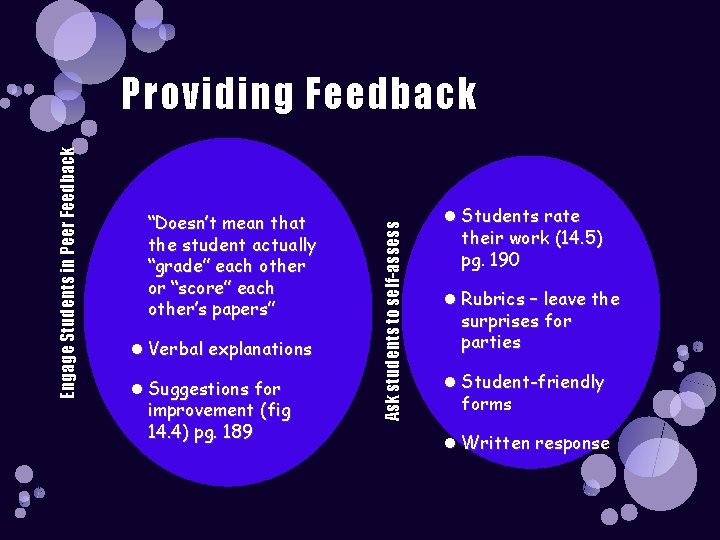
“Doesn’t mean that the student actually “grade” each other or “score” each other’s papers” Verbal explanations Suggestions for improvement (fig 14. 4) pg. 189 Ask students to self-assess Engage Students in Peer Feedback Providing Feedback Students rate their work (14. 5) pg. 190 Rubrics – leave the surprises for parties Student-friendly forms Written response
Strategies for feedback Give students opportunities to improve, try again, and get it right. Engage students in review of their own work and others. Give students time to absorb new ideas. Tests are more effective as opportunities for learning if a day has gone by between learning experiences and the test. Use rubrics. Rubrics provide criteria against which students can compare their learning. Involve students in developing rubrics. Rubrics help students focus their effort.
Assessing the Impact Rubric Impact on student (fig 14. 7 and 14. 8) pg. 194 Rubric Assessing myself as a facilitator (14. 9 and 14. 10) pg. 185

Fighting the Invisible Tigers: Be a Better You
Let go of activities that bog you down. 80/20 Rule Give your best where you have your best to give. Outsource your 80% what you are not good at…yet Model from others – see what others or doing in your building or youtube/google Focus on 20% of activities that produce 80% of the value.
- Slides: 29