
SETTING NORMS FOR AND MANAGING THE PROCESS OF
- Slides: 16
SETTING NORMS FOR AND MANAGING THE PROCESS OF EVALUATION OF JUDICIAL OFFICERS
THE NEED FOR EVALUATION • To identify and establish institutional objectives • To try and attain such goals • To set standards of performance based on the purpose of the institution and its desired objectives
MANAGEMENT OF EVALUATION (INSTITUTIONAL) • To focus on purpose and goals • To make course corrections • To plan systemic changes
INDIVIDUAL EVALUATION • To promote performance • To check, arrest and weed out nonperformance
USE TO THE INSTITUTION • Help identify merit based on institutional parameters • Help detect personal deficiencies for correction • Help discover the rotten apples
MODE OF EVALUATION • Set the parameters • Determine the modes for assessment • Arrive at the parameters and the method of assessment in consultation with judicial officers
THE PRESENT SYSTEM • • Unit method Judgments appraisal Complaints Subjective personal perception
THE DESIRED PROCESS • Based more on objectivity or, at least, subjective satisfaction of objective criteria • Based more on promoting merit and good quality • A process in which comparison would be possible • Demerit should be dealt with in punishments, unless used as a tool in comparison
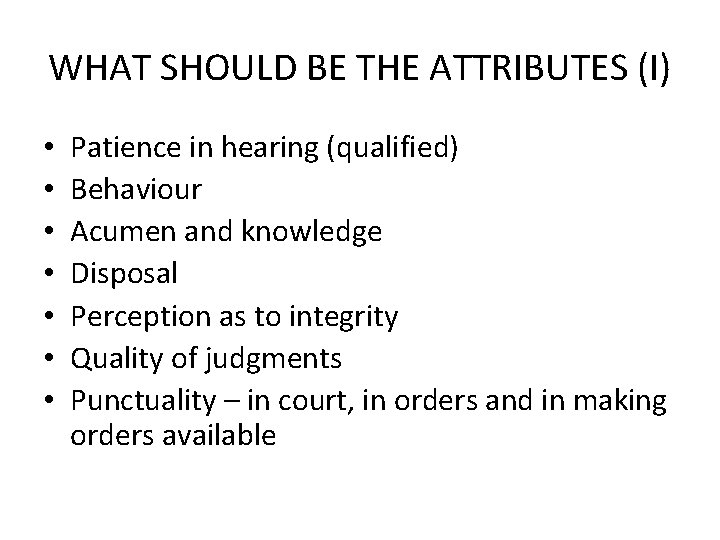
WHAT SHOULD BE THE ATTRIBUTES (I) • • Patience in hearing (qualified) Behaviour Acumen and knowledge Disposal Perception as to integrity Quality of judgments Punctuality – in court, in orders and in making orders available
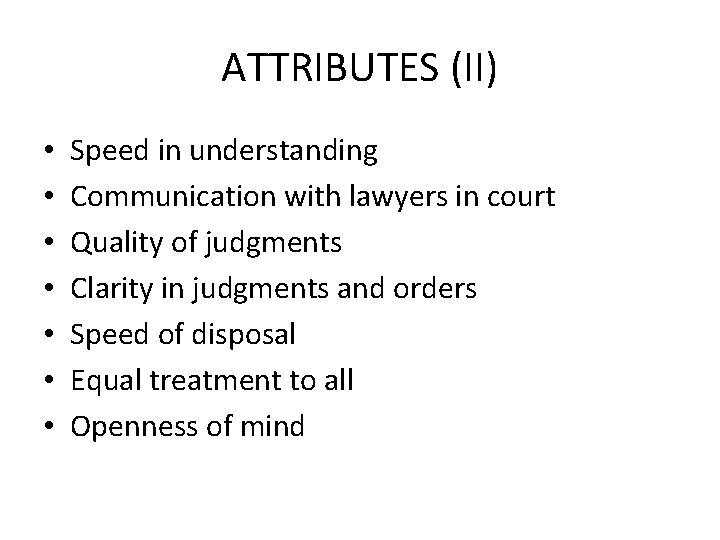
ATTRIBUTES (II) • • Speed in understanding Communication with lawyers in court Quality of judgments Clarity in judgments and orders Speed of disposal Equal treatment to all Openness of mind
SUGGESTIONS • • Qualities and attitudes Functional skills Domain skills Knowledge
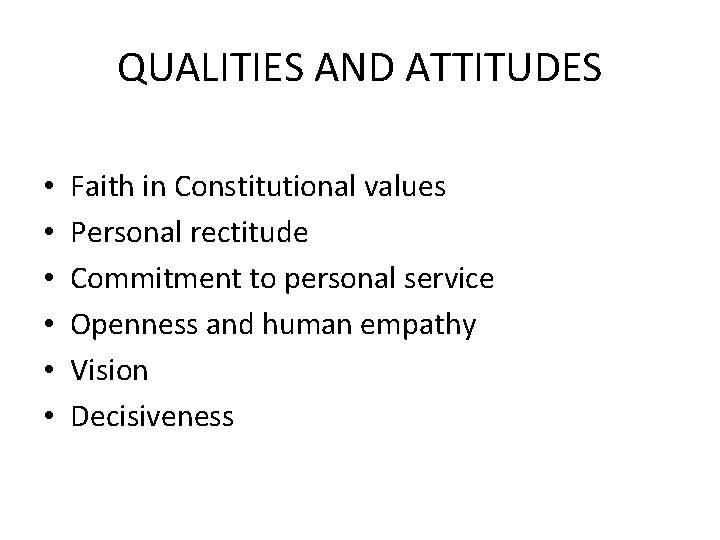
QUALITIES AND ATTITUDES • • • Faith in Constitutional values Personal rectitude Commitment to personal service Openness and human empathy Vision Decisiveness
FUNCTIONAL SKILLS Listening, including active listening Reading Speaking Writing Analysis – logic and reasoning English language and communication (including non-verbal communication) • Dispute settlement, negotiation, bargaining abilities • • •
DOMAIN SKILLS • Appreciation of facts • Finding and appreciation of the law • Judging and decision-making; responsiveness in judging • Managing the adjudication process; teamwork abilities • Judgment writing • Administrative abilities • Foreseeing the impact of judicial decisions
KNOWLEDGE • Basic legal knowledge • Awareness of key social challenges, including the history of the Constitution • Jurisprudence • Development of the laws
FINALLY • Identification of who will assess • Allocation of weights to the different parameters • Use of technology both in evaluation and in managing the process of evaluation