
SETTING CREATIVE ARTS EXAM PAPERS Lead Teacher training
- Slides: 60
SETTING CREATIVE ARTS EXAM PAPERS Lead Teacher training 21 February 2014
SUMMATIVE ASSESSMENT • Assessment of learning • Key purpose is to determine and report on attainment of skills, content and concepts at a given time
CONTENT, CONCEPTS & SKILLS IN THE TOPICS PRACTICAL WRITTEN • 2 D • 3 D • Terminology • Art elements • Design principles • Symbolic language in art • Role of the artist in society • Reflection QUESTION PAPER TOTAL GRADE 9: 50 MARKS; GRADE 8: 40; GRADE 7: 25
FRAMEWORK
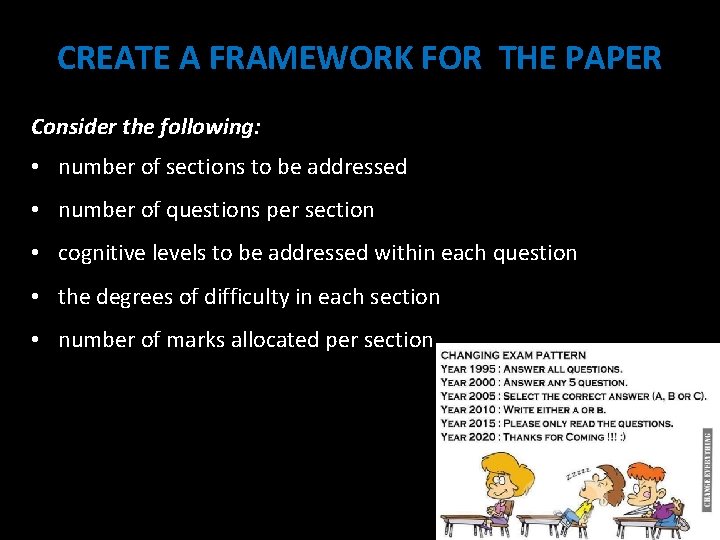
CREATE A FRAMEWORK FOR THE PAPER Consider the following: • number of sections to be addressed • number of questions per section • cognitive levels to be addressed within each question • the degrees of difficulty in each section • number of marks allocated per section
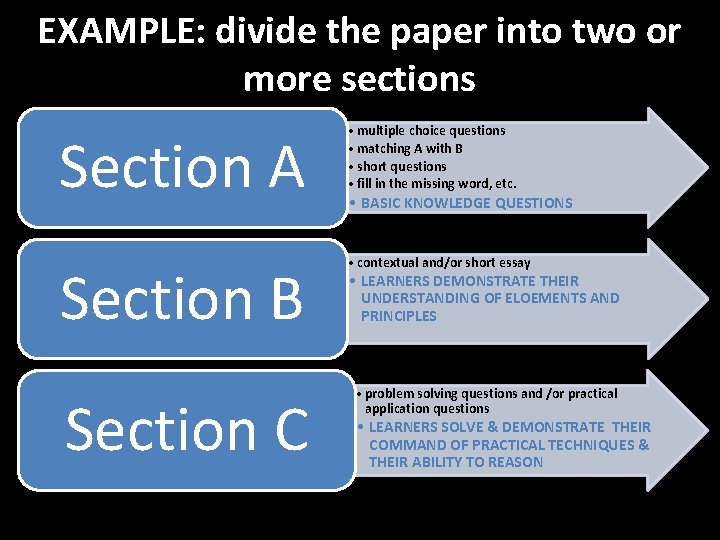
EXAMPLE: divide the paper into two or more sections Section A • multiple choice questions • matching A with B • short questions • fill in the missing word, etc. Section B • contextual and/or short essay Section C • BASIC KNOWLEDGE QUESTIONS • LEARNERS DEMONSTRATE THEIR UNDERSTANDING OF ELOEMENTS AND PRINCIPLES • problem solving questions and /or practical application questions • LEARNERS SOLVE & DEMONSTRATE THEIR COMMAND OF PRACTICAL TECHNIQUES & THEIR ABILITY TO REASON
COGNITIVE LEVELS
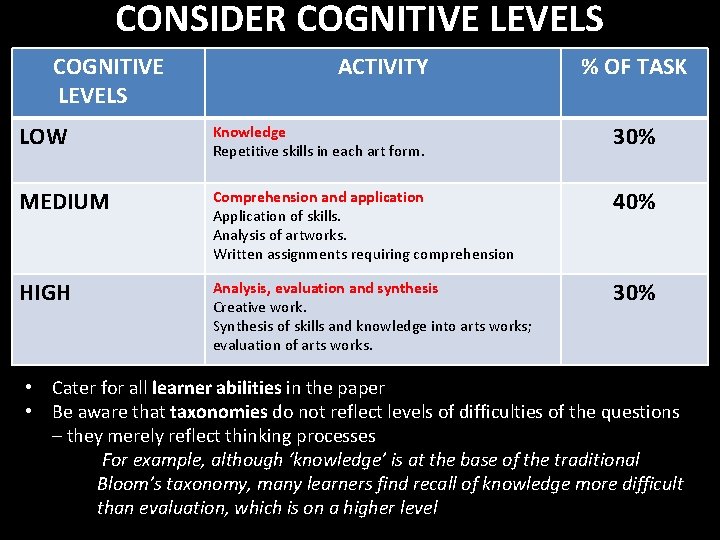
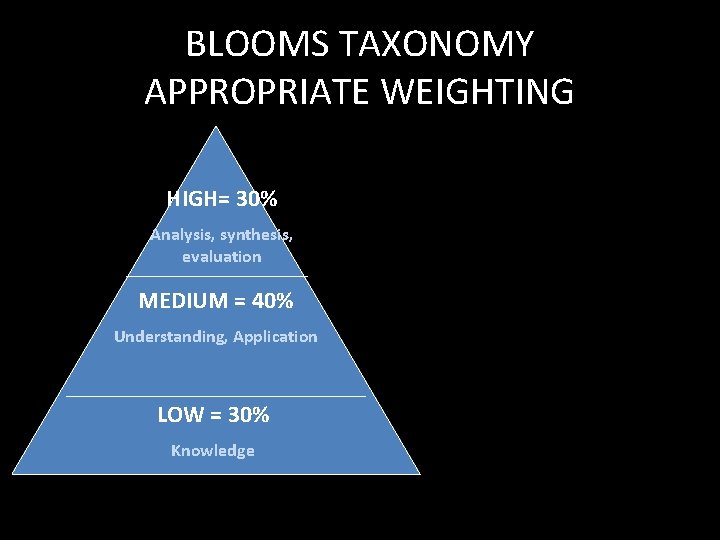
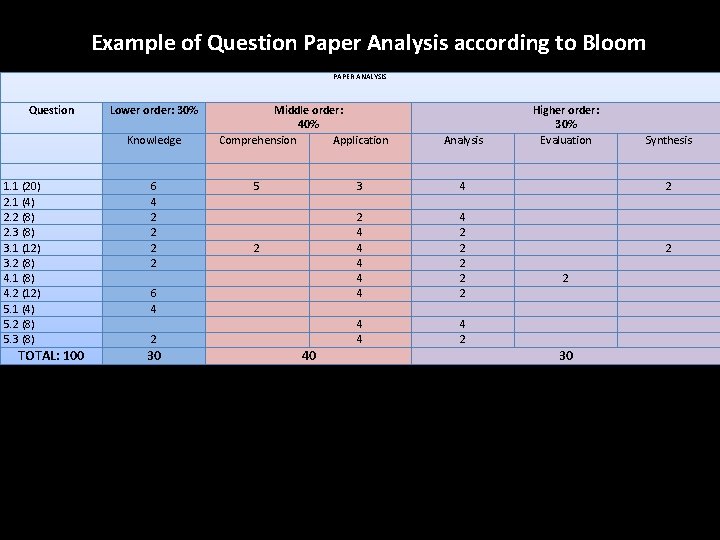
CONSIDER COGNITIVE LEVELS ACTIVITY % OF TASK LOW Knowledge Repetitive skills in each art form. 30% MEDIUM Comprehension and application Application of skills. Analysis of artworks. Written assignments requiring comprehension 40% HIGH Analysis, evaluation and synthesis Creative work. Synthesis of skills and knowledge into arts works; evaluation of arts works. 30% • Cater for all learner abilities in the paper • Be aware that taxonomies do not reflect levels of difficulties of the questions – they merely reflect thinking processes For example, although ‘knowledge’ is at the base of the traditional Bloom’s taxonomy, many learners find recall of knowledge more difficult than evaluation, which is on a higher level
BLOOMS TAXONOMY APPROPRIATE WEIGHTING HIGH= 30% Analysis, synthesis, evaluation MEDIUM = 40% Understanding, Application LOW = 30% Knowledge
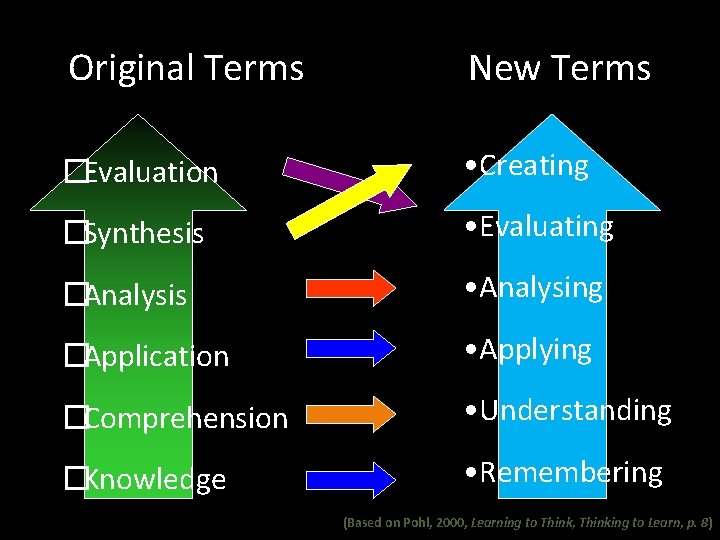
Original Terms New Terms �Evaluation • Creating �Synthesis • Evaluating �Analysis • Analysing �Application • Applying �Comprehension • Understanding �Knowledge • Remembering (Based on Pohl, 2000, Learning to Think, Thinking to Learn, p. 8)
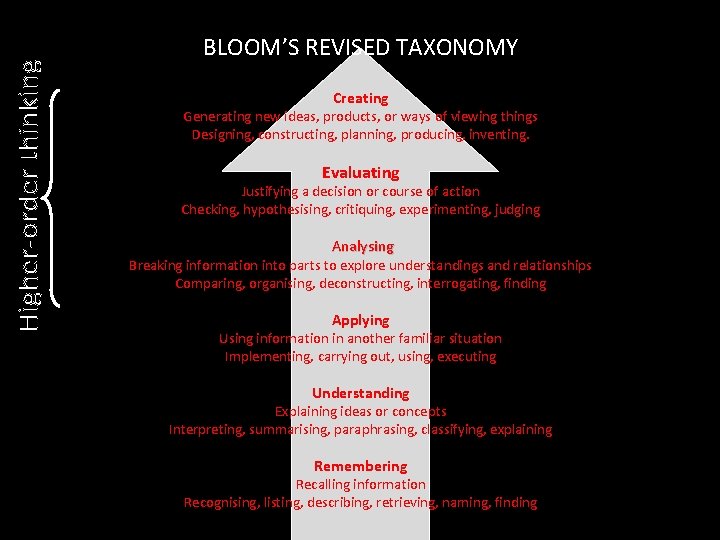
BLOOM’S REVISED TAXONOMY Creating Generating new ideas, products, or ways of viewing things Designing, constructing, planning, producing, inventing. Evaluating Justifying a decision or course of action Checking, hypothesising, critiquing, experimenting, judging Analysing Breaking information into parts to explore understandings and relationships Comparing, organising, deconstructing, interrogating, finding Applying Using information in another familiar situation Implementing, carrying out, using, executing Understanding Explaining ideas or concepts Interpreting, summarising, paraphrasing, classifying, explaining Remembering Recalling information Recognising, listing, describing, retrieving, naming, finding
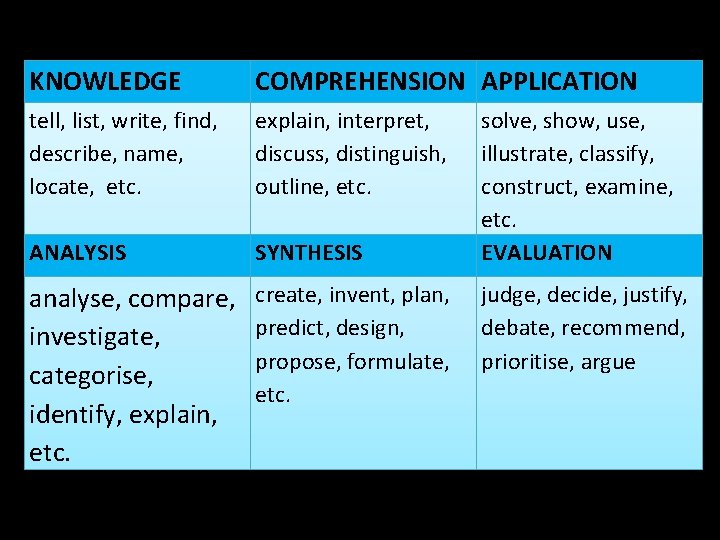
KNOWLEDGE COMPREHENSION APPLICATION tell, list, write, find, describe, name, locate, etc. explain, interpret, discuss, distinguish, outline, etc. ANALYSIS SYNTHESIS analyse, compare, investigate, categorise, identify, explain, etc. create, invent, plan, predict, design, propose, formulate, etc. solve, show, use, illustrate, classify, construct, examine, etc. EVALUATION judge, decide, justify, debate, recommend, prioritise, argue
Example of Question Paper Analysis according to Bloom PAPER ANALYSIS Question Lower order: 30% Knowledge 1. 1 (20) 2. 1 (4) 2. 2 (8) 2. 3 (8) 3. 1 (12) 3. 2 (8) 4. 1 (8) 4. 2 (12) 5. 1 (4) 5. 2 (8) 5. 3 (8) TOTAL: 100 6 4 2 2 Middle order: 40% Comprehension Application 5 2 6 4 2 30 40 Analysis 3 4 2 4 4 4 2 2 2 4 4 4 2 Higher order: 30% Evaluation Synthesis 2 2 2 30
DIFFERENT KINDS OF QUESTIONS
BRAINSTORM DIFFERENT KINDS OF QUESTIONS WHY? To cater for: different learning styles multiple intelligences different cognitive levels different levels of difficulty To allow learners to demonstrate different competencies and skills. A lack of variation may advantage some learners and disadvantage others.
EXAMPLE: Include a variety of question types • • • Factual recall questions Contextual questions – visual, auditory and written texts Practical application questions Critical evaluation questions Visual questions Closed questions Open-ended questions Problem solving questions Creative, explorative questions Provocative questions Real-life scenarios
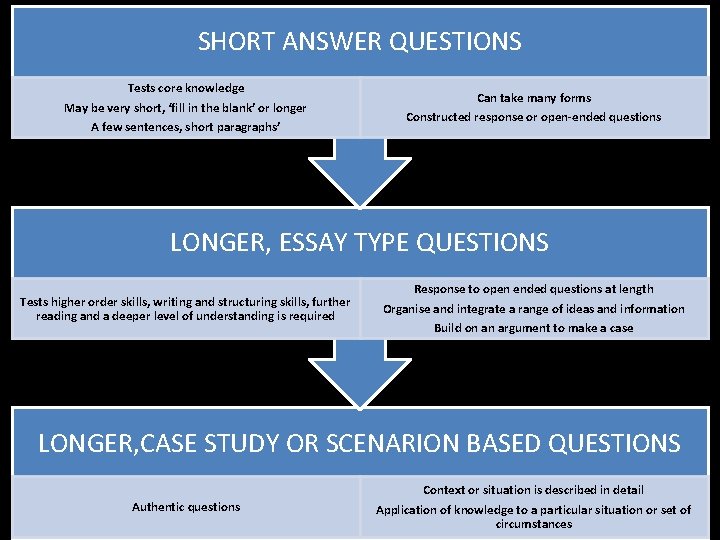
SHORT ANSWER QUESTIONS Tests core knowledge May be very short, ‘fill in the blank’ or longer A few sentences, short paragraphs’ Can take many forms Constructed response or open-ended questions LONGER, ESSAY TYPE QUESTIONS Tests higher order skills, writing and structuring skills, further reading and a deeper level of understanding is required Response to open ended questions at length Organise and integrate a range of ideas and information Build on an argument to make a case LONGER, CASE STUDY OR SCENARION BASED QUESTIONS Authentic questions Context or situation is described in detail Application of knowledge to a particular situation or set of circumstances
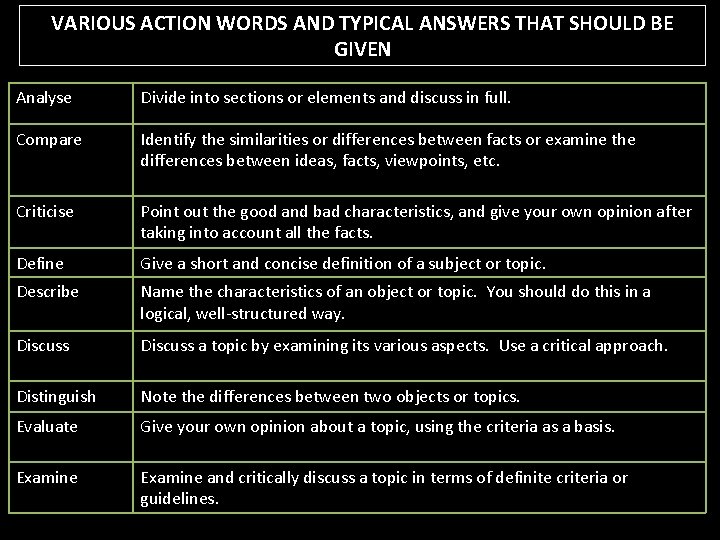
VARIOUS ACTION WORDS AND TYPICAL ANSWERS THAT SHOULD BE GIVEN Analyse Divide into sections or elements and discuss in full. Compare Identify the similarities or differences between facts or examine the differences between ideas, facts, viewpoints, etc. Criticise Point out the good and bad characteristics, and give your own opinion after taking into account all the facts. Define Give a short and concise definition of a subject or topic. Describe Name the characteristics of an object or topic. You should do this in a logical, well-structured way. Discuss a topic by examining its various aspects. Use a critical approach. Distinguish Note the differences between two objects or topics. Evaluate Give your own opinion about a topic, using the criteria as a basis. Examine and critically discuss a topic in terms of definite criteria or guidelines.
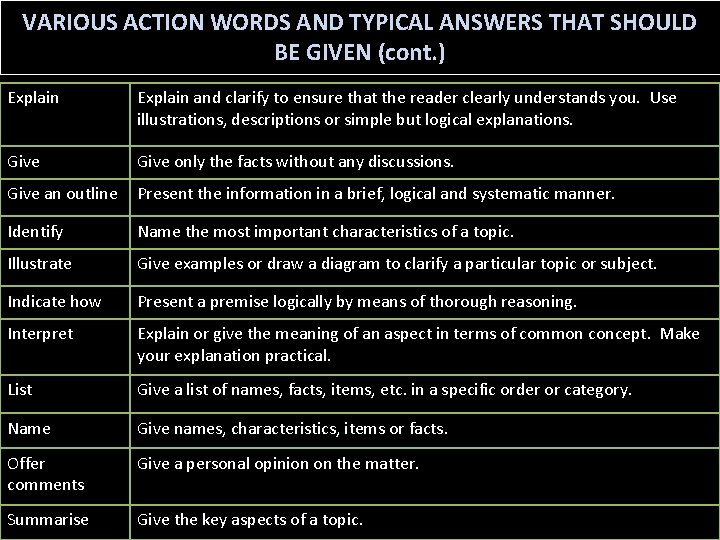
VARIOUS ACTION WORDS AND TYPICAL ANSWERS THAT SHOULD BE GIVEN (cont. ) Explain and clarify to ensure that the reader clearly understands you. Use illustrations, descriptions or simple but logical explanations. Give only the facts without any discussions. Give an outline Present the information in a brief, logical and systematic manner. Identify Name the most important characteristics of a topic. Illustrate Give examples or draw a diagram to clarify a particular topic or subject. Indicate how Present a premise logically by means of thorough reasoning. Interpret Explain or give the meaning of an aspect in terms of common concept. Make your explanation practical. List Give a list of names, facts, items, etc. in a specific order or category. Name Give names, characteristics, items or facts. Offer comments Give a personal opinion on the matter. Summarise Give the key aspects of a topic.
VISUAL SOURCES
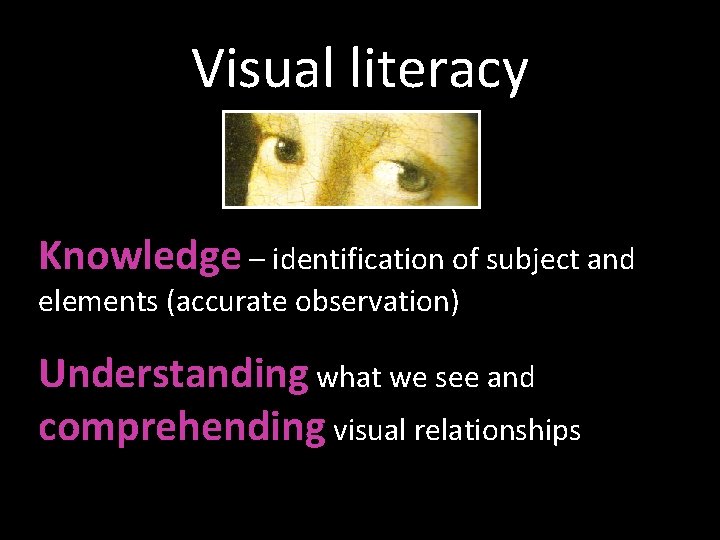
Visual literacy Knowledge – identification of subject and elements (accurate observation) Understanding what we see and comprehending visual relationships
Visual art is about visual images. The visual Teaching visual literacy skills image is the most important aspect of teaching Visual Culture Studies. Start with ‘basics’ – an understanding of the formal elements and principles of design Learners need to develop the skill of ‘reading’ images
A guide or ‘recipe’ to look at visual images 1. BASIC INFORMATION – label information 2. DESCRIPTION – what can be seen? 3. DISCUSSION – analysis 4. MEANING/MESSAGE – context
Make your learners used to writing about unseen artworks. Choose the artwork with care. ?
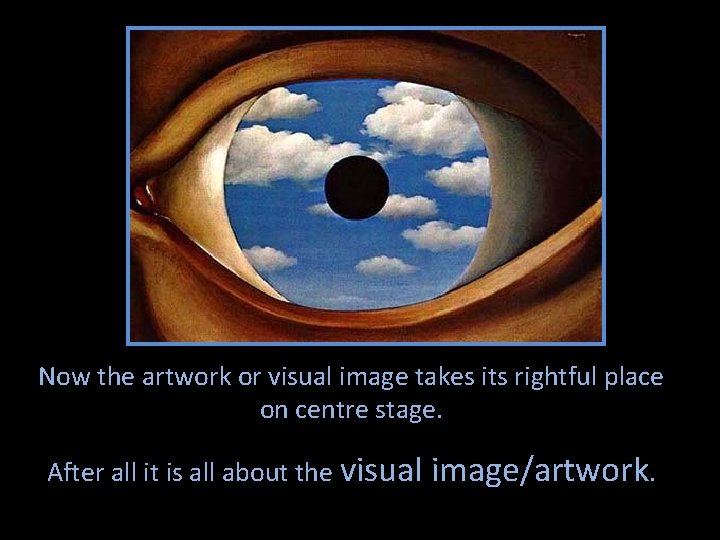
Now the artwork or visual image takes its rightful place on centre stage. After all it is all about the visual image/artwork.
TECHNICAL REQUIREMENTS
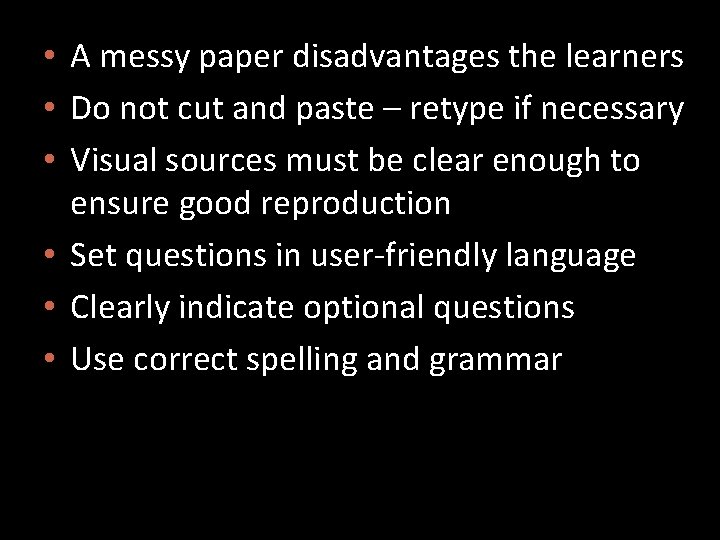
• A messy paper disadvantages the learners • Do not cut and paste – retype if necessary • Visual sources must be clear enough to ensure good reproduction • Set questions in user-friendly language • Clearly indicate optional questions • Use correct spelling and grammar
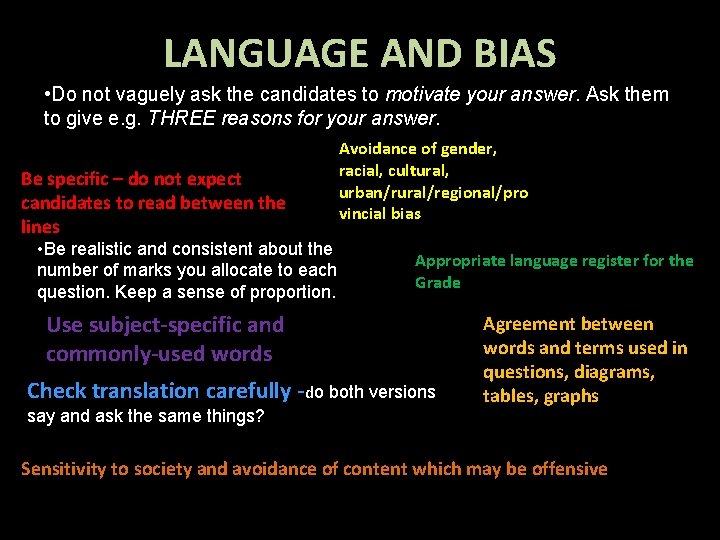
LANGUAGE AND BIAS • Do not vaguely ask the candidates to motivate your answer. Ask them to give e. g. THREE reasons for your answer. Be specific – do not expect candidates to read between the lines • Be realistic and consistent about the number of marks you allocate to each question. Keep a sense of proportion. Avoidance of gender, racial, cultural, urban/rural/regional/pro vincial bias Appropriate language register for the Grade Use subject-specific and commonly-used words Check translation carefully -do both versions say and ask the same things? Agreement between words and terms used in questions, diagrams, tables, graphs Sensitivity to society and avoidance of content which may be offensive
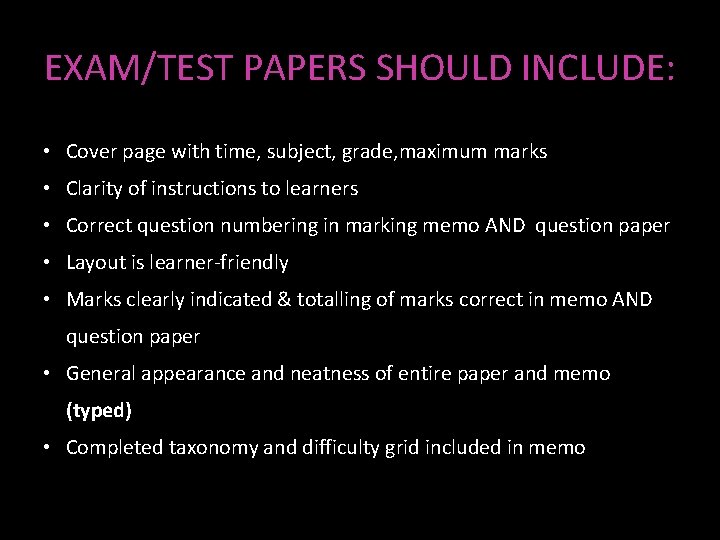
EXAM/TEST PAPERS SHOULD INCLUDE: • Cover page with time, subject, grade, maximum marks • Clarity of instructions to learners • Correct question numbering in marking memo AND question paper • Layout is learner-friendly • Marks clearly indicated & totalling of marks correct in memo AND question paper • General appearance and neatness of entire paper and memo (typed) • Completed taxonomy and difficulty grid included in memo
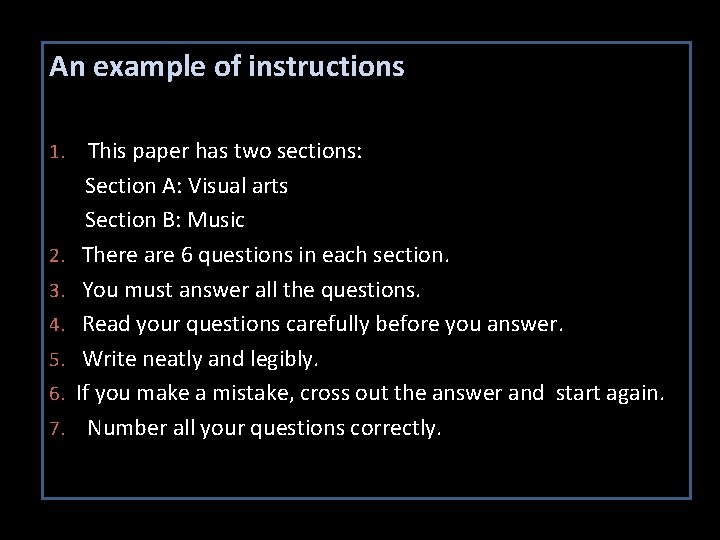
INSTRUCTIONS TO LEARNERS An example of instructions TRUCTIONS TO LEARNERS: 1. . This paper has two sections: 2. 3. 4. 5. 6. 7. Section A: Visual arts Section B: Music There are 6 questions in each section. You must answer all the questions. Read your questions carefully before you answer. Write neatly and legibly. If you make a mistake, cross out the answer and start again. Number all your questions correctly.
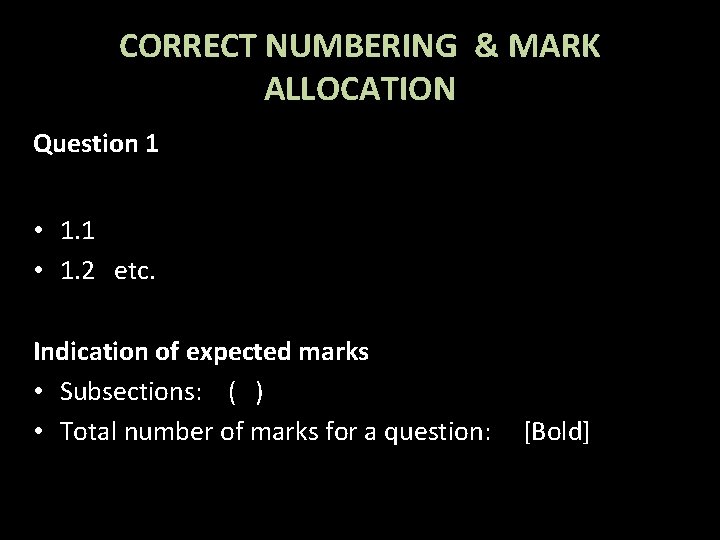
CORRECT NUMBERING & MARK ALLOCATION Question 1 • 1. 1 • 1. 2 etc. Indication of expected marks • Subsections: ( ) • Total number of marks for a question: [Bold]
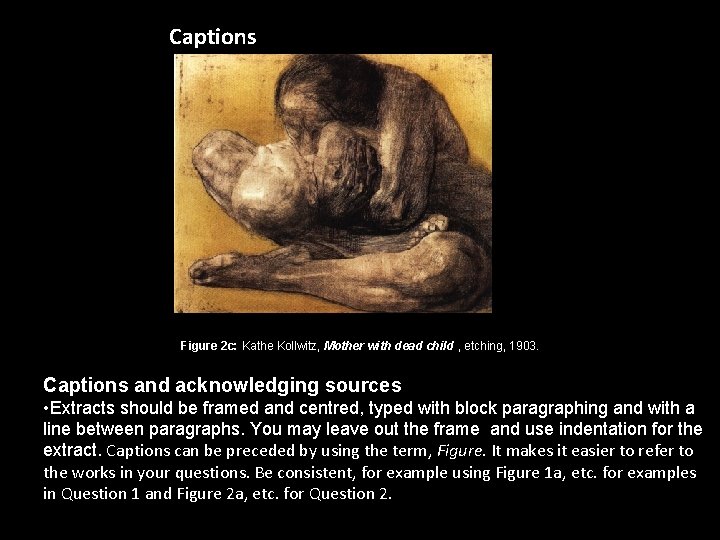
Captions Figure 2 c: Kathe Kollwitz, Mother with dead child , etching, 1903. Captions and acknowledging sources • Extracts should be framed and centred, typed with block paragraphing and with a line between paragraphs. You may leave out the frame and use indentation for the extract. Captions can be preceded by using the term, Figure. It makes it easier to refer to the works in your questions. Be consistent, for example using Figure 1 a, etc. for examples in Question 1 and Figure 2 a, etc. for Question 2.
Memorandum
MEMORANDUM (p 34) • Setting exams is very creative, but takes time and skill. • Write your paper! • Do not expect factual, academic information. • Open-minded • Cater for diverse answers.
Moderation
INTERNAL EXAM MODERATION • Are the papers fair and properly structured? • Do they address the topics? • Are there open-ended questions in the papers catering for a variety of responses? • Do the papers create a culture of success & a belief that all can achieve? • Completed taxonomy and difficulty grid included in memo
Marking
• Allowance is made to learners in many instances. • Informed personal dialogue. • Reward learners for their knowledge, skill and ability to insightfully engage and interpret artworks within their historical context at their age level.
Make detailed notes while marking to use for: • Feedback to learners • Evaluating your skill in setting exams • Testing your teaching skills.
EXAMPLES OF QUESTIONS
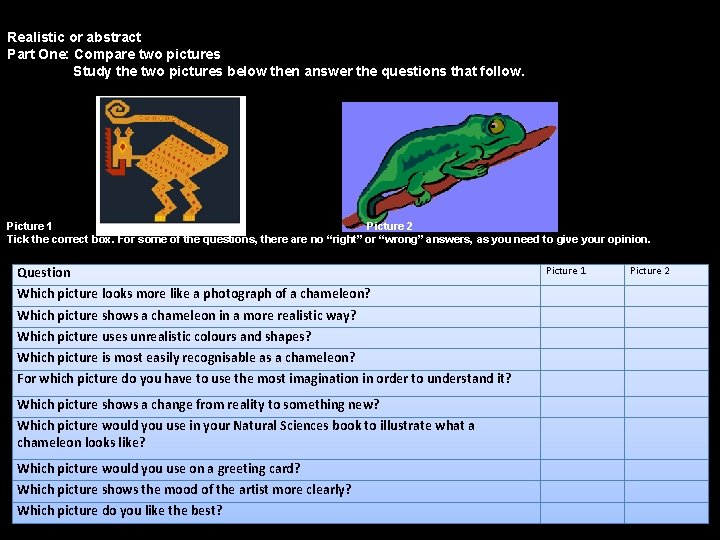
Realistic or abstract Part One: Compare two pictures Study the two pictures below then answer the questions that follow. Picture 1 Picture 2 Tick the correct box. For some of the questions, there are no “right” or “wrong” answers, as you need to give your opinion. Question Which picture looks more like a photograph of a chameleon? Which picture shows a chameleon in a more realistic way? Which picture uses unrealistic colours and shapes? Which picture is most easily recognisable as a chameleon? For which picture do you have to use the most imagination in order to understand it? Which picture shows a change from reality to something new? Which picture would you use in your Natural Sciences book to illustrate what a chameleon looks like? Which picture would you use on a greeting card? Which picture shows the mood of the artist more clearly? Which picture do you like the best? Picture 1 Picture 2
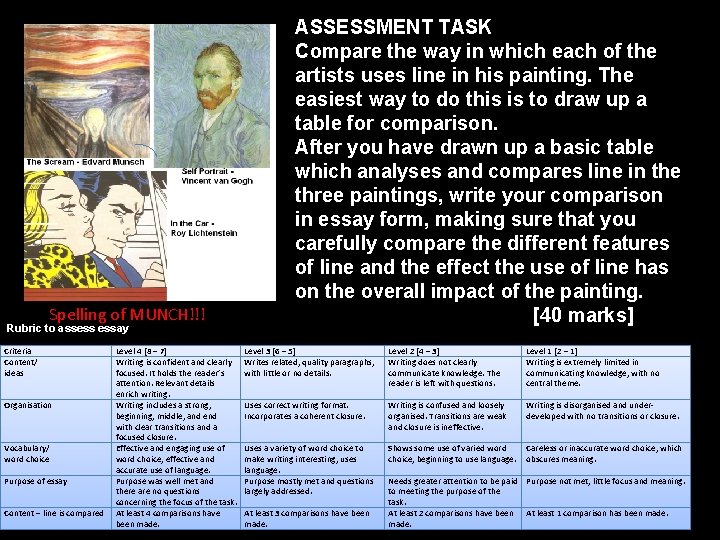
Spelling of MUNCH!!! Rubric to assess essay Criteria Content/ ideas Organisation Vocabulary/ word choice Purpose of essay Content – line is compared Level 4 [8 – 7] Writing is confident and clearly focused. It holds the reader’s attention. Relevant details enrich writing. Writing includes a strong, beginning, middle, and end with clear transitions and a focused closure. Effective and engaging use of word choice; effective and accurate use of language. Purpose was well met and there are no questions concerning the focus of the task. At least 4 comparisons have been made. ASSESSMENT TASK Compare the way in which each of the artists uses line in his painting. The easiest way to do this is to draw up a table for comparison. After you have drawn up a basic table which analyses and compares line in the three paintings, write your comparison in essay form, making sure that you carefully compare the different features of line and the effect the use of line has on the overall impact of the painting. [40 marks] Level 3 [6 – 5] Writes related, quality paragraphs, with little or no details. Level 2 [4 – 3] Writing does not clearly communicate knowledge. The reader is left with questions. Level 1 [2 – 1] Writing is extremely limited in communicating knowledge, with no central theme. Uses correct writing format. Incorporates a coherent closure. Writing is confused and loosely organised. Transitions are weak and closure is ineffective. Writing is disorganised and underdeveloped with no transitions or closure. Uses a variety of word choice to make writing interesting; uses language. Purpose mostly met and questions largely addressed. Shows some use of varied word choice, beginning to use language. Careless or inaccurate word choice, which obscures meaning. At least 3 comparisons have been made. Needs greater attention to be paid Purpose not met; little focus and meaning. to meeting the purpose of the task. At least 2 comparisons have been At least 1 comparison has been made.
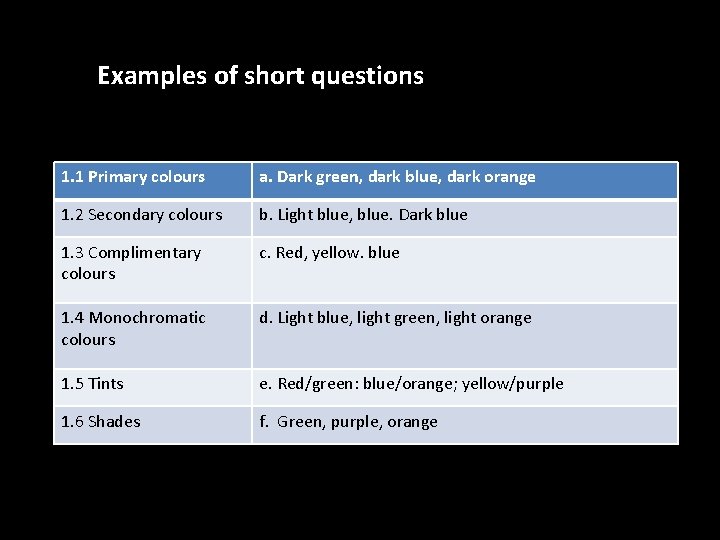
Examples of short questions 1. 1 Primary colours a. Dark green, dark blue, dark orange 1. 2 Secondary colours b. Light blue, blue. Dark blue 1. 3 Complimentary colours c. Red, yellow. blue 1. 4 Monochromatic colours d. Light blue, light green, light orange 1. 5 Tints e. Red/green: blue/orange; yellow/purple 1. 6 Shades f. Green, purple, orange
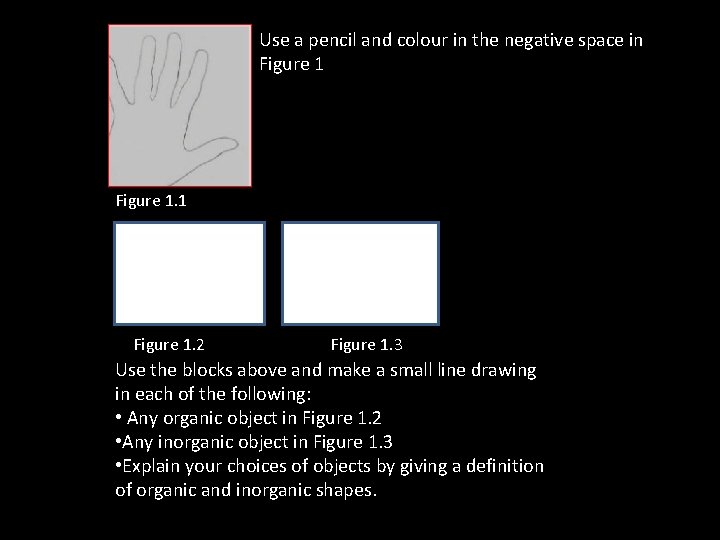
Use a pencil and colour in the negative space in Figure 1. 1 Figure 1. 2 Figure 1. 3 Use the blocks above and make a small line drawing in each of the following: • Any organic object in Figure 1. 2 • Any inorganic object in Figure 1. 3 • Explain your choices of objects by giving a definition of organic and inorganic shapes.
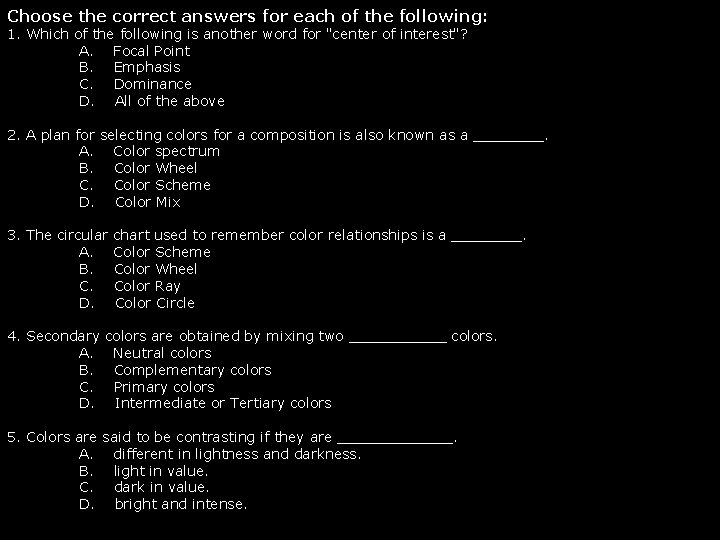
Choose the correct answers for each of the following: 1. Which of the following is another word for "center of interest"? A. Focal Point B. Emphasis C. Dominance D. All of the above 2. A plan for selecting colors for a composition is also known as a ____. A. Color spectrum B. Color Wheel C. Color Scheme D. Color Mix 3. The circular A. B. C. D. 4. Secondary A. B. C. D. chart used to remember color relationships is a ____. Color Scheme Color Wheel Color Ray Color Circle colors are obtained by mixing two ______ colors. Neutral colors Complementary colors Primary colors Intermediate or Tertiary colors 5. Colors are said to be contrasting if they are _______. A. different in lightness and darkness. B. light in value. C. dark in value. D. bright and intense.
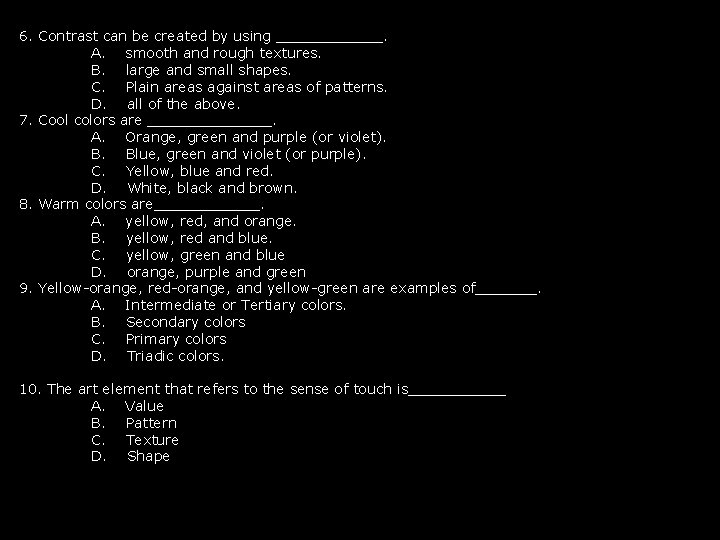
6. Contrast can be created by using ______. A. smooth and rough textures. B. large and small shapes. C. Plain areas against areas of patterns. D. all of the above. 7. Cool colors are _______. A. Orange, green and purple (or violet). B. Blue, green and violet (or purple). C. Yellow, blue and red. D. White, black and brown. 8. Warm colors are______. A. yellow, red, and orange. B. yellow, red and blue. C. yellow, green and blue D. orange, purple and green 9. Yellow-orange, red-orange, and yellow-green are examples of_______. A. Intermediate or Tertiary colors. B. Secondary colors C. Primary colors D. Triadic colors. 10. The art element that refers to the sense of touch is______ A. Value B. Pattern C. Texture D. Shape
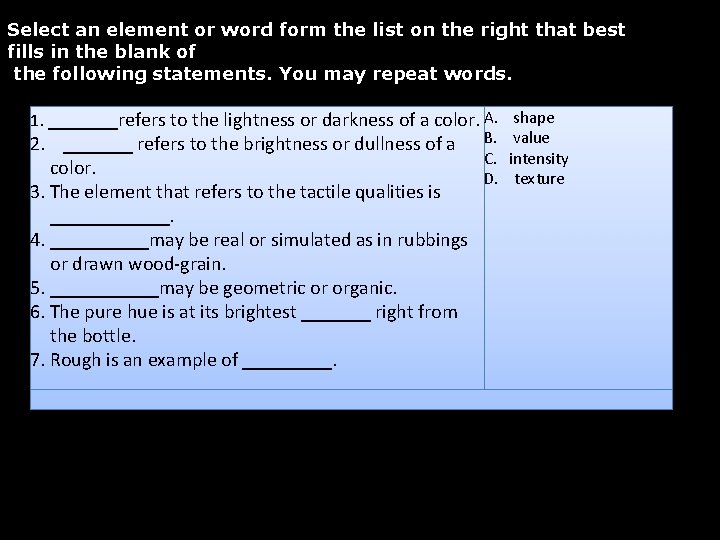
Select an element or word form the list on the right that best fills in the blank of the following statements. You may repeat words. 1. _______refers to the lightness or darkness of a color. A. shape 2. _______ refers to the brightness or dullness of a B. value intensity A. C. focal point color. 40. Visual _____ is achieved texture when all parts of a composition appear B. D. unity 3. The element thatequal refersweight. to the tactile qualities is C. balance to have It seems stable. ______. 41. ______ in a work is obtained by D. pattern 4. _____may becolors real orand simulated as in rubbings repeating shapes--all parts a design are working together as a or drawnofwood-grain. team. 5. ______may be geometric or organic. 42. Another term for center of interest 6. The pure hue is at its brightest _______ right from is ______. the bottle. 43. Lines, colors, or shapes repeated 7. Rough is over an example of _____. and over in a planned way is ______.
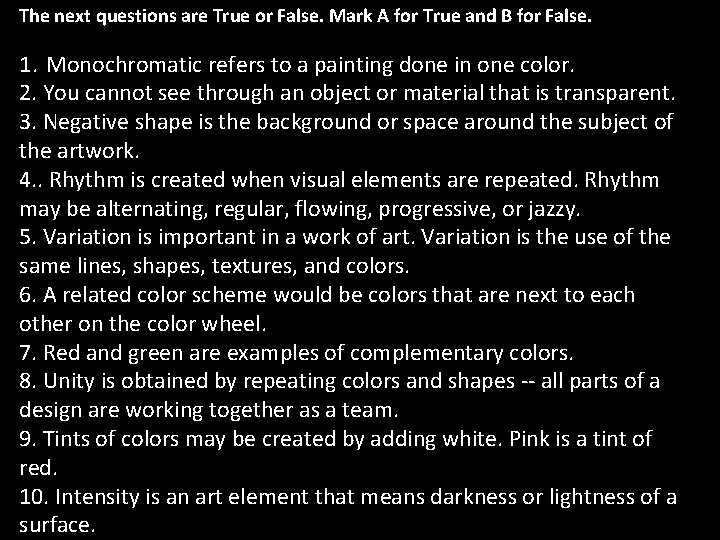
The next questions are True or False. Mark A for True and B for False. 1. Monochromatic refers to a painting done in one color. 2. You cannot see through an object or material that is transparent. 3. Negative shape is the background or space around the subject of the artwork. 4. . Rhythm is created when visual elements are repeated. Rhythm may be alternating, regular, flowing, progressive, or jazzy. 5. Variation is important in a work of art. Variation is the use of the same lines, shapes, textures, and colors. 6. A related color scheme would be colors that are next to each other on the color wheel. 7. Red and green are examples of complementary colors. 8. Unity is obtained by repeating colors and shapes -- all parts of a design are working together as a team. 9. Tints of colors may be created by adding white. Pink is a tint of red. 10. Intensity is an art element that means darkness or lightness of a surface.
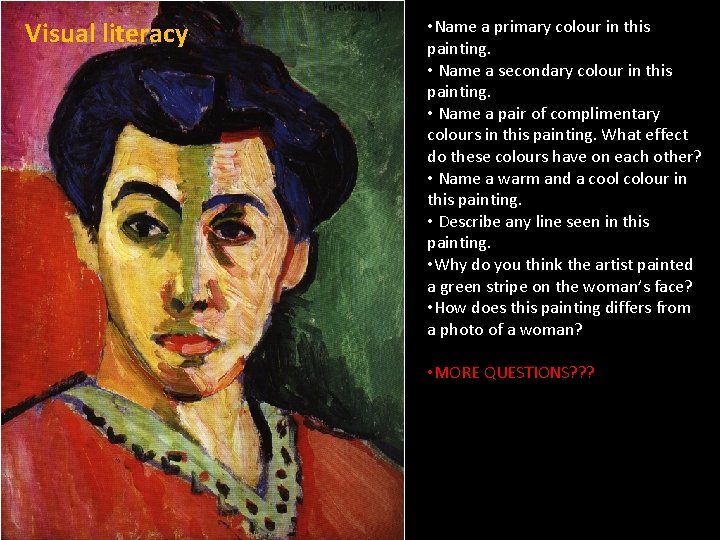
Visual literacy • Name a primary colour in this painting. • Name a secondary colour in this painting. • Name a pair of complimentary colours in this painting. What effect do these colours have on each other? • Name a warm and a cool colour in this painting. • Describe any line seen in this painting. • Why do you think the artist painted a green stripe on the woman’s face? • How does this painting differs from a photo of a woman? • MORE QUESTIONS? ? ?
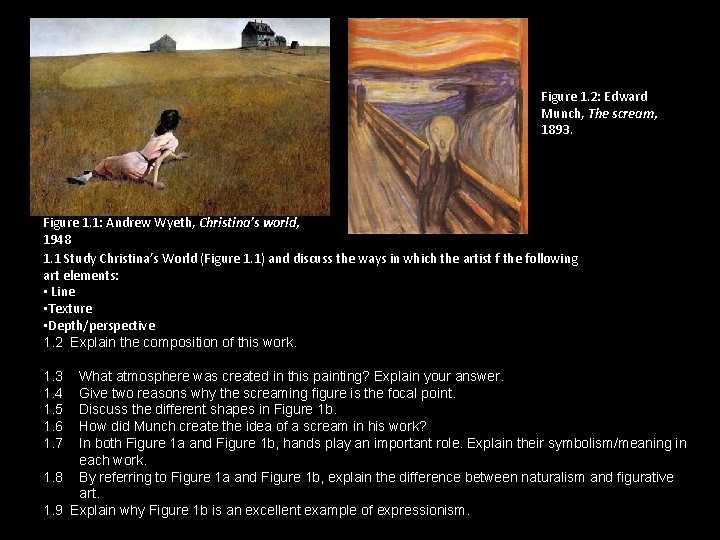
Figure 1. 2: Edward Munch, The scream, 1893. Figure 1. 1: Andrew Wyeth, Christina’s world, 1948 1. 2 Christina’s World (Figure 1. 1) and discuss the ways in which the artist f the following 1. 1 Study art elements: • Line • Texture • Depth/perspective 1. 2 Explain the composition of this work. 1. 3 1. 4 1. 5 1. 6 1. 7 What atmosphere was created in this painting? Explain your answer. Give two reasons why the screaming figure is the focal point. Discuss the different shapes in Figure 1 b. How did Munch create the idea of a scream in his work? In both Figure 1 a and Figure 1 b, hands play an important role. Explain their symbolism/meaning in each work. 1. 8 By referring to Figure 1 a and Figure 1 b, explain the difference between naturalism and figurative art. 1. 9 Explain why Figure 1 b is an excellent example of expressionism.
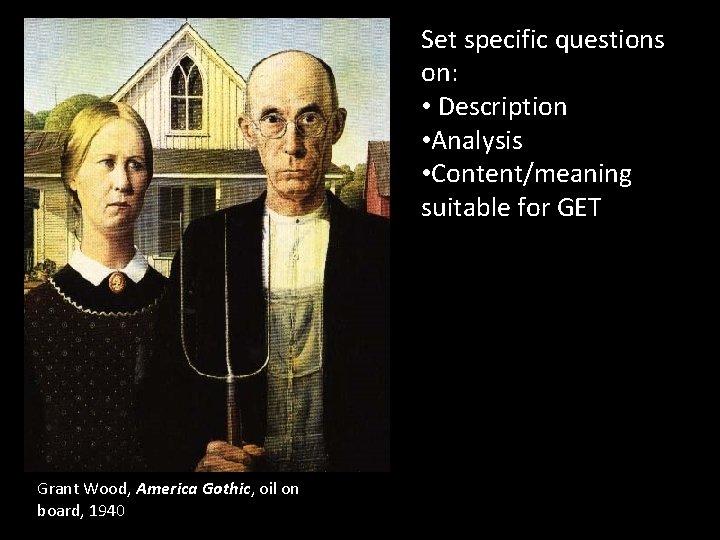
Set specific questions on: • Description • Analysis • Content/meaning suitable for GET Grant Wood, America Gothic, oil on board, 1940
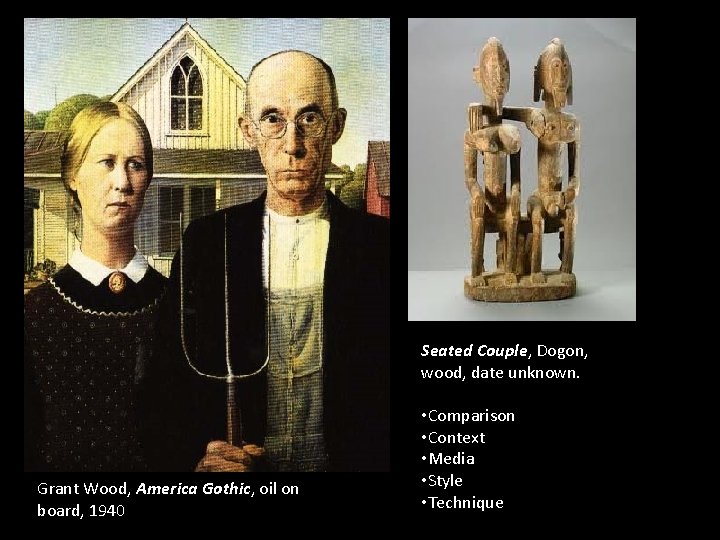
Seated Couple, Dogon, wood, date unknown. Grant Wood, America Gothic, oil on board, 1940 • Comparison • Context • Media • Style • Technique
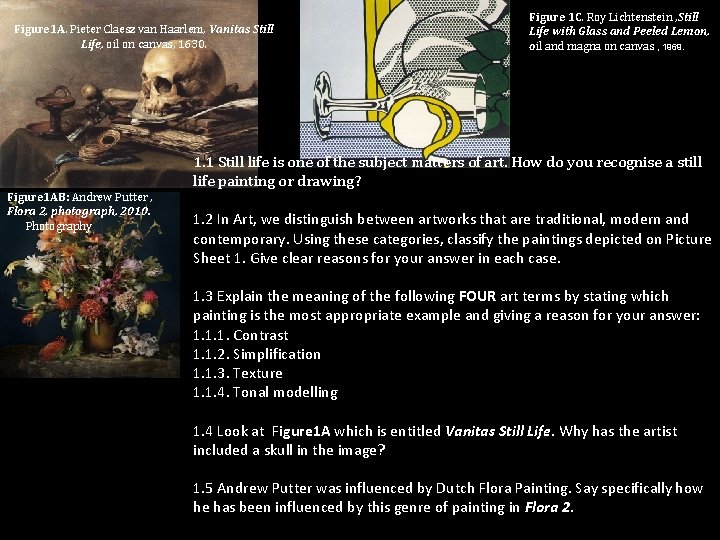
Figure 1 A. Pieter Claesz van Haarlem, Vanitas Still Life, oil on canvas, 1630. Figure 1 AB: Andrew Putter , Flora 2, photograph, 2010. Photography Figure 1 C. Roy Lichtenstein , Still Life with Glass and Peeled Lemon, oil and magna on canvas , 1969. 1. 1 Still life is one of the subject matters of art. How do you recognise a still life painting or drawing? 1. 2 In Art, we distinguish between artworks that are traditional, modern and contemporary. Using these categories, classify the paintings depicted on Picture Sheet 1. Give clear reasons for your answer in each case. 1. 3 Explain the meaning of the following FOUR art terms by stating which painting is the most appropriate example and giving a reason for your answer: 1. 1. 1. Contrast 1. 1. 2. Simplification 1. 1. 3. Texture 1. 1. 4. Tonal modelling 1. 4 Look at Figure 1 A which is entitled Vanitas Still Life. Why has the artist included a skull in the image? 1. 5 Andrew Putter was influenced by Dutch Flora Painting. Say specifically how he has been influenced by this genre of painting in Flora 2.
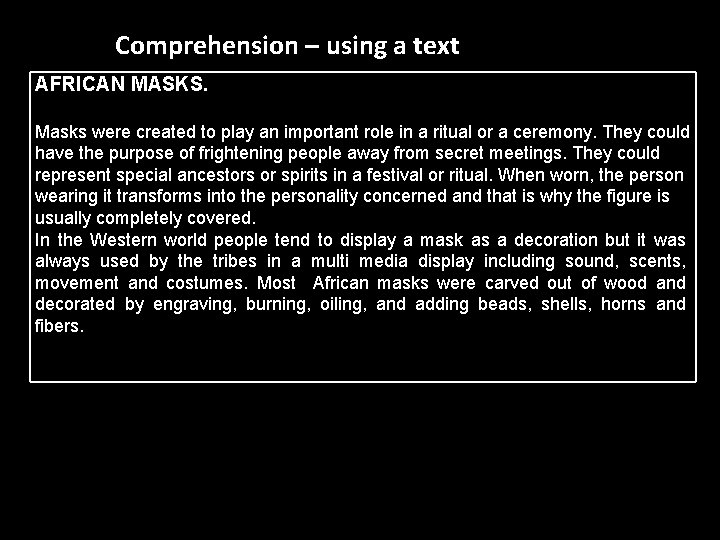
Comprehension – using a text AFRICAN MASKS. Masks were created to play an important role in a ritual or a ceremony. They could have the purpose of frightening people away from secret meetings. They could represent special ancestors or spirits in a festival or ritual. When worn, the person wearing it transforms into the personality concerned and that is why the figure is usually completely covered. In the Western world people tend to display a mask as a decoration but it was always used by the tribes in a multi media display including sound, scents, movement and costumes. Most African masks were carved out of wood and decorated by engraving, burning, oiling, and adding beads, shells, horns and fibers.
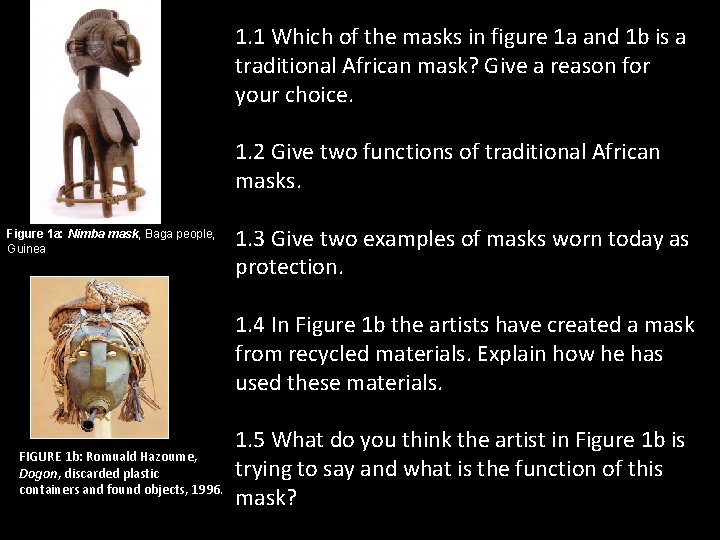
1. 1 Which of the masks in figure 1 a and 1 b is a traditional African mask? Give a reason for your choice. 1. 2 Give two functions of traditional African masks. Figure 1 a: Nimba mask, Baga people, Guinea 1. 3 Give two examples of masks worn today as protection. 1. 4 In Figure 1 b the artists have created a mask from recycled materials. Explain how he has used these materials. FIGURE 1 b: Romuald Hazoume, Dogon, discarded plastic containers and found objects, 1996. 1. 5 What do you think the artist in Figure 1 b is trying to say and what is the function of this mask?
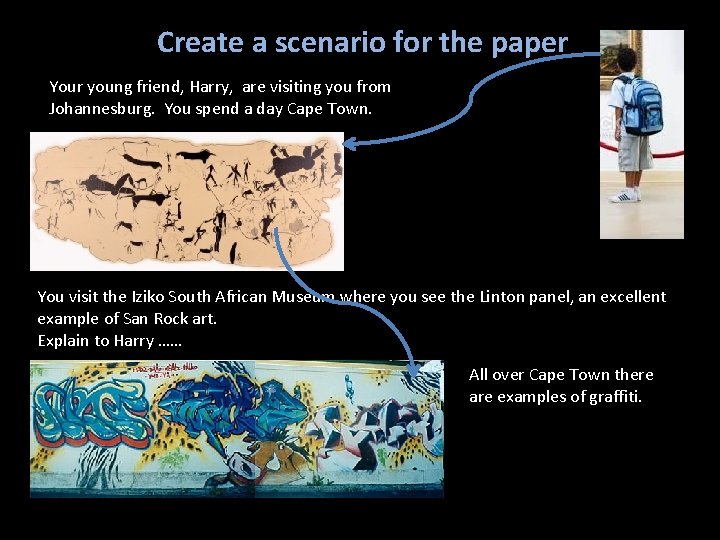
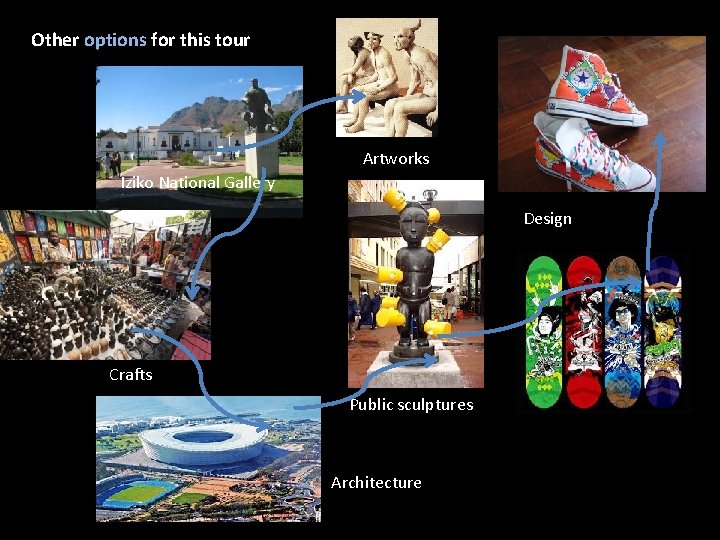
Create a scenario for the paper Your young friend, Harry, are visiting you from Johannesburg. You spend a day Cape Town. You visit the Iziko South African Museum where you see the Linton panel, an excellent example of San Rock art. Explain to Harry …… All over Cape Town there are examples of graffiti.
Other options for this tour Artworks Iziko National Gallery Design Crafts Public sculptures Architecture
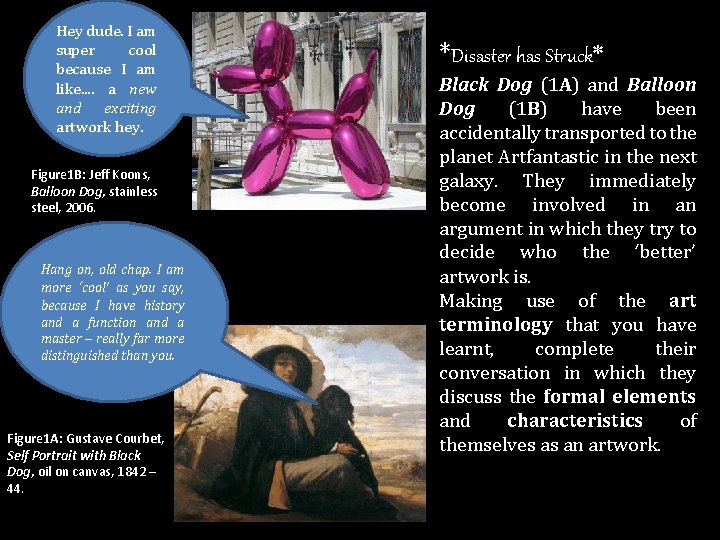
Hey dude. I am super cool because I am like. . a new and exciting artwork hey. Figure 1 B: Jeff Koons, Balloon Dog, stainless steel, 2006. Hang on, old chap. I am more ‘cool’ as you say, because I have history and a function and a master – really far more distinguished than you. Figure 1 A: Gustave Courbet, Self Portrait with Black Dog, oil on canvas, 1842 – 44. *Disaster has Struck* Black Dog (1 A) and Balloon Dog (1 B) have been accidentally transported to the planet Artfantastic in the next galaxy. They immediately become involved in an argument in which they try to decide who the ‘better’ artwork is. Making use of the art terminology that you have learnt, complete their conversation in which they discuss the formal elements and characteristics of themselves as an artwork.
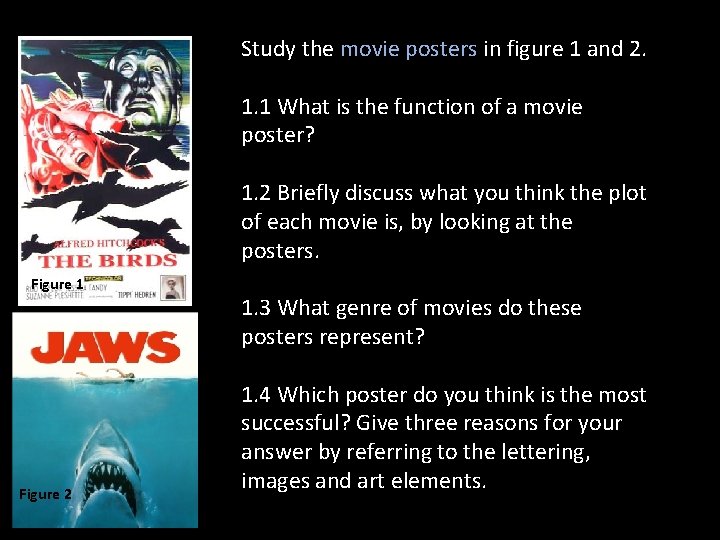
Study the movie posters in figure 1 and 2. 1. 1 What is the function of a movie poster? 1. 2 Briefly discuss what you think the plot of each movie is, by looking at the posters. Figure 1 Figure 2 1. 3 What genre of movies do these posters represent? 1. 4 Which poster do you think is the most successful? Give three reasons for your answer by referring to the lettering, images and art elements.
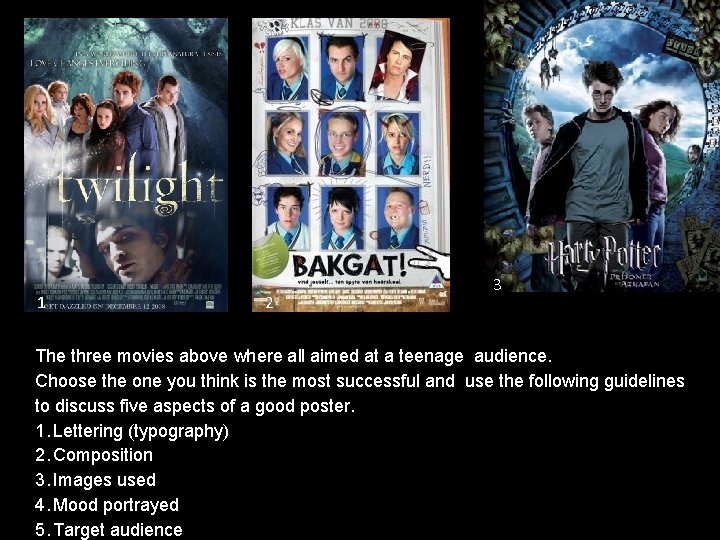
1 2 3 The three movies above where all aimed at a teenage audience. Choose the one you think is the most successful and use the following guidelines to discuss five aspects of a good poster. 1. Lettering (typography) 2. Composition 3. Images used 4. Mood portrayed 5. Target audience