
Setting Actuarial Standards These slides are based on
Setting Actuarial Standards These slides are based on the paper “Setting Actuarial Standards”, published by the Standard-Setters Round Table (SSRT) in 2017, and should be considered in conjunction with that paper. They are available for use by other parties (suitably adapted, if so required), such as actuarial associations or other bodies that wish to set actuarial standards of practice.
What is the SSRT? �An informal group of representatives from actuarial standard-setting organizations. �Website: http: //www. actuaries. org/roundtable/index. cfm
Objective of Presentation �To share experience of established standard-setters in order to assist actuarial associations considering the development or modification of a standard-setting process.
Before we get started. . . �There is no single or “correct” way to develop or implement actuarial standards. �Local circumstances differ widely from association to association. �The information in these slides is a nonexhaustive “tool kit, ” not a “copy machine. ”

Agenda Objective of Standards Standard-Setting Models Implementing a Standard-Setting Process

Objective of Standards
Why have standards? �Ensure appropriately high-quality actuarial work for a user �Provide assurance that the profession serves the public effectively and responsibly �Assure government officials that actuarial standards exist and can be relied upon �Enable government officials and the public to trust the work of actuaries
Why have standards? �Assure related professions that they can rely upon standards-based actuarial practice �Establish a basis for determining sound actuarial practice and for professional discipline �Provide actuaries with known, relevant, and consistent benchmarks within which they can operate with respect to techniques, applications, procedures, and assumptions
Standard-Setting Models Self-Regulation External Regulation Mixed Model
Self Regulation �Actuarial profession establishes �A standard-setting process or separate standard-setting body to develop and promulgate actuarial standards �A professional discipline mechanism to ensure that the standards are enforced
External Regulation �Standards are set by an external body that operates independently of the profession �Regulator, government agency, other external body �Standards may be imposed on actuaries through legislation or through condition of membership of the actuarial association
Mixed Model �Some standards are set by the actuarial profession �May be with external oversight �Some standards set by external body
What structure is appropriate for your jurisdiction? �Will it meet the needs of the actuarial profession in your jurisdiction? �Will it meet the needs of the users of the profession’s services in your jurisdiction? �Consider the characteristics of each model and of the environment in which it would be applied.
Considerations in Implementing a Standard-Setting Process Organizational Structure Authority to set Standards Accountability and Oversight Due Process Scope and format of Standards Assessing Effectiveness Non-compliance
Organizational Structure �In any model of standard-setting, there needs to be an organizational structure. �Suggested considerations include: �Organization, staff, resources �Source of the standard-setter’s authority �Accountability
Organizational Structure �Organization, staff and resources �Will the standard-setter establish a board or council? �Will members of the board or council include both actuarial and non-actuarial members? �Will the standard-setter have standing committees or task forces to develop detailed technical standards? �Will the developers be paid staff members or volunteers? Or both? �What administrative support is required?
Organizational Structure �Source of the standard-setter’s authority �May be set down in legislative or regulatory requirements �An actuarial association’s constitution may authorise its governing body to set standards �Compliance with standards may be a condition of membership of the association �An actuarial association’s code of conduct may provide that an association or external body has the authority to set standards that are binding on its members.
Organizational Structure �Accountability and Oversight �Standard-setter should be held accountable �Implies the standard-setter is subject to some form of oversight �Form and structure of the oversight body needs to be considered along with the responsibilities of the body �Composition of the body fulfilling the oversight function could include both actuarial and nonactuarial representatives
Due Process � What is a due process framework? � The standard-setter uses procedures to develop, expose, promulgate, review, and revise standards. � Due process should be determined based on local conditions and circumstances to ensure that � standards constitute appropriate guidance for practicing actuaries, and � due process followed reflects the independence and integrity of the standard-setter.
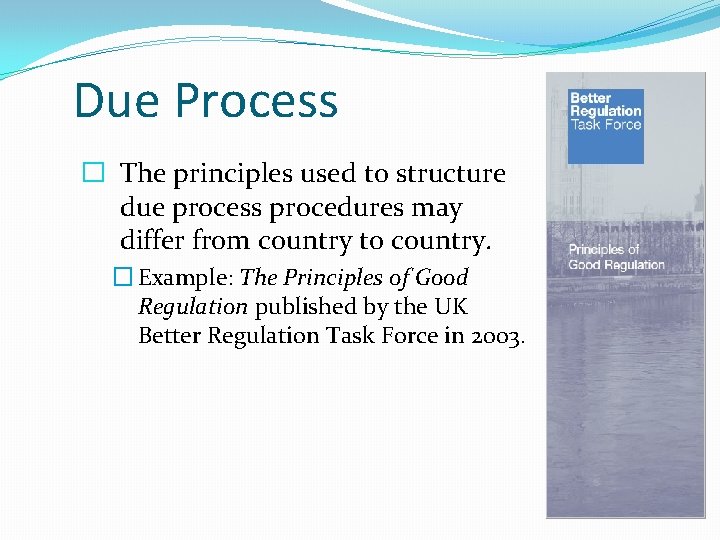
Due Process � The principles used to structure due process procedures may differ from country to country. � Example: The Principles of Good Regulation published by the UK Better Regulation Task Force in 2003.
Principle: Transparency � - operating with openness and accountability, making actions visible to others. �Actions to ensure transparency may include: �Open meetings for technical discussions �Schedules and agendas could be made publicly available �Summary of decisions reached could be made publicly available �Consultation: � With stakeholders prior to and during the standard-setting process � New or amended standards exposed for public comment � Timely discussion of responses received � Publication of responses received to consultation along with an explanation of how the responses have been taken into account.
Principle: Accountability �Accountability – accounting for and taking responsibility for actions taken �Actions to ensure accountability may include: �Consultation with practitioners and stakeholders �Report to the oversight body on status �Agree criteria against which progress is measured.
Due Process � IAA minimum criteria � Proposal to consider standard must follow due process � Make proposed standard available for comment � Consider comments � When adopted, standard must be disseminated by an authority that has power to do so � Publish standards and make them available to practicing actuaries
Scope and format of Standards �Each standard-setting body should determine to which area the standards will apply, how the body of standards will be structured and what matters will be addressed. �Considerations include: �General or cross-practice standards applying to all areas of practice vs. practice-specific standards �Rules-based (prescriptive) standards vs. principles-based standards �Status and application to specify whether compliance is mandatory and if so, in what circumstances �Subject matter which may be technical, ethical or other professional matter such as peer review �Style and Language �The definition and use of terms (e. g. , “must, ” “should, ” and “may” ) �Consistent style and use of terms
Assessing the Effectiveness of Standards �An association might also consider the processes to be put in place for promoting standards and assessing the effectiveness of standards �The assessment can take many forms, including: �Post-implementation review to consider �Assessment of whether the standards are improving practice �Assessment of ongoing relevance and effectiveness �Monitoring compliance with standards �Assessment of whether the standards are being applied as intended �Promotion of standards may increase use and effectiveness
Dealing with Non-Compliance �Consideration of the actions an association can and will take in the case of members noncompliance with standards �Ensure that members of the actuarial association understand the consequences of non-compliance.

Questions?
- Slides: 27